🥤 Sucking Type Mouthparts
Five types of haustellate mouthparts -- chewing-lapping, piercing-sucking, rasping-sucking, sponging, and siphoning -- with agricultural and medical significance
In the previous lesson, we studied biting and chewing mouthparts -- the primitive mandibulate type. Now we examine the advanced modifications where mouthparts are redesigned for sucking liquid food.
When a farmer sees yellowing, curling, or silvery streaks on crop leaves without any visible holes, the culprit is almost always an insect with sucking mouthparts. These pests -- aphids, whiteflies, thrips, and plant bugs -- extract plant sap from within the tissue, causing damage that is often invisible until the plant is already weakened. Some of these sap-feeders also transmit viral diseases, making them doubly dangerous. Understanding their mouthpart types helps in choosing the right control strategy (systemic insecticides for sap-suckers vs. contact insecticides for chewing pests).
This lesson covers:
- Five types of sucking mouthparts -- chewing-lapping, piercing-sucking, rasping-sucking, sponging, and siphoning
- Structural modifications -- which primitive parts are modified in each type
- Agricultural and medical significance -- crop pests and disease vectors
Overview of Haustellate (Sucking) Mouthparts
- Haustellate mouthparts are primarily modified for sucking liquids -- nectar, plant sap, or blood.
- Considered the advanced type -- oral appendages are extensively modified from the primitive biting-chewing condition.
- The evolution from mandibulate to haustellate mouthparts represents a major adaptive radiation, allowing insects to exploit entirely new food sources.
Think of it this way: If biting-chewing mouthparts are like a knife and fork (for solid food), then sucking mouthparts are like different kinds of straws -- some are sharp enough to pierce through packaging (stylet types), while others can only drink from an open cup (non-stylet types).
Two Subgroups
| Subgroup | Key Feature | Food Access | Everyday Analogy |
|---|---|---|---|
| With stylets | Needle-like projections to pierce tissue | Can penetrate plant tissue or animal skin | Like a syringe needle piercing skin |
| Without stylets | No piercing structures | Must rely on easily accessible liquids (nectar, exposed fluids) | Like drinking through a straw from an open glass |
- Many Hemiptera feed directly on phloem sap -- nutrient-rich and generally lacking in toxins.
- The modified mandibles, maxillae, and hypopharynx form the stylets and feeding tube.
Five Types of Sucking Mouthparts
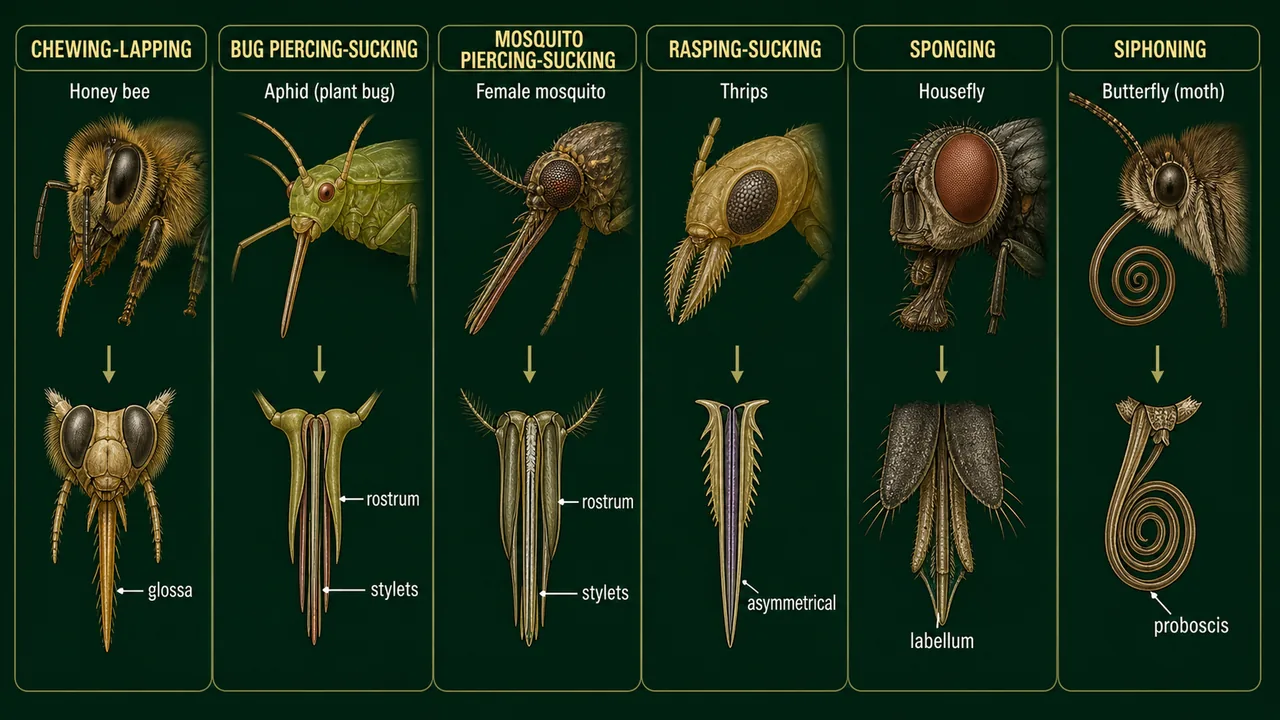
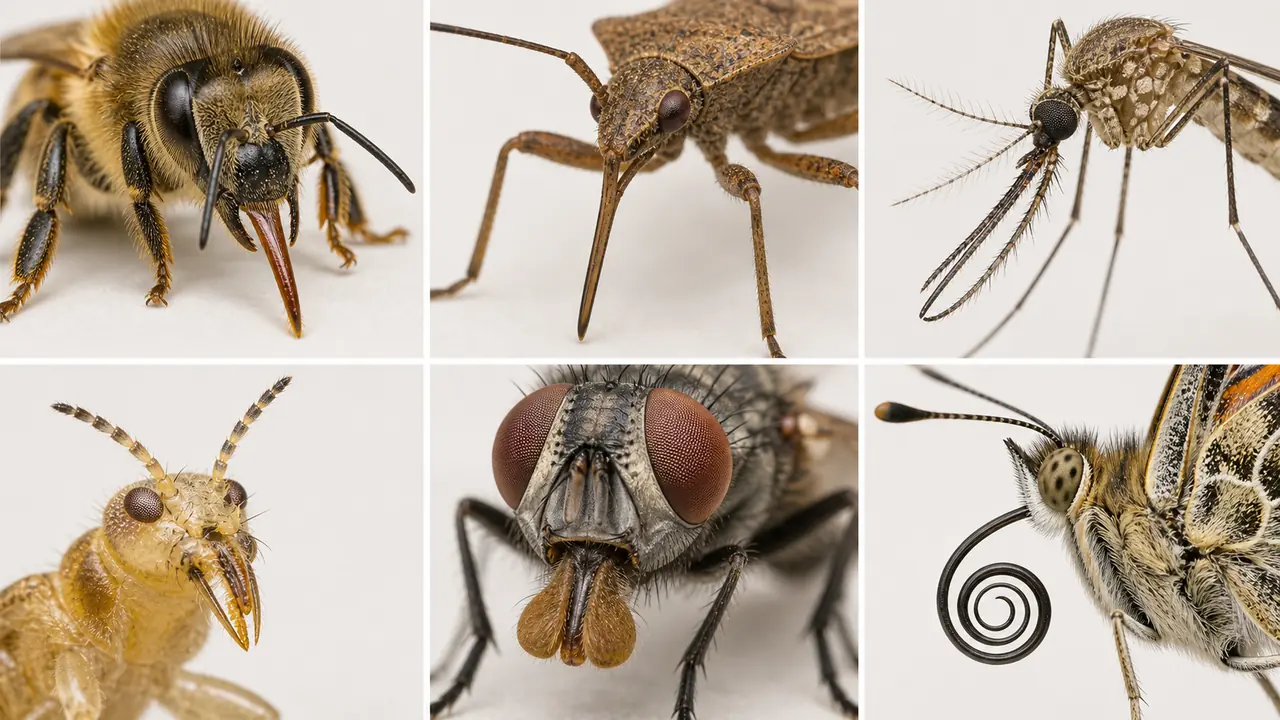
Exam reading shortcut: first ask whether the insect has a piercing stylet bundle or not. If yes, compare bug, mosquito, and thrips; if no, compare bee, housefly, and butterfly by how they collect exposed liquid food.
1. Chewing and Lapping Type
An intermediate form between purely biting-chewing and purely sucking mouthparts.
| Feature | Detail |
|---|---|
| Mandibles | Present but blunt and not toothed (not used for cutting food) |
| Mandible use | Crush and shape wax for comb building; ingest pollen; other manipulative functions |
| Sucking proboscis | Formed from modified maxillolabial and hypopharynx structures (the "lapping tongue") |
| Tongue unit | Two galea of maxillae + two labial palps + elongated flexible hairy glossa of labium |
| Flabellum | Circular spoon-shaped lobe at the tip of glossa; licks/scoops nectar |
| Food uptake | Nectar rises by capillary action through the central channel of glossae |
| Examples | Honeybee, Bumble bee, Wasp (adult) |
Agricultural importance: Honeybees are the most important pollinators of many crops (sunflower, mustard, apple, litchi). Their chewing-lapping mouthparts are perfectly adapted for both pollen handling and nectar collection.
2. Piercing and Sucking Type
Mouthparts are modified for piercing tissues and sucking either plant sap, nectar, or blood. This type is extremely important from both agricultural (crop pest) and medical (disease vector) perspectives.
a) Hemipterous (Bug) Type
- Form a beak-like rostrum inserted into plant tissue to tap phloem or xylem vessels.
- Damage appears as stippling, wilting, or curling of leaves.
- Examples: Plant bugs (aphids, jassids, whiteflies, mealybugs).
- In hemipteran mouthparts, both mandibles and maxillae are modified into four stylets, while the labium acts as the outer protective sheath.
- The paired maxillary stylets interlock to form separate food and salivary canals inside the stylet bundle.
Crop damage: Aphids on mustard, jassids on cotton, whiteflies on tomato -- all pierce-and-suck pests that also transmit viral diseases (e.g., leaf curl virus by whitefly).
IMPORTANT
Over 70% of all insect vectors of plant viruses belong to order Hemiptera — their piercing-sucking mouthparts allow direct phloem access, making them highly effective virus vectors. Order Hemiptera includes scale insects, aphids, whiteflies, and planthoppers.
b) Dipterous (Mosquito) Type
- Mandibles present only in females -- only females bite (they need blood protein for egg development; males feed on nectar).
- The standard exam recall is six stylets in the female mosquito: two mandibles, two maxillae, one labrum-epipharynx, and one hypopharynx.
- Female pierces skin and injects saliva containing:
- Anticoagulant -- keeps blood flowing
- Anaesthetic -- keeps victim unaware
- Pathogens (in infected mosquitoes) -- transmits malaria, dengue, filariasis
- Example: Female mosquito.
3. Rasping and Sucking Type (Asymmetrical)
| Feature | Detail |
|---|---|
| Stylets | Three (2 maxillae + 1 left mandible) -- right mandible is absent |
| Feeding method | Stylets scrape and shred surface cells; oozing sap is sucked up by the mouth cone |
| Damage appearance | Silvery or bronze streaks on plant surfaces |
| Symmetry | Asymmetrical (right mandible rudimentary) -- unique among insect mouthparts |
| Example | Thrips |
Agricultural significance: Thrips are major pests of chilli, onion, groundnut, and cotton. Their rasping damage and virus transmission (e.g., bud necrosis virus in groundnut) cause severe yield losses. The asymmetrical mouthpart is a key diagnostic character for identifying thrips.
4. Sponging Type
| Feature | Detail |
|---|---|
| Primary structure | Proboscis formed from the labium |
| Proboscis divisions | Basal rostrum → middle haustellum → distal labellum |
| Labellum | Sponge-like structure with narrow transverse channels called pseudotracheae |
| Feeding process | Proboscis pressed on food → fly regurgitates saliva/enzymes onto solid food to liquify it (extraoral digestion) → pseudotracheae fill by capillary action → food sucked into oesophagus |
| Example | Housefly |
Public health note: Houseflies are important vectors of cholera, typhoid, and dysentery because their sponging feeding habit involves regurgitating on food, contaminating it with pathogens picked up from filth.
5. Siphoning Type
| Feature | Detail |
|---|---|
| Modified structure | Galea of maxillae form a slender, hollow, tubular proboscis |
| Labrum and mandibles | Both rudimentary or absent |
| Resting position | Coiled like a watch spring under the head |
| Feeding | Uncoils to reach deep into flowers for nectar |
| Food | Exclusively liquid (nectar) |
| Example | Butterfly, Moth (simple sucking type) |
Agricultural role: Adult moths and butterflies are important pollinators for certain crops. However, their larvae (caterpillars) have biting-chewing mouthparts and are destructive crop pests.
Field Damage Identification Guide
Practical skill for farmers and IBPS AFO aspirants: You can often identify the mouthpart type of an unseen pest just by looking at the damage pattern on the plant.
| Damage You See | Mouthpart Type | Likely Pest | What to Do |
|---|---|---|---|
| Ragged holes in leaves, missing leaf tissue | Biting-chewing | Caterpillar, grasshopper | Contact insecticide or bio-agent (Bt, Trichogramma) |
| Yellowing, curling leaves with no holes; sticky honeydew on surface | Piercing-sucking | Aphid, whitefly, jassid | Systemic insecticide (imidacloprid); check for viral symptoms |
| Silvery or bronze streaks on leaves, petals distorted | Rasping-sucking | Thrips | Blue sticky traps + systemic spray |
| Stippling (tiny pale dots) on leaves | Piercing-sucking | Mites (not insect, but similar damage) | Acaricide, NOT insecticide |
| No visible damage on plant but grain has round holes | Biting-chewing | Storage weevil, grain borer | Fumigation (aluminium phosphide) |
Comparison of Sucking Mouthpart Types
| Type | Key Structure | Stylets? | Symmetry | Food Source | Example |
|---|---|---|---|---|---|
| Chewing & Lapping | Lapping tongue (glossa + galea) | No | Symmetrical | Nectar + pollen | Honeybee |
| Piercing & Sucking (Bug) | Rostrum with stylets | Yes (4) | Symmetrical | Plant sap | Aphid, jassid |
| Piercing & Sucking (Mosquito) | Fascicle in labium sheath | Yes (6) | Symmetrical | Blood (female) | Mosquito |
| Rasping & Sucking | Mouth cone + 3 stylets | Yes (3) | Asymmetrical (right mandible absent) | Plant cell sap | Thrips |
| Sponging | Labellum with pseudotracheae | No | Symmetrical | Liquified food | Housefly |
| Siphoning | Coiled proboscis (galea) | No | Symmetrical | Nectar | Butterfly, moth |
Exam Tips
Asymmetrical mouthpart = Thrips. This is the only insect with asymmetrical mouthparts (right mandible absent). Frequently asked.
Only female mosquitoes bite -- they need blood protein for egg development. Males feed on plant juices.
Sponging = Housefly and Siphoning = Butterfly/Moth. Do not confuse these two. Sponging involves regurgitation (extraoral digestion); siphoning is simple suction.
Number of stylets mnemonic: Bug = 4, Mosquito = 6, Thrips = 3. Remember "4-6-3" for the three piercing types.
Capillary action is the key physical principle in both lapping (honeybee) and sponging (housefly) mouthparts.
Summary Cheat Sheet
| Concept | Key Detail |
|---|---|
| Haustellate = | Sucking mouthparts (advanced type) |
| With stylets | Can pierce tissue (bugs, mosquitoes, thrips) |
| Without stylets | Feed on exposed liquids (honeybee, housefly, butterfly) |
| Chewing & Lapping | Honeybee; blunt mandibles + lapping tongue; flabellum scoops nectar |
| Piercing-Sucking (Bug) | Rostrum; taps phloem/xylem; causes stippling, wilting; transmits viruses |
| Piercing-Sucking (Mosquito) | Only female bites; injects anticoagulant + anaesthetic; transmits malaria, dengue |
| Rasping-Sucking | Thrips; asymmetrical (right mandible absent); 3 stylets; silvery streaks on plants |
| Sponging | Housefly; labellum + pseudotracheae; extraoral digestion |
| Siphoning | Butterfly/moth; coiled proboscis from galea; mandibles absent; nectar feeding |
TIP
Next: The next lesson moves from the head to the thorax, examining insect legs -- their five-segment structure and twelve remarkable modifications.
References
1 source
References
Lesson Doubts
Ask questions, get expert answers