🦞 Biting and Chewing Type Mouthparts
Primitive mandibulate mouthparts, structure and function of mandibles, maxillae, labrum, labium, and hypopharynx with agricultural pest examples
In the previous lesson, we explored the insect head -- its sclerites, sutures, orientation, and antennae. Now we focus on what the head carries: the mouthparts, starting with the most primitive type.
A paddy farmer notices irregular holes in rice leaves and wonders what kind of pest could cause such damage. The answer lies in the pest's mouthparts -- insects with biting and chewing mouthparts (like grasshoppers and caterpillars) tear and consume leaf tissue, leaving characteristic ragged holes. This is very different from the damage caused by sucking pests, which leave no holes at all. Identifying the mouthpart type from the damage pattern is one of the most practical skills in pest management.
This lesson covers:
- Two major mouthpart categories -- mandibulate vs. haustellate
- Five components of biting-chewing mouthparts -- labrum, mandibles, maxillae, labium, hypopharynx
- Agricultural pest examples with biting-chewing mouthparts
Types of Insect Mouthparts
Mouthpart structure is one of the most reliable features for classification and identification at the order level.
| Mouthpart Type | Feeding Mode | Food Type |
|---|---|---|
| Mandibulate | Bite, chew, grind | Solid food (leaves, stems, grains) |
| Haustellate | Suck | Liquid food (nectar, plant sap, blood) |
Memory aid: Mandibulate = Munch; Haustellate = Haul (suck up)
- The earliest insects had chewing mouthparts -- this is the primitive (ancestral) condition.
- Most specialised mouthparts are for piercing and sucking, and this mode has evolved independently multiple times.
The mouthpart types can be grouped based on type of food and method of feeding:
| SN | Types of Mouth Parts | Examples |
|---|---|---|
| I. | Biting and Chewing / Mandibulate Type | Grasshoppers, Cockroaches |
| II. | Sucking Type / Haustellate Type | |
| 1. Piercing and Sucking type | Plant Bugs and Mosquitoes | |
| 2. Rasping and Sucking type | Thrips | |
| 3. Sponging type | Adult Houseflies | |
| 4. Chewing and Lapping type | Honeybees | |
| 5. Siphoning type | Butterflies and moths | |
| III. | Other Types | |
| 1. Mask type | Naids of Dragonflies | |
| 2. Degenerate type | Maggots of Diptera |
Biting and Chewing Type (Mandibulate)
This is the primitive (typical) mouthpart type, found in Orthoptera, Isoptera, Coleoptera, and larvae of Lepidoptera and Neuroptera. Understanding this type thoroughly provides the foundation for understanding all other mouthpart modifications.
A typical biting-chewing mouthpart consists of five components -- think of them as a dining toolkit: an upper lip (labrum) to hold food in place, two sets of jaws (mandibles for cutting, maxillae for handling), a lower lip (labium) to catch falling food, and a tongue (hypopharynx) to mix food with saliva:
- In the primitive arrangement, the mandibles lie between the labrum above and the maxillae at the sides, forming the main cutting pair inside the pre-oral cavity.
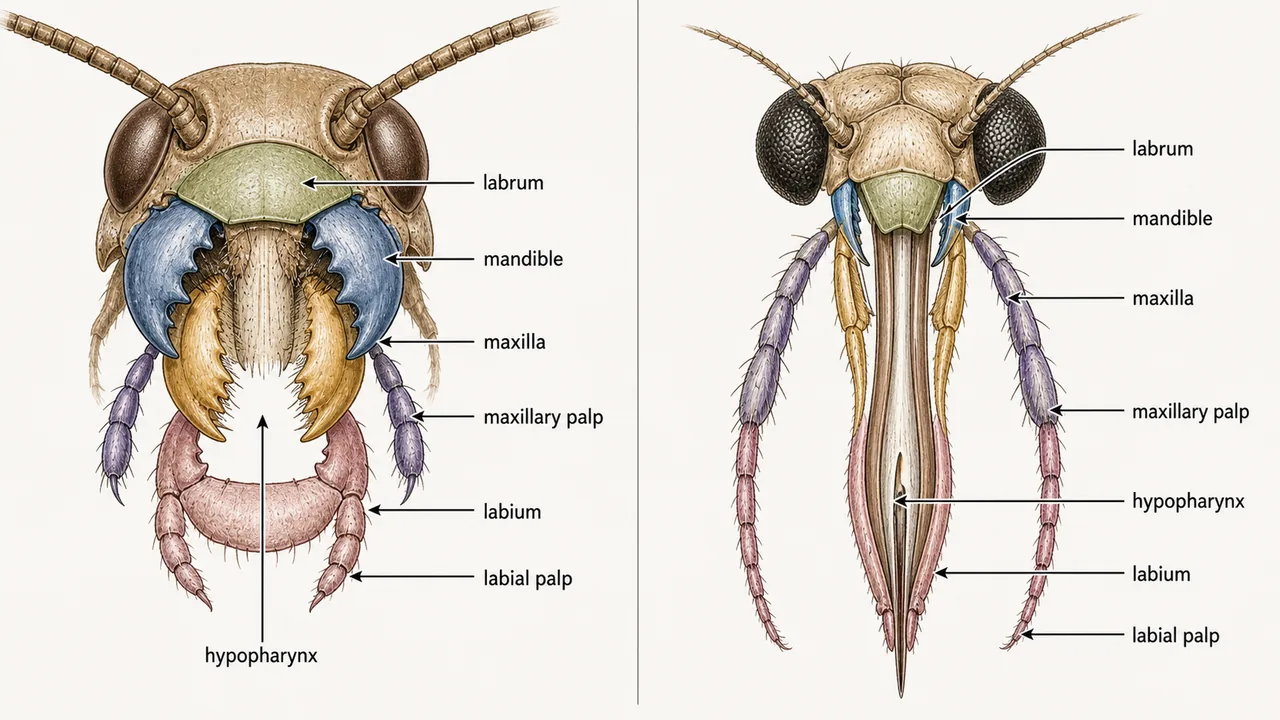
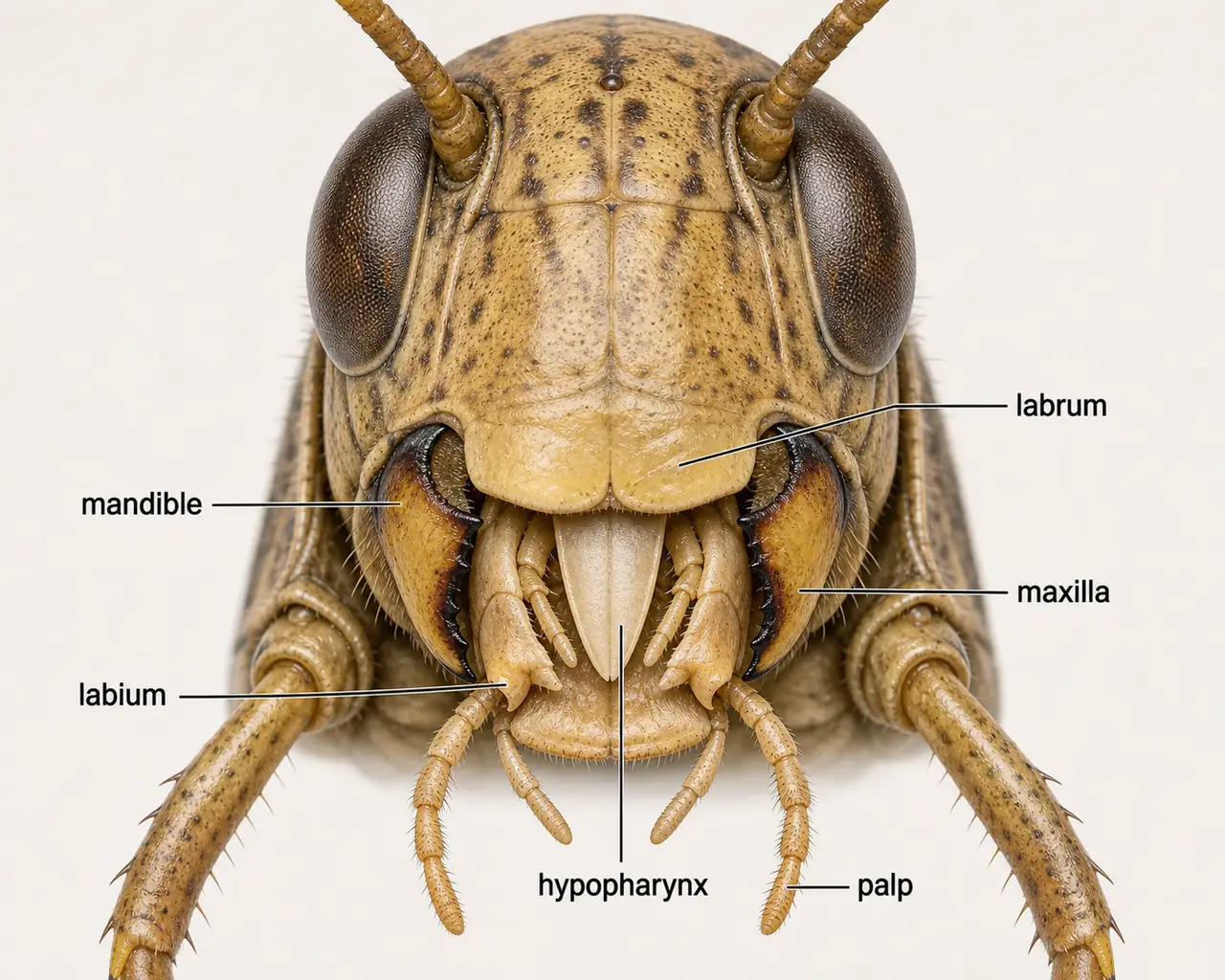
How to use this map: first locate the two heavy mandibles because they are easiest to recognize. Then identify the softer supporting parts around them -- labrum above, labium below, and maxillae with palps at the sides.
1. Labrum (Upper Lip)
- A flap-like, bilobed structure attached to the clypeus by an articular membrane; movable.
- Forms the roof of the pre-oral food cavity.
- Function: Pulls food into the mouth and holds it in position for the mandibles to work on it. Think of it as a "lid" that keeps food within the mouth area.
Labrum--Epipharynx
- A lobe-like structure on the inner surface of the labrum.
- Functions as an organ of taste (gustatory receptors).
- Well developed in Hymenoptera.
2. Mandibles (Primary Jaws)
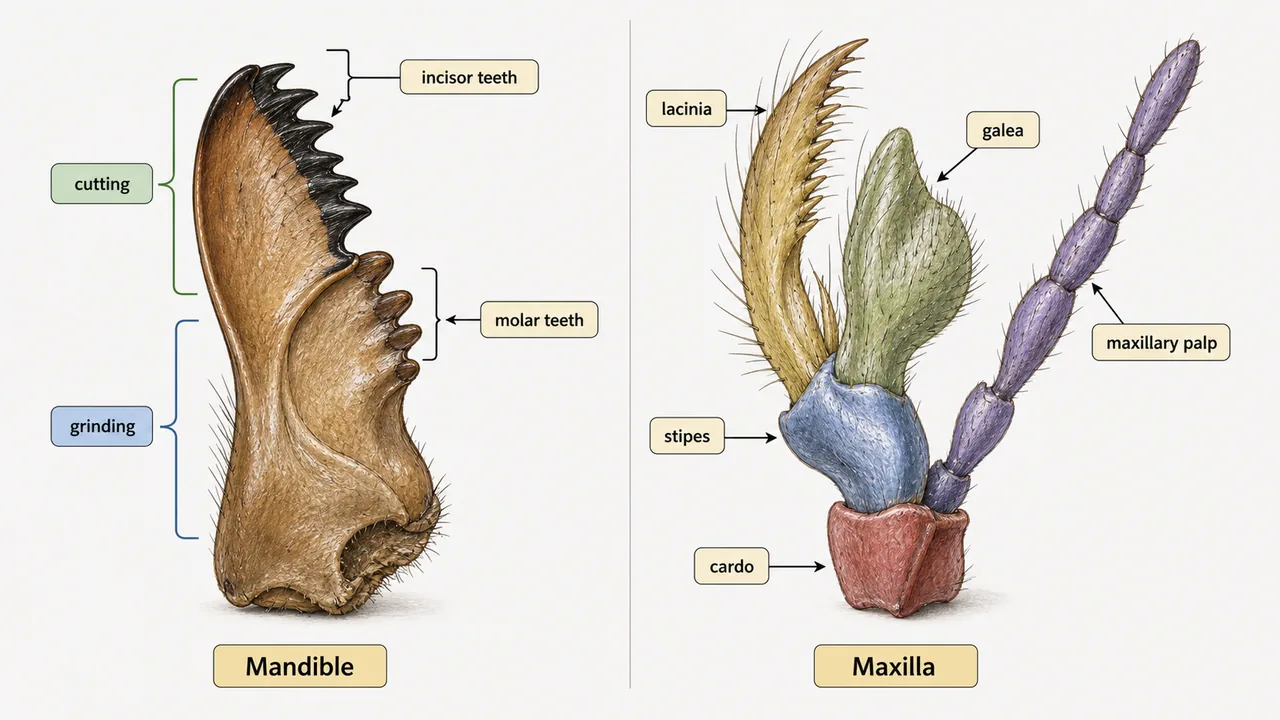
- One pair (2 mandibles) -- hence the name "mandibulate" mouthparts.
- The first pair of jaws; also called primary jaws or true jaws.
- Paired, unsegmented, strongest, and heavily sclerotized structures.
- Toothed on their inner border with two types of teeth:
| Tooth Type | Position | Function |
|---|---|---|
| Incisor teeth | Distal (outer) | Sharply pointed; cutting food material |
| Molar teeth | Proximal (inner) | Blunt; crushing and grinding food material |
This division of labour between cutting and grinding teeth makes the mandible a highly efficient food-processing tool -- similar in principle to human incisors and molars.
3. Maxillae (Secondary Jaws)
- One pair (2 maxillae); more complex than mandibles with multiple components.
- Called secondary jaws or accessory jaws -- assist in food manipulation while mandibles do the heavy cutting.
| Component | Position | Function |
|---|---|---|
| Cardo | Proximal (base) | Hinge that joins maxilla to head |
| Stipes | Articulates with cardo | Main body of the maxilla; bears other components |
| Palpifer | Lateral sclerite on stipes | Bears the 5-segmented maxillary palp (sensory -- taste and touch) |
| Galea | Outer distal lobe | Protective cover over food |
| Lacinia | Inner distal lobe (toothed) | Holds and tears food |
- Maxillae direct food into the mouth and hold it while mandibles are in action.
- Maxillary palps are essential for food selection -- the insect "tastes" potential food with its palps before deciding to eat.
4. Labium (Lower Lip)
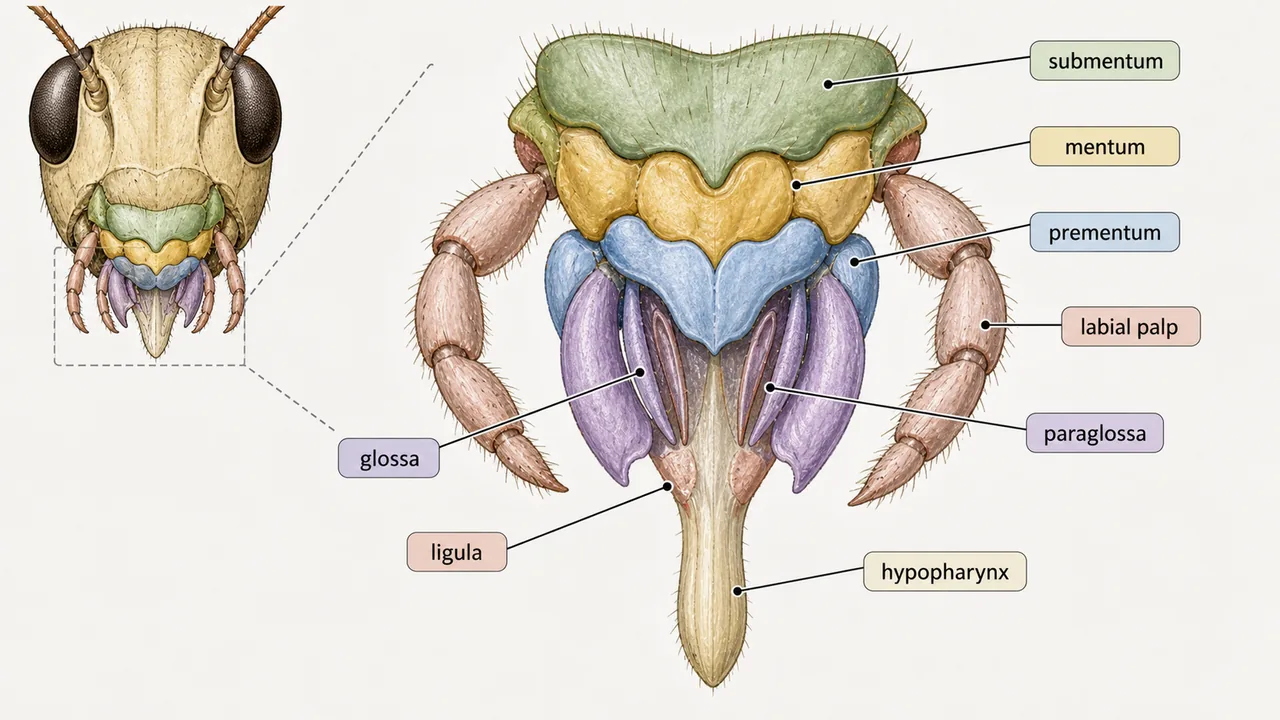
- Acts as the lower lip, bounding the mouth cavity from below.
- A composite structure formed by the fusion of two primitive appendages (essentially two maxilla-like structures fused along the midline).
| Component | Position | Description |
|---|---|---|
| Submentum | Proximal (base) | Large basal sclerite |
| Mentum | Middle | Central region |
| Prementum | Distal (anterior) | Bears palps and lobes |
| Palpiger | Lateral on prementum | Bears 3-segmented labial palps (sensory -- taste and touch) |
| Glossae | Median (inner) pair of lobes | Gustatory sense organs |
| Paraglossae | Outer pair of lobes | Gustatory sense organs |
| Ligula | Glossae + Paraglossae fused | Combined tasting and food-manipulating structure; greatly elongated in bees for lapping nectar |
5. Hypopharynx (Tongue)
- A tongue-like structure situated between labrum and labium.
- Unpaired (not present as a pair -- a frequent exam question).
- Ducts of salivary glands open on or near its base, delivering saliva directly to the food mass.
- Function: Mixes the crushed and cut food material with saliva, aiding in digestion from the start.
Comparison of Mouthpart Components
| Component | Number | Analogy | Primary Function |
|---|---|---|---|
| Labrum | 1 (unpaired) | Upper lip | Covers mouth from above; pushes food in |
| Mandibles | 1 pair | Primary jaws | Cutting and grinding solid food |
| Maxillae | 1 pair | Secondary jaws | Manipulating food; sensory (taste/touch via palps) |
| Labium | 1 (fused pair) | Lower lip | Bounds mouth from below; sensory via labial palps |
| Hypopharynx | 1 (unpaired) | Tongue | Mixes food with saliva |
Agricultural Examples
| Insect | Order | Life Stage with Biting-Chewing Mouthparts | Crop Damage | What damage looks like in the field |
|---|---|---|---|---|
| Grasshopper / Locust | Orthoptera | Nymph and adult | Defoliation of cereals, pulses | Large, irregular holes from leaf margins inward; entire leaves may be consumed leaving only midribs |
| Termites | Isoptera | All stages | Root and stem damage in sugarcane, wheat | Plants wilt suddenly despite adequate moisture; pulling up shows hollowed-out roots with mud tubes |
| Beetles / Weevils | Coleoptera | Larva (grub) and adult | Grain boring (rice weevil), leaf feeding | Small round holes in stored grain; shothole pattern on leaves |
| Caterpillars | Lepidoptera | Larva only (adults have sucking mouthparts) | Bollworm in cotton, stem borer in rice | Irregular ragged holes in leaves; entry holes in bolls/stems with frass (droppings) visible |
Note: Adult Coleoptera emerge from their cocoon by cutting through it with their mandibles -- a direct demonstration of mandibulate mouthpart function.
Thrips -- Rasping and Sucking (Asymmetrical) Type
Thrips possess an unusual asymmetrical mouthpart: the right mandible is absent, leaving only the left mandible and two maxillary stylets (three stylets total). They use this to rasp plant cell surfaces and suck the oozing sap, producing characteristic silvery streaks on onion, chilli, and cotton leaves. The asymmetrical mouthpart is a key diagnostic character -- no other insect group has it.
Key insight: In Lepidoptera, the larva (caterpillar) has biting-chewing mouthparts and chews leaves voraciously, but the adult (butterfly/moth) has sucking mouthparts (siphoning type) and feeds on liquid nectar. This dramatic change during metamorphosis reflects entirely different nutritional needs.
Exam Tips
Unpaired mouthparts: Only the labrum and hypopharynx are unpaired (1 each). Mandibles, maxillae, and the embryological components of the labium are paired.
Maxillary palp = 5 segments; Labial palp = 3 segments. Remember: Maxillary = More (5 > 3).
Labium = fused second maxillae. That is why it has paired structures (glossae, paraglossae) on each side.
Lepidoptera trick question: Caterpillars (larvae) = biting-chewing. Adult butterflies/moths = siphoning (sucking). The mouthpart type changes with metamorphosis.
Summary Cheat Sheet
| Concept | Key Detail |
|---|---|
| Mouthpart classification | Mandibulate (solid food) vs. Haustellate (liquid food) |
| Primitive type | Biting and chewing (mandibulate) |
| Labrum | Upper lip; covers mouth from above; bears epipharynx (taste organ) |
| Mandibles | 1 pair; primary jaws; incisor teeth (cutting) + molar teeth (grinding) |
| Maxillae | 1 pair; secondary jaws; components: cardo, stipes, palpifer, galea, lacinia, 5-segmented palp |
| Labium | Lower lip; fused pair; components: submentum, mentum, prementum, glossae, paraglossae, 3-segmented palp |
| Ligula | Glossae + Paraglossae combined |
| Hypopharynx | Unpaired tongue; salivary duct opens at its base |
| Lepidoptera larvae | Biting-chewing (caterpillar); adult has siphoning type |
| Damage pattern | Ragged holes, defoliation, boring (not stippling or wilting) |
TIP
Next: The next lesson covers sucking-type mouthparts -- the five haustellate modifications that allow insects to feed on plant sap, nectar, and blood.
References
1 source
References
Lesson Doubts
Ask questions, get expert answers