🐛 Pest Classification and Economic Threshold Concepts
How pests are defined, categorised by occurrence pattern, and classified using DB Singh's system based on EIL, ETL, GEP, and Damage Boundary — with formulas, examples, and exam mnemonics
A Farmer's Dilemma — When Does an Insect Become a Pest?
Imagine a cotton farmer in Gujarat who notices a few aphids on his crop. Should he spray immediately? Not necessarily. A handful of aphids cause no economic harm, and spraying would kill beneficial ladybird beetles that feed on those aphids. The insects become a "pest" only when their numbers grow large enough to threaten profit. This simple idea — that pest status depends on population density, not mere presence — is the foundation of modern pest management and the starting point for every concept in this lesson.
This lesson covers:
- Definition of a pest — what makes an insect a pest
- Economic framework — DB, ETL, EIL, and GEP concepts with formulas
- Occurrence-based categories — Regular, Occasional, Seasonal, Persistent, Sporadic
- DB Singh Classification — the exam-critical framework using GEP and EIL positions
All sections are high-yield for IBPS AFO, NABARD Grade A, and FCI exams.
Pro Content Locked
Upgrade to Pro to access this lesson and all other premium content.
Charged once for one year · ₹1188 total
Save ₹100/month vs ₹2388/year launch price
- All Agriculture & Banking Courses
- AI Lesson Questions (100/day)
- AI Doubt Solver (50/day)
- Glows & Grows Feedback (30/day)
- AI Section Quiz (20/day)
- 22-Language Translation (100/day)
- Recall Questions (20/day)
- AI Quiz (15/day)
- AI Quiz Paper Analysis (100/day)
- AI Step-by-Step Explanations (100/day)
- Spaced Repetition Recall (FSRS)
- AI Tutor
- Immersive Text Questions
- Audio Lessons — Hindi & English
- Mock Tests & Previous Year Papers
- Summary & Mind Maps
- XP, Levels, Leaderboard & Badges
- Generate New Classrooms
- Voice AI Teacher (AgriDots Live)
- AI Revision Assistant
- Knowledge Gap Analysis
- Interactive Revision (LangGraph)
🔒 Secure one-time yearly payment via Razorpay · No hidden fees
A Farmer's Dilemma — When Does an Insect Become a Pest?
Imagine a cotton farmer in Gujarat who notices a few aphids on his crop. Should he spray immediately? Not necessarily. A handful of aphids cause no economic harm, and spraying would kill beneficial ladybird beetles that feed on those aphids. The insects become a "pest" only when their numbers grow large enough to threaten profit. This simple idea — that pest status depends on population density, not mere presence — is the foundation of modern pest management and the starting point for every concept in this lesson.
This lesson covers:
- Definition of a pest — what makes an insect a pest
- Economic framework — DB, ETL, EIL, and GEP concepts with formulas
- Occurrence-based categories — Regular, Occasional, Seasonal, Persistent, Sporadic
- DB Singh Classification — the exam-critical framework using GEP and EIL positions
All sections are high-yield for IBPS AFO, NABARD Grade A, and FCI exams.
What Is a Pest?
A pest is any organism that occurs in large numbers and conflicts with human welfare, convenience, or profit. The key word is "large numbers" — a single insect on a plant is not a pest; a population that causes measurable loss is.
IMPORTANT
Competitive exams (IBPS AFO, NABARD Grade A, and FCI) often test whether you understand that pest status is population-dependent, not species-dependent. The same insect can be a pest on one crop and a non-pest on another.
The Economic Framework — DB, ETL, EIL, and GEP
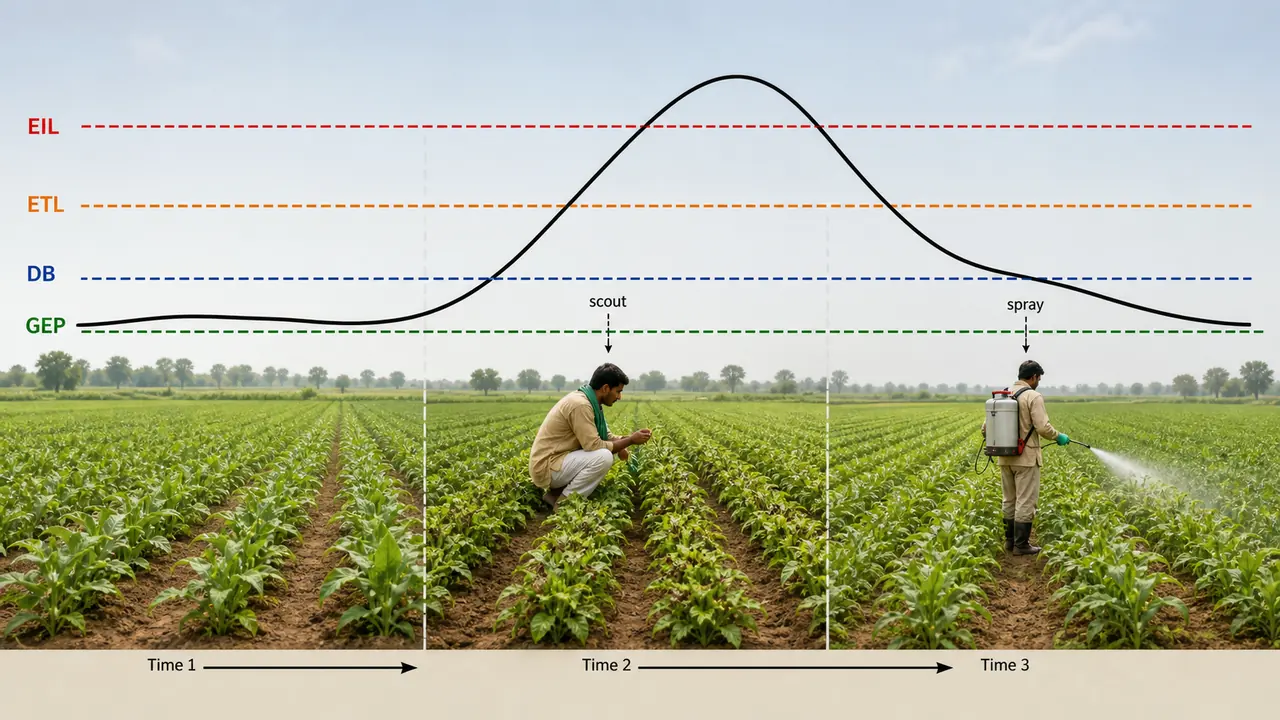
Before we classify pests, we need four economic concepts that describe the relationship between pest numbers and crop loss. Think of these as four rungs on a ladder — each represents a different population density.
Damage Boundary (DB)
Damage Boundary (DB) is the lowest level of pest injury at which any loss can first be recognised. Below this level, the crop compensates naturally and no visible damage occurs.
Economic Threshold Level (ETL)
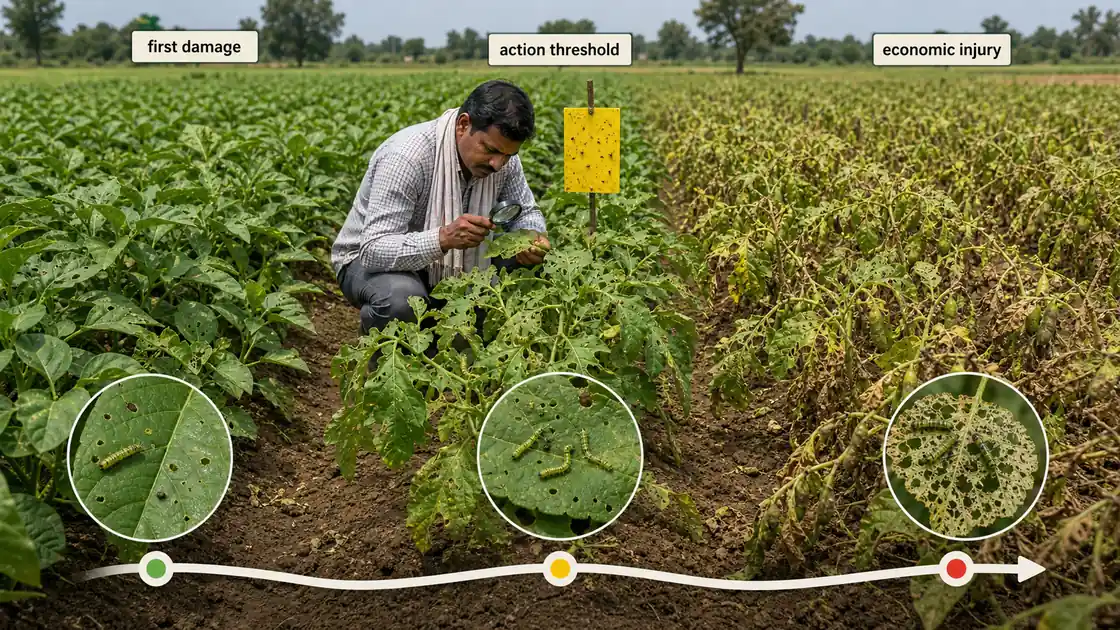
Economic Threshold Level (ETL) is the pest density at which control measures should be applied to prevent the population from reaching the Economic Injury Level. It is also called the Action Threshold Level.
Agricultural example: In rice, the ETL for stem borer is typically 5% dead hearts at the vegetative stage. When scouting reveals this level, the farmer should act.
Economic Injury Level (EIL)
Economic Injury Level (EIL) is the lowest population density that will cause economic damage — meaning the cost of crop loss equals or exceeds the cost of control. It is also known as Damage Threshold Level (DTL).
- Classical threshold literature is commonly linked with Stern et al. (1959) for the EIL/ETL framework used in modern pest management teaching.
General Equilibrium Position (GEP)
General Equilibrium Position (GEP) is the average population density of an insect over a long period, unaffected by temporary pest control interventions. It represents the natural balance point of the population in a given environment.
The Critical Relationship
TIP
Remember the ladder: DB < ETL < EIL. Control at ETL prevents reaching EIL.
Mnemonic — "DTE": Damage seen → Take action → Economic loss. This gives you the order DB → ETL → EIL.
- In applied economics, EIL is generally inversely related to product price and directly related to cost of control. If crop value rises, even a smaller pest population can justify action; if control becomes costly, the tolerable pest density becomes higher.
- Later exam-oriented notes also mention the Environmental Economic Injury Level (EEL) associated with Pedigo and Higley (1992).
Relative Ways to Express ETL in the Field
In real scouting work, ETL is not always written in the same unit. It may be expressed relative to the crop structure being observed.
- Common relative expressions include:
- number of insects per plant
- number of insects per leaf
- number of insects per twig
- number of insects per hill
- number of insects per panicle
- number of larvae per metre row length
High-Yield ETL Reference Values
These values are best used as quick scouting anchors, while the detailed crop lessons remain the primary source for diagnosis and management.
| Crop-Pest Situation | Quick ETL Anchor |
|---|---|
| BPH in rice | 5-10 hoppers/hill |
| Rice yellow stem borer | 5% dead hearts or 1% white ears |
| Rice gall midge | 10% silver shoots |
| Rice gundhi bug | 1 bug/hill at flowering or 3 bugs/hill at milky stage |
| Gram pod borer in chickpea | 1 larva per metre row length |
| Cotton bollworm complex | 5-10% boll infestation |
| Cotton jassid | 1-2 nymphs/leaf |
| Cotton whitefly | 5-10 adults/leaf |
| Mustard aphid | 50-60 aphids per 10 cm twig |
| Mango hopper | 5 adults/panicle |
| Vector insects | Zero tolerance / effectively zero ETL in practical management because even low vector density can initiate disease spread |
| Concept | What It Answers | Farmer's Decision |
|---|---|---|
| DB | "Is there any damage at all?" | No action needed yet |
| ETL | "Should I spray now?" | Yes — act to prevent loss |
| EIL | "Am I already losing money?" | Loss is occurring — too late for prevention |
| GEP | "What is the long-term average population?" | Determines pest category (see below) |
Categories of Pests Based on Occurrence
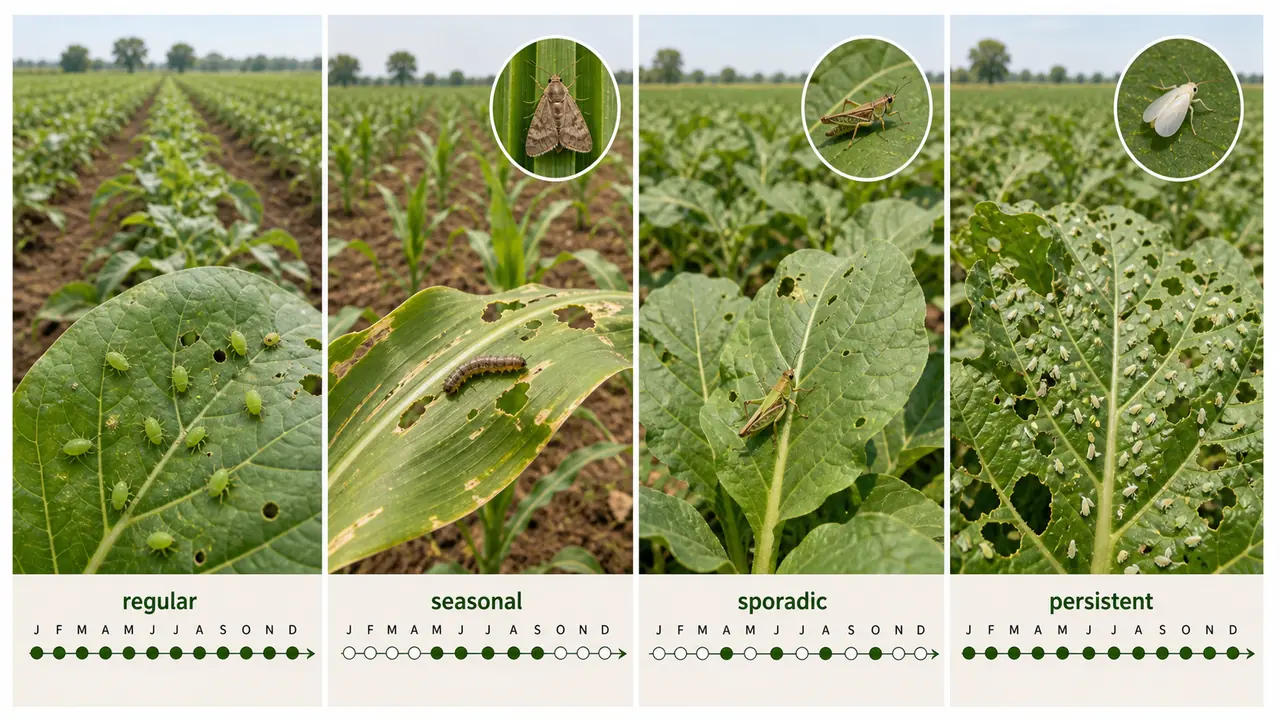
Before learning DB Singh's classification (which uses GEP and EIL), it is useful to know how pests are grouped by their pattern of occurrence on crops.
| Category | Description | Agricultural Example |
|---|---|---|
| Regular pest | Frequently occurs on the crop; close association | Rice stem borer on rice, Brinjal fruit borer |
| Occasional pest | Infrequently occurs; no close association with the crop | Caseworm on rice, Mango stem borer |
| Seasonal pest | Appears during a particular season every year | Red hairy caterpillar on groundnut (kharif), Mango hoppers (spring) |
| Persistent pest | Present throughout the year; difficult to control | Chilli thrips, Mealy bug on guava |
| Sporadic pest | Appears in isolated localities during some periods | Coconut slug caterpillar |
TIP
Mnemonic — "ROSPS": Regular, Occasional, Seasonal, Persistent, Sporadic. Think "ROSPS sounds like crops" — these categories describe how pests appear on crops.
DB Singh Classification — The Exam-Critical Framework
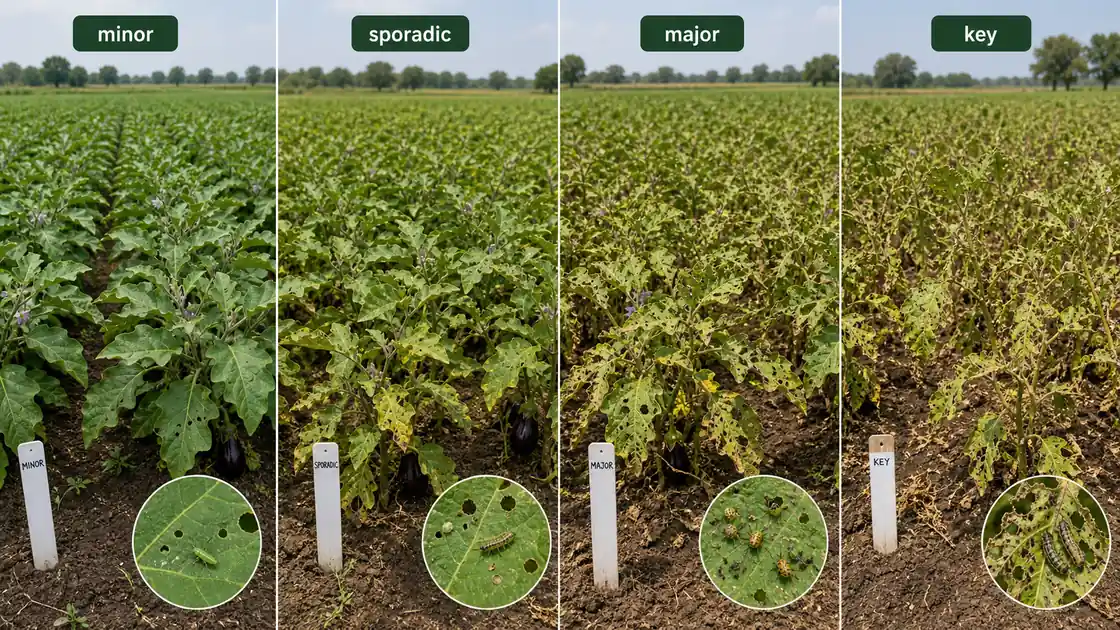
DB Singh classified pests by comparing the position of their GEP relative to the EIL and Damage Boundary (DB). This classification is the most frequently tested topic in AFO/NABARD entomology sections.
1. Key Pest
- Most severe and damaging category
- GEP lies above both DB and EIL — the population is always at damaging levels
- These are persistent pests requiring continuous management
- The environment itself must be modified to bring GEP below EIL
- Examples: Cotton bollworm (Helicoverpa armigera), Diamond Back Moth (DBM) on cabbage, Gram pod borer
Agricultural context: A cabbage farmer in Nashik district faces DBM every season regardless of what he does. The moth's natural equilibrium population is so high that damage is guaranteed without major intervention such as resistant varieties or biological control.
2. Major Pest
- GEP lies very close to EIL — damage is avoidable only with timely interventions
- Without action at ETL, these pests quickly cross into economically damaging territory
- Examples: Cotton jassid, Rice stem borer, Sucking pests of cotton and rice
3. Minor Pest
- GEP lies below both EIL and DB
- Under favourable conditions (drought, excess nitrogen), the population may briefly cross EIL
- A single application of insecticide is usually enough to prevent damage
- Examples: Thrips, Mites, Sugarcane mealy bug
4. Regular Pest
- Affects specific seasonal crops (cereals, pulses, fruits) every year
- Passes through many generations during the crop period
- Example: Rice stem borer
5. Sporadic Pest
- GEP generally below EIL
- Occasionally crosses EIL and causes severe loss in some places or periods
- Examples: Sugarcane pyrilla, White grub in groundnut, Hairy caterpillar
6. Potential Pest
- Not a pest at present — GEP is always below EIL
- If the environment changes (new variety, altered climate, removal of natural enemies), they may become economically important
- Examples: Spodoptera litura is a potential pest in North India; Army worm on wheat
Key Pest vs Major Pest — The Critical Distinction
NOTE
Exams frequently ask you to distinguish Key and Major pests. The difference is simple:
- Key pest: GEP is above EIL — damage is inevitable without environmental modification.
- Major pest: GEP is close to EIL — damage is avoidable with timely chemical/biological intervention.
| Feature | Key Pest | Major Pest |
|---|---|---|
| GEP position | Above EIL | Close to EIL |
| Damage without intervention | Certain | Likely but avoidable |
| Control strategy | Environmental modification | Timely spray at ETL |
| Example | Cotton bollworm | Cotton jassid |
Farmer's Decision Guide: When Should I Spray?
Use this 3-step process before reaching for the sprayer:
Step 1: Is this pest actually causing economic damage?
- Count pest population per plant/hill → Compare with ETL for that crop-pest combination
- Below ETL? → Do NOT spray. Natural enemies may be controlling the population. Re-check after 3-5 days.
- At or above ETL? → Go to Step 2
Step 2: What category is this pest?
- Key pest (GEP always above EIL — e.g., cotton bollworm)? → Environmental modification needed (resistant varieties, crop rotation, biocontrol). Chemical spray alone won't solve the problem long-term.
- Major pest (GEP near EIL — e.g., cotton jassid)? → Timely spray at ETL is effective. One well-timed spray often enough.
- Minor/sporadic pest (GEP well below EIL)? → Usually no action needed unless unusual outbreak. Check if natural enemies were disrupted.
Step 3: Choose the right response
- First: Cultural + biological methods (cheapest, safest)
- Then: Chemical only if ETL is crossed and other methods are insufficient
- Never spray on a calendar schedule — this is the single biggest mistake in Indian agriculture
IBPS AFO/NABARD exam tip: ETL is always lower than EIL. ETL = "time to act"; EIL = "damage is already happening." You spray at ETL to prevent reaching EIL.
Exam Tips and Mnemonics
- "Key is King" — Key pests are the most severe; their GEP sits above EIL like a king above the crowd.
- DB Singh classification uses three reference lines: DB, ETL (implicit), and EIL. The position of GEP relative to EIL determines the category.
- Potential pests can become key/major pests if natural enemies are destroyed (e.g., indiscriminate pesticide use killing predators).
- ETL vs EIL confusion: ETL is the action point (spray now); EIL is the damage point (loss is happening). ETL is always lower than EIL.
Summary Table
| Pest Type | GEP Position | Severity | Action Required | Example |
|---|---|---|---|---|
| Key Pest | Above EIL and DB | Most severe | Environmental modification | Cotton bollworm, DBM |
| Major Pest | Close to EIL | High | Timely intervention at ETL | Cotton jassid, Rice stem borer |
| Minor Pest | Below EIL and DB | Low | Single spray if needed | Thrips, Mites |
| Regular Pest | Seasonal presence | Moderate | Seasonal management | Rice stem borer |
| Sporadic Pest | Generally below EIL | Variable | Occasional action | Sugarcane pyrilla, White grub |
| Potential Pest | Always below EIL | None currently | Monitor only | Spodoptera litura (North India) |
Additional Exam Facts
| Topic | Key Detail |
|---|---|
| DPPQ&S Headquarters | Faridabad, Haryana — established 1946 |
| Destructive Insects and Pests Act (DIPA) | 1914 — Legislative/Legal method of pest control |
| First pest surveillance (1969) | Conducted against Parthenium hysterophorus — weed surveillance concept |
Resurgence and Secondary Pest Outbreak
- Resurgence means a pest population rebounds to a level higher than before suppression, often because broad-spectrum insecticides removed natural enemies and opened a vacant niche.
- A classic Indian cotton example links whitefly resurgence with indiscriminate use of cypermethrin / synthetic pyrethroids.
- A secondary pest outbreak occurs when a previously minor pest becomes major after insecticide application wipes out predators, parasitoids, and competing species that had kept it suppressed.
- In short exam language: resurgence is a rebound of the same target pest, while secondary pest outbreak is the rise of a different formerly minor pest after spraying.
IMPORTANT
Use of resistant varieties in IPM = Cultural method — NOT biological or physical. This is frequently tested. Resistant varieties are an agronomic/farming practice, not a living organism (biological) or physical agent.
Summary Cheat Sheet
| Concept / Topic | Key Details |
|---|---|
| Pest definition | Organism in large numbers conflicting with human welfare — pest status is population-dependent |
| DB (Damage Boundary) | Lowest pest injury level where loss is first recognised — no action needed |
| ETL | Pest density at which control measures should be applied; AKA Action Threshold Level |
| EIL | Lowest density causing economic damage; AKA Damage Threshold Level (DTL) |
| GEP | Average population density over long period — determines pest category in DB Singh system |
| Critical order | DB < ETL < EIL; mnemonic: DTE (Damage → Take action → Economic loss) |
| Occurrence categories | ROSPS: Regular, Occasional, Seasonal, Persistent, Sporadic |
| Key Pest | GEP above EIL — most severe — requires environmental modification — Cotton bollworm, DBM |
| Major Pest | GEP close to EIL — timely intervention at ETL — Cotton jassid, Rice stem borer |
| Minor Pest | GEP below EIL and DB — single spray if needed — Thrips, Mites |
| Sporadic Pest | GEP generally below EIL — occasionally crosses — Sugarcane pyrilla, White grub |
| Potential Pest | GEP always below EIL — may become key/major if natural enemies destroyed |
TIP
Next: Lesson 02 covers Integrated Pest Management (IPM) — the philosophy that combines all these classification concepts with practical control strategies to keep pests below EIL without relying solely on chemicals.