🌿 Integrated Pest Management — Principles, Components, and Practice
What IPM is, its five core principles, all seven control components, advantages over calendar spraying, and India's national IPM infrastructure — with field examples and exam strategies
From Spray-and-Pray to Smart Pest Control
In the previous lesson, we established how pests are defined and classified — using concepts like EIL, ETL, GEP, and the DB Singh framework. Now we move from theory to practice: how do farmers actually decide when and how to control pests?
In the 1960s and 70s, Indian farmers sprayed DDT and BHC on cotton fields every week on a fixed calendar. The result? Pest resistance skyrocketed, beneficial insects were wiped out, and secondary pests like whitefly — previously harmless — became devastating. This crisis forced agricultural scientists worldwide to develop a smarter approach: Integrated Pest Management (IPM). Instead of blanket spraying, IPM asks a simple question — "Is the pest population high enough to justify the cost and risk of control?"
This lesson covers:
- IPM definition and philosophy — what it is and what it is not
- Five core principles — Prevention, Monitoring, Economic Threshold, Integration, Evaluation
- Seven control components — each introduced here, detailed in subsequent lessons
- IPM vs calendar spraying — why IPM wins
- India's national IPM infrastructure — DPPQS, CIPMCs, NCIPM
What Is Integrated Pest Management?
Integrated Pest Management (IPM) is a pest management philosophy that uses all suitable techniques and methods in a compatible manner to keep pest populations below economically injurious levels.
- Older history notes connect the stepwise terminology with:
- Geier (1966) for the broader idea of pest management
- Geier and Clark (1961) for early use of the integrated pest management concept
- the Council on Environmental Quality (1972) as a classical citation for the term in policy-oriented exam summaries
- FAO (1972) for the ecosystem-oriented wording that emphasises compatibility with the associated environment and population dynamics of the pest
Two critical qualifiers make IPM different from ad-hoc control:
- Every technique must be environmentally sound.
- Every technique must be compatible with producer objectives (cost, yield, quality).
IMPORTANT
IPM does NOT mean zero pesticide use. It means judicious, need-based use of pesticides as a last resort, integrated with cultural, biological, and mechanical methods. This distinction is a common exam trap.
The Five Core Principles of IPM
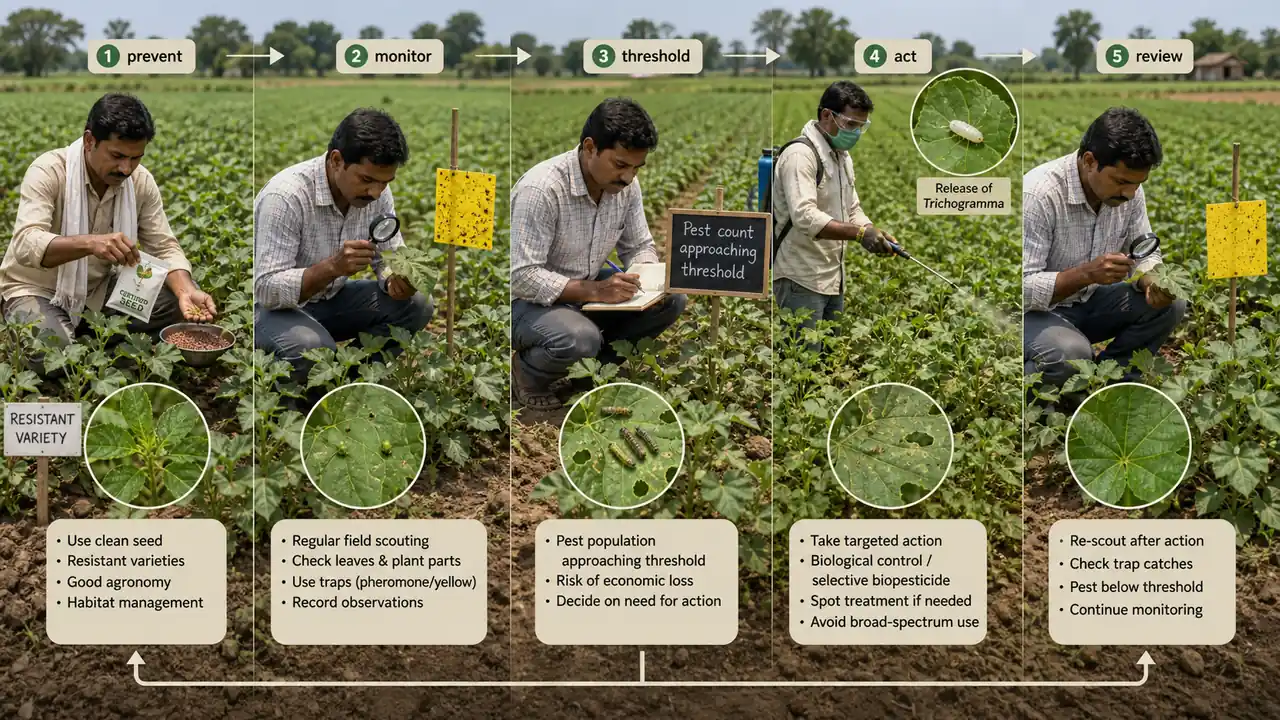
IPM follows a logical sequence — prevent, observe, decide, act, and review. Each principle builds on the previous one.
| Principle | What It Means | Field Example |
|---|---|---|
| 1. Prevention | Stop pests before they appear | Use resistant varieties (Bt cotton), crop rotation, clean seed material |
| 2. Monitoring | Regular field scouting and trap-based assessment | Weekly pheromone trap counts for Helicoverpa in gram |
| 3. Economic Threshold | Apply control only when pest population reaches ETL | Spray rice stem borer insecticide only at 5% dead hearts |
| 4. Integration | Combine multiple compatible control methods | Neem spray + Trichogramma release + resistant variety in sugarcane |
| 5. Evaluation | Assess the effectiveness of control measures | Post-spray scouting to check if pest numbers dropped below ETL |
TIP
Mnemonic — "PM-IEE": Prevention, Monitoring, threshold (Injury-based decision), Execute integrated controls, Evaluate outcomes.
The Seven Components of IPM
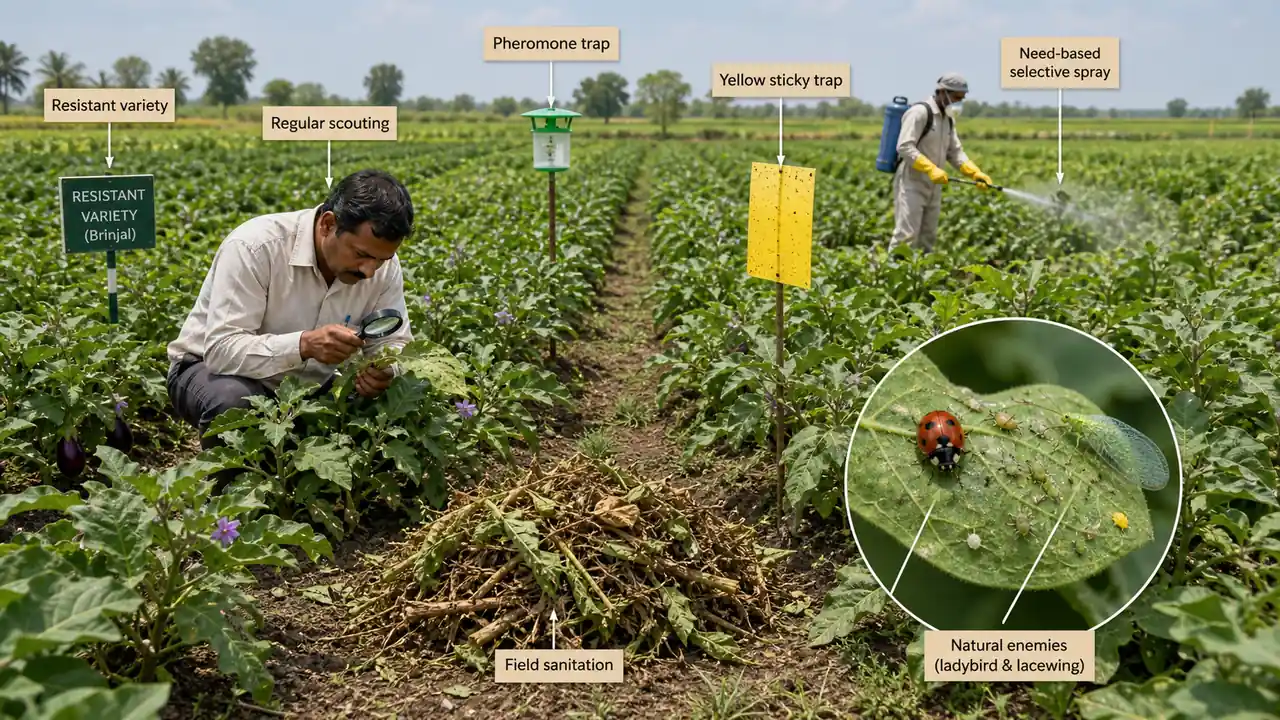
IPM draws from every available tool. The following table introduces all seven components — each is covered in detail in subsequent lessons.
| Component | Key Principle | Agricultural Examples |
|---|---|---|
| Cultural Control | Manipulation of agronomic practices to disadvantage pests | Crop rotation breaks stem borer cycle; intercropping sorghum with cowpea reduces stem borer |
| Physical Control | Use of temperature, moisture, light, or radiation | Sun drying seeds kills stored-grain pest eggs; cold storage kills fruit fly larvae |
| Mechanical Control | Manual or device-based removal/exclusion of pests | Hand picking caterpillars; grease banding on mango trunks against mealy bug |
| Biological Control | Use of natural enemies — parasitoids, predators, pathogens | Trichogramma chilonis egg parasitoid release in sugarcane; Chrysoperla against aphids |
| Chemical Control | Judicious, need-based use of insecticides | Spray imidacloprid on rice at ETL for BPH; granular carbofuran in rice nursery |
| Legal/Regulatory Control | Quarantine and legislation to prevent pest introduction/spread | DIPA 1914, DPPQS at Faridabad, Plant Quarantine Order 2003 |
| Host Plant Resistance | Use of resistant or tolerant crop varieties | Bt cotton against bollworm; BPH-resistant rice varieties (Ratna, Ptb 33) |
Why IPM Works — Advantages
Understanding the advantages helps answer "why IPM?" questions in exams and also highlights the contrast with calendar-based spraying.
- Reduces pesticide residues in food and the environment — safer for consumers
- Cost-effective — eliminates unnecessary sprays, lowering input costs for farmers
- Delays resistance development — rotating control methods prevents pests from adapting to any single pesticide
- Preserves natural enemies — ladybird beetles, spiders, and parasitoids survive and continue suppressing pests
- Sustainable — maintains long-term ecological balance in the agroecosystem
- Reduces environmental pollution — less chemical runoff into soil and water
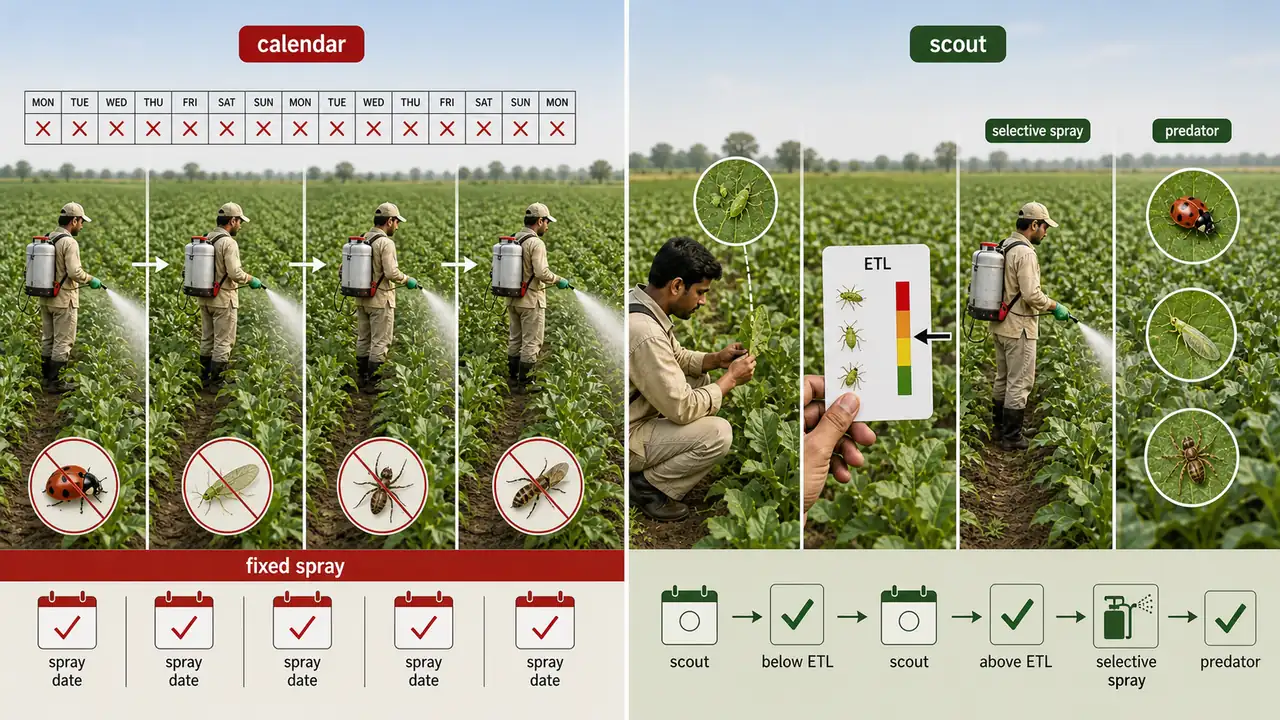
IPM vs Calendar-Based Spraying — A Comparison
This comparison is frequently tested in exams.
| Feature | IPM Approach | Calendar-Based Spraying |
|---|---|---|
| Spray decision | Based on ETL/EIL monitoring | Fixed schedule (e.g., every 15 days) |
| Cost | Lower — sprays only when needed | Higher — many sprays may be unnecessary |
| Resistance risk | Lower — diverse methods used | Higher — repeated exposure to same chemical |
| Environmental impact | Minimal | Significant (soil, water, beneficial organisms) |
| Natural enemy conservation | Yes — selective methods preserve them | No — broad-spectrum sprays kill everything |
| Farmer skill required | Higher — needs scouting and decision-making | Lower — follow calendar blindly |
NOTE
Real-world example: Cotton farmers in Andhra Pradesh who adopted IPM in the 1990s reduced pesticide use by 50-70% while maintaining yields. The key was replacing calendar sprays with ETL-based decisions and Trichogramma releases.
India's National IPM Infrastructure
India has built institutional support for IPM implementation. These facts are regularly tested.
| Institution | Role | Key Detail |
|---|---|---|
| DPPQS | Directorate of Plant Protection, Quarantine & Storage | Headquartered at Faridabad, Haryana |
| CIPMCs | Central Integrated Pest Management Centres | 35 centres across India; operate under DPPQS |
| NCIPM | National Centre for Integrated Pest Management | Under ICAR; located at New Delhi; established in 1988 |
| Plant Quarantine Stations | Prevent exotic pest introduction | 37 stations at ports, airports, and land borders |
TIP
Exam shortcut: When asked about India's IPM policy, remember that CIPMCs (under DPPQS) are the field-level implementation arm, while NCIPM (under ICAR) handles research and training.
Additional Exam Facts
ETL-Based Decision Making
ETL (Economic Threshold Level) is the cornerstone of IPM spray timing. Spraying before ETL wastes money and kills natural enemies; spraying after EIL means the crop is already losing economic value. ETL-based decisions are the defining feature that separates IPM from calendar-based spraying.
- IPM does not seek complete pest eradication. A small pest residue below ETL is often ecologically useful because it helps maintain predator and parasitoid populations in the field.
Pest Surveillance and Forecasting
- Pest surveillance means a constant watch on pest population dynamics and crop damage through surveys at fixed intervals.
- The three basic surveillance questions are:
- What is the level of incidence of the pest species?
- What loss is being caused by that incidence?
- What economic benefit would control provide?
- Pest forecasting is the prediction of pest outbreak or incidence using information generated through surveillance.
Vertical vs Horizontal Resistance
| Type | Mechanism | Durability |
|---|---|---|
| Vertical resistance | Single-gene (monogenic) resistance — effective against specific pest biotypes | Can be broken by new pest biotypes; less durable |
| Horizontal resistance | Multi-gene (polygenic) resistance — partial but broad resistance | More durable; harder to overcome |
IMPORTANT
Resistant varieties = Cultural method (not biological). Using resistant/tolerant varieties is classified under Cultural Control in IPM — a modification of agronomic practice. This is one of the most frequently confused points in exams.
Sterile Insect Technique (SIT)
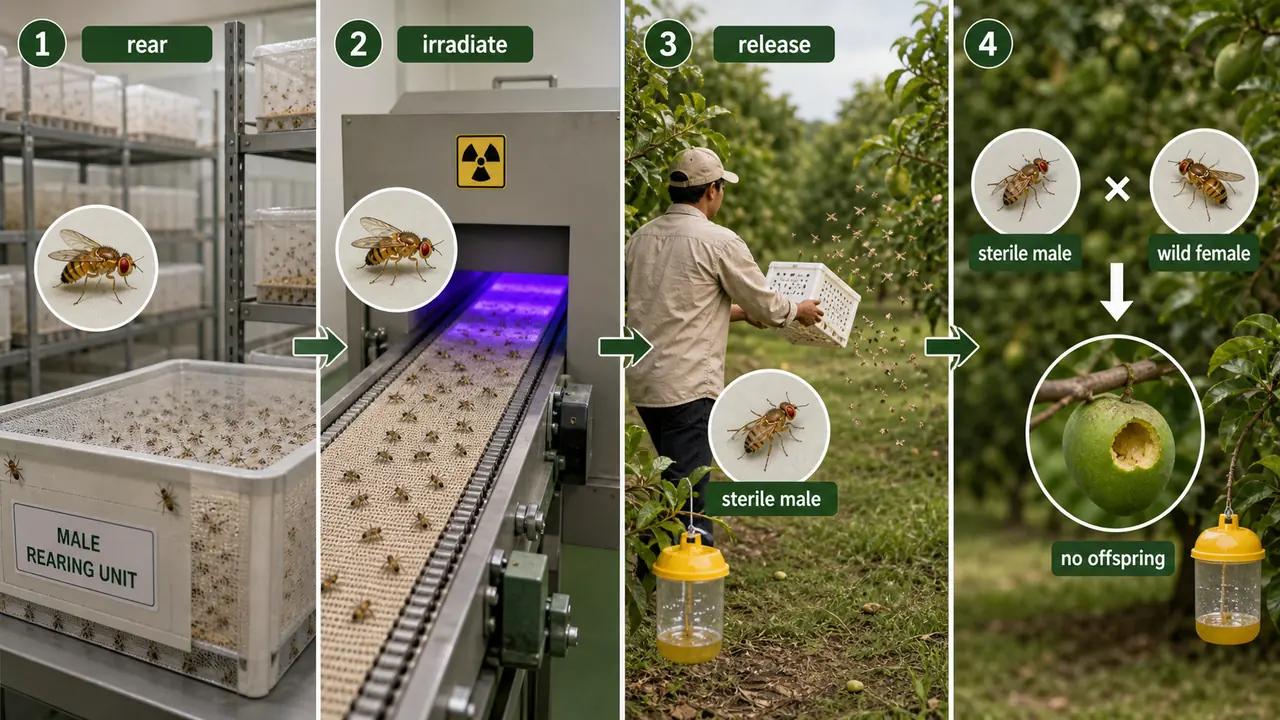
Sterile Insect Technique (SIT) is classified as a Physical method (using irradiation to sterilise male insects). Mass-reared males are sterilised by gamma irradiation, released into the field, and mate with wild females — producing no offspring. Used successfully for fruit fly control (Medfly, Oriental fruit fly).
- Classical SIT history is associated with E.F. Knipling and the early screwworm fly programme, where gamma irradiation became the practical basis for autocidal suppression and later eradication campaigns.
Historical IPM / Integrated-Control Lineage
- Older exam-oriented history notes often sequence the concept as follows:
- Michelbacher and Bacon (1952) associated with the early integrated-control concept
- the term "integrated control" classically linked with Bartlett (1956)
- a widely cited formal definition attributed to Stern et al. (1959), integrating biological and chemical control in an applied framework
IPM Component Selection Guide
Which IPM tool to use first? Follow this priority order:
| Priority | Method | When to Use | Cost | Example |
|---|---|---|---|---|
| 1st | Cultural control | Always — before pest appears | Lowest | Crop rotation, resistant varieties, adjusting sowing date |
| 2nd | Biological control | When natural enemies available, pest below ETL | Low | Release Trichogramma, conserve spiders, apply NPV |
| 3rd | Physical/mechanical | Small-scale or storage situations | Low-moderate | Light traps, hand-picking, grease banding |
| 4th | Botanical insecticides | When mild intervention needed, organic farming | Moderate | Neem seed kernel extract, pyrethrum |
| 5th | Chemical control | Only when ETL is crossed and above methods insufficient | Highest | Selective insecticide at recommended dose |
The golden rule: Move down this list only when the previous level is insufficient. Never jump straight to chemicals. The "I" in IPM means all methods work together, not that you pick one.
Exam Tips
- Definition precision matters. IPM is a "philosophy" that uses "all suitable techniques" — not just biological control, not just reduced spraying.
- ETL is the trigger. The defining feature of IPM is that control actions are based on economic thresholds, not calendar dates.
- Integration is key. Using only one method (even biological control alone) is NOT IPM. The "I" stands for Integrated.
- Host Plant Resistance is sometimes listed separately from the other six components. Be prepared for both 6-component and 7-component versions in exams.
Summary Table
| Aspect | Key Point |
|---|---|
| Definition | Use all suitable, compatible, environmentally sound methods to keep pests below EIL |
| Core trigger | Control applied at ETL, not on a calendar |
| Components | Cultural, Physical, Mechanical, Biological, Chemical, Legal, Host Plant Resistance |
| Key advantage | Sustainable, cost-effective, preserves natural enemies |
| India's nodal agency | DPPQS (Faridabad) with 35 CIPMCs |
| Research body | NCIPM under ICAR, New Delhi |
| Common exam trap | IPM does not mean zero pesticide — it means judicious, need-based use |
Summary Cheat Sheet
| Concept / Topic | Key Details |
|---|---|
| IPM definition | Use all suitable, compatible, environmentally sound methods to keep pests below EIL |
| Core trigger | Control applied at ETL, not on a calendar |
| 5 Principles | Prevention → Monitoring → Economic Threshold → Integration → Evaluation (mnemonic: PM-IEE) |
| 7 Components | Cultural, Physical, Mechanical, Biological, Chemical, Legal, Host Plant Resistance |
| Key advantage | Sustainable, cost-effective, preserves natural enemies, delays resistance |
| DPPQS | Directorate of Plant Protection, Quarantine & Storage; HQ at Faridabad, Haryana |
| CIPMCs | 35 Central IPM Centres under DPPQS — field-level implementation |
| NCIPM | Under ICAR, New Delhi — research and training |
| Quarantine stations | 37 stations at ports, airports, and land borders |
| Common exam trap | IPM does NOT mean zero pesticide — it means judicious, need-based use |
TIP
Next: Lesson 03 covers the first three IPM components in detail — Cultural, Physical, and Mechanical Control — the cheapest and most sustainable methods available to farmers.