🌾 Cultural, Physical, and Mechanical Control Methods
Farm-level and community-level cultural practices, physical control through temperature, moisture, light, and air manipulation, mechanical methods like trapping and banding — with crop-pest examples, safe moisture levels, and exam mnemonics
The Oldest Pest Control — Working With the Farm
In the previous lesson, we introduced IPM's seven components. The first three — Cultural, Physical, and Mechanical control — are the subject of this lesson. These are the non-chemical foundation of any IPM programme, and they are always the cheapest option available.
Long before synthetic insecticides existed, Indian farmers controlled pests by adjusting how and when they farmed. A rice grower who flooded his field to drown armyworm larvae, or a sugarcane farmer who removed dried leaf trash to deny whiteflies their hiding places — these were acts of cultural control. Combined with physical methods (heat, cold, light) and mechanical removal (hand picking, banding), these approaches remain the cheapest, safest, and most sustainable first line of defence in any IPM programme.
This lesson covers:
- Cultural control — farm-level and community-level agronomic practices
- Physical control — temperature, moisture, light, air, abrasive dusts
- Mechanical control — hand picking, banding, netting, trench digging
- Comparison of all three categories
1. Cultural Control Methods
Cultural control is the manipulation of agronomic practices to make the environment unfavourable for pests. It is the oldest and most economical method of pest management.
Pro Content Locked
Upgrade to Pro to access this lesson and all other premium content.
Charged once for one year · ₹1188 total
Save ₹100/month vs ₹2388/year launch price
- All Agriculture & Banking Courses
- AI Lesson Questions (100/day)
- AI Doubt Solver (50/day)
- Glows & Grows Feedback (30/day)
- AI Section Quiz (20/day)
- 22-Language Translation (100/day)
- Recall Questions (20/day)
- AI Quiz (15/day)
- AI Quiz Paper Analysis (100/day)
- AI Step-by-Step Explanations (100/day)
- Spaced Repetition Recall (FSRS)
- AI Tutor
- Immersive Text Questions
- Audio Lessons — Hindi & English
- Mock Tests & Previous Year Papers
- Summary & Mind Maps
- XP, Levels, Leaderboard & Badges
- Generate New Classrooms
- Voice AI Teacher (AgriDots Live)
- AI Revision Assistant
- Knowledge Gap Analysis
- Interactive Revision (LangGraph)
🔒 Secure one-time yearly payment via Razorpay · No hidden fees
The Oldest Pest Control — Working With the Farm
In the previous lesson, we introduced IPM's seven components. The first three — Cultural, Physical, and Mechanical control — are the subject of this lesson. These are the non-chemical foundation of any IPM programme, and they are always the cheapest option available.
Long before synthetic insecticides existed, Indian farmers controlled pests by adjusting how and when they farmed. A rice grower who flooded his field to drown armyworm larvae, or a sugarcane farmer who removed dried leaf trash to deny whiteflies their hiding places — these were acts of cultural control. Combined with physical methods (heat, cold, light) and mechanical removal (hand picking, banding), these approaches remain the cheapest, safest, and most sustainable first line of defence in any IPM programme.
This lesson covers:
- Cultural control — farm-level and community-level agronomic practices
- Physical control — temperature, moisture, light, air, abrasive dusts
- Mechanical control — hand picking, banding, netting, trench digging
- Comparison of all three categories
1. Cultural Control Methods
Cultural control is the manipulation of agronomic practices to make the environment unfavourable for pests. It is the oldest and most economical method of pest management.
Cultural methods work at two levels — what an individual farmer does on his field, and what a community of farmers does together.
A. Farm-Level Practices
The following table lists specific cropping techniques and the pests they control. This table is highly exam-relevant and frequently asked in AFO/NABARD papers.
| Cropping Technique | Pest Controlled | How It Works |
|---|---|---|
| Flooding | Rice armyworm | Drowns larvae and pupae in soil |
| Puddling | Rice mealy bug | Destroys mealy bug colonies in soil clods |
| Trap cropping | Diamond Back Moth (DBM) | Mustard planted as trap crop attracts 80-90% of DBM away from cabbage |
| Detrashing | Sugarcane whitefly | Removes dried leaves where whitefly hides |
| Earthing up | Sugarcane whitefly | Buries lower leaf sheaths, reducing whitefly habitat |
| Pruning / Topping | Rice stem borer | Removes egg masses laid on leaf tips |
| Trash mulching | Sugarcane early shoot borer | Mulch keeps soil cool, discouraging borer emergence |
| Destruction of alternate host | Cotton whitefly | Removing weeds that harbour whitefly between seasons |
| Destruction of weed hosts | Citrus fruit sucking moth | Eliminates breeding sites of the moth |
| Plant density / Rogue spacing | Rice brown planthopper (BPH) | Wider spacing improves air circulation, discourages BPH |
| High seed rate | Sorghum shootfly | More plants compensate for shootfly-damaged tillers |
| Early sowing | Gram pod borer in chickpea | Escapes peak pest buildup by shifting the vulnerable crop stage earlier |
| Pest-free seed material | Potato tuber moth | Clean tubers prevent introducing moth into new fields |
| Trimming and plastering | Rice grasshopper | Removes egg-laying sites on bunds |
| Ploughing | Red hairy caterpillar | Exposes pupae in soil to sun and predators |
| Intercropping | Sorghum stem borer | Cowpea or lablab intercrop disrupts borer host-finding |
| Intercropping | Mustard aphid | Taramira intercropped with raya helps reduce aphid buildup |
| Water management | Brown planthopper | Alternate wetting and drying discourages BPH buildup |
| Judicious fertiliser application | Rice leaf folder | Avoiding excess nitrogen reduces succulent growth that attracts leaf folder |
| Timely harvesting | Sweet potato weevil | Early harvest prevents weevil damage in mature tubers |
| Early sowing | Mustard aphid | Escapes the period of peak aphid multiplication in mustard |
TIP
BPH control mnemonic — "PWR": Plant density, Water management, Rogue spacing. BPH outbreaks are almost always linked to excess nitrogen and stagnant water — two conditions farmers can directly control.
Trap Crops — Complete Reference Table
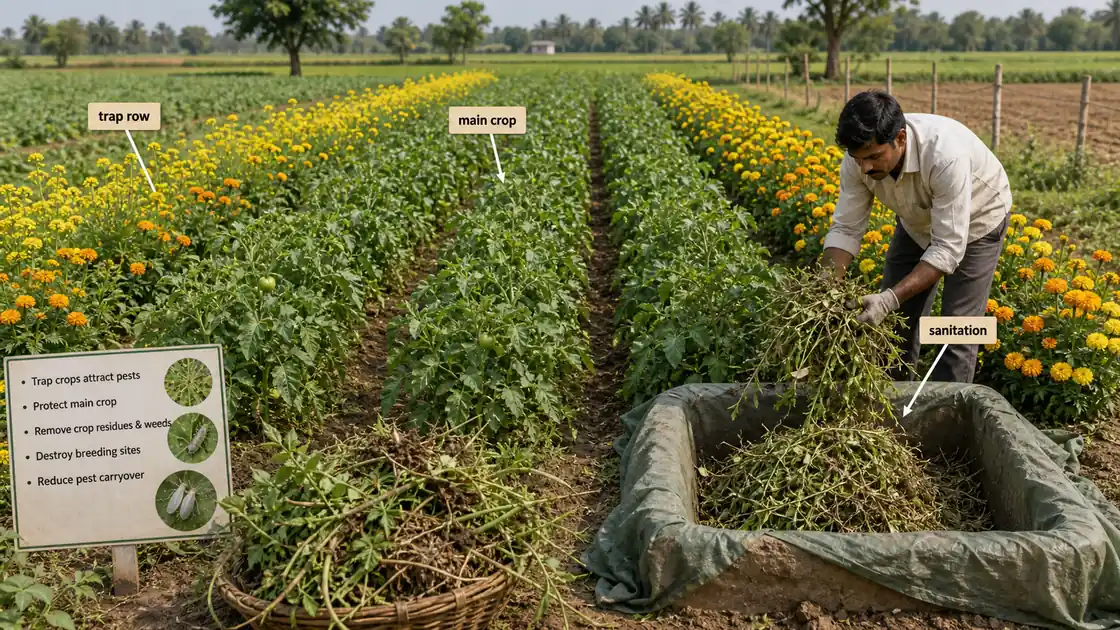
Trap crops are planted near or around a main crop to divert pests. This is a Cultural method (not mechanical or biological).
- In broader IPM language, push-pull strategy is also a form of behavioural crop manipulation: one companion plant pushes the pest away, while a border or trap crop pulls it toward a safer landing zone.
| Trap Crop | Target Pest | Main Crop | How It Works |
|---|---|---|---|
| Marigold | Tomato fruit borer (Helicoverpa) | Tomato | Moths prefer marigold for egg-laying; diverts infestation |
| Marigold | Root-knot nematode | Various vegetables | Nematode management via root exudates |
| Mustard | DBM (Plutella xylostella) | Cabbage/cole crops | Attracts 80-90% of DBM away from main crop |
| Castor | Tobacco cutworm (Spodoptera litura) | Groundnut | Highly preferred oviposition/feeding site that diverts infestation from the main crop |
| Castor | Earias shoot and fruit borer | Okra | Acts as an attractive border trap crop around okra |
| Cowpea | Leaf miner, tobacco caterpillar | Groundnut | Border rows divert pests away from main crop |
| Sudan grass around maize | Stem borer parasitoids | Maize | Banker plant — increases parasitisation of stem borers |
| Desmodium + Napier grass | Fall armyworm / stem borer complex | Maize | Desmodium intercrop pushes pests away; Napier border pulls them to the field edge |
TIP
Marigold = double duty — trap crop for Helicoverpa in tomato AND nematode management via root exudates. One plant, two pest control benefits.
B. Community-Level Practices
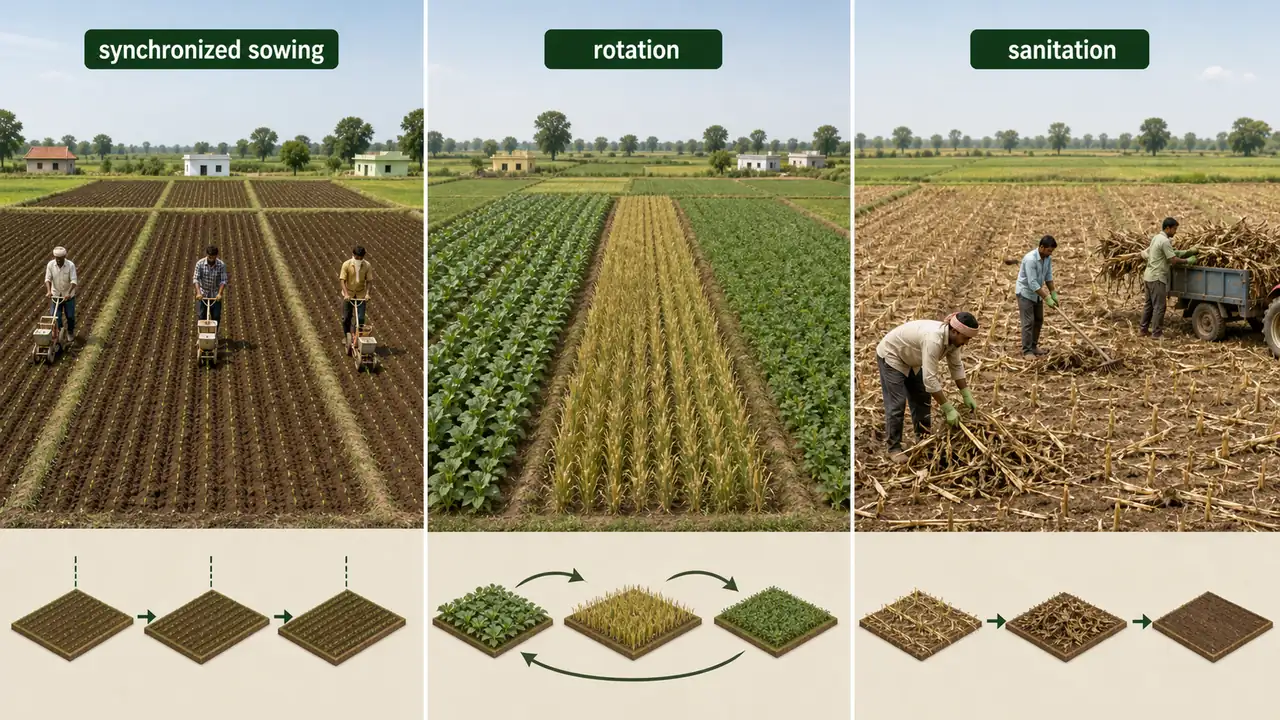
Individual farm practices work best when neighbouring farmers coordinate. Three community-level strategies are important for exams.
| Practice | Mechanism | Example |
|---|---|---|
| Synchronised sowing | Dilutes pest infestation across a large area | All rice farmers in a block sow within the same 10-day window |
| Crop rotation | Breaks the pest's life cycle by removing its host | Rice-pulse rotation breaks stem borer continuity |
| Crop sanitation | Removal of crop residues and debris eliminates overwintering sites | Burning cotton stalks after harvest destroys pink bollworm pupae |
NOTE
Synchronised sowing is especially effective against rice stem borer and cotton bollworm. When all farmers sow together, the pest cannot move from early-sown to late-sown fields, reducing overall infestation.
2. Physical Control Methods
Physical control uses temperature, moisture, light, air, and radiation to kill or repel pests. These methods are especially important for stored-grain pest management.
A. Temperature Manipulation
| Method | Target Pest | Key Detail |
|---|---|---|
| Sun drying | Stored grain pest eggs | Exposure to sunlight kills eggs and early-stage larvae |
| Sun heating of cotton seed | Pink bollworm | Helps kill diapausing larvae carried over in infested seed lots |
| Hot water treatment | Rice white tip nematode | 50-55°C for 15 minutes — memorise this temperature and duration |
| Flame throwers | Locusts | Used during locust swarm control operations |
| Burning torch | Hairy caterpillars | Aggregating caterpillars on tree trunks are burned at night |
| Cold storage | Fruit flies in mango/guava | 1-2°C for 12-20 days kills all stages of fruit fly |
IMPORTANT
Exam favourite: Hot water treatment at 50-55°C for 15 minutes against rice white tip nematode. The exact temperature and duration are tested repeatedly.
B. Moisture Manipulation
Moisture control is critical for both field pests and stored-grain pests.
- Alternate wetting and drying of rice fields controls BPH (Brown Planthopper)
- Drying seeds below 10% moisture disrupts insect development and reproduction
- Flooding fields controls cutworms by drowning soil-dwelling larvae
Safe Storage Moisture Levels — Must Memorise:
| Commodity | Safe Moisture Level | Why This Level |
|---|---|---|
| Cereals (rice, wheat) | 10-12% | Below this, insect eggs fail to hatch |
| Pulses (gram, lentil) | 8-10% | Pulses are more susceptible to bruchid attack |
| Oilseeds and seed spices | 6-8% | Oil content makes them prone to fungal growth at higher moisture |
TIP
Memory trick for safe moisture: Think "COP = 12, 10, 8" — Cereals 10-12%, Oilseeds 6-8%, Pulses 8-10%. Notice the descending pattern: cereals need the least drying, oilseeds need the most.
C. Light Manipulation
- Infra-Red (IR) light treatment kills all stages of insects in stored grain — used in IR seed treatment units
- Providing light in storage godowns reduces the fertility of Indian Meal Moth (Plodia interpunctella)
- Light trapping attracts nocturnal (positively phototactic) insects for monitoring and mass trapping
- In orchard sanitation, raking the soil around tree basins helps expose and destroy overwintering fruit-fly pupae in mango orchards.
D. Air Manipulation
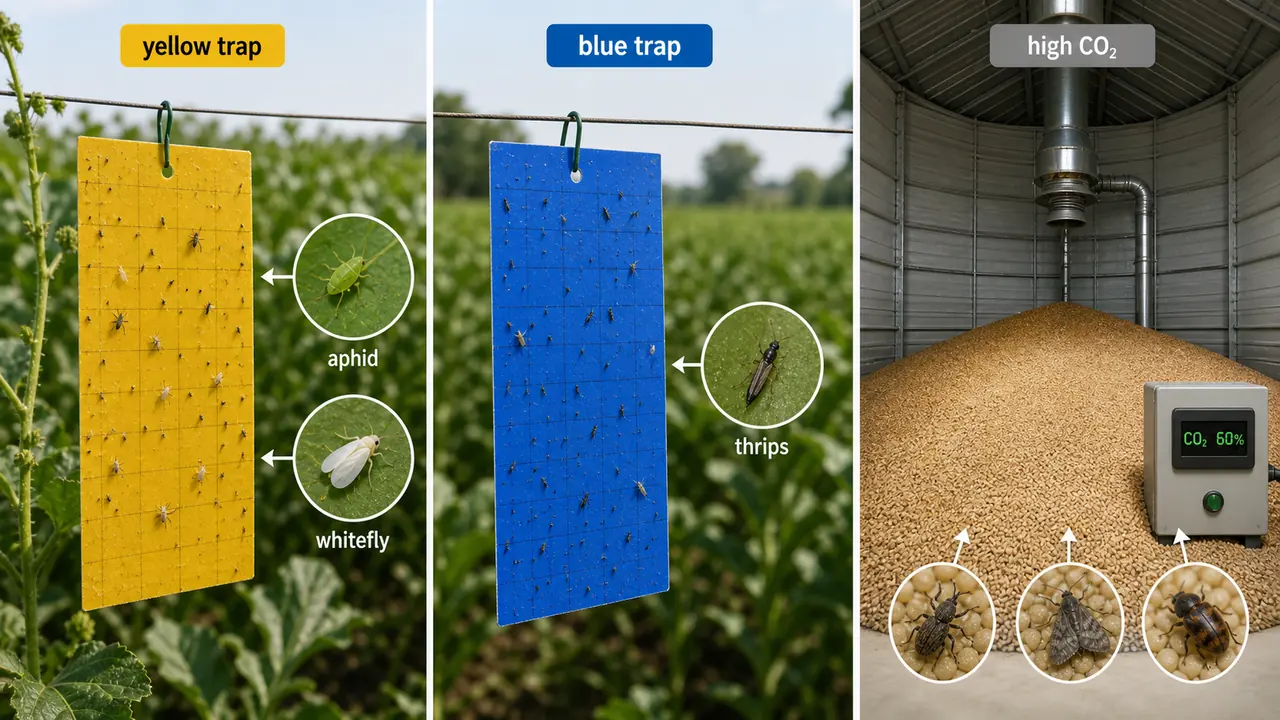
- Increasing CO₂ concentration in controlled-atmosphere storage causes asphyxiation (suffocation) of stored-product pests
- This method is used in modern hermetic storage systems and is chemical-free
E. Colour-Based Trapping (Visible Radiation)
- Yellow colour attracts aphids and cotton whitefly — basis for yellow sticky traps
- Blue colour attracts thrips — basis for blue sticky traps
TIP
"Yellow for Yellowing pests, Blue for tiny Blue-black thrips" — a rough colour association to remember which trap catches which pest.
F. Abrasive Dusts
Abrasive dusts work by damaging the waxy cuticle of insects, causing them to lose moisture and die from desiccation.
| Abrasive Dust | How It Works | Used Against |
|---|---|---|
| Red earth treatment | Applied to red gram; injures insect wax layer | Bruchids on pulses |
| Activated clay | Damages wax layer causing moisture loss and death | Stored product pests |
| Drie-Die | Finely divided porous silica gel absorbs cuticular wax | Storage insects |
G. Greasing Material
- Treating stored grains (especially pulses) with vegetable oils blocks oviposition pores and prevents egg hatching
- Effective against bruchid adults in pulses like green gram and black gram
3. Mechanical Control Methods
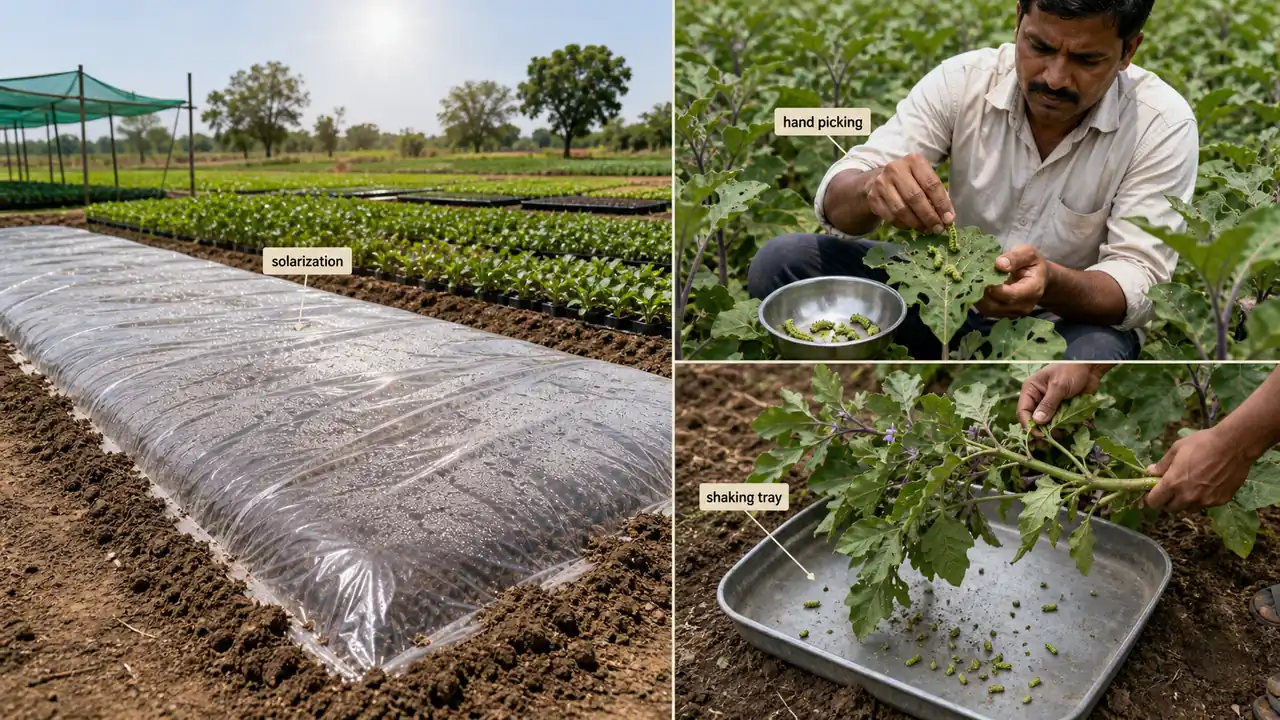
Mechanical methods involve the physical removal, exclusion, or destruction of pests using manual labour or simple devices. They require no chemicals and are safe for the environment.
| Method | How It Works | Target Pest |
|---|---|---|
| Hand picking | Large insects collected by hand and destroyed | Caterpillars, bugs, beetles on vegetables |
| Shaking plants | Rope dragged across rice field dislodges insects | Rice caseworm |
| Banding | Grease or polythene band on tree trunk | Mango mealy bug nymphs (prevents climbing) |
| Beating/Swatting | Physical striking | Housefly, mosquito |
| Wire gauze screen | Metal screen protection around fruits | Fruit borers |
| Netting | 40-mesh insect-proof net over greenhouse | Whiteflies, thrips, aphids |
| Wrapping fruits | Paper or cloth covers on individual fruits | Pomegranate and papaya fruit borer |
| Trench digging | Trenches dug around field edges trap crawling pests | Locust nymphs, red hairy caterpillar larvae |
| Flooding and draining | Water manipulation in the field | Various soil-dwelling pests |
IMPORTANT
Classic exam fact: Banding with grease or polythene on mango tree trunks is the standard mechanical control for mango mealy bug. The nymphs hatch in the soil and crawl up the trunk — the band traps them before they reach the canopy.
Comparison: Cultural vs Physical vs Mechanical Control
| Feature | Cultural Control | Physical Control | Mechanical Control |
|---|---|---|---|
| Principle | Modify farming practices | Use physical agents (heat, cold, light) | Physically remove or exclude pests |
| Cost | Very low (part of normal farming) | Low to moderate | Low (labour-intensive) |
| Scale | Field or community level | Storage or field level | Individual plant or field level |
| Timing | Preventive (before pest appears) | Preventive or curative | Curative (after pest appears) |
| Chemical use | None | None | None |
| Example | Crop rotation against stem borer | Hot water treatment of rice seed | Grease banding on mango trunk |
| Limitation | Slow-acting; needs community cooperation | Equipment may be needed | Labour-intensive; impractical at large scale |
Which Cultural Practice for Which Pest Type?
Match the pest's biology to the right cultural tool:
| Pest Type | Why Cultural Control Works | Best Cultural Practice | Example |
|---|---|---|---|
| Soil-dwelling pests (white grub, termites) | Exposed to sun/predators by tillage | Deep summer ploughing + flooding | White grub in groundnut |
| Stem borers (hibernate in stubble) | Breaking life cycle between seasons | Stubble destruction after harvest | Rice stem borer in Punjab |
| Monocrop pests (build up on same host) | Host not available next season | Crop rotation (cereal → pulse → oilseed) | Gram pod borer |
| Sap-sucking pests (aphids, jassids) | Microclimate modification | Spacing adjustment + detrashing | BPH in rice (wider spacing) |
| Egg-laying on leaves | Remove eggs before transplanting | Clip seedling tips before transplanting | Rice stem borer eggs |
| Storage pests | Prevent infestation before it starts | Sun-drying to safe moisture (cereals 10-12%) | Rice weevil |
| Polyphagous pests | Divert away from main crop | Trap cropping (castor for Spodoptera, marigold for Helicoverpa) | Tobacco cutworm in groundnut |
Remember: Cultural control = prevention. You do it before the pest appears. It's the cheapest and most sustainable method but requires planning.
Exam Tips
- Cultural control is always the cheapest and first option in any IPM programme. If an exam asks "most economical method," the answer is cultural control.
- Safe moisture levels (Cereals 10-12%, Pulses 8-10%, Oilseeds 6-8%) are tested in almost every exams paper.
- Hot water treatment temperature (50-55°C) and duration (15 min) are exact values — do not approximate.
- Trap cropping is cultural control, not mechanical control. The trap crop is planted to lure pests away — it is an agronomic manipulation.
- Banding is mechanical, not physical control. It physically blocks the pest's path.
Summary Table
| Control Type | Best Used For | Key Methods to Remember |
|---|---|---|
| Cultural (Farm) | Preventing pest buildup | Crop rotation, trap cropping, intercropping, water management, timely sowing |
| Cultural (Community) | Area-wide pest suppression | Synchronised sowing, crop sanitation |
| Physical — Temperature | Stored grain pests, nematodes | Sun drying, hot water treatment (50-55°C/15 min), cold storage |
| Physical — Moisture | Stored grain pests, BPH | Safe moisture levels (C-12%, P-10%, O-8%), alternate wetting/drying |
| Physical — Light/Air | Storage and monitoring | IR treatment, CO₂ atmosphere, light traps |
| Physical — Dusts/Oils | Stored grain bruchids | Red earth, activated clay, vegetable oil coating |
| Mechanical | Visible, accessible pests | Hand picking, banding (mango mealy bug), netting, trench digging |
Summary Cheat Sheet
| Concept / Topic | Key Details |
|---|---|
| Cultural control | Oldest and most economical pest management method; manipulation of agronomic practices |
| Trap cropping | Cultural (not mechanical) control — mustard as trap crop for DBM on cabbage |
| Synchronised sowing | Community-level; dilutes infestation — effective against rice stem borer, cotton bollworm |
| Hot water treatment | 50-55°C for 15 minutes — against rice white tip nematode |
| Cold storage | 1-2°C for 12-20 days — kills fruit fly stages in mango/guava |
| Safe moisture — Cereals | 10-12% moisture for safe storage |
| Safe moisture — Pulses | 8-10% moisture for safe storage |
| Safe moisture — Oilseeds | 6-8% moisture for safe storage |
| Yellow sticky trap | Attracts aphids and whitefly |
| Blue sticky trap | Attracts thrips |
| Banding | Mechanical (not physical) control — grease/polythene on mango trunk for mealy bug nymphs |
| BPH control | Plant density + water management + rogue spacing (mnemonic: PWR) |
| Abrasive dusts | Red earth, activated clay, Drie-Die — damage insect wax cuticle causing desiccation |
TIP
Next: Lesson 04 covers Biological Control — parasitoids, predators, and microbial agents that nature provides as pest-killing allies.