🐞 Biological Control — Parasitoids, Predators, and Microbial Agents
Natural enemies used in Indian agriculture — parasitoid-crop-pest associations, key predators, microbial biocontrol agents (Bt, NPV, Beauveria), insect traps, and cocoon types with exam mnemonics
Nature's Own Pest Control
The previous lesson covered cultural, physical, and mechanical control — methods that modify the environment or physically remove pests. This lesson introduces the fourth IPM component: biological control, which harnesses living organisms to suppress pest populations.
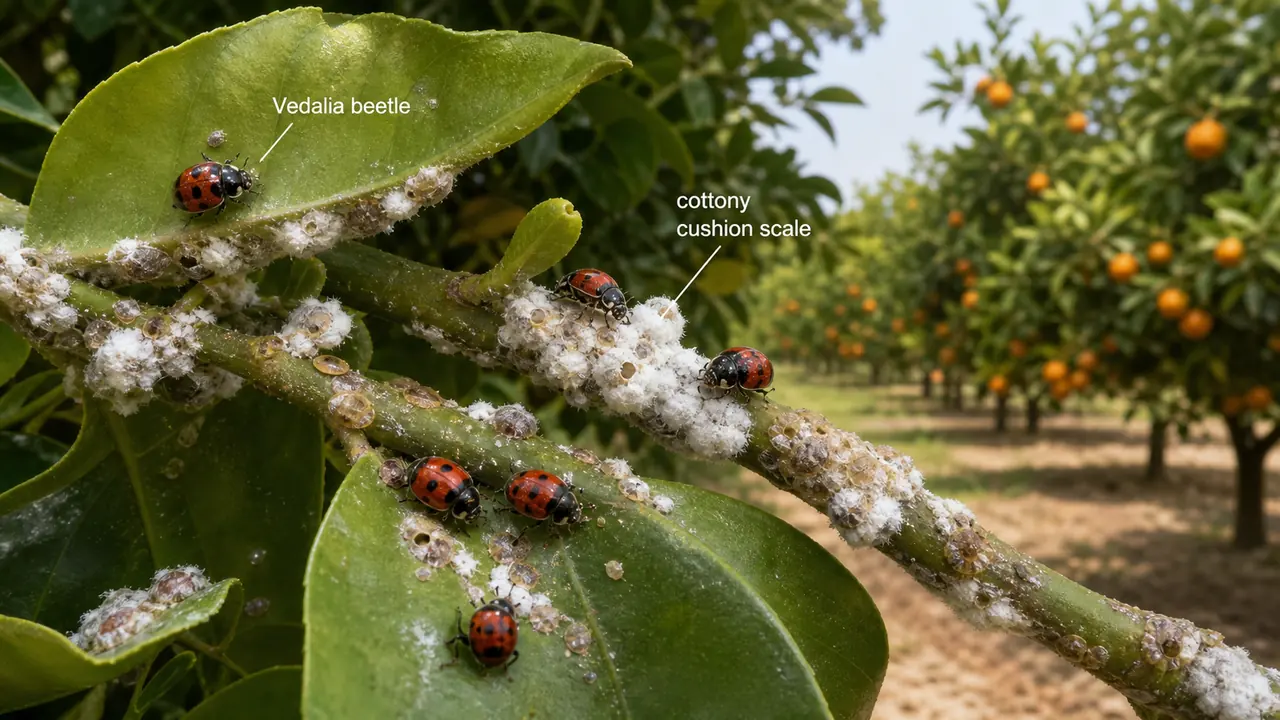
In 1888, California's citrus industry was being destroyed by the cottony cushion scale — an invasive pest from Australia. Instead of chemicals, scientists introduced the Vedalia beetle (Rodolia cardinalis), a natural predator from Australia. Within two years, the scale was under complete control. This landmark success proved that nature's own enemies can be more effective than any chemical — and it launched the modern science of biological control.
Indian agriculture uses biological control extensively today. Trichogramma parasitoid wasps are released on millions of hectares of sugarcane and rice. Chrysoperla lacewings protect cotton from aphids. Understanding these natural enemies — who eats whom, who parasitises whom — is essential for both farming practice and competitive exams.
Pro Content Locked
Upgrade to Pro to access this lesson and all other premium content.
Charged once for one year · ₹1188 total
Save ₹100/month vs ₹2388/year launch price
- All Agriculture & Banking Courses
- AI Lesson Questions (100/day)
- AI Doubt Solver (50/day)
- Glows & Grows Feedback (30/day)
- AI Section Quiz (20/day)
- 22-Language Translation (100/day)
- Recall Questions (20/day)
- AI Quiz (15/day)
- AI Quiz Paper Analysis (100/day)
- AI Step-by-Step Explanations (100/day)
- Spaced Repetition Recall (FSRS)
- AI Tutor
- Immersive Text Questions
- Audio Lessons — Hindi & English
- Mock Tests & Previous Year Papers
- Summary & Mind Maps
- XP, Levels, Leaderboard & Badges
- Generate New Classrooms
- Voice AI Teacher (AgriDots Live)
- AI Revision Assistant
- Knowledge Gap Analysis
- Interactive Revision (LangGraph)
🔒 Secure one-time yearly payment via Razorpay · No hidden fees
Nature's Own Pest Control
The previous lesson covered cultural, physical, and mechanical control — methods that modify the environment or physically remove pests. This lesson introduces the fourth IPM component: biological control, which harnesses living organisms to suppress pest populations.
In 1888, California's citrus industry was being destroyed by the cottony cushion scale — an invasive pest from Australia. Instead of chemicals, scientists introduced the Vedalia beetle (Rodolia cardinalis), a natural predator from Australia. Within two years, the scale was under complete control. This landmark success proved that nature's own enemies can be more effective than any chemical — and it launched the modern science of biological control.
Indian agriculture uses biological control extensively today. Trichogramma parasitoid wasps are released on millions of hectares of sugarcane and rice. Chrysoperla lacewings protect cotton from aphids. Understanding these natural enemies — who eats whom, who parasitises whom — is essential for both farming practice and competitive exams.
This lesson covers:
- Parasitoids — crop-pest-parasitoid associations (the most-tested table)
- Predators — ladybird beetles, lacewings, Cryptolaemus
- Microbial agents — Bt, NPV, Beauveria, Metarhizium
- Insect collecting traps and cocoon types
What Is Biological Control?
Biological control is the use of natural enemies — parasitoids, predators, and pathogens — to suppress pest populations below the Economic Injury Level (EIL).
- A classical exam-style definition also describes biological control as the action of parasites, predators, and pathogens in keeping another organism's population at a lower average than would occur in their absence.
- Older history notes link the term biological control with H.S. Smith, and associate global recognition of the field with Hans R. Herren, who received the World Food Prize in 1995.
- In the more specific pathogen-based branch, the term microbial control is classically linked with Steinhaus (1949), while Felix d'Herelle is frequently remembered as a foundational figure in microbial control history.
- In institutional recall, international biological-control coordination is commonly anchored to the IOBC at Zurich, Switzerland, while older literature often cites the IIBC in the UK; modern applied entomology references frequently connect this lineage with CABI at Wallingford, UK.
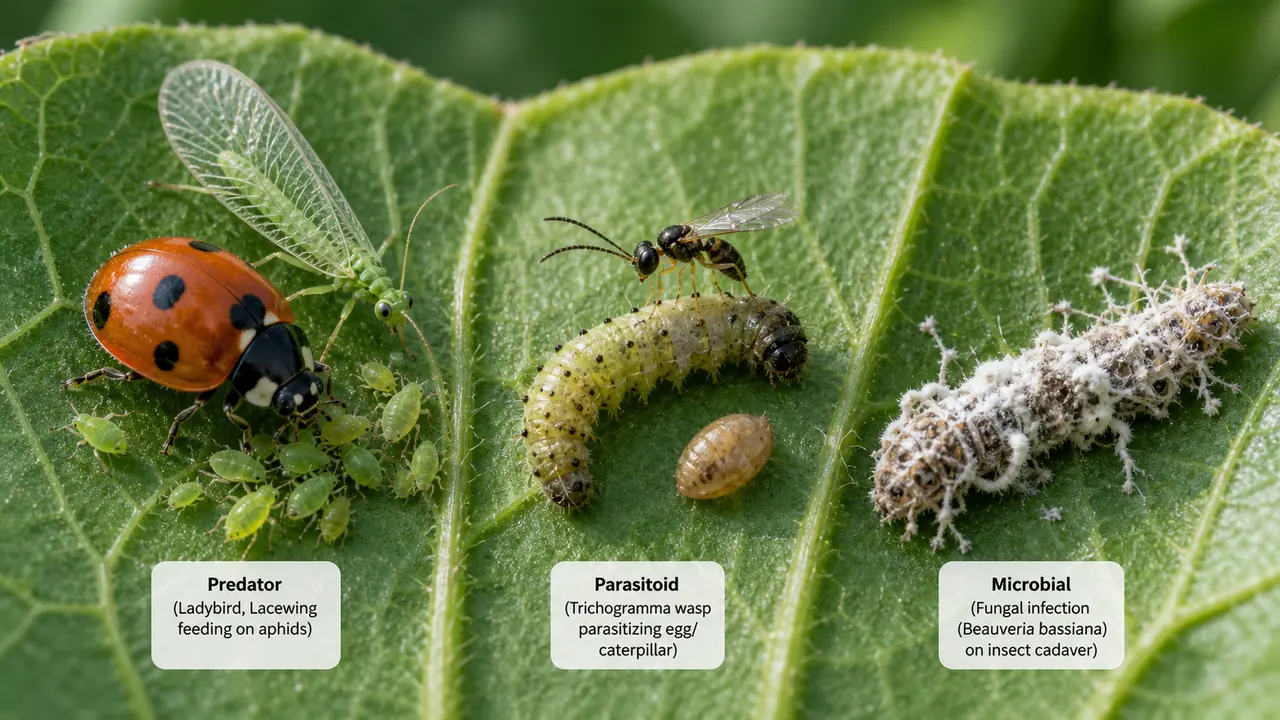
Three categories of natural enemies are used:
- Parasitoids — insects whose larvae develop inside or on a single host, killing it
- Predators — organisms that kill and consume multiple prey during their lifetime
- Microbial agents — bacteria, viruses, and fungi that cause disease in insects
Operational Approaches in Biological Control
In applied crop protection, biological control is commonly organised into four working approaches:
- Introduction — bringing a useful natural enemy into a new region against an introduced pest
- Colonization / establishment — helping the released natural enemy settle and persist
- Augmentation — increasing the number or effect of natural enemies already associated with the crop ecosystem
- Conservation — protecting natural enemies by avoiding disruptive practices such as indiscriminate insecticide use
IMPORTANT
The parasitoid tables below are among the most frequently asked topics in IBPS AFO, NABARD Grade A, and FCI exams. Focus on memorising the crop-pest-parasitoid associations.
1. Parasitoids
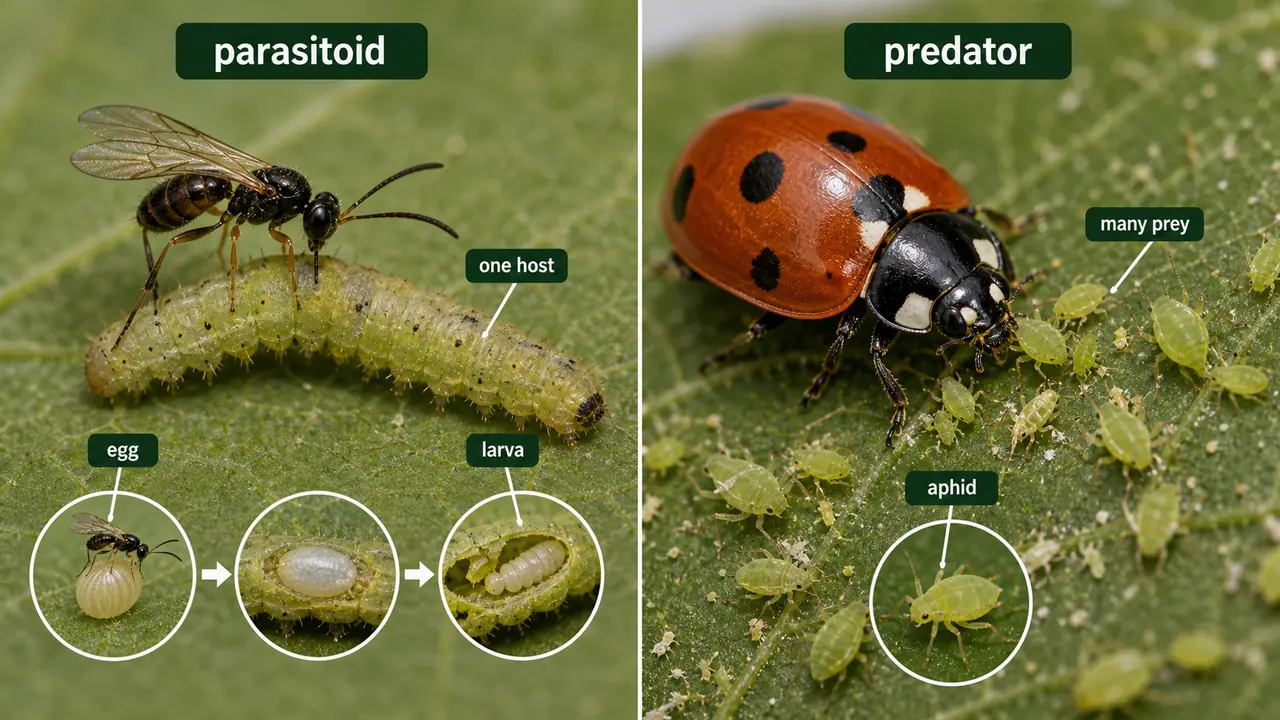
A parasitoid is an insect whose immature stage develops on or within a single host insect, eventually killing it. The adult parasitoid is free-living and does not feed on the host.
Key difference from parasites: A parasite weakens but does not kill its host. A parasitoid always kills its host.
- In compact exam language, a parasitoid is parasitic in the immature stage but free-living as an adult, and usually requires only one host to complete its development.
Important Parasitoids in Indian Agriculture
| Crop | Pest | Parasitoid | Exam Note |
|---|---|---|---|
| Cotton | Helicoverpa armigera, Pectinophora gossypiella | Bracon hebetor | Larval parasitoid |
| Sugarcane | Top shoot borer | Isotima javensis | |
| Maize | Stem borer (Chilo partellus) | Apanteles flavis | |
| Rice | Gall midge (Orselia oryzae) | Platygaster oryzae | |
| Citrus | Mealy bug | Leptomastix dactylopii | asked in exams-2019 |
| Tobacco | Spodoptera litura | Telenomus remus | Egg parasitoid |
| Sugarcane | Stem borer and top borer | Trichogramma chilonis | Most widely used egg parasitoid |
| Rice | Stem borer | Trichogramma japonicum | Specific to rice |
| Sugarcane | Pyrilla perpusella | Epiricania melanoleuca | Larval parasitoid |
| Apple | Woolly aphid | Aphelinus mali | Classical biocontrol success |
| Sugarcane | Shoot borer | Sturmiopsis inferens | |
| Apple | San Jose scale | Encarsia perniciosi (= Prospaltella perniciosi) | Older synonym pair often asked |
| Sugarcane & Coconut | Shoot borer & Black Headed Caterpillar (BHC) | Tetrastichus israelii | |
| Coconut | Black headed caterpillar | Trichospilus pupivora | Pupal parasitoid |
| Cotton | Spotted bollworm (Earias sp.) | Chilonus blackburnii | |
| Cotton & Sugarcane | Pink bollworm & top shoot borer | Bracon kirkpotricki | |
| Sugarcane & Coconut | Top shoot borer & BHC | Bracon bravicornis | |
| Potato | Tuber moth | Copidosoma kochleri | |
| Gram, Cotton | Pod borer (Helicoverpa armigera) | Campoletis chloridae | |
| Cotton | Bollworms (H. armigera, Earias, P. gossypiella) | Trichogramma japonicum | |
| Greenhouse crops | Whitefly | Encarsia formosa | Key greenhouse biocontrol agent |
| Guava, papaya, mango | Spiralling whitefly (Aleurodicus dispersus) | Encarsia guadeloupae | Common classical parasitoid link |
Parasitoid Classification by Stage Attacked
| Parasitoid | Family | Target Pest | Stage Attacked |
|---|---|---|---|
| Trichogramma sp. | Trichogrammatidae | Lepidopteran pests (bollworms, stem borers) | Egg parasitoid |
| Apanteles glomeratus | Braconidae | Cabbage butterfly | Larval parasitoid |
| Cotesia plutellae | Braconidae | DBM (Plutella xylostella) | Larval parasitoid |
| Gryon sp. | Scelionidae | Painted bug | Egg parasitoid |
| Alophora sp. | Tachinidae | Painted bug | Adult parasitoid |
| Xanthopimpla punctata | Ichneumonidae | Lepidopteran pupae | Pupal parasitoid |
| Trichospilus sp. / Brachymeria sp. | Eulophidae / Chalcididae | Coconut black-headed caterpillar | Pupal parasitoids |
IMPORTANT
Trichogramma is the egg parasitoid of Lepidopterans. It is mass-reared on Corcyra cephalonica (Rice moth) as a factitious host — a host that is not the natural host but is used for commercial production. Corcyra eggs are easy to produce in large quantities in the laboratory.
TIP
"Tricho-Egg-Lepi" — Trichogramma parasitises the Egg stage of Lepidopterans. If an exam asks about egg parasitoids of Lepidoptera, the answer is always Trichogramma.
TIP
Trichogramma memory aid: Trichogramma is the most widely used egg parasitoid in India.
- T. chilonis → Chilonis for sugarcane (Cane)
- T. japonicum → Japonicum for rice (paddy, Japonica rice)
- In field-release language, a trichocard is a small card carrying parasitized host eggs for field deployment. Older exam-style notes commonly recall about 100 trichocards/ha or roughly 75,000 wasps/ha for rice stem-borer use, with one trichocard carrying approximately 16,000-20,000 Trichogramma eggs.
- An older released-strain note sometimes mentioned in exam material is Endogram, a pesticide-tolerant strain of Trichogramma chilonis associated with PDBC, Bengaluru.
- Older historical recall also notes that a Telenomus species was introduced from New Guinea in 1964 against Achaea janata.
2. Predators
Predators kill and consume multiple prey during their lifetime. Unlike parasitoids, they are usually larger than their prey and do not develop inside the host.
Important Predators in Indian Agriculture
| Predator | Common Name | Prey / Target Pest | Agricultural Use |
|---|---|---|---|
| Coccinellids | Ladybird beetles | Aphids, scale insects, mealy bugs | Natural populations conserved; some species mass-reared |
| Chrysoperla carnea | Green lacewing | Aphids, whiteflies, bollworm eggs | Mass-released in cotton and vegetable fields |
| Cryptolaemus montrouzieri | Australian ladybird beetle | Mealy bugs | Mass-released in citrus, grape, and mango orchards |
| Hover flies (Syrphidae) | Syrphid flies | Aphids | Larvae are important aphid predators in field crops and vegetables |
| Cyrtorhinus lividipennis | Predatory mirid bug | Brown planthopper | Important predator of BPH eggs and nymphs in rice |
| Dipha aphidivora | Predatory moth larva | Sugarcane woolly aphid | Important Indian predator of woolly aphid outbreaks |
| Predatory mites | Phytoseiulus persimilis, Amblyseius chilenensis and allied spp. | Phytophagous mites / spider mites | Useful in suppressing plant-feeding mite populations in several crops |
| Platymerys laevicollis | Predatory reduviid bug | Coconut rhinoceros beetle | Older crop-pest-predator recall link |
| Spiders | Various species | Small insects in rice and cotton | Natural biocontrol; conserved by reducing broad-spectrum sprays |
| Dragonflies | — | Mosquitoes, small flying insects | Natural predators in wetland agroecosystems |
| Praying mantis | — | Various insects | Generalist predator in gardens and orchards |
| Eublemma amabilis | White moth (Noctuidae) | Lac insect (Kerria lacca) | Predator of lac insects; most destructive lac pest |
| Holococera pulverea | Black/grey moth (Blastobasidae) | Lac insect (Kerria lacca) | Predator of lac insects; second major lac enemy |
NOTE
Exam favourite: Cryptolaemus montrouzieri (Australian ladybird beetle) is the key predator of mealy bugs. It is mass-reared and released in citrus, grape, and mango orchards across India.
- Historical recall points often add that the vedalia beetle was introduced into India in 1929 for cottony cushion scale, and that Cryptolaemus montrouzieri was introduced from Australia into India against the coffee green scale.
- Older biological-control recall notes also mention Cryptochaetum iceryae among the natural enemies associated with cottony cushion scale.
- In green lacewings, remember the stage distinction clearly: the larva is the active predator, while the adult commonly feeds on pollen and nectar.
- Epiricania melanoleuca is classically treated as an ectoparasitoid, because it develops externally on the body of its host.
- For invasive-mite management recall, older notes often pair coconut eriophyid mite with Amblyseius / Neoseiulus predatory mites and the fungus Hirsutella thompsonii.
Augmentative Release Types
- Augmentation includes all practices that strengthen the action of natural enemies already relevant to the field system.
- Two classic subtypes are:
- Inoculative release — a relatively small release intended to establish the agent, with later control expected from its progeny and subsequent generations
- Inundative release — a large release meant to produce immediate suppression, without depending mainly on long-term field multiplication
Types of Parasitism
- Simple parasitism — only one parasitoid attacks a single host
- Multiparasitism — the same host is parasitized by two or more parasitoid species
- Superparasitism — repeated parasitism of the same host by members of the same parasitoid species
- Hyperparasitism — one parasitoid develops at the expense of another parasitoid
- Cleptoparasitism — a parasitoid attacks or exploits a host that has already been parasitized by another parasitoid
- In predator-rich food webs, cases where one predator disrupts another predator's ability to capture prey are described as antagonistic interactions.
Parasitoids vs Predators — A Comparison
| Feature | Parasitoid | Predator |
|---|---|---|
| Size relative to host/prey | Smaller than or equal to host | Larger than prey |
| Number of hosts/prey consumed | One (immature stage kills one host) | Many prey consumed in a lifetime |
| Development | Immature develops on/in host | No development on prey |
| Adult feeding | Free-living; feeds on nectar/pollen | Feeds on prey throughout life |
| Specificity | Usually host-specific | Often generalist |
| Example | Trichogramma on sugarcane borer eggs | Ladybird beetle eating aphids |
3. Microbial Biocontrol Agents
Microbial agents are bacteria, viruses, and fungi that cause disease in pest insects. They offer the advantage of being highly specific — they kill the target pest without harming beneficial insects or humans.
| Bioagent | Type | Target Pest | Key Fact |
|---|---|---|---|
| Bacillus thuringiensis (Bt) | Bacterium | Lepidopteran larvae (caterpillars) | Produces Cry toxin; basis for Bt crops (Bt cotton, Bt brinjal) |
| NPV (Nuclear Polyhedrosis Virus) | Virus | Helicoverpa armigera, Spodoptera litura | Highly specific; each NPV strain attacks only one pest species |
| Beauveria bassiana | Fungus | Various insects (coffee berry borer, whitefly) | White muscardine disease; works best in humid conditions |
| Metarhizium anisopliae | Fungus | White grubs, termites | Green muscardine disease; applied as soil treatment |
| Trichoderma | Fungus | Soil-borne plant pathogens (NOT insects) | Biocontrol of Fusarium, Rhizoctonia; often confused with insect biocontrol |
| Paenibacillus popilliae | Bacterium | White grubs (especially Japanese-beetle group) | Causes milky disease; older white-grub biocontrol recall |
TIP
Do not confuse Trichoderma with insect biocontrol. Trichoderma controls soil-borne plant diseases (fungi), not insects. If an exam lists it alongside Bt and NPV, it is testing whether you know the difference.
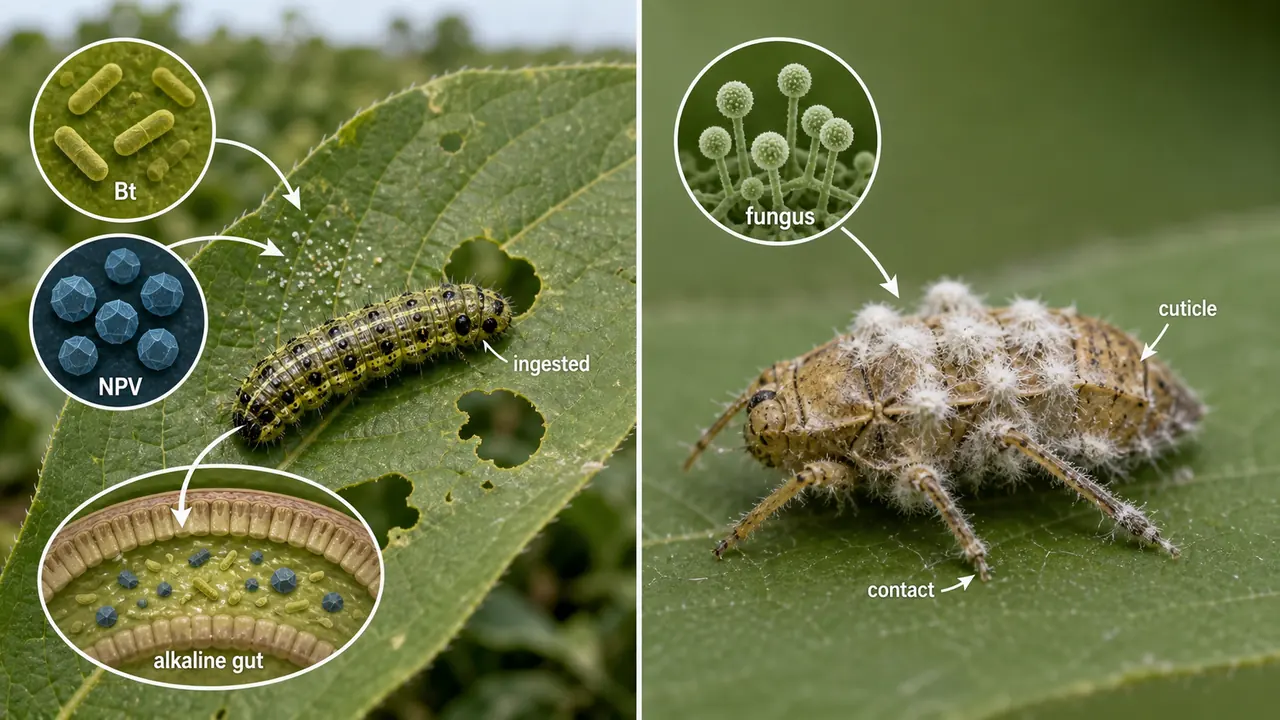
- Bacillus thuringiensis (Bt) is classically described as a Gram-positive, spore-forming, crystalliferous bacterium. Its delta-endotoxin becomes active after ingestion in the alkaline gut of susceptible caterpillars.
- After ingestion, Bt protoxin is solubilised and activated in the alkaline midgut, binds to gut cells, creates pores, and causes ionic imbalance; affected larvae stop feeding, may regurgitate, pass watery excreta, and become flaccid.
- Common exam-style Bt variants include:
- Bt var. kurstaki — mainly against Lepidopteran larvae
- Bt var. israelensis — especially against mosquito larvae
- Bt var. san diego and Bt var. tenebrionis — linked with beetles and weevils
- Frequently cited Bt commercial formulations include Dipel, Delfin, Halt, Biobit, Javelin, and Vectobac.
Insect-Resistant Transgenic Logic
- The microbial-control lesson also connects directly with insect-resistant transgenic crops:
- the best-known example is insertion of the delta-endotoxin (Cry) gene from Bacillus thuringiensis
- in addition to Bt toxins, some insect-resistant transgenic strategies use lectins or cysteine-protease inhibitors that interfere with insect feeding or digestion
- A useful target association is that cysteine-protease-inhibitor strategies are especially linked with coleopteran pests.
Stomach vs Contact Mode of Action in Bioagents
| Agent | Mode of Action |
|---|---|
| Bt (Bacillus thuringiensis) and NPV | Stomach poison — must be ingested; Bt toxin dissolves in the alkaline gut of Lepidoptera and becomes toxic |
| Entomopathogenic Fungi (Beauveria, Metarhizium) and Nematodes | Contact action — infect through the cuticle; do not need to be ingested |
NPV and Silkworm Disease
- NPV causes Grasserie disease (jaundice) of silkworm (Bombyx mori)
- Infected larvae become swollen, yellowish, and their body contents liquefy
- Larvae hang inverted from branches/rearing trays in the characteristic symptom called Caterpillar wilt
Baculoviruses and Field-Use Recall
- The best-known insect viruses used in biocontrol belong to family Baculoviridae; they are classically described as double-stranded DNA viruses, obligate intracellular pathogens, with the nucleocapsid as a constant structural element.
- Two major practical baculovirus groups are:
- NPV — Nuclear Polyhedrosis Virus
- GV — Granulosis Virus
- NPV is used mainly against the larval stage of susceptible insects and is highly host-specific.
- Older field recommendations commonly recall about 250-500 LE/ha (larval equivalents per hectare) for Helicoverpa armigera and other lepidopteran NPV uses.
- NPV-infected larvae often develop a shiny, oily appearance, stop feeding, climb upward into the canopy, and die in the classic symptom known as tree-top disease; the body then becomes fragile and ruptures easily.
- Common virus-product recall names include Ha-NPV, Sl-NPV, SPOD-X, Elcar, and Gypchek.
- Exam-style crop links often include:
- Ha-NPV — for Helicoverpa armigera
- Sl-NPV — for Spodoptera litura
- GV of Chilo infuscatellus — linked with sugarcane shoot borer management
Entomopathogenic Fungi
- Entomopathogenic fungi infect insects mainly by directly penetrating the integument, then multiplying inside the host and covering the cadaver with mycelium and spores.
- Frequently cited fungal examples include:
- Beauveria bassiana — against rice hispa, Spodoptera litura, whiteflies, aphids, thrips, and several tissue borers
- Verticillium lecanii — against aphids, scale insects, and other soft-bodied insects
- Hirsutella thompsonii — especially linked with mite control
- Metarhizium anisopliae — against white grub beetles (Holotrichia spp.), rhinoceros beetle, and other soil-associated beetles
- Older formulation recall names sometimes listed with entomopathogenic fungi include Bio-1020, Green Muscle, Vertalec, and Mycotal.
Protozoa
- Protozoan pathogens usually act more slowly and chronically than bacterial or viral bioagents, often weakening the host or reducing adult fecundity rather than causing immediate collapse.
- Exam-style examples include:
- Nosema melolonthae — against chaffer / scarab beetles
- Nosema locustae — against grasshoppers
Entomopathogenic Nematodes (EPNs)
- The two main EPN genera are Steinernema and Heterorhabditis.
- Their infective juveniles carry symbiotic bacteria such as Xenorhabdus or Photorhabdus, which rapidly kill the invaded host, often within 1-2 days.
- EPNs are useful but are also susceptible to desiccation, so field moisture matters greatly for performance.
- Common exam-style examples include:
- Steinernema carpocapsae — linked with tissue borers
- Heterorhabditis bacteriophora — linked with soil-inhabiting insects
- Steinernema glaseri — classical recall for Japanese beetle biocontrol
- Older commercial recall names include DD-136, Green Commandos, and Soil Commandos.
Endophytes
- Some beneficial microbes, mainly fungi and sometimes bacteria, live largely or entirely inside plant tissues as endophytes, occupying intercellular or intracellular spaces and potentially contributing to plant protection.
Insect Collecting Traps and Equipment
Field monitoring requires the right trap for the right insect. This table links specific pests to their recommended collection method.
| Target Insect | Trap / Equipment | Principle |
|---|---|---|
| BPH (Brown Planthopper) | Water trap | BPH drops into water when disturbed |
| Grasshopper | Hand net (sweep net) | Sweep through vegetation to catch hopping insects |
| Whiteflies | Sticky trap, suction trap | Yellow colour attracts whiteflies; suction pulls them in |
| Nocturnal moths | Light trap | Positive phototaxis attracts moths at night |
| Specific moth species | Pheromone trap (sex lure) | Synthetic pheromone attracts males of target species |
| House fly | Food lure (molasses) | Attracted to fermenting sugar |
Types of Cocoons
Different insect orders and species construct different cocoon types during pupation. This classification is a niche but regularly tested topic.
| Cocoon Type | Material Used | Example Insect | Exam Detail |
|---|---|---|---|
| Silken cocoon | Silk | Silkworm (Bombyx mori) | Commercially harvested for silk |
| Earthen cocoon | Soil + saliva | Gram pod borer (Helicoverpa) | Pupates in soil |
| Hairy cocoon | Body hairs | Woolly bears (Arctiidae) | Hairs from larval body |
| Frassy cocoon | Frass (excrement) + saliva | Coconut black headed caterpillar | Unique material |
| Fibrous cocoon | Plant fibres | Red palm weevil | Found inside palm trunk |
| Puparium | Hardened last larval skin | House fly, fruit fly | NOT a true cocoon |
IMPORTANT
Puparium is NOT a true cocoon. It is the hardened last larval skin that serves as a protective case for the pupa. It is characteristic of Diptera (flies). This distinction is a frequent exam question.
When to Use Which Biocontrol Agent?
Quick decision guide for field officers:
| Pest to Control | Best Biocontrol Agent | Type | When to Release/Apply | Dose |
|---|---|---|---|---|
| Bollworm/stem borer eggs | Trichogramma spp. | Egg parasitoid | At egg-laying peak (use pheromone trap to monitor) | 50,000-1,00,000/ha |
| Caterpillars (Lepidoptera) | Bacillus thuringiensis (Bt) | Bacterium | Early larval instars (L1-L2); evening spray | 1-2 kg/ha |
| Helicoverpa larvae | HaNPV | Virus | Early instars; evening application (UV-sensitive) | 250-500 LE/ha |
| Mealybug | Cryptolaemus montrouzieri | Predator beetle | When colonies visible | 10 beetles/tree |
| Aphids | Chrysoperla carnea (lacewing) | Predator | When aphid colonies appear | 50,000 eggs/ha |
| Pyrilla (sugarcane) | Epiricania melanoleuca | Parasitoid | Release cocoons on infested leaves | 4000-5000 cocoons/ha |
| White grubs in soil | Metarhizium anisopliae | Fungus | Soil application before planting | 5 kg/ha mixed with FYM |
| Fruit fly | Sterile Insect Technique (SIT) | Physical | Continuous area-wide release | Govt. programme |
Critical timing rule: Biocontrol agents must be released before pest population explodes. Once pest is at epidemic level, biocontrol alone cannot save the crop — you'll need to integrate with other methods.
Exam Tips and Mnemonics
- Vedalia beetle story — the first major biological control success (1888, California, cottony cushion scale). Know the pest, predator, and country.
- Trichogramma = egg parasitoid. If the question says "egg parasitoid," think Trichogramma first.
- Cryptolaemus = mealy bug predator. The name sounds like "crypto-lame-us" — mealy bugs are cryptic (hidden) and lame (slow-moving).
- NPV is virus, Bt is bacterium, Beauveria is fungus — know the type of each microbial agent.
- Puparium belongs to Diptera. All other cocoon types belong to Lepidoptera or Coleoptera.
Summary Table
| Category | Key Agents | Target Pests | Exam Priority |
|---|---|---|---|
| Egg parasitoids | Trichogramma chilonis, T. japonicum, Telenomus remus | Sugarcane/rice borers, Spodoptera | Very high |
| Larval parasitoids | Bracon hebetor, Apanteles flavis, Epiricania melanoleuca | Cotton bollworm, maize borer, pyrilla | High |
| Predators | Ladybird beetles, Chrysoperla, Cryptolaemus | Aphids, whiteflies, mealy bugs | High |
| Bacterial | Bacillus thuringiensis (Bt) | Lepidopteran larvae | Very high |
| Viral | NPV (Nuclear Polyhedrosis Virus) | Helicoverpa, Spodoptera | High |
| Fungal | Beauveria bassiana, Metarhizium anisopliae | Various insects, white grubs | Moderate |
Summary Cheat Sheet
| Concept / Topic | Key Details |
|---|---|
| Vedalia beetle | Rodolia cardinalis; 1888 California; controlled cottony cushion scale — first major biocontrol success |
| Parasitoid vs Parasite | Parasitoid always kills host; parasite weakens but does not kill |
| Trichogramma chilonis | Most widely used egg parasitoid in India — sugarcane borers |
| Trichogramma japonicum | Egg parasitoid specific to rice stem borer |
| Cryptolaemus montrouzieri | Australian ladybird beetle — key predator of mealy bugs in citrus, grape, mango |
| Chrysoperla carnea | Green lacewing — predator of aphids, whiteflies, bollworm eggs in cotton |
| Bt (Bacillus thuringiensis) | Bacterium; Cry toxin; targets Lepidopteran larvae; basis for Bt crops |
| NPV | Nuclear Polyhedrosis Virus; highly specific — each strain attacks one pest species |
| Beauveria bassiana | Fungus; white muscardine disease; works best in humid conditions |
| Metarhizium anisopliae | Fungus; green muscardine disease; soil treatment for white grubs, termites |
| Trichoderma | Controls soil-borne plant diseases (fungi), NOT insects — common exam confusion |
| Puparium | NOT a true cocoon; hardened last larval skin; characteristic of Diptera (flies) |
TIP
Next: Lesson 05 covers Chemical Control — insecticide generations, formulations, toxicology, and the WHO hazard classification that appears on every pesticide label.