🧪 Chemical Control — Insecticides, Formulations, and Toxicology
Four generations of insecticides, formulation types (EC, WP, GR, SP), particle sizes, spray volumes, toxicology basics (LD50, LC50), WHO hazard classification, and mode-of-action categories with exam mnemonics
The Double-Edged Sword of Agriculture
The previous lesson covered biological control — nature's pest management agents. This lesson addresses the fifth IPM component: chemical control, the most powerful but also the most risky tool in the pest management toolkit.
When the desert locust swarms descended on Rajasthan in 2020, only chemical insecticides — sprayed from aircraft and vehicle-mounted sprayers — could stop them fast enough to save standing crops. Chemical control remains the fastest and most powerful weapon against pest emergencies. But misuse of the same chemicals caused the pesticide treadmill in cotton, where ever-stronger sprays led to ever-more-resistant pests and devastated ecosystems.
This lesson covers:
- Four generations of insecticides — from organochlorines to synthetic pyrethroids
- Mode of action — stomach, contact, systemic, fumigant
- Formulation types — EC, WP, GR, SP, and others
- Spray volume and particle sizes — HV, LV, ULV
- Toxicology — LD50, LC50, types of toxicity
- WHO hazard classification — the colour-coded label system
Generations of Insecticides
Insecticides evolved over four generations, each addressing limitations of the previous one. This progression is a staple of AFO/NABARD question papers.
Pro Content Locked
Upgrade to Pro to access this lesson and all other premium content.
Charged once for one year · ₹1188 total
Save ₹100/month vs ₹2388/year launch price
- All Agriculture & Banking Courses
- AI Lesson Questions (100/day)
- AI Doubt Solver (50/day)
- Glows & Grows Feedback (30/day)
- AI Section Quiz (20/day)
- 22-Language Translation (100/day)
- Recall Questions (20/day)
- AI Quiz (15/day)
- AI Quiz Paper Analysis (100/day)
- AI Step-by-Step Explanations (100/day)
- Spaced Repetition Recall (FSRS)
- AI Tutor
- Immersive Text Questions
- Audio Lessons — Hindi & English
- Mock Tests & Previous Year Papers
- Summary & Mind Maps
- XP, Levels, Leaderboard & Badges
- Generate New Classrooms
- Voice AI Teacher (AgriDots Live)
- AI Revision Assistant
- Knowledge Gap Analysis
- Interactive Revision (LangGraph)
🔒 Secure one-time yearly payment via Razorpay · No hidden fees
The Double-Edged Sword of Agriculture
The previous lesson covered biological control — nature's pest management agents. This lesson addresses the fifth IPM component: chemical control, the most powerful but also the most risky tool in the pest management toolkit.
When the desert locust swarms descended on Rajasthan in 2020, only chemical insecticides — sprayed from aircraft and vehicle-mounted sprayers — could stop them fast enough to save standing crops. Chemical control remains the fastest and most powerful weapon against pest emergencies. But misuse of the same chemicals caused the pesticide treadmill in cotton, where ever-stronger sprays led to ever-more-resistant pests and devastated ecosystems.
This lesson covers:
- Four generations of insecticides — from organochlorines to synthetic pyrethroids
- Mode of action — stomach, contact, systemic, fumigant
- Formulation types — EC, WP, GR, SP, and others
- Spray volume and particle sizes — HV, LV, ULV
- Toxicology — LD50, LC50, types of toxicity
- WHO hazard classification — the colour-coded label system
Generations of Insecticides
Insecticides evolved over four generations, each addressing limitations of the previous one. This progression is a staple of AFO/NABARD question papers.
NOTE
A major industrial-toxicology fact linked with pesticide manufacture is the Bhopal Gas Tragedy of the night of 2-3 December 1984, caused by leakage of methyl isocyanate (MIC) in Bhopal, Madhya Pradesh. MIC is classically linked with the manufacture of carbaryl.
| Generation | Type | Examples | Key Characteristic |
|---|---|---|---|
| First | Inorganic compounds and chlorinated hydrocarbons (organochlorines) | BHC, DDT, Lead arsenate | Persistent in environment; bioaccumulate in food chain |
| Second | Organophosphates (OP) and Carbamates | Malathion, Monocrotophos, Carbofuran | More toxic but less persistent; nerve poisons |
| Third | Hormonal insecticides / Insect Growth Regulators (IGRs) | Juvenile hormone analogues, Diflubenzuron | Disrupt insect development; highly specific |
| Fourth | Synthetic pyrethroids | Cypermethrin, Deltamethrin, Fenvalerate | Fast knockdown; low mammalian toxicity; photostable |
IMPORTANT
DDT and BHC are first-generation insecticides (organochlorines). DDT was banned for agricultural use in India but is still permitted for malaria vector control under WHO guidelines. This distinction is frequently tested.
TIP
Mnemonic for generations — "I-O-H-S": Inorganic/organochlorine → Organophosphate/carbamate → Hormonal (IGR) → Synthetic pyrethroid. Or remember: "In Old Houses, Spray" — the chronological order of development.
Classification by Mode of Action
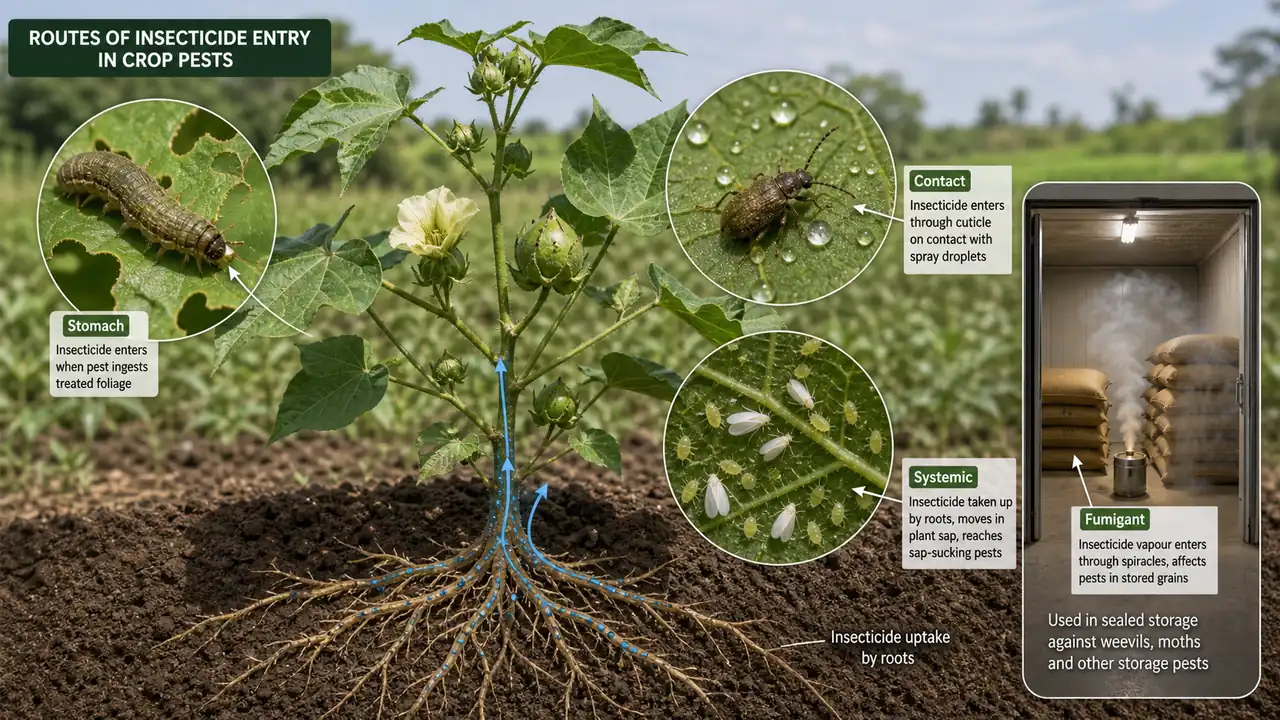
How an insecticide kills the pest determines how it should be applied. Four modes of action are recognised.
| Type | How It Kills | Application Method | Examples |
|---|---|---|---|
| Stomach poison | Kills when ingested by the insect | Applied to plant surface; insect must eat treated material | Lead arsenate, Paris green |
| Contact poison | Kills on contact with insect body | Sprayed directly on insects or surfaces they walk on | Malathion, DDT, Cypermethrin |
| Systemic poison | Absorbed by the plant; kills insects that feed on plant sap/tissue | Applied to soil or foliage; translocated within plant | Monocrotophos, Imidacloprid, Dimethoate |
| Fumigant | Kills through inhalation of toxic vapour or gas | Sealed space (godown, container, soil under tarpaulin) | Aluminium phosphide, Methyl bromide, Chloropicrin |
NOTE
Aluminium phosphide (trade name: Celphos) releases phosphine gas (PH₃), which is the actual fumigant. It is the most commonly used fumigant for stored-grain pest management in India. The tablet itself is not the fumigant — the gas it produces is.
Additional Toxicological Grouping by Physiological Effect
- In older toxicology classifications, insecticides are also grouped by the physiological system they disturb:
- Physical poisons — act through physical effects such as abrasion and desiccation; examples include ash, diatomaceous earth, inert dusts, and activated clay
- Protoplasmic poisons — classically linked with arsenicals
- Respiratory poisons — interfere with respiratory enzymes; older examples include hydrogen cyanide (HCN)
- Nerve poisons — act mainly on the nervous system; the standard examples are organophosphates and carbamates
Key Synthetic Insecticides Reference Table
| Insecticide | Chemical Group | Key Use |
|---|---|---|
| Imidacloprid | Neonicotinoid | Systemic; seed treatment for sucking pest management |
| Malathion | Organophosphate | Safest for vegetables, warehouses, godowns |
| Malathion 5% dust | Organophosphate | Seed treatment for stored grains |
| Chlorpyriphos | Organophosphate | Soil application for termites, white grubs |
| Endosulfan | Organochlorine | Safest insecticide for honey bee (textbook standard) |
| Buprofezin | Chitin Synthesis Inhibitor (CSI) | Most used CSI for Hemiptera (planthoppers, whiteflies) |
| Phorate 10 G | Organophosphate | Granular; soil application for white grub |
WARNING
Endosulfan is listed as "safest for honey bees" in exam textbooks — answer "Endosulfan" when asked in competitive exams. However, Endosulfan was banned in India in 2011 following the Stockholm Convention on Persistent Organic Pollutants. It is no longer in use, but the textbook answer remains "Endosulfan" for this specific question.
OP vs Neonicotinoid Comparison
| Feature | Organophosphate (OP) | Neonicotinoid |
|---|---|---|
| Example | Malathion, Chlorpyriphos | Imidacloprid, Thiamethoxam |
| Mode | Inhibits acetylcholinesterase | Nicotinic acetylcholine receptor agonist |
| Antidote (OP poisoning) | Atropine | No specific antidote |
| Use | Broad-spectrum contact/systemic | Systemic; seed treatment; sucking pests |
TIP
"A for Atropine, A for Anticholinesterase" — Organophosphate poisoning is treated with Atropine because OP compounds inhibit the enzyme acetylcholinesterase, and atropine blocks the resulting overaccumulation of acetylcholine at nerve synapses.
IGR and Chitin-Synthesis Recall
- A major IGR subgroup is the benzoyl phenyl ureas (BPU), which act as chitin synthesis inhibitors by blocking the chitin-synthetase pathway needed for new cuticle formation.
- In exam-style crop protection recall, Diflubenzuron is classically linked with borers, while Buprofezin is the better-known CSI for sucking pests such as planthoppers and whiteflies.
- Classical chemical-sterility notes also list chemosterilants such as TEPA, 5-fluorouracil, colchicine, and thiourea as reproductive inhibitors used in older autocidal-control discussions.
- In direct endocrine-control language, the key internal regulators are:
- Brain hormone — often called the activation hormone; released by neurosecretory cells and stimulates the prothoracic glands
- Molting hormone (ecdysone) — produced by the prothoracic glands; its active form is 20-hydroxyecdysone; cholesterol is the classical precursor
- Juvenile hormone (JH) — a terpenoid secreted by the corpora allata
- The standard developmental recall is:
- high JH -> larval cuticle
- low JH -> pupal cuticle
- absent JH -> adult cuticle
- Older exam terminology also remembers that Williams (1967) popularized the phrase third-generation pesticide for juvenile-hormone-analogue style control.
- Older IGR recall often adds:
- Methoprene as the first registered / widely cited early insect growth regulator
- Precocenes as anti-juvenile-hormone compounds that suppress JH biosynthesis
- juvenile-hormone analogue examples such as Methoprene, Fenoxycarb, and Pyriproxyfen
- ecdysone-analogue examples such as Tebufenozide and Methoxyfenozide
- additional CSI recall like Lufenuron and Novaluron, with Diflubenzuron classically linked to the trade name Dimilin
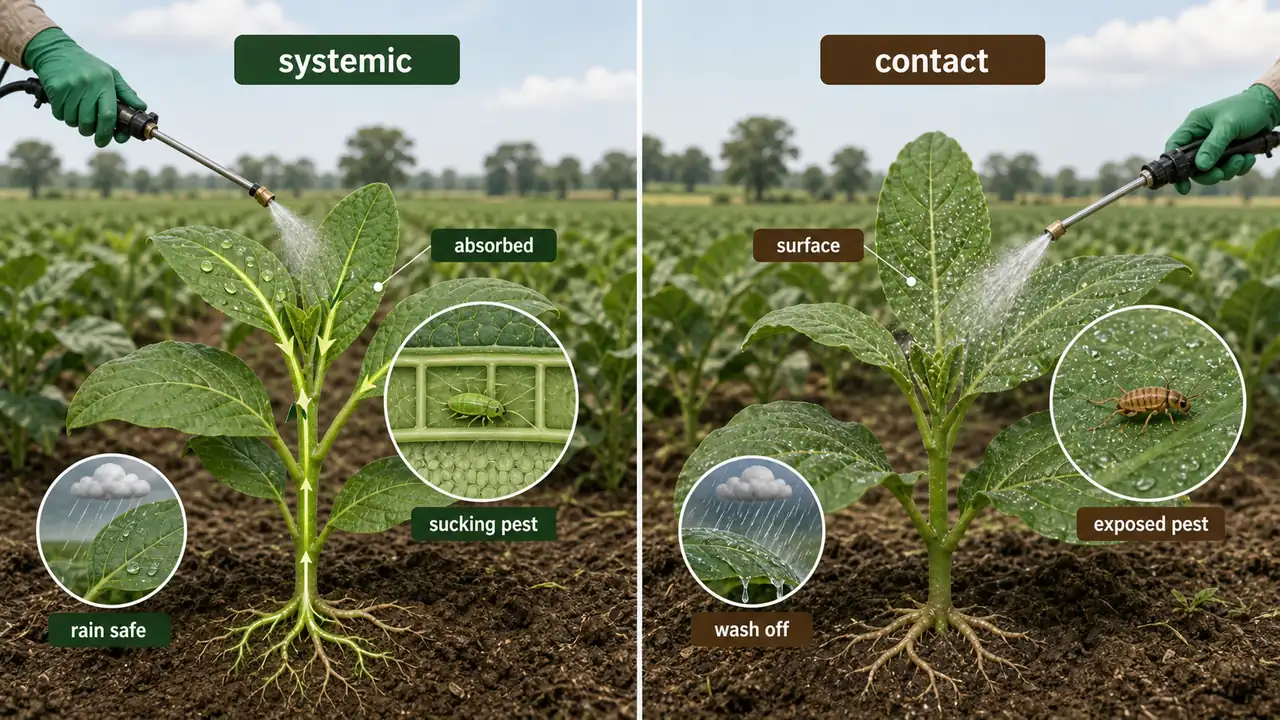
Comparison: Systemic vs Contact Insecticides
| Feature | Systemic Insecticide | Contact Insecticide |
|---|---|---|
| Absorption | Absorbed into plant tissue | Remains on surface |
| Effective against | Sucking pests (aphids, BPH, whitefly) | Exposed/crawling pests |
| Rain resistance | Good (inside plant) | Poor (washed off by rain) |
| Natural enemy safety | Safer (only feeding insects affected) | Less safe (kills on contact) |
| Example | Imidacloprid | Cypermethrin |
Insecticide Formulation Types
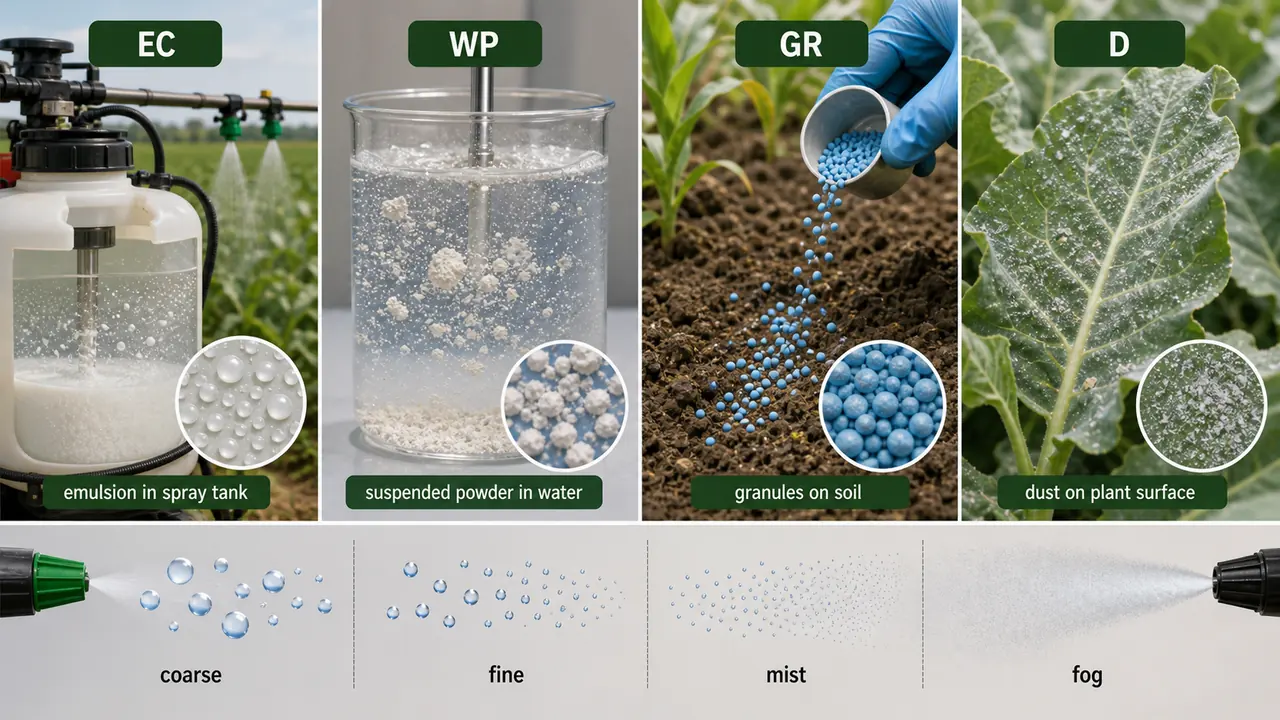
The active ingredient (AI) of an insecticide is rarely used in pure form. It is mixed with carriers, solvents, and additives to create a formulation that can be safely and effectively applied. Knowing the abbreviations is essential for reading pesticide labels and answering exam questions.
| Abbreviation | Full Form | Description |
|---|---|---|
| EC | Emulsifiable Concentrate | AI dissolved in organic solvent + emulsifier; mixes with water to form emulsion |
| WP | Wettable Powder | AI + inert filler + wetting agent; mixed with water but does not dissolve |
| SP | Soluble Powder | Dissolves completely in water |
| SL | Soluble Liquid | Liquid that dissolves in water |
| GR | Granules | Coarse particles for direct application to soil or plant whorls |
| D | Dust | Fine powder for direct dusting without water |
| SC | Suspension Concentrate | Finely ground solid particles suspended in liquid |
| WG / WDG | Water Dispersible Granule | Granules that break apart and disperse in water |
| CG | Capsule Granule | Controlled-release granules; AI released slowly over time |
TIP
EC is the most common formulation in Indian agriculture. When a farmer buys "Monocrotophos 36% SL," the "36%" is the active ingredient concentration, and "SL" tells you it is a Soluble Liquid.
Classification by Chemical Nature
- A compact chemistry-based grouping often used in exam toxicology is:
- Inorganic compounds — mineral-origin insecticides such as zinc phosphide, calcium arsenate, sulfur compounds, and the stomach poison Paris green
- Synthetic organic compounds — especially organochlorines, organophosphates, carbamates, synthetic pyrethroids, and related modern groups
Organochlorines
- Organochlorines are characterised by long residual stability and environmental persistence; many act as both contact and stomach poisons.
- Classical organochlorine recall includes:
- DDT
- BHC and its isomers
- cyclodiene compounds such as Aldrin, Dieldrin, Endrin, and Endosulfan
- cyclohexane-type recall centered on Lindane
- Historical anchors often asked:
- O. Zeidler first synthesized DDT in 1874
- Paul Muller discovered its insecticidal property in 1939 and received the Nobel Prize in 1948
- older India-focused exam notes often add that DDT became the first widely used chemical pesticide in India from 1948
- Michael Faraday synthesized BHC in 1825
- among BHC isomers, the gamma isomer is the most insecticidally active and is known as Lindane
- Older DDT-analogue recall commonly includes Methoxychlor and Dicofol (Kelthane).
Organophosphates
- Organophosphates are esters of phosphoric or phosphorothioic acids and are remembered for:
- strong insecticidal and often acaricidal action
- lower environmental persistence than organochlorines
- broad-spectrum activity
- frequent systemic action in many members
- The insecticidal importance of organophosphates is classically associated with Schrader (1942).
- Their core mode of action is inhibition of acetylcholinesterase at synapses.
- Common organophosphate examples in compact recall include Monocrotophos, Phosphamidon, Methyl demeton (Metasystox), Chlorpyriphos, Malathion, Dimethoate, and Acephate.
- Additional operational recall often includes:
- Dichlorvos (DDVP / Nuvan) — notable for fumigant action
- Phorate — classically recalled in granular formulations
- Chlorpyriphos 20% EC — linked with termites and other soil insects
Carbamates
- Carbamates are classically described as synthetic derivatives inspired by physostigmine (eserine), the principal alkaloid of the Calabar bean (Physostigma venenosum).
- Standard recall examples include:
- Carbaryl
- Carbofuran — often remembered in granular form and also as a nematicide
- Aldicarb (Temik)
Synthetic Pyrethroids
- Synthetic pyrethroids are designed as more photostable analogues of natural pyrethrins and act mainly as contact poisons.
- Their nerve action is classically explained through interference with sodium-channel gating and axonic transmission.
- Frequently asked historical anchors include:
- Allethrin — first synthetic pyrethroid
- Tefluthrin — first soil-active pyrethroid
- Fenvalerate — first non-ester pyrethroid
- Permethrin — first photostable pyrethroid
Newer Insecticide Classes
- Newer insecticide classes are typically valued for:
- novel modes of action
- lower dose requirement
- lower persistence
- usefulness in resistance management
- High-yield class-example recall includes:
- Neonicotinoids — Imidacloprid, Acetamiprid, Thiamethoxam; synthetic nicotine analogues acting at postsynaptic nicotinic acetylcholine receptors; especially effective against sucking pests
- Phenyl pyrazoles — Fipronil
- Pyridine / pyridine azomethine group — Pymetrozine, remembered for blocking stylet penetration in sucking pests
- Oxadiazine group — Indoxacarb, especially for lepidopteran pests
- Thiourea derivatives — Diafenthiuron, active against sucking pests and mites
- Sulfite ester group — Propargite, classically remembered as an acaricide
- Diamide group — potent against lepidopteran pests through modulation of the ryanodine receptor
- Additional advanced recall often extends this block with:
- Diamides — examples Flubendiamide and Chlorantraniliprole; they activate / modulate the ryanodine receptor, causing calcium release from muscle stores and paralysis
- Tetronic-acid derivatives — Spiromesifen; linked with inhibition of lipid biosynthesis and used in mite/insect management
- Nereistoxin analogues — Cartap hydrochloride; classically derived from the nereistoxin line and useful against coleopteran and lepidopteran insects
- Spinosyns — derived from Saccharopolyspora spinosa; Spinosad is based mainly on Spinosyn A and D, and Tracer is a standard trade-name recall
- Avermectins — derived from Streptomyces avermitilis; examples Abamectin and Emamectin benzoate
- Formamidines — classically represented by Amitraz, with octopaminergic mode-of-action recall
Quick Mode-of-Action Anchors by Group
- Useful exam-style pairings include:
- Organochlorines / DDT — sodium-channel modulator
- Synthetic pyrethroids — sodium-channel modulator
- Cyclodienes / Endosulfan — GABA-gated chloride-channel inhibitor
- Organophosphates and carbamates — acetylcholinesterase inhibitors
- Neonicotinoids — nicotinic acetylcholine receptor agonists
- Phenyl pyrazoles — classically grouped with GABA-gated chloride-channel inhibition
- Avermectins — chloride-channel activators
- Pymetrozine — stylet blocker
- Indoxacarb — voltage-dependent sodium-channel blocker
Common Trade-Name Recall
- Frequently asked brand-name pairs include:
- Imidacloprid — Confidor, Gaucho, Provado, Pride
- Aldicarb — Temik
- Methyl demeton — Metasystox
- Permethrin — Ambush
- Cypermethrin — Cymbush
- Carbaryl — Sevin
- Monocrotophos — Azodrin
- Carbofuran — Furadan
- Phorate — Thimet
- Dimethoate — Rogor
- Endosulfan — Thiodan
- Chlorpyriphos — Dursban
- Quinalphos — Ekalux
Attractants, Repellents, and Related Behavioural Chemicals
- Insect attractants are chemicals that orient insects toward a source and are widely used in monitoring and mass-trapping systems.
- High-yield lure pairs include:
- Mediterranean fruit fly (Ceratitis capitata) — trimedlure
- Melon fly (Bactrocera / Dacus cucurbitae) — cue-lure
- Oriental fruit fly (Bactrocera dorsalis) — methyl eugenol
- Common repellent recall includes:
- DEET (diethyl-m-toluamide) and dimethyl phthalate — mosquitoes and ticks
- Citronella oil — mosquito repellent
- Dichlorobenzene and naphthalene — cloth-moth repellents
- Pentachlorophenol — termite-repellent recall in older notes
- In practical botanical recall, azadirachtin is remembered for both antifeedant and repellent action.
- Older autocidal-control notes may further classify chemosterilants into:
- antimetabolites — e.g. 5-fluorouracil
- alkylating agents — e.g. TEPA, HEMPA
- phosphoramide-type recall — e.g. HEMPA, HEMEL
Spray Volume Classification
The volume of spray liquid applied per hectare determines coverage and drift risk.
| Spray Type | Volume (litres/ha) | Equipment Used |
|---|---|---|
| High Volume (HV) | >400 | Knapsack sprayer, power sprayer |
| Low Volume (LV) | 5-400 | Motorised mist blower, battery sprayer |
| Ultra Low Volume (ULV) | <5 | Spinning disc sprayer, aircraft-mounted sprayer |
NOTE
ULV spraying uses concentrated formulations with very small droplets. It is used for locust control (aerial spraying) and public health (mosquito fogging). The low volume reduces water requirement in arid areas.
Because the droplets are extremely small, drift hazard is greatest in ULV spraying; this is why wind, nozzle choice, and target timing become especially important.
Particle Size of Insecticide Formulations
Different formulations produce different particle sizes, which affect how the insecticide reaches the pest.
| Formulation / Application | Particle Size (microns) |
|---|---|
| Granule (GR) | 250-2400 |
| Dust (D) | 1-40 |
| Coarse spray | >400 |
| Fine spray | 100-400 |
| Mist | 50-150 |
| Fog | 1-50 |
| Aerosol | 0.1-50 |
| Smoke | 0.001-0.1 |
| Vapour | <0.001 |
TIP
From largest to smallest: Granule > Dust > Coarse > Fine > Mist > Fog > Aerosol > Smoke > Vapour.
Mnemonic — "Good Dogs Chase Foxes; Most Foxes Avoid Smelly Vans" — first letters match the sequence G-D-C-F-M-F-A-S-V.
Nozzles, Dusters, and Spray Delivery
- A nozzle is the spray-delivery unit that breaks liquid into droplets, shapes the spray pattern, and regulates flow.
- In functional terms:
- flat-fan nozzles produce a flat tapered sheet and are preferred for many herbicide applications
- flood-fan nozzles produce a wide-angle flat pattern used where broad coverage is needed
- hollow-cone nozzles generate fine droplets concentrated toward the outer ring and are widely used for insecticides and fungicides
- full-cone nozzles produce larger, more uniformly distributed droplets at higher flow rates and suit soil-directed applications
- rotary nozzles / controlled-droplet applicators (CDA) use centrifugal force to control droplet size
- gaseous nozzles are associated with mist blowers
- A few operational anchors:
- ULV sprayers typically work with about 1-5 L/ha
- high-volume spray droplets are commonly remembered in the 300-500 microns range
- for locust and some forest-insect control, a finer droplet range around 20-60 microns is classically cited
- rocker sprayers are traditionally linked with tall crops and plantation spraying such as coconut and palm
- For dust formulations, the corresponding delivery devices are dusters; standard manual types include package, plunger, bellows, and rotary dusters.
Toxicology Basics
Toxicology is the study of the harmful effects of chemicals on living organisms. Two key measurements quantify how toxic a pesticide is.
LD₅₀ and LC₅₀
| Measure | Unit | Meaning |
|---|---|---|
| LD₅₀ (Lethal Dose 50) | mg/kg body weight | Dose that kills 50% of test population — used for solids/liquids |
| LC₅₀ (Lethal Concentration 50) | mg/litre (ppm) | Concentration that kills 50% — used for fumigants, aquatic toxicity |
| ADI (Acceptable Daily Intake) | mg/kg/day | Maximum daily exposure considered safe over a lifetime |
IMPORTANT
LD₅₀ = dose (mg/kg body weight). LC₅₀ = concentration (mg/litre). Both measure what kills 50% of the test population — the key difference is dose vs. concentration. This distinction is a guaranteed exam question. Lower LD₅₀ = more toxic (inverse relationship).
IMPORTANT
Lower LD₅₀ = More toxic. A pesticide with LD₅₀ of 5 mg/kg is far more dangerous than one with LD₅₀ of 500 mg/kg. This inverse relationship is a common source of exam errors.
Types of Toxicity
| Toxicity Type | Definition | Example |
|---|---|---|
| Acute toxicity | Effect of a single dose | Farmer accidentally swallows pesticide |
| Chronic toxicity | Effect of repeated small doses accumulated over time | Farm worker exposed to low-level spray residues daily for years |
| Oral toxicity | Effect when pesticide is swallowed | Measured by oral LD₅₀ |
| Dermal toxicity | Effect when pesticide enters through skin | Contact during mixing/spraying without gloves |
| Inhalation toxicity | Effect when poisonous vapour is inhaled | Fumigant exposure (aluminium phosphide) |
Poisoning Symptoms and Antidote Recall
- Older exam-oriented toxicology notes often summarize poisoning management as:
- Organophosphates — muscarinic, nicotinic, and central-nervous-system effects; key antidote recall is atropine, often paired with an oxime such as PAM / pralidoxime
- Carbamates — cholinergic excess with bradycardia; atropine remains the classical antidote recall
- Synthetic pyrethroids — hyperexcitability, tremors, hypersensitivity, salivation; supportive anticonvulsant recall may include diazepam or phenobarbital
- In older first-aid wording:
- after ingestion of an insecticidal poison, stomach decontamination is classically emphasized
- atropine is remembered as a classic antidote obtained from belladonna
- the so-called universal antidote is recalled as a mixture of activated charcoal, tannic acid, and magnesium oxide in the ratio 2:1:1
WHO Toxicity Classification of Pesticides
The World Health Organization classifies pesticides into four hazard classes based on acute oral LD₅₀. This classification determines the colour coding on pesticide labels in India.
| Class | Hazard Level | Signal Word | Label Colour | Oral LD₅₀ — Solid (mg/kg) | Oral LD₅₀ — Liquid (mg/kg) |
|---|---|---|---|---|---|
| Ia | Extremely hazardous | Danger-Poison | Bright Red | <5 | <20 |
| Ib | Highly hazardous | Danger-Poison | Bright Red | 5-50 | 20-200 |
| II | Moderately hazardous | Warning | Bright Yellow | 50-500 | 200-2000 |
| III | Slightly hazardous | Caution | Bright Blue | >500 | >2000 |
TIP
"Red is deadly, Green is safe" — the label colours follow the traffic light principle. If you see a red-label pesticide, it requires extreme caution and PPE (Personal Protective Equipment).
Fumigation Reference
| Fact | Detail |
|---|---|
| Most used fumigant | Aluminium phosphide (Celphos) → releases Phosphine gas (PH₃) |
| Quarantine fumigant | Methyl bromide |
| Traditional mixture | Ethylene dichloride + Carbon tetrachloride (3:1 ratio) |
| Aerosol particle size | 0.1 to 50 microns |
| Vapour heat treatment | 46°C for 10 minutes — Mango fruit fly quarantine treatment |
| Hot water treatment | 50°C for 2 hours — Tundu disease control in wheat |
TIP
"46-10 for fly, 50-2 for tundu" — Vapour heat: 46°C for 10 minutes (fruit fly). Hot water: 50°C for 2 hours (tundu disease in wheat).
Regulatory Recall for Insecticides
- The Insecticides Act, 1968 was enacted on 2 September 1968 and came into force in 1971 along with the Insecticides Rules.
- Its purpose is to regulate the import, manufacture, sale, transport, distribution, and use of insecticides in India.
- In older textbook recall:
- the Central Insecticides Board (CIB) is the policy / advisory body under the Act
- the registration function is commonly remembered through the CIBRC framework
- the Central Insecticides Laboratory (CIL) at Faridabad serves as the central referral laboratory for quality control
Bioassay, Residues, and Toxicological Interpretation
- Bioassay is the estimation of the potency or biological effect of a chemical by observing the response it produces in a living organism.
- In practical pesticide toxicology:
- LD₅₀ remains the standard dose-based measure of median lethality
- lower LD₅₀ means the toxicant is more poisonous
- probit analysis is the classical method used to estimate median lethal levels from the regression of log dose against transformed mortality
- For corrected mortality in screening tests, Abbott's formula is used only when the mortality in the control treatment does not exceed about 20%.
- A useful residue distinction is:
- deposit = the amount of insecticide initially laid down on the treated surface just after application
- residue = the amount still remaining after some time has passed
- MRL stands for Maximum Residue Limit, the highest pesticide concentration legally permitted in food commodities or animal feed.
- ADI stands for Acceptable Daily Intake, expressed in mg per kg body weight per day as the quantity considered safe over a lifetime.
- In environmental toxicology recall, DDT is classically remembered to be metabolized into DDE (dichloro-diphenyl-dichloroethylene).
- The environmental legacy of persistent pesticides was powerfully popularized by Rachel Carson in Silent Spring (1962), which helped draw attention to:
- biomagnification of persistent insecticides like DDT through food chains
- conversion of DDT into DDE
- eggshell thinning in birds because DDE interferes with normal calcium deposition, reducing shell strength and reproductive success
Resistance and Resurgence
| Term | Definition |
|---|---|
| Resistance | Pest population is genetically adapted and NO LONGER killed by a spray — genetic change over generations |
| Resurgence | Pest population increases AFTER spraying because natural enemies were killed more than the pest itself |
- First recorded insecticide resistance: San Jose Scale — 1908, USA
- First reported DDT resistance is classically linked with mosquitoes such as Culex fatigans in 1952.
- In Indian agricultural entomology recall, an early field case is Pradhan et al. (1963), who reported resistance of the Singhara beetle (Galerucella birmanica) to DDT and BHC.
- DBM (Plutella xylostella) is now resistant to most insecticide groups
- DBM (Plutella xylostella) is also widely cited for resistance even to Bt-based control.
- "Knockout" transgenic hybrid using Bt technology: Maize
- Maximum resurgence observed in: Homoptera (44%) and Lepidoptera (24%)
- The Insecticide Resistance Action Committee (IRAC) provides the standard mode-of-action grouping and resistance-management framework used to delay resistance development through rotation and stewardship.
- Important resistance vocabulary:
- cross resistance = resistance to different insecticides because they share a similar mode of action or detoxification pathway
- multiple resistance = one insect population independently carries resistance to insecticides having different modes of action
- Mechanistically, resistance may involve:
- pre-existing genetic resistance factors selected by insecticide pressure, such as the classical kdr type resistance associated with reduced knockdown to DDT and pyrethroids
- enhanced detoxification through enzymes such as mixed-function oxidases / cytochrome P450 and carboxylesterases
- reduced cuticular penetration or behavioral resistance, where insects avoid treated surfaces
- Classical resistance-management strategies are often summarized as:
- moderation — reduce selection pressure by avoiding unnecessary repeated applications and favoring less persistent chemistries
- saturation — use a sufficiently effective dose to avoid survival of partially resistant individuals
- multiple attack — combine tactics through mixtures, synergists, or integration with non-chemical control methods
IMPORTANT
Resurgence vs Resistance — frequently confused in exams:
- Resurgence = pest INCREASES after spray (natural enemies were wiped out, not the pest)
- Resistance = pest is NO LONGER killed by spray (genetic adaptation in pest population) These are two distinct phenomena with different causes and management strategies.
- A classic resurgence explanation is hormoligosis, where a sub-lethal dose stimulates survival, fecundity, or population increase instead of causing mortality, along with destruction of natural enemies by broad-spectrum insecticides.
- Older textbook examples note that repeated sulphur sprays used against powdery mildew in grapes may trigger resurgence of the red spider mite.
Crop-Specific Recommendations
| Situation | Recommended Treatment |
|---|---|
| White grub in soil | Phorate 10 G (granular soil application) |
| Sucking pests — preventive seed treatment | Imidacloprid seed treatment |
| Stored grain seed treatment | Malathion 5% dust |
| Mite control | Sulphur |
| Shoot fly monitoring | Fish meal trap |
Miscellaneous Chemical Control Facts
- DDT insecticidal property discovered by Paul Muller in 1939
- Synergists = non-toxic chemicals that enhance insecticide toxicity without having activity alone (e.g., Piperonyl butoxide with pyrethrins)
- Emulsifier = reduces surface tension in formulations, allowing EC to mix with water
- A pro-pesticide is a compound that is initially inactive or less active but becomes pesticidally active after transformation inside a living system.
Which Insecticide for Which Situation?
Decision guide for selecting the right chemical:
| Situation | Insecticide Type | Why This Choice | Example |
|---|---|---|---|
| Sucking pests (aphid, jassid, whitefly) | Systemic (neonicotinoid) | Absorbed into plant; reaches pests hidden on undersurface | Imidacloprid |
| Chewing pests (caterpillar, beetle) | Contact + stomach poison | Pest ingests treated tissue | Chlorpyriphos, Quinalphos |
| Borers inside stem | Systemic or granular | Must reach pest inside plant tissue | Carbofuran 3G (granular in whorl) |
| Storage pest fumigation | Fumigant | Gas penetrates grain mass | Aluminium phosphide (→ PH₃ gas) |
| Mites (not insects!) | Acaricide (NOT insecticide) | Insecticides often don't work on mites | Sulphur, Dicofol |
| Immature stages (larvae, nymphs) | IGR (Insect Growth Regulator) | Disrupts moulting/chitin synthesis | Diflubenzuron, Buprofezin |
| Quick knockdown needed | Synthetic pyrethroid | Fast-acting contact poison | Cypermethrin, Deltamethrin |
| Organic/low-residue needed | Botanical insecticide | Biodegrades quickly; safe for beneficials | Neem (azadirachtin), Pyrethrum |
Safety rule: Always check waiting period (pre-harvest interval) before spraying on food crops. Lower LD₅₀ = MORE toxic. Red label = extremely toxic; green label = least toxic.
Exam Tips
- Generation sequence is the most basic question: 1st = Organochlorine, 2nd = OP/Carbamate, 3rd = IGR, 4th = Synthetic pyrethroid.
- LD₅₀ is inversely related to toxicity — lower number means more dangerous. Do not confuse this.
- Aluminium phosphide releases PH₃ (phosphine gas). The tablet is not the fumigant.
- Formulation abbreviations (EC, WP, GR, etc.) appear in nearly every exams paper. Know what each stands for.
- WHO Class Ia = Extremely hazardous = lowest LD₅₀ values. The classification uses LD₅₀, not LC₅₀.
- Systemic insecticides are best for sucking pests (aphids, BPH, whitefly) because the insect must feed on plant sap to ingest the chemical.
Summary Table
| Topic | Key Facts to Remember |
|---|---|
| 1st Gen insecticides | Organochlorines (DDT, BHC); persistent; bioaccumulate; banned for agriculture |
| 2nd Gen insecticides | Organophosphates (Malathion) and Carbamates (Carbofuran); nerve poisons |
| 3rd Gen insecticides | IGRs / Hormonal; disrupt moulting and metamorphosis |
| 4th Gen insecticides | Synthetic pyrethroids (Cypermethrin, Deltamethrin); fast knockdown |
| Most common formulation | EC (Emulsifiable Concentrate) |
| Most common fumigant | Aluminium phosphide → releases PH₃ |
| LD₅₀ rule | Lower value = more toxic |
| WHO Ia (most toxic) | Oral LD₅₀ < 5 mg/kg (solid), < 20 mg/kg (liquid) |
| Particle size order | Granule (largest) → Vapour (smallest) |
| Spray volume | HV > 400 L/ha; LV 5-400; ULV < 5 |
| Rodenticide recall | Zinc phosphide = classic acute bait poison; Warfarin = first anticoagulant; Bromadiolone = anticoagulant with Vitamin K antidote |
| Molluscicide recall | Metaldehyde is the standard molluscicide for snail management such as Achatina fulica |
Summary Cheat Sheet
| Concept / Topic | Key Details |
|---|---|
| 1st Generation | Organochlorines — DDT, BHC; persistent; bioaccumulate; banned for agriculture |
| 2nd Generation | Organophosphates (Malathion) and Carbamates (Carbofuran); nerve poisons |
| 3rd Generation | IGRs / Hormonal; disrupt moulting and metamorphosis; highly specific |
| 4th Generation | Synthetic pyrethroids (Cypermethrin, Deltamethrin); fast knockdown; low mammalian toxicity |
| Stomach poison | Kills when ingested — Lead arsenate, Paris green |
| Systemic poison | Absorbed by plant; best for sucking pests — Monocrotophos, Imidacloprid |
| Fumigant | Aluminium phosphide releases PH₃ (phosphine gas); most common stored-grain fumigant |
| EC | Emulsifiable Concentrate — most common formulation in Indian agriculture |
| Spray volumes | HV > 400 L/ha; LV 5-400; ULV < 5 |
| Particle size order | Granule (largest) → Vapour (smallest); mnemonic: G-D-C-F-M-F-A-S-V |
| LD₅₀ | Lethal Dose 50; lower value = more toxic — inverse relationship |
| WHO Ia | Extremely hazardous; oral LD₅₀ < 5 mg/kg (solid); bright red label |
| WHO III | Slightly hazardous; oral LD₅₀ > 500 mg/kg (solid); bright blue label |
| DDT exception | Banned for agriculture; still allowed for malaria vector control under WHO guidelines |
TIP
Next: Lesson 06 covers Botanical Insecticides — plant-derived pest control agents like neem, pyrethrum, and rotenone that offer safer alternatives to synthetic chemicals.