🌱 Botanical Insecticides — Plant-Origin Pest Control
Major botanical insecticides — rotenone, pyrethrum, azadirachtin (neem), and nicotine — their plant sources, active ingredients, modes of action, and role in organic farming, with comparison tables and exam mnemonics
Pest Control Before the Chemical Age
The previous lesson covered synthetic chemical insecticides — their generations, formulations, and toxicology. This lesson examines an older and increasingly relevant alternative: botanical insecticides, which are derived from plants and play a central role in organic farming and IPM.
Centuries before DDT existed, Indian farmers protected stored grain by mixing neem leaves into gunny bags, and European gardeners dusted chrysanthemum flower powder on vegetables to kill caterpillars. These traditional practices used botanical insecticides — pesticides extracted from plants. Today, with rising concerns about chemical residues in food and environmental damage, botanical insecticides are making a comeback as key tools in organic farming and IPM programmes.
This lesson covers:
- Four major botanicals — Rotenone, Pyrethrum, Azadirachtin (Neem), Nicotine
- Source plant, plant part, active ingredient, mode of action for each
- Other plant-derived substances — neem cake, karanja oil, custard apple
- Comparison table across all four major botanicals
Why Botanical Insecticides Matter
Before diving into individual chemicals, understand three properties that distinguish botanicals from synthetic insecticides:
Pro Content Locked
Upgrade to Pro to access this lesson and all other premium content.
Charged once for one year · ₹1188 total
Save ₹100/month vs ₹2388/year launch price
- All Agriculture & Banking Courses
- AI Lesson Questions (100/day)
- AI Doubt Solver (50/day)
- Glows & Grows Feedback (30/day)
- AI Section Quiz (20/day)
- 22-Language Translation (100/day)
- Recall Questions (20/day)
- AI Quiz (15/day)
- AI Quiz Paper Analysis (100/day)
- AI Step-by-Step Explanations (100/day)
- Spaced Repetition Recall (FSRS)
- AI Tutor
- Immersive Text Questions
- Audio Lessons — Hindi & English
- Mock Tests & Previous Year Papers
- Summary & Mind Maps
- XP, Levels, Leaderboard & Badges
- Generate New Classrooms
- Voice AI Teacher (AgriDots Live)
- AI Revision Assistant
- Knowledge Gap Analysis
- Interactive Revision (LangGraph)
🔒 Secure one-time yearly payment via Razorpay · No hidden fees
Pest Control Before the Chemical Age
The previous lesson covered synthetic chemical insecticides — their generations, formulations, and toxicology. This lesson examines an older and increasingly relevant alternative: botanical insecticides, which are derived from plants and play a central role in organic farming and IPM.
Centuries before DDT existed, Indian farmers protected stored grain by mixing neem leaves into gunny bags, and European gardeners dusted chrysanthemum flower powder on vegetables to kill caterpillars. These traditional practices used botanical insecticides — pesticides extracted from plants. Today, with rising concerns about chemical residues in food and environmental damage, botanical insecticides are making a comeback as key tools in organic farming and IPM programmes.
This lesson covers:
- Four major botanicals — Rotenone, Pyrethrum, Azadirachtin (Neem), Nicotine
- Source plant, plant part, active ingredient, mode of action for each
- Other plant-derived substances — neem cake, karanja oil, custard apple
- Comparison table across all four major botanicals
Why Botanical Insecticides Matter
Before diving into individual chemicals, understand three properties that distinguish botanicals from synthetic insecticides:
- Rapid biodegradation — they break down quickly in the environment, leaving minimal residues
- Lower mammalian toxicity (with exceptions like nicotine) — safer for farmers and consumers
- Compatibility with organic farming — neem, pyrethrum, and rotenone are approved for organic production
The trade-off is that botanicals generally have shorter residual activity, meaning they may need more frequent application than synthetics.
The Four Major Botanical Insecticides
A. Rotenone
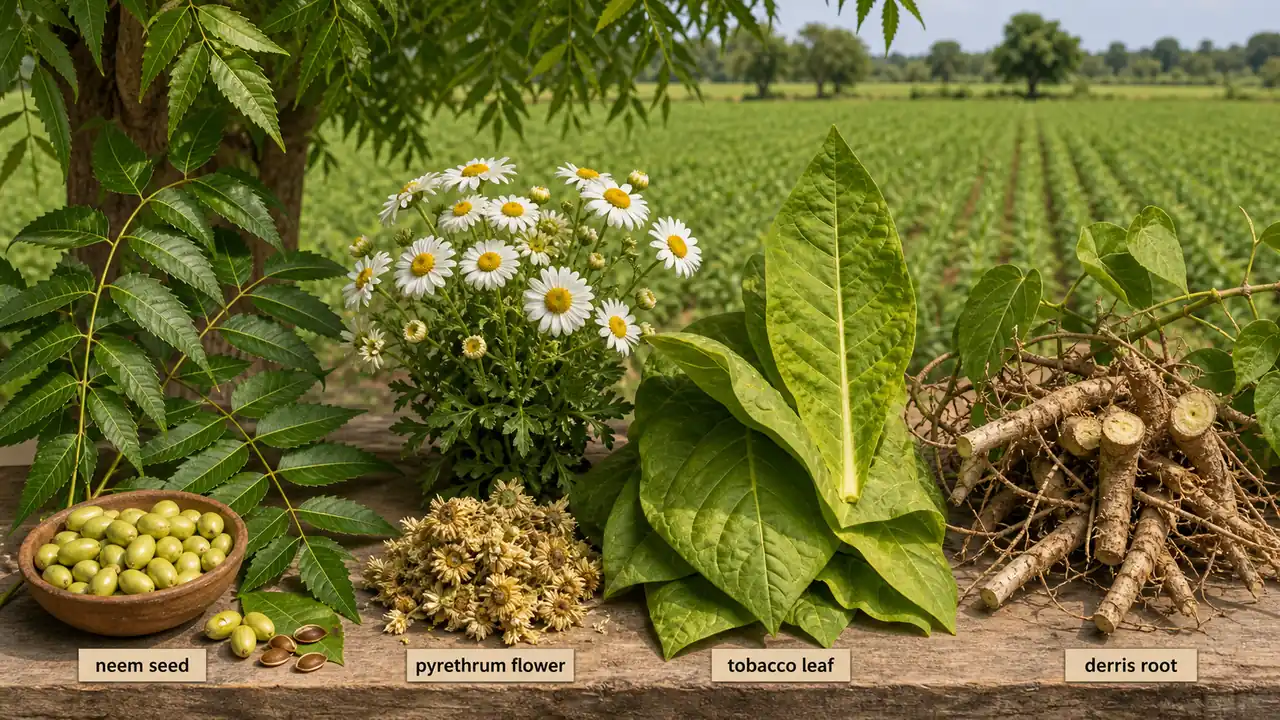
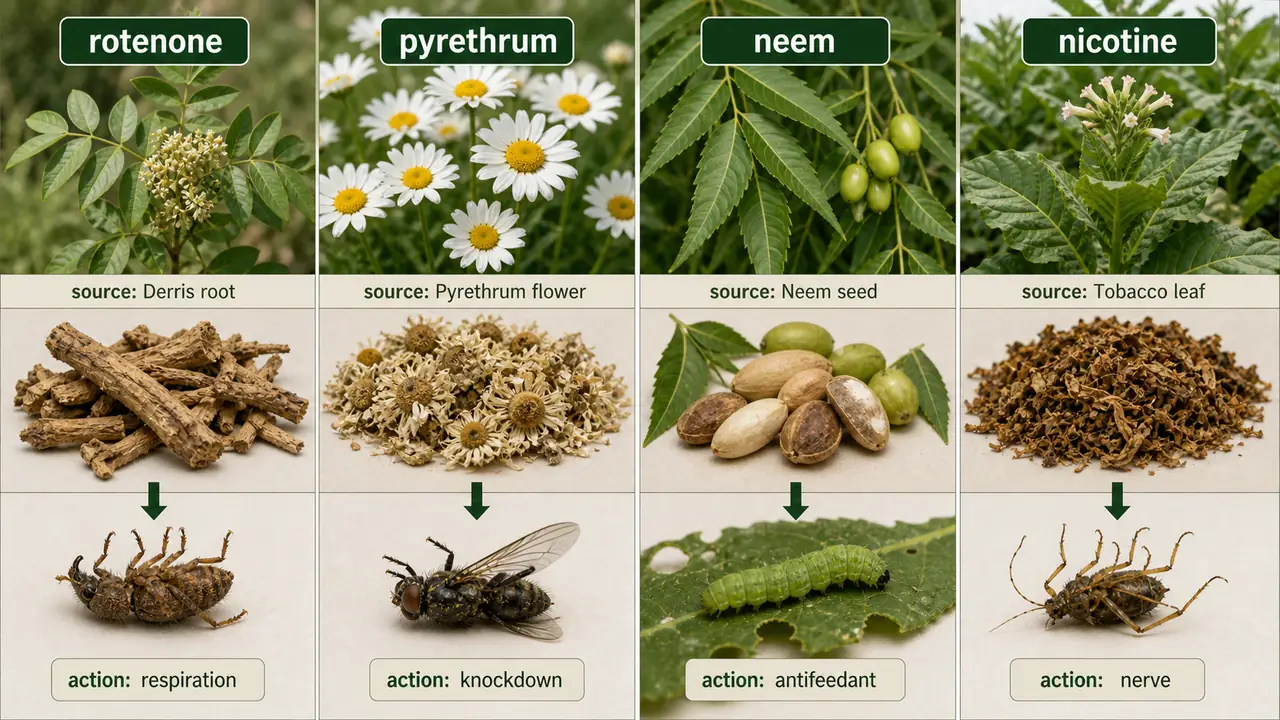
- Source plant: Derris elliptica (tuba root) or Lonchocarpus species
- Plant part used: Roots
- Active ingredient: Rotenone
- Mode of action: Inhibits mitochondrial electron transport chain (Complex I inhibitor) — blocks cellular respiration
- Properties: Contact and stomach poison; photodegradable
TIP
Older exam language often describes rotenone as a respiratory inhibitor. The meaning is the same: it blocks cellular respiration by inhibiting mitochondrial electron transport.
Agricultural use: Effective against aphids, caterpillars, and beetles on vegetables and fruits.
IMPORTANT
Rotenone is extremely toxic to fish (piscicidal) but has low mammalian toxicity. It is actually used as a fish poison (piscicide) in fisheries management. If an exam question mentions "toxic to fish," think rotenone.
WARNING
Rotenone — NEVER use near water bodies. Even small amounts are lethal to fish. It must never be applied near ponds, rivers, streams, or irrigation channels.
B. Pyrethrum (Pyrethrin)
- Source plant: Chrysanthemum cinerarifolium (Dalmatian pyrethrum)
- Plant part used: Flowers — specifically found in the achenes of flowers (the seed-like fruits of the flower head)
- Active ingredient: Pyrethrins — a group of six compounds (Pyrethrin I & II, Cinerin I & II, Jasmolin I & II)
- Mode of action: Disrupts sodium channels in insect nerve membranes → rapid knockdown effect
- Properties: Contact poison; strong knockdown; rapidly photodegraded by sunlight
- A widely cited synergist used with pyrethrum is piperonyl butoxide, which improves efficacy by slowing detoxification in the insect.
Agricultural use: Household insect sprays, mosquito coils, stored grain protection. Less used in open-field agriculture due to photodegradation.
TIP
Pyrethrum vs Pyrethroids — a common exam confusion:
- Pyrethrum = natural extract from chrysanthemum flowers (botanical insecticide)
- Synthetic pyrethroids = man-made analogues (cypermethrin, deltamethrin) = 4th generation insecticides with improved UV stability and longer residual activity
Producer recall: Older exam material often notes Kenya as the major producer associated with pyrethrum.
C. Azadirachtin (Neem-Based)
-
Source plant: Azadirachta indica (Neem tree)
-
Plant part used: Seeds and leaves
-
Active ingredient: Azadirachtin
-
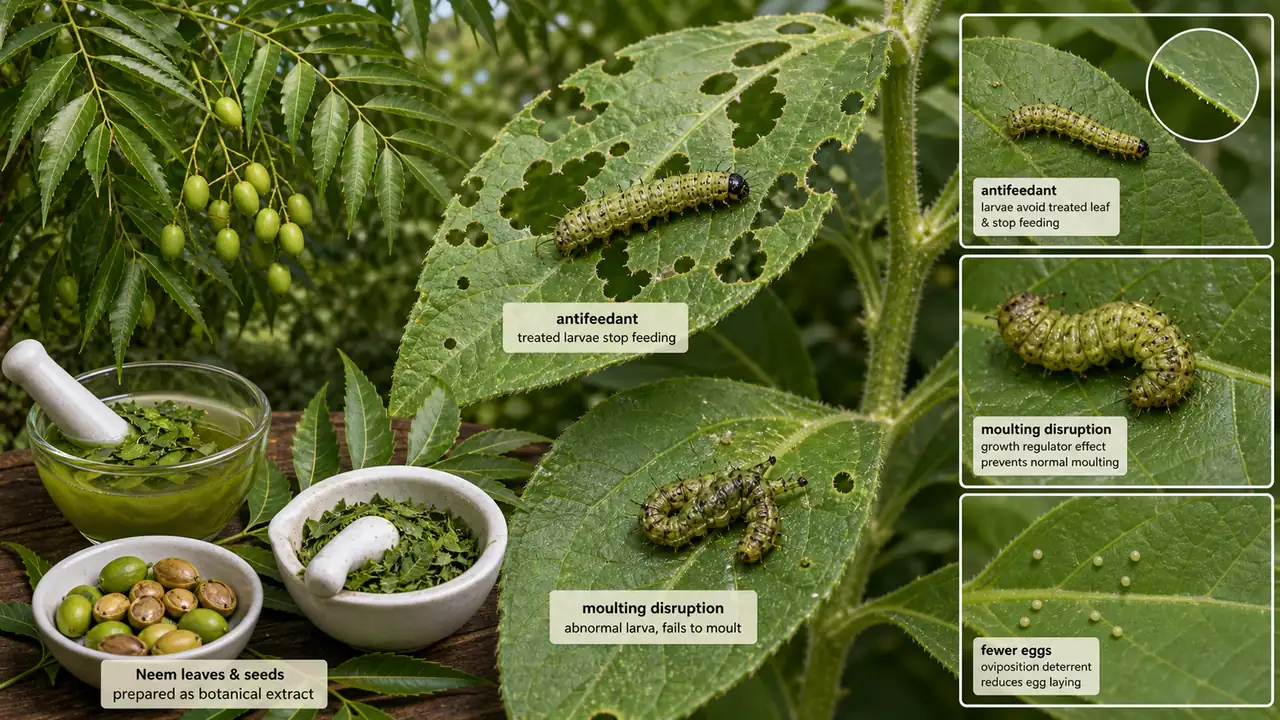
Mode of action: Multiple actions — antifeedant, insect growth regulator, repellent, oviposition deterrent, and sterilant
-
Neem is indigenous to India, and older entomology recall notes often associate the reporting of its insecticidal potential with S. Pradhan in the early modern literature.
Azadirachtin is the most versatile botanical insecticide, effective against over 200 insect species. Its multiple modes of action make resistance development very difficult.
The five actions of Azadirachtin:
| Action | What It Does | Practical Effect |
|---|---|---|
| Antifeedant | Reduces or stops insect feeding | Treated leaves are rejected by caterpillars |
| Growth regulator (IGR) | Disrupts moulting and metamorphosis | Larvae fail to pupate; die during moulting |
| Repellent | Repels insects from treated surfaces | Insects avoid landing on sprayed plants |
| Oviposition deterrent | Prevents egg-laying by female insects | Fewer eggs laid on treated crops |
| Sterilant | Reduces fecundity (egg production) of adults | Surviving adults produce fewer offspring |
IMPORTANT
Neem-based pesticides are approved for organic farming in India. Additionally, neem cake applied to soil acts as a nitrification inhibitor, slowing the conversion of ammonium to nitrate and improving nitrogen use efficiency. This dual benefit (pest control + soil nutrition) makes neem uniquely valuable.
Formulation recall: In exam-oriented neem-product standards, formulated azadirachtin insecticides are commonly remembered as containing not less than about 1500 ppm azadirachtin. Older commercial recall also links neem seed kernel extract (NSKE) with formulations such as Margocide and Achook.
TIP
Mnemonic for azadirachtin's five actions — "AGROS": Antifeedant, Growth regulator, Repellent, Oviposition deterrent, Sterilant. "AGROS" sounds like "agro" — fitting for an agricultural insecticide.
D. Nicotine
- Source plant: Nicotiana tabacum and other Nicotiana species (Tobacco)
- Plant part used: Roots and leaves
- Active ingredient: Nicotine (alkaloid)
- Mode of action: Mimics acetylcholine at nicotinic receptors → overstimulation of the nervous system → paralysis and death
- Properties: Contact and fumigant action; highly toxic to mammals (unlike other botanicals)
Historical use: Effective against aphids and soft-bodied insects. Largely replaced by synthetic neonicotinoids (imidacloprid, thiamethoxam) which have the same target site but lower mammalian toxicity.
- Older Indian pesticide recall also mentions a 40% nicotine sulfate formulation manufactured for export purposes only; textbook notes often state its domestic use was prohibited because of toxicity concerns.
NOTE
Nicotine is the exception among botanicals — it has high mammalian toxicity, unlike rotenone, pyrethrum, and neem. Neonicotinoids were developed as safer synthetic analogues of nicotine.
E. Lantana (Lantana camara)
- Source: Lantana camara (an invasive weed itself)
- Use: Botanical pesticide — leaves and extracts have insecticidal and repellent properties
WARNING
Lantana camara causes renal failure in cattle — it is toxic to livestock (hepatotoxic and nephrotoxic). Never allow cattle to graze near Lantana. This dual nature — usable as botanical pesticide but dangerous to livestock — is exam-relevant.
Comparison of the Four Major Botanicals
| Feature | Rotenone | Pyrethrum | Azadirachtin | Nicotine |
|---|---|---|---|---|
| Source plant | Derris elliptica | Chrysanthemum | Azadirachta indica | Nicotiana spp. |
| Plant part | Roots | Flowers | Seeds & leaves | Roots & leaves |
| Mode of action | Respiration inhibitor | Sodium channel disruptor | Multiple (IGR + antifeedant) | Nerve receptor agonist |
| Speed of action | Slow | Very fast (knockdown) | Slow (growth disruption) | Fast |
| Mammalian toxicity | Low | Low | Very low | High |
| Fish toxicity | Very high | Moderate | Low | Moderate |
| Photostability | Low | Very low | Moderate | Low |
| Organic farming approved | Yes | Yes | Yes | Restricted |
| Modern synthetic analogue | — | Synthetic pyrethroids | — | Neonicotinoids |
Other Plant-Derived Pest Control Substances
Beyond the four major botanicals, several other plant products are used in Indian agriculture, especially in organic and traditional farming.
| Substance | Source Plant | Use | Key Fact |
|---|---|---|---|
| Neem oil | Neem seeds | Insecticide, fungicide, nematicide | Broad-spectrum; safe for beneficials |
| Neem cake | Neem seed (after oil extraction) | Soil amendment + nitrification inhibitor | Dual benefit: pest control + N-use efficiency |
| Karanja oil | Pongamia pinnata | Stored grain protectant | Traditional protectant for pulses |
| Custard apple seed extract | Annona squamosa | Insecticidal properties | Contains acetogenins |
| Tobacco decoction | Nicotiana tabacum | Against sucking pests | Traditional spray for aphids on vegetables |
| Sabadilla | Schoenocaulon officinale seeds | Botanical insecticide | Rapidly photodegrades and is highly toxic to honey bees |
TIP
"ARPNL" — remember the five major botanicals: Azadirachtin (Neem), Rotenone (Derris), Pyrethrum (Chrysanthemum), Nicotine (Tobacco), Lantana. "ARPNL" covers all five for quick exam recall.
When to Choose Botanicals Over Chemicals
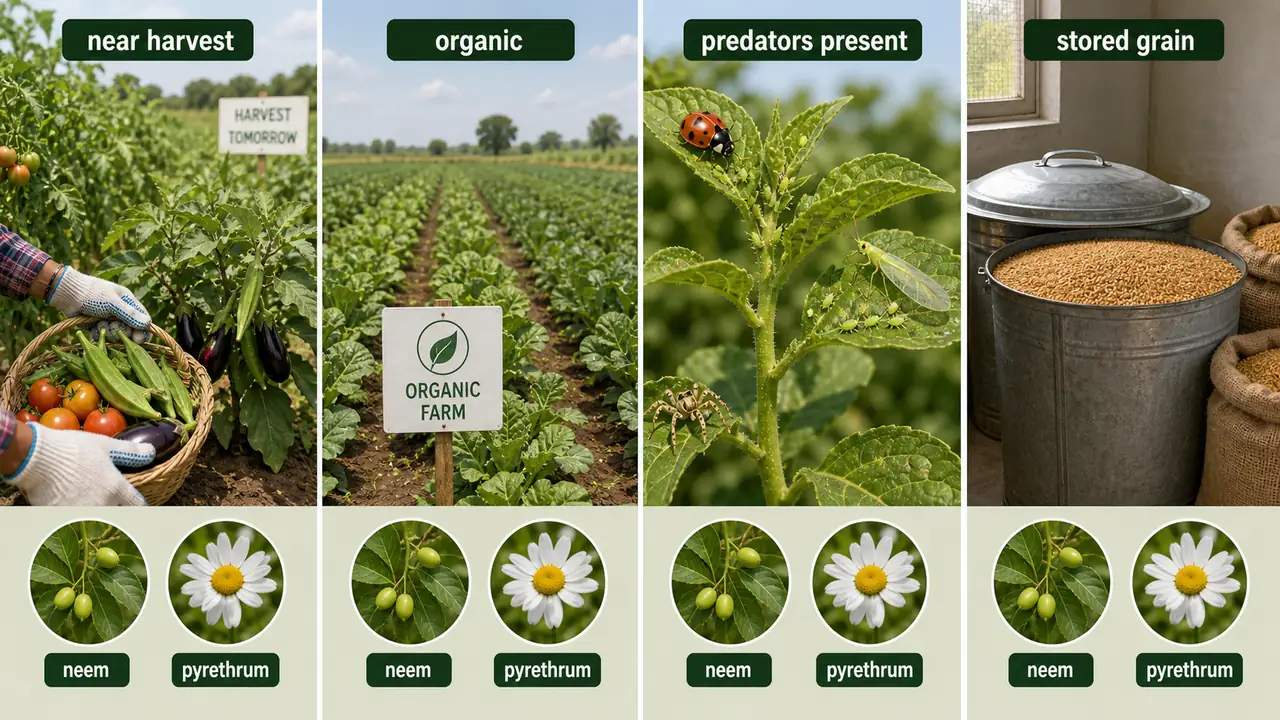
Botanicals are the right choice when:
| Situation | Why Botanical Works Better | Recommended Botanical |
|---|---|---|
| Vegetable crops near harvest | Short waiting period; quick biodegradation | NSKE 5% (neem seed kernel extract) |
| Organic farming | No synthetic residue | Azadirachtin, Pyrethrum, Rotenone |
| Beneficial insects present in field | Most botanicals safer for natural enemies | Neem oil (antifeedant — pests stop feeding but predators unharmed) |
| Low pest pressure (below ETL but rising) | Mild intervention to slow build-up | Neem oil spray (repellent + IGR effect) |
| Stored grain (small farmer, no fumigation facility) | Safe for home storage; traditional method | Neem leaf layering, Karanja oil on pulses |
| Aquatic environments nearby | Avoid chemical runoff into water bodies | Neem (but NOT rotenone — it kills fish!) |
Key limitation: Botanicals photodegrade quickly (1-3 days in sunlight). Always spray in evening for maximum effectiveness. They need repeated applications compared to synthetic chemicals.
Exam Tips
- Source plant + plant part + active ingredient — these three facts are the minimum you need for each botanical. Exams test all three.
- Rotenone = fish killer. Any question linking a botanical insecticide to fish toxicity or piscicide = rotenone.
- Pyrethrum = knockdown. Fast-acting contact poison from chrysanthemum flowers.
- Azadirachtin = multiple modes. If asked "which botanical has antifeedant, IGR, and repellent properties," the answer is always azadirachtin.
- Nicotine = high mammalian toxicity. The only major botanical that is dangerous to mammals.
- Pyrethrum vs pyrethroid is a trick question — natural vs synthetic. Pyrethroids are 4th generation insecticides, not botanicals.
- Neem cake as nitrification inhibitor crosses the boundary between entomology and soil science — it appears in both subject papers.
Summary Table
| Botanical | Source Plant | Part Used | Active Ingredient | Key Property | Organic Approved |
|---|---|---|---|---|---|
| Rotenone | Derris elliptica | Roots | Rotenone | Fish poison; Complex I inhibitor | Yes |
| Pyrethrum | Chrysanthemum cinerarifolium | Flowers | Pyrethrins | Fast knockdown; photodegradable | Yes |
| Azadirachtin | Azadirachta indica (Neem) | Seeds & leaves | Azadirachtin | Antifeedant + IGR; organic approved | Yes |
| Nicotine | Nicotiana spp. (Tobacco) | Roots & leaves | Nicotine | Nerve poison; high mammalian toxicity | Restricted |
| Neem cake | Neem | Seeds (residue) | Various | Soil amendment + nitrification inhibitor | Yes |
| Karanja oil | Pongamia pinnata | Seeds | Karanjin | Stored grain protectant | Yes |
Summary Cheat Sheet
| Concept / Topic | Key Details |
|---|---|
| Rotenone | Source: Derris elliptica roots; Complex I inhibitor; extremely toxic to fish (piscicidal); low mammalian toxicity |
| Pyrethrum | Source: Chrysanthemum cinerarifolium flowers; sodium channel disruptor; rapid knockdown; photodegradable |
| Azadirachtin | Source: Azadirachta indica seeds & leaves; 5 actions (mnemonic: AGROS); effective against 200+ species |
| Nicotine | Source: Nicotiana tabacum roots & leaves; high mammalian toxicity — exception among botanicals |
| Pyrethrum vs Pyrethroids | Pyrethrum = natural (botanical); Pyrethroids = synthetic (4th gen insecticides) — exam trap |
| Azadirachtin 5 actions | Antifeedant, Growth regulator, Repellent, Oviposition deterrent, Sterilant |
| Neem cake | Soil amendment + nitrification inhibitor — dual benefit: pest control + N-use efficiency |
| Neonicotinoids | Synthetic analogues of nicotine (imidacloprid, thiamethoxam); same target site, lower mammalian toxicity |
TIP
Next: Lesson 07 covers Trapping and Monitoring Methods — light traps, pheromone traps, sticky traps, and the named pheromones that are classic exam questions.