🪤 Trapping and Monitoring Methods for Pest Management
Light traps, pheromone traps (with identified pheromone names), sticky traps, poison bait traps, pit fall traps, suction traps, and probe traps — their principles, target pests, and exam-critical facts
Why Trapping Is the Foundation of Smart Pest Management
The previous lesson covered botanical insecticides — plant-derived chemicals for pest control. This lesson addresses a different aspect of IPM: monitoring and trapping, which is how farmers gather the data needed to make ETL-based decisions rather than spraying on a calendar.
A gram farmer in Madhya Pradesh sets up pheromone traps in his field at sowing time. Each week, he counts the male Helicoverpa armigera moths caught in the trap. When the count crosses the threshold, he knows the pest population is building up and it is time to release Trichogramma or apply NPV spray. Without the trap, he would either spray blindly on a calendar (wasting money and killing natural enemies) or wait until visible damage appears (too late for effective control).
This lesson covers:
- Seven major trap types — light, pheromone, sticky, poison bait, suction, pit fall, probe
- Named insect pheromones — Bombykol, Gossyplure, Helilure, and others
- Pheromone types — sex, aggregation, trail-marking
- Insect-trap matching — which trap for which pest
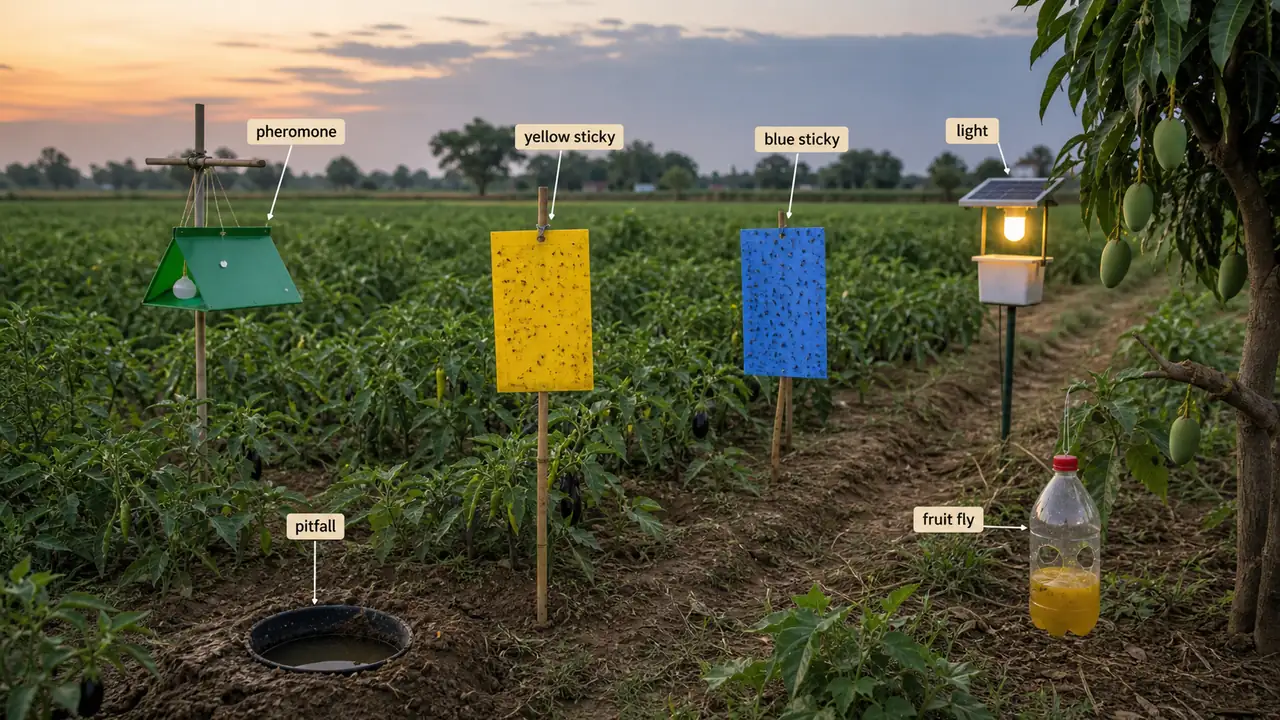
1. Light Trap
Principle: Many adult insects are attracted to light at night (positive phototaxis). A light source draws them in, and they are collected in a container or funnel below the light.
Pro Content Locked
Upgrade to Pro to access this lesson and all other premium content.
Charged once for one year · ₹1188 total
Save ₹100/month vs ₹2388/year launch price
- All Agriculture & Banking Courses
- AI Lesson Questions (100/day)
- AI Doubt Solver (50/day)
- Glows & Grows Feedback (30/day)
- AI Section Quiz (20/day)
- 22-Language Translation (100/day)
- Recall Questions (20/day)
- AI Quiz (15/day)
- AI Quiz Paper Analysis (100/day)
- AI Step-by-Step Explanations (100/day)
- Spaced Repetition Recall (FSRS)
- AI Tutor
- Immersive Text Questions
- Audio Lessons — Hindi & English
- Mock Tests & Previous Year Papers
- Summary & Mind Maps
- XP, Levels, Leaderboard & Badges
- Generate New Classrooms
- Voice AI Teacher (AgriDots Live)
- AI Revision Assistant
- Knowledge Gap Analysis
- Interactive Revision (LangGraph)
🔒 Secure one-time yearly payment via Razorpay · No hidden fees
Why Trapping Is the Foundation of Smart Pest Management
The previous lesson covered botanical insecticides — plant-derived chemicals for pest control. This lesson addresses a different aspect of IPM: monitoring and trapping, which is how farmers gather the data needed to make ETL-based decisions rather than spraying on a calendar.
A gram farmer in Madhya Pradesh sets up pheromone traps in his field at sowing time. Each week, he counts the male Helicoverpa armigera moths caught in the trap. When the count crosses the threshold, he knows the pest population is building up and it is time to release Trichogramma or apply NPV spray. Without the trap, he would either spray blindly on a calendar (wasting money and killing natural enemies) or wait until visible damage appears (too late for effective control).
This lesson covers:
- Seven major trap types — light, pheromone, sticky, poison bait, suction, pit fall, probe
- Named insect pheromones — Bombykol, Gossyplure, Helilure, and others
- Pheromone types — sex, aggregation, trail-marking
- Insect-trap matching — which trap for which pest
1. Light Trap
Principle: Many adult insects are attracted to light at night (positive phototaxis). A light source draws them in, and they are collected in a container or funnel below the light.
Key features:
- Used for both monitoring and mass trapping
- Most effective for moths, beetles, and other nocturnal insects
- Works best on moonless nights when the trap light has no competition
- Should be placed at canopy level for maximum catch in field crops
Agricultural example: Rice farmers in Tamil Nadu use mercury vapour light traps to monitor rice stem borer and leaf folder moth populations throughout the crop season.
TIP
Light traps catch a wide range of species (non-specific), making them good for general pest surveys. But they are poor at detecting specific low-density pests — use pheromone traps for that.
2. Pheromone Trap
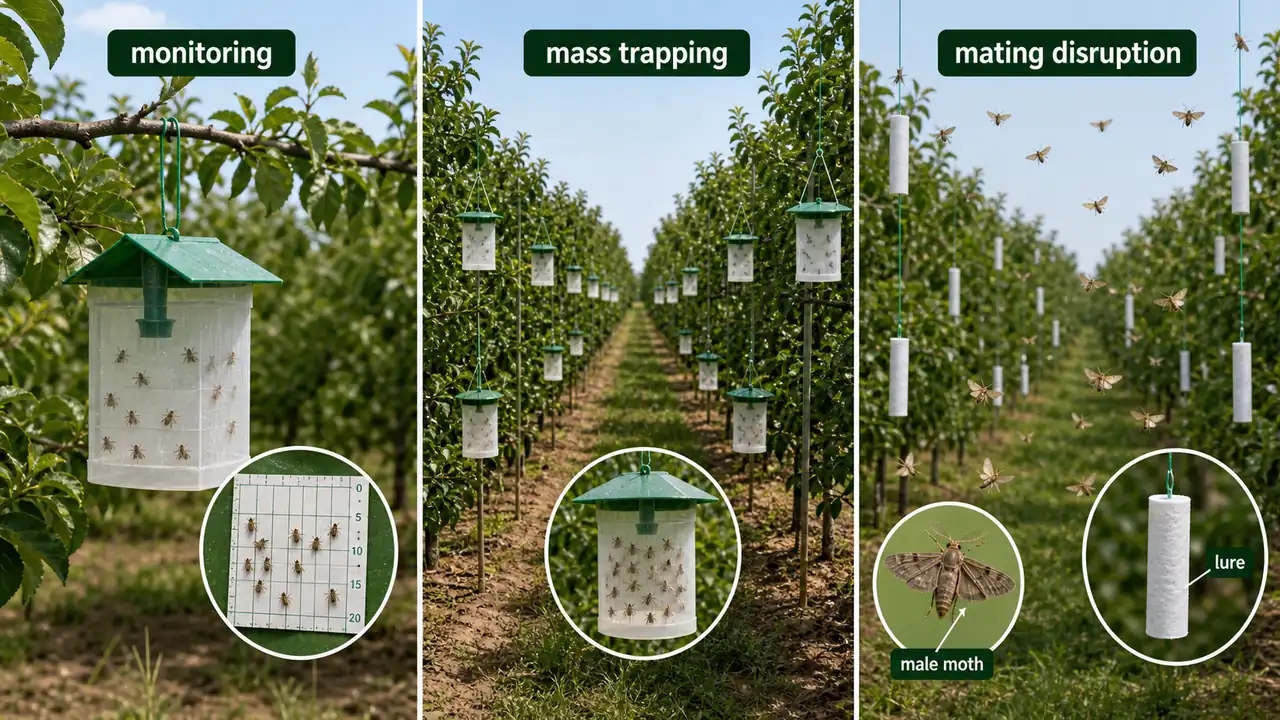
Pheromone traps use synthetic sex pheromones placed on rubber septa inside specially designed traps to attract male moths of a specific pest species.
- More broadly, these lures belong to the larger group of semiochemicals -- signalling chemicals involved in communication. In exam language, semiochemicals are divided into pheromones (within the same species) and allelochemicals (between different species).
- Older entomology notes also describe pheromones as ectohormones, emphasizing that they are released into the external environment rather than acting only inside the body.
Three uses of pheromone traps:
| Use | How It Works | Example |
|---|---|---|
| Monitoring | Count trapped males to assess population level | Weekly Helicoverpa counts in gram fields |
| Mass trapping | Deploy many traps to remove males from population | Pink bollworm control in cotton |
| Mating disruption | Saturate the field with synthetic pheromone so males cannot locate females | Used for codling moth in apple orchards globally |
- In routine field use, the pheromone lure is commonly replaced about every 15 days, because lure release declines with weather exposure and trap counts become less reliable if septa are left too long.
Female Sex Pheromones Identified in Insects
This table is extremely exam-critical. Memorise the insect-pheromone name association.
| Insect | Scientific Name | Pheromone Name | Memory Aid |
|---|---|---|---|
| Silkworm | Bombyx mori | Bombykol | Bombyx → Bombykol |
| Gypsy moth | Porthesia dispar | Gyplure / Disparlure | Gypsy → Gyplure; Dispar → Disparlure |
| Pink bollworm | Pectinophora gossypiella | Gossyplure | Gossypiella → Gossyplure (cotton = Gossypium) |
| Cabbage looper | Trichoplusia ni | Looplure | Looper → Looplure |
| Tobacco cutworm | Spodoptera litura | Spodolure / Litlure | Spodoptera → Spodolure |
| Gram pod borer | Helicoverpa armigera | Helilure | Helicoverpa → Helilure |
| Honey bee queen | Apis sp. | Queen's substance | A primer pheromone (not a sex lure for trapping) |
IMPORTANT
Bombykol from silkworm (Bombyx mori) was the first insect pheromone to be chemically identified, by Adolf Butenandt in 1959. This is a landmark fact in entomology and a classic exam question.
Historical note: The term pheromone itself is classically linked with Karlson and Butenandt in older exam-oriented entomology summaries surrounding the first isolation of Bombykol.
TIP
Pheromone naming pattern: Most pheromone names are derived from the genus or common name of the insect + "lure" or "ol." If you know the insect's scientific name, you can often guess the pheromone name.
Other Types of Pheromones
Beyond sex pheromones, insects produce other types of chemical signals. Two are important for exams:
| Pheromone Type | Insect | Function | Key Distinction |
|---|---|---|---|
| Primer pheromone | Honey bee queen | Produces longer-lasting physiological or developmental effects in nestmates | Slower and regulatory, not just an immediate behavioural trigger |
| Trail-marking pheromone | Ants | Guides colony members to food source | Communication, not attraction |
| Aggregation pheromone | Bark beetle | Attracts both males and females to host tree | Unlike sex pheromone which attracts only one sex |
| Alarm pheromone | Aphids, ants | Warns colony members of danger | Defensive signal that triggers escape or agitation |
NOTE
Sex pheromone attracts only one sex (usually males). Aggregation pheromone attracts both sexes. This distinction is tested in exams.
- Releaser pheromones cause an immediate behavioural response (for example sex, alarm, aggregation, or trail behaviour), whereas primer pheromones set off a longer chain of physiological or caste-related effects in social insects.
- In practical monitoring language, sex pheromones are the most heavily used class in crop protection because they support monitoring, mass trapping, and mating disruption.
- A commonly cited aggregation-pheromone example in Indian exam material is anisole / methoxy benzene linked with white grub adult trapping, including longer-duration gel formulations developed for field use.
3. Sticky Traps
Sticky traps use coloured panels coated with adhesive to attract and trap flying insects. The colour of the trap determines which pests are caught.
| Trap Colour | Target Pest | Why This Colour |
|---|---|---|
| Yellow sticky trap | Whitefly, aphids | These insects are attracted to yellow wavelengths |
| Blue sticky trap | Thrips | Thrips prefer blue wavelengths |
Agricultural use: Widely used in greenhouses and polyhouses for monitoring and reducing whitefly and thrips populations on tomato, capsicum, and flower crops.
- In exam-oriented field recommendations, installing about 10-12 blue/yellow sticky traps per hectare is a common recall point for managing grape thrips.
TIP
"Yellow for whitefly, Blue for thrips" — this is one of the most commonly asked one-liners in competitive exams. Memorise it as a pair.
4. Poison Bait Trap
- Used primarily for rats, rodents, and fruit flies
- Bait (food attractant) is mixed with a toxicant and placed in strategic locations
- For fruit flies: methyl eugenol + insecticide combination attracts and kills male fruit flies
- Cue-lure is the classic attractant associated with melon fruit fly in exam-style trap questions
- Protein hydrolysate is used as attractant in MAT (Male Annihilation Technique) bait traps for fruit flies — protein-based lure that attracts both male and female fruit flies
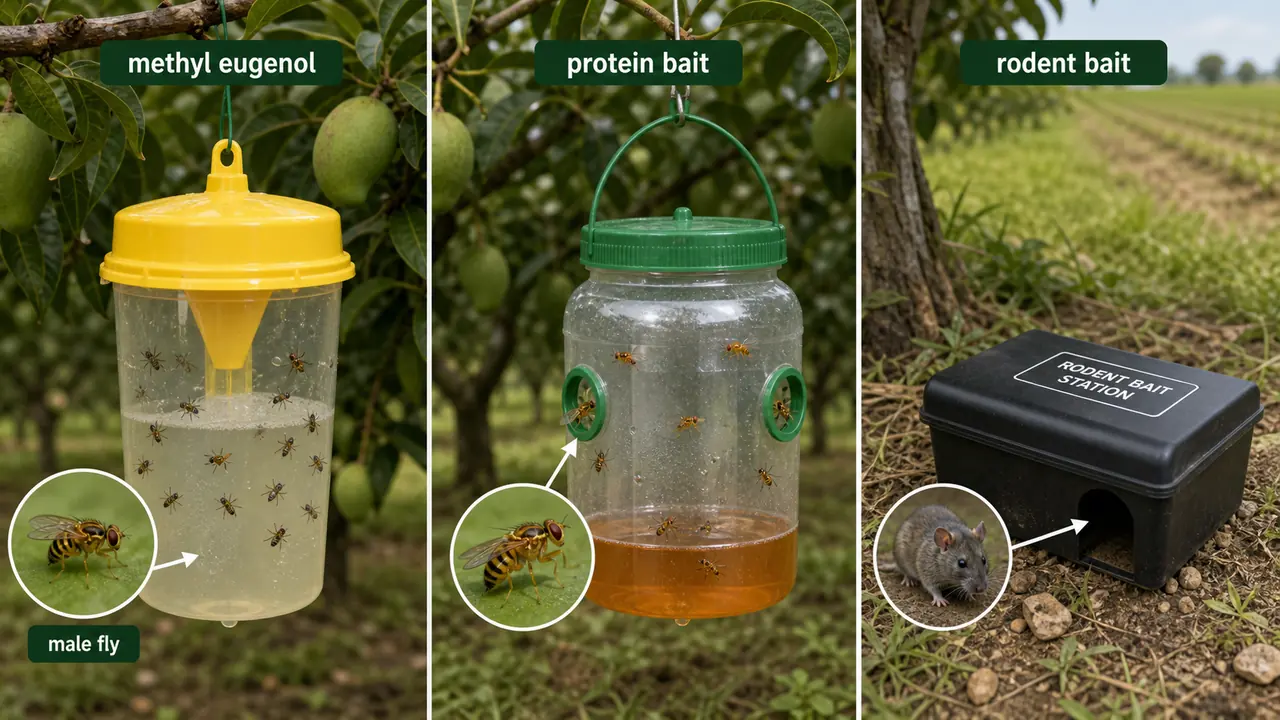
Agricultural example: Mango growers in Andhra Pradesh hang methyl eugenol traps in orchards from March onwards to control Oriental fruit fly (Bactrocera dorsalis) before the fruiting season.
5. Suction Trap
- Works by creating a vacuum that sucks in small flying insects
- Used for monitoring aphid populations in the field
- Particularly useful for catching insects that are too small for other trap types
6. Pit Fall Trap
- A container (jar or cup) buried flush with the ground surface
- Contains water + detergent or preservative fluid
- Used for trapping ground-dwelling beetles, spiders, and other crawling arthropods
- Provides continuous, passive monitoring without human presence
7. Probe Trap
- Inserted into soil to intercept insects emerging from soil after pupation
- Used to monitor emergence timing of soil-pupating pests
- Helps determine the start of adult flight activity for timing spray decisions
Comparison of Major Trap Types
| Trap Type | Specificity | Target Group | Cost | Best Application |
|---|---|---|---|---|
| Light trap | Low (catches many species) | Nocturnal flying insects | Moderate | General pest surveys |
| Pheromone trap | Very high (one species) | Specific moth/borer species | Moderate | ETL-based decision making |
| Yellow sticky trap | Moderate | Whitefly, aphids | Low | Greenhouse monitoring |
| Blue sticky trap | Moderate | Thrips | Low | Greenhouse monitoring |
| Poison bait trap | Moderate | Rodents, fruit flies | Low | Orchard/field edges |
| Pit fall trap | Low | Ground-dwelling arthropods | Very low | Ecological surveys, natural enemy monitoring |
| Suction trap | Low | Small flying insects | High | Research-grade aphid monitoring |
Insect-Trap Matching — Quick Reference
| Target Insect | Best Trap / Equipment | Principle |
|---|---|---|
| BPH (Brown Planthopper) | Water trap | BPH falls into water when plant is tapped |
| Grasshopper | Hand net (sweep net) | Swept through vegetation canopy |
| Whiteflies | Yellow sticky trap, suction trap | Colour attraction + vacuum |
| Nocturnal moths | Light trap | Positive phototaxis |
| Specific moth species | Pheromone trap (sex lure) | Species-specific chemical attraction |
| House fly | Food lure (molasses bait) | Attracted to fermenting sugars |
| Fruit flies | Methyl eugenol trap / Protein hydrolysate bait | Male attractant / MAT technique |
| Melon fruit fly | Cue-lure attractant trap | Species-linked lure used in fruit-fly management |
| Sorghum shoot fly | Fish meal trap | Protein-based attractant for monitoring shoot fly adult activity |
| Thrips | Blue sticky trap | Colour preference |
| Ground beetles | Pit fall trap | Passive ground-level collection |
| Stored grain pests | Pheromone trap | Used for pests such as Sitophilus oryzae, Tribolium castaneum, and Trogoderma granarium |
Which Trap for Which Pest? — Quick Selection Guide
Match the trap to the pest's behaviour:
| Pest Behaviour | Trap Type | Colour/Lure | Where to Place |
|---|---|---|---|
| Flies at night (moths) | Light trap | Mercury vapour / UV bulb | Field edge, 1-2 m height |
| Attracted to yellow (aphid, whitefly) | Yellow sticky trap | Yellow board + grease | Among crop canopy |
| Attracted to blue (thrips) | Blue sticky trap | Blue board + grease | At canopy level |
| Male moth seeking female | Pheromone trap (sex lure) | Species-specific lure | 5-10/ha for monitoring; 25-50/ha for mass trapping |
| Crawls on ground (beetles, earwigs) | Pitfall trap | None needed | Flush with soil surface |
| Falls when tapped (BPH) | Water trap | None | Below plant; tap plants over water tray |
| Fruit fly males | Methyl eugenol trap | Methyl eugenol + malathion | Mango/guava orchards, 10/ha |
| Shoot fly (sorghum, bajra) | Fish meal trap | Protein-based bait | Field edge at sowing time |
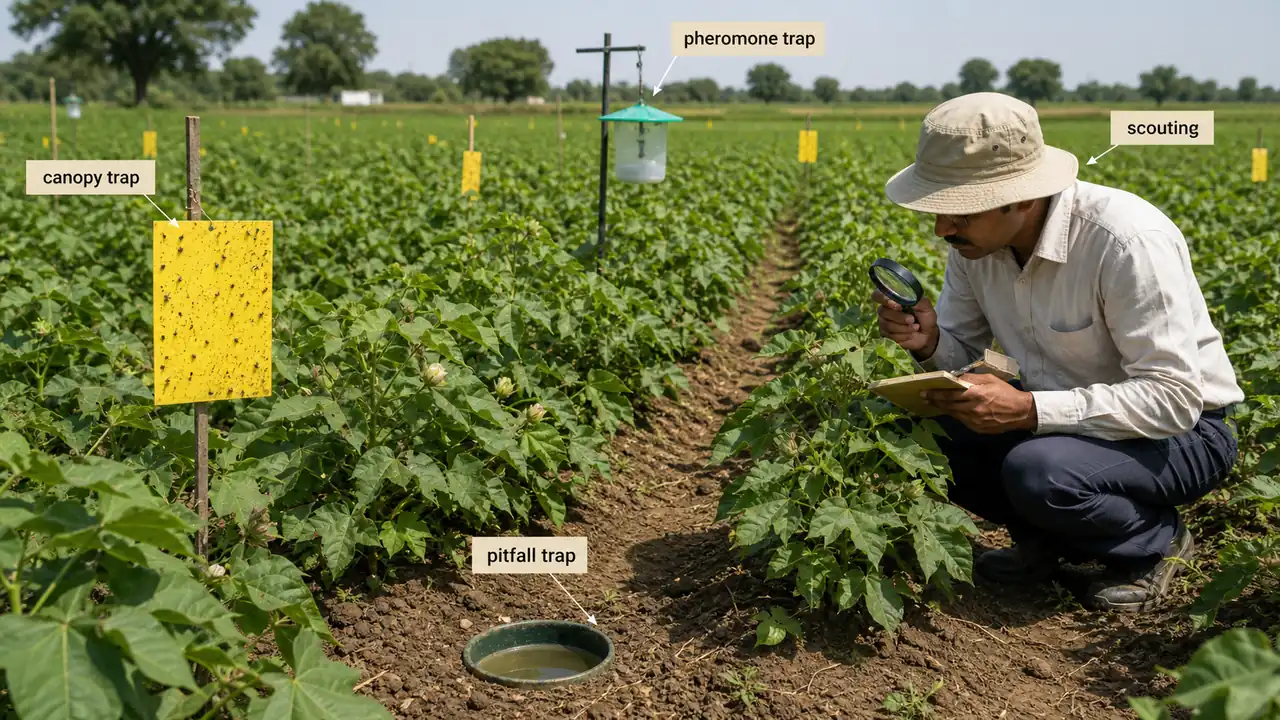
Monitoring vs mass trapping: Use fewer traps (5-10/ha) for monitoring — just to know when pest appears. Use many traps (25-50/ha) for mass trapping — to actually reduce pest population.
Exam Tips
- Bombykol = first identified pheromone (1959, Butenandt). This appears in nearly every entomology exam.
- Pheromone traps catch only males (using female sex pheromone). Mass trapping works by removing males and preventing mating.
- Yellow = whitefly/aphid; Blue = thrips. Simple but tested repeatedly.
- Aggregation pheromone attracts both sexes; sex pheromone attracts one sex. Know the difference.
- Light traps are non-specific; pheromone traps are species-specific. If the question asks about monitoring a specific pest, choose pheromone trap.
- Gossyplure for pink bollworm is derived from Gossypium (cotton genus) — the naming pattern helps recall.
- In IPM, traps are primarily for monitoring (to decide when to act), not for direct pest control. Mass trapping is effective only for some pests.
Summary Table
| Trap Type | Principle | Key Target | Exam-Critical Fact |
|---|---|---|---|
| Light trap | Positive phototaxis | Nocturnal insects (moths, beetles) | Best on moonless nights at canopy level |
| Pheromone trap | Synthetic sex pheromone attracts males | Specific moth/borer species | Bombykol = first pheromone (1959) |
| Yellow sticky trap | Colour attraction | Whitefly, aphids | Yellow for whitefly |
| Blue sticky trap | Colour attraction | Thrips | Blue for thrips |
| Poison bait trap | Food + toxicant | Rodents, fruit flies | Methyl eugenol for fruit flies |
| Pit fall trap | Ground-level passive collection | Ground beetles, spiders | Buried flush with soil surface |
| Suction trap | Vacuum | Small flying insects (aphids) | Research-grade monitoring tool |
Summary Cheat Sheet
| Concept / Topic | Key Details |
|---|---|
| Bombykol | First pheromone identified (1959, Butenandt); from silkworm Bombyx mori |
| Gossyplure | Pheromone of pink bollworm (Pectinophora gossypiella); from Gossypium (cotton) |
| Helilure | Pheromone of gram pod borer (Helicoverpa armigera) |
| Sex vs Aggregation | Sex pheromone attracts one sex; aggregation pheromone attracts both sexes |
| Yellow sticky trap | Targets whitefly and aphids |
| Blue sticky trap | Targets thrips |
| Light trap | Non-specific; best on moonless nights at canopy level; for nocturnal insects |
| Pheromone trap | Species-specific; used for ETL-based decisions and mass trapping |
| Methyl eugenol | Attracts male fruit flies (Bactrocera dorsalis); used in mango orchards |
| Pit fall trap | Buried flush with soil; targets ground-dwelling beetles and spiders |
| 3 pheromone uses | Monitoring, Mass trapping, Mating disruption |
TIP
Next: Lesson 08 covers Applied Concepts — diapause, pollination syndromes, invasive pests, and legal control — tying entomology to the broader agricultural picture.