🦗 Applied Concepts — Diapause, Pollination, Invasive Pests, and Legal Control
Insect diapause stages and triggers, pollination syndromes and their agents, pests accidentally introduced into India with countries of origin, and legal control measures including DIPA 1914, Insecticides Act 1968, and quarantine systems
Connecting Entomology to the Bigger Agricultural Picture
The previous seven lessons covered pest classification, IPM principles, and specific control methods — cultural, physical, mechanical, biological, chemical, botanical, and trapping. This final lesson in the pest management series ties together four applied topics that connect entomology to the broader agricultural picture.
Not all entomology is about killing pests. Insects also play vital roles — bees pollinate crops, and certain life-cycle strategies like diapause determine when pests appear and how they survive harsh seasons. Meanwhile, some of India's worst agricultural pests were never native — they arrived accidentally from other countries, which is why quarantine laws exist.
This lesson covers:
- Diapause — how insects survive harsh seasons through programmed dormancy
- Pollination syndromes — insect-flower associations and their terminology
- Invasive pests — accidentally introduced pests and their countries of origin
- Legal control — DIPA 1914, Insecticides Act 1968, quarantine systems
Ecology Primer
Before pest management is applied, entomology first asks an ecological question: how does an insect relate to its environment?
Pro Content Locked
Upgrade to Pro to access this lesson and all other premium content.
Charged once for one year · ₹1188 total
Save ₹100/month vs ₹2388/year launch price
- All Agriculture & Banking Courses
- AI Lesson Questions (100/day)
- AI Doubt Solver (50/day)
- Glows & Grows Feedback (30/day)
- AI Section Quiz (20/day)
- 22-Language Translation (100/day)
- Recall Questions (20/day)
- AI Quiz (15/day)
- AI Quiz Paper Analysis (100/day)
- AI Step-by-Step Explanations (100/day)
- Spaced Repetition Recall (FSRS)
- AI Tutor
- Immersive Text Questions
- Audio Lessons — Hindi & English
- Mock Tests & Previous Year Papers
- Summary & Mind Maps
- XP, Levels, Leaderboard & Badges
- Generate New Classrooms
- Voice AI Teacher (AgriDots Live)
- AI Revision Assistant
- Knowledge Gap Analysis
- Interactive Revision (LangGraph)
🔒 Secure one-time yearly payment via Razorpay · No hidden fees
Connecting Entomology to the Bigger Agricultural Picture
The previous seven lessons covered pest classification, IPM principles, and specific control methods — cultural, physical, mechanical, biological, chemical, botanical, and trapping. This final lesson in the pest management series ties together four applied topics that connect entomology to the broader agricultural picture.
Not all entomology is about killing pests. Insects also play vital roles — bees pollinate crops, and certain life-cycle strategies like diapause determine when pests appear and how they survive harsh seasons. Meanwhile, some of India's worst agricultural pests were never native — they arrived accidentally from other countries, which is why quarantine laws exist.
This lesson covers:
- Diapause — how insects survive harsh seasons through programmed dormancy
- Pollination syndromes — insect-flower associations and their terminology
- Invasive pests — accidentally introduced pests and their countries of origin
- Legal control — DIPA 1914, Insecticides Act 1968, quarantine systems
Ecology Primer
Before pest management is applied, entomology first asks an ecological question: how does an insect relate to its environment?
- An ecotype is a locally adapted strain or population of a species suited to a particular environmental set of conditions.
- Autecology is the branch of ecology that studies an individual organism or single species in relation to its environment.
- Synecology is the branch of ecology that studies groups of organisms or communities as an associated unit.
- A guild is a group of species that exploit a common resource in a similar manner, even if they are not closely related taxonomically.
- Organisms living on the bottom of an aquatic habitat are termed benthos.
- The living place of an organism is its habitat, while its functional role in the community is its niche.
- In practical agricultural entomology, autecology helps explain why a specific pest thrives only under certain host, moisture, temperature, or seasonal conditions.
Ecological Interactions and Population Ideas
- In defensive resemblance, Batesian mimicry occurs when a palatable or harmless species resembles an unpalatable or harmful one, whereas Mullerian mimicry occurs when two or more genuinely harmful/distasteful species converge in appearance.
- Gause's competitive exclusion principle states that two species cannot coexist indefinitely on the same single limiting resource without some form of separation or displacement.
- In practice, coexistence among similar species is often made possible by temporal or spatial segregation, or by use of different microhabitats.
- Competition within members of the same species is called intraspecific competition, while competition between different species is called interspecific competition.
- In older social-ecology terminology, insects sharing a common nest site but not cooperating in brood care are described as communal.
- In broad feeding-ecology language, insects feeding on living plants are herbivores, while those feeding on dead and decaying organic matter are described as scavengers or detritus-feeders.
- In a grazing food chain, energy flow begins with green plants, then passes to herbivores and carnivores. In a detritus food chain, it begins with dead organic matter, then moves through microorganisms, detritus-feeders, and their predators.
- A commonly used population-change expression is: N_t = N_0 + B - D + I - E where B = births, D = deaths, I = immigration, and E = emigration. In this language, natality simply means the birth rate.
- A population growth curve is usually described as either S-shaped / sigmoid (logistic, restricted growth) or J-shaped (exponential growth).
- In broad life-history terms, r-strategists show high reproductive rate and low survival in unstable or hostile environments, whereas K-strategists show lower reproductive rate but higher survival in more stable environments.
- A pest outbreak means a rapid rise in pest density by several orders of magnitude. Common drivers include destruction of natural enemies, monoculture, favourable weather, heavy nitrogen fertilisation, reduced mortality, pesticide resistance, and introduction of susceptible varieties or new crops.
- A life table is a structured summary of death rates, survival chances, causes of mortality, and life expectancy across different age or stage intervals. Older entomology notes classically link this concept with Raymond Pearl (1924).
- Classical population-regulation notes also mention:
- Pimentel (1961): genetic feedback interpretation of population regulation
- Milne (1962): joint action of density-dependent and density-independent factors
- Andrewartha and Birch (1954): emphasis on resources, inaccessibility, and shortage of time
- Nicholson (1933): population regulation mainly through density-dependent factors
1. Diapause — How Insects Survive Harsh Seasons
What Is Diapause?
Diapause is a genetically programmed physiological state of dormancy in insects, with specific initiating and inhibiting conditions.
Key distinctions:
- Diapause is not simple dormancy or quiescence (which is a direct response to current conditions)
- Diapause is initiated before adverse conditions actually arrive — it is anticipatory
- The diapause hormone is secreted by neurosecretory cells in the insect brain
- It is a highly evolved adaptation for surviving cyclic environmental extremes (winter cold, summer heat, drought)
- Older recall notes also link the term diapause with Wheeler.
Agricultural significance: A cotton farmer wonders why pink bollworm appears every year despite clean cultivation. The answer is diapause — the larvae enter diapause in the soil and survive the off-season, emerging when the next cotton crop is planted.
IMPORTANT
Diapause vs quiescence is a frequently tested distinction. Diapause is genetically programmed and begins before adverse conditions. Quiescence is a direct, immediate response to current unfavourable conditions and ends as soon as conditions improve.
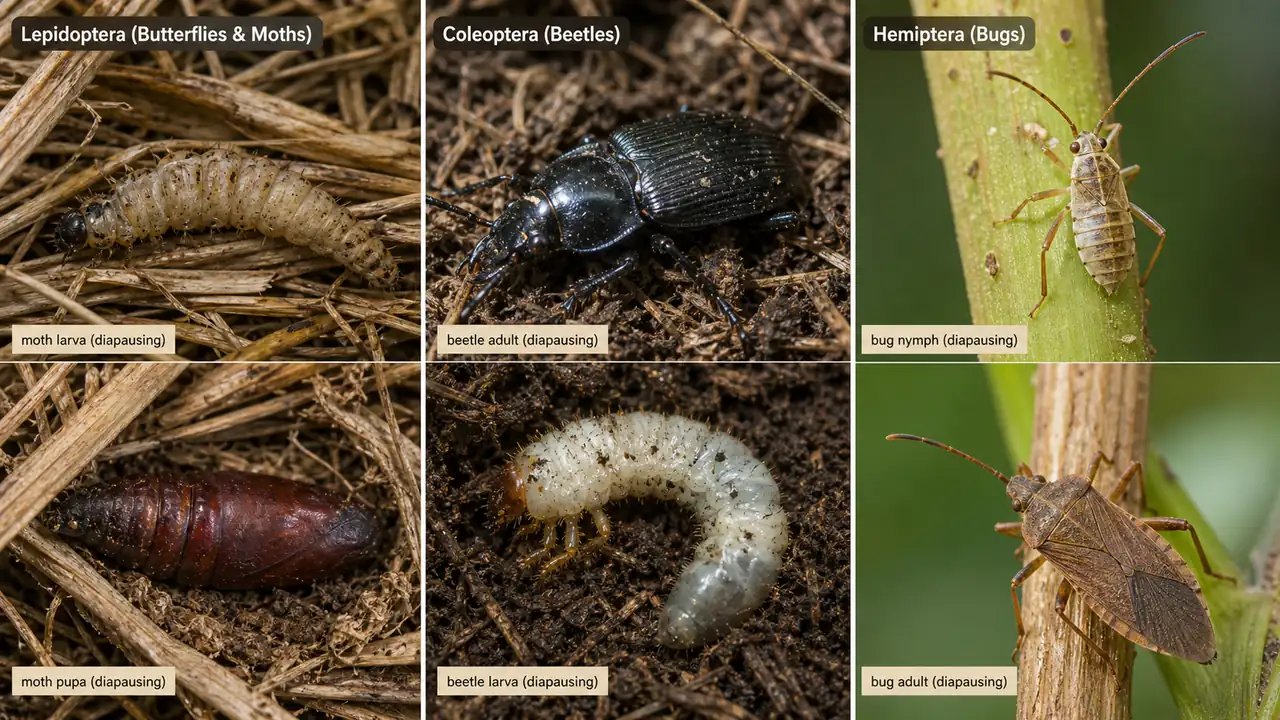
Diapause Stages in Different Insects
Different insect species enter diapause at different life stages. This table is heavily tested.
| Diapause Stage | Example Insect | Agricultural Relevance |
|---|---|---|
| Egg diapause | Grasshopper | Eggs survive dry season in soil |
| Embryo diapause | Silkworm (Bombyx mori) | Determines voltinism (uni/bivoltine) in sericulture |
| Larval diapause | Pink bollworm | Larvae survive off-season in soil/cotton bolls |
| Prepupal diapause | Indian meal moth (Plodia interpunctella) | Survives in stored grain between harvests |
| Pupal diapause | Red hairy caterpillar, Cabbage butterfly | Pupae survive winter in soil |
| Adult diapause | White grub (beetle) | Adults survive underground during unfavourable months |
Diapause by Insect Order
Each major insect order has characteristic diapause stages. This pattern helps in recall.
| Insect Order | Common Diapause Stages | Memory Aid |
|---|---|---|
| Lepidoptera (moths, butterflies) | Mostly larvae and pupae | Lepidoptera = Larvae & pupae |
| Coleoptera (beetles) | Mostly adults and larvae | Coleoptera = adults Carry on (adults survive) |
| Hemiptera (bugs) | Nymphs and adults | Hemiptera = both Halves of life (nymph + adult) |
TIP
Quick recall: Lepidoptera diapause in immature stages (larvae/pupae). Coleoptera diapause in mature stages (adults mainly). Hemiptera diapause in both nymph and adult stages.
2. Pollination Syndromes — Insects as Crop Helpers
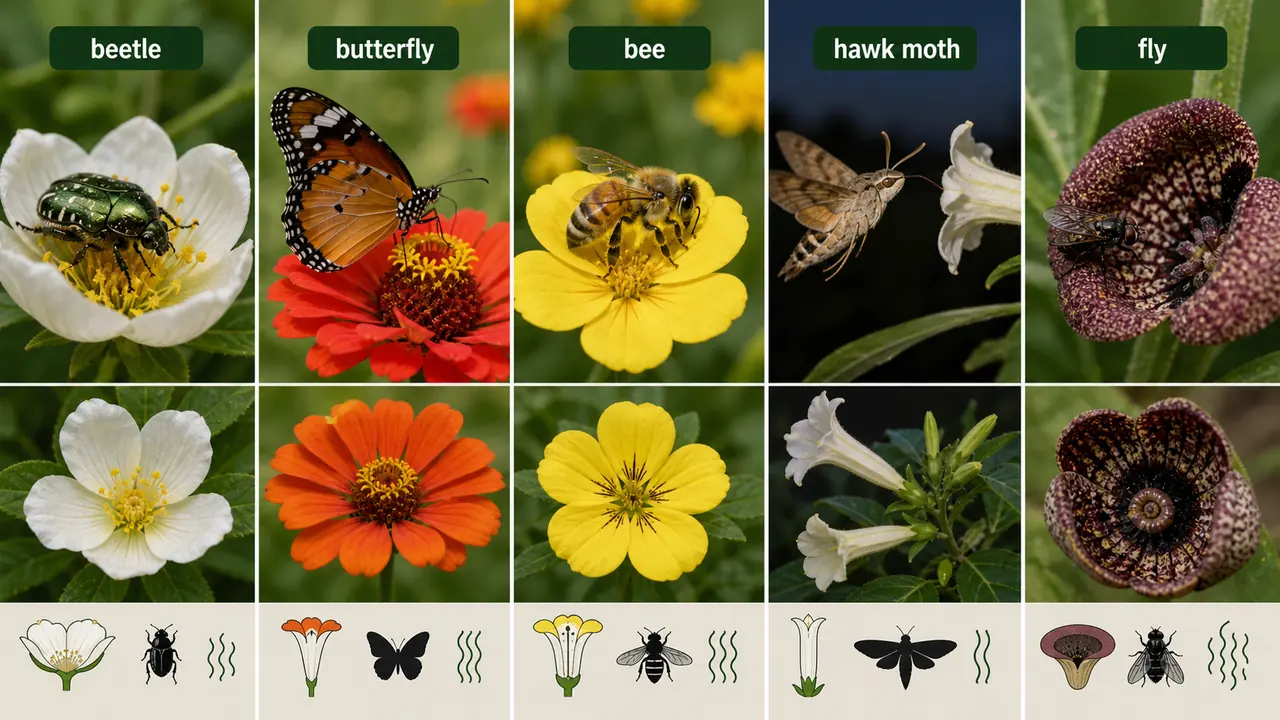
Pollination syndrome refers to the set of flower characteristics (colour, shape, scent, nectar) that have evolved to attract specific pollinators. For entomology exams, you need to know which insect group is associated with each syndrome name.
- Entomophily means pollination carried out by insects in general, while mellitophily refers specifically to bee pollination.
- A commonly used exam-style generalization is that a very large share of flowering-plant pollination, often recalled around 85%, is carried out by insects.
| Pollination Syndrome | Pollinating Agent | Flower Characteristics |
|---|---|---|
| Cantharophily | Beetles | Dull-coloured, strong-scented, bowl-shaped flowers |
| Psychophily | Butterflies | Bright, upright flowers with landing platform |
| Mellitophily | Bees | Yellow/blue flowers, sweet scent, nectar guides |
| Sphingophily | Hawk moths | White/pale flowers, strong night scent, deep tubes |
| Phaleophily | Small moths | Pale flowers, open at night, mild scent |
| Saprophily | Carrion/dung flies | Dark, foul-smelling flowers (mimic rotting flesh) |
TIP
Mnemonic — "Can Psycho Mel Sphinx Fly Safely?"
- Cantharophily = beetles
- Psychophily = butterflies
- Mellitophily = bees (mel = honey in Latin)
- Sphinxophily = hawk moths (sphinx moths)
- Phaleophily = small moths
- Saprophily = flies
NOTE
Mellitophily (bee pollination) is the most commercially important pollination syndrome. Honey bees (Apis spp.) are the most widely managed pollinators, essential for crops like mustard, sunflower, apple, and many vegetables.
3. Pests Accidentally Introduced into India
International trade in plant material has accidentally brought several devastating pests to India. Knowing the pest name and country of origin is a high-yield exam topic (IBPS AFO and NABARD Grade A).
| Pest Name | Country of Origin | Affected Crop/Host | Impact |
|---|---|---|---|
| Cottony cushion scale | Australia | Citrus, ornamentals | Sucking pest; historically devastating |
| Woolly aphid of apple | Europe | Apple | Causes gall formation on roots and branches |
| San Jose scale | China | Apple, pear, plum | Tiny scale insect; damages fruit quality |
| Potato tuber moth | Italy | Potato | Larvae bore into tubers in field and storage |
| Serpentine leaf miner | California (USA) | Vegetables, ornamentals | Larvae mine leaves, reducing photosynthesis |
| Spiralling whitefly | Sri Lanka | Coconut, banana, guava | Sooty mould on honeydew; recent introduction |
IMPORTANT
The Vedalia beetle story: Cottony cushion scale from Australia was devastating California's citrus in the 1880s. In 1888, the Vedalia beetle (Rodolia cardinalis) was introduced from Australia as a predator — and it completely controlled the scale. This is the most famous classical biological control success in history and a favourite exam question.
TIP
Memory aid for pest origins:
- Australia → Cottony cushion scale (A-CC)
- China → San Jose scale (C-SJ)
- Italy → Potato tuber moth (I-PT)
- USA → Serpentine leaf miner (US-SL)
- Europe → Woolly aphid (E-WA)
Older invasive-pest entry recall sometimes asked with biocontrol: San Jose scale (1879) → Encarsia perniciosi; woolly apple aphid (1889) → Aphelinus mali; cottony cushion scale (1920) → Rodolia cardinalis; coconut eriophyid mite (1997) → Amblyseius / Neoseiulus spp. and Hirsutella thompsonii.
More Recent Invasive-Pest Recall in India
- Later exam-oriented invasive-pest chronology often continues with:
- Cotton mealybug (Phenacoccus solenopsis) — around 2006; linked with parasitoid Aenasius bambawalei
- Papaya mealybug (Paracoccus marginatus) — around 2007; commonly linked with Cryptolaemus montrouzieri
- Tomato leaf miner (Tuta absoluta) — around 2014; often paired in recall with Trichogramma spp.
- Rugose spiralling whitefly (Aleurodicus rugioperculatus) — around 2016; linked with Encarsia guadeloupae
- Fall armyworm (Spodoptera frugiperda) — first reported in India in 2018; linked with Telenomus remus, Trichogramma spp., and Campoletis chloridae
- Neotropical whitefly (Aleurotrachelus atratus) — around 2019; commonly summarized with Encarsia spp.
Applied Pest Management Concepts
Resurgence and Resistance
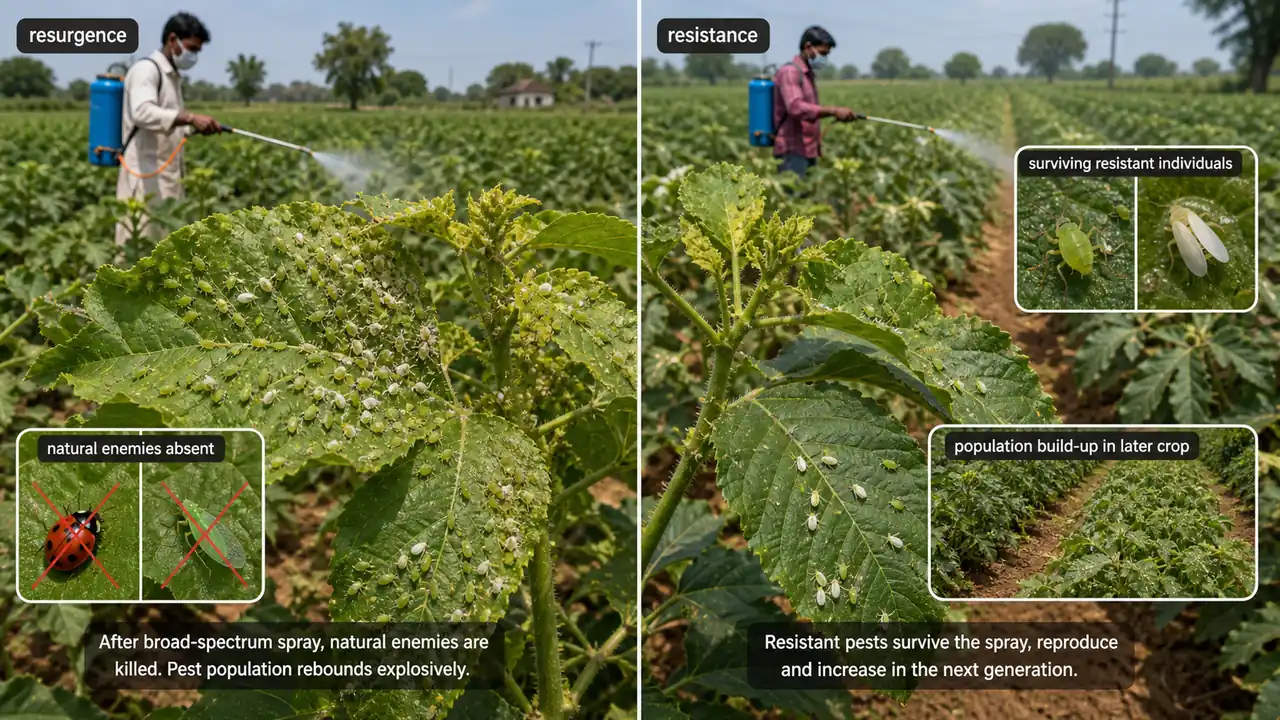
Resurgence is defined as the abnormal increase in a target pest population after spraying, caused by the selective killing of natural enemies (predators and parasitoids) that kept the pest population in check. The pest recovers faster than its natural enemies, resulting in population levels higher than pre-spray levels.
- Maximum resurgence recorded in: Homoptera (44%) and Lepidoptera (24%)
IMPORTANT
Resurgence vs Resistance — frequently confused:
- Resurgence = pest INCREASES after spray (natural enemies destroyed more than pest)
- Resistance = pest is NO LONGER killed by spray (genetic adaptation in pest)
Insect Vectors of Plant Viruses
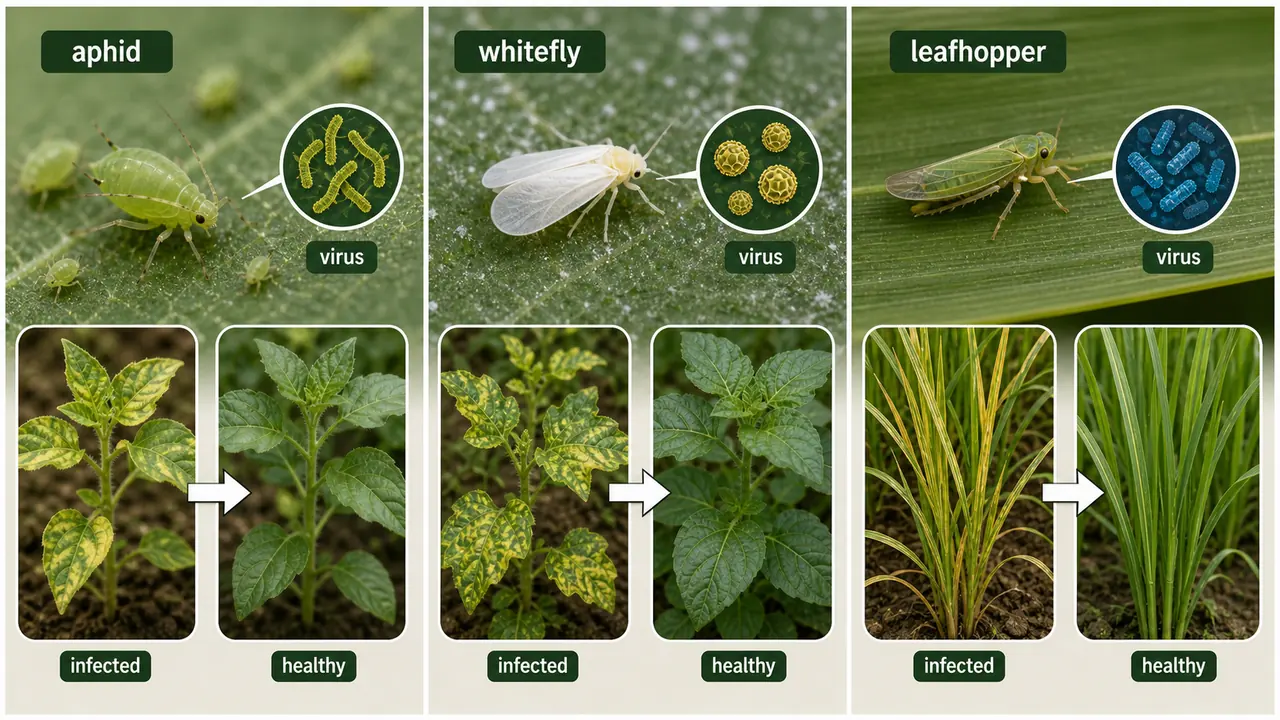
- Over 70% of insect vectors of plant viruses belong to Hemiptera (aphids, whiteflies, planthoppers, leafhoppers)
- This is why systemic insecticides applied as seed treatments are critical for virus management in crops
- Aphids are the most common plant-virus vectors, and potyviruses are classically remembered as the major aphid-transmitted virus group
- Transmission language is easiest to keep in three conceptual classes:
- Non-circulative / stylet-borne / non-persistent — the virus does not cross the gut wall, so acquisition and inoculation are rapid
- Circulative / persistent — the virus crosses the gut and circulates inside the vector before inoculation
- Circulative-propagative — the virus not only circulates but also multiplies inside the vector
- Older quick-recall tables often attach whiteflies mainly to semi-persistent and persistent transmission patterns, though final disease revision should still be learned crop by crop
Blister Beetle — Dual Role
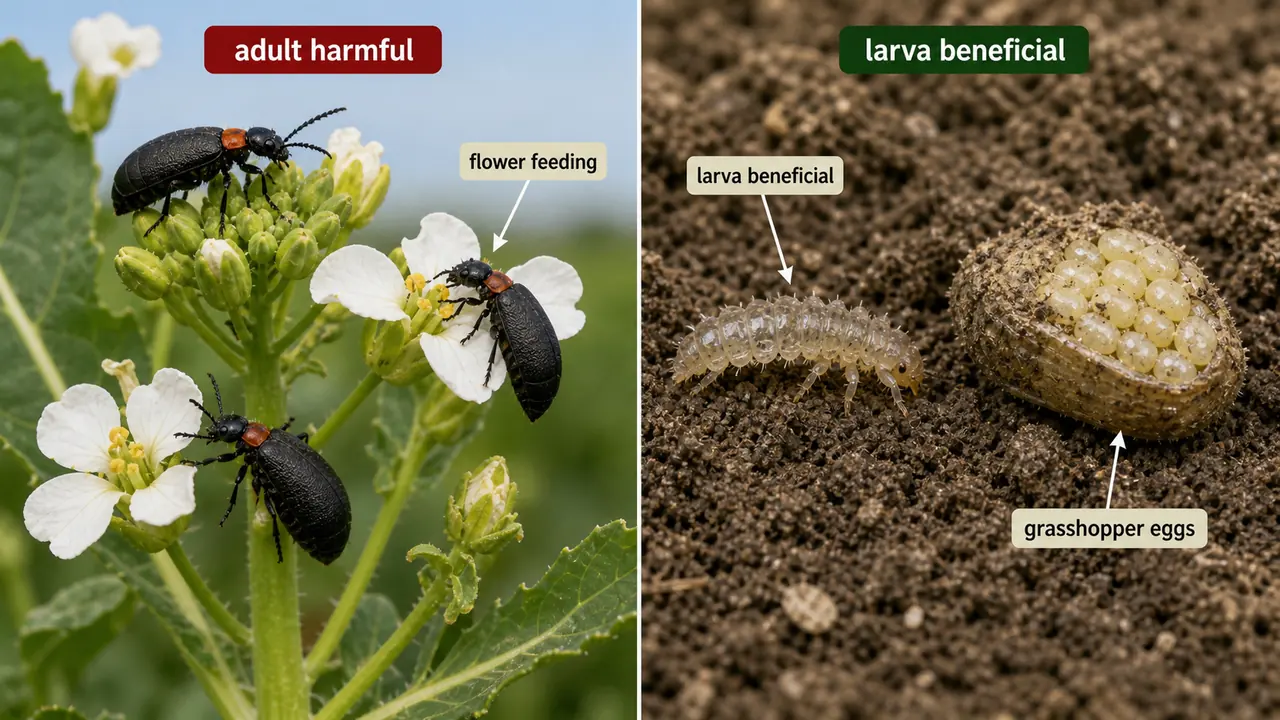
The blister beetle has a fascinating dual role in agriculture:
- Adult (harmful): Feeds on flower buds and flowers; prefers yellow and orange flowers; can cause significant crop loss at flowering
- Larva (beneficial): Larvae are hypermetamorphic — they go through multiple larval forms. Early-stage larvae (triungulins) are mobile and seek out grasshopper egg pods in soil, feeding on them. This makes them biocontrol agents against grasshoppers.
Moisture as Abiotic Factor
Moisture = abiotic factor with no lethal effect on insects (unlike temperature extremes which can kill insects directly). Moisture affects insect behaviour, distribution, and reproduction — but rarely kills insects outright. This is a conceptual distinction tested in exams.
Soil Solarisation and Flooding Against Nematodes
Soil solarisation + flooding = most effective environmental/physical methods against nematodes in soil. These raise soil temperature above nematode survival thresholds and deprive them of oxygen.
Ecological Control
Any deliberate manipulation of the environment intended to reduce pest numbers is broadly described as ecological control. In practice this overlaps strongly with cultural and habitat-management tactics inside IPM.
4. Legal Control (Regulatory Control)
Legal control uses legislation and quarantine measures to prevent the introduction of new pests and restrict the spread of existing ones. It is the only pest management method backed by the force of law.
Key Acts and Organizations
| Act / Organization | Year | Key Detail |
|---|---|---|
| DIPA (Destructive Insect Pest Act) | 1914 | Oldest pest-related legislation in India; empowers government to restrict import/movement of plant material |
| DPPQS (Directorate of Plant Protection, Quarantine & Storage) | 1946 | Headquartered at Faridabad, Haryana; nodal agency for plant protection |
| Insecticides Act | 1968 | Regulates import, manufacture, sale, transport, distribution, and use of insecticides |
| Plant Quarantine Order | 2003 (amended) | Regulates import of plants and plant materials; lists restricted and prohibited items |
TIP
DIPA year mnemonic: DIPA = Destructive Insect Pest Act, 1914. The digits "14" match — DIPA ends with A, and 14 has the same "one-four" rhythm as D-I-P-A (4 letters, year ending in 4).
Types of Quarantine
| Type | Scope | Example |
|---|---|---|
| Domestic quarantine | Restricts movement of plant material within India | Preventing mango material from moving from fruit-fly-infested zones to pest-free zones |
| Foreign quarantine | Regulates import/export across national borders | Inspecting imported apple consignments from the USA for codling moth |
Purposes of Quarantine
- Prevent introduction of exotic pests into the country
- Prevent spread of existing pests from infested to non-infested areas
- Certify that exported plant material is pest-free (phytosanitary certificates)
- Regulate the movement of planting material, germplasm, and seeds
NOTE
India has 37 plant quarantine stations at major ports, airports, and land borders, functioning under DPPQS. The main stations are at Chennai, Mumbai, Kolkata, Delhi, and Amritsar.
Comparison: Diapause vs Quiescence vs Hibernation
| Feature | Diapause | Quiescence | Hibernation |
|---|---|---|---|
| Trigger | Genetically programmed; anticipatory | Direct response to current conditions | Seasonal cold/food scarcity |
| Onset | Before adverse conditions arrive | When adverse conditions begin | When winter begins |
| Duration | Fixed; not ended by brief favourable spells | Ends immediately when conditions improve | Ends with spring |
| Hormonal control | Yes (neurosecretory cells) | No specific hormonal control | Yes (in mammals/reptiles) |
| Occurs in | Insects (specific to one life stage) | Many organisms | Mammals, reptiles (not insects) |
| Example | Pink bollworm larval diapause | Aphids becoming inactive during brief cold snap | Bear hibernation |
Seasonal Dormancy Language
- In older agriculture-entomology wording, hibernation is used for winter dormancy associated with temperatures below the optimum, while aestivation is used for summer dormancy associated with temperatures above the optimum.
- These labels help describe seasonal suppression of development, but the key conceptual distinction remains that diapause is programmed whereas quiescence resumes immediately once favourable conditions return.
Cold Hardiness and Supercooling
- Insects survive winter through cold hardiness: the capacity to resist chilling or freezing injury.
- One important mechanism is supercooling, where body fluids remain liquid below their normal freezing point.
- Common cryoprotectants include sugars and polyols such as sorbitol, erythritol, mannitol, and glycerol, which help depress the freezing point and protect tissues.
Practical Application: When Does Diapause Matter for Pest Control?
Understanding diapause helps you time control measures:
| Crop-Pest | Diapause Stage | When Diapause Breaks | What to Do |
|---|---|---|---|
| Pink bollworm in cotton | Larva (in old bolls/soil) | Early monsoon; rising temperature + moisture | Destroy old cotton stalks by April-May; deep plough to expose diapausing larvae |
| Rice stem borer | Larva (in stubble) | Start of next rice season | Destroy stubble after harvest; flood fields |
| White grub | Grub (in soil) | First monsoon rains (adults emerge) | Collect adults from neem trees in June-July evenings |
| Red hairy caterpillar | Pupa (in soil) | First monsoon rains | Deep ploughing in May exposes pupae to sun and predators |
The key insight: Most pests diapause in a predictable location (soil, stubble, old fruit). If you destroy that location before diapause breaks, you break the pest's life cycle — this is the cheapest and most effective control strategy.
Exam Tips
- DIPA 1914 — the year is the most commonly tested fact in legal control. Know it cold.
- Diapause is anticipatory; quiescence is reactive. If the question says "genetically programmed dormancy," the answer is diapause.
- Bombykol (silkworm pheromone) and diapause in silkworm (embryo stage) are two separate facts about Bombyx mori — do not confuse them.
- Mellitophily = bee pollination — "mel" means honey, linking to bees.
- Cottony cushion scale links three exam facts: (a) from Australia, (b) controlled by Vedalia beetle, (c) landmark biological control success of 1888.
- 37 quarantine stations under DPPQS — the number is asked directly.
- Pink bollworm has larval diapause and its pheromone is Gossyplure — two facts about the same pest from different topics.
Summary Table
| Topic | Key Facts to Remember |
|---|---|
| Diapause | Genetically programmed dormancy; anticipatory; hormone from neurosecretory cells |
| Diapause stages | Egg (grasshopper), Embryo (silkworm), Larval (pink bollworm), Pupal (red hairy caterpillar), Adult (white grub) |
| Pollination syndromes | Mellitophily (bees) most important; Cantharophily (beetles); Psychophily (butterflies) |
| Invasive pests | Cottony cushion scale (Australia), San Jose scale (China), Potato tuber moth (Italy) |
| Vedalia beetle | Rodolia cardinalis; controlled cottony cushion scale; 1888; landmark biocontrol |
| DIPA | 1914; oldest pest legislation in India |
| DPPQS | Faridabad; 37 quarantine stations; nodal agency for plant protection |
| Insecticides Act | 1968; regulates manufacture, sale, and use of insecticides |
| Quarantine types | Domestic (within India) and Foreign (cross-border) |
Summary Cheat Sheet
| Concept / Topic | Key Details |
|---|---|
| Diapause | Genetically programmed dormancy; anticipatory (begins before adverse conditions); hormone from neurosecretory cells |
| Diapause vs Quiescence | Diapause = programmed, anticipatory; Quiescence = reactive, ends when conditions improve |
| Egg diapause | Grasshopper — eggs survive dry season in soil |
| Embryo diapause | Silkworm (Bombyx mori) — determines voltinism in sericulture |
| Larval diapause | Pink bollworm — larvae survive off-season in soil/bolls |
| Pupal diapause | Red hairy caterpillar, cabbage butterfly — pupae survive winter |
| Adult diapause | White grub (beetle) — adults survive underground |
| Mellitophily | Bee pollination — most commercially important; "mel" = honey |
| Cantharophily | Beetle pollination — dull, strong-scented flowers |
| Cottony cushion scale | From Australia; controlled by Vedalia beetle (1888) — landmark biocontrol |
| San Jose scale | From China; affects apple, pear, plum |
| Potato tuber moth | From Italy; larvae bore into tubers |
| DIPA | 1914 — oldest pest legislation in India |
| Insecticides Act | 1968 — regulates manufacture, sale, and use of insecticides |
| DPPQS | HQ at Faridabad; 37 quarantine stations at ports, airports, land borders |
| Plant Quarantine Order | 2003 (amended) — regulates import of plants and plant materials |