👶 Father of Extension Education in India and World — Meaning, Origin and Definitions
Understand the meaning, origin, and evolution of extension education from 1866 England to modern India. Learn key definitions, the fathers of extension, and foundational concepts for IBPS AFO, NABARD Grade A, and FCI exams.
Visual Overview
Why Extension Matters in Agriculture
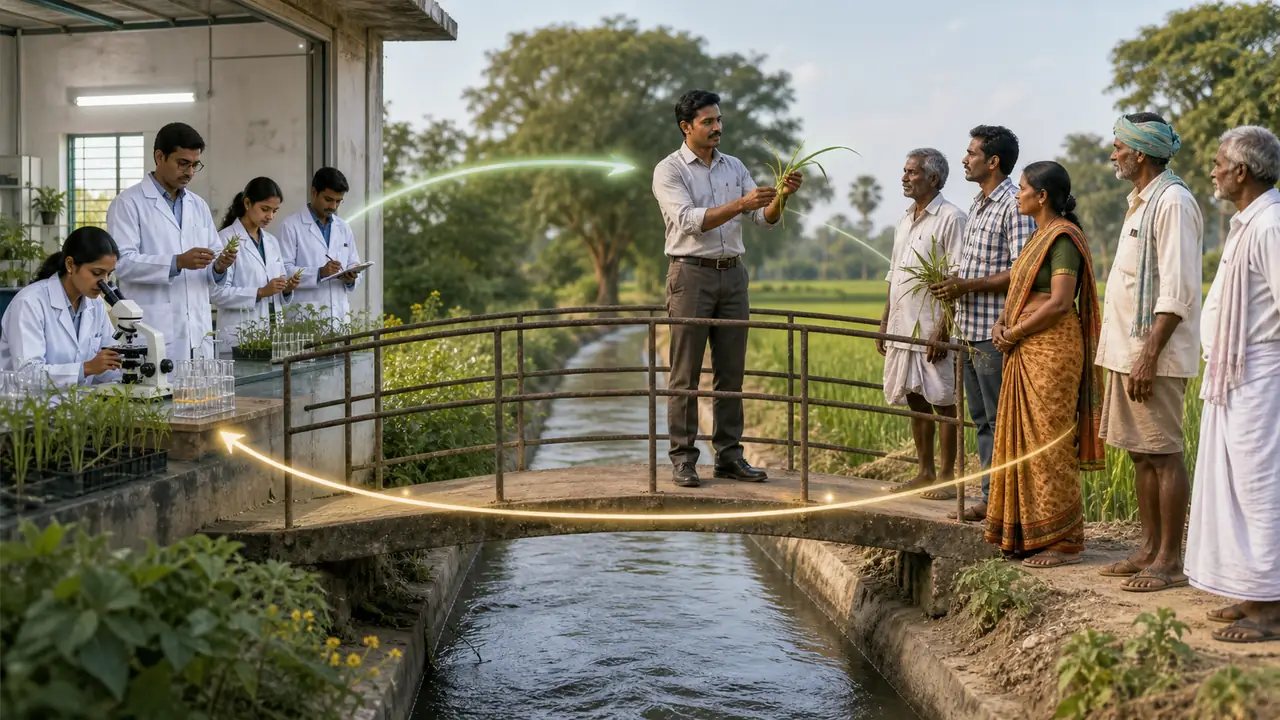
Imagine a scientist at IARI develops a drought-resistant wheat variety that can boost yields by 40%. That discovery means nothing if the wheat farmer in Bundelkhand never hears about it. Extension education is the bridge that carries knowledge from the research laboratory to the farmer's field -- and carries the farmer's problems back to the researcher.
This lesson covers:
- What is Extension? -- etymology, meaning, and definition
- Fathers of Extension -- key personalities in India and globally
- Key Definitions -- education, extension education, and the KAS framework
- Origin Timeline -- how extension education emerged from 1866 England
- Two-Way Bridge -- how extension connects research and farming
All sections are high-yield for IBPS AFO, NABARD Grade A, and FCI exams.
IMPORTANT
Quick answer: Father of Extension Education (Global): Dr. J.P. Leagans; (India): K.N. Singh.
What is Extension?
-
The word 'Extension' is derived from the Latin roots: ex meaning out and tensio meaning stretching. Extension literally means "stretching out" -- taking knowledge beyond the walls of institutions and delivering it to those who need it most.
-
Extension is an out-of-school system of education for rural people. Unlike formal classroom education, it operates in real-world settings such as farms, homes, and community centres.
-
Extension is a type of education to bring desirable change in human behaviour. The instrument used to bring this change is Communication. The core purpose is not merely to share information but to transform how people think, feel, and act.
NOTE
Agricultural example: When a KVK scientist demonstrates the System of Rice Intensification (SRI) to paddy farmers in Tamil Nadu, that is extension in action -- taking research-proven technology directly to the field.
Fathers of Extension
| Title | Person | Context |
|---|---|---|
| Father of Extension Education (Global) | Dr. J.P. Leagans (USA) | Laid foundational concepts and philosophy of extension worldwide |
| Father of Extension Education (India) | K.N. Singh | Pioneered the development of extension education in India |
| Father of University Extension | James Stuart | First practical step -- lectures to Women's Associations and Working Men's Clubs (1867-68) |
| Father of Method Demonstration | Dr. Seeman A. Knapp | First successful farm demonstration (1903, Texas, USA) |
IMPORTANT
Remember the two "fathers" -- Dr. J.P. Leagans is the global Father of Extension Education, while K.N. Singh is the Father of Extension Education specifically in India. This distinction is frequently tested.
Key Definitions
-
Education: Production of desirable changes in human behaviour through gaining desirable Knowledge, Attitude, and Mental and Manual Skill (KAS). In extension, education encompasses practical skills, attitudinal shifts, and behavioural improvements.
-
Extension Education: The type of education that is stretched out to villages and fields beyond the limits of schools and colleges to which formal education is normally confined. It bridges the gap between research institutions and the farming community.
-
Extension education is applied in various fields: Agriculture, Animal Husbandry, Dairy, Veterinary, Health, Home Science, Industry, Cooperative, and Forestry. This wide scope makes it a versatile, multi-disciplinary approach to community development.
Origin of Extension -- A Timeline
| Year | Event | Significance |
|---|---|---|
| 1866 | Term 'extension' originated in England/U.K. | System of University Extension by Cambridge and Oxford |
| 1867-68 | James Stuart gave lectures to Women's Associations and Working Men's Clubs | First practical step; regarded as Father of University Extension |
| 1873 | Cambridge University formally used the term "Extension Education" | Official recognition of extension as a distinct branch of education |
-
The term extension was first used by Vorhees.
-
The objective of university extension was to take the educational innovations and advantages of universities to ordinary people at their doorsteps -- democratising knowledge so that research benefits were not restricted to a privileged few.
-
According to Webster's dictionary, the term "extension" means "Branch of a university for students who cannot attend the university properly."
TIP
Quick Timeline for Extension Origins: 1866 (term originated in UK) → 1867-68 (James Stuart's lectures) → 1873 (Cambridge formally used "Extension Education").
Agricultural Context: Extension as a Two-Way Bridge
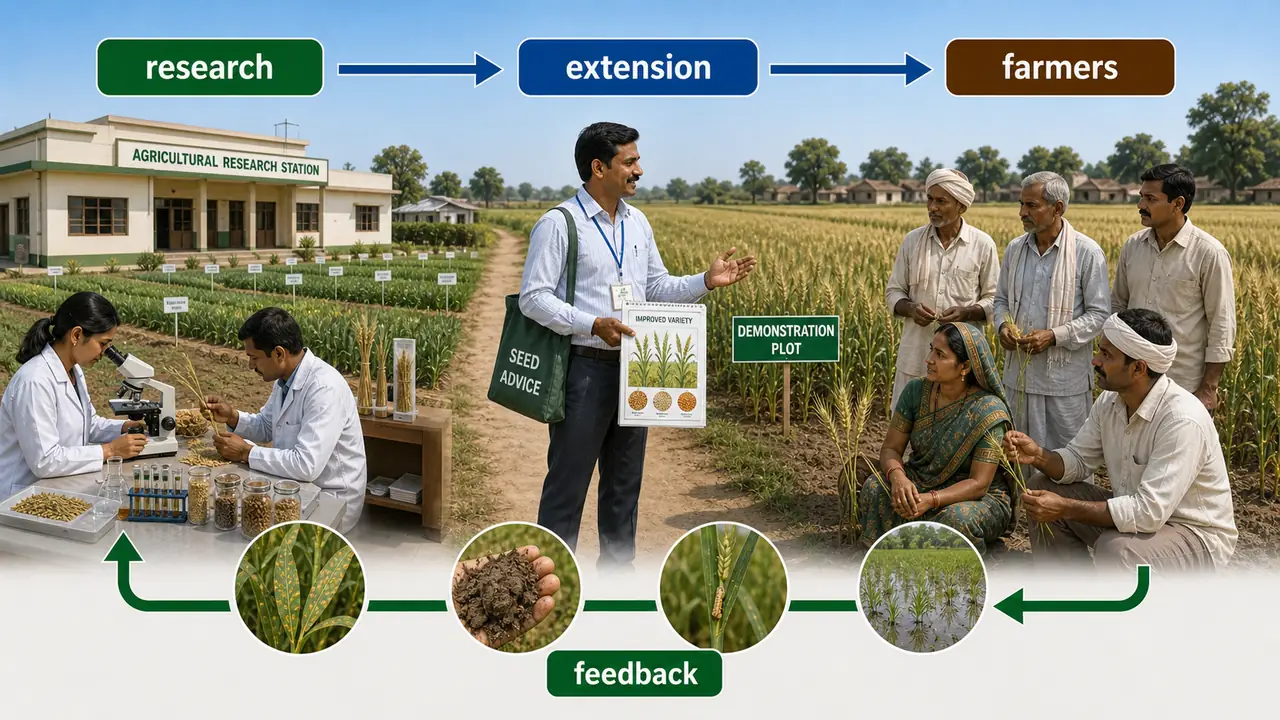
Extension serves as a vital two-way bridge between research laboratories and farmers' fields:
-
Lab to Field: Scientists develop improved seeds, better pest management, and efficient irrigation techniques. Extension workers carry these innovations to farmers through demonstrations, training, and advisory services.
-
Field to Lab: Farmers face real-world challenges -- soil salinity, new pest outbreaks, water scarcity. Extension workers communicate these problems back to researchers, guiding future research priorities.
Example: The success of the Green Revolution in India (1966-67) was not just about developing High Yielding Varieties -- it was the massive extension effort through National Demonstrations, KVKs, and the T&V system that carried those varieties to millions of farmers' fields.
Exam Tips and Mnemonics
TIP
Mnemonic -- "EX-TEN-SION":
- EX = Out (Latin: ex)
- TEN = Stretching (Latin: tensio)
- SION = Education that stretches OUT to rural people
IMPORTANT
Common exam traps:
- Extension is NON-FORMAL education (not formal)
- Extension teaching is HORIZONTAL (not vertical)
- Extension is a TWO-WAY process between farmer and researcher
- The basic concept of extension is EDUCATION
Summary Cheat Sheet
| Concept / Topic | Key Details |
|---|---|
| Extension etymology | Latin: ex (out) + tensio (stretching) |
| Term originated | 1866 in England/UK |
| First used by | Vorhees |
| Formal use of term | 1873 by Cambridge University |
| Father of Extension (Global) | Dr. J.P. Leagans (USA) |
| Father of Extension (India) | K.N. Singh |
| Father of University Extension | James Stuart (1867-68 lectures) |
| Father of Method Demo | Dr. Seeman A. Knapp (1903, Texas) |
| Extension type | Non-formal education; out-of-school |
| Teaching direction | Horizontal (participatory) |
| Extension nature | Two-way process between farmer and researcher |
| Basic concept | Education |
| Instrument of change | Communication |
| Goal | Desirable change in human behaviour (KAS) |
| Education definition | Production of desirable changes in Knowledge, Attitude, Skill |
TIP
Next: Lesson 02 traces the historical development of extension -- from the Morrill Act in America to ICAR, IARI, and the agricultural university system in India.
Frequently Asked Questions
Who is the Father of Extension Education?
Global: Dr. J.P. Leagans (USA). India: K.N. Singh.
When did the term extension originate?
The term 'extension' originated in England (UK) in 1866 (as commonly cited in extension education notes).
Lesson Doubts
Ask questions, get expert answers