📜 Historical Development of Extension -- USA and India, Key Acts, ICAR, IARI and Agricultural Universities
Complete history of extension education covering US development (Morrill Act, Hatch Act, Smith-Lever Act), Indian milestones (Famine Commissions, IARI, ICAR, EEIs, Pantnagar), agricultural universities, NAARM, MANAGE, and key publications for IBPS AFO, NABARD Grade A, and FCI exams.
Historical Development of Extension
In the previous lesson, we explored what extension education means -- its etymology, definition, and founding figures. Now we trace how the extension system actually developed, first in the United States and then in India, through a series of landmark acts, commissions, and institutional milestones.
This lesson covers:
- USA -- Morrill Act, Hatch Act, Smith-Lever Act, and the Land Grant model
- India -- Famine Commissions, IARI, ICAR, agricultural universities, and key institutions
- Key Institutions -- EEIs, NAARM, MANAGE, NIAM
All dates, acts, and institutional names in this lesson are frequently tested in IBPS AFO, NABARD Grade A, and FCI exams.
USA
Understanding the origins of extension in the United States is essential because India's extension system was significantly influenced by the American Land Grant model.
-
To stop the migration of rural people to cities President Roosevelt established County Commission in 1862. This was one of the earliest attempts to address rural-to-urban migration through education and community development.
Pro Content Locked
Upgrade to Pro to access this lesson and all other premium content.
₹99 charged monthly · Cancel anytime
- All Agriculture & Banking Courses
- AI Lesson Questions (100/day)
- AI Doubt Solver (50/day)
- Glows & Grows Feedback (30/day)
- AI Section Quiz (20/day)
- 22-Language Translation (100/day)
- Recall Questions (20/day)
- AI Quiz (15/day)
- AI Quiz Paper Analysis (100/day)
- AI Step-by-Step Explanations (100/day)
- Spaced Repetition Recall (FSRS)
- AI Tutor
- Immersive Text Questions
- Audio Lessons — Hindi & English
- Mock Tests & Previous Year Papers
- Summary & Mind Maps
- XP, Levels, Leaderboard & Badges
- Generate New Classrooms
- Voice AI Teacher (AgriDots Live)
- AI Revision Assistant
- Knowledge Gap Analysis
- Interactive Revision (LangGraph)
🔒 Secure via Razorpay · Cancel anytime · No hidden fees
Historical Development of Extension
In the previous lesson, we explored what extension education means -- its etymology, definition, and founding figures. Now we trace how the extension system actually developed, first in the United States and then in India, through a series of landmark acts, commissions, and institutional milestones.
This lesson covers:
- USA -- Morrill Act, Hatch Act, Smith-Lever Act, and the Land Grant model
- India -- Famine Commissions, IARI, ICAR, agricultural universities, and key institutions
- Key Institutions -- EEIs, NAARM, MANAGE, NIAM
All dates, acts, and institutional names in this lesson are frequently tested in IBPS AFO, NABARD Grade A, and FCI exams.
USA
Understanding the origins of extension in the United States is essential because India's extension system was significantly influenced by the American Land Grant model.
-
To stop the migration of rural people to cities President Roosevelt established County Commission in 1862. This was one of the earliest attempts to address rural-to-urban migration through education and community development.
-
To keep rural people in rural areas "Out of school education" should be given to them, for this Philadelphia Committee was signed. The concept of "out of school education" -- reaching people who were not enrolled in formal educational institutions -- became the foundation of what we now call extension education.
-
Land Grant Colleges came into existence as a part of Morrill Act 1862. The act was passed under the presidency of Abraham Lincoln. JRF 2011/2014 The Morrill Act provided federal land to each state for the establishment of colleges that would teach agriculture and mechanical arts, making higher education accessible to ordinary citizens beyond the traditional elite.
-
Experimental stations came into existence as a part of Hatch Act 1887. These stations were attached to Land Grant Colleges and provided a scientific base for agricultural improvement by conducting research on crops, soils, and farming methods relevant to local conditions.
-
Seed corn trains were organised in Lowa in 1904 by Prof. Holden. These were an innovative early form of mobile extension education, where trains carrying seed samples and educational materials would travel through rural areas.
-
Extension service in USA is K/W Cooperative extension service which came as a consequence of Smith-Lever Act 1914. It is a branch of the land-grant institution. JRF 2011/2017 The Smith-Lever Act formalised the extension system by creating a partnership between the federal government, state governments, and land-grant colleges to deliver practical agricultural knowledge to farmers.
-
Cooperative extension service of USA is composed of Federal services & basic unit for extension service is state. This federal-state partnership structure ensures both national coordination and local relevance of extension programmes.
IMPORTANT
Three Key US Acts to Remember: Morrill Act (1862) → Land Grant Colleges | Hatch Act (1887) → Experimental Stations | Smith-Lever Act (1914) → Cooperative Extension Service.
- In 1885, the concept of demonstration was given by Dr. Seaman A. Knapp. He generated a new variety and demonstrated on one million acre farm in Lausannia. Therefore he is known as Father of Method Demonstration. Farm demonstration work started in 1903 under Dr. Seaman A. Knapp. Dr. Knapp's approach of showing farmers practical results on actual farms rather than just lecturing them became the cornerstone of modern extension methodology worldwide.
India
The development of agricultural extension in India was shaped by colonial-era famines, post-independence institution building, and the adaptation of the American Land Grant model. The key milestones below trace this evolution from the 1860s to the modern era.
Famine Commission 1866 and the First Agricultural Department
Famine commission 1866 recommended establishment of Agriculture department in 1871 in the tenure of Lord Mayo. The devastating famines of the 19th century were the primary catalyst for the British government to invest in agricultural institutions in India. The creation of DRAC was the first institutional step towards organised agricultural development.
The Famine Commission 1880
Recommended revival of Dept. of Agriculture (DOA) under the control of secretary (1881) and all provinces to have 'DOA' (1882). This commission recognised that each province needed its own agricultural department to address region-specific farming challenges.
1891 -- Dr. Voelcker's Report
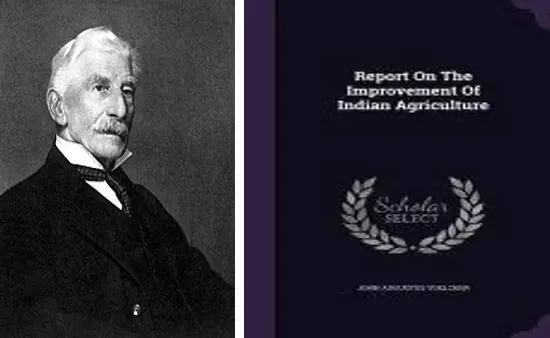
- Dr. J.A. Voelcker's report on Improvement of Indian Agriculture laid the foundation for agricultural research in India.
- The Imperial Biological Laboratory had been established in 1889, providing the institutional base for scientific inquiry.
Dr. Voelcker, a British chemist, conducted a comprehensive study of Indian agriculture and concluded that Indian farming methods were largely sound but could benefit from scientific improvements in areas like irrigation, soil management, and pest control. His report is considered a landmark document in the history of Indian agricultural development.
1892 -- First Research Appointments
Agriculture chemist and assistant chemist were appointed to look after research and teaching. This marked the beginning of scientific research in Indian agriculture with dedicated personnel.
The Famine Commission 1901
- Recommended the appointment of experts capable of applying scientific methods to the improvement of agriculture.
- Setting up of Imperial Agricultural Research Institute at Pusa, Bihar in 1905 was established. This institute became the premier agricultural research institution in India and laid the groundwork for modern agricultural science in the country.
- First Irrigation Commission 1901
1901-05 -- First Agricultural Colleges
- Six agricultural colleges were set up at Pune, Nagpur, Kanpur, Sabour, Coimbatore, and Lyallpur (now in Pakistan). These six colleges were among the first formal institutions for agricultural education in India, training the next generation of agricultural scientists and administrators.
The Government of India Act 1919
- Empowered the transfer of all the departments closely connected with rural development to the major provinces and agriculture become the state subject. This constitutional change meant that individual provinces (later states) became responsible for agricultural policy, education, and extension. Even today, agriculture remains a state subject under the Indian Constitution, which is why agricultural policies and programmes vary from state to state.
The Royal Commission on Agriculture in India 1928
- It paved the way for development of Extension in India. This commission is considered the most important milestone in the history of Indian agricultural extension because it specifically recommended systematic efforts to take research findings to farmers' fields.
- Visual demonstration to motivate farmers in farmer's field & appointment of Director of agriculture etc.
NOTE
The Royal Commission on Agriculture (1928) is often called the turning point for extension in India. It not only recommended taking science to farmers but also led to the establishment of ICAR in 1929.
Extension Education Institutes (EEIs)
- To cater extension education and training needs of the large number of extension professionals in the country, four Extension Education Institutes (EEIs) were established in India at the regional level. These institutes serve as regional training centres that build the capacity of extension workers across the country. These were:
- Nilokheri in Haryana (1959): [Haryana Institute of Rural Development, HIRD]
- Anand in Gujarat (1962)
- Hyderabad in Andhra Pradesh (1962)
- Jorhat in Assam (1987)
Objectives of creating EEI
- To provide in-service training to the staff of the State/Regional Training Centers in extension and communication methodology.
- To organize workshops on training methods / communication techniques for master trainers.
- To conduct training programmes in specialized fields like monitoring and evaluation.
- Supervision and extension management for middle level extension functionaries.
- To conduct subject matter and extension education training programmes.
Agricultural Universities and Extension
Extension Role of Agricultural Universities
-
The University Education Commission (1949), headed by Dr S. Radhakrishnan, recommended the establishment of 'Rural Universities' in India. This recommendation was rooted in the belief that universities should not be confined to cities but should actively contribute to rural development.
-
Endorsing this idea, the two joint Indo-American Teams on Agricultural Research and Education (1954-55 and 1959-60) recommended the setting up of Agricultural Universities in the States on the pattern of Land Grant Colleges of the United States of America. The American model was chosen because it successfully integrated the three functions of teaching, research, and extension under a single institution.
-
Accordingly first Agricultural University came into existence at Pantnagar, Uttaranchal State (Erstwhile Uttar Pradesh), in 1960. On the basis of American pattern of Land Grant College. G.B. Pant University of Agriculture and Technology at Pantnagar became the model for all subsequent agricultural universities in India.
-
The role of Agricultural University is presented following the Report of the Review Committee of Agricultural University headed by Dr. M.S. Randhawa (1978): Teaching, Research and Extension. These three functions form the triple mandate of every agricultural university in India.
-
Dr. Ralph W. Cummings prepared blue print for establishment of Agricultural Universities in different states of India.
-
104 National institutes & 64 SAUs are in India.
-
Central Agricultural University is at Manipur.
- First extension teaching at the under graduate level was started by College of Agriculture, Calcutta University in 1950.
- First Post Graduate teaching started by College of Agriculture, Sabour, Bihar in 1955.
- First Ph.D. programme was introduced by IARI in 1961.
- The role of extension education in India is performed by State Agricultural Universities. SAUs serve as the backbone of India's agricultural extension system, connecting research laboratories with farmers' fields.
Quick Institutional Facts
- Indian Society of Extension Education was established on 22 June 1964. It gave extension education a dedicated professional platform in India through conferences, publications, and academic exchange.
- Directorate of Extension Education was established in 1966, strengthening institutional support for extension teaching, training, and field coordination.
- The Indian Journal of Extension Education is published from IARI, New Delhi, which is why IARI remains central not only to research but also to extension scholarship.
IARI and ICAR
Indian Agricultural Research Institute (IARI)
IARI is India's premier agricultural research institution and has played a central role in the country's agricultural transformation, including the Green Revolution. Its evolution is summarised below:
| 1905 | Agricultural Research Institute was established at Pusa, Bihar under the viceroyalty of Lord Curzon. Earlier it was in West Bengal. With the help of sum of rupees 9 lakh was donated by an American Philip Foundation of USA. |
|---|---|
| 1911 | Renamed as Imperial Agricultural Research Institute |
| 1923 | Institute start offering Diploma of Associate ship |
| 1934 | Major earth quake damaged the building at Pusa, Bihar |
| 1936 | Shifted to Pusa Road, New Delhi |
| 1936 | B. Vishwanath, first Indian Director of Institute |
| 1946 | The Diploma of Associate ship was recognised equivalent to M.Sc. |
| 1947 | Name was changed from Imperial to Indian |
| 1958 | Recognised as "Deemed University" under UGC Act 1956. PG school was established. |
Indian Council of Agricultural Research (ICAR)
ICAR is the apex body for coordinating, guiding, and managing agricultural research and education in India. It operates under the Department of Agricultural Research and Education (DARE) of the Ministry of Agriculture.
- ICAR is registered cooperative not an educational organisation or research institute.
- Union Minister of Agriculture is the ex-officio President of the ICAR Society.
- Director General (DG) of ICAR is also Secretary of DARE. This dual role ensures seamless coordination between research policy and implementation.
- 1st President of ICAR: Sir Mohammad Habibullah
- First Vice-president of ICAR: Vijay Raghavacharya
- First secretary of ICAR: Mr. S.A. Hydari
- First Agricultural minister of India: Rajendra Prashad
- Current President of ICAR: Narendra Singh Tomar
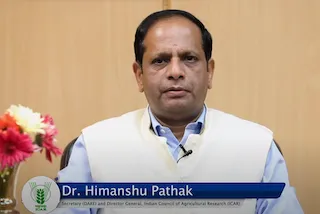
- Current DG of ICAR: Dr Himanshu Pathak
- Directorate of Extension Education was established in 1966.
- ICAR Division of Extension was established in 1971.
- First All India Coordinated Research Project in Extension Education sanctioned on A Study on Farming System in 1977.
- There are 8 scientific divisions at ICAR
- HQ New Delhi.
- It is the largest network of agricultural research and education institutes in the world.
History
| 1926 | Established Royal Commission on Agriculture, headed by Lord Linlithgow recommended setting up Imperial Council of Agricultural Research to promote, guide and coordinate agricultural research throughout the India. |
| 1928 | Royal Commission on Agriculture submitted its report |
| 16th July, 1929 | Imperial Council of Agricultural Research was set up as registered society under the Societies Registration Act 1860. On the recommendation of RCA Exams |
| March, 1946 | Under the president ship of Jogendra Singh it was decided to change the 'Imperial' into 'Indian' and now it is called Indian Council of Agricultural Research. |
| 1963 | The Agricultural Review Team headed by Dr. Marion W. Parker of USDA was appointed. |
| 1965 | 1st DG of ICAR was Dr. Benjamin Peary Pal (BP Pal), he initiated All India Co-ordinated Research Projects (AICRPs). |
| 1966 | ICAR was made a fully autonomous organisation on the recommendation of Agricultural Review Committee. Placement of different agricultural research institutes under the preview of ICAR. |
| June, 1972 | Gajendragadkar Committee was established to review the recruitment and personal policies of ICAR and its institutes, which submitted its report in 1973. |
| 1973 | Department of Agricultural Research and Education (DARE) was created in the Ministry of Agriculture. Agricultural Scientist Recruitment Board (ASRB) was established on 1 November 1973 as an independent recruitment agency in pursuance of the recommendations of the Gajendra Gadkar Committee. |
| 1975 | The Agricultural Research Services (ARS) was architect by Dr M.S. Swaminathan. |
MANDATE
- Plan, Undertake, Coordinate and Promote Research and Technology Development for Sustainable Agriculture.
- Aid, Impart and Coordinate Agricultural Education to enable Quality Human Resource Development.
- Frontline Extension for technology application, adoption, knowledge management and capacity development for agri-based rural development.
- Policy, Cooperation and Consultancy in Agricultural Research, Education & Extension.
ICAR Publications
- Indian Journal of Agricultural Sciences (Monthly)
- Indian Journal of Animal Sciences (Monthly)
- Indian Farming (Monthly)
- Indian Horticulture (Quarterly)
- ICAR Reporter (Quarterly)
- APIS (Quarterly)
Periodicals (Hindi)
- Kheti
- Phal Phool
- Krishi Chayanika
These publications serve as important channels of knowledge dissemination for scientists, extension workers, and progressive farmers.
ICAR Mobile Applications
- Kisan Suvidha
- Pusa Krishi
- MKisan Application
- Shetkari Masik Android App
- Farm-o-pedia
- Bhuvan Hailstorm App
- Crop Insurance Mobile App
- AgriMarket
- Application for Poultry
- Pashu Poshan
These mobile applications represent ICAR's effort to leverage digital technology for reaching farmers directly with advisories, market information, and insurance services on their smartphones.
NAARM, MANAGE, and NIAM
National Academy of Agricultural Research and Management (NAARM)
- Hyderabad in 1976.
- The new recruits & serving staffs in agricultural research management get trained at NAARM. NAARM plays a vital role in capacity building for agricultural scientists and managers, equipping them with leadership and management skills needed to run research institutions effectively.
National Institute of Agricultural Extension Management (MANAGE)
- Hyderabad in 1986
- To provide managerial and technical skills. MANAGE is the apex institution for building the professional competency of agricultural extension professionals across India. It conducts training programmes, research studies, and consultancy services focused on improving the effectiveness of extension delivery.
National Institute of Agricultural Marketing (NIAM)
- Jaipur
NIAM focuses on agricultural marketing education, research, and training. It plays a key role in developing professionals who can strengthen market linkages for farmers and improve the efficiency of agricultural marketing systems.
TIP
Key Institutions and Locations: NAARM → Hyderabad (1976) | MANAGE → Hyderabad (1986) | NIAM → Jaipur | Central Agricultural University → Manipur | First Agricultural University → Pantnagar (1960).
Summary Cheat Sheet
| Concept / Topic | Key Details |
|---|---|
| Morrill Act (1862) | Land Grant Colleges in USA; under Abraham Lincoln |
| Hatch Act (1887) | Experimental Stations attached to Land Grant Colleges |
| Smith-Lever Act (1914) | Cooperative Extension Service in USA |
| Dr. Seeman A. Knapp | Father of Method Demonstration; demo started 1903 in Texas |
| Famine Commission 1866 | Led to Agriculture Dept (1871) under Lord Mayo |
| Famine Commission 1901 | Led to IARI at Pusa, Bihar (1905) under Lord Curzon |
| Dr. Voelcker (1891) | Report on Improvement of Indian Agriculture |
| Govt of India Act 1919 | Agriculture became a state subject |
| Royal Commission on Agriculture 1928 | Most important milestone; paved way for extension in India; led to ICAR (1929) |
| EEIs | Nilokheri (1959), Anand (1962), Hyderabad (1962), Jorhat (1987) |
| First Agri University | Pantnagar (1960); Land Grant model; reviewed by Dr. M.S. Randhawa |
| IARI timeline | Pusa Bihar (1905) → shifted New Delhi (1936) → Deemed University (1958) |
| First Indian Director (IARI) | B. Vishwanath (1936) |
| ICAR established | 16 July 1929; registered society; on recommendation of Royal Commission |
| 1st DG of ICAR | Dr. B.P. Pal (1965); initiated AICRPs |
| DARE | Created 1973; ASRB also in 1973 (Gajendragadkar Committee) |
| ARS | Architected by Dr. M.S. Swaminathan (1975) |
| NAARM | Hyderabad, 1976; training for agri research management |
| MANAGE | Hyderabad, 1986; managerial & technical skills for extension professionals |
| NIAM | Jaipur; agricultural marketing education |
| First UG extension teaching | Calcutta University (1950) |
| First PG extension | Sabour, Bihar (1955) |
| First Ph.D. programme | IARI (1961) |
TIP
Next: Lesson 03 presents a comprehensive chronological timeline of Indian agriculture -- from ancient Krishi Parashar texts to modern flagship schemes like NFSM and RKVY.
Lesson Doubts
Ask questions, get expert answers