🧑🏫 Extension Teaching Methods -- Individual, Group, Mass Contacts, Cone of Experience and Classification
Complete guide to extension teaching methods covering Edgar Dale's Cone of Experience, individual contacts (farm visits, clinics), group contacts (FFS, demonstrations, workshops), mass contacts (radio, TV, campaigns), classification by use and form, and retention percentages for exams.
Teaching Methods
In the previous lesson, we covered the teaching and learning process -- elements of learning, the 12 principles, and the AIDCAS steps. Now we examine the specific methods extension workers use to reach farmers, from one-on-one farm visits to mass media campaigns.
This lesson covers:
- Cone of Experience -- Edgar Dale's retention framework
- Individual contacts -- farm visits, clinics, result demonstrations
- Group contacts -- discussions, FFS, method demonstrations, field days
- Mass contacts -- radio, television, newspapers, campaigns
- Classification by form -- written, spoken, visual, and combined methods
Understanding which method to use in which situation is a core exam skill for IBPS AFO and NABARD.
Cone of Experience
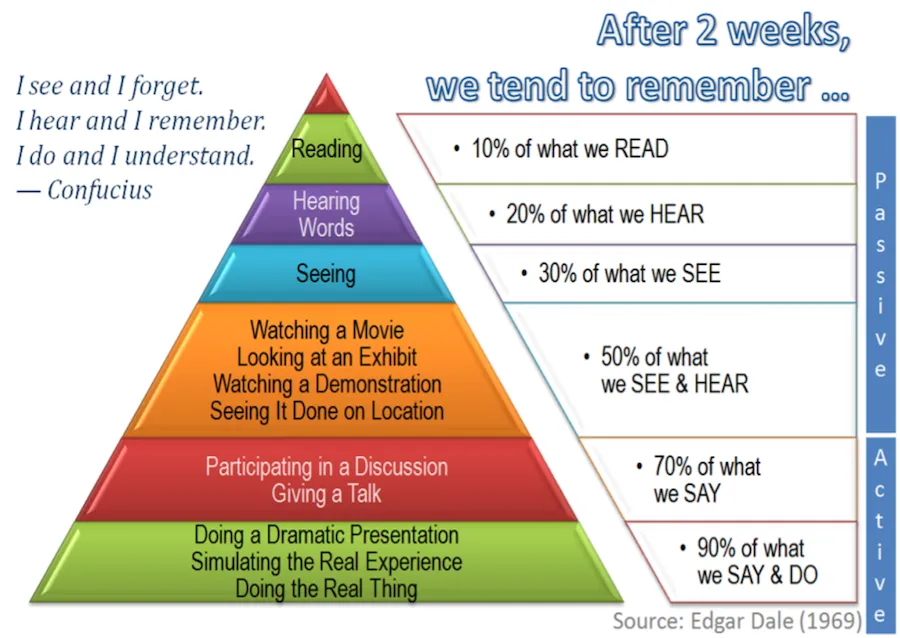
- Developed by Edgar Dale, modified by Sheal (1989). The Cone of Experience is one of the most important frameworks in extension education for understanding how different teaching methods produce varying levels of learning.
- As we move downwards from the pinnacle of the cone, increased involvement, and increased learning occurs because abstraction decreases. At the top of the cone are the most abstract methods (reading, hearing words), while at the bottom are the most concrete, hands-on experiences (direct, purposeful experience). The more senses and active participation involved, the deeper the learning.
- The Dale's Cone of Experience depicts the degree of direct & indirect learning experience associated with each method. It serves as a practical guide for extension workers when choosing the most effective teaching method for a given situation.
- Most people retain 10-15% of what they read.
- Most people retain 30-35% of what they see.
- Up to 90% of what is taught is kept in mind by majority of people, if they participate actively, and if all the senses (read, hear and seen) are involved.
TIP
Pro Content Locked
Upgrade to Pro to access this lesson and all other premium content.
₹99 charged monthly · Cancel anytime
- All Agriculture & Banking Courses
- AI Lesson Questions (100/day)
- AI Doubt Solver (50/day)
- Glows & Grows Feedback (30/day)
- AI Section Quiz (20/day)
- 22-Language Translation (100/day)
- Recall Questions (20/day)
- AI Quiz (15/day)
- AI Quiz Paper Analysis (100/day)
- AI Step-by-Step Explanations (100/day)
- Spaced Repetition Recall (FSRS)
- AI Tutor
- Immersive Text Questions
- Audio Lessons — Hindi & English
- Mock Tests & Previous Year Papers
- Summary & Mind Maps
- XP, Levels, Leaderboard & Badges
- Generate New Classrooms
- Voice AI Teacher (AgriDots Live)
- AI Revision Assistant
- Knowledge Gap Analysis
- Interactive Revision (LangGraph)
🔒 Secure via Razorpay · Cancel anytime · No hidden fees
Teaching Methods
In the previous lesson, we covered the teaching and learning process -- elements of learning, the 12 principles, and the AIDCAS steps. Now we examine the specific methods extension workers use to reach farmers, from one-on-one farm visits to mass media campaigns.
This lesson covers:
- Cone of Experience -- Edgar Dale's retention framework
- Individual contacts -- farm visits, clinics, result demonstrations
- Group contacts -- discussions, FFS, method demonstrations, field days
- Mass contacts -- radio, television, newspapers, campaigns
- Classification by form -- written, spoken, visual, and combined methods
Understanding which method to use in which situation is a core exam skill for IBPS AFO and NABARD.
Cone of Experience
- Developed by Edgar Dale, modified by Sheal (1989). The Cone of Experience is one of the most important frameworks in extension education for understanding how different teaching methods produce varying levels of learning.
- As we move downwards from the pinnacle of the cone, increased involvement, and increased learning occurs because abstraction decreases. At the top of the cone are the most abstract methods (reading, hearing words), while at the bottom are the most concrete, hands-on experiences (direct, purposeful experience). The more senses and active participation involved, the deeper the learning.
- The Dale's Cone of Experience depicts the degree of direct & indirect learning experience associated with each method. It serves as a practical guide for extension workers when choosing the most effective teaching method for a given situation.
- Most people retain 10-15% of what they read.
- Most people retain 30-35% of what they see.
- Up to 90% of what is taught is kept in mind by majority of people, if they participate actively, and if all the senses (read, hear and seen) are involved.
TIP
Remember the retention hierarchy: Read = 10-15%, See = 30-35%, Active Participation = up to 90%. This is a favourite exam question. This powerfully demonstrates why learning by doing and multi-sensory approaches are far superior to passive methods.
Classification of Extension Teaching Methods
- Method: Process or procedure for attaining an objective. In extension, choosing the right method is just as important as having the right message.
- According to Leagans, extension teaching methods are the devices used to create situations in which communication can take place between an instructor & the learner.
- Wilson & Gallup classified extension teaching methods according to their use & form. This dual classification system helps extension workers select appropriate methods based on both how they will be used and what form they take.
According to Use
(A) Individual contacts
- Face to face or person to person. This is the most personal and direct form of extension communication.
- Facilitates in gaining first-hand knowledge of farm & home. The extension worker can directly observe the farmer's conditions, challenges, and resources.
- Very effective and quantum of feedback is very high but slow communication. While feedback is immediate and rich, the method is limited in the number of people it can reach.
- Mostly used to get first-hand information.
- Highest intensity of influence. Because of the personal nature of the interaction, this method has the greatest power to persuade and motivate.
- Useful for "stay at home" type individuals. Some farmers are reluctant to attend group meetings -- individual contact reaches them where they are.
- Sensory situation is more in inter-personal communication.
- Limitation: Time consuming, relatively expensive & low coverage of audience. These drawbacks make individual methods impractical as the sole approach for large-scale extension work.
Major Individual Contact Methods
1. Farm and Home Visits
- It is a direct face-to-face contact by the extension agent with the farmer or homemaker at their farm or home for extension work. This is considered the cornerstone of individual extension methods.
- The ratio of 'takes' (acceptance) to 'exposures' (efforts) is high in this method. Because the message is delivered personally and contextually, farmers are more likely to accept and act on the advice.
- It gives first-hand information & solves specific problems about farm and home condition.
2. Farmer's Calls / Office Calls
- Farmer's call is a call made by a farmer or homemaker at the working place of the extension agent for obtaining information & assistance. This shows the farmer's initiative and interest in seeking knowledge.
- In this method farmer meets the extension worker at his work place to show diseased plants or insect pests etc. so that the extension worker can identify them and give necessary advice to the farmers.
- Telephone call is most effective approach for personal contact. It offers convenience and immediacy without requiring travel.
3. Personal Letters
- Letter written to a particular farmer in connection with an extension activity.
- Personal letter consists of 4S: Short, Simple, Strength & Sincere. Following the 4S principle ensures that the message is clear, impactful, and received positively.
4. Adaptive / Mini-Kit Trials
- It is method of determining the suitability or otherwise of a new practice in farmer's situation. By testing a new technology on a small scale under the farmer's own conditions, the risk is minimised and the farmer gains first-hand evidence of its value.
- This method builds the confidence of the researcher, extension worker and the farmer also.
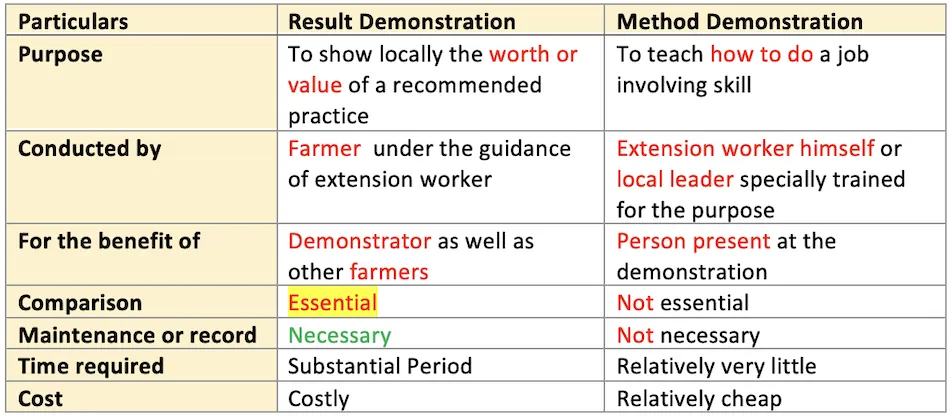
- Maintenance of record is absolutely necessary in this case.
5. Farm Clinics / Agricultural Clinics
- It is the facility developed & extended to individual farmers for diagnosis & treatment of farm problems through specialist advice. Similar to a medical clinic for crops and livestock, this method provides expert, problem-specific solutions to farmers.
6. Flag Method
- This method is used when farmer is not there in the field while the extension worker makes a visit. The extension worker leaves a visible flag or marker with a message, alerting the farmer that a visit was made and advice is available.
- Most common in Latin America.
7. Result Demonstrations
- It is a method of motivating the people for adoption of a new practice by showing its distinctly superior result. The power of this method lies in providing visible, tangible proof that a new practice works.
- Result demonstration is conducted by farmers at farmer's field under the supervision of a extension worker. The farmer should be an average farmer, not progressive farmer. Using an average farmer makes the results more relatable and convincing for other community members.
- Best suited to show relative worth/value of new practice.
- Based on principle of seeing is believing.
- First successful result demonstration conducted in Texas, USA on the farm of Walter C. Porter in 1903 by Seaman A. Knapp in Cotton. This landmark event laid the foundation for demonstration-based extension worldwide.
- So, Seaman A. Knapp is considered as Father of Demonstration in Extension.
Group Contacts
(B) Group contacts
- Group is an aggregate of small number of people in reciprocal communication & interaction around some common interest. Group methods allow extension workers to reach more people simultaneously while still maintaining a degree of personal interaction.
- Small group: 15-25
- Medium group: 25-50
- Large group: 50-100
- Face to face contact.
1. Group Discussion (Group Thinking Conference)
- It is a method of democratically arriving at certain decisions by a group of people, by taking into consideration the members' point of view. This method encourages participatory decision-making and ensures that multiple perspectives are considered.
- It acts as a safety valve in reducing tension. By allowing people to express their views openly, group discussion reduces frustration and builds consensus.
a. Lecture
- The lecture method is extensively used to present authoritative or technical information to develop back-ground and appreciation & to integrate ideas. It is the simplest and most common method for delivering information to a group.
- Its weakness is, it is one-way communication. So to overcome this a discussion or question & answer period may be held following the speech. This is generally called a forum. Adding a forum component transforms a passive lecture into a more interactive learning experience.
b. Symposium
- Symposium is a short series of lectures, usually by 2-5 speakers. Each speaker addresses a different aspect of the same broad topic, providing the audience with multiple expert perspectives.
- Each one speaks for a definite amount of time, and presents a different phase or subdivision of a general topic.
c. Panel
- It is an informal conversation put on for the benefit of the audience, by a small group of speakers, usually from 2 to 8 in number. Unlike a symposium, a panel involves spontaneous discussion and exchange among the panellists, making it more dynamic.
- They are selected on the basis of the information & experience they have.
d. Debate
- The common pattern is to have two teams, one representing the affirmative, and the other the negative side of the question. This method helps the audience examine both sides of an issue critically.
- It is two-way communication b/w debater but one-way communication for the audience.
e. Forum
- It is a discussion period that may follow any of the above methods of presentation. The forum gives the audience an opportunity to ask questions, seek clarifications, and share their views.
- It consists of question period in which members of the audience may ask questions make brief statements.
f. Buzz group (Phillips 60/Hurdle system)
- In large groups when there is limited time for discussion, the audience may be divided into smaller units for short period. This technique allows everyone to participate even in large gatherings, making discussions more inclusive and productive.
g. Workshop
- It is long meeting from one day to several weeks, involving all the delegates in which the problems being discussed are considered by delegates in small private groups. Workshops emphasise hands-on problem-solving and produce concrete outputs or action plans.
h. Brainstorming
- Small group interaction designed to encourage the free introduction of ideas on an unrestricted basis without any limitations to feasibility. The key rule of brainstorming is that no idea is criticised or rejected during the idea-generation phase, which encourages creative and out-of-the-box thinking.
i. Seminar
- Members of the audience discuss the subject to which ready answers are not available. This method has advantage of pooling together the opinions of a large number of persons. Seminars are particularly useful for exploring complex, open-ended topics where collective wisdom can generate insights.
j. Syndicate Studies
- It is essentially follow the seminar method and the focus is on any particular subject or problem. A syndicate study involves intensive small-group research into a specific topic, with each group reporting back to the larger assembly.
k. Conference
- Pooling of experiences & opinions among a group of people who have special qualifications in an area. Conferences bring together experts and practitioners to share knowledge and develop common strategies.
2. Method Demonstrations
- Purpose is to teach a skill (motor skill) to a group. Means, how to carry out entirely new practice or an old practice in a batter way. Method demonstration is all about showing how something is done -- the emphasis is on the process and technique.
- Based on principle of Learning by Doing.
- If an extension worker practically explain improved practice and also shows its superiority over traditional methods; includes both method & result demonstration.
- It is conducted by extension worker or trained leader or specialist.
- It is most influence type of demonstration. Because it combines both visual evidence and hands-on practice, it has the greatest potential to change behaviour.
3. Meeting on Result Demonstration
Comparison in Method & Result Demonstration
4. Conducted Farm Tours
- A group of interested persons accompanied and guided by one or more extension agents move out of their neighbourhood to study and learn significant improvements in farm & home elsewhere. Farm tours provide exposure visits that broaden farmers' horizons and inspire them to adopt proven practices they see in other locations.
5. Farmer Field Schools (FFS)
- FFS engages a group of typically 25-30 farmers in season-long learning activities, which take place in the field or centre around concrete field problem. The FFS approach is highly participatory and experiential, putting farmers in charge of their own learning.
- The FFS participate cultivate a chosen crop & conduct various experiments together on a learning plot. During weekly sessions of an average 3-4 hours, participatory learning on a learning plot.
- FFS approach is mainly adopted for mobilizing financial resources among farmers.
- FFS was designed initially as a way to introduce IPM. Integrated Pest Management (IPM) was the original focus, but the FFS methodology has since been applied to many other agricultural topics.
6. Field Days / Farmer's Day
- A method of motivating the people to adopt a new practice by showing what has actually been achieved by applying the practice under field conditions. Field days invite farmers to visit demonstration plots and see the results of improved practices with their own eyes.
7. Peripatetic Team Meetings
- A team of 3 to 5 subject-matter specialists, led by an extension worker, visits village on a pre-drawn schedule, presents ideas on some timely topic to the group of farmers present, seek & questions-answers & later provides on-the-spot advice to farmers individually, by examining their problems. This method brings multi-disciplinary expertise directly to the village, addressing a range of farmer concerns in a single visit.
- General meeting are broadly, the meeting of heterogeneous participation.
8. Media Forums
- Media Forum: Small organized groups of individuals who meet regularly to receive a mass media programme and discuss on its contents. This method combines the reach of mass media with the depth of group discussion, creating a powerful learning combination.
- Rural radio forums, tele-clubs, discussion groups etc. are some examples of such forums.
- Originated in Canada.
9. Agricultural Games
Eg. Snakes & ladders. Games make learning fun and engaging, particularly for younger audiences, and help reinforce key messages in a memorable way.
Mass Contacts
(C) Mass contacts
- Size of mass: few hundred in mass meeting, few thousand in campaign & exhibition & millions in newspaper, radio, television. Mass methods can reach an enormous audience simultaneously.
- Cheapest method. So should be used under limited resource of manpower, time and money. When resources are scarce, mass contact methods offer the best cost-per-person ratio.
- It is more useful for making people aware of the new agricultural technology quickly.
- Mass communication channel most suited to inform the audience about the existence of an innovation. Mass media excels at the awareness stage of the adoption process.
- Major drawback: Lack of free feedback. The audience cannot easily ask questions or seek clarification, making it a one-way communication channel.
- Indirect and inferential feedback is available in mass media.
- The main problem is no local dialect.
- The term class media refers to Group Media.
- Mass communication is intended to be consumed immediately hence it is called transient.
1. Mass Meeting
- Method used in communicating interesting & useful information to a large audience at a time.
2. Campaign
- Campaign is an intensive teaching activity undertaken at an opportune time for a brief period, focussing attention in a concentrated manner on a particular problem so as to stimulate the widest possible interest in the community. Campaigns create a sense of urgency and collective action around a specific issue.
- The normal group boundaries get obliterated (wipe out).
- Most effective method of TOT in a community.
- It is used to create interest in wide range of people and to stimulate mass scale adoption.
- Campaign organize for:
- Single day: Water for life
- Few weeks: Rat control or Family Planning
- Few months: Van Mahotsava (Forest Festival)
- Few years: Grow More Food Campaign
3. Exhibits
- It is a systematic display of models, specimens, charts, photographs, pictures, posters information etc. in a sequence around a theme to create awareness & interest in the community. Well-designed exhibits tell a visual story that attracts attention and communicates ideas at a glance.
- Display exhibts about 50 to 60 cm above the floor of the stall, up to a height of 2 m (2ft. -- 7 ft).
- The material used in exhibit is 3 dimensional.
- The material used in display is 2 dimensional.
4. Farmer's Fair / Kisan Mela
5. Radio
- It is an electronic audio-medium for broadcasting programmes to the audience. Radio remains one of the most accessible and far-reaching mass media tools in rural India.
- Most frequently used mass media by farmers.
- It does not disturb normal work much. Farmers can listen while working in the field or at home, making it a highly convenient medium.
- Broadcasting through radio was started in India on July 23, 1927.
- Radio broadcasting in India started from Mumbai.
- All India Radio (AIR) was started in 1936.
- The broadcasting in India came to know as Akashawani from the year 1957.
- Radio broadcast include: Straight talks, Interviews & songs.
- The best style of presentation for radio talks with farmers is group discussion.
- The amount of message distortion in verbal communication is 30%.
- The effective rate of delivery of talks in radio is 120-140 words/minute.
- Radio is characterised by one-way without instant audience response.
- The Farm & Home Unit of Akashavai were started to support the Intensive Agricultural District Programme (IADP) & the coming of the HYV's seed in the year 1966.
- Media Forum is a combination of mass media & inter-personal communication.
- Radio Rural Form: Started in 1956, by UNESCO India in Pune as an experiment.
- Farm school on the Air: It is a method of providing systematic education on farming to the farmers through the process of distance learning.
- Namma Dhwani is a community radio. Community radio stations are locally operated and provide region-specific content in the local language.
5. Television
- Provide pictures with synchronised sound. Television combines visual and audio channels, making it one of the most powerful tools for extension communication.
- Educational TV = Broadcast media.
- A/Q to the Research & Reference Division of the Ministry of Information and Broadcasting, the television era in India began modestly on 15th September 1959 by a UNESCO grant to study the use of TV as a medium of education, rural upliftment & community development. The service was started by the All India Radio, Delhi & programmes were telecast twice a week for duration of 1 hour each day.
- Broadcasting of First Rural Programme in TV started on Doordarshan named Krishi Darshan on 26 January 1967 (Pilot project of agricultural communication initiated by Dr. Vikram Sarabhai). It was telecasted from Mumbai. Timing: 6:30 pm to 7:00 pm. It was longest running television series in the world. This programme became a landmark in agricultural communication in India.
- DD-Gyandarshan, an exclusive education channel was started in India on 26th January, 2000.
- The government recognized the imperative role of TV in bringing about the desired social change & established a separate organisation named Doordarshan in April 1, 1976. The chief aim of 'Dooradarshan' in India is to entertain, educate and inform.
- First state to start DD was Rajasthan.
- On August 15, 1982 the National networking became a reality by the establishment of satellite links through Indian National Satellite (INSAT-1A). It was landmark in the history of television in India. This is also marked the introduction of colour TV in India.
- Then in 1990, INSAT-2 was launched.
- Millions of people around the world can see all kind of events because of the power of satellite.
- SITE (Satellite Instructional Television Experiment) programme was the first attempt in the world at using the sophisticated technology of satellite transmission for social education (in 1975-76). This was a groundbreaking experiment that demonstrated the potential of satellite TV for reaching remote rural communities.
- CAI: Computer - Assisted Instruction.
- Rural TV (RTV) project was launched by FAO (Sudan, 1974)
- DD Kisan was started on 26th May, 2015.
6. Newspaper
- It is a bunch of loose printed papers properly folded which contains news, views advertisements etc. & is offered for sale at regular interval, particularly daily or weekly. Newspapers provide a permanent, re-readable record of information, unlike radio or TV.
- First newspaper started in India was Bengal Gazette. It was weekly published from Serampore, Calcutta. It was started by James Augustus Hicky.
- The weekly agricultural column of "The Hindu" appears on Thursday.
- The coverage of agricultural news in newspaper is 3 to 5%. This relatively low coverage highlights the need for more dedicated agricultural media to serve the farming community.
7. Leaflets
8. Bulletins
9. Posters
10. Circular letter
11. Screen Media
Slides, Film strips, Movies, Video Recordings
12. Puppet show
13. Agricultural Film Shows
- It is an effective medium in rural areas because rural people show keen interest in films. The combination of visual storytelling and entertainment makes films a compelling medium for communicating agricultural messages.
- Disadvantage is film can't be projected with low voltage power.
- So not popular in rural areas.
According to Form
(A) Written
Written methods provide a permanent record that can be referred to again and again, making them ideal for sharing detailed technical information.
1. Bulletins
- Printed, bound booklet with a number of pages, containing comprehensive information relating to a particular topic. Bulletins are designed to serve as reference materials that farmers can keep and consult whenever needed.
- A bulletin should contain 24-48 pages.
2. Leaflets
- Leaflet is a single printed sheet of paper folded to make a 4 page piece of printed matter. Leaflets are one of the most economical and widely distributed written extension tools.
- It is the extension system used to provide precise and reliable scientific information in simple language about a simple practice.
- It gives a specific information on a specific topic in concise manner.
- There are four hotspots in a page.
3. Folder
- It is a single printed sheet of paper of big size, folded once or twice and gives essential information relating to a particular topic. Folders offer slightly more space than leaflets and are useful for presenting summary information with visuals.
4. News letter
- It is a miniature newspaper in good quality paper, containing information relating to the activities & achievements of the organisation. Newsletters help keep stakeholders informed and connected with the work of the extension agency.
5. Personal letter
6. Circular letters
- Letter written to farmers in connection with an extension activity. Circular letters allow extension workers to send the same message to many farmers simultaneously.
- Mass contact method.
7. Farm Publications/Journals
- A class of publications prepared by the extension agency in printed form, containing information relating to the improvement of farm & home. These publications serve as a regular source of updated knowledge for the farming community.
(B) Spoken
Oral communication is best type for largely illiterate audience. In communities where literacy levels are low, spoken methods are the primary channel for effective knowledge transfer.
- General and special meetings of all kinds
- Farm and home visits
- Framer's calls
- Radio & Recordings
- Flag method
- Agricultural Clinics
(C) Visual or Objective
Visual methods leverage the fact that sight is the most dominant sense for learning, accounting for up to 87% of sensory learning.
- Result Demonstrations (Personal demonstration)
- Exhibits
- Posters
- Motion pictures, charts, slides, film-strips
- Flash card
- Flannel graphs
- Bulletin boards
(D) Spoken and Visual
These methods combine auditory and visual channels, engaging multiple senses simultaneously for the most effective learning outcomes.
- Method demonstration
- Meetings at result demonstrations
- Movies
- Television
- Puppets & Drama
- Campaign
Quick Recap: Classification of Teaching Methods
By Use: Individual (farm visits, office calls, letters, mini-kit trials, clinics, flag method, result demo) | Group (discussions, method demo, FFS, field days, tours) | Mass (campaigns, exhibits, radio, TV, newspapers)
By Form: Written (bulletins, leaflets, folders, newsletters) | Spoken (meetings, visits, radio) | Visual (demos, exhibits, posters, charts) | Spoken + Visual (method demo, TV, movies, campaigns)
Key People: Edgar Dale (Cone of Experience), Wilson & Gallup (classification), Seaman A. Knapp (Father of Demonstration), Leagans (definition of methods)
Which Teaching Method for Which Situation?
Extension officer's decision guide — pick the right method for the audience:
| Situation | Best Method | Why | Retention Rate |
|---|---|---|---|
| One farmer, specific problem (e.g., pest on his crop) | Farm visit (individual) | Personalised, see actual field conditions | High (direct + contextual) |
| Small group (10-15 farmers), practical skill (e.g., grafting) | Method demonstration | Learning by doing; hands-on practice | 90% (active participation) |
| Medium group (20-50), new technology adoption | Result demonstration on a progressive farmer's field | "Seeing is believing"; peer influence | 50-70% (see + discuss) |
| Large group (100+), awareness creation | Campaign or exhibition | Mass reach; creates initial awareness | 10-30% (seeing/hearing only) |
| Remote/scattered villages | Radio or mobile-based advisory | No travel needed; reaches many simultaneously | 10-15% (audio only) |
| Detailed, repeatable information | Bulletin/leaflet (written) | Farmer can refer back; permanent record | 10-15% (reading only) |
Edgar Dale's Cone of Experience — the key principle:
- We remember 10% of what we read
- 30% of what we see
- 50% of what we see AND hear
- 90% of what we do ourselves
Implication: The most effective extension is participatory — Farmer Field Schools (FFS), method demonstrations, and learning-by-doing approaches. Lectures and pamphlets alone are the LEAST effective.
Seaman A. Knapp = Father of Demonstration. He proved that one successful result demonstration convinces more farmers than 100 lectures. This principle drives India's entire KVK (Krishi Vigyan Kendra) system.
Summary Cheat Sheet
| Concept / Topic | Key Details |
|---|---|
| Cone of Experience | By Edgar Dale; modified by Sheal (1989); more senses = deeper learning |
| Retention: Read | 10-15% |
| Retention: See | 30-35% |
| Retention: Active participation | Up to 90% |
| Classification of methods | By Wilson & Gallup; classified by use and form |
| Individual contacts | Highest feedback & intensity of influence; most expensive; low coverage |
| Farm & home visit | Cornerstone of individual methods; high takes-to-exposures ratio |
| Personal letter — 4S | Short, Simple, Strength, Sincere |
| Result Demonstration | At farmer's field; principle = Seeing is Believing; first by Knapp (1903) on Walter C. Porter's farm |
| Method Demonstration | Done by extension worker; principle = Learning by Doing; most influential type |
| Group contacts | Small (15-25), Medium (25-50), Large (50-100); face-to-face |
| Group discussion | Democratic decision-making; safety valve for tension |
| FFS | 25-30 farmers; season-long; originally for IPM |
| Campaign | Intensive, brief; most effective TOT method; stimulates mass adoption |
| Mass contacts | Cheapest method; best for awareness; drawback = no free feedback |
| Radio broadcasting (India) | Started 23 July 1927 from Mumbai; AIR in 1936; Akashvani from 1957 |
| Krishi Darshan | First rural TV programme; 26 Jan 1967 on DD; by Dr. Vikram Sarabhai |
| SITE | First satellite TV experiment in world; 1975-76 |
| DD Kisan | 26 May 2015; 24-hour agriculture channel |
| Bengal Gazette | First Indian newspaper by James Augustus Hicky; weekly from Calcutta |
| Bulletin | 24-48 pages; comprehensive information |
| Leaflet | Single printed sheet; 4 pages; specific topic, concise |
| Verbal communication distortion | 30% message loss |
Lesson Doubts
Ask questions, get expert answers