🔉 Audio-Visual Aids in Extension -- Classification, Types and Projection Systems
Complete guide to AV aids in agricultural extension including audio, visual, and audio-visual aids, the COIK fallacy, two-dimensional and three-dimensional visuals, projection types, and key exam facts for IBPS AFO, NABARD Grade A, and FCI exams.
Why AV Aids Matter on the Farm
Picture an extension worker trying to explain the life cycle of a stem borer to a group of rice farmers who have never seen one under a microscope. Words alone are not enough. But when the worker shows a colourful poster with the egg, larva, pupa, and adult stages -- and then plays a short video of the pest damaging a crop -- farmers immediately grasp the concept and remember it. This is the power of audio-visual aids in agricultural extension.
What Are Audio-Visual Aids?
- AV aids are instructional devices used to communicate messages more effectively through sound and visuals. They enhance clarity, interest, and retention.
- While preparing AV aids, extension personnel must give more importance to the personality of the farmer -- materials should suit the audience's background, literacy level, and familiarity with the subject.
The COIK Fallacy
- COIK fallacy (Edgar Dale, 1965): Clear Only If Known
- The assumption that what is clear to the expert is also clearly understood by the learner
- One of the most important limitations of AV aids
WARNING
Pro Content Locked
Upgrade to Pro to access this lesson and all other premium content.
₹99 charged monthly · Cancel anytime
- All Agriculture & Banking Courses
- AI Lesson Questions (100/day)
- AI Doubt Solver (50/day)
- Glows & Grows Feedback (30/day)
- AI Section Quiz (20/day)
- 22-Language Translation (100/day)
- Recall Questions (20/day)
- AI Quiz (15/day)
- AI Quiz Paper Analysis (100/day)
- AI Step-by-Step Explanations (100/day)
- Spaced Repetition Recall (FSRS)
- AI Tutor
- Immersive Text Questions
- Audio Lessons — Hindi & English
- Mock Tests & Previous Year Papers
- Summary & Mind Maps
- XP, Levels, Leaderboard & Badges
- Generate New Classrooms
- Voice AI Teacher (AgriDots Live)
- AI Revision Assistant
- Knowledge Gap Analysis
- Interactive Revision (LangGraph)
🔒 Secure via Razorpay · Cancel anytime · No hidden fees
Why AV Aids Matter on the Farm
Picture an extension worker trying to explain the life cycle of a stem borer to a group of rice farmers who have never seen one under a microscope. Words alone are not enough. But when the worker shows a colourful poster with the egg, larva, pupa, and adult stages -- and then plays a short video of the pest damaging a crop -- farmers immediately grasp the concept and remember it. This is the power of audio-visual aids in agricultural extension.
What Are Audio-Visual Aids?
- AV aids are instructional devices used to communicate messages more effectively through sound and visuals. They enhance clarity, interest, and retention.
- While preparing AV aids, extension personnel must give more importance to the personality of the farmer -- materials should suit the audience's background, literacy level, and familiarity with the subject.
The COIK Fallacy
- COIK fallacy (Edgar Dale, 1965): Clear Only If Known
- The assumption that what is clear to the expert is also clearly understood by the learner
- One of the most important limitations of AV aids
WARNING
The COIK Fallacy is one of the most common mistakes in extension work. Always design AV materials from the learner's perspective, not the expert's.
Agricultural example: An extension worker showing a soil test card to farmers must not assume they understand pH values. The concept of pH must first be explained in simple, relatable terms.
Classification of AV Aids
| Category | Subdivisions | Examples |
|---|---|---|
| I. Audio Aids | -- | Tape recorder, radio, telephone, public address system |
| II. Visual Aids | 2D Non-projected | Chalkboard, poster, flannel graph, flash card, flip chart |
| 2D Projected | Slide projector, OHP, opaque projector | |
| 3D Visuals | Models, mock-ups, specimens, objects, diorama | |
| III. Audio-Visual Aids | Non-projected | Drama, puppet show, talking doll, flash card |
| Projected | Cinema, telecasts, sound-synchronised slides |
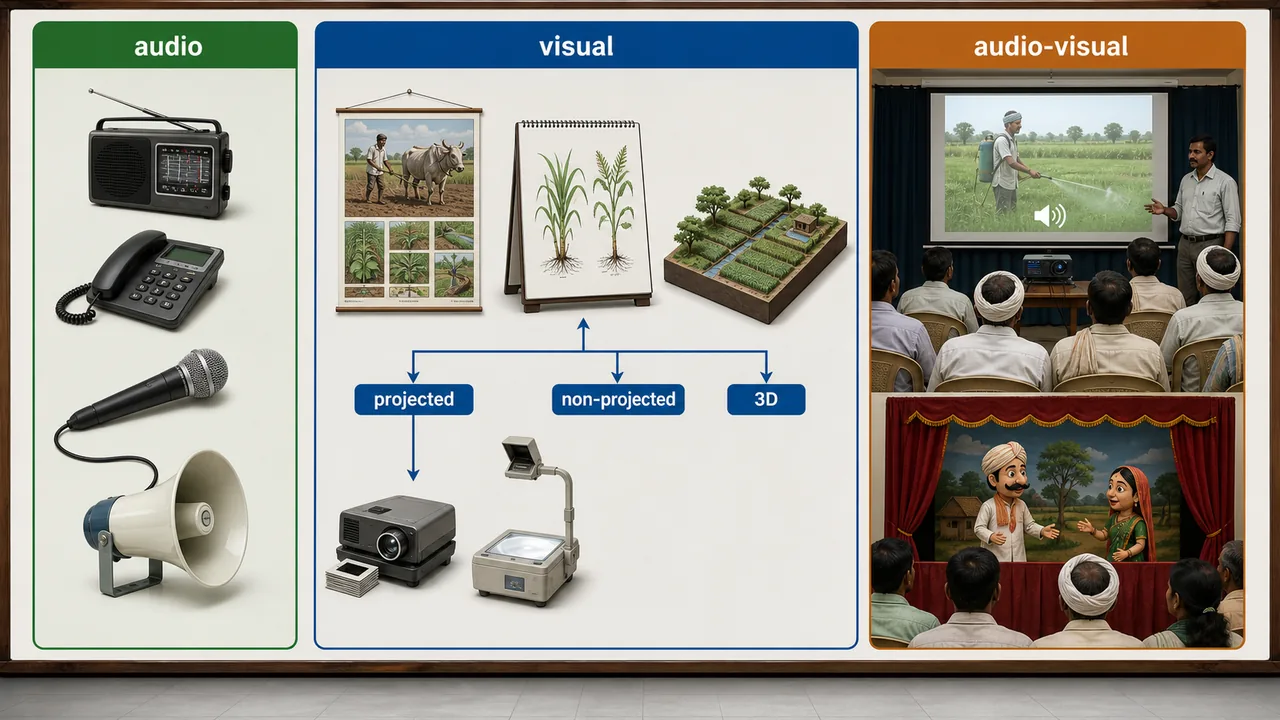
I. Audio Aids
Audio aids use sound as the primary channel, making them effective for illiterate audiences and people engaged in other activities.
Key Audio Aids
| Aid | Key Facts |
|---|---|
| Tape recorder | Records sound by electromagnetic process; 3 recording methods -- Disc (mechanical), Tape/wire (magnetic), Movie film (optical) |
| Public address system | Amplifies sound for large audiences; consists of microphone, amplifiers, loudspeakers; Amplifier is an electronic medium UPPSC 2021 |
| Telephone | Mobile services introduced in India in 1995; most transformative tool for instant farmer-expert communication |
| Radio talks | Most frequently used mass media by farmers |
II. Visual Aids
- 25-30% learning efficiency can be increased by using visuals
- A one-inch object can be seen clearly up to 36 feet
- Human eye moves in a 'Z' like pattern while reading visuals -- place key information along this pattern
- All-capital words are difficult to read due to lack of symmetry
- Black and white are Achromatic colours (no colour pigment)
[A] Two-Dimensional Visuals -- Non-Projected
| Aid | Key Features | Agricultural Example |
|---|---|---|
| Chalkboard | Simplest, most universal visual aid | Drawing crop rotation cycles step-by-step |
| Bulletin Board | Display board in prominent locations | Posting mandi prices at village office |
| Pictures & Photographs | Exact visual recording; Illustration = non-photographic reconstruction | Before-after photos of a treated vs untreated field |
| Flannel graph (Khaddar graph) | Sandpaper-backed papers placed in sequence; storytelling effect; chief advantage is step-by-step presentation | Showing stages of wheat sowing -- land preparation, seed treatment, sowing, irrigation |
| Flash cards | Series of 10-12 cards flashed in sequence; characterised by sequence, suspense, storytelling; Small group (10-25): 10x12 inches; Larger group (30-50): 15x20 inches | Demonstrating steps of IPM in cotton |
| Poster | Conveys one idea; used at awareness stage; must be ABC -- Attractive, Brief, Clear | "Save Water -- Use Drip Irrigation" poster at village crossroads |
| Diagrams, maps, charts, graphs | Chart title letter size: 2.5 inches; Budget cash flow best shown by Pie graph | Pie chart showing crop-wise area distribution |
| Flip Charts | Series of charts on a stand like a calendar; character height: 20 points; storytelling effect | Explaining soil testing procedure in sequence |
| Translide | Transparent big-size photographs with backlight; non-projected AV aid | Enlarged photo of pest damage displayed at farmer mela |
| Leaflet | Usually contains 4 pages | Leaflet on organic manure preparation |
Two-Dimensional Visuals -- Projected
Three major projection systems:
| System | Principle | Projector | Key Facts |
|---|---|---|---|
| Direct | Light passes directly from bulb | Slide projector (Diascope) | Object kept between condenser and objective lens; material must be kept inverted; most commonly used |
| Indirect | Mirror system redirects light | Overhead Projector (OHP) | Presenter faces the audience while presenting |
| Reflected | Light reflected from opaque materials | Opaque projector (Epidiascope) | Absorbs much light -- must use in darkened room; projects from non-transparent materials like book pages |
TIP
Projection Types at a Glance: Direct (Slide projector / Diascope) | Indirect (OHP) | Reflected (Opaque projector / Epidiascope).
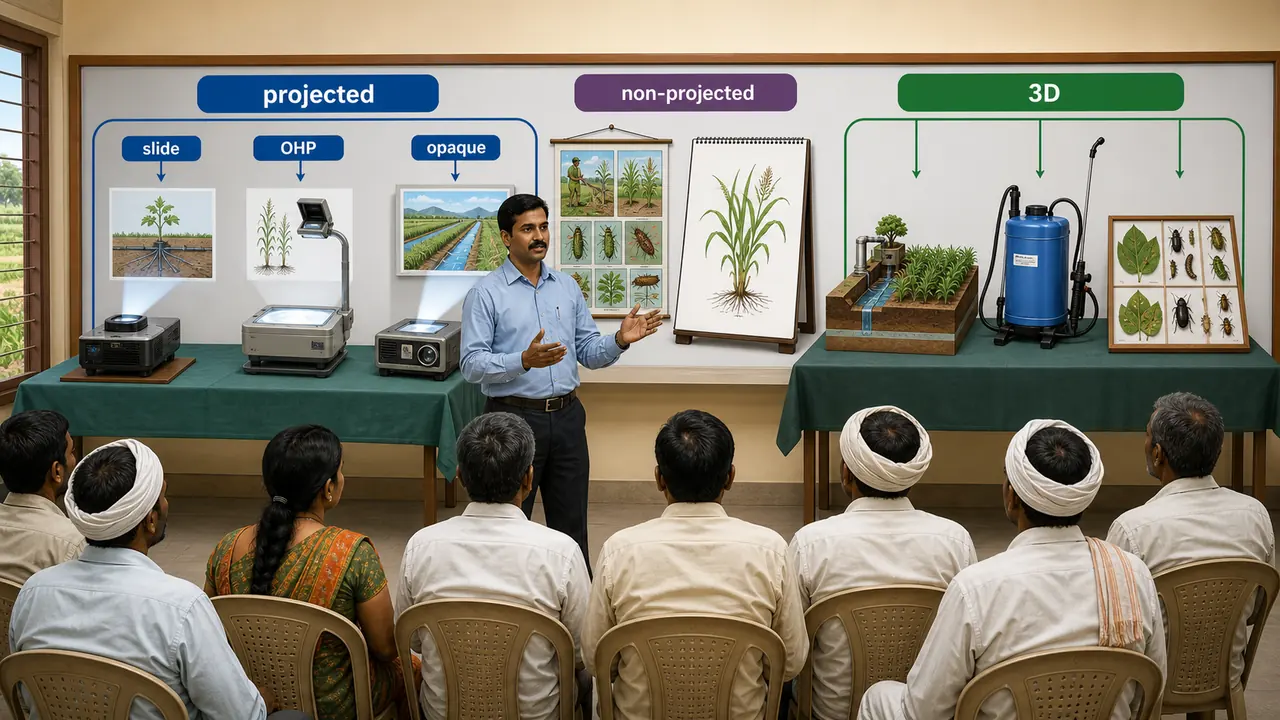
[B] Three-Dimensional Visuals
3D visuals provide physical, tangible representations learners can examine from multiple angles.
| Aid | Definition | Types/Notes | Agricultural Example |
|---|---|---|---|
| Model | 3D recognisable imitation of an object; may be same size, larger, or smaller; group contact method | Scale (correct proportion), Simplified (rough external form), Working (shows function), Cutaway/Cross-sectional (shows inside) | Cross-sectional model of a drip irrigation emitter |
| Mock-up | 3D imitation in certain aspects only; focuses on functional accuracy, not visual resemblance; a working model is known as mock-up | Prototype for teaching/demonstration | Mock-up of a sprayer pump for training |
| Specimen | Sample of real things minus natural setting; represents the whole | Ex: coins, diseased leaves, insect pests | Beetle specimen for pest identification class |
| Object | Real thing in its natural setting | Most authentic learning experience | Observing a cow being milked at a dairy farm |
| Diorama | Scenic representation of original with specimen, model, and painting; Greek: "to see through" | Used when natural exposure is not possible | Diorama of a watershed management model at an exhibition |
III. Audio-Visual Aids
Audio-visual aids combine both sound and visuals, engaging multiple senses for the highest learning effectiveness.
Non-Projected AV Aids
- Drama -- combines dialogue, visuals, and emotion
- Puppet show -- effective in rural areas using local language and humour
- Talking doll
- Flash Card (when presented with narration)
Projected AV Aids
| Aid | Key Facts |
|---|---|
| Motion Picture (Cinema) | Film recorded by optical process; camera records at 24 frames/second; extension uses 16mm format; seating follows the 2 and 6 formula (nearest = 2x screen width, farthest = 6x screen width) |
| Telecasts | LCD = Liquid Crystal Display |
| Sound-Synchronised Slides | Slides with recorded commentary |
Comparison Table: Display vs Presented Type
| Feature | Display Type | Presented Type |
|---|---|---|
| Nature | Static presentations | Sequentially presented by facilitator |
| Pace | Audience views at own pace | Guided by presenter |
| Examples | Poster, bulletin board, models, exhibits | Flash card, slides, filmstrip |
Exam Tips and Mnemonics
TIP
Mnemonic for Projection Types -- "DIR":
- Direct = Diascope (Slide projector)
- Indirect = OHP (Indirect mirror system)
- Reflected = Opaque projector (Epidiascope) -- needs dark Room
IMPORTANT
Frequently tested facts:
- COIK Fallacy = Clear Only If Known (Edgar Dale, 1965)
- Poster conveys one idea and is used at the awareness stage
- Poster ABC = Attractive, Brief, Clear
- Flash cards: 10-12 cards per talk
- Flannel graph chief advantage = step-by-step telling
- 16mm film used in extension; 24 frames/second
- Visual learning increases efficiency by 25-30%
- Eye reads in Z pattern
Summary Cheat Sheet
| Concept | Key Fact |
|---|---|
| COIK Fallacy | Clear Only If Known (Edgar Dale, 1965) |
| Visual learning boost | 25-30% |
| Eye reading pattern | Z-like |
| 1-inch object visibility | 36 feet |
| Flash cards per talk | 10-12 |
| Poster purpose | One idea; awareness stage |
| Poster principle | ABC: Attractive, Brief, Clear |
| Flannel graph alias | Khaddar graph |
| Direct projection | Diascope / Slide projector |
| Indirect projection | OHP |
| Reflected projection | Opaque projector / Epidiascope |
| Cinema frame rate | 24 per second |
| Extension film format | 16mm |
| Seating formula | 2 and 6 (nearest 2x, farthest 6x screen width) |
| Achromatic colours | Black and white |
| Leaflet pages | 4 |
| Chart title letter size | 2.5 inches |
Lesson Doubts
Ask questions, get expert answers