💬 Communication in Extension -- Models, Elements, Barriers and Feedback
Comprehensive guide to communication in agricultural extension covering 8 models (Aristotle to Rogers-Shoemaker), 6 elements (CMCTAR), message flow, distortion types, noise, barriers, and feedback for IBPS AFO, NABARD Grade A, and FCI exams.
Communication is the foundation of all extension work -- without effective communication, no technology transfer, no behaviour change, and no rural development is possible. From Aristotle's ancient model of persuasion to modern interactive frameworks, understanding how messages travel from source to receiver is essential for every extension professional.
This lesson covers:
- Definition and origin of communication
- Types -- verbal and non-verbal
- Eight communication models -- Aristotle, Lasswell, SR, Schramm, Shannon-Weaver, Berlo, Leagans, Rogers-Shoemaker
- Six elements of communication (Leagans' CMCTAR)
- Feedback, barriers, and noise
- Exam-critical associations and summary
All topics are high-yield for IBPS AFO, NABARD Grade A, and FCI exams.
From Farmer to Farmer: Communication in Action
When a progressive wheat farmer in Haryana tells his neighbour about a new seed-treatment method he learned from a KVK scientist, that is communication. When the neighbour tries it, gets better yields, and tells five more farmers -- that is diffusion through communication. Every successful extension programme depends on effective communication.
Pro Content Locked
Upgrade to Pro to access this lesson and all other premium content.
₹99 charged monthly · Cancel anytime
- All Agriculture & Banking Courses
- AI Lesson Questions (100/day)
- AI Doubt Solver (50/day)
- Glows & Grows Feedback (30/day)
- AI Section Quiz (20/day)
- 22-Language Translation (100/day)
- Recall Questions (20/day)
- AI Quiz (15/day)
- AI Quiz Paper Analysis (100/day)
- AI Step-by-Step Explanations (100/day)
- Spaced Repetition Recall (FSRS)
- AI Tutor
- Immersive Text Questions
- Audio Lessons — Hindi & English
- Mock Tests & Previous Year Papers
- Summary & Mind Maps
- XP, Levels, Leaderboard & Badges
- Generate New Classrooms
- Voice AI Teacher (AgriDots Live)
- AI Revision Assistant
- Knowledge Gap Analysis
- Interactive Revision (LangGraph)
🔒 Secure via Razorpay · Cancel anytime · No hidden fees
Communication is the foundation of all extension work -- without effective communication, no technology transfer, no behaviour change, and no rural development is possible. From Aristotle's ancient model of persuasion to modern interactive frameworks, understanding how messages travel from source to receiver is essential for every extension professional.
This lesson covers:
- Definition and origin of communication
- Types -- verbal and non-verbal
- Eight communication models -- Aristotle, Lasswell, SR, Schramm, Shannon-Weaver, Berlo, Leagans, Rogers-Shoemaker
- Six elements of communication (Leagans' CMCTAR)
- Feedback, barriers, and noise
- Exam-critical associations and summary
All topics are high-yield for IBPS AFO, NABARD Grade A, and FCI exams.
From Farmer to Farmer: Communication in Action
When a progressive wheat farmer in Haryana tells his neighbour about a new seed-treatment method he learned from a KVK scientist, that is communication. When the neighbour tries it, gets better yields, and tells five more farmers -- that is diffusion through communication. Every successful extension programme depends on effective communication.
What is Communication?
-
Derived from Latin word "communis" meaning common. At its core, communication is about establishing commonness -- creating shared understanding between people.
-
According to Leagans: "Process by which two or more people exchange ideas, facts, feelings or impressions in ways of common understanding of the meaning, intent and use of messages."
-
Effective communication requires not just sending information, but ensuring the receiver understands the meaning, purpose, and application exactly as intended.
Types of Communication
| Type | Key Facts | Agricultural Example |
|---|---|---|
| Verbal | Average person spends 70% of time communicating verbally; 30% message distorted in verbal communication | Extension worker explaining fertiliser doses to a farmer group |
| Non-verbal | 40% of communication through body language (gestures, postures, facial expressions) | A farmer nodding while listening but crossing arms -- may indicate doubt despite verbal agreement |
NOTE
Nearly one-third of verbal messages get distorted, and nearly half of all communication is non-verbal. Extension workers must master both channels.
Eight Models of Communication
Over the centuries, scholars have developed different frameworks to explain how communication works. Each model adds a new dimension -- from Aristotle's simple one-way persuasion to Rogers-Shoemaker's focus on measurable effects. Understanding these models helps extension professionals choose the right approach for different situations.
1. Aristotle's Model (384-322 BC)
Speaker → Speech → Audience
- First basic persuasive communication model
- One-way model with no feedback mechanism
- Focuses on the speaker's ability to persuade

2. Lasswell's Communication Sequence (1948)
Who says → What → Which channel → To whom → What effect
- Pioneered research into political communication, propaganda, and political symbolism
- Identifies the five essential components of any communication act

3. Stimulus-Response Model (SR Model)
A → B = X
- Proposed by Stevens
- Communication is the discriminatory response of an organism to a stimulus
- Also called interpersonal communication
- Not all messages produce the same response in all receivers
4. Schramm's Model (1961) -- SESDD
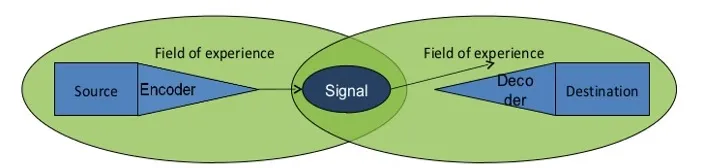
- Effective communication requires common field of experience between source-encoder and decoder-receiver
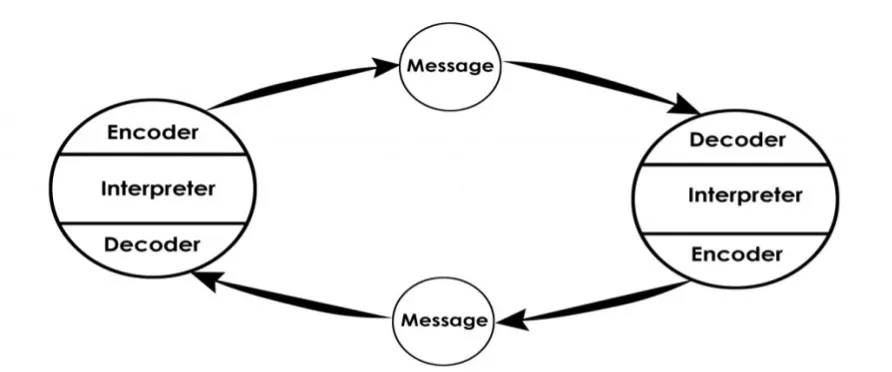
- Key insight: "Each person is both an encoder and decoder" -- communication is a two-way, continuous process
5. Shannon-Weaver's Mathematical Theory (1949)
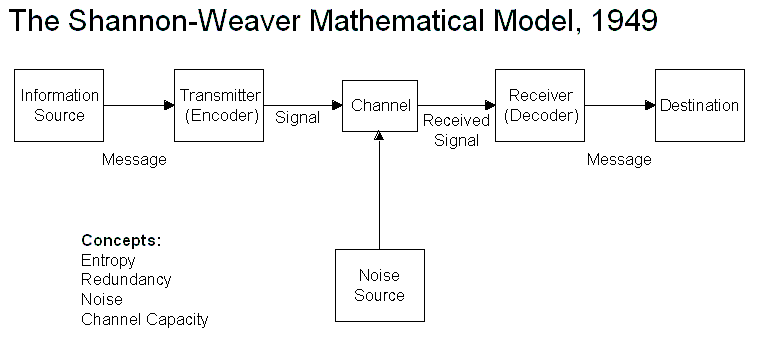
Source → Transmitter → Signal → Receiver → Destination (with Noise Source)
- Best suited for broadcast of farm information
- Mathematical/Information Theory of communication
- Introduced the concept of noise in communication
Three Levels of Problems:
| Level | Problem | Meaning |
|---|---|---|
| 1 | Technical | Accuracy of information transfer from sender to receiver |
| 2 | Semantic | People attach different meanings to words and language |
| 3 | Influence | Whether the message leads to desired behaviour change |
Key Concepts by Shannon-Weaver:
| Concept | Definition |
|---|---|
| Entropy | Degree of randomness or freedom to select a message; higher entropy = more information content |
| Redundancy | Information that could be omitted without losing meaning; English language is ~50% redundant; helpful in noisy channels |
| Noise | Any distortion not intended by communicator -- physical (background sounds), psychological (prejudices), or semantic (misunderstood terms) |
| Channel Capacity | Amount of information transmittable per unit time |
6. Berlo's Model (1960) -- SMCR
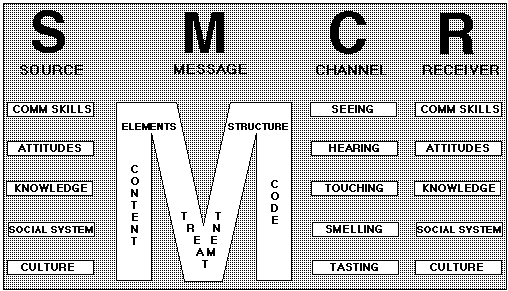
Source → Message → Channel → Receiver
- Berlo is known as Father of Communication
- Six elements: Source, Encoder, Message, Channel, Decoder, Receiver
- Purpose of communication should be behaviour control
- Effectiveness depends on communication skills, attitudes, knowledge, social system, and culture of both source and receiver
7. Leagans' Model (1963) -- CMCTAR
Communicator → Message → Channel → Treatment → Audience → Response
- The Communicator is the characteristic element
- Best described for field extension work
- Unique features: includes Treatment (how message is packaged) and Response (audience's reaction)

8. Rogers and Shoemaker's Model (1971) -- SMCRE
Source → Message → Channel → Receiver → Effects
- Added the concept of Effects -- what changes occur in the receiver
- Definition: "The process by which messages are transferred from a source to a receiver"
Comparison of Communication Models
| Model | Year | Key Element | Best For |
|---|---|---|---|
| Aristotle | 384-322 BC | Speaker | First persuasive model |
| Lasswell | 1948 | Who-What-Which-Whom-Effect | Political communication |
| Shannon-Weaver | 1949 | Noise | Broadcasting farm information |
| Schramm | 1961 | Common field of experience | Two-way communication |
| Berlo (SMCR) | 1960 | Encoding/Decoding | Father of Communication |
| Leagans (CMCTAR) | 1963 | Communicator + Treatment | Field extension work |
| Rogers-Shoemaker (SMCRE) | 1971 | Effects | Change measurement |
TIP
Quick Model Summary: Aristotle (first persuasive) | Lasswell (Who-What-Which-Whom-Effect) | Shannon-Weaver (best for broadcast, mathematical) | Berlo/SMCR (Father of Communication) | Leagans/CMCTAR (best for field extension) | Rogers-Shoemaker/SMCRE (Effects).
Six Elements of Communication (Leagans)
While models give us the overall framework, understanding the individual elements of communication is equally important. Leagans identified six elements that make up any communication act -- mastering each element is key to effective extension work.
Basic elements: Source, Message, Channel, Receiver. According to Leagans, there are 6 elements:
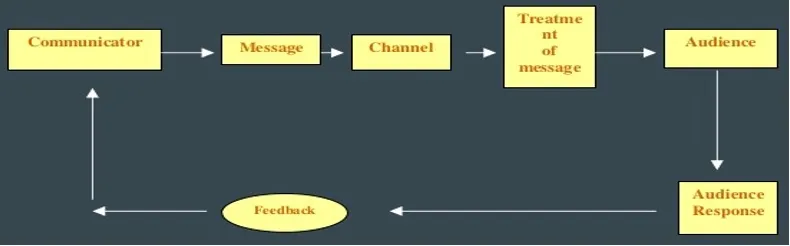
I. Communicator
- Person who initiates the communication process (source/sender)
- Attitude matters towards: Self, audience, and content
- Berlo identified 5 verbal communication skills: Writing, Speaking (encoding), Reading, Listening (decoding), and Thought/Reasoning (master skill for both)
II. Message
- Physical product of source-encounter
- Berlo's dimensions: Message Code, Message Content, Message Treatment
- Phonemes = basic speech sounds; Morphemes = smallest meaningful unit of speech; Syntax = rules for word order
Message Flow Models
- Hypodermic Needle Model -- information flows directly to masses with nothing intervening; assumes direct, immediate, powerful effects (later proved simplistic)
- Two-step Flow Model -- ideas flow from media to key communicators (opinion leaders), then from them to less active members
Message Distortion (Explained by Kirk)
| Type | What Happens | Information Status | Memory Aid |
|---|---|---|---|
| Systematic (Stretch) | Message stretched/expanded systematically | No information lost | Stretch = Safe |
| Fog | Parts become unclear | Information lost (partially) | Fog = Faded |
| Mirage | Extra/unwanted information added | Extra and unwanted; loss is maximum | Mirage = More than needed |
III. Channel
- According to Leagans: a physical bridge between sender and receiver
- Controlling flow of information through a channel is called gate keeping
Rogers & Shoemaker's Generalisations:
| Channel Type | Best For | When More Important |
|---|---|---|
| Interpersonal | Persuading individuals to accept new ideas | Persuasion function |
| Mass media | Creating awareness/knowledge about innovations | Knowledge function; for early adopters |
| Cosmopolite (external: radio, newspapers) | Knowledge function | For early adopters |
| Localite (local: leaders, neighbours) | Persuasion function | For later adopters |
IV. Treatment
- How the message is handled before placing in the channel -- packaging, organisation, and presentation
V. Audience
- The most important element in communication
- Active audience is suited for the communication process
- Audience segmentation = identifying sub-audiences and conveying special messages to each
VI. Audience Response
- Terminating element in communication
- Ultimate objective of any communication = audience response
- Feedback = carrying significant response back to the communicator
Feedback
Feedback is what transforms one-way information delivery into a genuine two-way communication process. Without feedback, the communicator has no way to know whether the message was received, understood, or acted upon.
- Concept given by Berlo
- Action-reaction interdependence in communication
- It stabilises the communication process
- Acceptance and rejection are types of feedback
- Feedback is source-oriented -- it travels back to inform the communicator
Barriers in Communication
Even well-designed communication can fail if barriers intervene. These barriers can originate from the communicator, the channel, or the receiver -- and recognising them is the first step to overcoming them.
| Barrier | Type | Example |
|---|---|---|
| Too much information (communication overload) | Communicator-related | Extension worker explaining 15 new practices in one session |
| Accuracy of information transfer | Technical problem | Static on a radio broadcast |
| Different meanings attached to things | Semantic barrier | "Urea" meaning fertiliser to a farmer but chemical compound to a chemist |
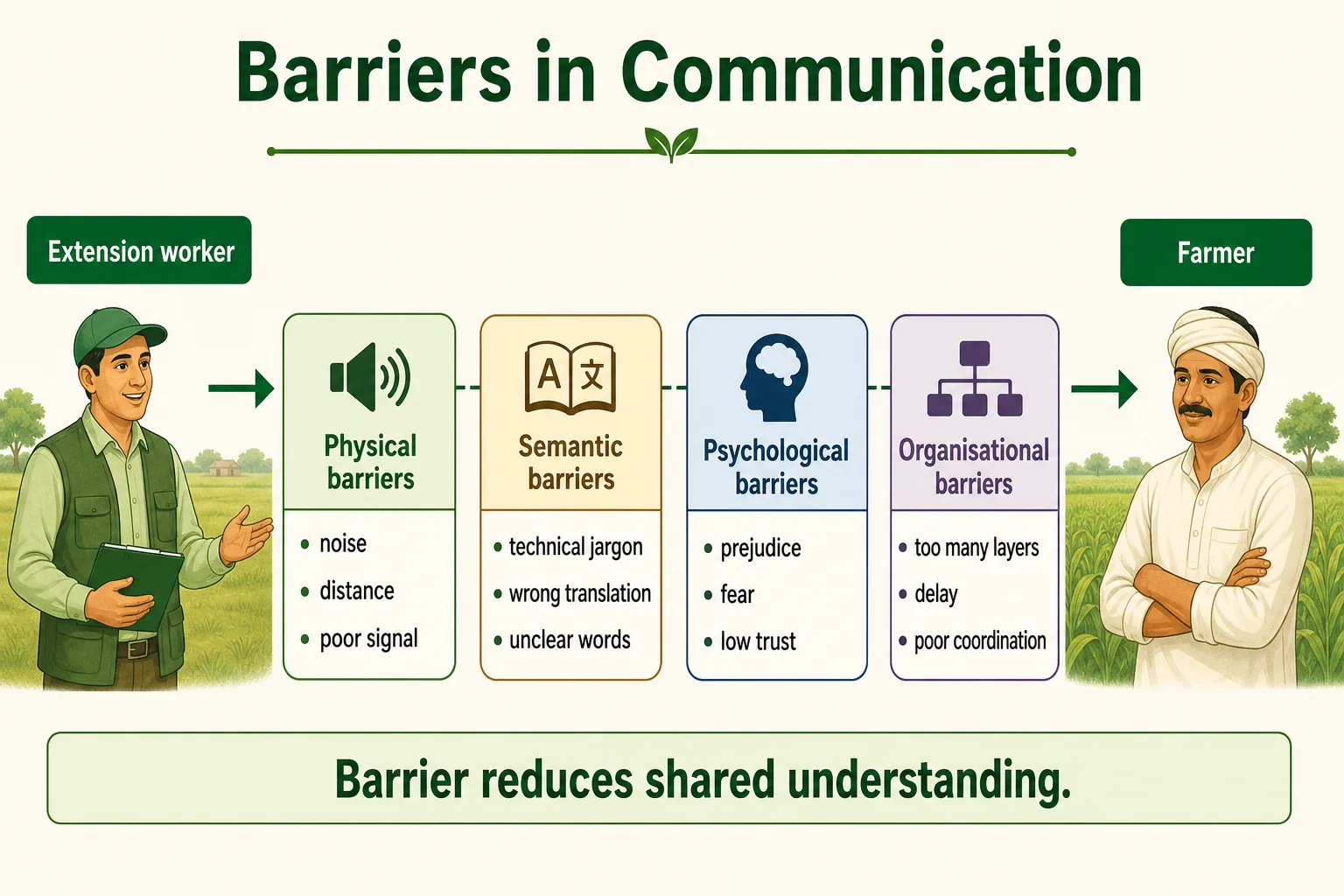
Noise
- An obstruction in communication that interferes with or distorts the message
- Main disadvantage: Wastage of time and energy (forces repetition)
- Also causes: environmental pollution, attention diversion, message distortion
Exam Tips
IMPORTANT
Most frequently tested facts:
- Communication derived from Latin "communis" = common
- Aristotle = first persuasive model
- Shannon-Weaver = best for broadcast; introduced noise
- Berlo = Father of Communication; SMCR model
- Leagans = best for field extension work; CMCTAR
- Receiver/Audience = most important element
- Feedback concept by Berlo
- Extension teaching is Horizontal
- Verbal distortion = 30%
- Non-verbal communication = 40% of total
- Only Complexity has negative correlation with adoption (from diffusion chapter)
Summary Cheat Sheet
| Concept | Key Fact |
|---|---|
| Word origin | Latin "communis" = common |
| Verbal time spent | 70% |
| Verbal distortion | 30% |
| Non-verbal share | 40% (body language) |
| First persuasive model | Aristotle |
| Best for broadcast | Shannon-Weaver (1949) |
| Father of Communication | Berlo (1960) |
| Best for field extension | Leagans' CMCTAR (1963) |
| Most important element | Receiver/Audience |
| Terminating element | Audience Response |
| Feedback concept by | Berlo |
| Extension teaching type | Horizontal |
| Gate keeping | Controlling information flow through channel |
| Distortion types | Systematic (safe), Fog (faded), Mirage (more) |
| Fidelity | Faithful performance by all elements |
| Empathy | Understanding other's internal frame of mind |
| Communication gap | Difference between sent and received message |
TIP
Next: The next lesson covers Diffusion and Adoption of Innovations -- how new ideas spread from a single source to millions of adopters through communication channels.