🙇♂️ Teaching and Learning Process -- Elements, Principles, Steps and Curves
Master the teaching-learning process in extension including 5 elements of learning, 12 principles of learning (Thorndike), AIDCAS steps in extension teaching, sensory learning percentages, and the S-shaped learning curve for IBPS AFO, NABARD Grade A, and FCI exams.
A Classroom Without Walls
In Section 1, we covered the foundations of extension education -- its meaning, history, concepts, and principles. Now we move to the teaching and learning process itself -- how extension workers actually create effective learning experiences that change farmer behaviour.
When an extension worker arranges a field day at a progressive farmer's plot to show the results of zero-tillage wheat, she is not just showing a crop -- she is designing a learning situation. The farmer's field becomes the classroom, the standing crop is the teaching material, and the farmers who walk through the plots are active learners. This is extension teaching and learning in action.
This lesson covers:
- Five Elements of a learning situation
- Teaching and Learning -- definitions and key facts
- Sensory Learning -- the 87% sight principle (Haas & Packer)
- Twelve Principles of Learning -- Thorndike's framework with agricultural examples
- AIDCAS -- the six steps in extension teaching
These topics form the theoretical backbone of Section 2 and are frequently tested in competitive exams.
Pro Content Locked
Upgrade to Pro to access this lesson and all other premium content.
₹99 charged monthly · Cancel anytime
- All Agriculture & Banking Courses
- AI Lesson Questions (100/day)
- AI Doubt Solver (50/day)
- Glows & Grows Feedback (30/day)
- AI Section Quiz (20/day)
- 22-Language Translation (100/day)
- Recall Questions (20/day)
- AI Quiz (15/day)
- AI Quiz Paper Analysis (100/day)
- AI Step-by-Step Explanations (100/day)
- Spaced Repetition Recall (FSRS)
- AI Tutor
- Immersive Text Questions
- Audio Lessons — Hindi & English
- Mock Tests & Previous Year Papers
- Summary & Mind Maps
- XP, Levels, Leaderboard & Badges
- Generate New Classrooms
- Voice AI Teacher (AgriDots Live)
- AI Revision Assistant
- Knowledge Gap Analysis
- Interactive Revision (LangGraph)
🔒 Secure via Razorpay · Cancel anytime · No hidden fees
A Classroom Without Walls
In Section 1, we covered the foundations of extension education -- its meaning, history, concepts, and principles. Now we move to the teaching and learning process itself -- how extension workers actually create effective learning experiences that change farmer behaviour.
When an extension worker arranges a field day at a progressive farmer's plot to show the results of zero-tillage wheat, she is not just showing a crop -- she is designing a learning situation. The farmer's field becomes the classroom, the standing crop is the teaching material, and the farmers who walk through the plots are active learners. This is extension teaching and learning in action.
This lesson covers:
- Five Elements of a learning situation
- Teaching and Learning -- definitions and key facts
- Sensory Learning -- the 87% sight principle (Haas & Packer)
- Twelve Principles of Learning -- Thorndike's framework with agricultural examples
- AIDCAS -- the six steps in extension teaching
These topics form the theoretical backbone of Section 2 and are frequently tested in competitive exams.
Teaching and Learning -- The Foundation
- Extension is an educational process to bring about desirable changes in human behaviour.
- The essential role of an extension worker is to create effective learning situations -- not merely deliver information, but design environments that promote meaningful behavioural change.
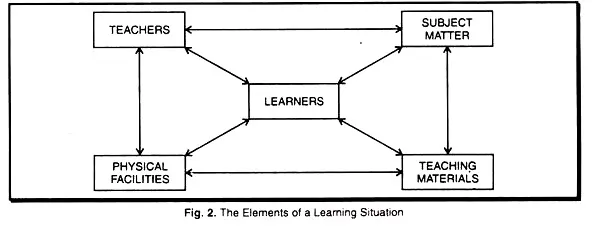
Five Elements of a Learning Situation
| Element | Role | Importance |
|---|---|---|
| 1. Teacher/Instructor | Facilitator who guides and motivates | Maximum interaction with learner |
| 2. Teaching materials and plan | Resources and strategy | Organised delivery |
| 3. Subject matter | Content to be learned | Must be relevant |
| 4. Learner | Most important and central element | Everything revolves around learner's needs |
| 5. Physical facilities and environment | Setting for learning | Affects comfort and attention |
IMPORTANT
The learner is the most important element. The instructor has the maximum interaction with the learner. These two facts are frequently tested.
Teaching
- Teaching is the process of arranging situations in which things to be learned are called to the attention of learners, their interest developed, desire aroused, and action promoted.
- In extension teaching, the teacher should first know the attitude of the learner.
- Effective teaching is not merely to inform people but to transform people.
Agricultural example: Before teaching farmers about soil testing, an extension worker first assesses whether they believe in scientific soil management or rely solely on traditional methods. Understanding their attitude is the essential first step.
Learning
Key Definitions and Facts
| Fact | Detail |
|---|---|
| Definition | Relatively enduring change in overt and covert responses as a result of perceived stimulus |
| Nature | Internal process mainly controlled by learner |
| Motivated by | Self |
| Most rapid when | Concentrating on one sense at a time |
| Learning theory | Bond/SR Theory by E.L. Thorndike (Father of Learning) |
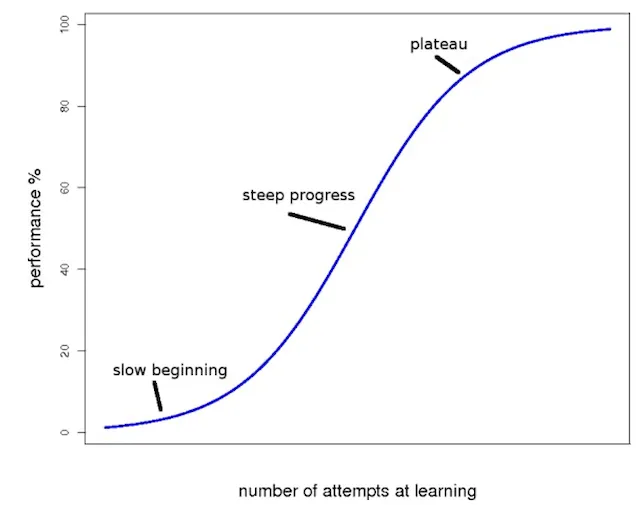
| Learning curve | S-shaped curve -- slow start, rapid middle, levels off |
| Experimental technique | Uses simulation games (learner-centred) |
| Latent learning | Learning that appears only when a reward or incentive is introduced |
Learning Through Senses (Haas & Packer, 1964)
| Sense | Contribution |
|---|---|
| Sight | 87% -- most dominant channel |
| Hearing | 7% |
| Smell | 3.5% |
| Touch | 1.5% |
| Taste | 1% |
TIP
Remember: Sight = 87%, Hearing = 7%. This is why visual aids are so powerful in extension. Combined with Edgar Dale's finding that active participation leads to 90% retention, the case for hands-on demonstrations is clear.
Twelve Principles of Learning
Each principle has been tested with scenario-based questions in competitive exams:
| # | Principle | Core Idea | Agricultural Example |
|---|---|---|---|
| 1 | Association | Learning is growth-like and continuous; link new to previous successful experiences | Profitable return from N fertiliser motivates farmer to try balanced NPK |
| 2 | Disassociation | Learning is affected by emotions; replace undesirable responses with better substitutes | Discouraging broadcasting, advocating line sowing for better yield |
| 3 | Clarity of Objectives | Learning must make sense; purposeful; easier when meaningful | Farmer uses crop loan only for growing crops -- clear about the objective |
| 4 | Self-activity | "Door to learning is locked on the inside"; learner must open it | Farmer conducting demonstration in own field -- learning by doing |
| 5 | Readiness | Learning is challenging and satisfying; happens when one is ready | Ready farmers cooperating to form a cooperative society |
| 6 | Satisfyingness (Reward) | Satisfying after-effect reinforces learning (Thorndike's Law of Effect) | Rabi-summer crops giving higher return -- farmers invest more in that season |
| 7 | Transfer | Applying learning from one situation to another similar situation | Water management technique learned in one crop applied to other crops |
| 8 | Motivation | Without motivation, no behaviour, hence no learning | Favourable tree-planting experience motivates tribals to collect more saplings |
| 9 | Set/Attitude | Unfavourable attitude retards learning; favourable attitude accelerates it | Farmer develops favourable attitude towards scientific cattle treatment |
| 10 | Practice (Law of Exercise) | Perfection requires correct, repeated practice; must result in functional understanding | Learning to use a sprayer correctly requires repeated trying |
| 11 | Timing | Learning happens best when topic is immediately relevant and usable | Teaching plant protection when insects have appeared or are likely to appear |
| 12 | Environment | Physical and social environment affect learning | Proper seating arrangement; supportive community atmosphere |
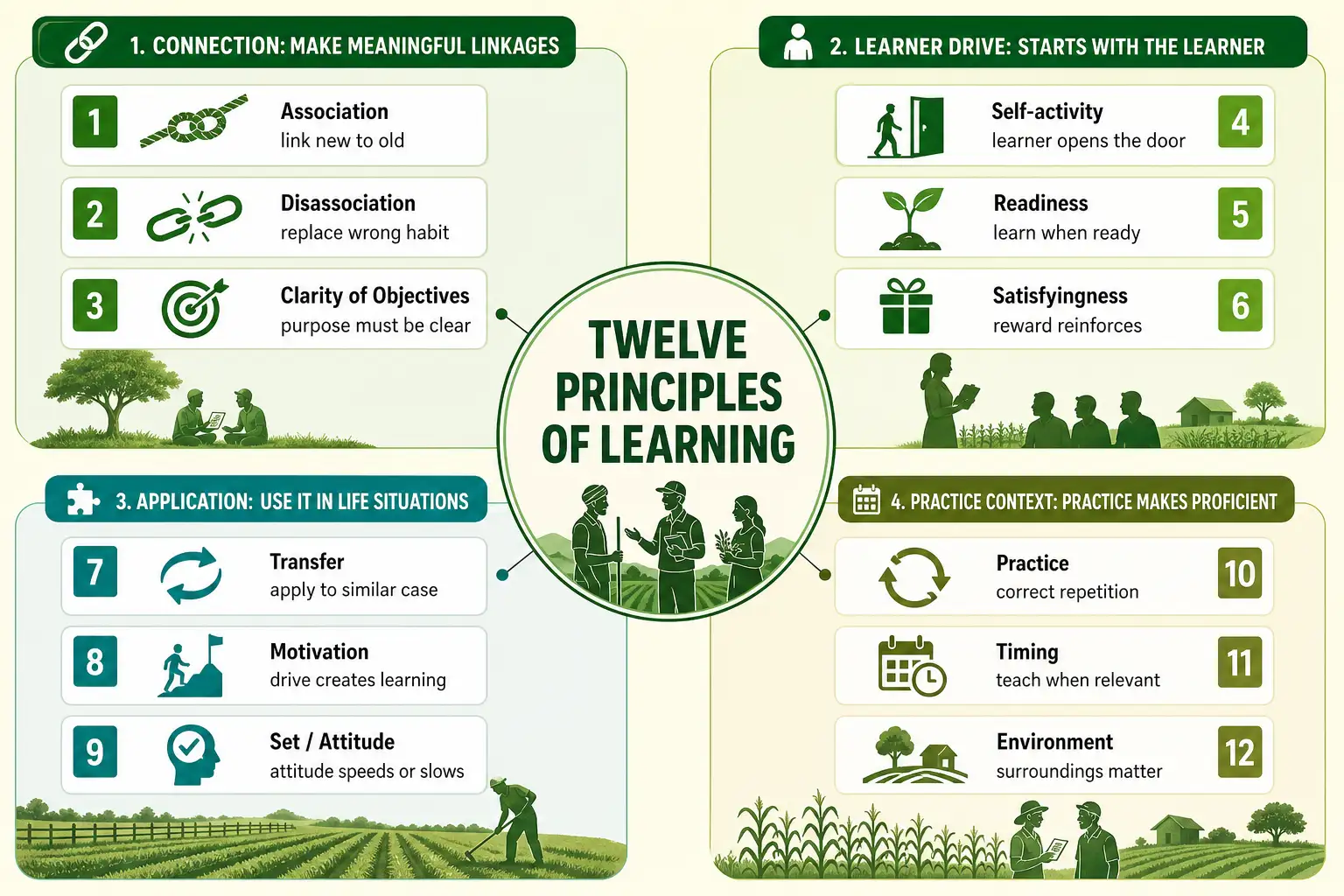
Quick Recap: 12 Principles of Learning
- Association -- Link new learning to existing knowledge
- Disassociation -- Replace undesirable responses with better ones
- Clarity of Objectives -- Learning must make sense to the learner
- Self-activity -- "Door locked on the inside"
- Readiness -- Learn when prepared
- Satisfyingness -- Reward reinforces learning
- Transfer -- Apply to new situations
- Motivation -- Drive towards action
- Set/Attitude -- Favourable attitude accelerates learning
- Practice -- Correct repetition builds skill
- Timing -- Teach when relevant
- Environment -- Physical and social settings matter
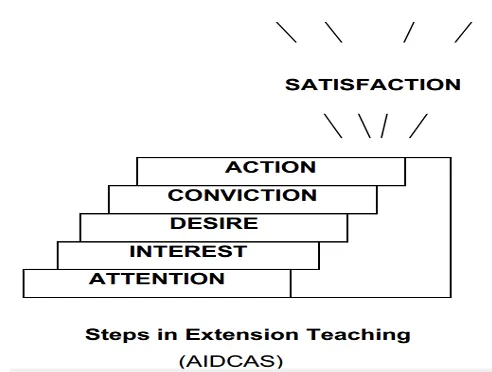
Steps in Extension Teaching -- AIDCAS
Given by Wilson & Gallup (1955)
| Step | Full Form | Description |
|---|---|---|
| A | Attention | Making people aware of new ideas and practices (first step) |
| I | Interest | Arousing curiosity to learn more |
| D | Desire | Unfreezing existing behaviour and motivating for change |
| C | Conviction | Convincing through evidence and demonstration |
| A | Action | Getting learners to implement the practice |
| S | Satisfaction | Ensuring results are satisfying to sustain adoption |
TIP
Mnemonic: Always Inspire Desire, Create Action, ensure Satisfaction.
Comparison: Learning Principles vs Extension Teaching Steps
| Learning Principle | Related AIDCAS Step |
|---|---|
| Motivation, Timing | Attention -- capture interest when relevant |
| Association | Interest -- connect new to known |
| Set/Attitude | Desire -- shift attitudes |
| Self-activity, Practice | Conviction and Action -- hands-on proof |
| Satisfyingness | Satisfaction -- positive outcomes reinforce |
Exam Tips
IMPORTANT
Frequently tested facts:
- Father of Learning = Thorndike (Bond/SR Theory)
- Learning curve = S-shaped
- Sight contributes 87% to learning
- Learner = most important element in learning situation
- Learning is motivated by Self
- "Door locked on the inside" = Principle of Self-activity
- "Evaluation prevents stagnation" (from extension principles)
- First step in extension teaching = Attention
- Desire = unfreezing existing behaviour
- AIDCAS by Wilson & Gallup (1955)
- Latent learning appears only when reward is introduced
Summary Cheat Sheet
| Concept / Topic | Key Details |
|---|---|
| Most important element | Learner (central element in learning situation) |
| Maximum interaction | Instructor has maximum interaction with learner |
| 5 Elements of learning | Teacher, Teaching materials, Subject matter, Learner, Physical facilities |
| Father of Learning | E.L. Thorndike; Bond/SR Theory |
| Learning curve | S-shaped (slow start → rapid middle → levels off) |
| Learning motivated by | Self |
| Sight contribution | 87% of sensory learning (Haas & Packer, 1964) |
| Hearing contribution | 7% |
| Active participation retention | Up to 90% |
| Read retention | 10-15% |
| 12 Principles of Learning | Association, Disassociation, Clarity of Objectives, Self-activity, Readiness, Satisfyingness, Transfer, Motivation, Set/Attitude, Practice, Timing, Environment |
| Self-activity | "Door to learning is locked on the inside" |
| Law of Exercise | Principle of Practice — correct repetition builds skill |
| Law of Effect | Principle of Satisfyingness — reward reinforces learning |
| Latent learning | Appears only when reward/incentive is introduced |
| AIDCAS | Attention → Interest → Desire → Conviction → Action → Satisfaction; by Wilson & Gallup (1955) |
| First step in teaching | Attention |
| Desire | Unfreezing existing behaviour |
| Effective teaching | Transform people, not just inform |
TIP
Next: Lesson 02 covers extension teaching methods in detail -- individual, group, and mass contacts, Edgar Dale's Cone of Experience, result vs method demonstrations, and classification by use and form.
Lesson Doubts
Ask questions, get expert answers