⛳️ 11 Principles of Extension Education -- With Examples and Exam Applications
Master all 11 principles of extension education with agricultural examples, scenario-based exam applications, and quick-recall mnemonics for IBPS AFO, NABARD Grade A, and FCI exams competitive exams.
Visual Overview
The Farmer-First Approach: Principles at Work
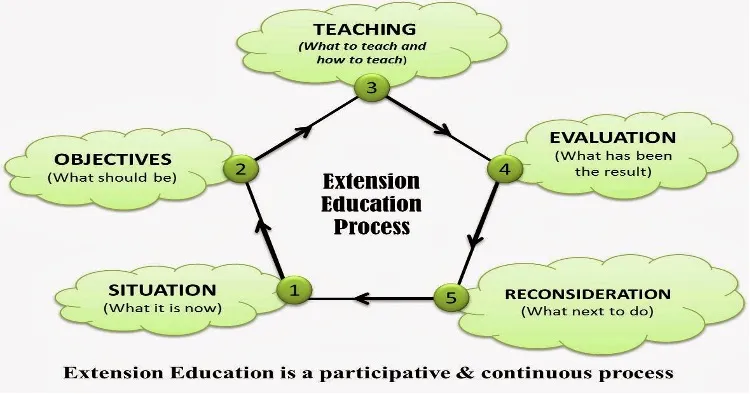
In the previous lesson, we explored the concepts, objectives, and philosophy of extension education -- the theoretical "what" and "why." Now we turn to the principles -- the practical "how" that guides every extension programme from planning to evaluation.
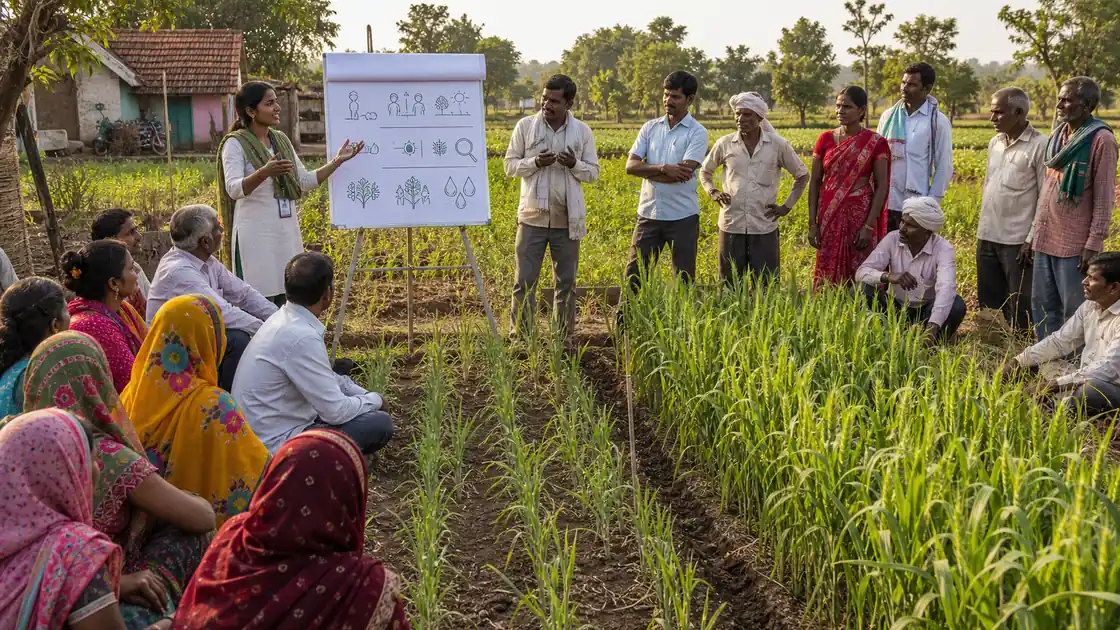
When a progressive farmer in Telangana successfully adopts System of Rice Intensification (SRI), the extension worker does not simply instruct every other farmer to copy the same method. Instead, she assesses local conditions, involves the farming community in identifying their needs, respects their traditional transplanting knowledge, and adapts SRI recommendations to suit each village's water availability and soil type. This farmer-first approach is guided by the 11 principles of extension education.
Pro Content Locked
Upgrade to Pro to access this lesson and all other premium content.
₹99 charged monthly · Cancel anytime
- All Agriculture & Banking Courses
- AI Lesson Questions (100/day)
- AI Doubt Solver (50/day)
- Glows & Grows Feedback (30/day)
- AI Section Quiz (20/day)
- 22-Language Translation (100/day)
- Recall Questions (20/day)
- AI Quiz (15/day)
- AI Quiz Paper Analysis (100/day)
- AI Step-by-Step Explanations (100/day)
- Spaced Repetition Recall (FSRS)
- AI Tutor
- Immersive Text Questions
- Audio Lessons — Hindi & English
- Mock Tests & Previous Year Papers
- Summary & Mind Maps
- XP, Levels, Leaderboard & Badges
- Generate New Classrooms
- Voice AI Teacher (AgriDots Live)
- AI Revision Assistant
- Knowledge Gap Analysis
- Interactive Revision (LangGraph)
🔒 Secure via Razorpay · Cancel anytime · No hidden fees
Visual Overview
The Farmer-First Approach: Principles at Work
In the previous lesson, we explored the concepts, objectives, and philosophy of extension education -- the theoretical "what" and "why." Now we turn to the principles -- the practical "how" that guides every extension programme from planning to evaluation.
When a progressive farmer in Telangana successfully adopts System of Rice Intensification (SRI), the extension worker does not simply instruct every other farmer to copy the same method. Instead, she assesses local conditions, involves the farming community in identifying their needs, respects their traditional transplanting knowledge, and adapts SRI recommendations to suit each village's water availability and soil type. This farmer-first approach is guided by the 11 principles of extension education.
This lesson covers:
- What are principles? -- definition and the two most important ones
- All 11 principles -- with agricultural examples for each
- Extension vs Learning principles -- comparison and overlap
- Exam mnemonics -- for quick recall
Scenario-based questions on these principles are common in exams.
What Are Principles?
- Principles are generalised guidelines that form the basis for decision and action in a consistent way. They are the foundation upon which all extension activities are planned and executed.
- The two most important principles of extension education are Participation and Leadership.
IMPORTANT
Remember the 11 principles of extension education. Exams frequently ask about individual principles with scenario-based questions.
The 11 Principles at a Glance
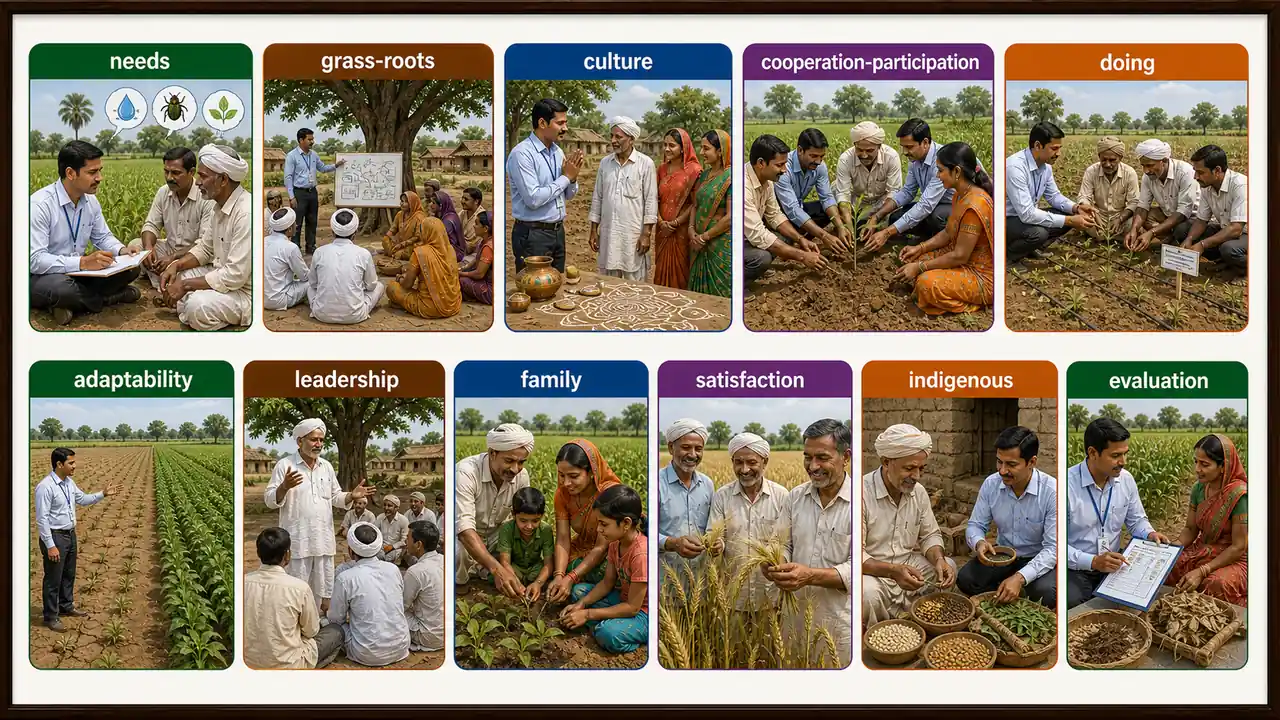
| # | Principle | Core Idea | Agricultural Example |
|---|---|---|---|
| 1 | Needs and Interests | Start from what people want and need | Extension on water-saving techniques in drought-prone Marathwada (farmers' felt need) |
| 2 | Grass-roots | Start local, think bottom-up | Panchayat Raj bodies identifying village-level priorities |
| 3 | Cultural Differences | Respect local culture | Introducing organic farming aligned with tribal farming traditions |
| 4 | Cooperation and Participation | Involve the community at every stage | Villagers assisting in implementing a new watershed programme |
| 5 | Learning by Doing | Hands-on experience | Farmers conducting demonstrations in their own fields |
| 6 | Adaptability | Flexible methods for local conditions | Modifying drip irrigation layout for hilly terrain |
| 7 | Leadership | Empower local voluntary leaders | Training a progressive farmer to become a para-extension worker |
| 8 | Whole Family | Involve farmers, youth, and women | Including farm women in dairy management training |
| 9 | Satisfaction | Outcomes must benefit people | Tangible income increase encourages continued adoption |
| 10 | Indigenous Knowledge | Integrate traditional wisdom | Blending local pest-repellent practices with modern IPM |
| 11 | Evaluation | Prevent stagnation through assessment | Annual review of KVK programme outcomes |
Detailed Principles
1. Principle of Needs and Interests
- Needs and interest of the people are the starting point of extension work.
- Extension succeeds only when programmes align with what people genuinely want and need -- participation increases, resistance decreases, and outcomes become lasting.
2. Grass-roots Principle
- Extension programmes should start with local groups, local situations, and local problems. Change must start from the existing situation.
- Example: The establishment of Panchayat Raj Bodies at various levels fulfils this principle -- grassroots governance where communities have direct say in decision-making.
TIP
If an exam question mentions "starting from where people are" or "bottom-up planning," it refers to the Grass-roots principle.
3. Principle of Cultural Differences
- Culture means social heritage. Differences exist between groups of farmers and between extension agents regarding their habits, customs, values, attitudes, and way of life.
- Extension must be carried out in harmony with the cultural pattern of the people. Ignoring cultural norms leads to resistance and failure.
4. Principle of Cooperation and Participation
- People must willingly cooperate and participate in identifying problems, planning solutions, and implementing projects.
- They must feel the programme is their own.
- People participation by merely being told what will happen = Passive participation.
- Example: Villagers assisting the extension worker at different levels in implementing a new programme.
5. Principle of Learning by Doing
- Learning remains far from perfect unless people actually do the work.
- This develops confidence as it involves the maximum number of sensory organs -- seeing, touching, and performing.
- People should learn what to do, why to do, how to do, and with what result.
- Learning by doing was coined by John Dewey.
6. Principle of Adaptability
- Extension work and teaching methods must be flexible and adapted to suit local conditions.
- People, situations, resources, and constraints vary from place to place and time to time -- a one-size-fits-all approach rarely works.
7. Principle of Leadership
- Local leaders are the custodians of local thought and action. Their involvement and legitimization are essential for programme success.
- "Never do anything that you can get someone to do for you" -- this famous quote relates to the leadership principle.
- Leadership development in extension is a means, not an end.
- Most useful leader in extension is the voluntary leader -- trusted and respected because they serve out of genuine concern.
- Example: Extending scientific knowledge to villagers by specialists of the same area.
8. Whole Family Principle
- Not only farmers but also farm youth and farm women must be involved.
- Primary unit of society is: Family.
- Farming is a family enterprise -- every member plays a vital role in productivity and household well-being.
9. Principle of Satisfaction
- The end product of extension work should produce satisfying results for the people.
- Satisfaction reinforces learning and motivates people to seek further improvement.
10. Principle of Indigenous Knowledge
- Instead of ignoring indigenous knowledge systems as outdated, the extension agent should understand them before recommending something new.
- A respectful, integrative approach -- blending modern science with traditional knowledge -- often produces the best results.
11. Principle of Evaluation
- Evaluation prevents stagnation.
- There should be a built-in method of measuring whether results match the objectives.
- Evaluation is a constructive process that guides continuous improvement.
Comparison: Extension Principles vs Learning Principles
| Feature | Extension Principles | Learning Principles |
|---|---|---|
| Total count | 11 | 11 (some texts list 12) |
| Focus | How to plan and implement extension programmes | How adults learn effectively |
| Key overlap | Learning by Doing, Participation | Self-activity, Motivation |
| Unique to extension | Grass-roots, Cultural differences, Leadership, Whole family | Association, Disassociation, Transfer, Timing |
| Common emphasis | Both stress Satisfaction, Evaluation, and Adaptability/Environment |
Exam Tips and Mnemonics
TIP
Mnemonic for 11 Extension Principles -- "NG-CCP-LA-WSI-E": Needs & interests, Grass-roots, Cultural differences, Cooperation & participation, Participation through learning by doing, Leadership, Adaptability, Whole family, Satisfaction, Indigenous knowledge, Evaluation
IMPORTANT
Frequently tested associations:
- "Starting from where people are" = Grass-roots
- "Never do anything you can get someone to do" = Leadership
- Panchayat Raj Bodies = Grass-roots principle
- Passive participation = being told what will happen
- Learning by Doing coined by John Dewey
- Most useful leader = Voluntary leader
- Evaluation prevents stagnation
- Primary unit of society = Family
Quick Recap: 11 Principles of Extension Education
- Needs and Interests -- Start with what people want
- Grass-roots -- Start local, think bottom-up
- Cultural Differences -- Respect local culture
- Cooperation and Participation -- Involve the community
- Learning by Doing -- Hands-on experience (John Dewey)
- Adaptability -- Flexible methods for local conditions
- Leadership -- Empower local voluntary leaders
- Whole Family -- Involve farmers, youth, and women
- Satisfaction -- Outcomes must benefit people
- Indigenous Knowledge -- Integrate traditional wisdom
- Evaluation -- Prevent stagnation through assessment
Summary Cheat Sheet
| Concept / Topic | Key Details |
|---|---|
| Total extension principles | 11 |
| Two most important | Participation and Leadership |
| Starting point of extension | Needs and Interests of people |
| Grass-roots principle | Start local; example = Panchayat Raj Bodies |
| Cultural Differences | Respect local habits, customs, and values |
| Cooperation & Participation | People must feel programme is their own |
| Passive participation | Being told what will happen |
| Learning by Doing | Coined by John Dewey; involves maximum sensory organs |
| Adaptability | Flexible methods for local conditions |
| Leadership principle | "Never do anything you can get someone to do for you"; most useful = voluntary leader |
| Whole Family | Primary unit = Family; include farmers, youth, women |
| Satisfaction | End product must produce satisfying results |
| Indigenous Knowledge | Understand before recommending new practices |
| Evaluation | Prevents stagnation; constructive, continuous process |
| Extension vs Learning | Both have 11 principles each; overlap on Learning by Doing, Satisfaction |
TIP
Next: Section 2 begins with the teaching and learning process -- the 5 elements of a learning situation, 12 principles of learning (Thorndike), AIDCAS steps, and the S-shaped learning curve.
Lesson Doubts
Ask questions, get expert answers