🖖🏻 Concept of Extension Education -- Types, Process, Objectives and Philosophy
Master the concept of extension education including formal vs non-formal education, the SOTER extension process, objectives at three levels, KSA framework, and the philosophy of teaching 'how to do' for exams.
From Farm to Framework: Why Concepts Matter
In the previous lessons, we traced the origin, history, and timeline of extension education. Now we move from what happened to how it works -- the conceptual framework that underpins every extension programme.
When a KVK scientist visits a village to teach farmers about integrated pest management in cotton, she does not follow a rigid school syllabus or give graded exams. Instead, she starts from the farmer's existing knowledge, demonstrates in the field, and encourages hands-on learning. This is extension education in practice -- and understanding its concepts helps us appreciate why this approach works so well.
This lesson covers:
- The Basic Concept -- education and the KSA framework
- Three Types of Education -- formal, non-formal, and informal
- The SOTER Process -- Leagans' five-step extension process
- Scope and Need -- why extension is indispensable
- Objectives and Philosophy -- the "how to do" approach
These conceptual distinctions are tested heavily in exams.
Pro Content Locked
Upgrade to Pro to access this lesson and all other premium content.
₹99 charged monthly · Cancel anytime
- All Agriculture & Banking Courses
- AI Lesson Questions (100/day)
- AI Doubt Solver (50/day)
- Glows & Grows Feedback (30/day)
- AI Section Quiz (20/day)
- 22-Language Translation (100/day)
- Recall Questions (20/day)
- AI Quiz (15/day)
- AI Quiz Paper Analysis (100/day)
- AI Step-by-Step Explanations (100/day)
- Spaced Repetition Recall (FSRS)
- AI Tutor
- Immersive Text Questions
- Audio Lessons — Hindi & English
- Mock Tests & Previous Year Papers
- Summary & Mind Maps
- XP, Levels, Leaderboard & Badges
- Generate New Classrooms
- Voice AI Teacher (AgriDots Live)
- AI Revision Assistant
- Knowledge Gap Analysis
- Interactive Revision (LangGraph)
🔒 Secure via Razorpay · Cancel anytime · No hidden fees
From Farm to Framework: Why Concepts Matter
In the previous lessons, we traced the origin, history, and timeline of extension education. Now we move from what happened to how it works -- the conceptual framework that underpins every extension programme.
When a KVK scientist visits a village to teach farmers about integrated pest management in cotton, she does not follow a rigid school syllabus or give graded exams. Instead, she starts from the farmer's existing knowledge, demonstrates in the field, and encourages hands-on learning. This is extension education in practice -- and understanding its concepts helps us appreciate why this approach works so well.
This lesson covers:
- The Basic Concept -- education and the KSA framework
- Three Types of Education -- formal, non-formal, and informal
- The SOTER Process -- Leagans' five-step extension process
- Scope and Need -- why extension is indispensable
- Objectives and Philosophy -- the "how to do" approach
These conceptual distinctions are tested heavily in exams.
The Basic Concept
The basic concept of extension is education. Everything extension does is aimed at helping people learn, grow, and improve their lives through knowledge.
Education -- The KSA Framework
- Education is essentially the production of desirable change in behaviour -- not just memorising facts, but producing observable and meaningful changes in how a person thinks, acts, and feels.
- Education causes change in three dimensions:
- Knowledge (things known)
- Skill (things done)
- Attitude (things felt)
TIP
Mnemonic -- KSA: Knowledge, Skill, Attitude. These three form the foundation of all educational outcomes in extension.
- "Education is the manifestation of perfection already in man" -- Swami Vivekananda. Education does not create ability from scratch but unlocks the latent potential within every individual.
- Education is shaped by society. The values, culture, and needs of the surrounding society determine what is taught and how.
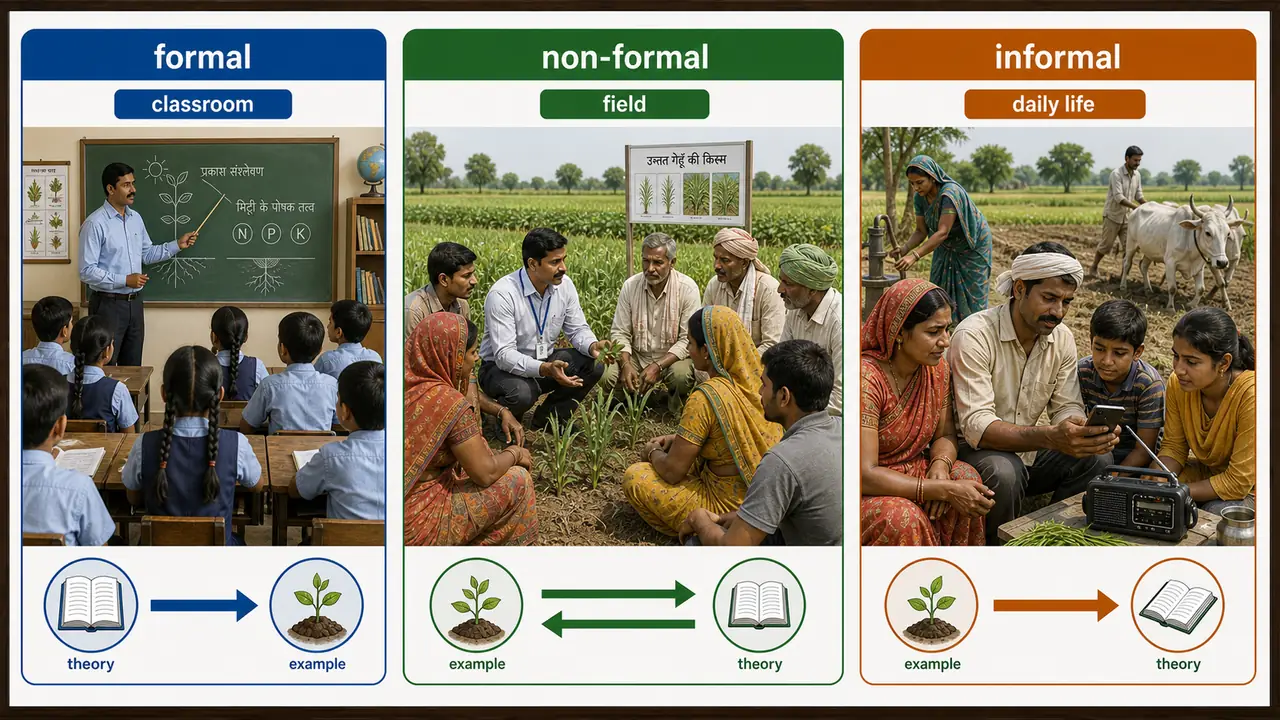
Three Types of Education
| Feature | Formal | Non-Formal | Informal |
|---|---|---|---|
| Structure | Institutionalised, graded, hierarchical | Organised but outside formal system | Unstructured, spontaneous |
| Approach | Deductive (theory to examples) | Inductive (examples to theory) | Learning through daily experience |
| Teaching | Vertical (top-down) | Horizontal (participatory) | No defined teacher-student relation |
| Curriculum | Fixed, standardised | Flexible, need-based | No curriculum |
| Learners | Specific age group | Heterogeneous (all ages and backgrounds) | Everyone, lifelong |
| Example | School, college | Agricultural Extension | Learning from family, community, media |
IMPORTANT
Formal vs Non-Formal: Formal education is Deductive (theory → examples) and Vertical (top-down). Non-formal education is Inductive (examples → theory) and Horizontal (participatory). Extension Education is a prime example of non-formal education.
Six Key Elements of Non-Formal Education
Identified by Etling, Radhakrishna & Bowen:
- Flexible curriculum -- content adapted to local needs
- Horizontal teaching -- democratic, participatory relationship
- Heterogeneous learners -- different ages, backgrounds, education levels
- Learner-centred -- focus on learner's needs and pace
- Less bureaucratic control
- More decentralisation -- decisions made locally
Agricultural example: When an extension worker teaches organic composting in a village, the group includes young farmers, elderly women, and landless labourers -- all learning together at their own pace. This is non-formal education at its best.
The Extension Education Process -- SOTER
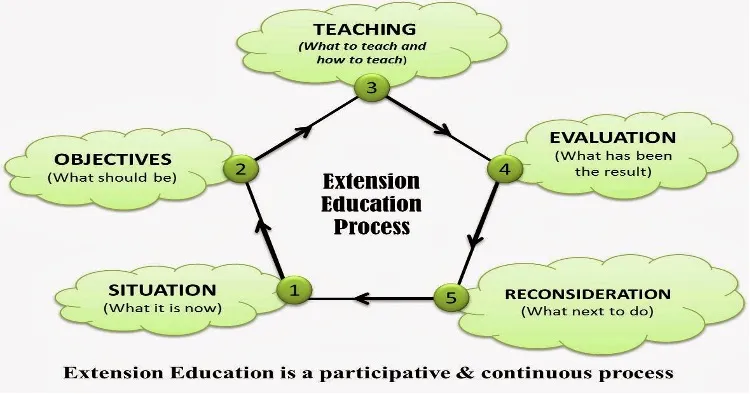
- Concept given by Leagans (1967)
- It involves 5 steps: SOTER
| Step | Full Form | What It Means |
|---|---|---|
| S | Situation | Assess the current conditions and baseline |
| O | Objectives | Set clear, measurable goals |
| T | Teaching | Deliver educational content through appropriate methods |
| E | Evaluation | Measure what was achieved vs what was planned |
| R | Reconsideration | Revise and improve based on evaluation |
TIP
Mnemonic: Smart Officers Teach Effectively, then Review.
Meaning of Extension Education
Extension education is an applied science consisting of content derived from research, accumulated field experiences, and relevant principles drawn from behavioural sciences -- synthesised with useful technology into a body of philosophy, principles, content, and methods focused on the problems of out-of-school education for adults and youths.
High-Yield Conceptual One-Liners
| Concept | Exam Fact |
|---|---|
| Basis of any extension approach | Individual is a means to an end |
| Extension approach in India | Follows norms of prescription |
| Most preferred work in extension | Democratic |
| Extension teaching | Mainly horizontal |
| Participatory development approach | Bottom-up approach |
Agricultural Extension
- Deals specifically with farmers and improving their knowledge, skills, and attitudes
- It is a special branch of Extension Education
- Book "Agricultural Extension" written by Van den Ban
- Book "Extension Education" written by Dr. A. Adivi Reddy
Scope of Extension Education
As a Discipline
| Dimension | Meaning |
|---|---|
| Educational Organisation/Agency | The institution that delivers extension |
| Educational Process/Means | The systematic method of teaching |
| Educational Job/Work | A professional career field |
Extension Service
- An organisation or programme for agricultural development and rural welfare that employs the extension process as a means of programme implementation
- Main responsibility of Extension Service is with State Government (agriculture is a state subject in India's federal structure)
Extension Process
- Working with rural people through out-of-school education -- emphasis on working with people, not for them
Scope of Agricultural Extension (Kelsey & Hearne)
Nine areas of programme emphasis:
- Efficiency in agricultural production
- Efficiency in marketing, distribution and utilisation
- Conservation, development and use of natural resources
- Management on the farm and in the home
- Family living
- Youth development
- Leadership development
- Community development and rural area development
- Public affairs
Need for Extension
Extension fills the gap between research and farming practice. Without it, scientific discoveries remain in labs and farmers' real-world challenges go unheard by researchers. Extension is the vital two-way bridge between these worlds.
Agricultural example: When IARI developed the Pusa Basmati 1121 rice variety, it was extension workers who organised demonstrations in farmers' fields across Punjab and Haryana, leading to its widespread adoption.
Objectives of Extension
Three Levels
| Level | Type | Example |
|---|---|---|
| 1 | Fundamental (all-inclusive) | People's participation in planning at grassroots level |
| 2 | General (more definite) | Mandatory creation of Panchayat Raj bodies |
| 3 | Working/Specific | Enacting laws for Panchayats, holding elections, providing funds |
Key Objective Facts
| Statement | Answer |
|---|---|
| Fundamental objective of extension | Overall development of the individual (Destination Man) |
| Ultimate objective of extension | Realising one's fullest potential / change in behaviour |
| Ultimate objective of extension work | Full development of an individual |
| Basic element at the core of extension | Man himself |
| Basic objective of extension education | Create opportunities for effective learning |
| Most important motive for extension work | Influence motivation |
Three Categories of Objectives
- Material -- Increase production and income
- Educational -- Change the outlook of people / develop the individual
- Social & Cultural -- Development of the community
Function of Extension Education
The primary function is to bring about desirable changes in human behaviour (KAS):
| Change In | Meaning |
|---|---|
| Knowledge | What people know |
| Skill | The technique of doing things |
| Attitude | Feelings or reactions towards certain things |
These three domains are interconnected -- a change in knowledge often leads to a change in attitude, which in turn motivates a change in skill and practice.
Motivation in Extension
- A motive is an inner drive, impulse, or intention that causes a person to act
- Motivation is the process of initiating conscious and purposeful action -- it is goal-directed behaviour
| Type | Description | Example |
|---|---|---|
| Intrinsic | Engaging in activity for its own sake | A farmer experimenting with new varieties out of curiosity |
| Extrinsic | Incentive or goal artificially introduced | Prize schemes, subsidies for adoption |
- Intrinsic motivation is more desirable for learning because it contributes to active, sustained participation
- All prize schemes are largely extrinsic in value
Philosophy of Extension Education
- The term philosophy is derived from Greek language
- The basic philosophy of extension is to teach people:
- How to do, NOT "What to do"
- How to think, NOT "What to think"
TIP
The twin philosophies of extension are easy to remember: "How to do" (not what to do) and "How to think" (not what to think). Both emphasise empowerment over dependence.
Agricultural example: Instead of simply telling a farmer to use drip irrigation, a good extension worker teaches the farmer how to assess water needs, how to calculate costs and benefits, and how to install and maintain the system. The farmer then becomes self-reliant.
Exam Tips
IMPORTANT
Frequently tested facts:
- Extension is non-formal education (never formal)
- Basic concept of extension = Education
- Extension process steps = SOTER (Leagans, 1967)
- Fundamental objective = Destination Man (overall individual development)
- Philosophy = Teach HOW to do and HOW to think
- Motivation in extension = Influence motivation
- Extension is both an organisation, a process, and a profession
Summary Cheat Sheet
| Concept / Topic | Key Details |
|---|---|
| Basic concept of extension | Education — producing desirable change in behaviour |
| KSA Framework | Knowledge (things known), Skill (things done), Attitude (things felt) |
| Formal education | Deductive (theory → examples), Vertical (top-down), fixed curriculum |
| Non-formal education | Inductive (examples → theory), Horizontal (participatory), flexible curriculum |
| Extension education | Prime example of non-formal education; heterogeneous learners |
| SOTER process | Situation → Objectives → Teaching → Evaluation → Reconsideration; by Leagans (1967) |
| Extension service responsibility | State Government (agriculture is a state subject) |
| Book: Agricultural Extension | Written by Van den Ban |
| Book: Extension Education | Written by Dr. A. Adivi Reddy |
| Fundamental objective | Overall development of the individual (Destination Man) |
| Ultimate objective | Full development of an individual / change in behaviour |
| Most important motive | Influence motivation |
| Philosophy of extension | Teach How to do (not what to do) & How to think (not what to think) |
| Intrinsic motivation | More desirable; activity done for its own sake |
| Extrinsic motivation | Incentive-driven; all prize schemes are extrinsic |
| 3 Objective categories | Material (production), Educational (individual), Social & Cultural (community) |
| Scope areas | 9 areas identified by Kelsey & Hearne |
| Swami Vivekananda | "Education is the manifestation of perfection already in man" |
TIP
Next: Lesson 05 covers the 11 principles of extension education -- the guiding rules that determine how extension programmes are planned and executed, from needs assessment to evaluation.
Lesson Doubts
Ask questions, get expert answers