⏰ Agricultural Timeline -- Chronological Events from Ancient India to Modern Era (900 AD to 2026)
Comprehensive chronological timeline of major events in Indian agriculture covering ancient farming, Portuguese crop introductions, Famine Commissions, IARI, ICAR, Green Revolution, NABARD, KVK, major schemes, and institutional milestones for IBPS AFO, NABARD Grade A, and FCI exams.
Visual Overview
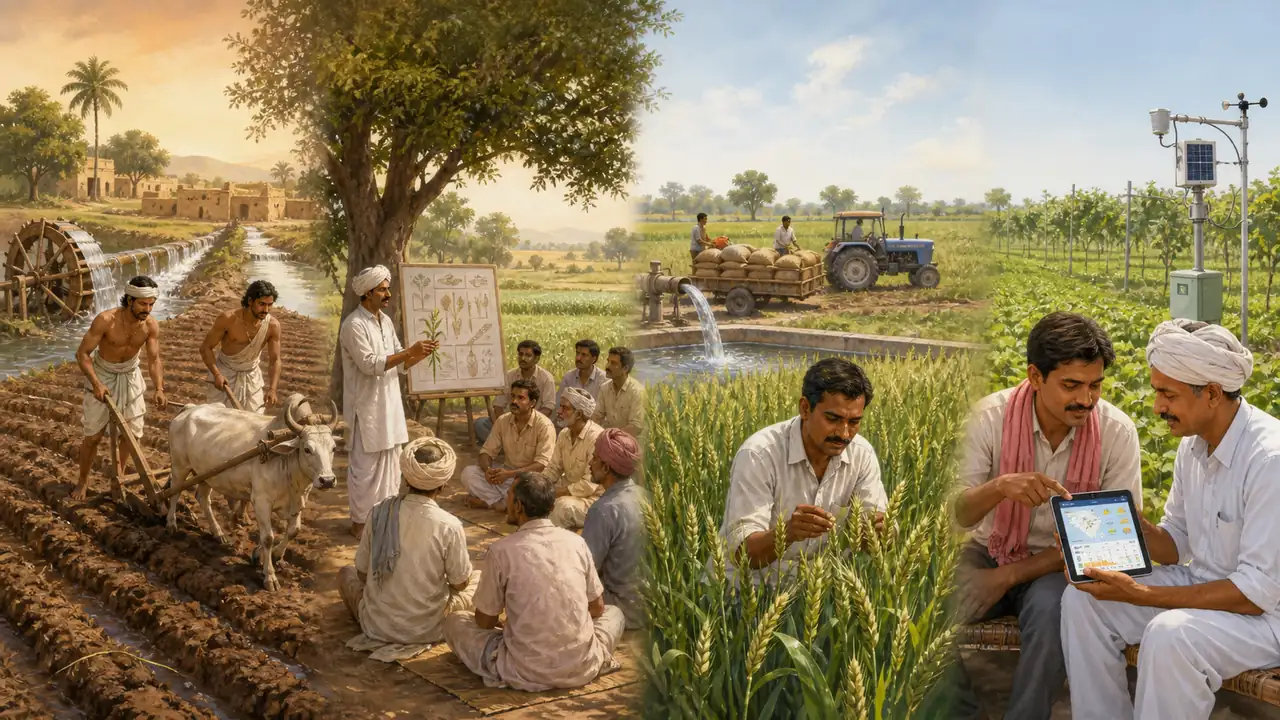
Important Chronological Events in Agriculture
In the previous lesson, we traced the historical development of extension through key acts and institutions in the USA and India. This lesson consolidates that knowledge into a single comprehensive timeline -- the most exam-dense reference in this entire module.
This timeline traces the evolution of Indian agriculture from ancient times through the modern era, covering key milestones in agricultural research, education, extension, and policy. Pay close attention to the years, names, and institutional developments -- these are frequently tested in competitive examinations.
IMPORTANT
This timeline is one of the most exam-relevant topics. Focus on italicised/bold years and the institutions established. Questions often ask about the year, location, or person associated with a milestone.
| Time | Description |
|---|---|
| 900-1000 A.D. | Construction of Anicuts and tanks, Krishi Parashar and Vrikshayurveda, manuals on agriculture and botany written, a textbook on Agriculture prepared by Kashyapa by the name Krishi Sukti |
| 15th Century A.D. | Cultivation of Wild Brinjal, Pomegranate, Sweet Orange, Sour Orange |
| 16th Century A.D. | Introduction of several crops to India by Portuguese. They are Potato, Sweet Potato, Tomato, Chillis, Papaya IBPS 2018, Pineapple, Pumpkin, Guava, Custard apple, Groundnut, Arrow Root, Cashewnut, Cassava, Tobacco, American Cotton, Rubber |
| 1550 A.D. | Portuguese introduced Grafting technique in horticulture |
| 1820 A.D. | G.L. Blane constructed Western Yamuna Canal |
| 1824 A.D. | Journal of Agriculture and Horticulture published |
| Lord Dalhousie (1848-1856) | 'Upper Bari Doab Canal' in Punjab was constructed. Improvement of agriculture started only in his period. |
| 1875 | Indian Meteorological Department established at Pune (Maharashtra) |
| 1880 | Famine Commission Appointed |
| 1891 | Dr. J.A. Volcker's report on Improvement of Indian Agriculture |
| 1898-1905 | Lord Curzon. His period is called as 'Golden period of agriculture'. 'Great Canal system of Western Punjab' was constructed. |
| 1901 | Appointed First Irrigation Commission (Chaired by Sir Colin Scott-Moncrieff to draw up a comprehensive irrigation plan for India.) |
| 1901-1905 | Agricultural colleges (6) were established at Pune, Nagpur, Kanpur, Sabour, Coimbatore and Lyallapur (In today's Pakistan). |
| 1905 | Established the Imperial (now known as Indian) Agricultural Research Institute at Pusa, Bihar shifted to New Delhi in 1936. |
| 1906 | Forest Research Institute (FRI) at Dehradun, Uttrakhand |
| 1912 | Sugarcane Breeding Institute (SBI) was established in Coimbatore |
| 1919 | Constitutional Reforms made Agriculture as a State Subject |
| 1921 | (ICC) Indian Central Cotton committee |
| 1926 | Appointment of Royal Commission on Agriculture (RCA) headed by Lord Linlithgow. |
| 1928 | RCA submitted its report |
| 1929 | Establishment of Imperial (now Indian) Council of Agricultural Research (ICAR), New Delhi |
| 1930 | First World Census of Agriculture |
| 1931 | Indian Central Lac Committee |
| 1936 | Indian Central Jute Committee |
| 1940 | Monthly magazine Indian Farming started by Imperial (Indian) Council of Agricultural Research (ICAR), New Delhi |
| 1942 | Grow more Food Campaign (Failed and again started in 1947) |
| 1943 | Great Bengal Famine -- Cochliobolus miyabeanus (earlier known as Helminthosporium oryzae) is a fungus that caused Brown Spot Disease in rice |
| 1944 | Indian Central Sugarcane Committee |
| 1945 | Indian Central Coconut Committee |
| 1945 | Indian Central Tobacco Committee |
| 1945 | Indian Village Services established by A.T. Mosher (New York) and B.N. Gupta |
| 1946 | Directorate of Plant Protection, Quarantine and Storage (DPPQ & S), Faridabad |
| 1946 | Central Rice Research Institute (CRRI), Cuttack (Orissa) |
| 1950 | NSSO (National Sample Survey Organisation) set up |
| 1947 | Indian Central Oil Seeds Committee |
| 1949 | Arecanut Committee |
| 2nd October 1952 | Community Development Program (CDP) was launched |
| 2nd October 1953 | Started National Extension Services (NES) |
| 1956 | Project for intensification of regional research on Cotton, Oil Seeds, Millets (PIRRCOM) |
| 1957 | First All India Coordinated Research Project (AICRP) on Maize Improvement |
| 1958 | Status of Deemed university accorded to IARI under UGC Act 1956 |
| 1958 | Spices and Cashewnut Committee |
| Oct. 1958 | NAFED (National Agricultural Cooperative Marketing Federation) |
| 1960 | First agricultural university in India, G.B. Pant University of Agriculture and Technology at Pantnagar, on the pattern of land grant system of USA |
| 1960-61 | Intensive Agriculture District Program (IADP) |
| 1963 | National Seed Corporation (NSC) |
| 1964 | Intensive Cattle Development Project (ICDP) |
| 1964 | Indian Society of Extension Education established on 22 June |
| 1965 | National Demonstration Program (NDP) |
| 1965 | First DG or Vice President of ICAR, Dr. B.P. Pal |
| 1966 | High Yielding Variety Programme (HYVP) |
| 1966 | Directorate of Extension (DoE) |
| 1966-67 | Green Revolution |
| 1969 | Second Irrigation Commission |
| 1970 | National Commission on Agriculture (NCA) |
| 1971 | All India Coordinated Research Project (AICRP) for Dry Land Agriculture |
| 1971 | Small Farmers Development Agency (SFDA) |
| 1971 | Marginal Farmers and Agricultural Labour Projects (MFAL) |
| 1973 | Creation of Department of Agricultural Research and Education (DARE) in the Ministry of Agriculture |
| 1st Nov 1973 | Establishment of Agricultural Scientists Recruitment Board (ASRB) based on the recommendation of G. Gadkar report |
| 1975 | Started Agricultural Research Service (ARS). For the Scientific Personnel two Services, viz. Agricultural Research Service (ARS) and Research Management Positions (RMP) for conducting research and management of research were constituted with effect from October 1, 1975 and April 1, 1976 respectively. The ARS was inaugurated on October 2, 1975 at NDRI, Karnal. |
| 1973-74 | Drought Prone Areas Programme (DPAP) |
| 1974 | Command Area Development Authority (CADA) |
| 1974 | Minimum Needs Programme (MNP) |
| 1974 | Krishi Vigyan Kendra (KVK). Mohan Singh Mehta committee recommended (First at Pondicherry, under TNAU, Coimbatore) |
| 1975 | Started 20 points Programme |
| 1976 | National Academy of Agricultural Research and Management (NAARM), Hyderabad |
| 1977-78 | Desert Development Programme (DDP) |
| April 1978 | Integrated Rural Development Program (IRDP) launched in financial year 1978 and extended throughout India in 1980 |
| 1979 | Training for Rural Youth for Self-Employment (TRYSEM) |
| 1st June 1979 | Lab to Land Programme (LLP), on the ICAR golden jubilee year |
| 1980 | National Rural Employment Programme (NREP) |
| 1980 | National Agricultural Research Project (NARP) |
| 12th July 1982 | National Bank for Agriculture and Rural Development (NABARD) |
| 1983 | National Agricultural Extension Project (NAEP) |
| 1983 | Rural Landless Employment Guarantee Programme (RLEGP) |
| 1985 | Crop Insurance Scheme (CIS) now National Agricultural Insurance Scheme (NAIS) |
| 1986 | Technology Mission on Oilseeds (TMO) |
| 1986 | National Watershed Development Programme for Rainfed Areas |
| 1986 | National Agricultural Research Project (Phase 2) |
| 1989 | Jawahar Rozgar Yojana [JRY] (Formed after merger of NREP and RLEGP) |
| 1989 | Integrated Watershed Development Programme |
| 1995 | Institutional Village Linkage Programme (IVLP) |
| 1996 | Establishment of National Gene Bank at New Delhi |
| 1997 | Swarana Jayanti Sahari Rozgar Yojana (SJSRY) |
| 1998 | National Agricultural Technology Project (NATP) |
| 1998 | Kisan Credit Card Scheme |
| 1999 | Jawahar Gram Samridhi Yojana (JGSY) |
| 1999 | SwaranaJayanti Gram Swarozgar Yojana (SGSY) (IRDP, TRYSEM, DWACRA, SITRA merged in SGSY) |
| Rabi 1999-2000 | National Agricultural Insurance Scheme (NAIS) |
| 2000 | Antyodaya Anna Yojana (AAY) |
| 2000 | Pradhan Mantri Gram Sadak Yojana (PGSY) |
| 2001 | Sampooma Grameen Rozgar Yojana (SGRY) |
| April 2004 | The four erstwhile schemes of DPP, OPDP, NPDP and AMDP have been merged into one Centrally Sponsored Integrated scheme of Oilseeds, Pulses, Oil Palm and Maize (ISOPOM) being implemented from 1.4.2004 |
| 2004 | National Food for Work Programme (NFWP) |
| 2004 | Inauguration of National Agricultural Science Complex (NASC) at New Delhi |
| 2004 | Marine Fishing Policy |
| 2004 | National Commission on Farmers constituted on November 18, 2004 under the chairmanship of Professor M.S. Swaminathan |
| 2005 | National Horticulture Mission (NHM) |
| 2006 | National Bamboo Mission (NBM) |
| 2006 | ICAR launched National Agricultural Innovation Project (NAIP) with financial support from World Bank |
| 2006 | Mahatma Gandhi National Rural Employment Guarantee Scheme (MGNREGS) |
| 2006 | National Rainfed Area Authority (NRAA) on 3.11.2006 |
| 2007 | National Food Security Mission (NFSM) |
| 2007 | Rashtriya Krishi Vikash Yojana (RKVY) |
| 2014 | NHM merged into a new Programme Mission for Integrated Development of Horticulture (MIDH) |
Key patterns to note in this timeline:
Pro Content Locked
Upgrade to Pro to access this lesson and all other premium content.
₹99 charged monthly · Cancel anytime
- All Agriculture & Banking Courses
- AI Lesson Questions (100/day)
- AI Doubt Solver (50/day)
- Glows & Grows Feedback (30/day)
- AI Section Quiz (20/day)
- 22-Language Translation (100/day)
- Recall Questions (20/day)
- AI Quiz (15/day)
- AI Quiz Paper Analysis (100/day)
- AI Step-by-Step Explanations (100/day)
- Spaced Repetition Recall (FSRS)
- AI Tutor
- Immersive Text Questions
- Audio Lessons — Hindi & English
- Mock Tests & Previous Year Papers
- Summary & Mind Maps
- XP, Levels, Leaderboard & Badges
- Generate New Classrooms
- Voice AI Teacher (AgriDots Live)
- AI Revision Assistant
- Knowledge Gap Analysis
- Interactive Revision (LangGraph)
🔒 Secure via Razorpay · Cancel anytime · No hidden fees
Visual Overview
Important Chronological Events in Agriculture
In the previous lesson, we traced the historical development of extension through key acts and institutions in the USA and India. This lesson consolidates that knowledge into a single comprehensive timeline -- the most exam-dense reference in this entire module.
This timeline traces the evolution of Indian agriculture from ancient times through the modern era, covering key milestones in agricultural research, education, extension, and policy. Pay close attention to the years, names, and institutional developments -- these are frequently tested in competitive examinations.
IMPORTANT
This timeline is one of the most exam-relevant topics. Focus on italicised/bold years and the institutions established. Questions often ask about the year, location, or person associated with a milestone.
| Time | Description |
|---|---|
| 900-1000 A.D. | Construction of Anicuts and tanks, Krishi Parashar and Vrikshayurveda, manuals on agriculture and botany written, a textbook on Agriculture prepared by Kashyapa by the name Krishi Sukti |
| 15th Century A.D. | Cultivation of Wild Brinjal, Pomegranate, Sweet Orange, Sour Orange |
| 16th Century A.D. | Introduction of several crops to India by Portuguese. They are Potato, Sweet Potato, Tomato, Chillis, Papaya IBPS 2018, Pineapple, Pumpkin, Guava, Custard apple, Groundnut, Arrow Root, Cashewnut, Cassava, Tobacco, American Cotton, Rubber |
| 1550 A.D. | Portuguese introduced Grafting technique in horticulture |
| 1820 A.D. | G.L. Blane constructed Western Yamuna Canal |
| 1824 A.D. | Journal of Agriculture and Horticulture published |
| Lord Dalhousie (1848-1856) | 'Upper Bari Doab Canal' in Punjab was constructed. Improvement of agriculture started only in his period. |
| 1875 | Indian Meteorological Department established at Pune (Maharashtra) |
| 1880 | Famine Commission Appointed |
| 1891 | Dr. J.A. Volcker's report on Improvement of Indian Agriculture |
| 1898-1905 | Lord Curzon. His period is called as 'Golden period of agriculture'. 'Great Canal system of Western Punjab' was constructed. |
| 1901 | Appointed First Irrigation Commission (Chaired by Sir Colin Scott-Moncrieff to draw up a comprehensive irrigation plan for India.) |
| 1901-1905 | Agricultural colleges (6) were established at Pune, Nagpur, Kanpur, Sabour, Coimbatore and Lyallapur (In today's Pakistan). |
| 1905 | Established the Imperial (now known as Indian) Agricultural Research Institute at Pusa, Bihar shifted to New Delhi in 1936. |
| 1906 | Forest Research Institute (FRI) at Dehradun, Uttrakhand |
| 1912 | Sugarcane Breeding Institute (SBI) was established in Coimbatore |
| 1919 | Constitutional Reforms made Agriculture as a State Subject |
| 1921 | (ICC) Indian Central Cotton committee |
| 1926 | Appointment of Royal Commission on Agriculture (RCA) headed by Lord Linlithgow. |
| 1928 | RCA submitted its report |
| 1929 | Establishment of Imperial (now Indian) Council of Agricultural Research (ICAR), New Delhi |
| 1930 | First World Census of Agriculture |
| 1931 | Indian Central Lac Committee |
| 1936 | Indian Central Jute Committee |
| 1940 | Monthly magazine Indian Farming started by Imperial (Indian) Council of Agricultural Research (ICAR), New Delhi |
| 1942 | Grow more Food Campaign (Failed and again started in 1947) |
| 1943 | Great Bengal Famine -- Cochliobolus miyabeanus (earlier known as Helminthosporium oryzae) is a fungus that caused Brown Spot Disease in rice |
| 1944 | Indian Central Sugarcane Committee |
| 1945 | Indian Central Coconut Committee |
| 1945 | Indian Central Tobacco Committee |
| 1945 | Indian Village Services established by A.T. Mosher (New York) and B.N. Gupta |
| 1946 | Directorate of Plant Protection, Quarantine and Storage (DPPQ & S), Faridabad |
| 1946 | Central Rice Research Institute (CRRI), Cuttack (Orissa) |
| 1950 | NSSO (National Sample Survey Organisation) set up |
| 1947 | Indian Central Oil Seeds Committee |
| 1949 | Arecanut Committee |
| 2nd October 1952 | Community Development Program (CDP) was launched |
| 2nd October 1953 | Started National Extension Services (NES) |
| 1956 | Project for intensification of regional research on Cotton, Oil Seeds, Millets (PIRRCOM) |
| 1957 | First All India Coordinated Research Project (AICRP) on Maize Improvement |
| 1958 | Status of Deemed university accorded to IARI under UGC Act 1956 |
| 1958 | Spices and Cashewnut Committee |
| Oct. 1958 | NAFED (National Agricultural Cooperative Marketing Federation) |
| 1960 | First agricultural university in India, G.B. Pant University of Agriculture and Technology at Pantnagar, on the pattern of land grant system of USA |
| 1960-61 | Intensive Agriculture District Program (IADP) |
| 1963 | National Seed Corporation (NSC) |
| 1964 | Intensive Cattle Development Project (ICDP) |
| 1964 | Indian Society of Extension Education established on 22 June |
| 1965 | National Demonstration Program (NDP) |
| 1965 | First DG or Vice President of ICAR, Dr. B.P. Pal |
| 1966 | High Yielding Variety Programme (HYVP) |
| 1966 | Directorate of Extension (DoE) |
| 1966-67 | Green Revolution |
| 1969 | Second Irrigation Commission |
| 1970 | National Commission on Agriculture (NCA) |
| 1971 | All India Coordinated Research Project (AICRP) for Dry Land Agriculture |
| 1971 | Small Farmers Development Agency (SFDA) |
| 1971 | Marginal Farmers and Agricultural Labour Projects (MFAL) |
| 1973 | Creation of Department of Agricultural Research and Education (DARE) in the Ministry of Agriculture |
| 1st Nov 1973 | Establishment of Agricultural Scientists Recruitment Board (ASRB) based on the recommendation of G. Gadkar report |
| 1975 | Started Agricultural Research Service (ARS). For the Scientific Personnel two Services, viz. Agricultural Research Service (ARS) and Research Management Positions (RMP) for conducting research and management of research were constituted with effect from October 1, 1975 and April 1, 1976 respectively. The ARS was inaugurated on October 2, 1975 at NDRI, Karnal. |
| 1973-74 | Drought Prone Areas Programme (DPAP) |
| 1974 | Command Area Development Authority (CADA) |
| 1974 | Minimum Needs Programme (MNP) |
| 1974 | Krishi Vigyan Kendra (KVK). Mohan Singh Mehta committee recommended (First at Pondicherry, under TNAU, Coimbatore) |
| 1975 | Started 20 points Programme |
| 1976 | National Academy of Agricultural Research and Management (NAARM), Hyderabad |
| 1977-78 | Desert Development Programme (DDP) |
| April 1978 | Integrated Rural Development Program (IRDP) launched in financial year 1978 and extended throughout India in 1980 |
| 1979 | Training for Rural Youth for Self-Employment (TRYSEM) |
| 1st June 1979 | Lab to Land Programme (LLP), on the ICAR golden jubilee year |
| 1980 | National Rural Employment Programme (NREP) |
| 1980 | National Agricultural Research Project (NARP) |
| 12th July 1982 | National Bank for Agriculture and Rural Development (NABARD) |
| 1983 | National Agricultural Extension Project (NAEP) |
| 1983 | Rural Landless Employment Guarantee Programme (RLEGP) |
| 1985 | Crop Insurance Scheme (CIS) now National Agricultural Insurance Scheme (NAIS) |
| 1986 | Technology Mission on Oilseeds (TMO) |
| 1986 | National Watershed Development Programme for Rainfed Areas |
| 1986 | National Agricultural Research Project (Phase 2) |
| 1989 | Jawahar Rozgar Yojana [JRY] (Formed after merger of NREP and RLEGP) |
| 1989 | Integrated Watershed Development Programme |
| 1995 | Institutional Village Linkage Programme (IVLP) |
| 1996 | Establishment of National Gene Bank at New Delhi |
| 1997 | Swarana Jayanti Sahari Rozgar Yojana (SJSRY) |
| 1998 | National Agricultural Technology Project (NATP) |
| 1998 | Kisan Credit Card Scheme |
| 1999 | Jawahar Gram Samridhi Yojana (JGSY) |
| 1999 | SwaranaJayanti Gram Swarozgar Yojana (SGSY) (IRDP, TRYSEM, DWACRA, SITRA merged in SGSY) |
| Rabi 1999-2000 | National Agricultural Insurance Scheme (NAIS) |
| 2000 | Antyodaya Anna Yojana (AAY) |
| 2000 | Pradhan Mantri Gram Sadak Yojana (PGSY) |
| 2001 | Sampooma Grameen Rozgar Yojana (SGRY) |
| April 2004 | The four erstwhile schemes of DPP, OPDP, NPDP and AMDP have been merged into one Centrally Sponsored Integrated scheme of Oilseeds, Pulses, Oil Palm and Maize (ISOPOM) being implemented from 1.4.2004 |
| 2004 | National Food for Work Programme (NFWP) |
| 2004 | Inauguration of National Agricultural Science Complex (NASC) at New Delhi |
| 2004 | Marine Fishing Policy |
| 2004 | National Commission on Farmers constituted on November 18, 2004 under the chairmanship of Professor M.S. Swaminathan |
| 2005 | National Horticulture Mission (NHM) |
| 2006 | National Bamboo Mission (NBM) |
| 2006 | ICAR launched National Agricultural Innovation Project (NAIP) with financial support from World Bank |
| 2006 | Mahatma Gandhi National Rural Employment Guarantee Scheme (MGNREGS) |
| 2006 | National Rainfed Area Authority (NRAA) on 3.11.2006 |
| 2007 | National Food Security Mission (NFSM) |
| 2007 | Rashtriya Krishi Vikash Yojana (RKVY) |
| 2014 | NHM merged into a new Programme Mission for Integrated Development of Horticulture (MIDH) |
Key patterns to note in this timeline:
-
Pre-Independence (before 1947): The focus was on establishing research institutions and commodity committees (Cotton, Jute, Sugarcane, etc.). The devastating famines drove the creation of agricultural departments and the appointment of commissions.
-
1950s-1960s: The post-independence era saw the launch of Community Development Programmes, establishment of agricultural universities, and the beginning of the Green Revolution with High Yielding Variety Programmes. This was the era of institutional foundation building.
-
1970s-1980s: Focus shifted to poverty alleviation and employment generation programmes (SFDA, IRDP, NREP, RLEGP). Key institutions like KVKs and NABARD were established. The Lab to Land Programme marked ICAR's direct engagement with farmers.
-
1990s-2000s: Economic reforms led to the restructuring and consolidation of schemes (multiple schemes merged into SGSY, JRY, etc.). Technology projects (NATP) and market-oriented schemes (Kisan Credit Card) emerged.
-
2006 onwards: Major flagship programmes like MGNREGS, NFSM, and RKVY were launched, representing a new era of rights-based and mission-mode approaches to agricultural and rural development.
Most Frequently Asked Dates
- 1905 -- IARI at Pusa, Bihar
- 1929 -- ICAR established
- 1952 -- Community Development Programme (2nd Oct)
- 1960 -- First Agricultural University (Pantnagar)
- 1960-61 -- IADP
- 1966-67 -- Green Revolution
- 1974 -- First KVK (Pondicherry)
- 1979 -- Lab to Land Programme (ICAR golden jubilee)
- 1982 -- NABARD (12th July)
- 1998 -- Kisan Credit Card
- 2007 -- NFSM and RKVY
Summary Cheat Sheet
| Concept / Topic | Key Details |
|---|---|
| 16th Century | Portuguese introduced Potato, Tomato, Chilli, Papaya, Tobacco, Groundnut, Rubber to India |
| 1871 | Agriculture Department established under Lord Mayo (Famine Commission 1866) |
| 1891 | Dr. Voelcker's report on Indian Agriculture improvement |
| 1901 | Famine Commission → IARI at Pusa, Bihar (1905) under Lord Curzon |
| 1901-05 | 6 agricultural colleges (Pune, Nagpur, Kanpur, Sabour, Coimbatore, Lyallpur) |
| 1919 | Agriculture became state subject (Govt of India Act) |
| 1926 | Royal Commission on Agriculture under Lord Linlithgow |
| 1929 | ICAR established (16 July); registered society |
| 1943 | Bengal Famine — Brown Spot of Rice (H. oryzae) |
| 1952 | Community Development Programme (2 Oct) |
| 1957 | First AICRP on Maize |
| 1960 | First Agri University — Pantnagar |
| 1960-61 | IADP launched |
| 1965 | National Demonstration; First DG ICAR = Dr. B.P. Pal |
| 1966-67 | Green Revolution; HYVP; Directorate of Extension |
| 1973 | DARE created; ASRB established (1 Nov) |
| 1974 | First KVK at Pondicherry (Mohan Singh Mehta Committee) |
| 1975 | ARS inaugurated (2 Oct, NDRI Karnal); SITE satellite TV experiment |
| 1976 | NAARM at Hyderabad; Doordarshan established (1 April) |
| 1979 | Lab to Land Programme (ICAR golden jubilee, 1 June); TRYSEM |
| 1982 | NABARD (12 July); colour TV via INSAT-1A (15 Aug) |
| 1998 | Kisan Credit Card; NATP |
| 1999 | SGSY (replaced IRDP, TRYSEM, DWCRA, SITRA) |
| 2004 | National Commission on Farmers under M.S. Swaminathan |
| 2006 | MGNREGS; NAIP (World Bank); NRAA |
| 2007 | NFSM; RKVY |
TIP
Next: Lesson 04 explores the concept of extension education in depth -- types of education (formal vs non-formal vs informal), the SOTER process, objectives, philosophy, and the KSA framework.
Lesson Doubts
Ask questions, get expert answers