🔄 Adoption & Diffusion Process
Adoption process stages (AIETA), factors affecting adoption, adopter categories with percentages, and diffusion concepts for IBPS AFO/NABARD exam.
Visual Overview
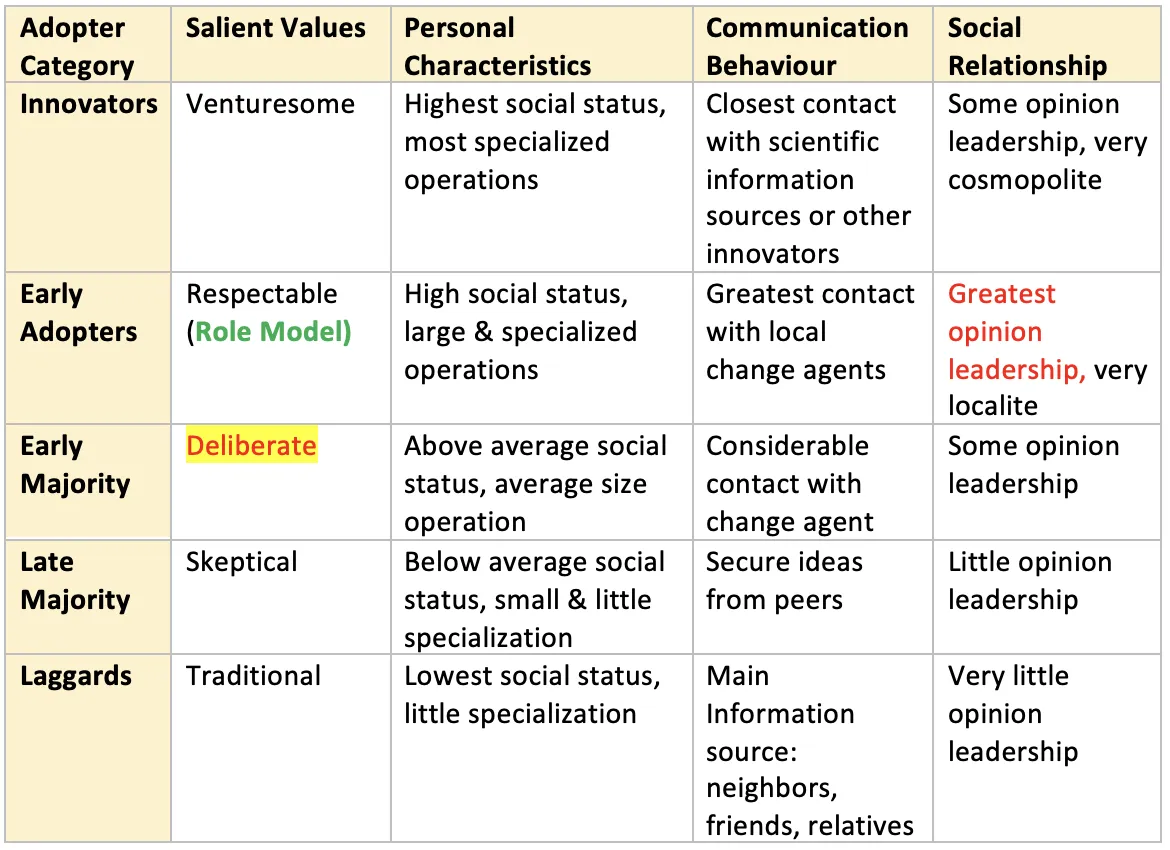
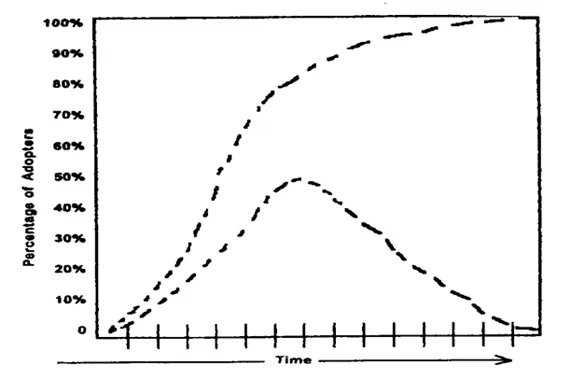
Understanding how new agricultural technologies move from the research station to the farmer's field is central to extension work. The adoption-diffusion framework explains both the journey an individual farmer takes (adoption) and how innovations spread across a community (diffusion). These concepts appear repeatedly in IBPS AFO, NABARD Grade A, and FCI exams.
This lesson covers:
- Diffusion and Adoption — definitions and how they differ
- Four Elements of Adoption — Innovation, Diffusion, Motivation, Adoption
- AIETA Stages — the five-step mental process every adopter passes through
- Five Factors Affecting Adoption — Relative Advantage, Compatibility, Complexity, Trialability, Observability
- Adopter Categories — the five types of adopters with their percentages on the bell curve
Diffusion
Diffusion is the process by which an innovation is communicated through certain channels over time among the members of a social system. It is a special type of communication where the messages are concerned with new ideas. The concept was formalized by sociologist Everett M. Rogers in his 1962 book Diffusion of Innovations, which remains the foundational text for understanding how technologies spread.
Pro Content Locked
Upgrade to Pro to access this lesson and all other premium content.
₹99 charged monthly · Cancel anytime
- All Agriculture & Banking Courses
- AI Lesson Questions (100/day)
- AI Doubt Solver (50/day)
- Glows & Grows Feedback (30/day)
- AI Section Quiz (20/day)
- 22-Language Translation (100/day)
- Recall Questions (20/day)
- AI Quiz (15/day)
- AI Quiz Paper Analysis (100/day)
- AI Step-by-Step Explanations (100/day)
- Spaced Repetition Recall (FSRS)
- AI Tutor
- Immersive Text Questions
- Audio Lessons — Hindi & English
- Mock Tests & Previous Year Papers
- Summary & Mind Maps
- XP, Levels, Leaderboard & Badges
- Generate New Classrooms
- Voice AI Teacher (AgriDots Live)
- AI Revision Assistant
- Knowledge Gap Analysis
- Interactive Revision (LangGraph)
🔒 Secure via Razorpay · Cancel anytime · No hidden fees
Visual Overview
Understanding how new agricultural technologies move from the research station to the farmer's field is central to extension work. The adoption-diffusion framework explains both the journey an individual farmer takes (adoption) and how innovations spread across a community (diffusion). These concepts appear repeatedly in IBPS AFO, NABARD Grade A, and FCI exams.
This lesson covers:
- Diffusion and Adoption — definitions and how they differ
- Four Elements of Adoption — Innovation, Diffusion, Motivation, Adoption
- AIETA Stages — the five-step mental process every adopter passes through
- Five Factors Affecting Adoption — Relative Advantage, Compatibility, Complexity, Trialability, Observability
- Adopter Categories — the five types of adopters with their percentages on the bell curve
Diffusion
Diffusion is the process by which an innovation is communicated through certain channels over time among the members of a social system. It is a special type of communication where the messages are concerned with new ideas. The concept was formalized by sociologist Everett M. Rogers in his 1962 book Diffusion of Innovations, which remains the foundational text for understanding how technologies spread.
Adoption
While diffusion describes the spread across a social system, adoption focuses on the individual decision-maker.
Adoption is an individual matter or phenomenon — a behavioural, socio-economical, or mental process through which an individual passes from hearing about an innovation to its final adoption. A farmer may hear about drip irrigation (diffusion happening around them) but will only adopt it after personally passing through several mental stages.
Four Elements of Adoption Process
Every adoption event involves four interconnected elements. Understanding these helps distinguish what drives a farmer from first hearing about a technology to actually using it.
- Innovation — an idea, practice, or object perceived as new by the individual. It does not need to be objectively new — what matters is that the adopter perceives it as new.
- Diffusion — the spread of that innovation through communication channels (mass media, interpersonal contact, extension agents) across a social system over time.
- Motivation — the process of initiating conscious and purposeful action. Without motivation, a farmer may be aware of an innovation but never act on it. Motivation bridges knowledge and behaviour.
- Adoption — the final acceptance and continued use of the innovation. A one-time trial does not count as adoption; the farmer must integrate it into regular practice.
Five Stages of Adoption Process (AIETA)
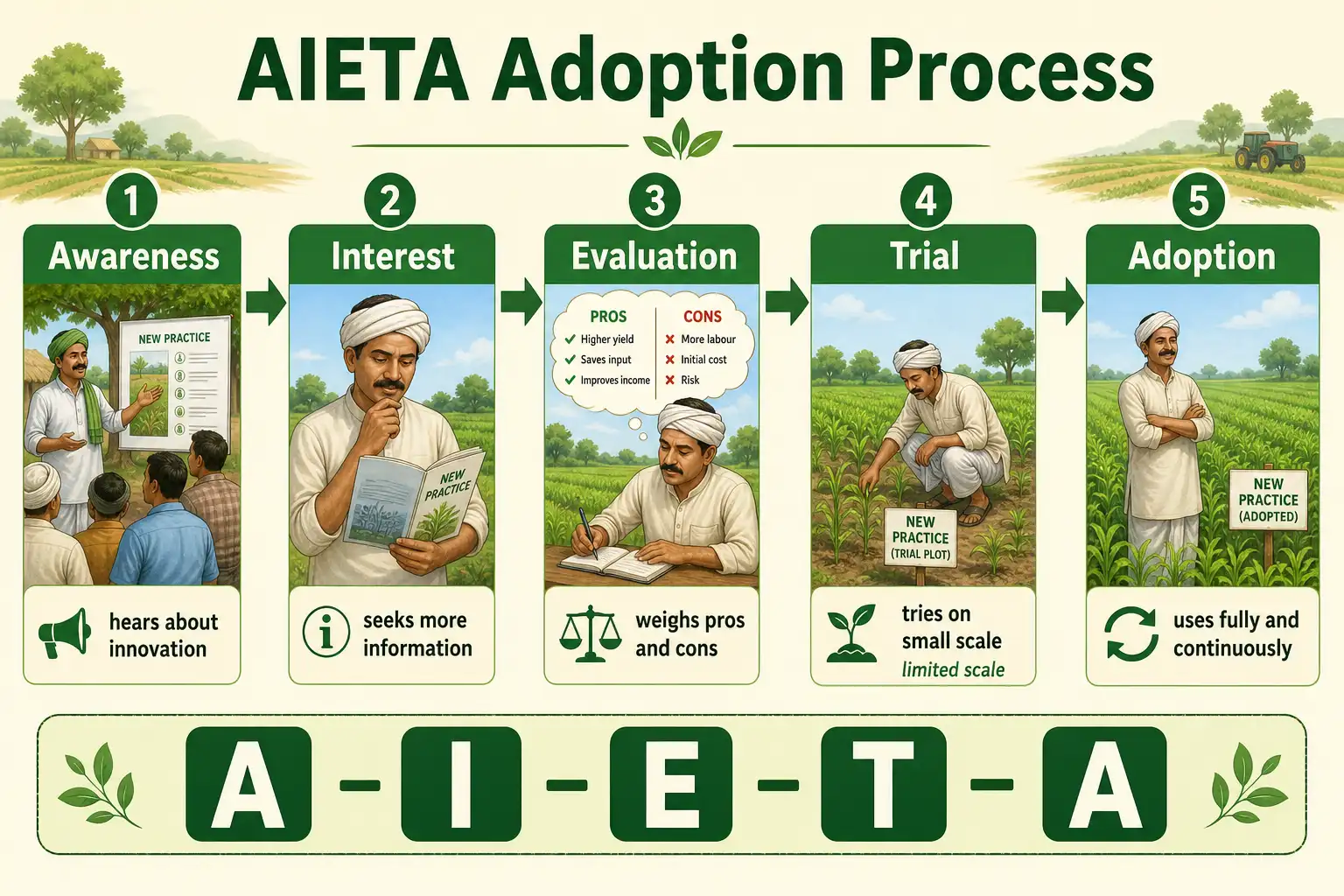
The adoption process is not instantaneous — every individual passes through five sequential mental stages before fully adopting an innovation. These stages were identified by researchers at Iowa State University and later refined by Everett Rogers. The acronym AIETA is one of the most frequently tested concepts in extension education.
| Stage | Name | Description |
|---|---|---|
| 1 | Awareness | Individual first learns about the innovation |
| 2 | Interest | Individual seeks more information |
| 3 | Evaluation | Individual mentally weighs pros and cons |
| 4 | Trial | Individual tries the innovation on a small scale |
| 5 | Adoption | Individual decides to use the innovation fully and continuously |
TIP
Mnemonic: A-I-E-T-A = "Any Intelligent Extension Teaches Adoption"
Five Factors Affecting Adoption of Innovation
Not all innovations spread at the same speed. Rogers identified five perceived attributes of an innovation that determine how quickly it is adopted. Four of these are positive (higher = faster adoption), while Complexity is the only negative factor — a distinction that exams test frequently.
| Factor | Effect on Diffusion | Direction | Example |
|---|---|---|---|
| Relative Advantage | Higher advantage = Faster diffusion | Positive (+) | A superior product/service that provides advantage over existing alternatives |
| Compatibility | Higher compatibility = Faster diffusion | Positive (+) | When a new crop variety suits the agro-climatic conditions and farmer's beliefs & values |
| Complexity | Higher complexity = Slower diffusion | Negative (-) | HYV technologies requiring balanced nutrition, plant protection, and better management Asked in exams Mains 2021 |
| Trialability | Higher trialability = Faster diffusion | Positive (+) | Providing free seeds and fertilizers to farmers for testing |
| Observability | Higher observability = Faster diffusion | Positive (+) | Effect of nitrogenous fertilizer is more visible in plants than phosphate/potash |
IMPORTANT
Only Complexity is a NEGATIVE factor. All other four factors are positive — higher = faster diffusion. Remember: "R-C-C-T-O" — only the middle C (Complexity) is negative.
Predictability
Beyond the five main factors, predictability also influences adoption decisions.
- Predictability = the degree of certainty of receiving expected benefits from the adoption of an innovation. When a farmer can reliably predict that a new seed variety will yield 20% more under their conditions, they are far more likely to adopt it.
- Higher predictability encourages adoption because it reduces the perceived risk — the main barrier for resource-poor farmers who cannot afford a failed experiment.
Five Adopter Categories
Rogers classified individuals into five categories based on how quickly they adopt innovations. The distribution follows a normal bell-shaped curve — most people fall in the middle categories, with a small percentage adopting very early or very late. This classification is one of the most important concepts in extension education and is tested in nearly every IBPS AFO/NABARD exam.
| Category | Also Called | Percentage | Behaviour |
|---|---|---|---|
| 1. Innovators | Venturesome | 2.5% | Adopt immediately; risk-takers, cosmopolite |
| 2. Early Adopters | Respectable | 13.5% | Adopt through local leaders; opinion leaders |
| 3. Early Majority | Deliberate | 34% | Adopt just before the common people; careful decision makers |
| 4. Late Majority | Skeptical | 34% | Adopt after seeing relatives & neighbours adopt; peer pressure driven |
| 5. Laggards | Traditional | 16% | Adopt last; resistant to change, past-oriented |
TIP
Percentage Memory Aid: 2.5 — 13.5 — 34 — 34 — 16
- The two middle categories (Early Majority + Late Majority) together make up 68%
- Innovators + Early Adopters = 16% (same as Laggards!)
- The curve is perfectly symmetrical: 16% on each tail, 68% in the middle
NOTE
Exam-critical associations:
- Innovators = Venturesome (2.5%)
- Early Adopters = Respectable (13.5%) — these are the opinion leaders
- Laggards = Traditional (16%) — they adopt last and are most resistant to change
Key Concepts Summary
This section consolidates additional exam-relevant terms related to adoption and diffusion that may appear as standalone MCQs.
| Concept | Definition |
|---|---|
| Innovation | An idea, practice, or object perceived as new by an individual |
| Diffusion | Process of communication of innovation through channels over time |
| Adoption | Mental process from awareness to final acceptance |
| Mass media | Best suited for creating awareness about innovations |
| Over-adoption | May occur due to insufficient knowledge |
Summary Cheat Sheet
Use this table for last-minute revision — it covers every key concept, percentage, and association from the adoption-diffusion framework.
| Concept / Topic | Key Details |
|---|---|
| Diffusion | Process of communicating an innovation through channels over time among a social system |
| Adoption | Individual mental process from hearing about innovation to final acceptance |
| 4 Elements of Adoption | Innovation, Diffusion, Motivation, Adoption |
| AIETA stages | Awareness → Interest → Evaluation → Trial → Adoption |
| Relative Advantage | Higher = faster diffusion; positive factor |
| Compatibility | Higher = faster diffusion; positive factor |
| Complexity | Higher = slower diffusion; only negative factor among 5 |
| Trialability | Higher = faster diffusion; positive factor |
| Observability | Higher = faster diffusion; positive factor |
| Innovators | Venturesome; 2.5%; adopt immediately; risk-takers |
| Early Adopters | Respectable; 13.5%; opinion leaders |
| Early Majority | Deliberate; 34%; adopt before common people |
| Late Majority | Skeptical; 34%; adopt after seeing neighbours adopt |
| Laggards | Traditional; 16%; adopt last; resistant to change |
| Normal curve split | Innovators + Early Adopters = 16% = Laggards; Middle 68% |
| Mass media | Best suited for creating awareness about innovations |
| Over-adoption | May occur due to insufficient knowledge |
| Predictability | Degree of certainty of receiving expected benefits from innovation |
TIP
Next: The following lessons compile important one-liner facts, key dates, award winners, and agricultural revolutions — essential quick-revision material for the final stretch of exam preparation.