📚 Principles of Extension & Learning
All 11 principles of extension education and 11 principles of learning with examples, plus AIDCAS steps in extension teaching for IBPS AFO/NABARD exam.
Visual Overview
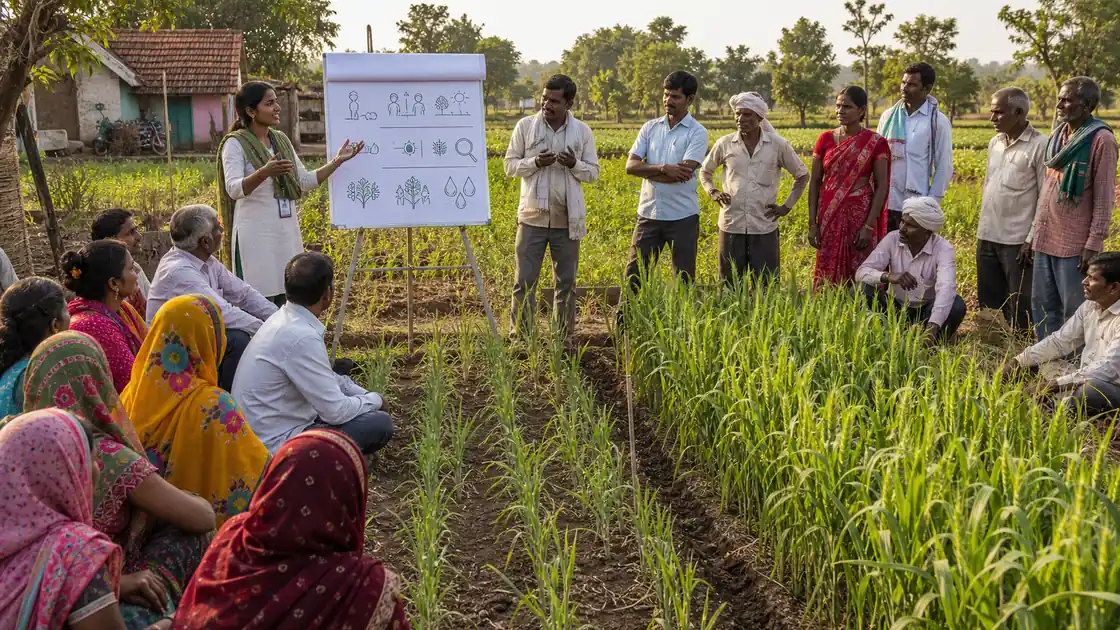
In the previous lesson, we explored demonstrations and teaching contact methods — the practical tools extension workers use in the field. But what theoretical principles should guide their work? And how do adults actually learn? This lesson covers both: the 11 principles of extension that define what good extension looks like, and the 11 principles of learning that explain how farmers absorb and apply new knowledge.
This lesson covers:
- 11 Principles of Extension — from Cultural Difference to Cooperation
- 11 Principles of Learning — from Self-Activity to Clarity
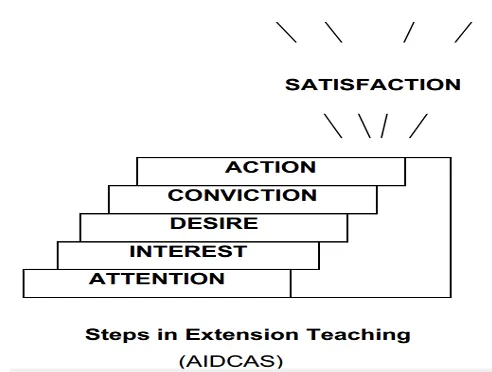
- AIDCAS steps — the sequence of extension teaching by Wilson and Gallup
- Key learning concepts — definitions and fundamental objectives
These principles are high-yield for exams, often tested through scenario-based questions where you must identify which principle is being applied.
Pro Content Locked
Upgrade to Pro to access this lesson and all other premium content.
₹99 charged monthly · Cancel anytime
- All Agriculture & Banking Courses
- AI Lesson Questions (100/day)
- AI Doubt Solver (50/day)
- Glows & Grows Feedback (30/day)
- AI Section Quiz (20/day)
- 22-Language Translation (100/day)
- Recall Questions (20/day)
- AI Quiz (15/day)
- AI Quiz Paper Analysis (100/day)
- AI Step-by-Step Explanations (100/day)
- Spaced Repetition Recall (FSRS)
- AI Tutor
- Immersive Text Questions
- Audio Lessons — Hindi & English
- Mock Tests & Previous Year Papers
- Summary & Mind Maps
- XP, Levels, Leaderboard & Badges
- Generate New Classrooms
- Voice AI Teacher (AgriDots Live)
- AI Revision Assistant
- Knowledge Gap Analysis
- Interactive Revision (LangGraph)
🔒 Secure via Razorpay · Cancel anytime · No hidden fees
Visual Overview
In the previous lesson, we explored demonstrations and teaching contact methods — the practical tools extension workers use in the field. But what theoretical principles should guide their work? And how do adults actually learn? This lesson covers both: the 11 principles of extension that define what good extension looks like, and the 11 principles of learning that explain how farmers absorb and apply new knowledge.
This lesson covers:
- 11 Principles of Extension — from Cultural Difference to Cooperation
- 11 Principles of Learning — from Self-Activity to Clarity
- AIDCAS steps — the sequence of extension teaching by Wilson and Gallup
- Key learning concepts — definitions and fundamental objectives
These principles are high-yield for exams, often tested through scenario-based questions where you must identify which principle is being applied.
Principles of Extension
There are 11 principles of extension that guide effective extension work. These principles were developed from decades of field experience and define the philosophical foundation of agricultural extension. Exam questions typically describe a scenario and ask which principle it illustrates.
1. Principle of Cultural Difference
- Differences exist between groups of farmers as well as between extension agents and farmers regarding their habits, customs, and values
- Extension workers must understand and respect the cultural context of the community they serve
2. Principle of Grass Roots
- Extension programmes should start with local groups, local situations, and local problems
- The establishment of Panchayati Raj bodies at various levels fulfills this principle
3. Principle of Indigenous Knowledge
- Instead of ignoring the indigenous knowledge system as outdated, the extension agent should try to understand them
- Traditional knowledge can be blended with modern scientific practices
4. Principle of Learning by Doing
- People should learn what to do, why to do, how to do, and with what result
- Hands-on experience is more effective than theoretical instruction
5. Principle of Participation
- People should willingly cooperate and participate in identifying problems, solving them, and implementing projects to get desired results
- People participation by being told what is going to happen = Passive participation
- Robert Chambers is strongly associated with the Farmer First and PRA orientation, which reinforces this participation-based view of extension
6. Principle of Family Unit
- Primary unit of society is: Family
- Extension must address the entire family unit, not just the individual farmer
7. Principle of Adaptability
- Extension work and teaching methods must be flexible and adapted to suit local conditions
- No single approach works everywhere
8. Principle of Satisfaction
- The end product of extension work should produce satisfying results for the people
- When farmers see tangible benefits, they continue to adopt new practices
9. Principle of Evaluation
- Evaluation prevents Stagnation
- Regular assessment ensures programmes remain relevant and effective
10. Principle of Leadership
- "Never do anything that you can get someone to do for you"
- Develop local leaders who can carry forward extension messages within their communities
11. Principle of Cooperation
- When villagers assist the extension worker at different levels in implementing a new programme, it demonstrates this principle
TIP
Mnemonic for 11 Extension Principles — "CG-ILP-FAS-EL-C": Cultural difference, Grass roots, Indigenous knowledge, Learning by doing, Participation, Family unit, Adaptability, Satisfaction, Evaluation, Leadership, Cooperation
Principles of Learning
While the extension principles above define what extension workers should do, the learning principles define how farmers actually learn. There are 11 principles of learning that govern how adults absorb and retain new knowledge. Exams test these through scenario-based examples — a situation is described and you must identify the learning principle at work.
1. Principle of Self-Activity
- Conducting demonstration by farmers in their own field provides opportunity of self-activity
- Learning is most effective when the learner is actively involved
2. Principle of Association
- If a farmer obtained profitable return by applying nitrogenous fertilizer, they may be motivated to use balanced fertilizer (phosphate and potash) for still higher return
- Learning is growth-like and continuous — one learning connects to the next
3. Principle of Transfer
- If a farmer learnt the technique of water management in a particular crop, he should be able to use this technique in other crops also
- Learning in one situation should be applicable to similar situations
4. Principle of Disassociation
- When planting a crop in lines gives better yield, farmers may be advised not to practice broadcasting
- Learning is affected by emotions
- Discouraging chemical fertilizers and advocating organic farming is another example
5. Principle of Readiness
- When farmers are ready to cooperate with good guidance, they may be able to form a cooperative society
- The learner must be mentally prepared and willing
6. Principle of Set or Attitude
- When farmers develop a favourable attitude towards scientific treatment of cattle, they shall learn the importance of this treatment
- Pre-existing attitudes shape how new knowledge is received
7. Principle of Practice
- Learning to use a sprayer correctly requires practice several times over
- Learning must result in functional understanding — also called the Law of Exercise
8. Principle of Motivation
- Favourable experiences of planting trees motivate tribal farmers to collect saplings from the forest nursery
- Motivation is the central problem in adult learning
- Learning is motivated by: Self
9. Principle of Timing
- When insects have appeared or are likely to appear in crops, farmers shall readily learn about plant protection
- The right message at the right time is most effective
10. Principle of Clarity of Objectives
- Learning must make sense to the learner
- Clear objectives help learners understand why they are learning
11. Principle of Clarity
- Learning is purposeful
- Content should be clear, simple, and understandable
TIP
Mnemonic for 11 Learning Principles — "SATD-RSPM-TOC": Self-activity, Association, Transfer, Disassociation, Readiness, Set/Attitude, Practice, Motivation, Timing, Objectives (clarity), Clarity
Steps in Extension Teaching — AIDCAS
The steps in extension teaching were presented by Wilson & Gallup:
| Step | Full Form | Description |
|---|---|---|
| A | Attention | Making people aware of new ideas and practices (first step) |
| I | Interest | Arousing curiosity to learn more |
| D | Desire | Unfreezing existing behaviour and motivating for change |
| C | Conviction | Convincing through evidence and demonstration |
| A | Action | Getting learners to implement the practice |
| S | Satisfaction | Ensuring the results are satisfying to sustain adoption |
IMPORTANT
- The first step in extension teaching is Attention
- Desire = unfreezing existing behaviour and motivating for change
- Decision making = the process of consciously choosing a course of action from available alternatives
Key Learning Concepts
| Concept | Description |
|---|---|
| Learning | Process by which an individual, through one's own efforts and abilities, changes behaviour |
| Learning is motivated by | Self |
| Fundamental objectives of learning | To do, By doing, and For doing |
| Starting point of extension work | Need & Interest of people |
| Function of extension | Desirable change in human behaviour |
| Extension educational process (Leagans, 1967) | 5 steps — SOTER (Situation, Objectives, Teaching, Evaluation, Reconsideration) |
Summary Cheat Sheet
| Concept / Topic | Key Details |
|---|---|
| 11 Extension Principles | Cultural Difference, Grass Roots, Indigenous Knowledge, Learning by Doing, Participation, Family Unit, Adaptability, Satisfaction, Evaluation, Leadership, Cooperation |
| Grass Roots principle | Start with local groups, situations, and problems |
| Passive participation | Being told what is going to happen or already happened |
| Primary unit of society | Family |
| Evaluation prevents | Stagnation |
| 11 Learning Principles | Self-Activity, Association, Transfer, Disassociation, Readiness, Set/Attitude, Practice, Motivation, Timing, Clarity of Objectives, Clarity |
| Self-Activity | Farmer conducting demo in own field; most effective learning |
| Transfer | Applying learning from one crop/situation to another |
| Practice / Law of Exercise | Learning requires repeated doing for functional understanding |
| Motivation | Central problem in adult learning; motivated by Self |
| Timing | Right message at right time is most effective |
| AIDCAS steps | Attention → Interest → Desire → Conviction → Action → Satisfaction; by Wilson & Gallup |
| First step in teaching | Attention |
| Desire | Unfreezing existing behaviour and motivating for change |
| Fundamental objectives of learning | To do, By doing, For doing |
| Starting point of extension | Need & Interest of people |