🎯 Demonstrations & Teaching Contact Methods
Method Demonstration, Result Demonstration, National Demonstration, and Individual/Group/Mass teaching contact methods for IBPS AFO/NABARD exam.
Visual Overview
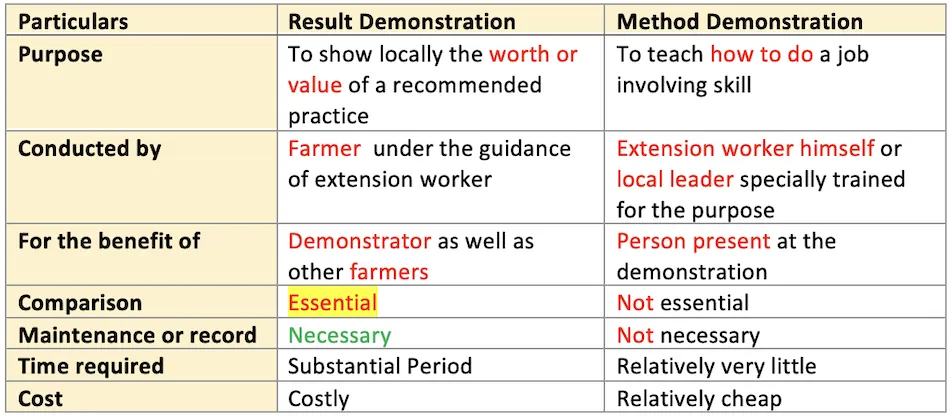
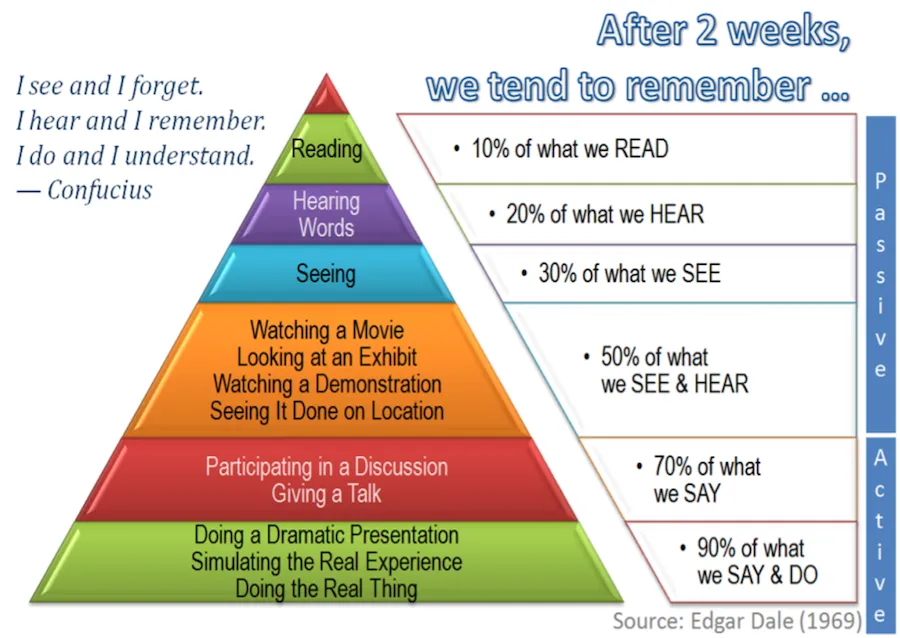
In the previous lesson, we studied communication models — the theoretical frameworks explaining how information flows in extension. Now we move from theory to practice: demonstrations are the most powerful hands-on tools extension workers use to show farmers new technologies in action. This lesson also covers the three categories of teaching contact methods — individual, group, and mass.
This lesson covers:
- Three types of demonstrations — Method, Result, and National/Composite
- Teaching contact methods — Individual, Group, and Mass
- Key extension terms — Field Day, Innovation, Perception, Uncertainty
All topics are high-yield for exams, especially the Method vs Result Demonstration comparison.
Demonstrations
Demonstration means showing by doing. The underlying principle is learning by seeing and doing. Demonstrations are among the most effective extension teaching methods because farmers trust what they can see working in real conditions far more than verbal advice or printed literature.
Pro Content Locked
Upgrade to Pro to access this lesson and all other premium content.
₹99 charged monthly · Cancel anytime
- All Agriculture & Banking Courses
- AI Lesson Questions (100/day)
- AI Doubt Solver (50/day)
- Glows & Grows Feedback (30/day)
- AI Section Quiz (20/day)
- 22-Language Translation (100/day)
- Recall Questions (20/day)
- AI Quiz (15/day)
- AI Quiz Paper Analysis (100/day)
- AI Step-by-Step Explanations (100/day)
- Spaced Repetition Recall (FSRS)
- AI Tutor
- Immersive Text Questions
- Audio Lessons — Hindi & English
- Mock Tests & Previous Year Papers
- Summary & Mind Maps
- XP, Levels, Leaderboard & Badges
- Generate New Classrooms
- Voice AI Teacher (AgriDots Live)
- AI Revision Assistant
- Knowledge Gap Analysis
- Interactive Revision (LangGraph)
🔒 Secure via Razorpay · Cancel anytime · No hidden fees
Visual Overview
In the previous lesson, we studied communication models — the theoretical frameworks explaining how information flows in extension. Now we move from theory to practice: demonstrations are the most powerful hands-on tools extension workers use to show farmers new technologies in action. This lesson also covers the three categories of teaching contact methods — individual, group, and mass.
This lesson covers:
- Three types of demonstrations — Method, Result, and National/Composite
- Teaching contact methods — Individual, Group, and Mass
- Key extension terms — Field Day, Innovation, Perception, Uncertainty
All topics are high-yield for exams, especially the Method vs Result Demonstration comparison.
Demonstrations
Demonstration means showing by doing. The underlying principle is learning by seeing and doing. Demonstrations are among the most effective extension teaching methods because farmers trust what they can see working in real conditions far more than verbal advice or printed literature.
1. Method Demonstration
- Type: Short type demonstration
- In this demonstration, any process is shown and made clear to the people by doing it in sequence from beginning to end
- Purpose: To provide skill — how to carry out a new practice or an old practice in a better way
- Principle followed: Learning by Doing (Seeing by Doing)
- Done by: Extension Worker
- Does NOT compare between old and new technique or skill
- Dr. Seeman A. Knapp is known as the Father of Method Demonstration
IMPORTANT
Method Demonstration = Short type, done by Extension Worker, principle is Learning by Doing, father is Dr. Seeman A. Knapp.
2. Result Demonstration
- Type: Long type demonstration — runs for an entire crop season or longer to show complete results
- Principle followed: Seeing is Believing — farmers are convinced when they see measurable differences in yield, quality, or profit
- Shows the value or worth of a new practice — the emphasis is on outcome, not process
- Comparison between two practices (old and new) is always done — side-by-side plots make the difference visible
- Results of both practices are shown — so farmers can judge for themselves
- Very effective in adoption of new technologies — because it provides proof under local conditions
- Conducted at: Farmer's field — this is critical because it proves the technology works in real farm conditions, not just on research stations
TIP
Method vs Result Demonstration:
| Feature | Method Demo | Result Demo |
|---|---|---|
| Type | Short | Long |
| Principle | Learning by doing | Seeing is believing |
| Done by | Extension worker | At farmer's field |
| Comparison | No | Yes (old vs new) |
| Purpose | Teach skill | Show value/worth |
3. National or Composite Demonstration
- Composite of both Method and Result Demonstration — combines the "how to do it" (method) with "what it achieves" (result) in a single comprehensive exercise
- Conducted by researchers on the farmer's field — unlike method demos done by extension workers, these are scientist-led to ensure technical precision
- Main objective: to show how production can be increased per unit area and per unit time — demonstrating the maximum achievable yield under improved practices
- Comparison between two practices (old vs new) is always done
- First started in: 1965 by Ministry of Food and Agriculture — coinciding with the Green Revolution era when new high-yielding varieties needed field-level validation
- Shows the genetic production potential of new technologies — the term "genetic production potential" specifically refers to the maximum yield a variety can achieve under optimal management
Teaching Contact Methods
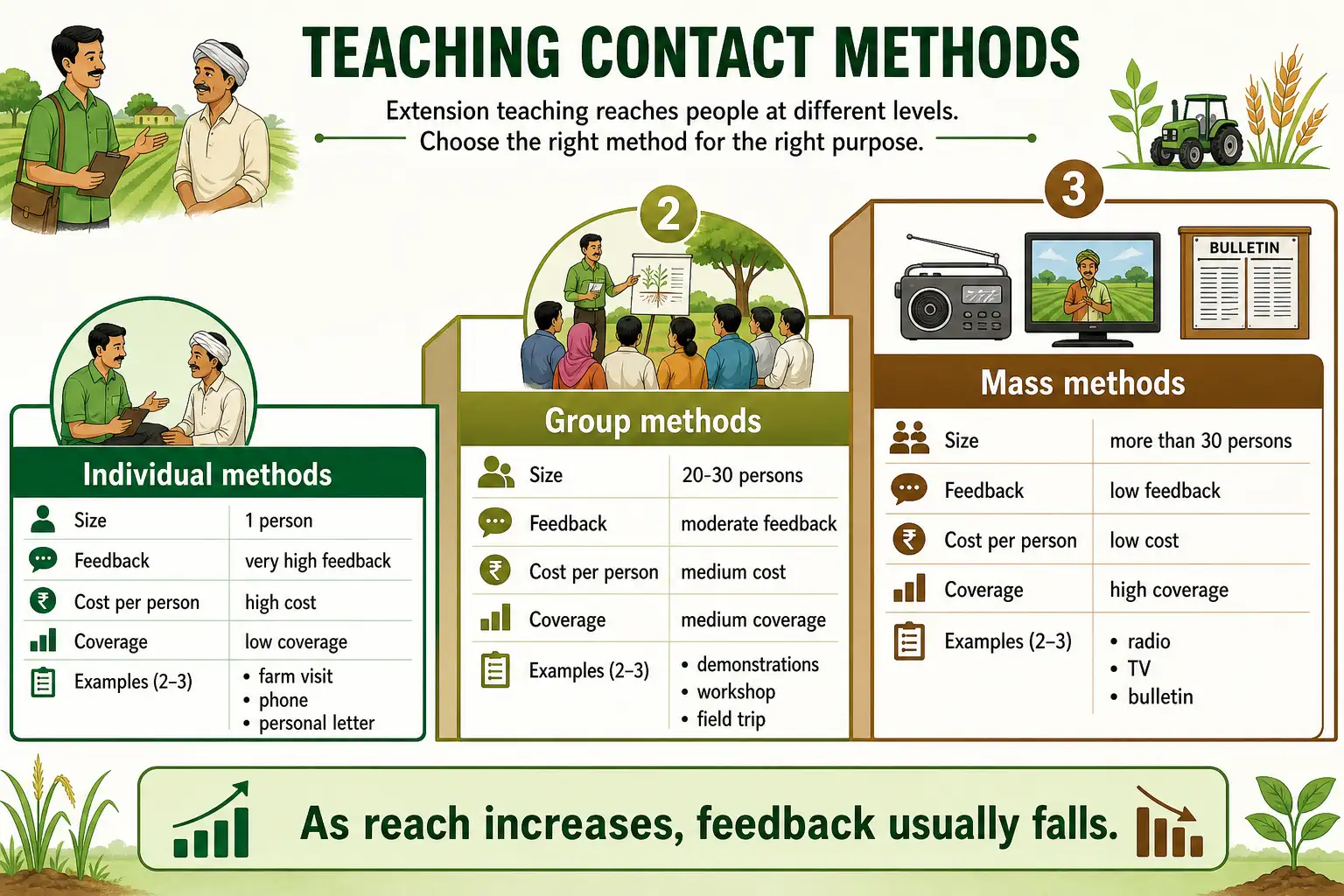
Extension teaching methods are classified by the number of people reached at a time. Each category involves a trade-off: individual methods give the deepest impact but reach the fewest people, while mass methods reach everyone but with shallow engagement. Understanding this trade-off is fundamental to extension planning.
1. Individual Contact Methods
- Quantum of feedback is very high
- Limitation: time consuming, relatively expensive, low coverage of audience
- Examples: Farm & Home visit, Office calls, Telephone calls, Personal letters, Official letters, Farm clinic, Minikit trial
NOTE
Individual methods give the highest feedback but are the most expensive and reach the fewest people.
2. Group Contact Methods
- Group size: 20-30 persons
- Examples: Result demonstration, Method demonstration, Conferences, Panel, Symposium, Workshops, Field trips, Tours
- Group meeting — a method of democratically arriving at decisions by taking into consideration the members' point of view
- Group meetings also act as a safety valve for reducing tension
3. Mass or Community Contact Methods
- Size: More than 30 persons
- Examples: Radio, TV, Exhibitions, Bulletins, Leaflets, Newsletter, Circular letters
- Best for creating awareness about innovations
- The communication channel most suited to inform about the existence of an innovation is: Mass media
Comparison Table
| Feature | Individual | Group | Mass |
|---|---|---|---|
| Size | 1 person | 20-30 persons | >30 persons |
| Feedback | Very high | Moderate | Low/None |
| Cost per person | High | Medium | Low |
| Coverage | Low | Medium | High |
| Examples | Farm visit, letters | Demo, workshop | Radio, TV, bulletin |
Key Terms
These definitions are frequently tested as direct "What is...?" or "Which term means...?" questions.
| Term | Meaning |
|---|---|
| Field Day / Farmers Day | A method of motivating people to adopt a new practice by showing what has been achieved by applying the practice under field conditions |
| Innovation | An idea, practice, or object that is perceived as new by an individual or unit of adoption |
| Perception | An activity through which an individual becomes aware of objects around oneself and of events taking place |
| Uncertainty | The degree to which alternatives are perceived with respect to an event and their relative probability |
Summary Cheat Sheet
| Concept / Topic | Key Details |
|---|---|
| Demonstration | Showing by doing; principle = learning by seeing and doing |
| Method Demonstration | Short type; done by Extension Worker; principle = Learning by Doing |
| Father of Method Demo | Dr. Seeman A. Knapp |
| Result Demonstration | Long type; at farmer's field; principle = Seeing is Believing; compares old vs new |
| National/Composite Demo | Combination of Method + Result; by researchers; started 1965; shows genetic production potential |
| Individual contact methods | Farm visit, office calls, phone calls, letters; highest feedback; most expensive |
| Group contact methods | 20-30 persons; demos, workshops, field trips, conferences |
| Mass/Community methods | >30 persons; Radio, TV, exhibitions, bulletins; best for awareness |
| Group meeting | Democratic decision-making; also a safety valve for reducing tension |
| Field Day / Farmers Day | Motivating adoption by showing field-level results |
| Mass media | Best channel to inform about existence of an innovation |
| Innovation | Idea/practice perceived as new by an individual |
| Perception | Activity through which one becomes aware of objects and events |
| Uncertainty | Degree to which alternatives are perceived with respect to an event and their relative probability |
TIP
Next: Lesson 03-14 covers the Principles of Extension and Learning — the 11+11 foundational principles and the AIDCAS teaching steps that govern how all these demonstrations and methods actually work.