📡 Communication Models
Five major communication models — Aristotle, Shannon-Weaver, Berlo's SEMCDR, Leagans CMCTAR, Rogers & Shoemaker — with distortion types and definitions for IBPS AFO/NABARD exam.
Visual Overview

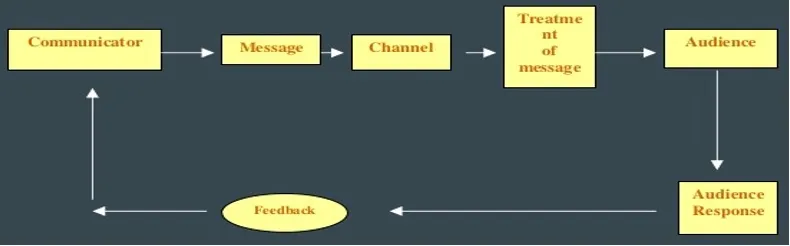
In the previous lesson, we examined rural development agencies and programmes — the schemes that channel resources to farmers and rural communities. But how do extension workers effectively communicate these programmes and new technologies to farmers? This lesson explores the theoretical models of communication that underpin all extension work.
Effective communication is the foundation of agricultural extension. Without it, even the best technology remains confined to research stations. Understanding these models helps extension workers diagnose why messages fail and how to improve information flow.
This lesson covers:
- Five communication models — Aristotle, Shannon-Weaver, Berlo, Leagans, and Rogers-Shoemaker
- Definitions of communication — by key scholars
- Distortion types — Systematic, Fog, and Mirage
- Key communication terms — Fidelity, Empathy, Propaganda, and more
All sections are frequently tested in exams.
Pro Content Locked
Upgrade to Pro to access this lesson and all other premium content.
₹99 charged monthly · Cancel anytime
- All Agriculture & Banking Courses
- AI Lesson Questions (100/day)
- AI Doubt Solver (50/day)
- Glows & Grows Feedback (30/day)
- AI Section Quiz (20/day)
- 22-Language Translation (100/day)
- Recall Questions (20/day)
- AI Quiz (15/day)
- AI Quiz Paper Analysis (100/day)
- AI Step-by-Step Explanations (100/day)
- Spaced Repetition Recall (FSRS)
- AI Tutor
- Immersive Text Questions
- Audio Lessons — Hindi & English
- Mock Tests & Previous Year Papers
- Summary & Mind Maps
- XP, Levels, Leaderboard & Badges
- Generate New Classrooms
- Voice AI Teacher (AgriDots Live)
- AI Revision Assistant
- Knowledge Gap Analysis
- Interactive Revision (LangGraph)
🔒 Secure via Razorpay · Cancel anytime · No hidden fees
Visual Overview
In the previous lesson, we examined rural development agencies and programmes — the schemes that channel resources to farmers and rural communities. But how do extension workers effectively communicate these programmes and new technologies to farmers? This lesson explores the theoretical models of communication that underpin all extension work.
Effective communication is the foundation of agricultural extension. Without it, even the best technology remains confined to research stations. Understanding these models helps extension workers diagnose why messages fail and how to improve information flow.
This lesson covers:
- Five communication models — Aristotle, Shannon-Weaver, Berlo, Leagans, and Rogers-Shoemaker
- Definitions of communication — by key scholars
- Distortion types — Systematic, Fog, and Mirage
- Key communication terms — Fidelity, Empathy, Propaganda, and more
All sections are frequently tested in exams.
Communication Models
Each model below represents a different era's understanding of how information flows from source to receiver. Earlier models are simpler and one-directional; later models incorporate feedback, encoding/decoding, and audience effects — reflecting the evolution from top-down lecturing to participatory extension.
NOTE
In extension communication, KCS (Kisan Call Service) is related to: Farmers — it provides agricultural information directly to farmers via telephone.
1. Aristotle's Model (384-322 BC)
The oldest and simplest communication model:
Speaker → Speech → Audience
- It was the first basic persuasive communication model
- Focuses on the speaker's ability to persuade the audience
- One-way model with no feedback mechanism
- Best suited for: public speaking and persuasion
IMPORTANT
Aristotle gave the first persuasive communication model. This is frequently tested.
2. Shannon-Weaver Model (1949)
Source → Transmitter → Signal → Receiver → Destination
With a Noise Source affecting the signal.
- Introduced the concept of noise (interference) in communication
- Best suitable for: Broadcasting of farm information
- Originally developed for telephone communication, later adapted for mass communication
- Key contribution: recognized that external disturbances can corrupt the message
3. Berlo's SEMCDR Model (1960)
Source → Encoding → Message → Channel → Decoding → Receiver
- Purpose of communication should be behaviour control
- Emphasizes the encoding and decoding processes
- Both source and receiver need shared communication skills, attitudes, knowledge, social system, and culture for effective communication
- Considers communication a two-way process with encoding at sender's end and decoding at receiver's end
4. Leagans Model — CMCTAR (1963)
Communicator → Message → Channel → Treatment → Audience → Response
- The Communicator is the characteristic element of this model
- Best application: Field extension work
- Unique feature: includes Treatment (how the message is packaged/presented) and Response (audience's reaction)
- Most practical model for extension workers because it considers the entire cycle from communication to feedback
TIP
Leagans' CMCTAR = the best model for field extension. Remember: "Communicator Makes Content Tailored for Audience Response"
5. Rogers and Shoemaker Model (1971)
Source → Message → Channel → Receiver → Effects
- Added the concept of Effects — what changes occur in the receiver after receiving the message (knowledge gain, attitude change, behaviour adoption)
- Defined communication as: "the process by which messages are transferred from a source to a receiver"
- This model is significant because it connects communication directly to the adoption-diffusion process — the Effects element measures whether the message actually changed the farmer's behaviour
Definitions of Communication
Exam questions often ask "Who defined communication as...?" — matching the definition to the scholar is the key skill here.
| Scholar | Definition |
|---|---|
| Rogers & Shoemaker (1971) | "The process by which messages are transferred from a source to a receiver" |
| Van den Ban & Hawkins (1988) | "The process of sending and receiving messages through channels which establishes common meanings between a source and a receiver" |
| Leagans | "The process by which two or more people exchange ideas, facts, feelings or impressions in ways of common understanding of the meaning, intent and use of messages" |
Distortion of Information
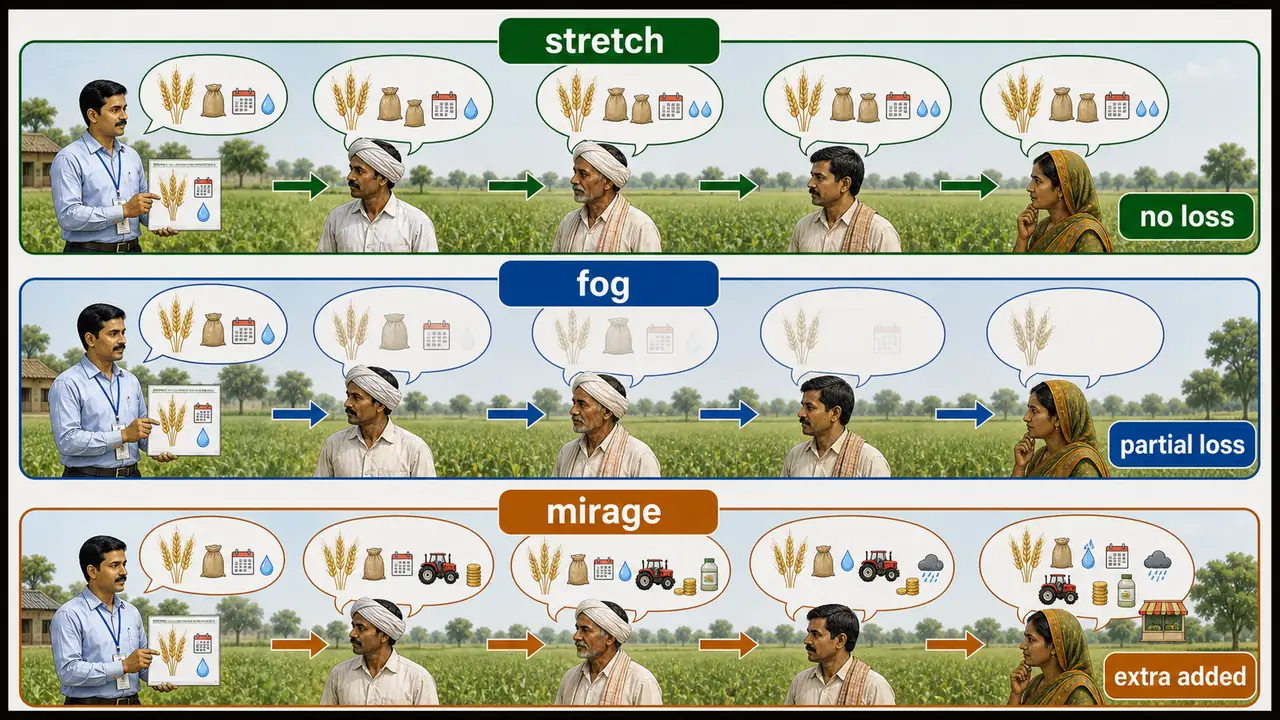
In any communication chain — especially in extension where messages pass through multiple intermediaries (researcher → subject matter specialist → extension worker → contact farmer → other farmers) — the original message can get corrupted. Understanding these three types of distortion helps diagnose communication failures.
| Type | What Happens | Information Status |
|---|---|---|
| Systematic (Stretch) | Message is stretched/expanded | No information is lost |
| Fog | Some parts become unclear | Information is lost (partially) |
| Mirage | Extra/unwanted information added | Extra and unwanted information appears |
TIP
Memory Aid for Distortion:
- Stretch = Safe (no loss)
- Fog = Faded (some lost)
- Mirage = More than needed (extra added)
Key Communication Terms
These terms appear frequently in MCQs as definition-matching questions. Each has a precise meaning in the context of extension communication.
| Term | Meaning |
|---|---|
| Fidelity | Faithful performance of communication process by all its elements |
| Communication gap | Difference between what was communicated by extension agent and what was actually received by audience |
| Empathy | Ability to understand the other person's internal frame of mind and reference |
| Propaganda | Deliberate manipulation of people's beliefs, values, and behaviour through words, gestures, images |
| Motivation | Process of initiating a conscious and purposeful action |
Important One-Liners
These are standalone exam facts that do not fit neatly into the models above but are frequently tested.
- Communication is derived from the Latin word "communis" meaning common — emphasizing that communication creates a shared understanding between people
- Extension teaching is: Horizontal — meaning it is participatory and peer-to-peer, not a top-down hierarchical instruction
- Over-adoption may be due to: Insufficient knowledge — when farmers adopt a practice beyond recommended levels (e.g., excessive fertilizer use) because they lack complete understanding of the recommendation
- The communication channel most suited to inform about the existence of an innovation is: Mass media — mass media creates initial awareness, but interpersonal channels are more effective for persuasion and adoption
Summary Cheat Sheet
| Concept / Topic | Key Details |
|---|---|
| Communication origin | Latin word "communis" meaning common |
| Aristotle's Model | Speaker → Speech → Audience; first persuasive model; one-way, no feedback |
| Shannon-Weaver (1949) | Source → Transmitter → Signal → Receiver → Destination; introduced Noise; best for broadcasting |
| Berlo's SEMCDR (1960) | Source → Encoding → Message → Channel → Decoding → Receiver; purpose = behaviour control |
| Leagans' CMCTAR (1963) | Communicator → Message → Channel → Treatment → Audience → Response; best for field extension |
| Rogers & Shoemaker (1971) | Source → Message → Channel → Receiver → Effects |
| Fidelity | Faithful performance of all communication elements |
| Empathy | Ability to understand another person's internal frame of mind |
| Communication gap | Difference between what was sent and what was received |
| Propaganda | Deliberate manipulation of beliefs/values through words and images |
| Systematic distortion (Stretch) | Message expanded; no information lost |
| Fog distortion | Parts become unclear; information partially lost |
| Mirage distortion | Extra/unwanted information added |
| Extension teaching | Horizontal (participatory, not top-down) |
| KCS | Related to Farmers (exams) |
| Mass media | Best for informing about existence of an innovation |
| Over-adoption | May be due to insufficient knowledge |
TIP
Next: Lesson 03-13 covers Demonstrations and Teaching Contact Methods — the practical tools extension workers use to put these communication models into action in the field.