🌈 Revolutions in Indian Agriculture — Green, White, Blue & Beyond
All agricultural revolutions in India — Green Revolution in detail, White Revolution, Yellow Revolution, and 20+ other colour-coded revolutions with key persons and commodities
In the early 1960s, India was on the brink of mass famine. The country depended on food imports under PL-480 from the USA, and wheat yield was a meagre 8.5 quintals per hectare. Then came the Green Revolution — and within a decade, wheat productivity nearly tripled to 22.81 quintals per hectare, transforming India from a food-deficit nation to a food-surplus one. This is the power of an agricultural revolution.
Revolutions in Agriculture are significant events that lead to radical changes in the production, productivity, and quality of agricultural produce — through new technology, discoveries, or interventions. For exams, remember each revolution by its colour/name, the commodity it relates to, and the key person associated with it.
The Green Revolution — In Detail
The Green Revolution is the single most important agricultural transformation in India's history and the most heavily tested topic in this domain. Every detail below — from the semi-dwarf genes to the yield numbers — is exam-critical.
Pro Content Locked
Upgrade to Pro to access this lesson and all other premium content.
₹99 charged monthly · Cancel anytime
- All Agriculture & Banking Courses
- AI Lesson Questions (100/day)
- AI Doubt Solver (50/day)
- Glows & Grows Feedback (30/day)
- AI Section Quiz (20/day)
- 22-Language Translation (100/day)
- Recall Questions (20/day)
- AI Quiz (15/day)
- AI Quiz Paper Analysis (100/day)
- AI Step-by-Step Explanations (100/day)
- Spaced Repetition Recall (FSRS)
- AI Tutor
- Immersive Text Questions
- Audio Lessons — Hindi & English
- Mock Tests & Previous Year Papers
- Summary & Mind Maps
- XP, Levels, Leaderboard & Badges
- Generate New Classrooms
- Voice AI Teacher (AgriDots Live)
- AI Revision Assistant
- Knowledge Gap Analysis
- Interactive Revision (LangGraph)
🔒 Secure via Razorpay · Cancel anytime · No hidden fees
In the early 1960s, India was on the brink of mass famine. The country depended on food imports under PL-480 from the USA, and wheat yield was a meagre 8.5 quintals per hectare. Then came the Green Revolution — and within a decade, wheat productivity nearly tripled to 22.81 quintals per hectare, transforming India from a food-deficit nation to a food-surplus one. This is the power of an agricultural revolution.
Revolutions in Agriculture are significant events that lead to radical changes in the production, productivity, and quality of agricultural produce — through new technology, discoveries, or interventions. For exams, remember each revolution by its colour/name, the commodity it relates to, and the key person associated with it.
The Green Revolution — In Detail
The Green Revolution is the single most important agricultural transformation in India's history and the most heavily tested topic in this domain. Every detail below — from the semi-dwarf genes to the yield numbers — is exam-critical.
What Was It?
- The term "Green Revolution" was coined in 1968 by USAID director William S. Gaud to describe the dramatic increase in food grain production driven by new technologies.
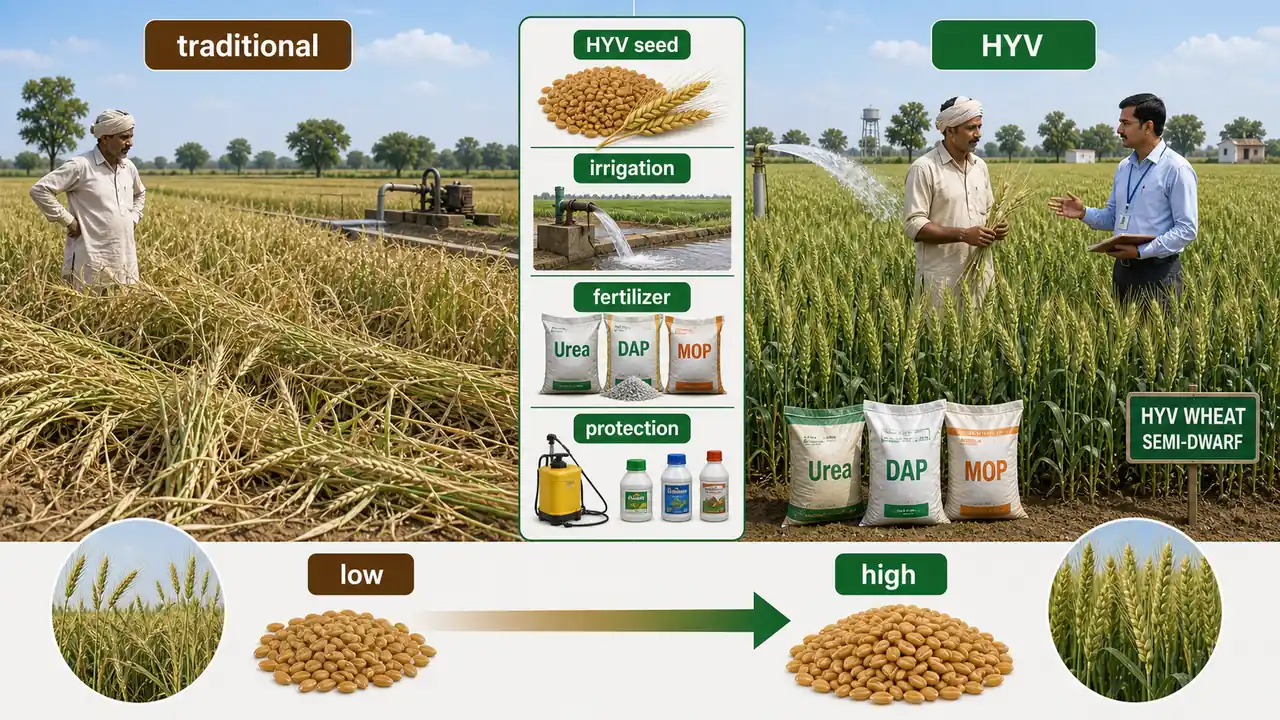
- A "package of practices" was introduced: improved seeds + chemical fertilizers + irrigation + modern farming techniques — applied together for maximum results.
- Agriculture shifted from subsistence (growing just enough for the family) to intensive form (producing large surpluses for the market).
- Primarily related to wheat and rice production.
Key Components
| Component | Agricultural Example |
|---|---|
| High Yielding Varieties (HYVs) — input-responsive, semi-dwarf | Mexican dwarf wheat varieties adapted for India |
| Chemical fertilizers and pesticides | Urea, DAP, and BHC applied in wheat fields of Punjab |
| Mechanical machinery | Tractors and combine harvesters replacing bullock-drawn ploughs |
| Irrigation facilities | Tube wells and canal systems in Punjab and Haryana |
| Modern scientific methods | Evidence-based agronomic practices replacing traditional farming |
Important Scientific Facts
-
HYVs had higher nitrogen-absorbing potential. Since excess nitrogen causes cereals to lodge (fall over), semi-dwarfing genes were bred into their genomes — shorter, sturdier plants could hold heavier grain heads.
-
Norin 10 — a Japanese dwarf wheat cultivar developed by Gonjiro Inazuka. It carried the semi-dwarf genes (Rht1 and Rht2) that became the foundation for modern HYV wheat worldwide.
-
IR8 — the first widely implemented HYV rice, developed by IRRI from a cross between Indonesian variety "Peta" and Chinese variety "Dee-geo-woo-gen". Nicknamed "Miracle Rice" for its dramatically higher yields.
Key Persons
| Person | Role |
|---|---|
| Dr. Norman Ernest Borlaug | Father of the Green Revolution (Global); bred rust-resistant semi-dwarf wheat; won Nobel Peace Prize in 1970 |
| Dr. M.S. Swaminathan | Father of the Green Revolution in India; adapted Mexican dwarf wheat to Indian conditions; launched India's Green Revolution in 1967-68 |
Where and What
| Aspect | Detail |
|---|---|
| First trial state | Punjab — selected for its reliable water supply, fertile Indus plains, and canal infrastructure |
| Main states | Punjab, Haryana, and Western Uttar Pradesh |
| Main crops | Wheat and Rice |
| Landmark institution | IARI, New Delhi |
| Supporting organization | Ford Foundation and Indian government; seed imported from CIMMYT |
Outcomes
- Wheat yield increased from 8.5 quintals to 22.81 quintals per hectare — nearly a threefold increase.
- India became self-sufficient in food grains and built buffer stocks, ending dependence on food imports.
Agricultural example: Before the Green Revolution, a farmer in Punjab growing traditional tall wheat varieties harvested about 1 tonne per hectare. After adopting semi-dwarf varieties like Kalyan Sona with recommended fertilizers and irrigation, the same farmer harvested 3+ tonnes per hectare.
All Agricultural Revolutions — Comparison Table
Beyond the Green Revolution, India has experienced over 20 sector-specific "revolutions" — each named after a colour and associated with a specific commodity and key person or initiative. This master table is the single most important reference for revolution-related MCQs.
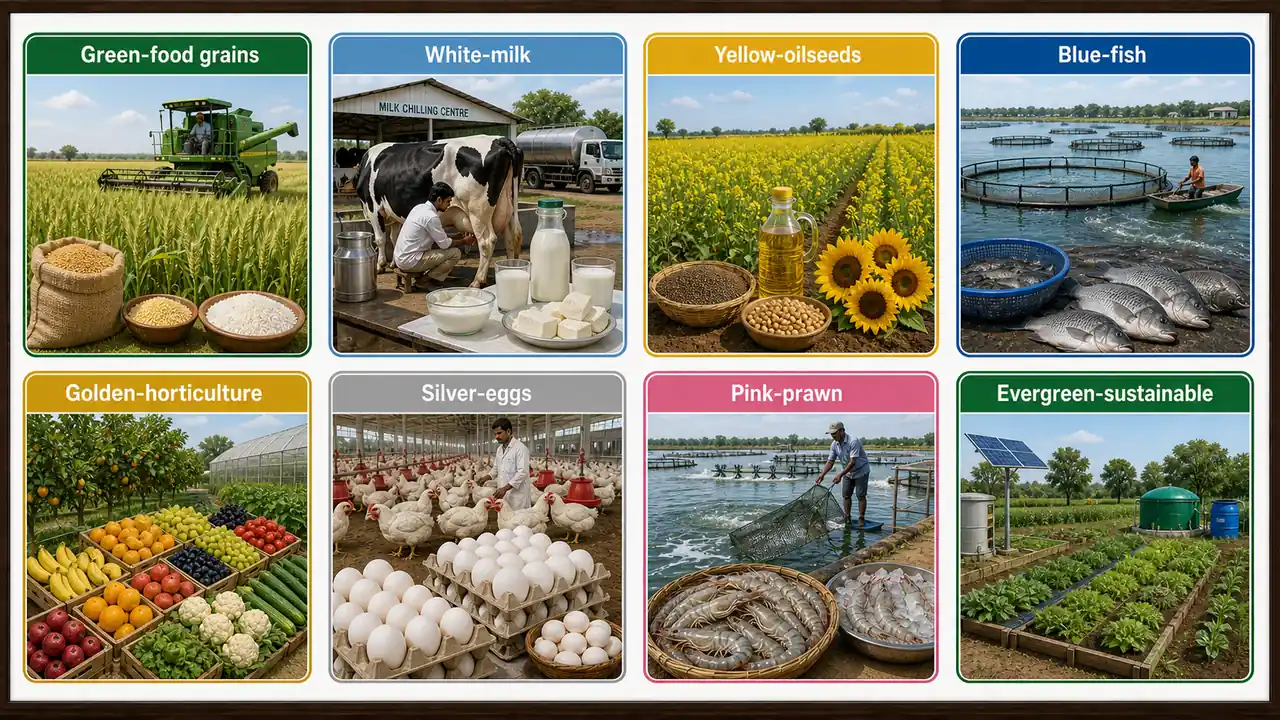
| Revolution | Related To | Key Person / Initiative |
|---|---|---|
| Green Revolution | Food grain (Wheat & Rice) | Dr. Norman Borlaug (Global); Dr. M.S. Swaminathan (India) |
| White Revolution | Milk production | Dr. Verghese Kurien — Operation Flood; made India world's largest milk producer |
| Yellow Revolution | Oilseeds production | Technology Mission on Oilseeds (1986) — self-sufficiency in edible oils |
| Blue Revolution | Fish production | Boosting aquaculture and marine fisheries |
| Red Revolution | Meat / Tomato production | Growing demand for animal protein |
| Round Revolution | Potato production | Improved varieties and cold storage |
| Silver Revolution | Egg / Poultry production | Modern breeding and poultry farming |
| Green Gold Revolution | Bamboo | Sustainable resource for construction and industry |
| Silver Fibre Revolution | Cotton | Boosted by introduction of Bt cotton |
| Golden Fibre Revolution | Jute | Modernizing jute industry for eco-friendly packaging |
| Pink Revolution | Prawn / Onion | Shrimp farming and onion production |
| Golden Revolution | Horticulture / Fruits / Honey | India = 2nd largest producer of fruits and vegetables |
| Gray Revolution | Manures and Fertilizers | Chemical and organic fertilizer use |
| Brown Revolution | Non-conventional energy | Bio-energy and renewable energy in agriculture |
| Black Revolution | Bio-fuel (Jatropha) | Jatropha cultivation for biodiesel |
| Rainbow Revolution | Overall agriculture growth | Comprehensive growth across all sectors |
| Sweet Revolution | Honey production | Modern apiculture techniques |
| Protein Revolution | Higher food production (2nd Green Revolution) | Increasing overall agricultural productivity |
| Prabhani Revolution | Okra (Bhindi) | Named after Parbhani city, Maharashtra (okra breeding research) |
| Badami Revolution | Spices | Increased production and export of Indian spices |
| Evergreen Revolution | Reduction in food wastage; sustainable productivity | Concept by M.S. Swaminathan — Father of Evergreen Revolution |
Exam Tips and Mnemonics
The colour-commodity-person associations are the most frequently tested format for revolution questions. Memorize the top eight pairings first, then expand to the rarer ones.
TIP
Colour-Commodity associations (most asked):
- Green = Food grains (Wheat, Rice) — Borlaug / Swaminathan
- White = Milk — Kurien / Operation Flood
- Yellow = Oilseeds — TMO 1986
- Blue = Fish — Aquaculture
- Golden = Horticulture/Fruits — India 2nd largest producer
- Silver = Eggs/Poultry
- Pink = Prawns/Onions
- Evergreen = Sustainable productivity — M.S. Swaminathan
IMPORTANT
Critical exam facts:
- Green Revolution coined by William S. Gaud (1968)
- India's Green Revolution started in 1967-68 under Dr. M.S. Swaminathan
- Borlaug won Nobel Peace Prize in 1970
- Semi-dwarf genes: Rht1 and Rht2 (from Norin 10)
- IR8 = cross of Peta x Dee-geo-woo-gen
- Green Revolution states: Punjab, Haryana, Western UP
- Wheat yield increase: 8.5 → 22.81 q/ha
Summary Table
This condensed table captures the most exam-critical facts from the Green Revolution and other revolutions for last-minute revision.
| Topic | Key Fact |
|---|---|
| Term "Green Revolution" coined by | William S. Gaud (1968) |
| Father of Green Revolution (Global) | Dr. Norman Borlaug — Nobel Peace Prize 1970 |
| Father of Green Revolution (India) | Dr. M.S. Swaminathan — started 1967-68 |
| Semi-dwarf genes | Rht1, Rht2 from Norin 10 (Japanese wheat) |
| First HYV rice | IR8 — Peta x Dee-geo-woo-gen (IRRI) |
| Green Revolution states | Punjab, Haryana, Western UP |
| Wheat yield improvement | 8.5 → 22.81 q/ha |
| White Revolution leader | Dr. Verghese Kurien — Operation Flood |
| Father of Evergreen Revolution | M.S. Swaminathan |
| Total revolutions covered | 21 |
Summary Cheat Sheet
Use this table for final revision — it covers every revolution's colour-commodity-person association in one place.
| Concept / Topic | Key Details |
|---|---|
| Green Revolution coined by | William S. Gaud (1968) |
| Father of Green Revolution (Global) | Dr. Norman Borlaug — Nobel Peace Prize 1970 |
| Father of Green Revolution (India) | Dr. M.S. Swaminathan — started 1967-68 |
| Semi-dwarf genes | Rht1, Rht2 from Japanese wheat Norin 10 (Gonjiro Inazuka) |
| IR8 (Miracle Rice) | Cross of Peta × Dee-geo-woo-gen at IRRI |
| Green Revolution states | Punjab, Haryana, Western UP |
| Wheat yield increase | 8.5 → 22.81 q/ha (nearly 3×) |
| White Revolution | Milk — Dr. Verghese Kurien; Operation Flood |
| Yellow Revolution | Oilseeds — Technology Mission on Oilseeds (1986) |
| Blue Revolution | Fish production — aquaculture |
| Golden Revolution | Horticulture / Fruits / Honey |
| Silver Revolution | Egg / Poultry |
| Pink Revolution | Prawn / Onion |
| Round Revolution | Potato |
| Silver Fibre Revolution | Cotton — Bt cotton boost |
| Golden Fibre Revolution | Jute |
| Black Revolution | Bio-fuel (Jatropha) |
| Rainbow Revolution | Overall agriculture growth |
| Evergreen Revolution | Sustainable productivity — M.S. Swaminathan |
| Prabhani Revolution | Okra (Bhindi) — Parbhani, Maharashtra |
| Sweet Revolution | Honey production |
Lesson Doubts
Ask questions, get expert answers