📊 Fisheries Sector in India -- Status, Schemes, Institutions and Current Policy Updates
India's fisheries statistics, production trends, key government schemes (Blue Revolution, PMMSY, PM-MKSSY, Mission Fingerling), digital governance, clusters, and important institutions
A Sector That Feeds Millions
India has the second longest coastline among Asian countries at over 8,100 km, thousands of rivers, and millions of ponds. Yet for decades, fisheries remained an afterthought in agricultural policy. That changed first with the Blue Revolution and later much more sharply with PMMSY and the current blue economy push. Today, fisheries contribute 7.43% of Agriculture GVA, support over 2.8 crore fishers and fish farmers, and form one of India's strongest export-oriented allied sectors. Understanding this sector's numbers, schemes, institutions, and latest policy direction is essential for banking and agriculture exams.
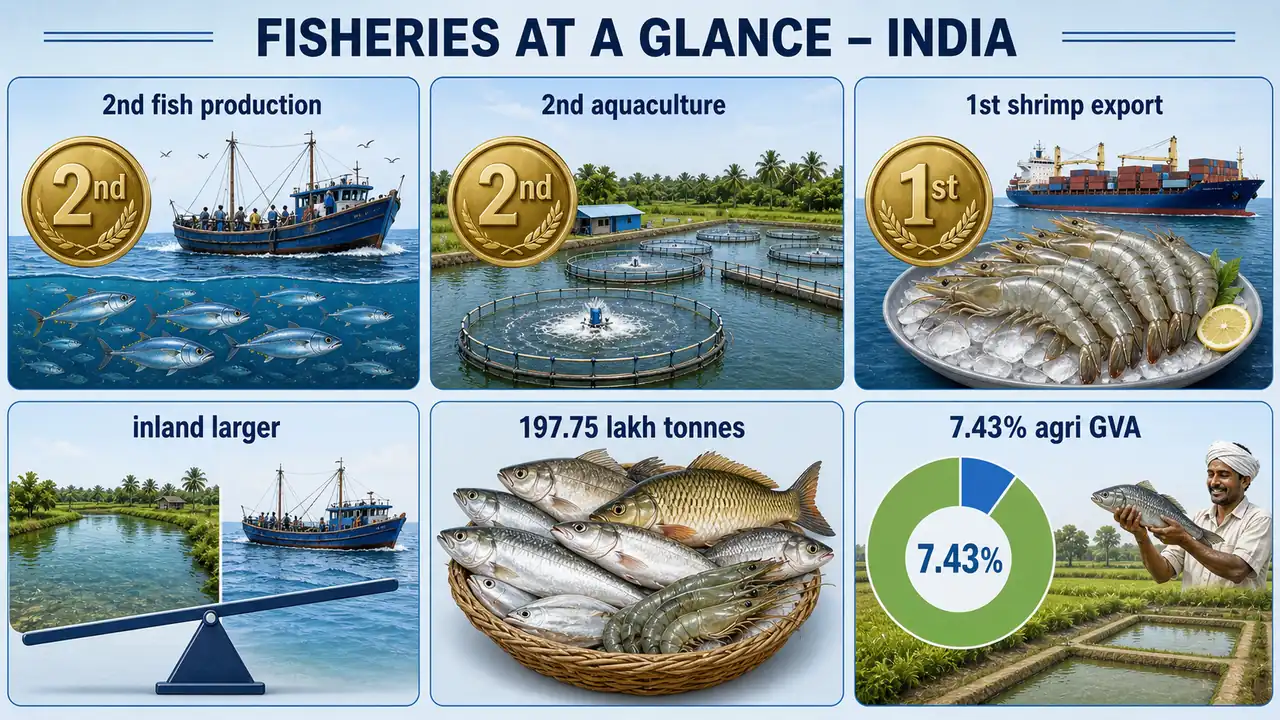
Fisheries at a Glance
| Parameter | Value |
|---|---|
| India's share of global fish production | 8% |
| Global rank -- fish production | 2nd largest (after China) |
| Global rank -- aquaculture | 2nd largest (after China) |
| Global rank -- capture fisheries | 2nd |
| Global rank -- shrimp production & export | 1st |
| Total fish production (2024-25) | 197.75 lakh tonnes |
| Inland sector contribution | 75.57% of FY 2023-24 production |
| Marine sector contribution | 24.43% of FY 2023-24 production |
| Share of agricultural GVA | 7.43% (highest among agri & allied) |
| Seafood exports (2024-25) | 16.98 lakh MT worth ₹62,408 crore (US$ 7.45 billion) |
| Per capita fish availability | 13.1 kg |
| ICMR recommended intake | 12 kg per annum |
TIP
Pro Content Locked
Upgrade to Pro to access this lesson and all other premium content.
₹99 charged monthly · Cancel anytime
- All Agriculture & Banking Courses
- AI Lesson Questions (100/day)
- AI Doubt Solver (50/day)
- Glows & Grows Feedback (30/day)
- AI Section Quiz (20/day)
- 22-Language Translation (100/day)
- Recall Questions (20/day)
- AI Quiz (15/day)
- AI Quiz Paper Analysis (100/day)
- AI Step-by-Step Explanations (100/day)
- Spaced Repetition Recall (FSRS)
- AI Tutor
- Immersive Text Questions
- Audio Lessons — Hindi & English
- Mock Tests & Previous Year Papers
- Summary & Mind Maps
- XP, Levels, Leaderboard & Badges
- Generate New Classrooms
- Voice AI Teacher (AgriDots Live)
- AI Revision Assistant
- Knowledge Gap Analysis
- Interactive Revision (LangGraph)
🔒 Secure via Razorpay · Cancel anytime · No hidden fees
A Sector That Feeds Millions
India has the second longest coastline among Asian countries at over 8,100 km, thousands of rivers, and millions of ponds. Yet for decades, fisheries remained an afterthought in agricultural policy. That changed first with the Blue Revolution and later much more sharply with PMMSY and the current blue economy push. Today, fisheries contribute 7.43% of Agriculture GVA, support over 2.8 crore fishers and fish farmers, and form one of India's strongest export-oriented allied sectors. Understanding this sector's numbers, schemes, institutions, and latest policy direction is essential for banking and agriculture exams.
Fisheries at a Glance
| Parameter | Value |
|---|---|
| India's share of global fish production | 8% |
| Global rank -- fish production | 2nd largest (after China) |
| Global rank -- aquaculture | 2nd largest (after China) |
| Global rank -- capture fisheries | 2nd |
| Global rank -- shrimp production & export | 1st |
| Total fish production (2024-25) | 197.75 lakh tonnes |
| Inland sector contribution | 75.57% of FY 2023-24 production |
| Marine sector contribution | 24.43% of FY 2023-24 production |
| Share of agricultural GVA | 7.43% (highest among agri & allied) |
| Seafood exports (2024-25) | 16.98 lakh MT worth ₹62,408 crore (US$ 7.45 billion) |
| Per capita fish availability | 13.1 kg |
| ICMR recommended intake | 12 kg per annum |
TIP
Key rankings to remember: India is 2nd in fish production (moved up from 3rd), 2nd in aquaculture, 2nd in capture fisheries, and 1st in shrimp production & export. The inland sector dominates with ~70% of production. For detailed statistics, see the Fisheries Statistics lesson.
State-wise Production Leaders
| Category | Leading State |
|---|---|
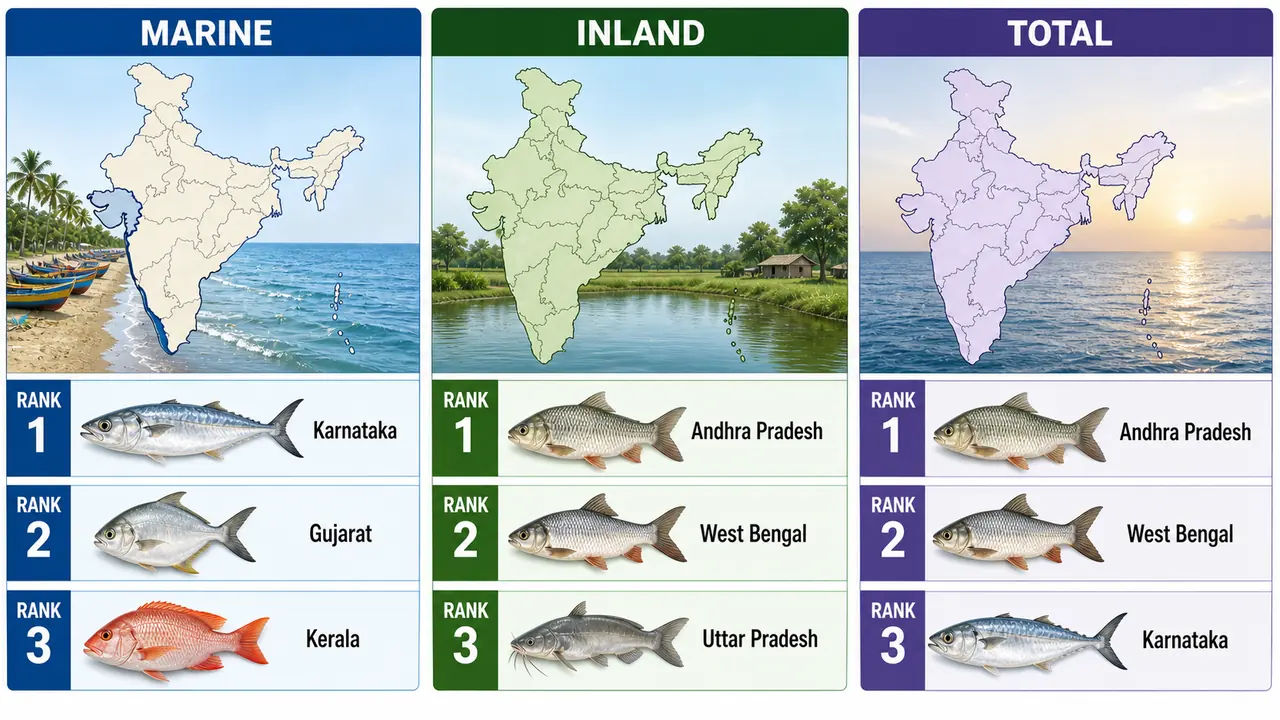
| Maximum total fish production | Andhra Pradesh |
| Second highest producer | West Bengal |
| Maximum inland fish production | Andhra Pradesh |
| Maximum marine fish production | Karnataka |
- Andhra Pradesh leads because of its extensive aquaculture practices, particularly shrimp and carp farming in the Krishna-Godavari delta region.
- Karnataka leads in marine production, followed by Gujarat and Kerala ("KGK").
NOTE
Statistics like minister names and exact production figures change frequently. Always verify against the latest data before exams.
Fishery Potential vs Actual Production
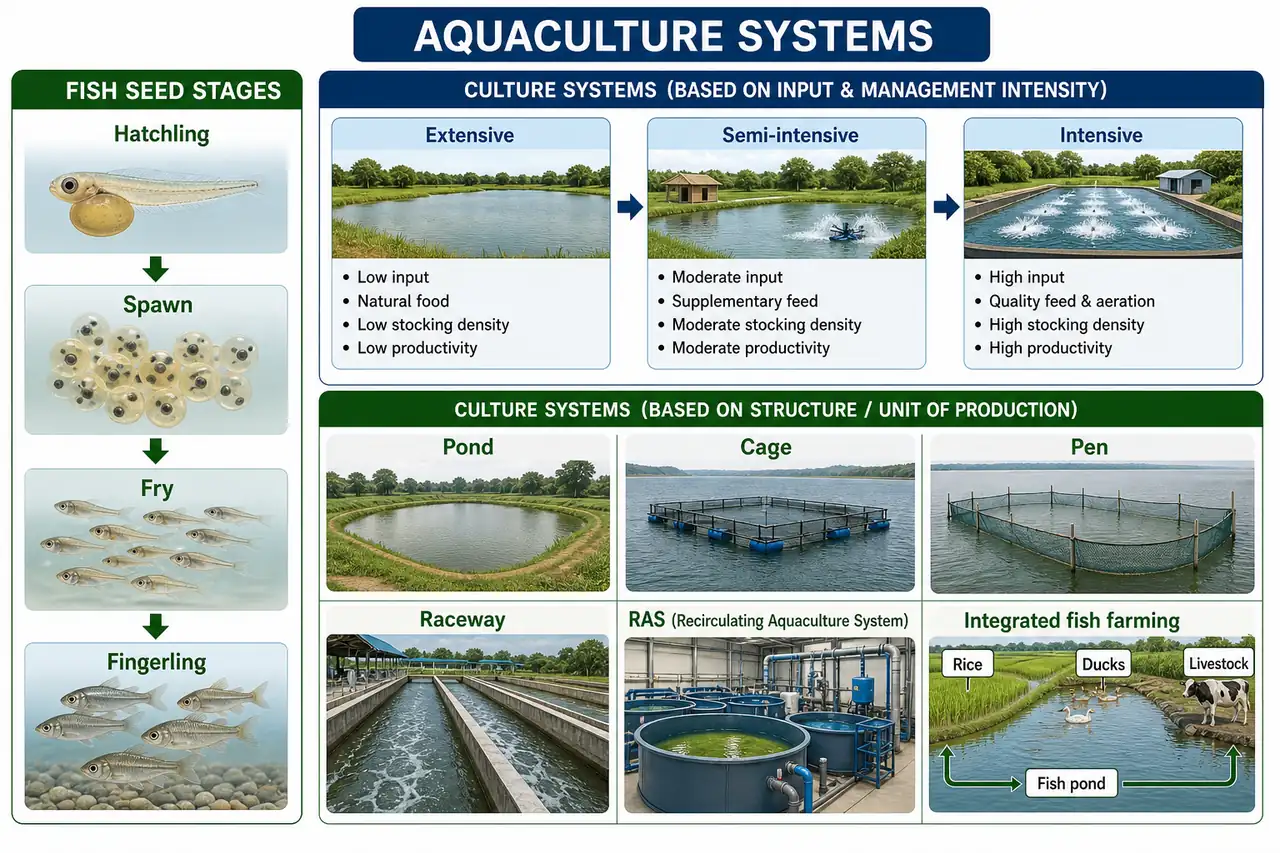
Understanding the gap between estimated potential and actual production is crucial for policy planning. India's water resources hold enormous untapped potential.
Estimated Potential (Million Metric Tonnes)
IMPORTANT
The significant gap between potential and actual production -- especially in inland fisheries -- indicates huge scope for expansion through better infrastructure, technology adoption, and policy support.
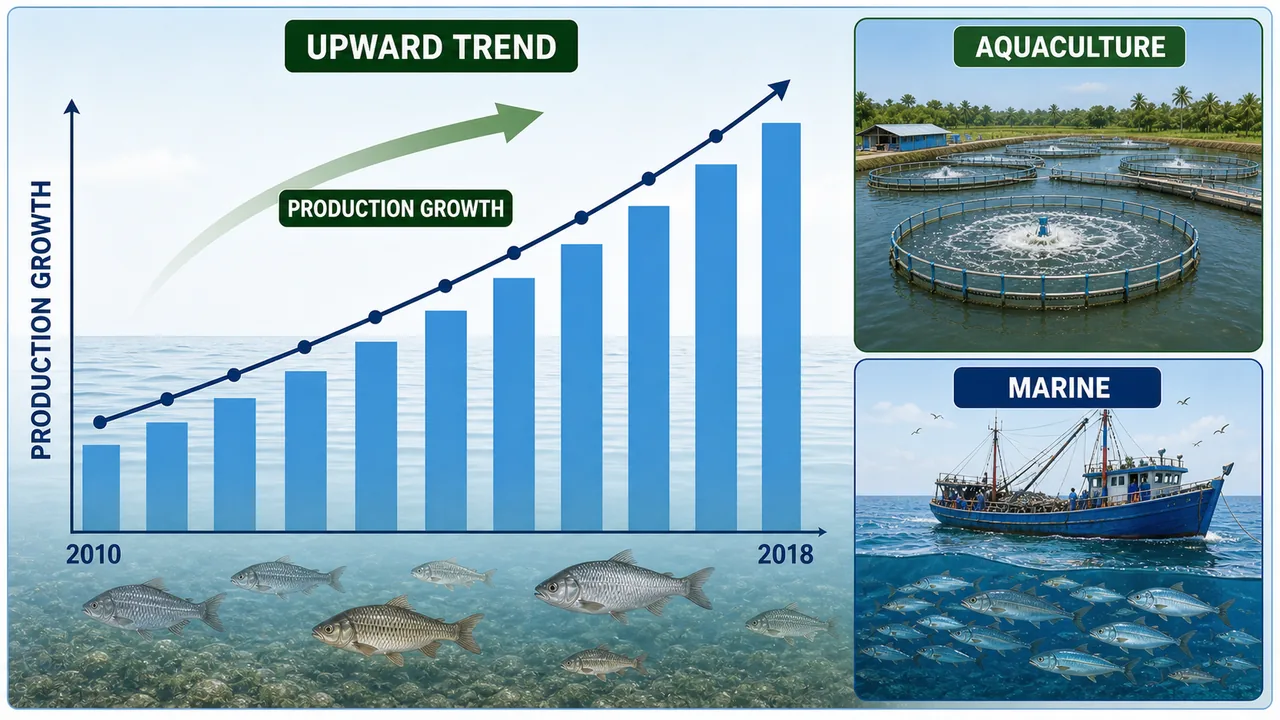
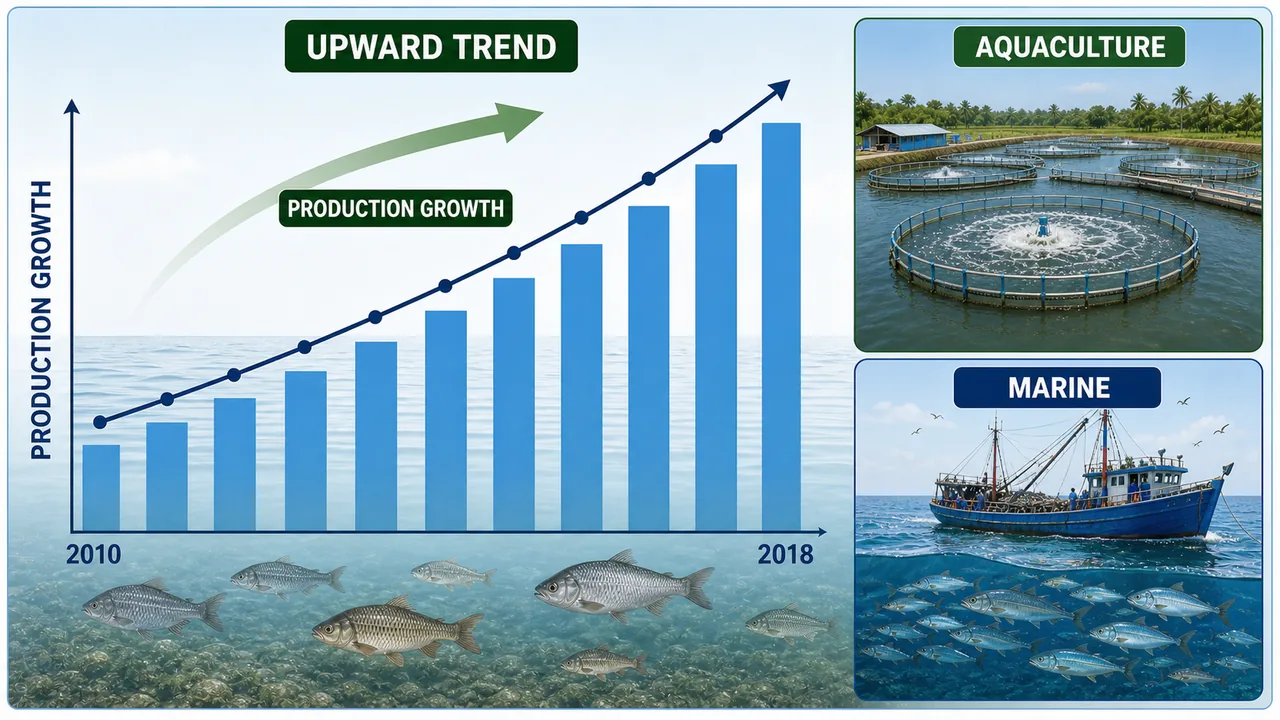
Fish Production Trend 2010-2018
The trend shows a consistently upward trajectory, reflecting the success of government interventions and increasing adoption of modern aquaculture techniques.
Important Marine Fisheries Characteristics
| Parameter | Value |
|---|---|
| Length of coastline | 8,118 km (9 states + 4 UTs) |
| Exclusive Economic Zone (EEZ) | 2.02 million km2 (up to 200 nautical miles) |
| Continental shelf | 0.50 million km2 |
| Fishing villages | 3,477 |
| Active fishers | ~20 lakh |
TIP
Mnemonic for marine fisheries numbers: "8-2-0.5" -- Coastline 8,118 km, EEZ 2.02 million km2, Continental shelf 0.50 million km2.
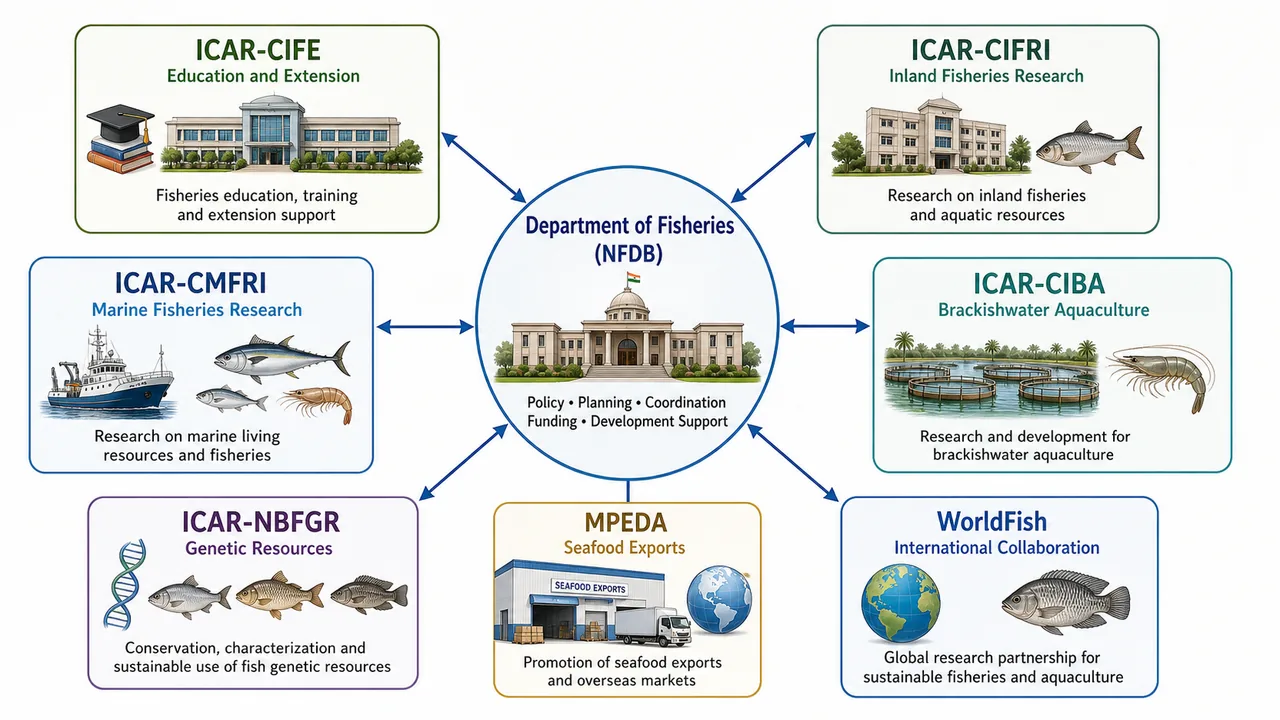
Key Institutions under Fisheries Department
| Institute | Focus Area |
|---|---|
| ICAR-CIFE (Mumbai) | Fisheries education |
| ICAR-CIFRI (Barrackpore) | Inland fisheries research |
| ICAR-CMFRI (Kochi) | Marine fisheries research |
| ICAR-CIBA (Chennai) | Brackishwater aquaculture |
| ICAR-NBFGR (Lucknow) | Fish genetic resources |
| MPEDA (Kochi) | Marine products export |
| NFDB (Hyderabad) | Fisheries development |
Foreign Collaboration
- World Fish Centre -- headquartered at Penang, Malaysia. An international research organization working with developing countries to reduce poverty through improved fisheries.
Government Schemes and Programmes
1. Blue Revolution (2015)
The Blue Revolution is India's flagship programme for holistic fisheries development, analogous to the Green Revolution in agriculture.
| Feature | Detail |
|---|---|
| Launch year | 2015 |
| Production target | 20 MT by 2022-23 |
| Budget (2019-20) | Rs. 3,000 crore |
| Central share -- UTs | 100% |
| Central share -- NE and Hilly states | 90% |
| Central share -- Other states | 60% |
Objectives:
- Fully tap the total fish potential of the country
- Transform fisheries into a modern industry
- Double income of fishers and fish farmers
- Triple export earnings
- Enhance food and nutritional security
The differential funding pattern ensures that North-Eastern and Hilly states with geographical disadvantages receive greater central support.
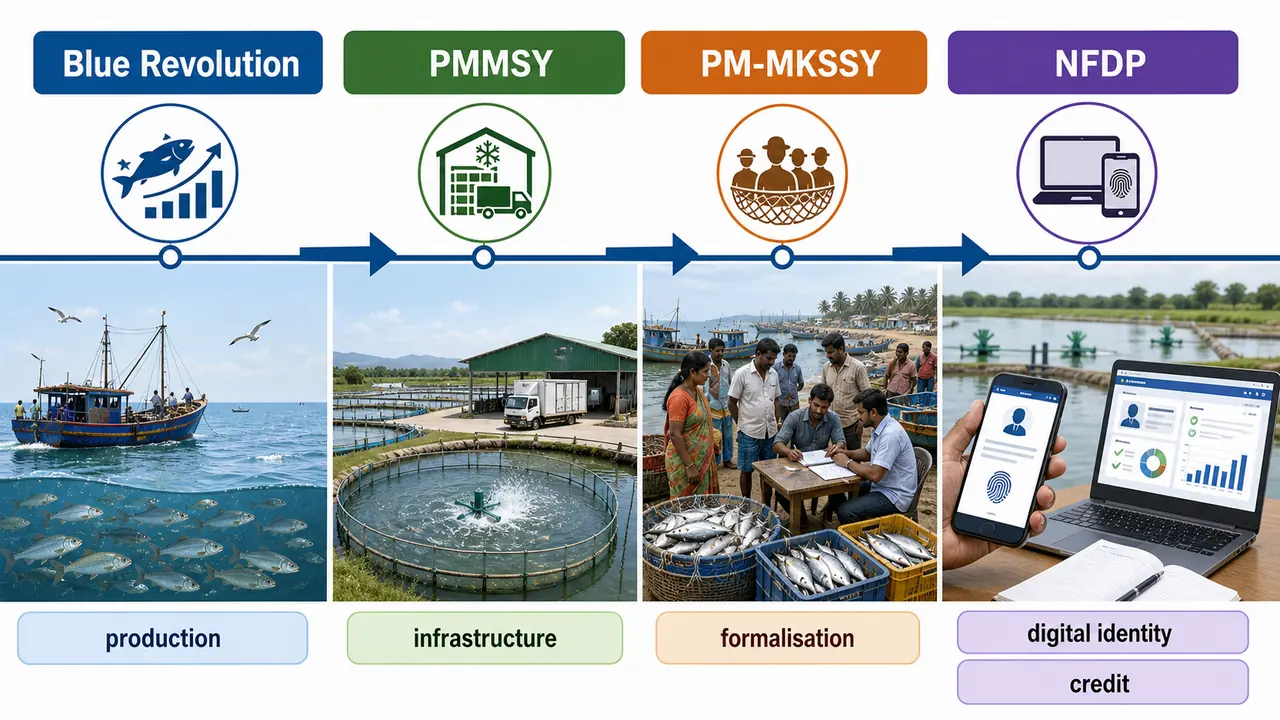
2. Pradhan Mantri Matsya Sampada Yojana (PMMSY)
PMMSY is the flagship scheme for fisheries sector development — representing the highest-ever investment in Indian fisheries.
| Parameter | Details |
|---|---|
| Announced | 5 July 2019 (Union Budget 2019-20) |
| Launched | 10 September 2020 |
| Total Investment | Rs 20,050 crore |
| Implementation Period | 5 years (FY 2020-21 to FY 2024-25) |
| Budget 2026-27 | Rs 2,500 crore |
Two Components:
| Component | Type | Focus |
|---|---|---|
| Central Sector Component | 100% Central funding | National-level institutions, R&D, monitoring |
| Centrally Sponsored Component | Shared funding | State-level infrastructure, beneficiary-oriented activities |
Investment Breakup: Beneficiary-oriented activities: Rs 12,340 crore | Fisheries infrastructure: Rs 7,710 crore
Key Targets:
| Target | Goal |
|---|---|
| Fish production increase | Additional 70 lakh tonnes by 2024-25 |
| Export earnings | Rs 1,00,000 crore by 2024-25 |
| Employment generation | About 55 lakh direct & indirect |
| Post-harvest losses reduction | From 20-25% to ~10% |
Subsidy Pattern:
| Beneficiary Category | Subsidy on Unit Cost |
|---|---|
| General category | 40% |
| SC/ST/Women/Differently-abled | 60% |
| NE & aspirational districts | Higher assistance |
TIP
Key numbers: Rs 20,050 crore (total), 70 lakh tonnes (production target), 55 lakh (employment). PMMSY is the single-largest fisheries scheme ever launched in India.
PM Matsya Kisan Samridhi Sah-Yojana (PM-MKSSY)
PM-MKSSY is a sub-scheme under PMMSY with a total investment of Rs 6,000 crore.
| Parameter | Detail |
|---|---|
| Period | 2023-24 to 2026-27 |
| Outlay | Rs 6,000 crore |
| Main role | Formalisation, insurance support, enterprise strengthening, traceability |
| Component | Focus |
|---|---|
| Component 1 — Formal Registration | Issue work identity documents to fishers & fish workers; bring unorganized sector into formal economy |
| Component 2 — Institutional Credit | Enable access to institutional credit and aquaculture insurance; support micro & small enterprises |
| Component 3 — Performance Grants | Incentive-based performance grants for adoption of best practices, traceability & market linkage |
NOTE
PM-MKSSY focuses on formalization — bringing unorganized fishers into the formal economy. This distinguishes it from PMMSY which is broader in scope covering infrastructure and production.
34 Fisheries Clusters Under PMMSY
On 10 February 2026, PIB reported that 34 fisheries clusters had been notified under PMMSY.
The cluster approach is important because it is meant to:
- improve competitiveness
- create economies of scale
- identify value-chain gaps
- attract private participation
This is one of the clearest signs that fisheries policy is moving from scattered subsidy delivery to cluster-based value-chain development.
Digital Fisheries Governance: NFDP
The National Fisheries Digital Platform (NFDP) is the digital-governance layer under the current fisheries policy architecture.
- launched in September 2024 under PM-MKSSY
- creates digital identities for fishers, fish farmers, and enterprises
- as of 5 March 2026, 30.60 lakh+ stakeholders were registered
- 12 banks were integrated
- 217 loans had been enabled through the platform
This makes NFDP the fisheries equivalent of the digital-public-infrastructure push seen in crops and dairy.
3. SAMPADA Scheme
| Feature | Detail |
|---|---|
| Full form | Scheme for Agro Marine Processing and Development of Agro Processing Clusters |
| Outlay | Rs. 6,000 crore |
| Period | 2016-20 (14th Finance Commission) |
| Implementing ministry | Ministry of Food Processing Industries |
Sub-schemes include:
- Mega Food Parks
- Integrated cold chain and preservation infrastructure
- Food processing and preservation capacities
- Agro processing cluster infrastructure
- Backward and forward linkages
- Food safety and quality assurance
- Human resources and institutions
SAMPADA addresses the critical issue of post-harvest losses and lack of processing infrastructure in the fisheries value chain.
4. Kisan Credit Card (KCC) for Fishers
- Extended to fishers in Union Budget 2018
- Helps fishers meet working capital needs through affordable credit
- RBI issued detailed guidelines on 4 February 2019
- Covers both marine and inland fisheries activities
- A landmark step in bringing the fisheries community into the formal financial system
IMPORTANT
In official 2026 policy references, KCC for fishers and fish farmers is clearly treated as available since 2019. This is the exam-safe way to frame the operational rollout.
FIDF and Fishing Community Policy Context
The National Integrated Policy for Fishing Community release of 17 March 2026 tied together welfare, credit, and infrastructure.
- KCC for fishers and fish farmers: available since 2019
- FIDF fund size cited: ₹7,522.48 crore
This matters because fisheries policy is no longer only production-centric. It now combines:
- working capital access
- infrastructure creation
- community policy
- formalisation and digital identity
5. Mission Fingerling (2017)
| Feature | Detail |
|---|---|
| Launch year | 2017 |
| Parent programme | Blue Revolution |
| Purpose | Boost availability of quality fish seed (fingerlings) |
| Production target | Enhance from 10.79 MMT (2014-15) to 15 MMT by 2020-21 |
| Implementing body | Department of Animal Husbandry, Dairying and Fisheries |
TIP
Why fingerlings matter: The success of any aquaculture operation begins with quality seed. Without adequate supply of healthy fingerlings, even the best infrastructure cannot yield desired results. Mission Fingerling is a foundational initiative for the sector.
Dedicated Department (2019)
- In Budget 2019-20, a separate Department of Fisheries was created by carving out from DAHDF
- Notification dated 05.02.2019
- Signals the government's commitment to treating fisheries as a priority sector
Marine Fisheries Census and Blue Economy Governance
The current blue-economy policy direction is increasingly data-driven.
The official 2026 fisheries backgrounder noted that the Marine Fisheries Census 2025 was launched on 31 October 2025 with georeferenced digital data-collection tools.
This matters because it supports:
- better socio-economic profiling of fishing communities
- more accurate scheme targeting
- stronger planning for coastal livelihoods
- better digital governance of the marine sector
Comparison of Major Schemes
| Scheme | Year | Focus | Outlay |
|---|---|---|---|
| Blue Revolution | 2015 | Holistic fisheries development | Rs. 3,000 crore |
| Mission Fingerling | 2017 | Quality fish seed supply | Part of Blue Revolution |
| KCC for Fishers | 2018 | Affordable credit | Through banking system |
| PMMSY | 2020 | Production, processing, marketing | Rs. 20,050 crore |
| PM-MKSSY | Sub-scheme of PMMSY | Formalization, credit, performance grants | Rs. 6,000 crore |
| SAMPADA | 2016 | Agro processing infrastructure | Rs. 6,000 crore |
| Fisheries clusters | 2026 | Cluster-based value-chain development | 34 clusters notified |
Exam Tips
TIP
Frequently asked facts:
- India's rank in aquaculture -- 2nd (after China)
- Inland vs Marine contribution -- 72:28
- Largest fish producing state -- Andhra Pradesh
- Largest marine fish producer -- Gujarat
- Blue Revolution launch year -- 2015
- PMMSY announced in -- Budget 2019-20
- EEZ extent -- 200 nautical miles (2.02 million km2)
- Coastline length -- 8,118 km
Summary Table
| Topic | Key Fact |
|---|---|
| Global rank (fisheries) | 2nd after China |
| Global rank (aquaculture) | 2nd after China |
| Total production (2024-25) | 197.75 lakh tonnes |
| Inland share | 75.57% in FY 2023-24 |
| Fisheries share in agri GVA | 7.43% |
| Top producer state | Andhra Pradesh |
| Top marine state | Gujarat |
| Coastline | 8,118 km |
| EEZ | 2.02 million km2 |
| Flagship scheme | Blue Revolution (2015) |
| Latest flagship umbrella | PMMSY (launched 10 Sep 2020); Rs. 20,050 crore |
| PM-MKSSY | Sub-scheme of PMMSY; Rs. 6,000 crore; formalization of fishers |
| NFDP | 30.60 lakh+ stakeholders; 12 banks integrated |
| Marine Fisheries Census | Launched 31 Oct 2025 |
| Seed mission | Mission Fingerling (2017) |
Summary Cheat Sheet
| Concept / Topic | Key Details |
|---|---|
| India's global fish rank | 2nd in fish production; 2nd in aquaculture; 2nd in capture fisheries |
| India's share of global production | 8% |
| Total fish production FY 2023-24 | 183.93 lakh tonnes |
| Total fish production FY 2024-25 | 197.75 lakh tonnes |
| Inland vs Marine | Inland: 75.57% in FY 2023-24; marine is the balance |
| Fisheries share in agricultural GVA | 7.43% |
| Seafood exports FY 2024-25 | ₹62,408 crore |
| Per capita fish availability | 13.1 kg (ICMR recommends around 12 kg) |
| Livelihood base | 2.8 crore+ fishers and fish farmers |
| Top total fish producer | Andhra Pradesh |
| Top marine fish producer | Gujarat |
| Top inland fish producer | Andhra Pradesh |
| Blue Revolution | Flagship scheme launched 2015; integrated fisheries development |
| PMMSY | Pradhan Mantri Matsya Sampada Yojana; announced 2019, launched 10 Sep 2020; Rs. 20,050 crore; Budget 2026-27 allocation Rs. 2,500 crore |
| PM-MKSSY | Sub-scheme under PMMSY; Rs. 6,000 crore; period 2023-24 to 2026-27; formalisation, credit, traceability |
| Fisheries clusters | 34 notified under PMMSY in Feb 2026 |
| KCC for fishers | Operationally available since 2019 |
| FIDF | ₹7,522.48 crore |
| NFDP | Launched Sept 2024; 30.60 lakh+ stakeholders; 12 banks; 217 loans |
| Marine Fisheries Census 2025 | Launched 31 Oct 2025 with georeferenced digital tools |
| Mission Fingerling | Launched 2017; fish seed production & supply |
| NFDB | National Fisheries Development Board; HQ: Hyderabad |
| CIFA | Central Institute of Freshwater Aquaculture; Bhubaneswar |
| CMFRI | Central Marine Fisheries Research Institute; Kochi |
| CIFRI | Central Inland Fisheries Research Institute; Barrackpore |
| Coastline length | 8,100+ km |