🐠 Fish Taxonomy
Classification Fish, Classification of Ocean Zones
Fish Classification
Understanding how fish are classified helps us appreciate their diversity and the biological characteristics that distinguish different groups. Fish taxonomy follows a hierarchical system, starting from the broadest grouping and narrowing down to specific classes.
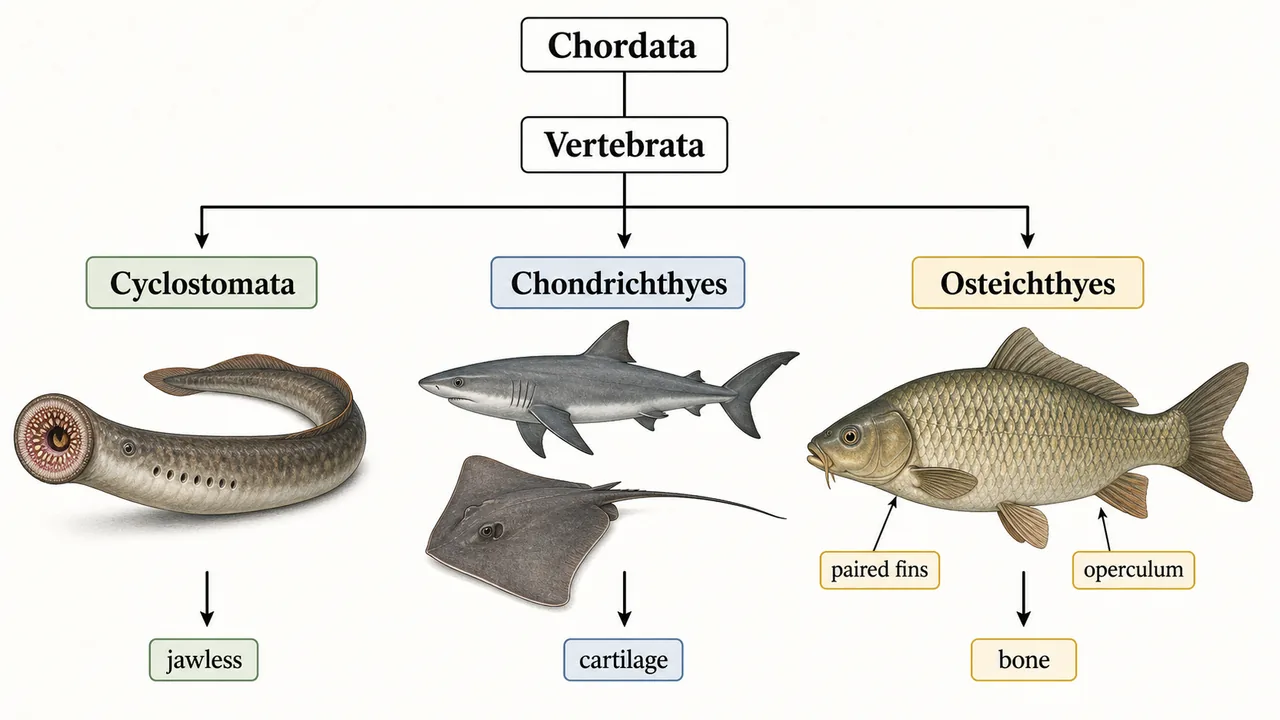
- Fish are members of the Animalia Kingdom (animals) and are also classified into the Phylum Chordata. This means fish share fundamental features with all other chordates, including mammals, birds, reptiles, and amphibians.
- In order to be a chordate an animal must:
- Have a notochord (a slim and flexible rod that supports the body) at some point in their lives. The notochord is an early structural support that, in many chordates, is later replaced by the vertebral column.
- Have a tubular nerve chord along their back (dorsal surface) with the brain developing from a swelling found at the anterior end (front) of this tube. This dorsal nerve cord is the precursor to the spinal cord and brain in vertebrates.
- Paired gill slits at some stage of their life history. In fish, these gill slits persist into adulthood and serve as the primary organs for respiration (gas exchange).
- Segmentation of at least part of their body
- A post-anal tail at some stage in their life history. This is a tail that extends beyond the anus, providing locomotion in aquatic environments.
- A ventral heart
- An endoskeleton
- Fish are further classified into the Vertebrata Subphylum.
- In order to be a vertebrate, an animal must have a vertebral column, or backbone.
- This backbone encloses, supports and protects the spinal cord.
- Fish are vertebrates that live in water and breathe with gills.
- Fish are ectotherms, or cold-blooded. This means they cannot regulate their own body temperature internally and instead depend on the surrounding water temperature.
- Fish have either backbone of cartilage or bone.
- Most fish are adapted to live in salt or fresh water. Most fish have fins and scales, which cover and protect the body.
- The body systems of the fish, such as the digestive, circulatory are well developed.
👉🏻 The sub-phylum Vertebrata is further divided into the following:
Pro Content Locked
Upgrade to Pro to access this lesson and all other premium content.
₹99 charged monthly · Cancel anytime
- All Agriculture & Banking Courses
- AI Lesson Questions (100/day)
- AI Doubt Solver (50/day)
- Glows & Grows Feedback (30/day)
- AI Section Quiz (20/day)
- 22-Language Translation (100/day)
- Recall Questions (20/day)
- AI Quiz (15/day)
- AI Quiz Paper Analysis (100/day)
- AI Step-by-Step Explanations (100/day)
- Spaced Repetition Recall (FSRS)
- AI Tutor
- Immersive Text Questions
- Audio Lessons — Hindi & English
- Mock Tests & Previous Year Papers
- Summary & Mind Maps
- XP, Levels, Leaderboard & Badges
- Generate New Classrooms
- Voice AI Teacher (AgriDots Live)
- AI Revision Assistant
- Knowledge Gap Analysis
- Interactive Revision (LangGraph)
🔒 Secure via Razorpay · Cancel anytime · No hidden fees
Fish Classification
Understanding how fish are classified helps us appreciate their diversity and the biological characteristics that distinguish different groups. Fish taxonomy follows a hierarchical system, starting from the broadest grouping and narrowing down to specific classes.
- Fish are members of the Animalia Kingdom (animals) and are also classified into the Phylum Chordata. This means fish share fundamental features with all other chordates, including mammals, birds, reptiles, and amphibians.
- In order to be a chordate an animal must:
- Have a notochord (a slim and flexible rod that supports the body) at some point in their lives. The notochord is an early structural support that, in many chordates, is later replaced by the vertebral column.
- Have a tubular nerve chord along their back (dorsal surface) with the brain developing from a swelling found at the anterior end (front) of this tube. This dorsal nerve cord is the precursor to the spinal cord and brain in vertebrates.
- Paired gill slits at some stage of their life history. In fish, these gill slits persist into adulthood and serve as the primary organs for respiration (gas exchange).
- Segmentation of at least part of their body
- A post-anal tail at some stage in their life history. This is a tail that extends beyond the anus, providing locomotion in aquatic environments.
- A ventral heart
- An endoskeleton
- Fish are further classified into the Vertebrata Subphylum.
- In order to be a vertebrate, an animal must have a vertebral column, or backbone.
- This backbone encloses, supports and protects the spinal cord.
- Fish are vertebrates that live in water and breathe with gills.
- Fish are ectotherms, or cold-blooded. This means they cannot regulate their own body temperature internally and instead depend on the surrounding water temperature.
- Fish have either backbone of cartilage or bone.
- Most fish are adapted to live in salt or fresh water. Most fish have fins and scales, which cover and protect the body.
- The body systems of the fish, such as the digestive, circulatory are well developed.
👉🏻 The sub-phylum Vertebrata is further divided into the following:
Class — Cyclostomata
The Cyclostomata (meaning "round mouth") represent one of the most primitive groups of living vertebrates. They are jawless fish with several unique characteristics.
- All living members of the class Cyclostomata are ectoparasites on some fishes. This means they live on the external body surface of other fish, feeding on their blood and body fluids.
- They have an elongated body bearing 6-15 pairs of gill slits for respiration.
- Cyclostomes have a sucking and circular mouth without jaws. The absence of jaws is a defining feature that distinguishes them from all other fish classes.
- Their body is devoid of scales and paired fins. Cranium and vertebral column are cartilaginous.
- Cyclostomes are marine but migrate for spawning to fresh water. This type of migration from sea to freshwater for reproduction is called anadromous migration.
- After spawning, within a few days, they die. Their larvae, after metamorphosis, return to the ocean.
- Examples: Petromyzon (Lamprey) and Myxine (Hagfish).
Class — Chondrichthyes
The name Chondrichthyes comes from Greek words meaning "cartilage fish." Members of this class have skeletons made entirely of cartilage rather than bone, which makes them lighter and more flexible in water.
- They are marine animals with streamlined body and have cartilaginous endoskeleton.
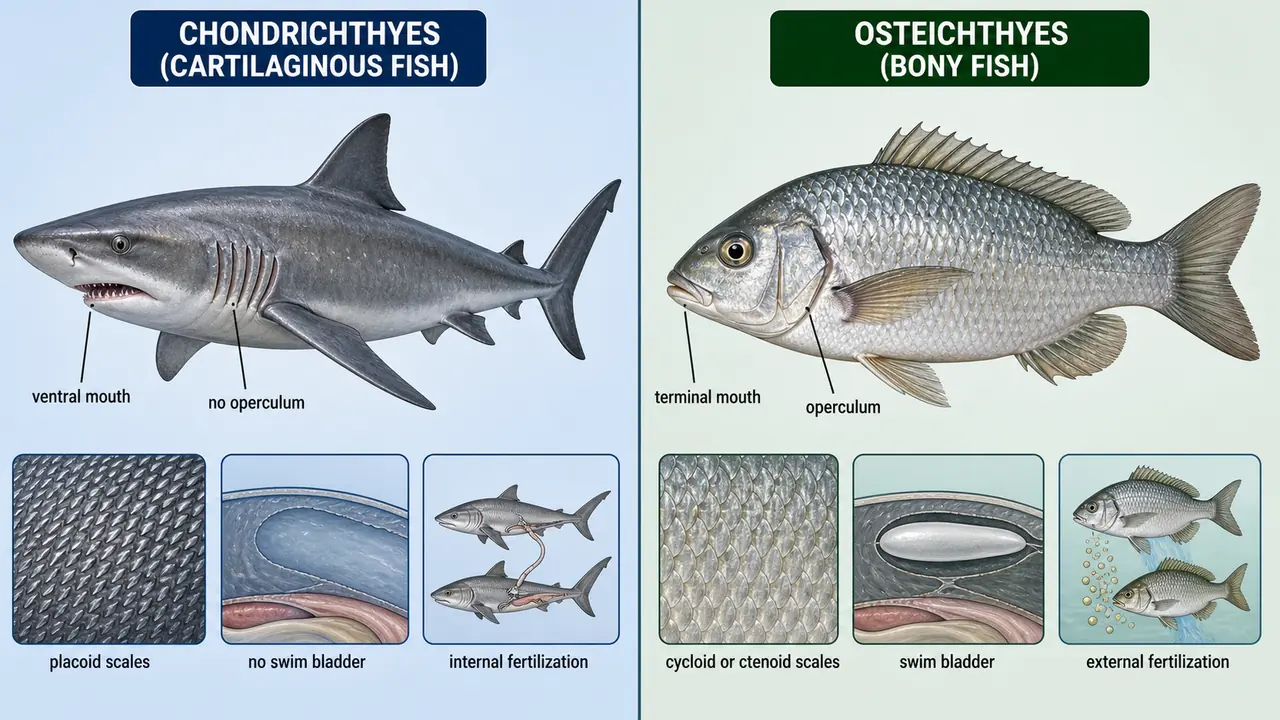
- Mouth is located ventrally. This ventral mouth position is adapted for bottom feeding and prey capture.
- Notochord is persistent throughout life. Unlike bony fish where the notochord is largely replaced, in Chondrichthyes it persists as a supporting structure.
- Gill slits are separate and without operculum (gill cover). The absence of an operculum means the gill slits are visibly exposed, which is a key distinguishing feature from bony fish.
- The skin is tough, containing minute placoid scales. These placoid scales (also called dermal denticles) have a structure similar to teeth, making the skin feel rough like sandpaper.
- Teeth are modified placoid scales which are backwardly directed.
- Their jaws are very powerful. These animals are predaceous. Being predaceous means they are active hunters that prey on other animals.
- Due to the absence of air bladder, they have to swim constantly to avoid sinking. The air bladder (or swim bladder) is an organ that helps fish maintain buoyancy. Without it, Chondrichthyes must keep moving to generate lift.
- Heart is two-chambered (one auricle and one ventricle).
- Some of them have electric organs (e.g., Torpedo) and some possess poison sting (e.g., Trygon).
- They are cold-blooded (poikilothermous) animals, i.e., they lack the capacity to regulate their body temperature.
- Sexes are separate. In males pelvic fins bear claspers. They have internal fertilization and many of them are viviparous. Viviparous means they give birth to live young rather than laying eggs.
- Examples: Scoliodon (Dog fish), Pristis (Saw fish), Carcharodon (Great white shark), Trygon (Sting ray).
Class — Osteichthyes
Osteichthyes (meaning "bony fish") is the largest and most diverse class of fish. These fish possess a skeleton made of true bone, which provides greater structural support compared to cartilage.
- It includes both marine and fresh water fishes with bony endoskeleton.
- Their body is streamlined. The streamlined shape reduces water resistance, allowing efficient movement through water.
- Mouth is mostly terminal. A terminal mouth is positioned at the very front of the head, which is typical of fish that feed in the water column rather than from the bottom.
- They have four pairs of gills which are covered by an operculum on each side. The operculum is a bony flap that protects the gills and aids in the process of pumping water over the gills for respiration.
- Skin is covered with cycloid/ctenoid scales. Cycloid scales are smooth and round, while ctenoid scales have tiny comb-like projections on their edges.
- Air bladder is present which regulates buoyancy. The air bladder (swim bladder) allows bony fish to control their depth in the water without expending energy on swimming, unlike Chondrichthyes.
- Heart is two-chambered (one auricle and one ventricle).
- They are cold-blooded animals.
- Sexes are separate. Fertilization is usually external. They are mostly oviparous, and development is direct. Oviparous means they lay eggs, and direct development means the young resemble adults without going through a larval stage.
- Bony fish are again classified into ray finned group (perch, and catfish) and lobe finned group (lungfish). Ray finned fish have thin, flexible skeleton rays. Lobe finned fish have muscular fins supported by bones. Lobe-finned fish are of special evolutionary significance as they are considered the ancestors of all land vertebrates.
- Examples:
- Marine — Exocoetus (Flying fish), Hippocampus (Sea horse)
- Freshwater — Catla (Katla), Labeo (Rohu), Clarias (Magur)
- Aquarium — Betta (Fighting fish), Pterophyllum (Angel fish)
Chondrichthyes vs Osteichthyes — Key Differences at a Glance
| Feature | Chondrichthyes | Osteichthyes |
|---|---|---|
| Skeleton | Cartilaginous | Bony |
| Scales | Placoid | Cycloid/Ctenoid |
| Gill cover | No operculum | Operculum present |
| Mouth position | Ventral | Terminal |
| Air bladder | Absent | Present |
| Fertilization | Internal | Usually external |
👉🏻 Difference between the two classes is summarized as follows:
| Class Chondrichthyes (Cartilaginous Fish) | Osteichthyes (Bony Fish) |
|---|---|
| Have cartilaginous endoskeleton. | Have bony endoskeleton. |
| Marine fishes | Both marine and fresh water fishes |
| Due to the absence of air bladder, they have to swim constantly to avoid sinking. | Air bladder is present which regulates buoyancy. |
| They have internal fertilization and many of them are viviparous. | Fertilization is usually external. They are mostly oviparous. |
| Scoliodon (Dog fish), Pristis (Saw Fish), Carcharodon (Great White Shark), Trygon (Sting Ray) | Marine: Exocoetus (Flying Fish), Hippocampus (Sea Horse). Freshwater: Labeo (Rahu), Catla (Katla), Clarias (Magur). Aquarium: Betta (Fighting Fish), Pterophyllum (Angle Fish) |
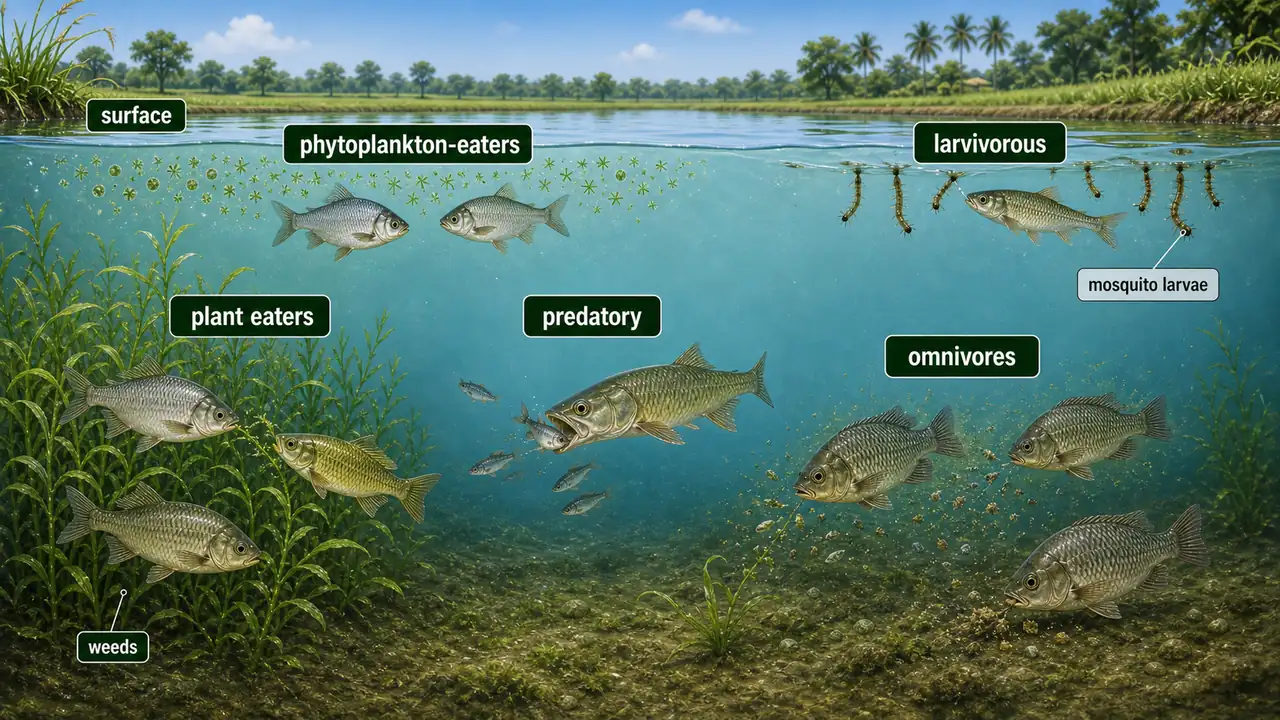
👉🏻 Classification of fish Species According to their Feeding Habits:
Understanding feeding habits is essential for aquaculture management, especially in polyculture systems where different species are stocked together to utilize all available food niches in a pond.
- Phytoplankton-eaters — These fish feed on microscopic algae floating in the water, typically occupying the surface and upper water layers.
- Chinese silver carp
- Indian 'catla' carp
- Indian 'rohu' carp
- Milk fish
- Water plant eaters — Also called herbivorous fish, these species consume aquatic weeds and macrophytes, helping control excessive plant growth in ponds.
- Chinese grass carp
- Chinese 'Wuchang' bream
- Big gourami
- Tilapia
- Zill's tilapia
- Predatory fish species (fish eaters) — These are carnivorous fish that actively hunt and consume other fish. They should generally be excluded from polyculture ponds to avoid losses.
- Snakehead species
- Omnivores (eat everything available) — These versatile feeders consume both plant and animal matter, making them highly adaptable in various culture environments.
- Barb species
- Crucian carp
- Chinese mud carp
- Common carp
- Catfish species
- Indian 'mrigala' carp
- Tilapia species
- Larvivorous fishes — These fish are particularly valued for biological control of mosquitoes.
- Fishes which prefer mosquito larvae and feed on them throughout their life are known as larvicidal fishes.
- The example are Carassius auratus, Lebistes, Gambusia affinis, Gambusia holbrooki, Tilapia, Notopterus notpterus etc.
Transgenic fish
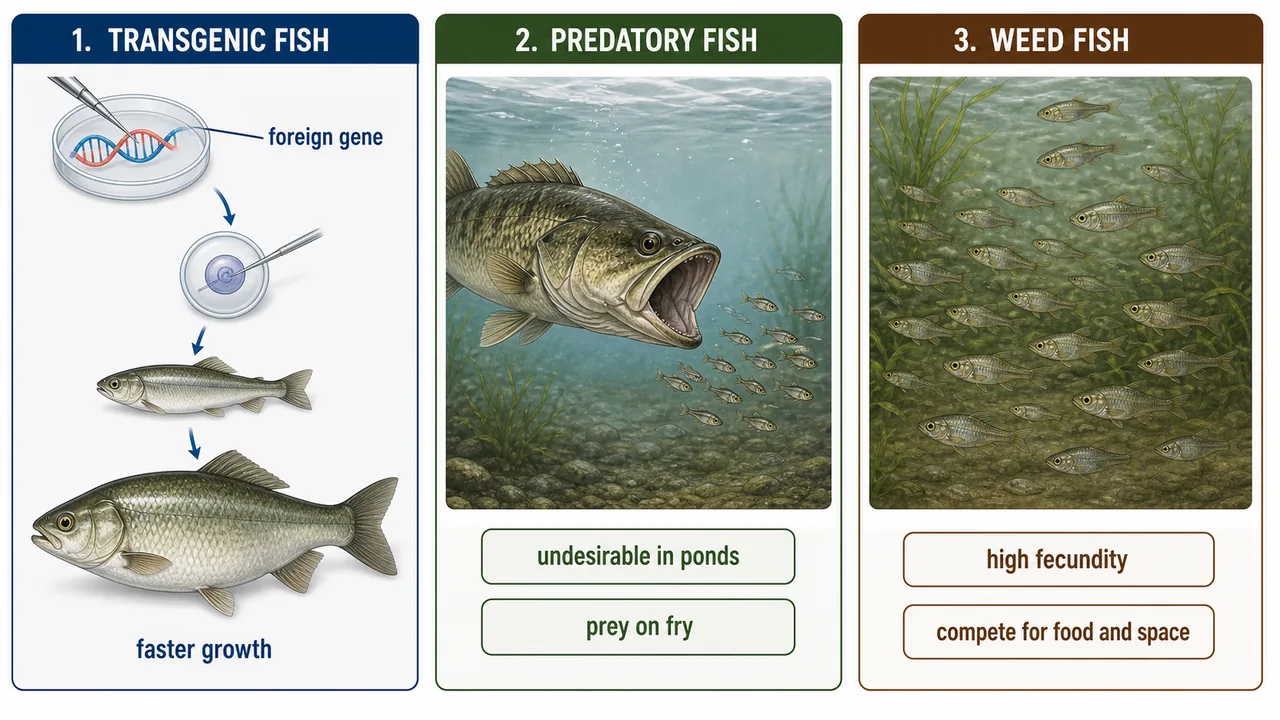
- A transgenic fish is one which carries one or more foreign genes.
- The foreign genes are selectively incorporated by microinjection into the eggs with a view to produce transgenic fish lines carrying such foreign genes.
Transgenic technology in fisheries aims to improve desirable traits such as faster growth rate, disease resistance, and cold tolerance. This is an advancing area of biotechnology in aquaculture.
Predatory fishes
- Fishes which prey on smaller fishes or hatchlings i.e. Clupisoma garua, Silonia silondia, Rita rita, Wallago attu, Nandus nandus, Channa striatus, Ailiaberg etc.
Predatory fishes are considered undesirable in culture ponds because they compete with and consume the stocked fish, reducing overall yield. Proper eradication of predatory fish during pond preparation is an important step in aquaculture management.
Weed fishes
- These fishes have good fecundity and attain sexual maturity in summer and breed even without rain prior to the monsoon and therefore their young ones are abundant in number during monsoon.
- The examples are Ambassis, Barilius barila, Chela cochins, Gad usia chapra, Punius ticto, Oxygaster bacaila etc.
- Fecundity: The capacity of an individual fish to produce female reproductive cells is known as fecundity. The fecundity is a quality of the species which ensures high rate of intraspecific competition and more rapid rate of evolution i.e. the species with high fecundity have a greater biotic potentiality.
Weed fishes are unwanted species in aquaculture ponds because they compete for food and space with the cultured fish species. Their high reproductive potential makes them difficult to eliminate once established. Controlling weed fish populations through repeated netting, pond drying, and use of mahua oil cake (a natural piscicide) is essential for successful fish culture.
Ocean Zones
Understanding ocean zones is fundamental to marine fisheries, as different species inhabit different zones depending on light availability, pressure, temperature, and food resources.
- Oceanic zones were created by oceanographers to make it easier to study individual areas of the oceans.
- They were also designed to study animals living in specific areas of the oceans.
- The Ocean can be divided into zones based on depth (Vertically) and distance from the land (Horizontally).
- Major vertical zones of the ocean begin at sea level and end at the deepest points in the ocean.
- Another set of zones in the ocean are horizontal.
- Starting at the seashore they cover the ocean floor. These zones include the seashore, continental shelf, continental slope, deep ocean floor, and ocean trenches.
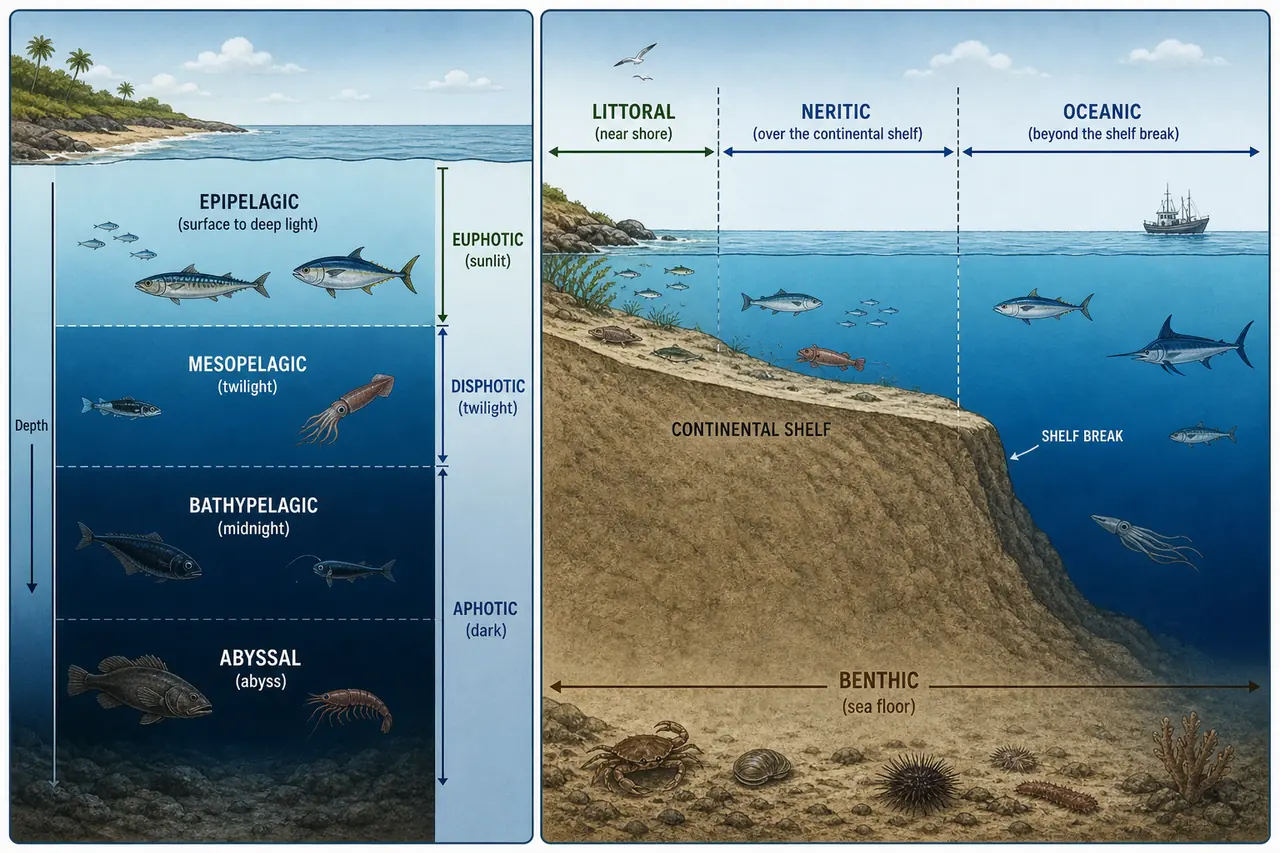
- Continental margin is the submerged area of the continents. It includes:
- Continental Shelf: (Flat gradually sloping seafloor) from shoreline to 200m. End of Shelf is called Shelf Break. The continental shelf is the most biologically productive part of the ocean, as sunlight penetrates the shallow waters supporting abundant marine life.
- Continental Slope (Steeply sloping seafloor) seaward of shelf break.
- Continental Rise (Moderately sloping seafloor) seaward of slope.
Various classification of Ocean Zones
Pelagic and Benthic Zones
- One simple ocean zone classification is between the Water and the Ocean Floor.
- The water is referred to as the Pelagic Zone (The organisms that swim through the water column are known as Nekton). Nekton includes all actively swimming organisms such as fish, whales, and squids.
- The Ocean floor is referred to as the Benthic Zone (The organisms that live here are benthic organisms or Benthos). Benthos includes organisms like crabs, starfish, sea cucumbers, and bottom-dwelling fish.
- The classification of the Pelagic Zones:
- The pelagic zone is the region of a body of water (lake, river, or ocean) that is not associated with the bottom (see benthic zone) or shore (see littoral zone).
- This habitat zone is truly a three-dimensional habitat space. Some fish that occupy the pelagic zone never encounter the bottom or shore throughout their lives.
- The pelagic zone is divided into zones based on light penetration from the surface (depth from surface)
- Epipelagic (sunlight: 0 - 200m)
- Mesopelagic (twilight: 200 - 1,000m)
- Bathypelagic (no light: 1,000 - 4,000m)
- Abyssopelagic (4,000 m — 6,000m)
- Hadopelagic (6,000 m — 10,000m)
- The bathypelagic zone is also called the midnight zone because no light penetrates the area and the water is near freezing.
Epipelagic Zone
- The epipelagic zone is the water from the surface of the sea down to 200 metres.
- It is also referred to as the surface waters or the sunlit zone and includes the photic zone.
- The photic zone is defined as the surface waters down to the point where the sunlight has attenuated to 1 percent of the surface value.
- This depth depends on how turbid the water is, but in clear water can extend to 200 metres, coinciding with the epipelagic zone.
- The photic zone has sufficient light for phytoplankton to photosynthesize.
The epipelagic zone is the most important zone for commercial fishing, as the majority of commercially harvested fish species live in this well-lit, nutrient-rich layer.
Horizontal division of the Pelagic Zone
Neritic Zone
- The Neritic zone lies above the continental shelf.
- It extends from the low-tide mark outward from the seashore to where the depth of the water reaches 200 meters (656 feet).
- This water is lit by sunlight and relatively shallow.
- The majority of sea life lives in this zone because it has well-oxygenated water, low pressure, and a fairly stable temperature.
The Neritic zone is considered the most productive marine environment and supports most of the world's marine fisheries.
Oceanic Zone
- The Oceanic zone extends from the edge of the continental shelf over the continental slope to the ocean floor beyond.
- It begins where the water is over 200 meter (656 feet) deep.
- This zone contains deep trenches, volcanoes, and ocean basins.
The oceanic zone is characterized by deep waters, low nutrient availability, and relatively fewer fish species compared to the neritic zone. However, it is home to large pelagic species like tuna, swordfish, and sharks.
Light Zones in the Ocean
Euphotic Zone
- The uppermost layer of the world's oceans is bathed in sunlight during the daytime.
- This bright ocean layer is called the sunlit zone or the euphotic zone (euphotic means well lit" in Greek) or the epipelagic zone (epipelagic means "upon the sea").
- The depth of this zone depends on the clarity or murkiness of the water.
- In clear water, the euphotic zone can be quite deep; in murky water, it can be only 50 feet deep.
- On average, it extends to about 660 feet (200 meters); the depth of the ocean averages about 13,000 feet or 4 000 m
- In this zone, there is enough light for photosynthesis to take place, so many plants and other photosynthetic organisms live in this zone and food is abundant.
- Photosynthesis is a process in which sunlight and carbon dioxide gas are converted into food (chemical energy contained in carbohydrates) and oxygen gas.
- Photosynthesis in the oceans creates approximately 90% of the Earth's gaseous oxygen. This remarkable fact highlights the critical role of ocean phytoplankton in sustaining life on Earth.
- Most of the oxygen is produced by phytoplankton.
IMPORTANT
Ocean phytoplankton produce roughly 90% of Earth's oxygen — more than all terrestrial forests combined. This is a frequently asked fact in environmental science questions.
- These primary producers (also called autotrophs) are the first link in the food chain in the oceans. Autotrophs are organisms that produce their own food using sunlight, forming the base of the marine food web.
- Because of this food source, many animals also live in this zone.
- In fact, most of the life in the ocean is found in this zone, although it is the smallest ocean zone in terms of volume of water.
Disphotic Zone
- The middle layer of the world's oceans receives only faint, filtered sunlight during the daytime. This is because the seawater absorbs the sunlight. This barely-lit ocean layer is called the twilight zone or the disphotic zone (disphotic means "poorly lit" in Greek) or the mesopelagic zone (mesopelagic means "middle sea").
- This zone appears deep blue to black in color.
- The depth of this zone depends on the clarity or murkiness of the water.
- On average, this zone extends from 660 to 3,300 feet (200 to 1,000 m).
- In the disphotic zone, there is enough light to see during the day, but not enough light for photosynthesis to take place, so no plants live in this zone.
- The amount of light decreases with depth. Because of this, food is not abundant.
- The water in the disphotic zone is cold (the temperature ranges from 41 to 39 degrees F) and decreases with depth. The pressure is high — it can be up to 1,470 psi (pounds per square inch) and increases with depth. The amount of dissolved oxygen in the water is less than in the sunlit zone.
- Thus, the Ocean can be divided broadly into Photic and Aphotic Zones based on the penetration of light. The Photic zone is where light reaches and supports photosynthesis, while the Aphotic zone is the dark region where no photosynthesis can occur.
- The Photic Zone is further divided into Euphotic Zone and Disphotic Zone.
Benthic Zone
- The benthic zone is ocean floor all the way from the low-tide mark outward to the deepest trenches on the ocean floor.
- Animals have been found living in all areas of the ocean.
- Most plant and animal life lives on the continental shelf that is relatively shallow, and sunlight penetrates the water to support plant life.
- Many different types of plants and animals live in the zone and are often attached to the rocks.
The benthic zone is home to a unique ecosystem of organisms adapted to life on the ocean floor. These include demersal fish (bottom-dwelling fish), crustaceans, molluscs, and various invertebrates that form important components of marine fisheries.
Classification of the Benthic Zones
Each benthic sub-zone corresponds to different depths and conditions:
- Littoral — The shallowest zone, extending from the shore to the edge of the continental shelf. Rich in biodiversity.
- Bathyl — Corresponds to the continental slope, where light begins to diminish significantly.
- Abyssal — The deep ocean floor, characterized by near-freezing temperatures and extreme pressure.
- Hadal — The deepest trenches of the ocean (below 6,000 m), representing the most extreme environment on Earth.
TIP
Remember the benthic zones in order of increasing depth: L-B-A-H (Littoral → Bathyl → Abyssal → Hadal). The pelagic zones follow a similar deepening pattern: Epi → Meso → Bathy → Abysso → Hado.
Summary Cheat Sheet
| Concept / Topic | Key Details |
|---|---|
| Fish phylum | Chordata; subphylum: Vertebrata |
| Fish are | Cold-blooded (ectotherms/poikilothermous) |
| Cyclostomata | Jawless fish; ectoparasites; circular sucking mouth; no scales/paired fins; e.g., Lamprey, Hagfish |
| Cyclostomata migration | Anadromous (sea → freshwater for spawning); die after spawning |
| Chondrichthyes | Cartilaginous skeleton; placoid scales; no operculum; no air bladder; ventral mouth |
| Chondrichthyes heart | 2-chambered; must swim constantly (no air bladder) |
| Chondrichthyes examples | Shark (Scoliodon), Sawfish (Pristis), Stingray (Trygon), Torpedo (electric) |
| Osteichthyes | Bony skeleton; cycloid/ctenoid scales; operculum present; air bladder present; terminal mouth |
| Osteichthyes examples | Catla, Rohu (freshwater); Seahorse, Flying fish (marine); Betta, Angelfish (aquarium) |
| Phytoplankton feeders | Silver Carp, Catla, Rohu, Milkfish |
| Weed eaters | Grass Carp, Tilapia |
| Predatory fish | Snakehead; excluded from polyculture ponds |
| Larvivorous fish | Gambusia; used for mosquito control |
| Weed fish | High fecundity; compete with cultured fish; e.g., Puntius ticto |
| Transgenic fish | Carries foreign genes via microinjection |
| Ocean phytoplankton | Produce 90% of Earth's oxygen |
| Euphotic zone | 0–200 m; sunlit; supports photosynthesis; most marine life |
| Neritic zone | Above continental shelf; most productive marine zone |
| Pelagic zones (depth) | Epi → Meso → Bathy → Abysso → Hado |
| Benthic zones (depth) | Littoral → Bathyl → Abyssal → Hadal (>6000 m) |
| Continental shelf | 0–200 m depth; ends at shelf break |