⨵ Cell Division: Types and Cell Cycle
Understand the cell cycle, types of cell division (amitosis, mitosis, meiosis, endomitosis), and their role in plant growth and breeding — with comparison tables and exam tips.
Why Cell Division Matters in Agriculture
Every seed that germinates, every root tip that elongates, every pollen grain that forms — all depend on cell division. When a wheat plant grows from a seedling to a mature crop bearing hundreds of grains, trillions of cell divisions have occurred. Plant breeders exploit specific types of cell division: mitosis drives vegetative propagation (cloning sugarcane, banana), meiosis creates genetic variation needed for hybridisation, and endomitosis (induced by colchicine) produces polyploid varieties with larger fruits and higher vigour.
What Is Cell Division?
- The cell is the structural and functional unit of life. All cells originate by division of existing cells — "Omnis cellula e cellula" (Virchow).
- Cell division involves:
- Karyokinesis — division of the nucleus (chromosomes are distributed to daughter cells).
- Cytokinesis — division of the cytoplasm (organelles and cell membrane are partitioned).

The Cell Cycle

The cell cycle is the complete sequence of events from one division to the next. It consists of interphase (preparation) and the M-phase (mitotic or meiotic division).
Pro Content Locked
Upgrade to Pro to access this lesson and all other premium content.
Charged once for one year · ₹1188 total
Save ₹100/month vs ₹2388/year launch price
- All Agriculture & Banking Courses
- AI Lesson Questions (100/day)
- AI Doubt Solver (50/day)
- Glows & Grows Feedback (30/day)
- AI Section Quiz (20/day)
- 22-Language Translation (100/day)
- Recall Questions (20/day)
- AI Quiz (15/day)
- AI Quiz Paper Analysis (100/day)
- AI Step-by-Step Explanations (100/day)
- Spaced Repetition Recall (FSRS)
- AI Tutor
- Immersive Text Questions
- Audio Lessons — Hindi & English
- Mock Tests & Previous Year Papers
- Summary & Mind Maps
- XP, Levels, Leaderboard & Badges
- Generate New Classrooms
- Voice AI Teacher (AgriDots Live)
- AI Revision Assistant
- Knowledge Gap Analysis
- Interactive Revision (LangGraph)
🔒 Secure one-time yearly payment via Razorpay · No hidden fees
Why Cell Division Matters in Agriculture
Every seed that germinates, every root tip that elongates, every pollen grain that forms — all depend on cell division. When a wheat plant grows from a seedling to a mature crop bearing hundreds of grains, trillions of cell divisions have occurred. Plant breeders exploit specific types of cell division: mitosis drives vegetative propagation (cloning sugarcane, banana), meiosis creates genetic variation needed for hybridisation, and endomitosis (induced by colchicine) produces polyploid varieties with larger fruits and higher vigour.
What Is Cell Division?
- The cell is the structural and functional unit of life. All cells originate by division of existing cells — "Omnis cellula e cellula" (Virchow).
- Cell division involves:
- Karyokinesis — division of the nucleus (chromosomes are distributed to daughter cells).
- Cytokinesis — division of the cytoplasm (organelles and cell membrane are partitioned).
The Cell Cycle
The cell cycle is the complete sequence of events from one division to the next. It consists of interphase (preparation) and the M-phase (mitotic or meiotic division).
Phases of the Cell Cycle
| Phase | Full Name | Key Events |
|---|---|---|
| G₁ | Gap 1 (pre-DNA phase) | Cell grows; synthesises RNA and proteins; longest phase |
| S | Synthesis phase | DNA replication — each chromosome is duplicated |
| G₂ | Gap 2 (post-DNA phase) | Cell checks DNA replication; prepares proteins for division |
| M | Mitotic/Meiotic phase | Actual division of nucleus and cytoplasm |
- The metabolically most active stage is interphase — the cell is intensely synthesising DNA, RNA, and proteins even though no visible division is occurring.
- The M-phase is completed in two linked steps: karyokinesis (nuclear division) followed by cytokinesis (cytoplasmic division).
- Karyokinesis typically takes less than one hour.
Agricultural connection: Understanding the cell cycle is critical for mutation breeding. Mutagens (like gamma rays or EMS) are most effective during the S-phase when DNA is being replicated and is most vulnerable to change.
Types of Cell Division
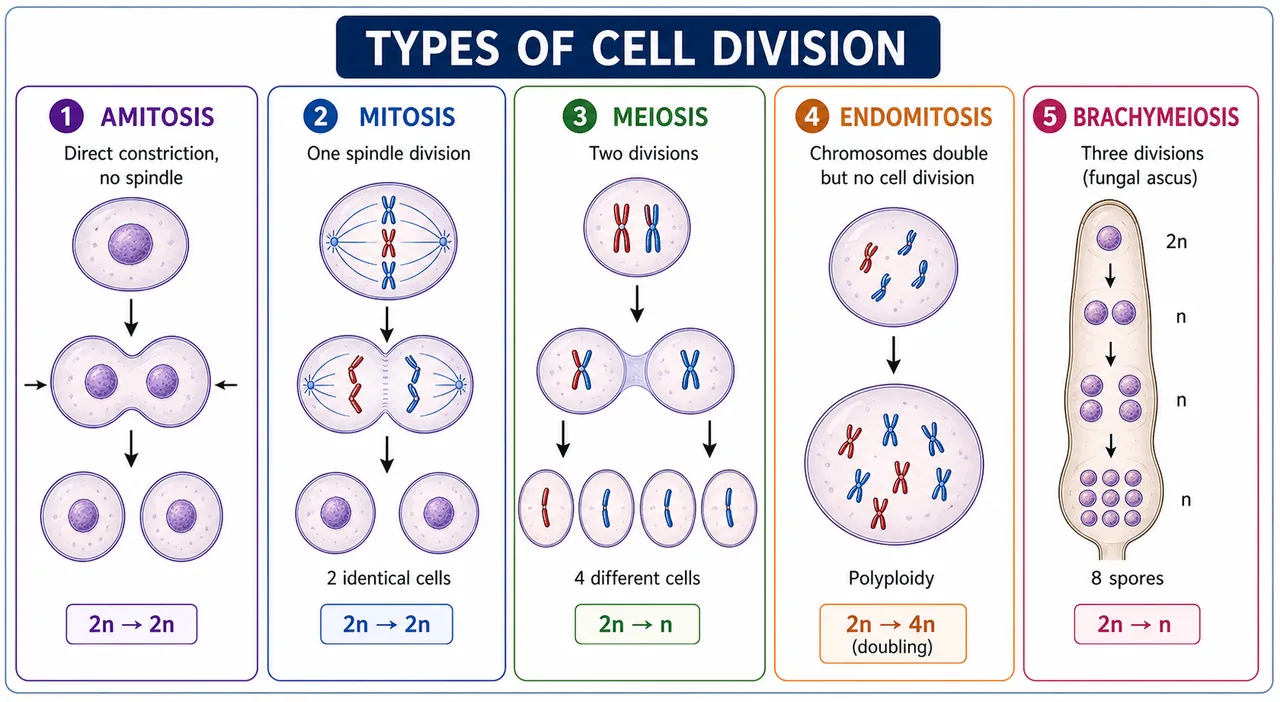
There are five types of cell division, each with distinct roles in plant biology and breeding:
| Type | Mechanism | Chromosome Outcome | Example |
|---|---|---|---|
| Amitosis | Direct division; no spindle or visible chromosomes | Same number (usually) | Fission (bacteria), budding (yeast) |
| Mitosis | Spindle-mediated; equational division | Same number (2n → 2n) | Growth, repair, vegetative propagation |
| Meiosis | Two divisions; reductional + equational | Halved (2n → n) | Gamete formation (pollen, ovules) |
| Endomitosis (C-mitosis) | Chromosomes double but cell does not divide | Doubled (polyploidy) | Colchicine-induced polyploidy |
| Brachymeiosis | Three divisions (1st & 3rd reductional, 2nd mitotic) | Variable | Ascospore formation in Ascomycetes |
Amitosis
- The simplest form of cell division — the nucleus simply constricts and divides without forming a spindle or visible chromosomes.
- Occurs mainly in prokaryotes and some lower eukaryotes.
Endomitosis (C-Mitosis)
- Chromosomes replicate but the cell does not divide, resulting in doubled chromosome number.
- Induced by colchicine, which binds to tubulin proteins and prevents spindle fibre formation.
- Colchicine is obtained from Colchicum luteum (family Liliaceae).
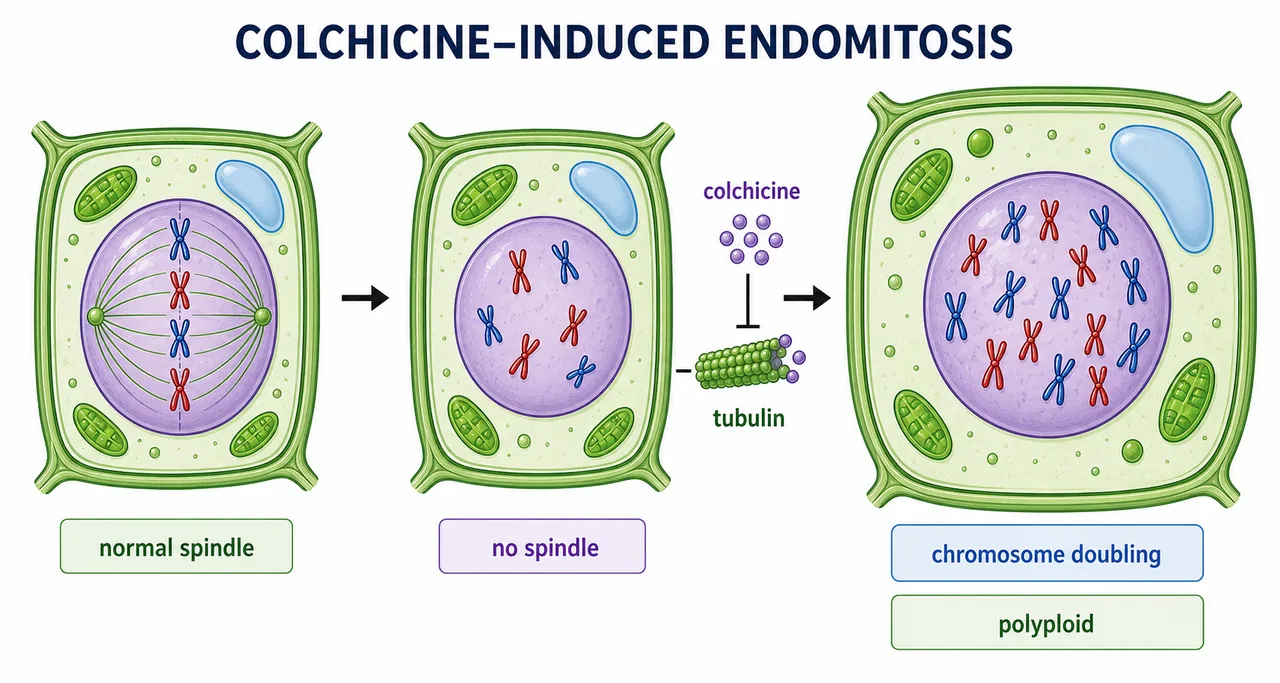
Agricultural application: Colchicine-induced polyploidy is one of the most powerful tools in plant breeding. Polyploid crops often have larger cells, organs, and higher vigour. Examples include seedless watermelon (triploid), certain wheat varieties (hexaploid), and polyploid sugarbeet with higher sugar content.
Brachymeiosis
- Rare type found in certain fungi.
- Nucleus divides three times — 1st and 3rd divisions are reductional, 2nd is mitotic.
- Discovered by Claussen in ascospore formation of Ascomycetes.
Mitosis — Equational Division
TIP
Mitosis = Same chromosome number. Meiosis = Half chromosome number. This is the most fundamental distinction.
- Occurs in both vegetative and reproductive cells.
- Nucleus and cytoplasm divide once → two genetically identical daughter cells.
- Responsible for growth, repair, and asexual reproduction.
- Term first used by Walter Flemming in 1882 (from Greek mitos = thread).
Agricultural example: When a farmer propagates sugarcane by stem cuttings, every new cell in the growing plant arises by mitosis — producing exact genetic copies of the parent, which is why vegetative propagation maintains varietal purity.
Meiosis — Reductional Division
- Occurs in reproductive cells (anthers and ovules in plants).
- Nucleus and cytoplasm divide twice → four genetically different daughter cells.
- Chromosome number is reduced to half (2n → n).
- Discovered by Strasburger; term given by Farmer & Moore.
Why Meiosis Creates Genetic Variation
- Crossing over at pachytene — exchange of segments between non-sister chromatids.
- Independent assortment — random orientation of bivalents at metaphase I.
- Random fertilisation — any sperm can fuse with any egg.
Agricultural significance: Meiosis is the biological basis of all hybridisation programmes. The genetic variation generated during meiosis in the F₁ hybrid is what breeders select from in subsequent generations to develop improved crop varieties.
Neurospora in Genetic Studies
Neurospora crassa is a model organism for studying meiosis because:
- All four products of a single meiosis are contained within the same sac (ascus) — allowing ordered tetrad analysis.
- Has a short life cycle — enabling rapid genetic experiments.
Asynapsis vs. Desynapsis
| Condition | What Happens | Effect on Breeding |
|---|---|---|
| Asynapsis | Homologous chromosomes fail to pair at all | Disrupts segregation → sterility |
| Desynapsis | Chromosomes pair but separate prematurely (chiasmata fall apart) | Abnormal gametes → reduced fertility |
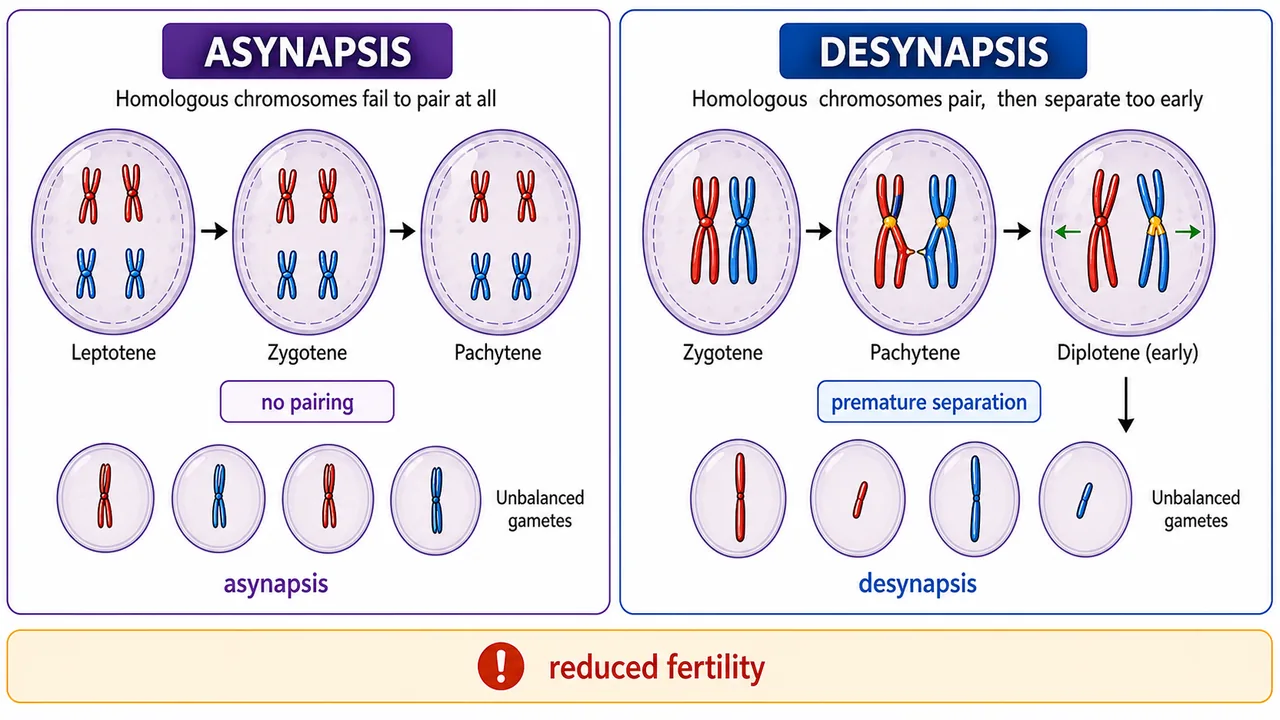
Both conditions are controlled by specific genes and are important in plant breeding because they affect fertility and recombination in crop plants.
Mitosis vs. Meiosis: Key Comparison
| Feature | Mitosis | Meiosis |
|---|---|---|
| Where | Somatic (body) cells | Reproductive cells |
| Divisions | One | Two (meiosis I + II) |
| Daughter cells | 2, genetically identical | 4, genetically different |
| Chromosome number | Maintained (2n → 2n) | Halved (2n → n) |
| Crossing over | No | Yes (at pachytene) |
| Synapsis | No | Yes (at zygotene) |
| Role | Growth, repair, asexual reproduction | Gamete formation, genetic variation |
| Discoverer | Flemming (1882) | Strasburger |
Summary Table
| Topic | Key Fact | Exam Pointer |
|---|---|---|
| Cell cycle phases | G₁ → S → G₂ → M | DNA replication occurs in S-phase |
| Most active stage | Interphase | "Resting phase" is misleading — very active metabolically |
| Amitosis | Simplest; no spindle | Bacteria (fission), yeast (budding) |
| Endomitosis | Colchicine stops spindle → polyploidy | Colchicine from Colchicum luteum (Liliaceae) |
| Mitosis | Equational; 2 identical cells | Growth and vegetative propagation |
| Meiosis | Reductional; 4 different cells | Gamete formation; basis of hybridisation |
| Asynapsis vs. Desynapsis | No pairing vs. premature separation | Both cause sterility; gene-controlled |
| Neurospora | All 4 meiotic products in one sac | Ideal for genetic studies |
Summary Cheat Sheet
| Concept / Topic | Key Details |
|---|---|
| Karyokinesis | Division of nucleus |
| Cytokinesis | Division of cytoplasm |
| Cell cycle phases | G₁ → S → G₂ → M |
| S-phase | DNA replication occurs; most vulnerable to mutagens |
| Interphase | Metabolically most active stage (not "resting") |
| Amitosis | Simplest; no spindle; bacteria (fission), yeast (budding) |
| Mitosis | Equational; 2 identical daughter cells (2n → 2n) |
| Mitosis term by | Walter Flemming (1882) |
| Mitosis role | Growth, repair, vegetative propagation |
| Meiosis | Reductional; 4 different daughter cells (2n → n) |
| Meiosis discovered by | Strasburger; term by Farmer & Moore |
| Meiosis role | Gamete formation; basis of hybridisation |
| Genetic variation sources | Crossing over, independent assortment, random fertilisation |
| Endomitosis (C-mitosis) | Chromosomes double but cell doesn't divide → polyploidy |
| Colchicine source | Colchicum luteum (family Liliaceae) |
| Colchicine mechanism | Binds tubulin; prevents spindle fibre formation |
| Brachymeiosis | 3 divisions; found in Ascomycetes; discovered by Claussen |
| Asynapsis | Homologous chromosomes fail to pair → sterility |
| Desynapsis | Chromosomes pair but separate prematurely → reduced fertility |
| Mitosis vs Meiosis: divisions | 1 vs 2 |
| Mitosis vs Meiosis: crossing over | No vs Yes (at pachytene) |
| Mitosis vs Meiosis: synapsis | No vs Yes (at zygotene) |
| Neurospora crassa | Model for meiosis; all 4 products in one ascus |