🧜🏼♀️ Vavilov's Centres of Origin and Law of Homologous Series
Understand Vavilov's 12 centres of origin, the concept of centres of diversity, and the Law of Homologous Series in Variation — with agricultural examples and exam tips.
Why Centres of Origin Matter in Agriculture
When a rice breeder needs genes for flood tolerance, they look to the Indo-Burma centre (Vavilov's Hindustan centre) — where rice originated and where the greatest diversity of wild rice species exists. When wheat breeders search for rust resistance, they explore collections from the Near Eastern centre where wheat was first domesticated. Vavilov's work on centres of origin tells breeders where to look for the genetic diversity they need.
NOTE
This topic is a high-frequency question area in competitive exams. Be sure to memorize the 12 Vavilov centers and the crops associated with each center.
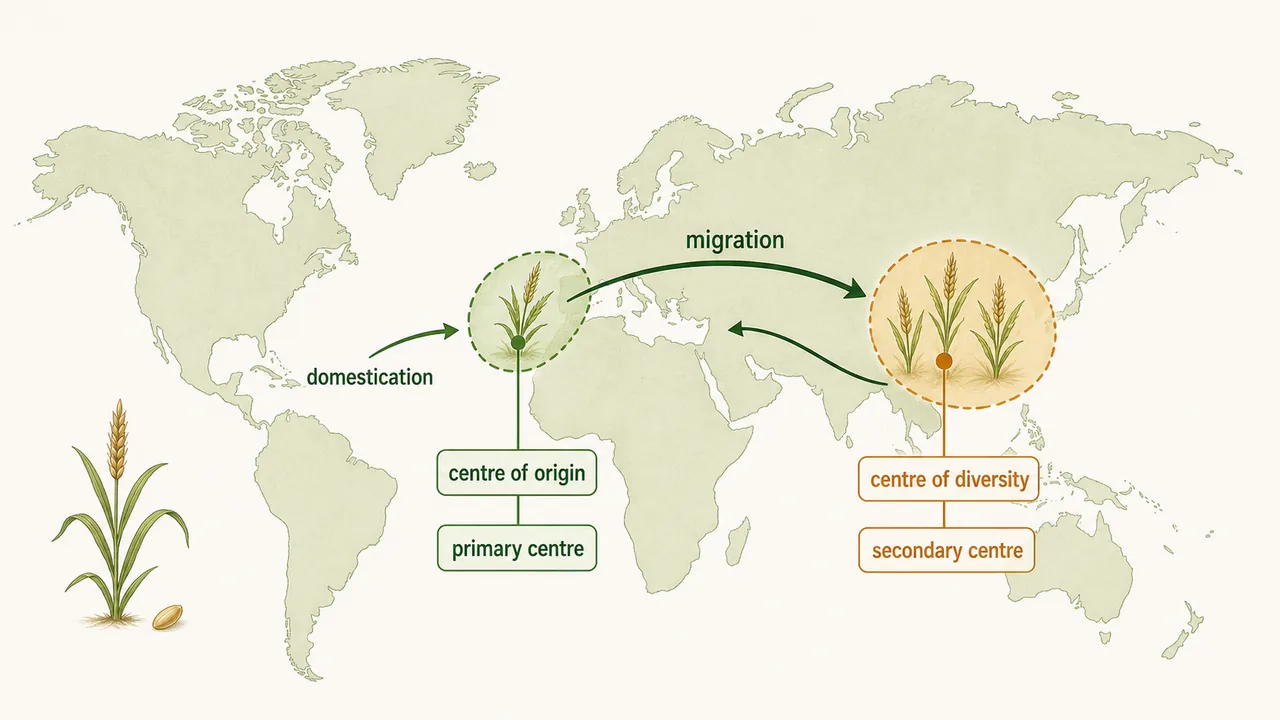
- A center of origin (or center of diversity) is a geographical area where a group of organisms, either domesticated or wild, first developed its distinctive properties. These regions are critically important in plant breeding because they harbour the greatest genetic diversity for a given crop species.
- They are also considered centers of diversity. The terms "center of origin" and "center of diversity" are often used interchangeably, though technically a center of diversity may not always coincide with the place where the crop was first domesticated.
- Centers of origin were first identified in 1924 by N. Vavilov. Vavilov, a Russian botanist and geneticist, conducted extensive exploration trips across the globe to collect and study crop plants, leading to his landmark theory.
- Vavilov centers are regions where a high diversity of crop wild relatives can be found, representing the natural relatives of domesticated crop plants. Later in 1935 Vavilov divided the centers into 12 centers, giving the following list:
- Chinese center
- Indian center
- Indo-Malayan center
- Central Asiatic center
- Persian center
- Mediterranean center
- Abyssinian center
- North American center
- South American center
- Central American center
- Chilean center
- Brazilian-Paraguayan center
Understanding these centers is essential for germplasm collection and conservation, as they represent the richest repositories of genetic variability for crop improvement.
Pro Content Locked
Upgrade to Pro to access this lesson and all other premium content.
Charged once for one year · ₹1188 total
Save ₹100/month vs ₹2388/year launch price
- All Agriculture & Banking Courses
- AI Lesson Questions (100/day)
- AI Doubt Solver (50/day)
- Glows & Grows Feedback (30/day)
- AI Section Quiz (20/day)
- 22-Language Translation (100/day)
- Recall Questions (20/day)
- AI Quiz (15/day)
- AI Quiz Paper Analysis (100/day)
- AI Step-by-Step Explanations (100/day)
- Spaced Repetition Recall (FSRS)
- AI Tutor
- Immersive Text Questions
- Audio Lessons — Hindi & English
- Mock Tests & Previous Year Papers
- Summary & Mind Maps
- XP, Levels, Leaderboard & Badges
- Generate New Classrooms
- Voice AI Teacher (AgriDots Live)
- AI Revision Assistant
- Knowledge Gap Analysis
- Interactive Revision (LangGraph)
🔒 Secure one-time yearly payment via Razorpay · No hidden fees
Why Centres of Origin Matter in Agriculture
When a rice breeder needs genes for flood tolerance, they look to the Indo-Burma centre (Vavilov's Hindustan centre) — where rice originated and where the greatest diversity of wild rice species exists. When wheat breeders search for rust resistance, they explore collections from the Near Eastern centre where wheat was first domesticated. Vavilov's work on centres of origin tells breeders where to look for the genetic diversity they need.
NOTE
This topic is a high-frequency question area in competitive exams. Be sure to memorize the 12 Vavilov centers and the crops associated with each center.
- A center of origin (or center of diversity) is a geographical area where a group of organisms, either domesticated or wild, first developed its distinctive properties. These regions are critically important in plant breeding because they harbour the greatest genetic diversity for a given crop species.
- They are also considered centers of diversity. The terms "center of origin" and "center of diversity" are often used interchangeably, though technically a center of diversity may not always coincide with the place where the crop was first domesticated.
- Centers of origin were first identified in 1924 by N. Vavilov. Vavilov, a Russian botanist and geneticist, conducted extensive exploration trips across the globe to collect and study crop plants, leading to his landmark theory.
- Vavilov centers are regions where a high diversity of crop wild relatives can be found, representing the natural relatives of domesticated crop plants. Later in 1935 Vavilov divided the centers into 12 centers, giving the following list:
- Chinese center
- Indian center
- Indo-Malayan center
- Central Asiatic center
- Persian center
- Mediterranean center
- Abyssinian center
- North American center
- South American center
- Central American center
- Chilean center
- Brazilian-Paraguayan center
Understanding these centers is essential for germplasm collection and conservation, as they represent the richest repositories of genetic variability for crop improvement.
Origin Places of Important Crops
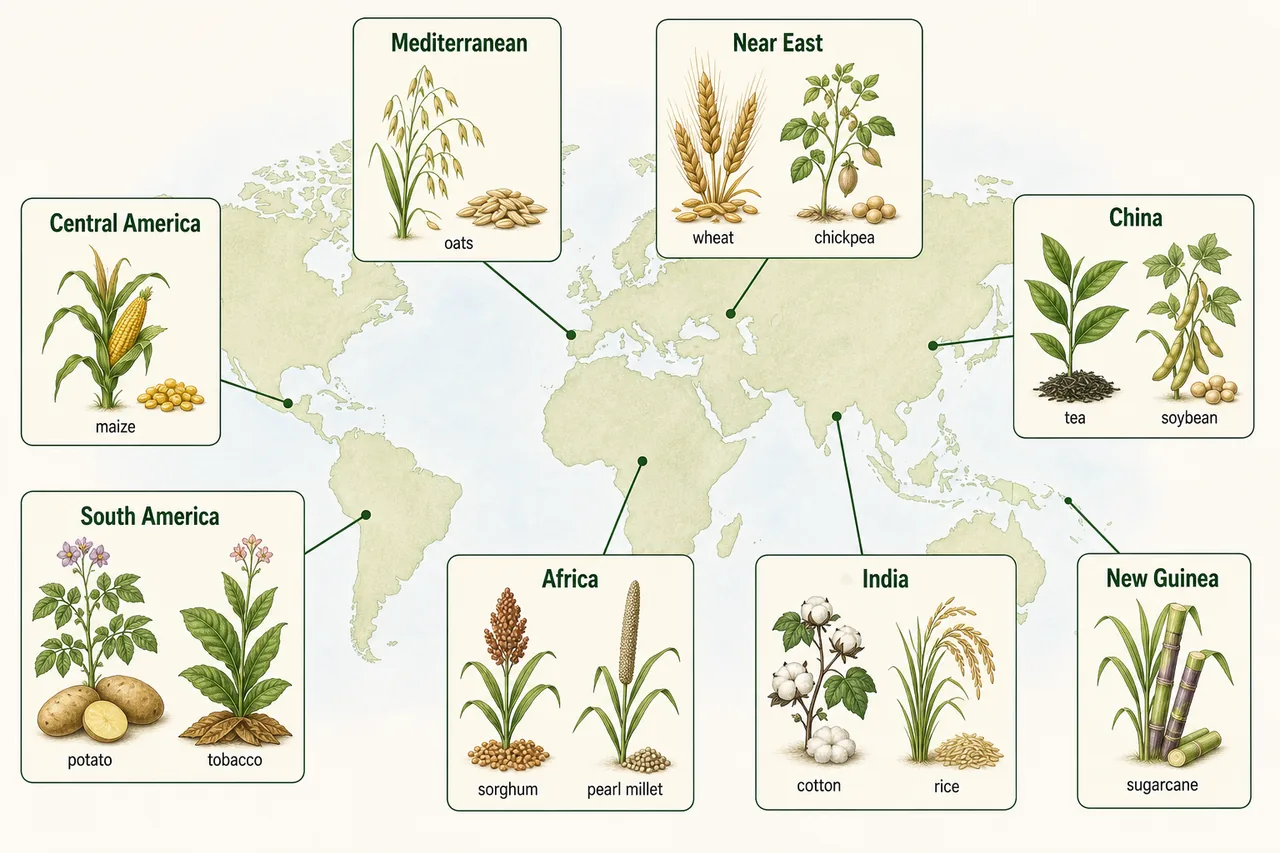
Quick-Reference: Crop → Origin
| Origin | Key Crops |
|---|---|
| India | Cotton (G. arboreum), Brinjal, Moong (Green gram), Finger Millet (Ragi), Rice (primary), Sugarcane, Jute, Mango, Turmeric, Pepper |
| Africa (Ethiopia) | Bajra (Pearl millet), Jowar (Sorghum), Cowpea, Arhar (Pigeon pea), Coffee, Castor |
| China | Tea, Soybean, Mustard, Buckwheat, Foxtail millet |
| South East Asia | Rice (secondary), Barley |
| South West Asia / Near East | Wheat, Gram (Chickpea), Lentil, Pea, Alfalfa |
| Mexico / Central America | Maize, Common bean, Sweet potato |
| South America | Potato (Peru), Groundnut (Brazil), Tobacco, Tomato, Rubber |
| New Guinea | Sugarcane (S. officinarum) |
| Mediterranean | Oats, Beet, Cabbage, Berseem |
TIP
Exam shortcut: Group by region. India = Cotton, Brinjal, Moong, Ragi. Africa = Bajra, Jowar, Cowpea, Arhar. China = Tea, Soybean, Mustard. Americas = Maize, Potato, Groundnut, Tobacco. New Guinea = Sugarcane.
Law of homologous series
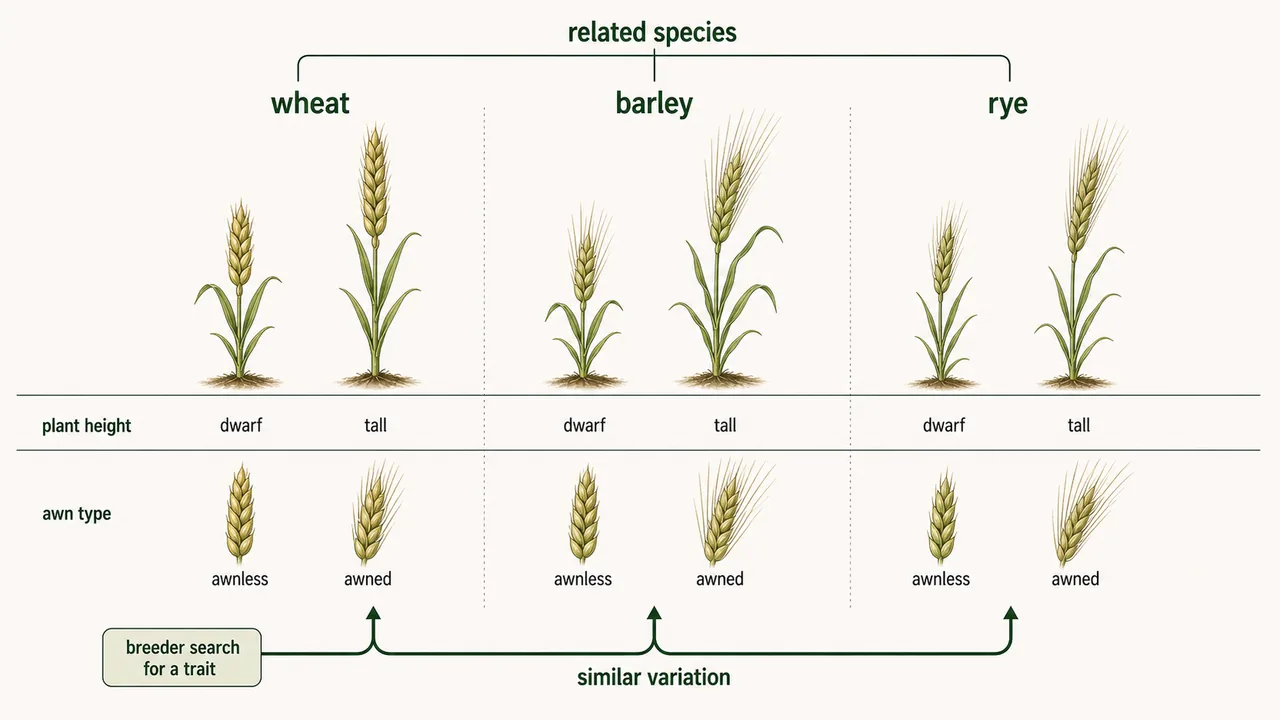
- The concept of parallel variation also known as law of homologous series of variation was developed by Vavilov (1951) based on his study of crop diversity and centres of origin. This law is one of the most significant contributions to our understanding of crop evolution and genetic diversity.
TIP
Think of the law of homologous series like "genetic cousins" -- if you find a trait in wheat, chances are you will find a similar trait in its relatives like barley or rye. This principle guides breeders on where to look for desired traits.
- Law of homologous series states that a particular variation observed in a crop species is also expected to be available in its related species. In simpler terms, if a certain trait -- such as dwarfness or disease resistance -- is found in one species, a similar variation is likely to exist in closely related species as well.
- For instance, if we get dwarf collections in one species of a crop, the same may be observed in another related species also. This predictability helps plant breeders search for specific traits in the right places.
- Vavilov used principle of homologous series of variation as a clue for discovering similar characters in related species. This law has been an invaluable guide for breeders and explorers, directing them to look for desired traits in related species when those traits are absent in the primary crop species.
Summary Cheat Sheet
| Concept / Topic | Key Details |
|---|---|
| Centre of origin concept | N.I. Vavilov (1926) — Russian geneticist |
| Original centres | 8 centres (later expanded to 12) |
| Centre of origin = | Region of maximum diversity of a crop species |
| Primary centre | Where crop was first domesticated |
| Secondary centre | Region of later diversification (e.g., via migration) |
| Law of Homologous Series | Related species show parallel variation (Vavilov) |
| Centre I: China | Soybean, rice (secondary), millet, buckwheat |
| Centre II: India | Rice (primary), sugarcane, mango, jute, cotton |
| Centre III: Central Asia | Wheat, pea, lentil, flax, hemp |
| Centre IV: Near East | Wheat (secondary), barley, rye, alfalfa, fig |
| Centre V: Mediterranean | Oats, beet, cabbage, clover, olive |
| Centre VI: Ethiopia | Sorghum, coffee, castor, finger millet |
| Centre VII: Mexico-Central America | Maize, common bean, sweet potato, cotton |
| Centre VIII: South America | Potato, tomato, groundnut, tobacco, rubber |
| Importance for breeding | Centres are sources of genetic diversity and resistance genes |
| India is centre for | Rice, sugarcane, jute, mango, turmeric, pepper |