🙅🏼♂️ Hybridisation: Procedure, Types, and Variety Development
Understand hybridisation procedure (emasculation, pollination), types of crosses, and development of synthetic, composite, and multiline varieties — with agricultural examples.
Why Hybridisation Is the Most Important Breeding Method
Almost every modern crop variety in India — from the semi-dwarf wheat varieties of the Green Revolution to today's hybrid rice and Bt cotton hybrids — was developed through hybridisation at some stage. The process of crossing two genetically different parents to combine their desirable traits is the single most powerful tool in a breeder's toolkit. This lesson covers the complete procedure from emasculation to variety release.
Hybridization
NOTE
Hybridization is the most common method of crop improvement today. Almost all modern crop varieties have been developed through hybridization at some stage. This lesson covers the complete procedure, types of crosses, and different variety types.
- The mating or Crossing of two plants or lines of dissimilar genotype is known as hybridization. In plants, crossing is done by placing pollen grains from one genotype i.e. male parent, on the stigma of flowers of other genotype i.e. female parent. It is essential to prevent self-pollination as well as chance cross-pollination in the flowers of female parent used for crossing.
- The seeds as well as progenies resulting from hybridization are called hybrid or F1. The F1 generation combines genetic material from both parents and is typically heterozygous at many loci.
- The progeny of F1 obtained from selfing or intermating of F1 plants, and the subsequent generations are known as segregating generations. In these generations, the alleles contributed by the two parents recombine, producing a wide range of genotypes among the progeny.
- The term 'Cross' is often used to denote the products of hybridization i.e. F1 & segregating generations.
- Metaxenia: The effect of pollen on the maternal tissue of the fruit i.e. the pollination effect on the same generation is called Metaxenia. The term is classically linked with T. Swingle, and standard examples include date palm and some cucurbits. This is distinct from xenia, where pollen influences the embryo or endosperm tissues.
- Sexuality: Reproductive parts of the plant were firstly reported by N. Grew in 1682.
- Sexual reproduction in the plant was first time described by R. Camerarius in 1694
- Camerarius also produced a hybrid between two different plant species, for the first time.
- However, in 1717, T. Fairchild produced a hybrid having characteristics of both parents popularly called "Fairchild's mule".
- The mammalian egg was discovered by Von Baer in 1928.
- Today hybridization is the most common method of crop improvement.
- Objective: The main objective of hybridization is to create genetic variation. By combining genes from different parents, breeders generate new allelic combinations that may not exist naturally.
- The aim of hybridization may be transfer of one or few qualitative characters, improvement of one or more qualitative character, or use of the F1 as a hybrid variety.
- Combination Breeding: The transfer of one or more characters from other varieties into a single variety is known as combination breeding. Development of disease resistance is the example of combination breeding. Here, the goal is to combine the best traits of different parents into a single superior genotype.
- Transgressive Breeding: Transgressive segregation means production of plants in F2 generation which are superior to both the parents for one or more characters. The breeding for improving yield or its contributing characters through transgressive segregation is called Transgressive breeding. This occurs when favorable alleles from both parents come together in the same individual.
- Hybrid Varieties: In most self-pollinated crops, F1 is more vigorous and higher yielding than the parents. F1 is used directly as a variety.
Types of hybridization
👉🏻 On the basis of taxonomic relationships of the two parents, hybridization is of two types. Intervarietal & Distant hybridization.
Pro Content Locked
Upgrade to Pro to access this lesson and all other premium content.
Charged once for one year · ₹1188 total
Save ₹100/month vs ₹2388/year launch price
- All Agriculture & Banking Courses
- AI Lesson Questions (100/day)
- AI Doubt Solver (50/day)
- Glows & Grows Feedback (30/day)
- AI Section Quiz (20/day)
- 22-Language Translation (100/day)
- Recall Questions (20/day)
- AI Quiz (15/day)
- AI Quiz Paper Analysis (100/day)
- AI Step-by-Step Explanations (100/day)
- Spaced Repetition Recall (FSRS)
- AI Tutor
- Immersive Text Questions
- Audio Lessons — Hindi & English
- Mock Tests & Previous Year Papers
- Summary & Mind Maps
- XP, Levels, Leaderboard & Badges
- Generate New Classrooms
- Voice AI Teacher (AgriDots Live)
- AI Revision Assistant
- Knowledge Gap Analysis
- Interactive Revision (LangGraph)
🔒 Secure one-time yearly payment via Razorpay · No hidden fees
Why Hybridisation Is the Most Important Breeding Method
Almost every modern crop variety in India — from the semi-dwarf wheat varieties of the Green Revolution to today's hybrid rice and Bt cotton hybrids — was developed through hybridisation at some stage. The process of crossing two genetically different parents to combine their desirable traits is the single most powerful tool in a breeder's toolkit. This lesson covers the complete procedure from emasculation to variety release.
Hybridization
NOTE
Hybridization is the most common method of crop improvement today. Almost all modern crop varieties have been developed through hybridization at some stage. This lesson covers the complete procedure, types of crosses, and different variety types.
- The mating or Crossing of two plants or lines of dissimilar genotype is known as hybridization. In plants, crossing is done by placing pollen grains from one genotype i.e. male parent, on the stigma of flowers of other genotype i.e. female parent. It is essential to prevent self-pollination as well as chance cross-pollination in the flowers of female parent used for crossing.
- The seeds as well as progenies resulting from hybridization are called hybrid or F1. The F1 generation combines genetic material from both parents and is typically heterozygous at many loci.
- The progeny of F1 obtained from selfing or intermating of F1 plants, and the subsequent generations are known as segregating generations. In these generations, the alleles contributed by the two parents recombine, producing a wide range of genotypes among the progeny.
- The term 'Cross' is often used to denote the products of hybridization i.e. F1 & segregating generations.
- Metaxenia: The effect of pollen on the maternal tissue of the fruit i.e. the pollination effect on the same generation is called Metaxenia. The term is classically linked with T. Swingle, and standard examples include date palm and some cucurbits. This is distinct from xenia, where pollen influences the embryo or endosperm tissues.
- Sexuality: Reproductive parts of the plant were firstly reported by N. Grew in 1682.
- Sexual reproduction in the plant was first time described by R. Camerarius in 1694
- Camerarius also produced a hybrid between two different plant species, for the first time.
- However, in 1717, T. Fairchild produced a hybrid having characteristics of both parents popularly called "Fairchild's mule".
- The mammalian egg was discovered by Von Baer in 1928.
- Today hybridization is the most common method of crop improvement.
- Objective: The main objective of hybridization is to create genetic variation. By combining genes from different parents, breeders generate new allelic combinations that may not exist naturally.
- The aim of hybridization may be transfer of one or few qualitative characters, improvement of one or more qualitative character, or use of the F1 as a hybrid variety.
- Combination Breeding: The transfer of one or more characters from other varieties into a single variety is known as combination breeding. Development of disease resistance is the example of combination breeding. Here, the goal is to combine the best traits of different parents into a single superior genotype.
- Transgressive Breeding: Transgressive segregation means production of plants in F2 generation which are superior to both the parents for one or more characters. The breeding for improving yield or its contributing characters through transgressive segregation is called Transgressive breeding. This occurs when favorable alleles from both parents come together in the same individual.
- Hybrid Varieties: In most self-pollinated crops, F1 is more vigorous and higher yielding than the parents. F1 is used directly as a variety.
Types of hybridization
👉🏻 On the basis of taxonomic relationships of the two parents, hybridization is of two types. Intervarietal & Distant hybridization.
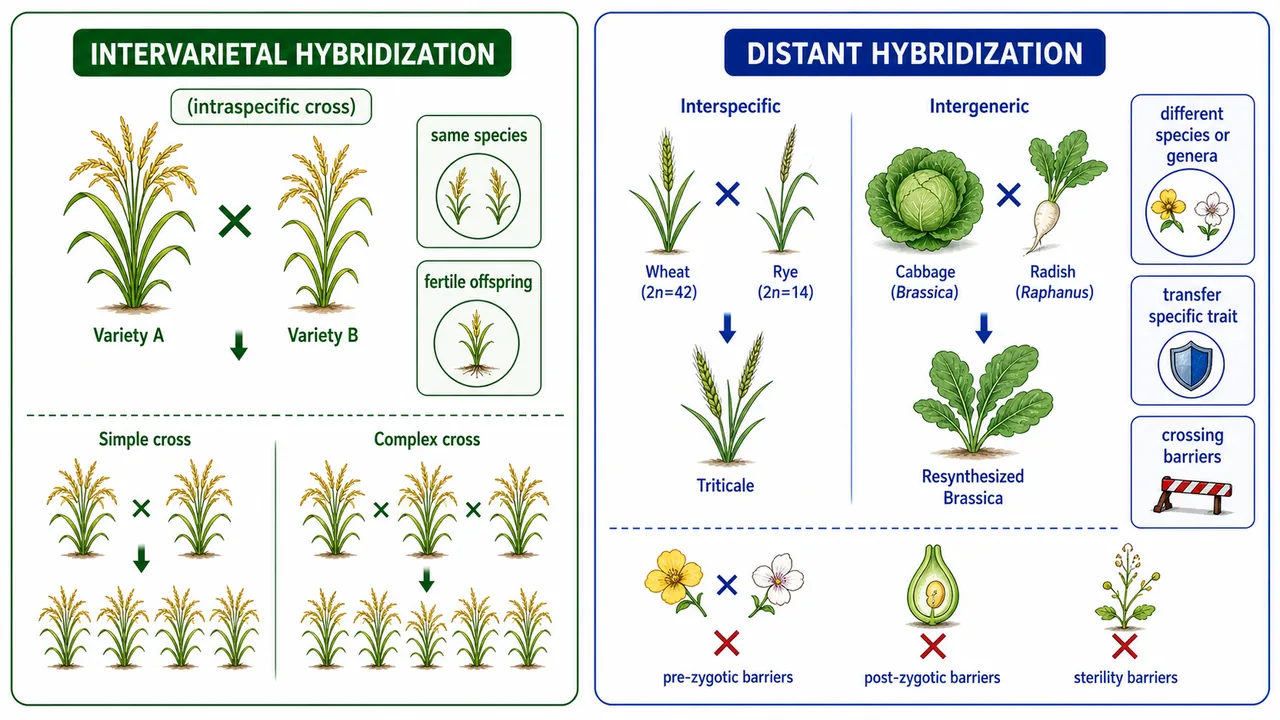
Intervarietal hybridization
-
Parents are of the same species i.e. maybe two strains, varieties or races of the same species. This is also known as intraspecific hybridization.
-
Infra - specific means within species.
-
Inter - specific means two different species.
-
Intervarietal means two different varieties (like inter - cast marriage).
-
Intervarietal hybridization is the most commonly used in the crop improvement programme because it produces fertile offspring with minimal crossing barriers.
-
Intervarietal crosses may be simple or complex:
- Simple cross: Here two parents are crossed to produce the F1. F1 is selfed to produce F2 or is used in a backcross programme E.g.

Simple cross — two parents crossed to produce F1; F1 selfed to give F2 or used in backcross; contrasted with complex cross involving more than two parents - Complex cross: Here > 2 parents (more than two parents) are crossed to produce F1 which is used to Produce or is used in a backcross programme. Such cross is used in converging the genes i.e. bringing the genes from several parents into a single hybrid. Therefore complex cross is also called Convergent Cross.
- When F1 from a simple cross is crossed to a third parent, it is called Three Way Cross or F1 top cross.
- When F1s from two single crossed are mated together, the cross is called Double Cross.
Distant hybridization
- Here crosses are made between different species of the same genus or of different genera.
- Interspecific cross means the cross, between two different species of the same genus E.g.
Gossypium arborium x Gossypium hirsutum.
- Intergeneric cross means the cross between two different genera. E.g.
Triticum turgicium x Secale cereale (Rye) → Triticale hexaploide
- Generally distant hybridization is made to transfer one or few simply inherited characters like disease resistance to a crop species. Many modern sugarcane cultivars, for example, trace back to wide crossing among Saccharum officinarum, S. spontaneum, and related canes.
- The major barriers in distant hybridization can be viewed in a simple sequence:
- Cross incompatibility — failure of functional pollen from one species or genus to achieve fertilization in the female parent of another.
- Hybrid inviability — fertilization may occur, but the zygote or embryo fails to develop properly.
- Hybrid sterility — the hybrid survives but cannot produce normal fertile gametes, usually because chromosome pairing is irregular.
- Because of these barriers, wide crosses often need supporting techniques such as embryo culture to rescue weak hybrids or protoplast fusion when normal sexual crossing is not feasible.
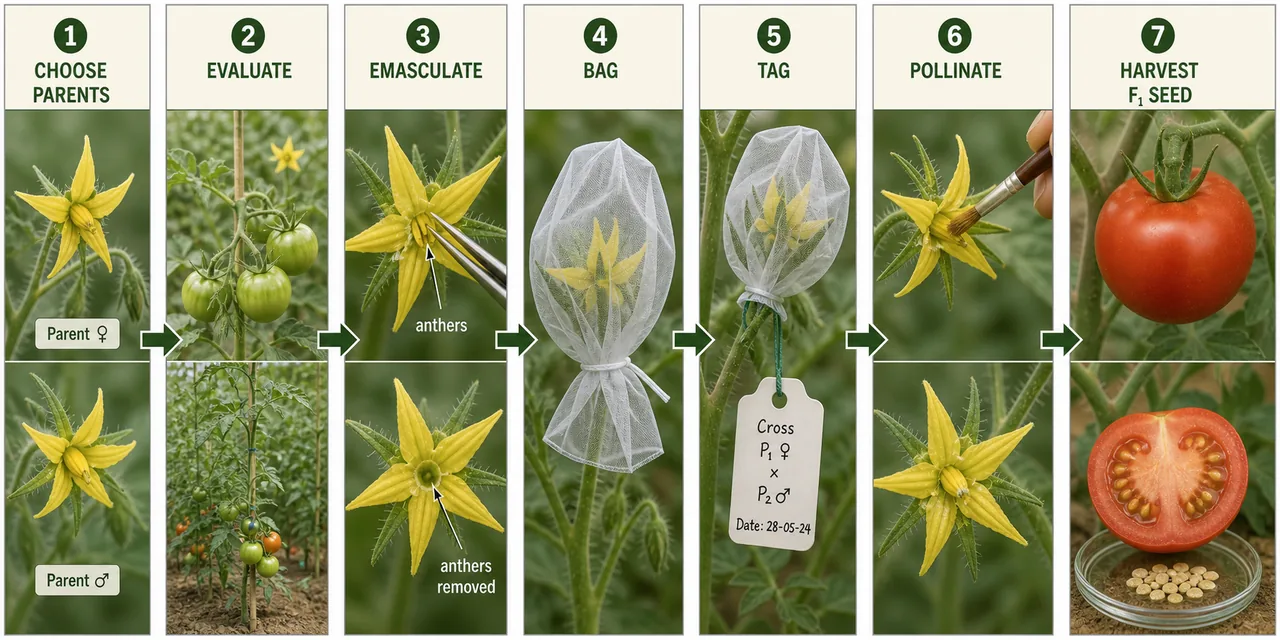
👉🏻 Procedure of Hybridization: There are 7 steps involved in hybridization:
- Choice of parents
- Evaluation of parents
- Emasculation
- Bagging
- Tagging
- Pollination
- Harvesting and storage of F1 seed
TIP
Remember the 7 steps with: "Choose, Evaluate, Emasculate, Bag, Tag, Pollinate, Harvest" -- the sequence must be followed precisely for successful hybridization.
Emasculation
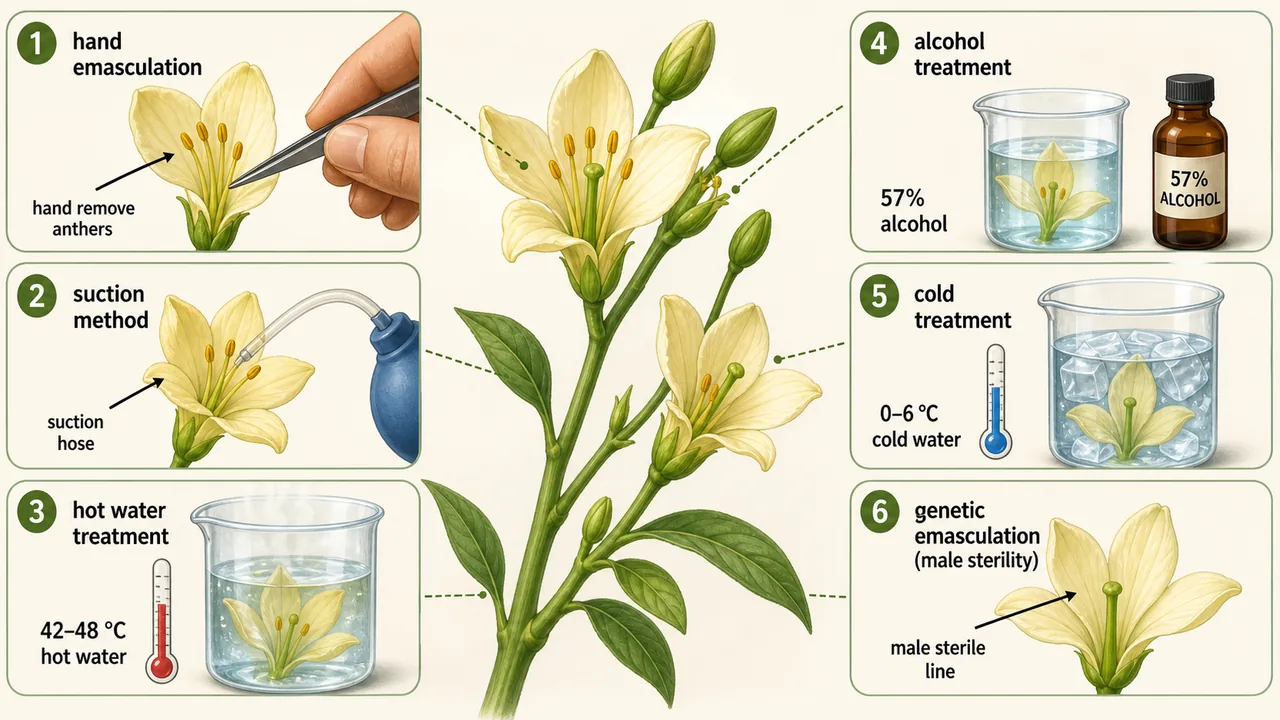
- Removal of stamens or anthers or killing the pollen grains of a flower without affecting the female reproductive organs is known as emasculation.
- Emasculation = E (means removal) + masculation (means masculine)
- Emasculation is the removal of masculinity.
- Purpose of Emasculation: To prevent self-fertilization in the flowers of the female parent. Without emasculation, the flower would self-pollinate before the desired pollen could be applied.
- In dioecious plants, male plants are removed.
- In monoecious plants, male Flowers (in castor) or male inflorescences (in maize) are removed.
- Emasculation is essential in bisexual flowers.
Techniques
- a) Hand emasculation: Hand emasculation is generally done
- in the evening between 4 pm to 6 pm.
- one day before the anthers are expected to dehisce or mature, and
- the stigma is like to become fully receptive.
- b) Suction method: useful in species with small flowers. Emasculation is done in the morning just before or immediately after opening of the flower. Here suction hose is used to suck the anthers.
- c) Hot water Emasculation: In jowar (S. bicolor) treatment of flower with water at 42-48 degrees C for 10 minutes and in rice (O. sativa), 10 minutes treatment with water at 40-44 degrees C, kill the pollen grains. Hot water treatment is given before anther's dehiscence and prior to opening of flowers.
- d) Alcohol treatment: It is not a common method. In Sweet clover, immersion of the inflorescence in 57% alcohol for 10 seconds was highly effective.
- e) Cold treatment: In rice cold water treatment at 0-6 degrees C kills the pollen grains without affecting gynoecium. Exposure of wheat plant at 0-2 degrees C for 15-24 hours kills the pollen grains.
- f) Genetic emasculation: Genetic or cytoplasmic male sterility may be used. This method is preferred for large-scale hybrid seed production because it eliminates the labour-intensive process of manual emasculation.
Tagging
- A tag having the following information written with a carbon pencil is attached:
- Date of emasculation
- Date of pollination rent
- Name of the male & female parents. The name of the female parent is written first. E.g. A x B. Here A is female parent and B is the male parent.
Pollination
- To bring about fertilization, mature, freshly and viable pollen should be placed on a receptive stigma.
- The pollination procedure consists of collecting pollens from freshly dehisced anther and dusting these pollens on the stigma of the emasculated flowers.
- Production of hybrid seed by hand pollination is commercially feasible in crops like tomato, brinjal & tobacco because each fruit produces a large no. of seeds.
- Cornerstones of hybridization
- Prevention of self-pollination in the flowers of parent is achieved through emasculation of the flowers.
- Prevention of pollination of the flowers of female parent by pollen from undefined sources is achieved through bagging of flowers.
- Ensuring pollination by the selected male parent i.e. prevention of contamination of the pollen used for pollination in a crop like maize is achieved through Hand pollination (Bagging of the male inflorescence)
Somatic Hybridization
- Development of hybrid plants through the fusion of somatic protoplasts of two different plant species/varieties is called somatic hybridization. This technique is particularly valuable when two species cannot be crossed through conventional sexual hybridization due to pre- or post-zygotic barriers.
- This is a non-conventional genetic procedure involving fusion between isolated protoplast under in vitro condition and subsequent development of their product (heterokaryon) to a hybrid plant. The resulting hybrid contains the complete nuclear genomes of both parents.

Example: Pomato = Potato + Tomato

The breeding methods commonly used in cross-pollinated crops
Population Improvement
- Population improvement was the earliest breeding method applied to cross-pollinated crops. The focus is on improving the gene frequency of desirable alleles in the entire population rather than developing a single superior genotype.
- Cross pollinated crops generally show moderate to severe inbreeding depression. Therefore, inbreeding must be avoided or kept to minimum in cross pollinated species.
- In cross pollinated species the genotype of the individual plants is generally of little importance particularly in population improvement. Here value of population is determined by the frequency of desirable genes or alleles in the population as a whole.
- Population improvement methods are grouped into two general classes.
- Without progeny testing: Plants are selected on the basis of their Phenotype and no progeny testing is carried out e.g. mass selection.
- With progeny testing: Plants are initially selected on the basis of their phenotype but final selection is one on progeny testing i.e. progeny selection (ear to row method) & recurrent selection
- Mass Selection: Oldest breeding method for cross pollinated crops. Here a no. of plants are selected on the basis of their phenotypes and open-pollinated seeds from them are bulked together to grow the next generation. No progeny test is conducted. Mass selection is based on the maternal parent only and there is no control on the pollen (male) parent. The same mass selection of self-pollinated crops is applied to the cross pollinated crops.
- Progeny Selection: The Simplest form of progeny selection is Ear to Row Method which has been extensively used in maize. This method was developed by Hopkins in 1908. Here a no. of plants (50-100) are selected on the basis of their superior phenotypes and are allowed to open pollinate. Seeds from individual plants are harvested separately. A single-row of 10-50 plants i.e. progeny row is grown from each selected plant. The progeny rows are evaluated for desirable characters and superior progenies are identified. Several phenotypically superior plants are selected and are allowed to open pollinate. Small progeny rows (10-15 plants) are grown from the selected plants and the process is repeated one or more times and then yield trials are done.
- Recurrent Selection (RS): The idea of recurrent selection was first suggested by Hayes and Garber in 1919 and independently by East & Jones in 1920. Hull suggested that recurrent selection may be useful in improving specific combining ability.
- In cross-pollinated population, a no. of plants are selected on the basis of phenotype or progeny test and are self-pollinated. The progenies obtained are intercrossed in all possible combinations by hand. Equal amount of seed from each cross is composited to produce next generation.
- General combining ability (GCA): GCA is the average performance of a strain in a series of cross combinations. GCA is estimated from the performance of F1s from the crosses. A high GCA value indicates that the parent contributes favorable additive genetic effects.
- Specific combining Ability (SCA): SCA is the deviation in performance of a cross combination from that predicted on the basis of GCAs of the parents involved in the cross. SCA reflects non-additive gene action (dominance and epistasis).
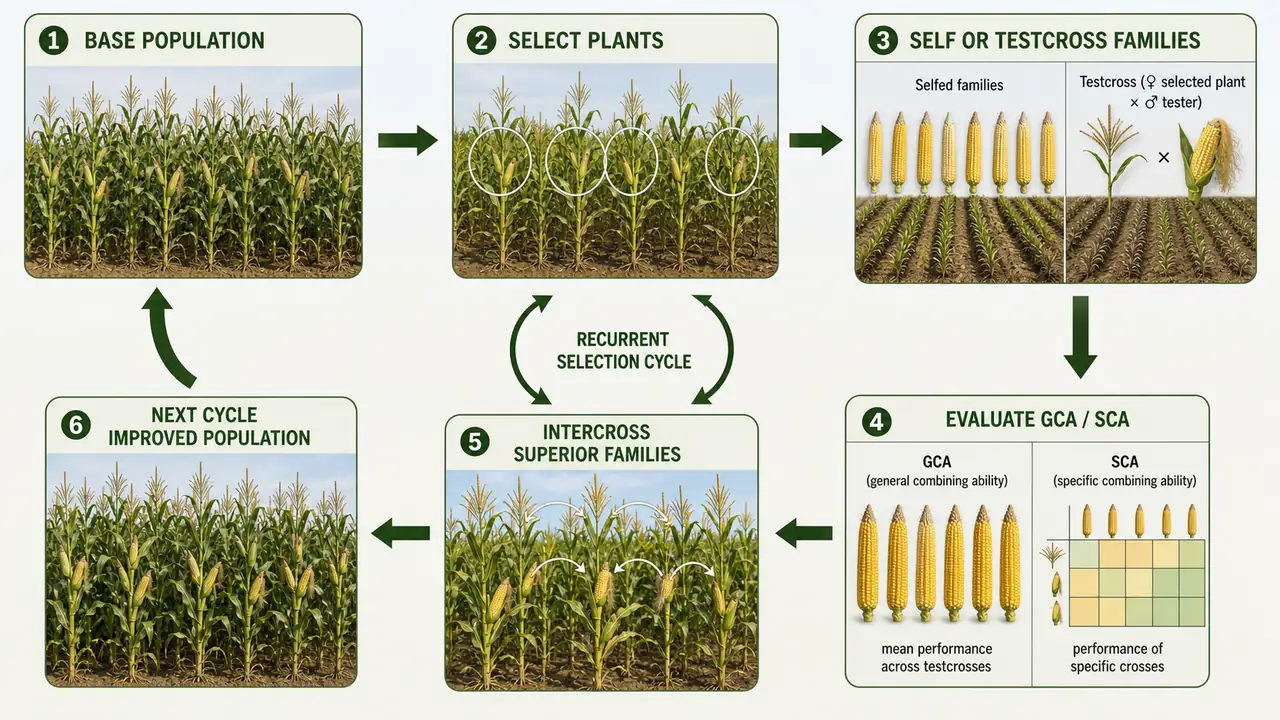
- Recurrent selection is based on progeny tests and rigid control on pollination. The seeds for progeny tests are obtained:
- by selling (i.e. Simple recurrent selection) or by crossing
- to a tester with broad genetic base (i.e. recurrent selection for GCA)
- or to an inbred (i.e. recurrent selection for SCA)
- In Reciprocal Recurrent Selection (RRS) two sources of populations are used as testers for each other. This approach simultaneously improves both GCA and SCA.
- Theoretically, in almost all practical situations, Reciprocal Recurrent selection (RRS) may be expected to be superior to recurrent selection for GCA (RSGCA) and Recurrent selection for SCA (RSSCA).
Hybrids
- Hybrid varieties are the first generations (F1) from crosses between two purelines, inbreeds, open - pollinated varieties, clones or other populations that are genetically dissimilar. The key advantage of hybrid varieties is that they exploit heterosis to produce yields significantly higher than either parent.
- Inbred: An inbred is a nearly homozygous line developed by continued inbreeding usually selfing, accompanied by selection in a cross-pollinated crop.
- Sister inbred: The inbreds which have 50% or more genetic commonality.
- Single cross: When two inbreds, A & B are crossed to produce the hybrid (A x B), it is called single cross. Single crosses show the maximum heterosis but produce less seed because inbred parents have reduced vigour.
- Double cross: When two single crosses i.e. (A x B) and (C x D) are crossed to produce the hybrid (A x B) x (C x D); it is called double cross. It means double cross involves four inbreeds crosses. i.e., A, B, C, D which are first crossed to produce two single cross.
- Top cross/Inbreed-variety cross: When an inbreed is crossed with an open-pollinated variety, it is known as top cross or inbreed variety cross.
- The purpose of top cross is to estimate GCA (general combining ability), of the plants or lines crossed with open pollinated variety. When the cross is made to assess combining ability, it is known as test cross. The common parent used in test cross is known as tester and the progenies obtained from these crosses are called test cross progenies.
- Poly cross: Means open-pollination (Assumed to be random mating) in isolation among a number of selected genotypes.
- Polycross is the progeny of a line produced through random pollination by a number of selected lines.
- Population cross/varietal cross: The cross between two open pollinated varieties is known as population cross or varietal cross.

- Hybrid varieties were first commercially exploited in maize. The greatest use of hybrid varieties has been made in maize.
- Four hybrids of maize i.e., Ganga 1, Ganga 101, Ranjit & Deccan were released in 1961 in India. All were double crosses. Production of double cross in maize was first suggested by Jones.
- Ganga Safed-2 is a double top cross variety of maize.
- In India first hybrid variety of Jowar (S. bicolor) was Coordinated Sorghum Hybrid CSH 1 (released in 1964) by using Cytoplasmic Genetic Male Sterility (CGMS) of Combine Kafir 60 as female parent.
- In India First hybrid variety of Pearl Millet (P. americanum) was Hybrid Bajra HB 1 (released in 1965) by using Cytoplasmic Genetic Male Sterility of Tift 23 A (Introduced from Tifton, Georgia, USA as female parent). HB 1 is the Single Cross.
- ICRISAT developed the world's first commercial pigeonpea hybrid, ICPH 8 (Prabhat), released in 1991 using a genetic male sterility (GMS) system.
- In India Hybrid Cotton is produced by hand pollination.
- Hybrid Cotton: India is the first country to exploit hybrid vigour commercially in cotton. All the hybrid varieties have been developed in the tetraploid cottons.
- Gregg-99 is a male sterile line used in cotton.
- H 4 was the first hybrid variety of cotton developed by Gujarat Agriculture University (Surat station) and released in 1970.
- Intraspecific Hybrid Cotton: by crossing two different strains of G. hirsutum i.e.,
G. hirsutum x G. hirsutum
- H4 (Hybrid-4)
- H6
- Godavari
- Interspecific Hybrid Cotton: by crossing one strain of G. hirsutum with a strain of G. barbadense. i.e.
G. hirsutum x G. barbadense
- Varalaxmi: Was the first interspecific hybrid variety (cotton) developed by University of Agricultural Sciences (Dharward Station) and released in 1972.
- Jaylaxmi
Hybrid Rice in India
- A Cytoplasmic Male Sterile (CMS) line of rice was first developed in 1972 by Athwal & Birmani by transferring the nuclear genotype of Indica rice variety Pankhari 203 into the cytoplasm of another indica variety TN-1.
- The CMS-WA (Wild Abortive) cytoplasm was identified. In a population of wild rice (O. sativa f. spontanea) in the year 1970 in China.
- The CMS-WA leads to pollen abortion and is presently used in 95% of the CMS lines used for hybrid rice production. First hybrid rice APHR-1 was released in 1994.
- Other hybrid rice varieties: APHR-2, MGR-1, KRH-1, CNHR-3, DRRH-1.
- A basmati hybrid rice named Pusa Rice Hybrid 10 (PRH-10) was developed at IARI, New Delhi.
- Commercial hybrid varieties are either single crosses or double crosses. Single cross hybrid varieties are common in Pearl Millet, Sorghum, Cotton, Rice and in Maize (in U.S.A.).
- Double cross varieties are common in Maize in India.
- The largest number of hybrid varieties have been developed in Pearl Millet & Sorghum (Maize stands second).
- The predicted performance of any double cross is the average performance of the four non-parental single crosses involving the four parental inbreds e.g. performance of double cross (A x B) x (C x D) would be the average of performance of the single crosses A x C, A x D, B x C and B x D, since these single crosses are not involved in producing the concerned double cross. This method was developed by Jenkins (1934).
- Two requirements of commercial hybrid seed production:
- Easy emasculation of the female parent.
- Effective pollen dispersal from male parent to ensure a satisfactory seed set in female parent.
- Hybrid seed may be produced by:
- Cytoplasmic Genetic Male Sterility (CGMS) -- the most commonly used system globally
- Cytoplasmic Male Sterility (CMS)
- Genetic Male Sterility (GMS)
- Self-Incompatibility (SI)
- Manual Emasculation and/or Pollination
Synthetic Varieties
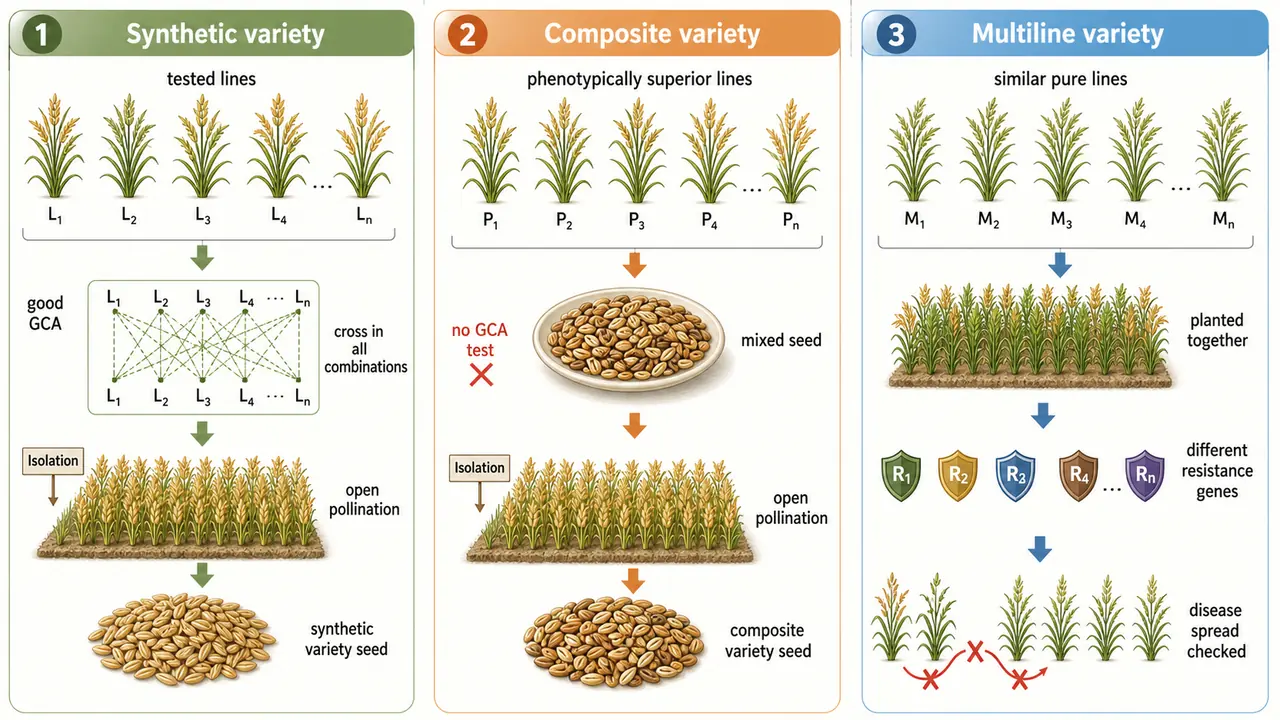
- Synthetic variety is produced by crossing in all combinations a number of lines that combine well with each other. The key feature is that only lines with proven good combining ability are selected for synthesis.
- Once synthesized, a synthetic is maintained by open pollination in isolation.
- The lines used to produce a synthetic variety are tested for combining ability with each other. Therefore, the yield of synthetic varieties can be predicted in advance using mathematical formulae based on the performance of component lines.
- GCA is generally estimated by top cross or poly cross test.
Composite Varieties
- Composite variety is produced by mixing seeds of several phenotypically outstanding lines and encouraging open-pollination to produce crosses in all combinations among the mixed lines.
- The lines used to produce a composite variety are rarely tested for combining ability with each other. Therefore the yield of composite varieties cannot be predicted in advance.
- Composites are more popular than the hybrid varities because the seeds produced by a composite variety
- Can be used again as seed for 3 to 4 years.
- Have negligible inbreeding effect
- Make varietal maintenance easy.
- The first six composite varieties in India were released in 1967:
- Six maize composites 👉🏻 Vijay, Kisan, Amber, Jawahar, Vikram & Sona
- Composite is often used as a synonym for synthetic but is not entirely accurate. The main distinction is that synthetics use lines tested for combining ability while composites rely on phenotypic selection alone.
- Like synthetics, composites are commercial varieties and are maintained by open-pollination in isolation.

- Germplasm Complexes are produced by mixing seed from several lines or populations of diverse genetic origins.
- The objective of germplasm complexes is to serve as reservoirs of germplasm. Such complexes are experimental populations and not commercial varieties.
- The possibility of commercial utilization of synthetic varieties in maize was first suggested by Hayes & Garber in 1912.
- Synthetic varieties have been of great value in breeding of those cross pollinated crops where pollination control is difficult e.g. forage crops, many clonal crops like cacao, alfalfa, clovers etc. The programme at CIMMYT, Mexico & Pearl millet breeding Programme at ICRISAT, Hyderabad are based on synthetic varieties.
- The performance of synthetic 2 (Syn2) is expected to be lower than that of Syn1 due to decrease in heterozygosity due to random mating. However, there would be no further decline in subsequent generations produced by open-pollination (Syn3, Syn4 etc.) because the zygotic equilibrium for any gene is reached after one generation of random mating.
- The performance of synthetic varieties is usually lower than the best single or double cross hybrid because synthetics exploit only GCA while hybrid varieties exploit both GCA & SCA (General Combining ability & Specific Combining ability).
Advantages of synthetic varieties:
- Synthetic varieties are practically feasible means of exploiting heterosis in species where pollination control is difficult.
- Seed production is simpler & cheaper.
- Farmer can save his own seed. Synthetics can be maintained for several years from open pollinated seed.
- Synthetics serve as good reservoirs of genetic variability.
- Synthetics may be expected to perform better than hybrids in a variable environment because synthetics have wide genetic base in comparison to that of hybrid varieties.
Multiline Varieties
- Multiline varieties are mixtures of several pure lines of similar height, flowering & maturity dates, seed colour & agronomic characteristics but they have different genes for disease resistance. This genetic diversity for resistance genes acts as a built-in protection system -- even if one component line is attacked by a particular pathogen race, the other lines remain unaffected, thereby limiting the spread of disease.
- The idea of multiline varieties was put forward by Jenson in 1952 for use in cereals.
- In stricter breeding language, multilines are often described as mixtures of closely similar isogenic lines, meaning the component lines are nearly identical except for the resistance genes being diversified.
- In the wheat context, N.E. Borlaug strongly promoted multiline use as a way to improve the durability of disease resistance, especially when many component lines are used together.
Hybrid Development: Key Decisions and Exam Essentials
How hybrid varieties are made — the complete chain:
| Step | What Happens | Key Requirement | If This Fails... |
|---|---|---|---|
| 1. Develop inbred lines | Self for 6-7 generations until homozygous | Large genetic base; many initial lines | Narrow base → weak inbreds → poor hybrids |
| 2. Test combining ability | Cross inbreds in all combinations; evaluate F1 yield | GCA (general) and SCA (specific) testing | Poor GCA = useless parent even if good per se |
| 3. Identify male sterility system | CMS, GMS, or chemical hybridising agents | Reliable pollen sterility in female parent | Without it, hand emasculation = uneconomic at scale |
| 4. Produce F1 seed | Cross A-line (CMS) × R-line (restorer) in isolation | Spatial or temporal isolation; sufficient pollinator rows | Contamination → impure F1 → no heterosis |
| 5. Release & sell | F1 seed to farmers; new seed needed each year | Strong seed system + farmer awareness | Farmer saves F2 seed → segregation → yield crash |
Why farmers must buy new hybrid seed every year: F1 is uniform and vigorous (heterosis). F2 (saved seed) segregates — tall/short, early/late, resistant/susceptible plants all mixed. Yield drops 15-30%. This is NOT a company trick — it's genetics. The heterosis that gives high yield exists ONLY in the F1 generation.
Three types of male sterility — exam favourite:
| Type | Genetic Basis | Restoration | Main Use |
|---|---|---|---|
| CMS (Cytoplasmic) | Mitochondrial gene (S cytoplasm) | Restorer (Rf) gene in R-line | Most commercial hybrids (rice, bajra, cotton, sorghum) |
| GMS (Genetic) | Nuclear recessive gene | Segregates 1:1 sterile:fertile | Limited commercial use (difficult seed production) |
| CGMS (Cytoplasmic-Genetic) | Interaction of cytoplasmic + nuclear genes | Specific Rf genes needed | Most widely used system (3-line system: A, B, R) |
Summary Cheat Sheet
| Concept / Topic | Key Details |
|---|---|
| Hybrid | F1 offspring of cross between genetically different parents |
| Heterosis / Hybrid vigour | F1 superior to both parents; term by Shull (1914) |
| Inbreeding depression | Decreased vigour on selfing; opposite of heterosis |
| Single cross hybrid | A x B; most uniform; highest heterosis |
| Double cross hybrid | (AxB) x (CxD); more stable; used commercially in maize |
| Three-way cross | (AxB) x C; intermediate uniformity |
| Top cross | Inbred x open-pollinated variety; tests GCA |
| GCA (General Combining Ability) | Average performance in crosses; additive gene action |
| SCA (Specific Combining Ability) | Performance in specific cross; non-additive gene action |
| Diallel cross | All possible crosses among a set of parents |
| Line x Tester | Lines crossed with testers to estimate GCA and SCA |
| Hybrid seed production requires | Male sterility or hand emasculation |
| CMS-based hybrid production | 3-line system: A-line, B-line, R-line |
| Commercial hybrids in India | Maize, bajra, jowar, cotton, rice, sunflower |
| Synthetic variety | Intercross of selected inbreds; can be re-synthesized |
| Composite variety | Broad genetic base; mass selection applied |