👨👩👦👦 Mass Selection: Principles, Procedure, and Varieties
Understand the basic principles of selection, mass selection procedure, advantages, limitations, and varieties developed — with agricultural examples and exam tips.
Why Mass Selection Matters in Agriculture
Some of India's most successful traditional crop varieties were developed through mass selection — farmers and breeders simply chose the best-looking plants from a mixed population and saved their seeds. Varieties like SLO 13 (rice) and K122 (potato) were developed this way. Mass selection remains the simplest and most widely used method for improving land races and cross-pollinated crops where genetic variation is naturally high.
- Selection is basic to any crop improvement. It is the process through which breeders identify and retain desirable individuals while discarding those that are inferior.
- Isolation of desirable plant types from the population is known as selection.
- It is one of the two fundamental steps of any breeding programme viz.,
- Creation of variation -- through hybridization, mutation, introduction, or other means
- Selection -- to identify and retain the best genotypes from the variable population
IMPORTANT
Every breeding programme, regardless of the crop or method used, revolves around these two steps: first generate diversity, then pick the best from it.
Pro Content Locked
Upgrade to Pro to access this lesson and all other premium content.
Charged once for one year · ₹1188 total
Save ₹100/month vs ₹2388/year launch price
- All Agriculture & Banking Courses
- AI Lesson Questions (100/day)
- AI Doubt Solver (50/day)
- Glows & Grows Feedback (30/day)
- AI Section Quiz (20/day)
- 22-Language Translation (100/day)
- Recall Questions (20/day)
- AI Quiz (15/day)
- AI Quiz Paper Analysis (100/day)
- AI Step-by-Step Explanations (100/day)
- Spaced Repetition Recall (FSRS)
- AI Tutor
- Immersive Text Questions
- Audio Lessons — Hindi & English
- Mock Tests & Previous Year Papers
- Summary & Mind Maps
- XP, Levels, Leaderboard & Badges
- Generate New Classrooms
- Voice AI Teacher (AgriDots Live)
- AI Revision Assistant
- Knowledge Gap Analysis
- Interactive Revision (LangGraph)
🔒 Secure one-time yearly payment via Razorpay · No hidden fees
Why Mass Selection Matters in Agriculture
Some of India's most successful traditional crop varieties were developed through mass selection — farmers and breeders simply chose the best-looking plants from a mixed population and saved their seeds. Varieties like SLO 13 (rice) and K122 (potato) were developed this way. Mass selection remains the simplest and most widely used method for improving land races and cross-pollinated crops where genetic variation is naturally high.
- Selection is basic to any crop improvement. It is the process through which breeders identify and retain desirable individuals while discarding those that are inferior.
- Isolation of desirable plant types from the population is known as selection.
- It is one of the two fundamental steps of any breeding programme viz.,
- Creation of variation -- through hybridization, mutation, introduction, or other means
- Selection -- to identify and retain the best genotypes from the variable population
IMPORTANT
Every breeding programme, regardless of the crop or method used, revolves around these two steps: first generate diversity, then pick the best from it.
- There are two agencies involved in carrying out selection: One is Nature itself (Natural selection) and the other is artificial selection.
- Though both may complement each other in some cases, they are mostly opposite in direction since their aims are different under the two conditions (nature and domestication). The effectiveness of selection primarily depends upon the degree to which phenotype reflects the genotype.
- The practical rate of genetic improvement from selection depends mainly on three linked factors: heritability of the trait, selection intensity, and generation interval. High heritability, strong but sensible selection pressure, and shorter generation turnover generally make progress faster.
- Before domestication, crop species were subjected to natural selection. The basic for natural selection was adaptation to the prevailing environment. After domestication man has knowingly or unknowingly practiced some selection. Thus crop species under domestication were exposed to both natural and artificial selection i.e. selection by man. For a long period, natural selection played an important role than selection by man. But in modern plant breeding methods natural selection is of little importance and artificial selection plays an important role.
Basic Principles of Selection
👉🏻 Selection has two basic characterics viz
- Selection is effective for heritable differences only. If the differences between plants are caused by the environment rather than genetics, selecting those plants will not produce improved offspring.
- Selection does not create any new variation. It simply identifies and preserves the best genotypes from the existing pool.
👉🏻 It only utilizes the variation already present in a population. The two basic requirements for selection to operate are:
- Variation must be present in the population.
- The variation should be heritable.

Selection intensity
-
Percentage of plants selected, to be advanced to next generation, from a population. Selection intensity (I).
-
It is the amount of selection applied expressed as the proportion of the population favoured (selected). The selection intensity is inversely proportional to the percentage proportion selected (PS), as reflected in the table below. In other words, the fewer individuals you select, the higher the selection intensity -- think of it as being more "strict" in choosing only the very best plants.
Selection Intensity (I) 2.64 2.42 2.06 1.76 1.40 1.16 0.97 0.80 0.34 0 Percentage Selected (PS) 1% 2% 5% 10% 20% 30% 40% 50% 80% 100%
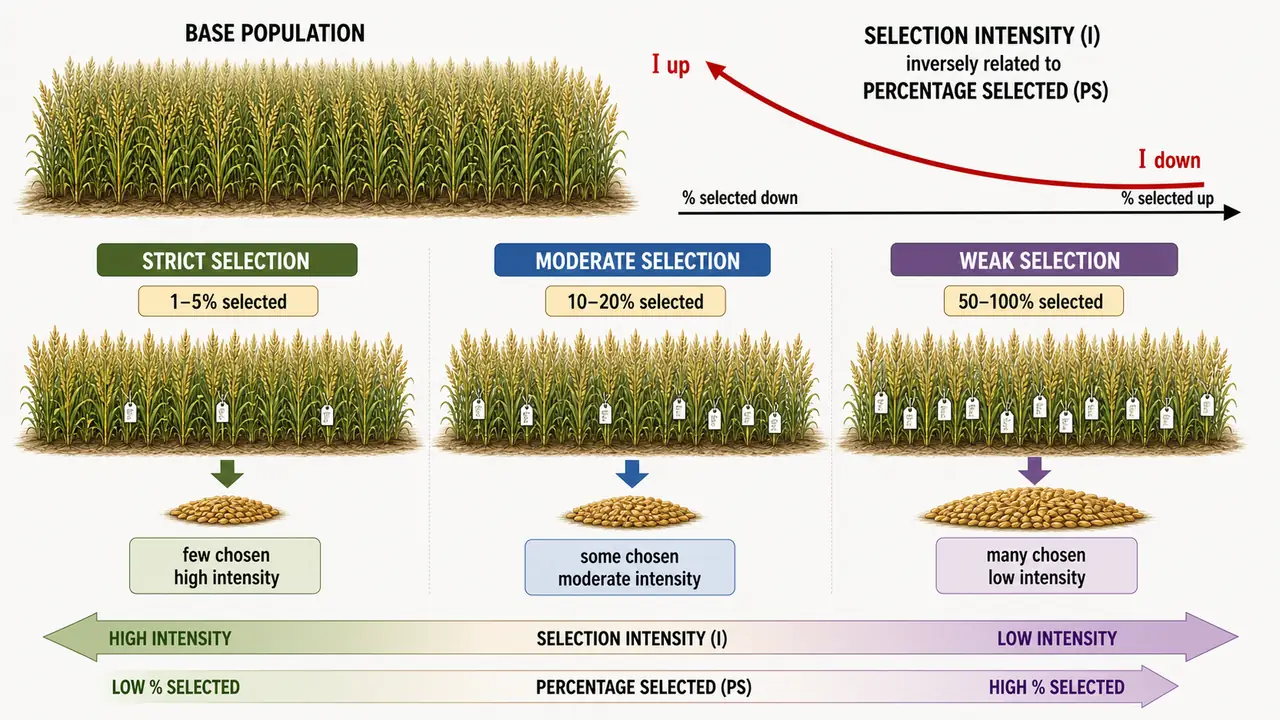
- Thus, larger the size of I, more stringent is the selection pressure (hence low fraction is selected) and vice versa. Then, no selection means all the members of a population are allowed to reproduce (I = 0, PS = 100 %), and zero selection means the whole population is rejected (PS = 0). However, in real selection experiments, as the desired alleles become preponderant after each cycle of selection, I is also changed.
- The I is of the greatest consequence is bringing about changes in the gene frequency under selection. However, since the latter does not mean undue loss of desirable alleles, or undue load of population size, the choice of an arbitrary value of I may be hazardous in a plant breeding programme.
- The small size of I (i.e. low selection pressure) may cause a large population size to be handled in the next generation, which will unnecessarily be taxing on time and resources.
- On the other hand, a large size of I (high selection pressure) might cause allelic erosion due to genetic drift (i.e. changes in gene frequencies due to sampling error, or small sample size under selection in a finite population not due to genetic causes). Therefore, an appropriate level of I should be chosen based upon the range of variability present in the population subjected to selection.
- The I = 2.06 to 1.76 (i.e. around 5-10 per cent of individuals selected) has generally been found appropriate in plant populations.
- However, the limit of selection intensity is set by two factors: (i) population size, and (ii) inbreeding. Under natural selection, selection intensity is expressed as the relative number of offsprings produced by different genotypes, and is termed as selection coefficient.
Selection differential
- Difference between the mean of the population and mean of the selected individuals.
- Expressed in terms of standard deviation and is designated as 'S'. Selection differential (S) is the average superiority of selected individuals over the mean of population of their origin. It is considered in the same parental generation before selection is made. An arbitrary culling level, k (i.e. I) is fixed for a trait and individuals beyond that level are selected. The average of all such selected individuals can be designated by X. Then the mean of selected individuals (X) exceeds the parental population (mu) mean by the measure of S.
S = X - mu
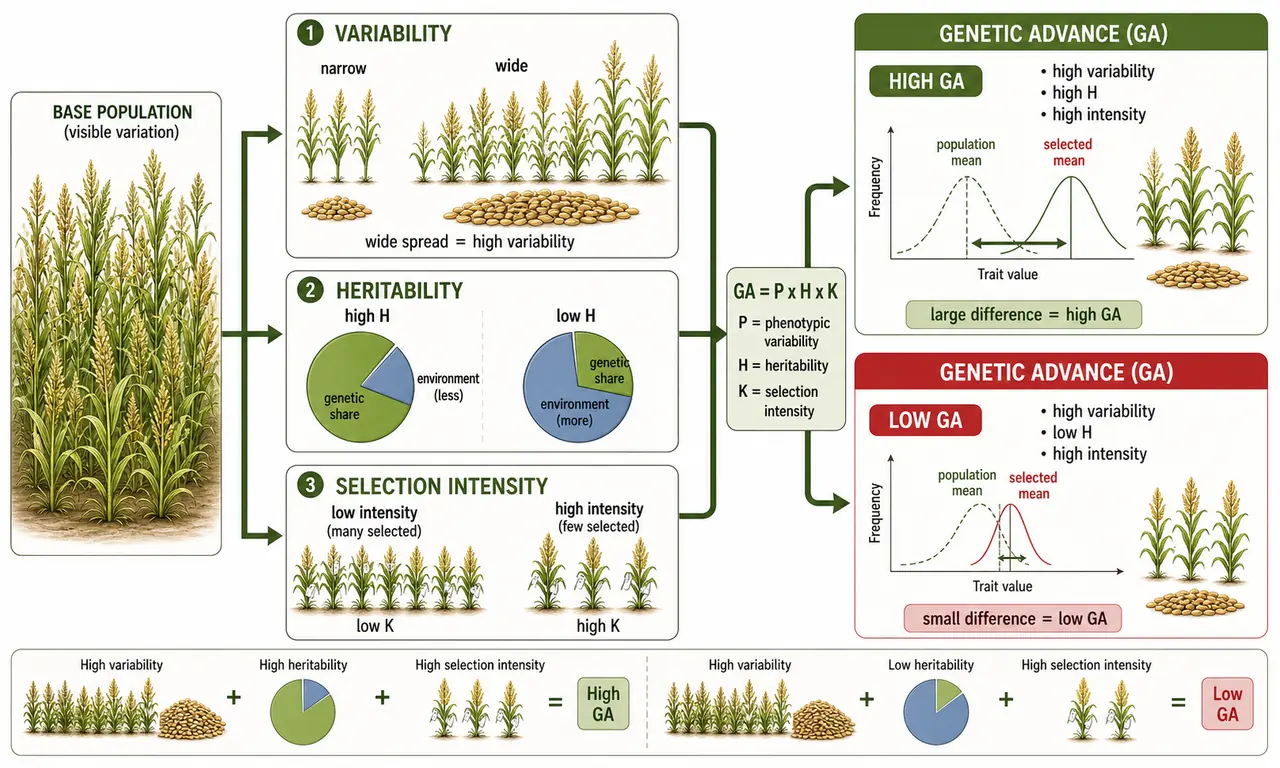
- Therefore, wider the phenotypic variability (i.e. Phenotypic Variance, and Phenotypic Standard Deviation, that measures Variability), greater is the possibility of S being large. In practical terms, a population with more variation provides a greater opportunity to select individuals that differ significantly from the population mean.
Heritability
- In crop improvement, only the genetic component of variation is important since only this component is transmitted to the next generation.
- The ratio of genetic variance to the total variance i.e. phenotypic variance is known as heritability. Heritability tells us what fraction of the observed variation is due to genetic differences. A high heritability means that most of the variation we see is genetic, making selection more effective.
H = Vg / Vp
Vp = Vg + Ve
- Where,
- Vp = phenotypic variance
- Vg = genotypic variance
- Ve = environmental variance
- Heritability estimated from the above formula is known as the broad sense heritability. This is valid when homozygous lines are studied. But when segregating generations are studied genotypic variance consists of (a) additive variance (b) dominance variance (c) and variance due to epistasis.
- Dominance variance is important when we are dealing with hybrids i.e. F1 generations. In self-pollinated crops we release varieties only after making them homozygous lines. Hence additive variance is more important in such cases. The proportion of additive genetic variance to the total variance is known as narrow sense heritability.
- If heritability is very high for any character it can be improved easily through selection. Improvement of characters with low heritability is very difficult because environmental effects mask the genetic differences.
Genetic Advance
- Genetic advance is the difference between the mean of the selected plants in the original population and the mean of the progeny raised from the selected plants in the next generation. It measures the actual progress achieved through one cycle of selection. It can be predicted by the following formula.
- Genetic advance (GA) = sP * H * K
- K = selection intensity (2.06 when 5% of the population is selected)
- P = phenotypic standard deviation of the character in the population
- H = heritability in broad sense
TIP
Remember the GA formula as: Genetic Advance = Phenotypic SD x Heritability x Selection Intensity (K). All three must be high for maximum improvement per generation.
This formula shows that genetic advance depends on three factors: the amount of variability in the population (P), how much of that variability is heritable (H), and how intensely we select (K). Maximizing all three leads to the greatest improvement per generation.
Mass Selection
- It is the earliest method of selection. Man has always practiced mass selection consciously or unconsciously from the time of domestication. In its most basic form mass selection consists of selecting individuals on the basis of phenotypic superiority and mixing the seeds for using as planting material for next season. Because seeds from many selected plants are bulked together, the resulting variety retains considerable genetic diversity.
- In open-pollinated populations, mass selection is judged mainly through the maternal parent, because the selected plant is known but the pollen parent usually remains uncontrolled under random mating.
NOTE
Mass selection is sometimes called "phenotypic selection" because it relies entirely on how plants look (phenotype), not on progeny testing to confirm their genotype.
👉🏻 Procedure for evolving variety by mass selection
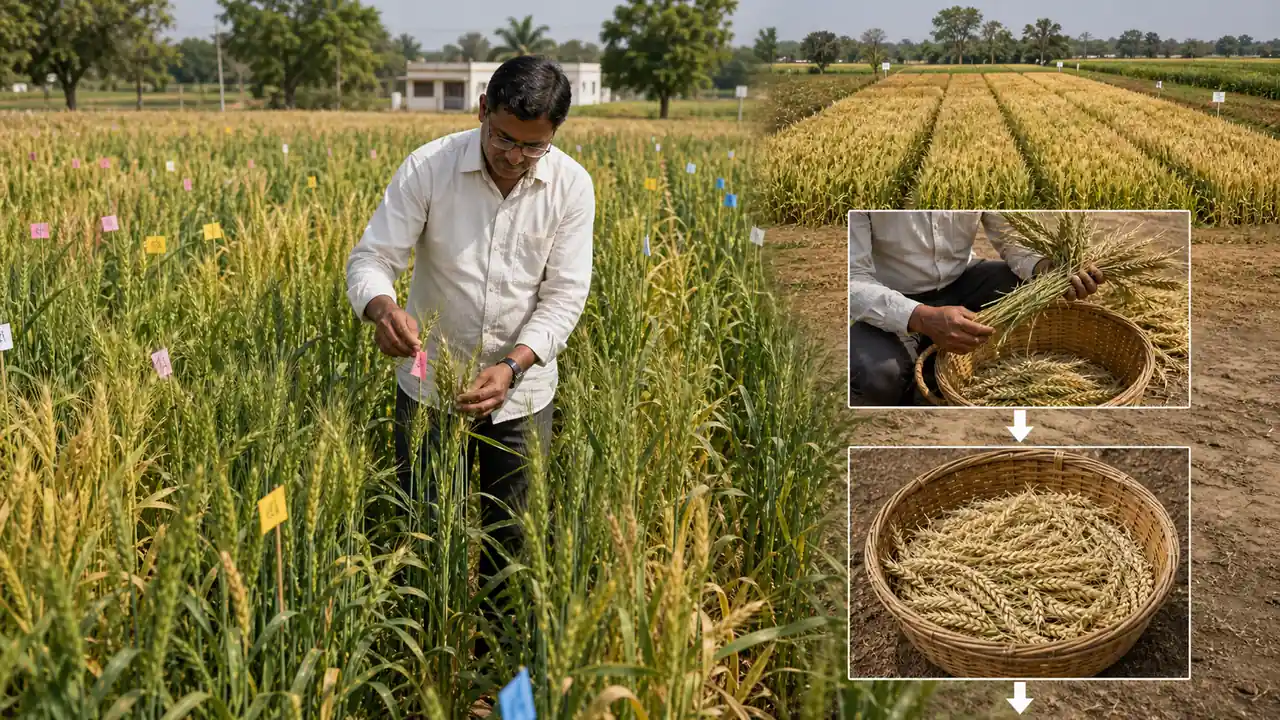
- First year: Large number of phenotypically similar plants having desirable characters are selected. The number may vary from few hundred to few thousand. The seeds from the selected plants are composited to raise the next generation.
- Second year: composited seed planted in a preliminary field trial along with standard checks. The variety from which the selection was made should also be included as check. Phenotypic characteristics of the variety are critically examined and evaluated.
- Third to Sixth year: The variety is evaluated in coordinated yield trials at several locations. It is evaluated in an initial evaluation (IET) trial for one year. If found superior it is promoted to main yield trials for 2 or 3 years.
- Seventh year: if the variety is proved superior in main yield trials it is multiplied and released after giving a suitable name.
Modification of mass selection
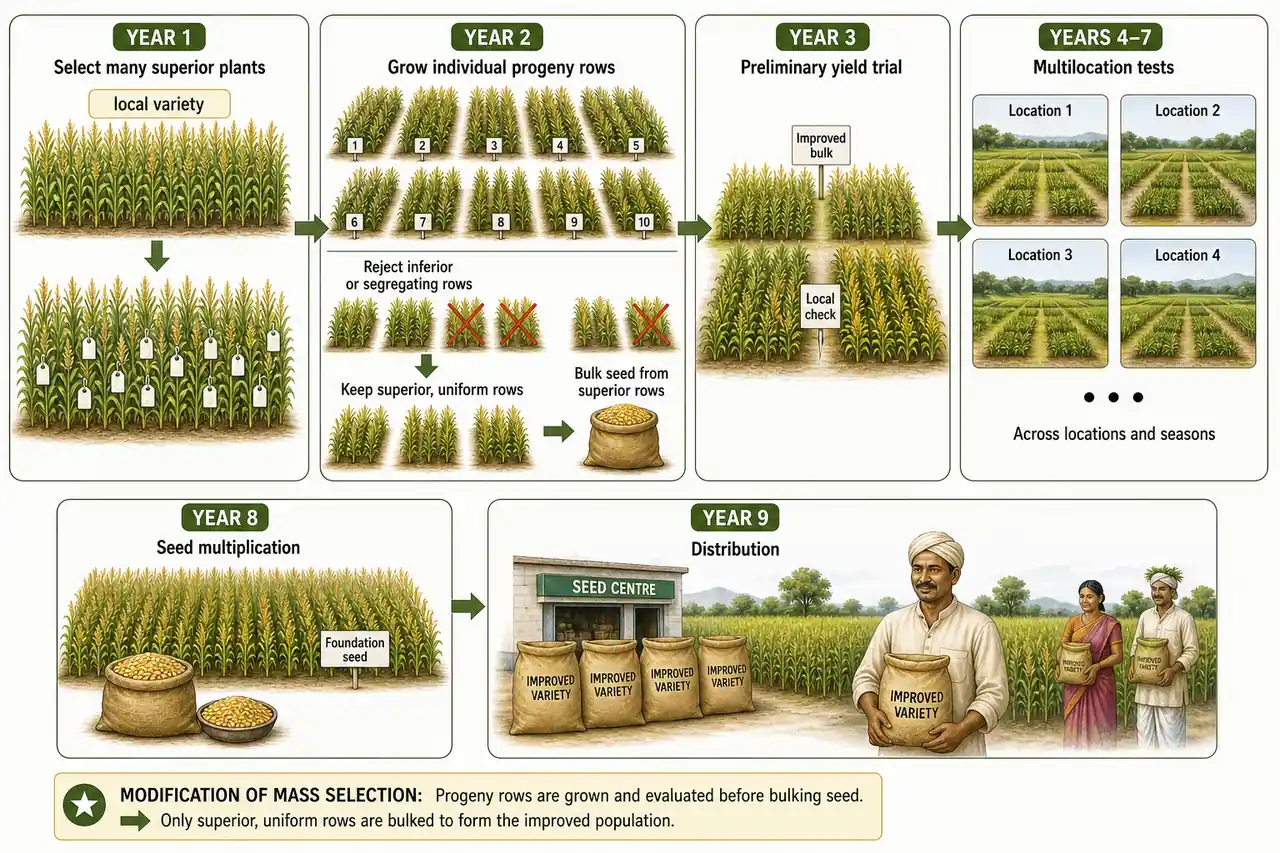
- Mass selection is used for improving a local variety. Large number of plants are selected (I year) and individual plant progenies are raised (II year). Inferior, segregating progenies are reflected.
- Uniform, superior rows are selected and the seed is bulked.
- Preliminary yield trials are conducted in third year.
- Fourth to seventh year multilocation tests are conducted and seed is multiplied in eight year and distributed in ninth year.
- Many other modifications also are followed depending on the availability of time and purpose for which it is used.
- A standard exam-oriented modification is the stratified or grid method of mass selection, proposed by Gardner (1961), in which the field is divided into smaller units so local environmental variation does not dominate plant choice.
✅ Merits of Mass selection
- Can be practiced both in self and cross pollinated crops.
- The varieties developed through mass selection are more widely adopted than pure lines because they contain more genetic diversity, which provides better adaptation to varying environments.
- It retains considerable variability and hence further improvement is possible in future by selection.
- Helps in preservation of land races
- Useful for purification of pureline varieties
- In self-pollinated crops, it is especially useful for improvement of local varieties / land races and for maintenance of genetic purity in established pureline varieties.
- Improvement of characters governed by few genes with high heritability is possible.
- Less time consuming and less expensive.
❌ Demerits of mass selection
- Varieties are not uniform because they are mixtures of several genotypes.
- Since no progeny test is done, the genotype of the selected plant is not known. This means we cannot be sure whether a plant's superiority is due to its genes or the environment.
- Since selection is based on phenotype and no control over pollination the improvement brought about is not permanent. Hence, the process of mass selection has to be repeated now and then.
- Characters which are governed by large number of genes with low heritability cannot be improved.
- It cannot create any new genotype but utilizes existing genetic variability.
🏆 Achievements
- Mass selection must have been used by pre historic man to develop present day cultivated crops from their wild parents.
- It was also used extensively before pureline selection came into existence.
- Cotton: Dharwad American Cotton
- Groundnut: TMV-1 & TMV-2
- Pearl Millet: Pusa moti, Baja puri, Jamnagar gaint, AF3
- Sorghum: R.S. 1
- Rice: SLO 13, MTU-15
- Potato: K122
Summary Cheat Sheet
| Concept / Topic | Key Details |
|---|---|
| Mass selection | Select phenotypically superior plants; bulk their seed |
| Oldest breeding method | Practiced since beginning of agriculture |
| Selection basis | Phenotype only (appearance, yield, disease reaction) |
| Genotype testing | Not done; no progeny testing |
| Effective for | Highly heritable traits (qualitative characters) |
| Ineffective for | Low heritability traits (quantitative like yield) |
| Result | Improved population; NOT a pure line |
| Population remains | Heterogeneous (mixture of genotypes) |
| Used in | Both self and cross-pollinated crops |
| Advantages | Simple, inexpensive, maintains genetic variability |
| Disadvantages | No genotype control; limited improvement for complex traits |
| Improvement is | Temporary unless repeated each generation |
| Modified mass selection | Stratified mass selection (grid system for field variation) |
| In cross-pollinated crops | More effective; maintains heterozygosity |
| In self-pollinated crops | Less effective; limited variability to select from |