👨👧 Pure Line Selection: Theory, Procedure, and Progeny Testing
Understand pure line theory, Johannsen's experiments, pure line selection procedure, progeny testing, and comparison with mass selection — with agricultural examples.
Why Pure Line Selection Matters in Agriculture
Most of India's early improved varieties of self-pollinated crops like wheat and rice were developed through pure line selection — identifying a single superior homozygous plant from a mixed population and multiplying its progeny. This method is faster than hybridisation and works well when natural variation already exists in local land races. Understanding pure line theory also explains why selection within a pure variety is ineffective — a key concept for exams.
Pure line theory
- A pureline is a progeny of a single homozygous plant of a self-pollinated species. All the plants of a pureline have the same genotype. This uniformity is the hallmark of pureline varieties and makes them highly predictable in their performance.
- The phenotypic differences within a pureline is due to environment. Therefore variation within a pureline is not heritable. Hence selection in a pureline is not effective. This is one of the most important principles in plant breeding -- you cannot improve a pureline by selecting within it.

- The concept of pureline was proposed by Johannsen in 1903 on the basis of his studies with princess variety of beans (Phaseolus vulgaris).
- From a commercial seed lot he selected seeds of different sizes and grew them separately. The progenies differed in seed size. Progenies from larger seeds produced larger seeds than those obtained from smaller seeds. This clearly showed that the variation in seed size in the commercial seed lot of princess variety had a genetic base. As a result selection for seed size was effective.
- Johannsen further studied 19 lines, each line was a progeny of a single seed from the original lot. He discovered that each line showed a characteristic mean seed weight, ranging from 640 mg in Line No 1 to 350 mg in line No 19. The seed size within a line showed some variation, which was much smaller than that in the original commercial seed lot. Johannsen postulated that the original seed lot was a mixture of purelines. Thus each of the 19 lines represented a pureline, and the variation in seed size within each of the purelines had no genetic basis and was entirely due to environment.
👉🏻 Confirmatory evidence was obtained in three ways
Pro Content Locked
Upgrade to Pro to access this lesson and all other premium content.
Charged once for one year · ₹1188 total
Save ₹100/month vs ₹2388/year launch price
- All Agriculture & Banking Courses
- AI Lesson Questions (100/day)
- AI Doubt Solver (50/day)
- Glows & Grows Feedback (30/day)
- AI Section Quiz (20/day)
- 22-Language Translation (100/day)
- Recall Questions (20/day)
- AI Quiz (15/day)
- AI Quiz Paper Analysis (100/day)
- AI Step-by-Step Explanations (100/day)
- Spaced Repetition Recall (FSRS)
- AI Tutor
- Immersive Text Questions
- Audio Lessons — Hindi & English
- Mock Tests & Previous Year Papers
- Summary & Mind Maps
- XP, Levels, Leaderboard & Badges
- Generate New Classrooms
- Voice AI Teacher (AgriDots Live)
- AI Revision Assistant
- Knowledge Gap Analysis
- Interactive Revision (LangGraph)
🔒 Secure one-time yearly payment via Razorpay · No hidden fees
Why Pure Line Selection Matters in Agriculture
Most of India's early improved varieties of self-pollinated crops like wheat and rice were developed through pure line selection — identifying a single superior homozygous plant from a mixed population and multiplying its progeny. This method is faster than hybridisation and works well when natural variation already exists in local land races. Understanding pure line theory also explains why selection within a pure variety is ineffective — a key concept for exams.
Pure line theory
- A pureline is a progeny of a single homozygous plant of a self-pollinated species. All the plants of a pureline have the same genotype. This uniformity is the hallmark of pureline varieties and makes them highly predictable in their performance.
- The phenotypic differences within a pureline is due to environment. Therefore variation within a pureline is not heritable. Hence selection in a pureline is not effective. This is one of the most important principles in plant breeding -- you cannot improve a pureline by selecting within it.
- The concept of pureline was proposed by Johannsen in 1903 on the basis of his studies with princess variety of beans (Phaseolus vulgaris).
- From a commercial seed lot he selected seeds of different sizes and grew them separately. The progenies differed in seed size. Progenies from larger seeds produced larger seeds than those obtained from smaller seeds. This clearly showed that the variation in seed size in the commercial seed lot of princess variety had a genetic base. As a result selection for seed size was effective.
- Johannsen further studied 19 lines, each line was a progeny of a single seed from the original lot. He discovered that each line showed a characteristic mean seed weight, ranging from 640 mg in Line No 1 to 350 mg in line No 19. The seed size within a line showed some variation, which was much smaller than that in the original commercial seed lot. Johannsen postulated that the original seed lot was a mixture of purelines. Thus each of the 19 lines represented a pureline, and the variation in seed size within each of the purelines had no genetic basis and was entirely due to environment.
👉🏻 Confirmatory evidence was obtained in three ways
- In the first case, he classified the seed from each pureline into 100 mg classes, and grew them separately. The mean seed weight of progenies from different seed weight class of a single pure line were comparable with each other, and with that of the parent pureline. For example Line no 13 had seed size classes of 200, 300, 400, and 500 mg. The mean seed weights of the progenies derived from these seed weight classes were 475, 450, 451 and 458 mg respectively. This demonstrated that within a pureline, seed size differences do not breed true.
- The second line of evidence came from selection within a pureline. From each pureline, the largest and the smallest seeds were selected to raise the next generation. In the subsequent generations, large seeds were selected in the progenies obtained from large seeds while in these from small seeds selection was done from small seeds. Six generations of selection was ineffective in increasing or decreasing the seed size. For example, after 6 generations of selection, the mean seed weight in Line No 1 was 690 and 680 mg in the progenies selected for small and large seeds respectively. Thus selection within a pureline was ineffective.
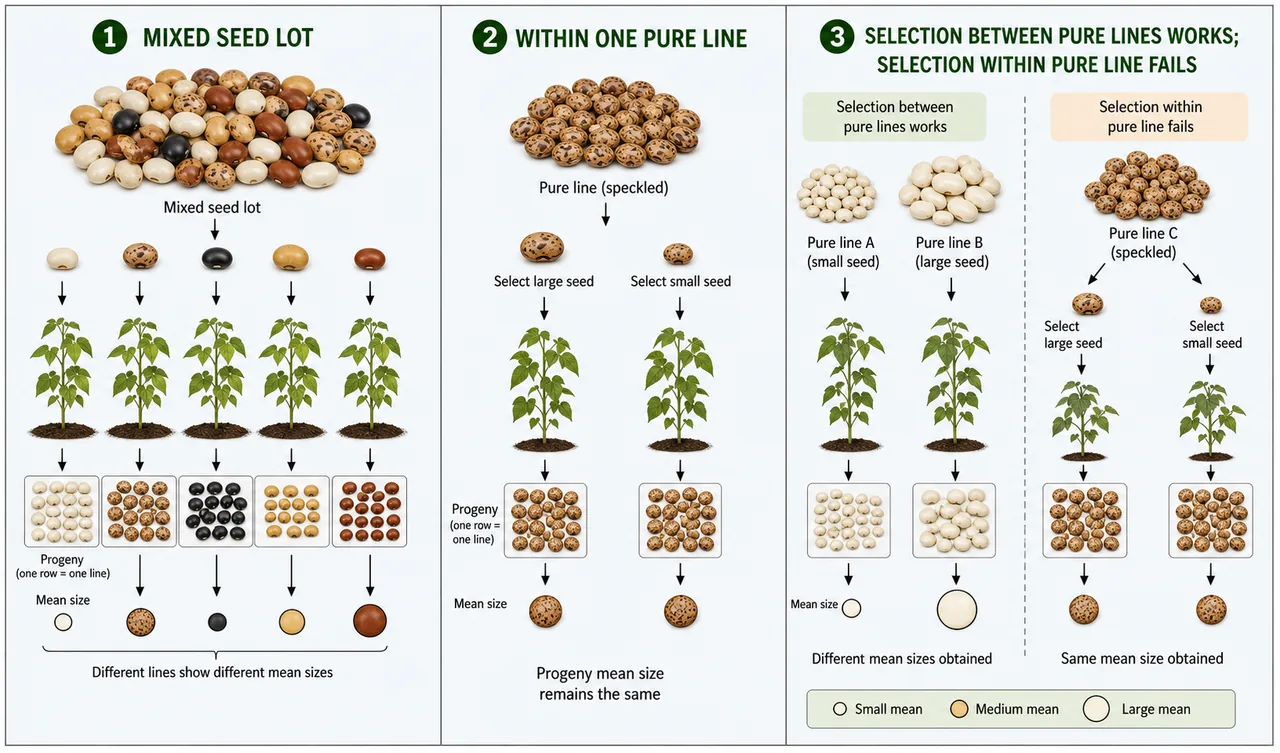
- The third approach was to estimate parent offspring correlation. The value of parent offspring correlation within line no 13 was -0.018 plus-minus 0.038, that is, zero, while it was 0.336 plus-minus 0.008 in the original seed lot of the Princess which is highly significant. The parent-offspring correlation will be zero when the variation is non heritable, while it will be significantly greater than zero when the variation has a genetic basis, i.e., is heritable.
- These observations reveal that the variation for seed size in the original seed lot of Princess had a genetic basis and was heritable. But the variation within the purelines obtained from the single seeds selected from this seed lot was purely due to the environment and, therefore, non-heritable.
👉🏻 The two main conclusions from the Johannsens' experiment are:
- A self-fertilized population consists of a mixture of several homozygous genotypes. Variation in such a population has a genetic component, and therefore selection is effective.
- Each individual plant progeny selected from a self-fertilized population consists of homozygous plants of identical genotype. Such a progeny is known as pureline. The variation within a pureline is purely environmental and, as a result, selection within a pureline is ineffective.
IMPORTANT
Key takeaway: Selection works between purelines (genetic differences exist) but NOT within a pureline (only environmental differences exist). This is the cornerstone of pureline theory.
👉🏻 Origin of variation in pure lines
- Pure lines show genetic variation after some time because of the following reasons. Even though a pureline starts as a genetically uniform population, over time variation creeps in through:
- Mechanical Mixture: During cultivation, harvesting, threshing and storage, other genotypes may get mixed up.
- Natural hybridization: Though pure lines are produced in self-pollinated crops, some amount of natural cross pollination occurs in them also. This can be avoided by isolation and rouging.
- Chromosomal aberrations: Structural chromosome changes may occasionally generate heritable deviation from the original uniform line.
- Mutation: occur spontaneously in nature at random and introduce new genetic variation.
👉🏻 Characters of pure lines
- All the plants within a pureline have the same genotype
- The variation within a pureline is environmental and non-heritable
- Purelines are stable over generations as long as the above sources of variation are controlled
Progeny test
- Evaluation of the worth of plants on the basis of performance of their progenies is known as progeny test. This was developed by Louis De Vilmorin and so it is also known as the Vilmorin Isolation principle. Vilmorin worked on sugarbeet plants. The progeny test serves two valuable functions:
- Determines the breeding behaviour of a plant i.e. whether it is homozygous or heterozygous.
- Whether the character for which the plant was selected is heritable i.e. is due to genotype or not. Selections have to be based on phenotype and so it is necessary to know the genotype of the selected plant. The progeny test is the only reliable way to confirm whether a selected plant's superiority is genetic.
Genetic basis of pure line
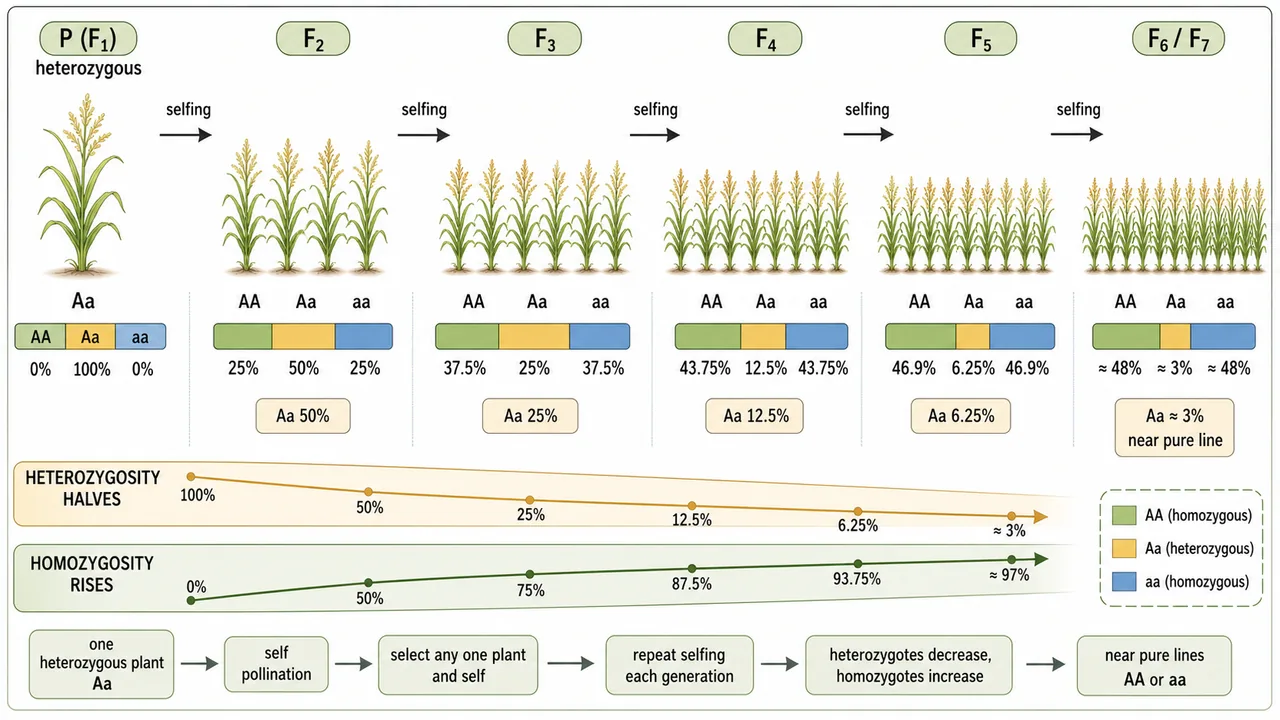
- Self-pollination increases homozygosity with a corresponding decrease in heterozygosity. The effect of homozygosity and heterozygosity may be illustrated by taking an individual heterozygous for (Aa) a single gene as follows:
| No of generations of selfing | AA | Aa | aa | Homozygosity | Heterozygosity |
|---|---|---|---|---|---|
| 1 | 0 | 100 | 0 | 0 | 100 |
| 2 | 25 | 50 | 25 | 50 | 50 |
| 3 | 37.5 | 25 | 37.5 | 75 | 25 |
| 4 | 43.75 | 12.5 | 43.75 | 87.5 | 12.5 |
| 5 | 46.875 | 6.25 | 46.875 | 93.73 | 6.25 |
| 6 | 48.437 | 3.125 | 48.437 | 96.874 | 3.125 |
| 7 | 49.218 | 1.562 | 49.218 | 98.436 | 1.562 |
| 8 | 49.608 | 0.781 | 49.608 | 99.216 | 0.781 |
| 9 | 49.803 | 0.39 | 49.803 | 99.606 | 0.39 |
With each generation of selfing, the proportion of heterozygous individuals is halved. After about 7 generations, more than 99% of the individuals are homozygous, which is why pureline varieties become essentially uniform.
Pureline Selection
- Pureline selection has been the most commonly used method of improvement of self-pollinated crops. Almost all the present day varieties of self-pollinated crops are purelines. Pureline selection has several applications in improvement of self-pollinated crops. It is used to improve:
- Local varieties
- Old pureline varieties and
- Introduced varieties
- General procedure for evolving a variety by pureline selection
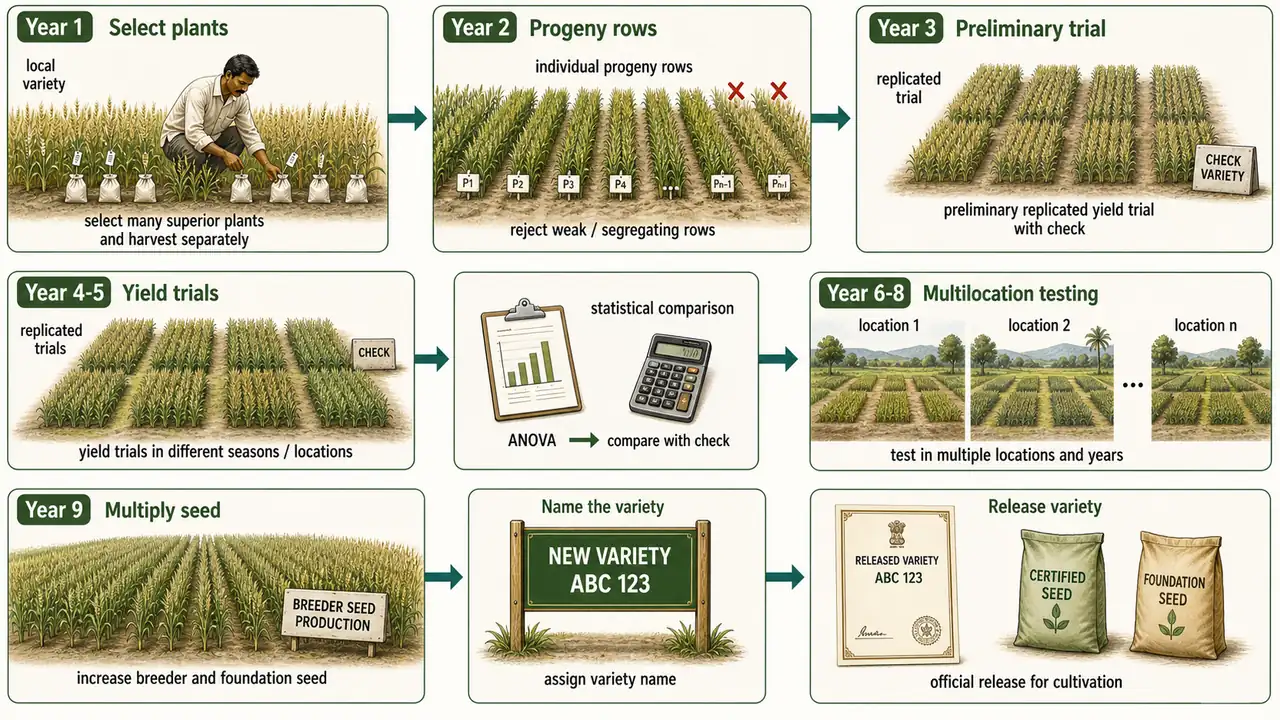
- The pureline selection has three steps:
- Selection of individual plants from a local variety or some other mixed population.
- Visual evaluation of individual plant progenies and
- Yield trials
- I. Selection First year:
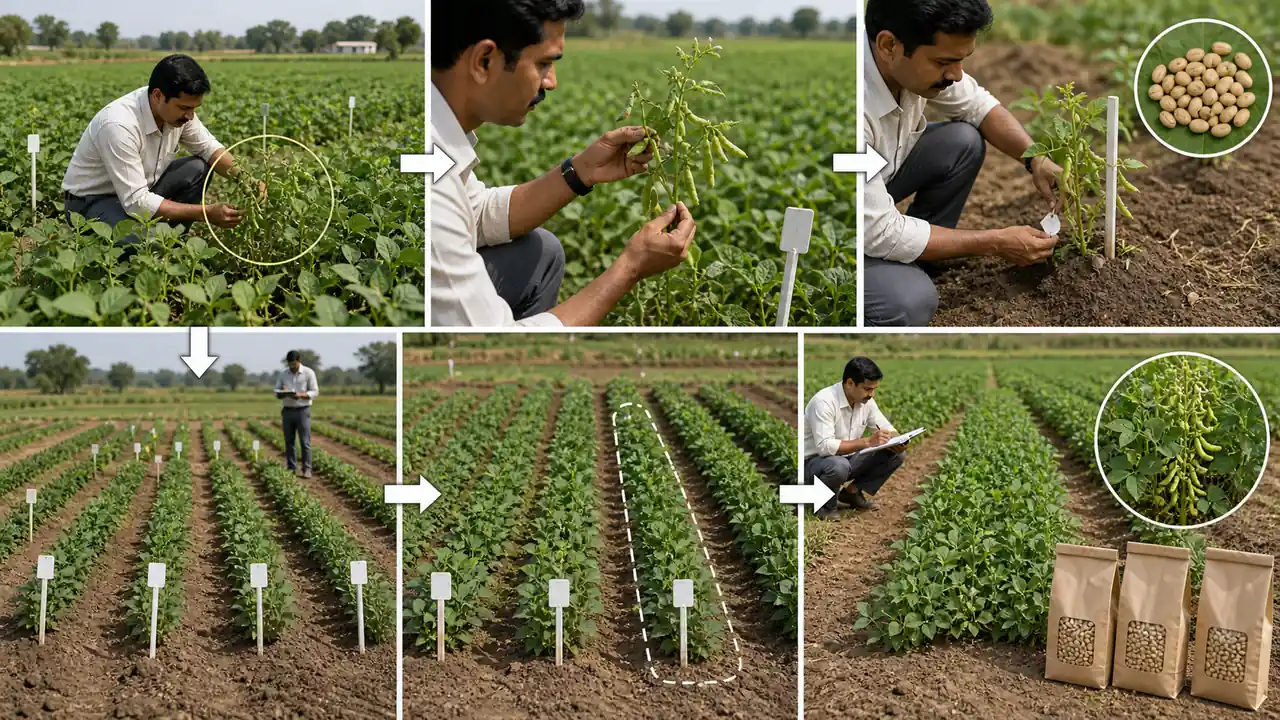
- A large number of plants (200-3000) which are superior than the rest are selected from a local variety or mixed population and harvested separately (in some cases individual heads or stems may be selected).
- The number of plants to be selected depends upon the breeder's discretion but should be as large as possible in view of the available time, land, funds, labour etc. It is advisable to select for easily observable characters such as flowering, maturity, disease resistance, plant height etc.
- II. Evaluation:
- Second year: Progenies of individual plants selected in 1st year are grown separately with proper spacing (plant to row or head to row). The progenies are evaluated by taking elaborate date on visual characters such as plant height, duration, grain type, ear characters besides yield. The number of progenies should be reduced as much as possible.
- Disease epiphytotics may be created to test the progenies for disease resistance, poor, weak, diseased, insect attacked and segregating progenies are rejected. Segregating progenies indicate that the original plant was heterozygous, so such progenies are not true purelines.
- The superior progenies are harvested separately. If necessary the process may be repeated for one or more years.
- III. Yield trials:
- Third year: The selected progenies, now called as cultures are grown in replicated trial for critical evaluation of yield etc. The best local variety is used as a check and should be grown at regular intervals, after every 15 or 20 cultures for comparison. This is known as preliminary yield trial. Superior cultures based on observable characters and yield are selected. The number is drastically reduced.
- Fourth & Fifth years: The superior cultures are tested against the local checks in yield trials. Observations are recorded on many characters like diseases resistance, days to flower, days to maturity, height of the plant ear characters, test weight and yield. The data is subjected to statistical analysis to identify really superior cultures. If necessary the trials may be extended for one more year or season. Inferior cultures are rejected and a few (4-5) promising cultures are selected.
- Sixth, Seventh and Eighth years: The promising cultures selected are evaluated at several locations along with strains or cultures of other breeders and local checks. One or two promising cultures are selected.
- Ninth year: The best progeny identified earlier is multiplied, named and released as a variety for official release of any variety (approval from the variety releasing committee of the state or central is necessary).
✅ Advantage of pureline selection
- The purelines are extremely uniform since all the plants in the variety will have the same genotype.
- Attractive and liked by the farmers and consumers.
- Purelines are stable and last for many years.
- Due to its extreme uniformity the variety can be easily identified in seed certification programmes.
❌ Limitations or disadvantages of pureline selection
- New genotypes are not created by pureline selection. The breeder can only isolate what already exists in the population.
- Improvement is limited to the isolation of the best genotype present in population. No more improvement is possible after isolation of the best available genotype in the population.
- Selection of purelines require great skill and familiarity with the crop.
- Difficult to detect small differences that exist between cultures
- The breeder has to devote more time
- Pure lines have limited adaptability hence can be recommended for cultivation in limited area only. This narrow adaptability is a consequence of their uniform genotype.
🏆 Achievements
- Several varieties developed by pureline selection were released in many crops. Some examples are given below
- Rice: Mtu-1, Mtu-3, Mtu-7, Bcp -1, Adt-1, 3, 5, and 10
- Sorghum: G 1 & 2, M 1 & 2, OO 1, 4 & 5
- Groundnut: TMV 3, 4, 7, 8 and Kadiri 71-1
- Redgram: TM-1, ST-1
- Chillies: G1 & G2
- Ragi: AKP 1 to 7
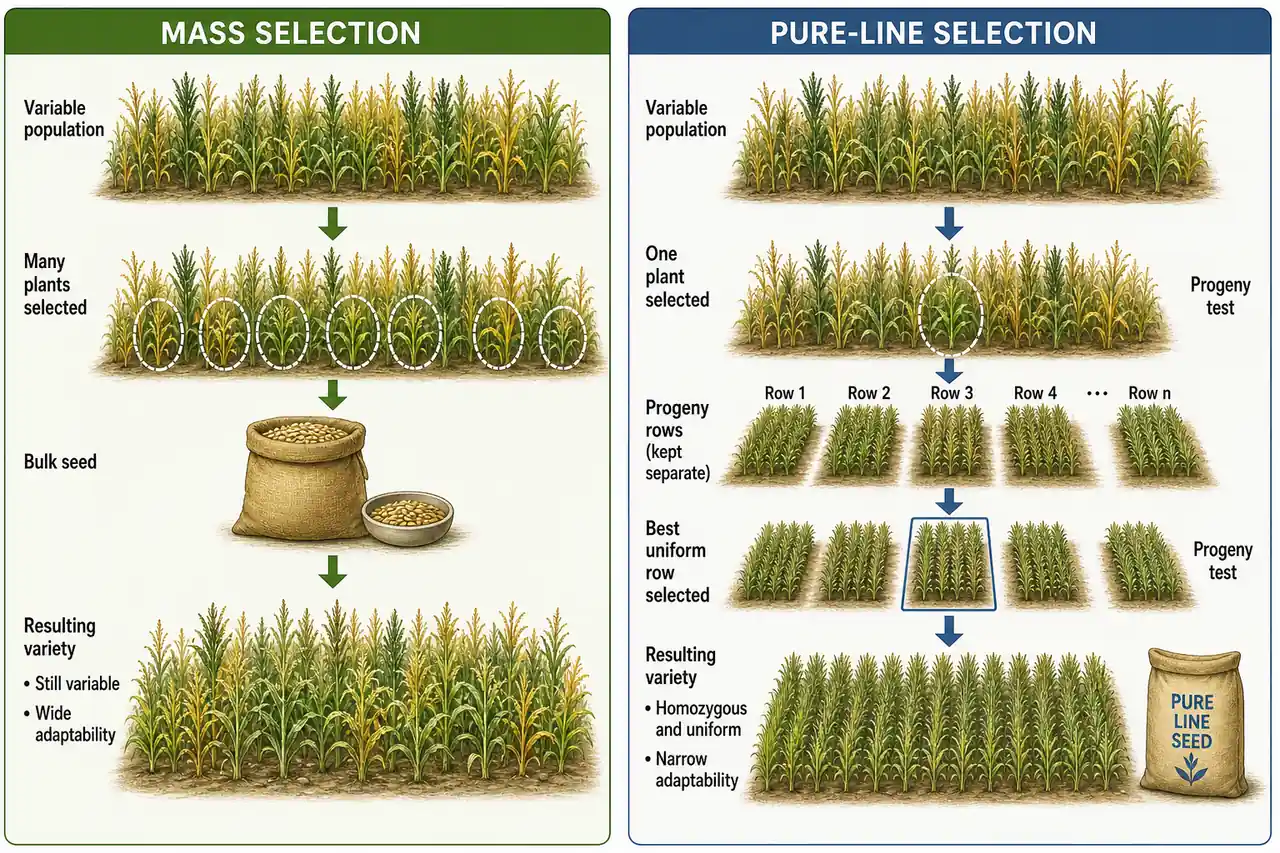
Differences between Mass and Pureline selections
| Mass Selection | Pureline Selection |
|---|---|
| Used both in self and cross pollinated crops | Practiced in self-pollinated crops only |
| Large number of plants are selected | Comparatively less number of plants are selected |
| The produce of the selected plants is mixed and sown as such in next year | Produce of individual plants is kept separate and progeny rows are raised next year |
| No control of pollination | Pollination is controlled |
| Variety developed is heterozygous and not uniform | Variety is homozygous homogeneous and uniform |
| Due to heterozygosity the variety deteriorates quickly | Due to homozygosity the variety lasts long |
| The method has to be repeated once in 2-3 years to purify the variety | No need to repeat |
| Wider adaptability due to heterozygosity | Narrow adaptability due to homozygosity |
| No knowledge of science is required. It is more an art | Knowledge of science and genetics is required |
| Selection within a variety is effective | Selection with in a pureline variety is not effective |
| The variety is relatively difficult to identify | It is relatively easy to identify in seed certification programmes |
The fundamental difference is that in mass selection, seeds from many selected plants are mixed to form the variety (resulting in a genetically diverse variety), while in pureline selection, individual plant progenies are kept separate and evaluated independently (resulting in a genetically uniform variety).
Summary Cheat Sheet
| Concept / Topic | Key Details |
|---|---|
| Pure line | Progeny of a single homozygous self-pollinated plant |
| Pure line theory by | Johannsen (1903) — experiments on beans |
| Pure line selection | Select individual superior plants; evaluate progeny separately |
| Pure line = | Genotypically homozygous and phenotypically uniform |
| Selection within pure line | Ineffective (all variation is environmental) |
| Selection among pure lines | Effective (variation is genetic) |
| Applicable to | Self-pollinated crops only |
| Advantages | Produces uniform, stable variety; simple procedure |
| Disadvantages | No new variability created; limited by existing variation |
| Steps | Select superior plants → grow progeny rows → compare → test → release |
| Difference from mass selection | Pure line tests progeny; mass selection selects on phenotype only |
| Nilsson-Ehle | Developed pure line selection procedure at Svalof, Sweden |
| Varieties remain pure until | Mutation or mechanical mixing occurs |
| Number of generations | 6–7 years to release a variety |
| Used for crops | Wheat, rice, barley, oat, pea, gram |