⚡️ Mutation: Types, Classification, and Characteristics
Understand gene mutations, chromosomal mutations, physical and chemical mutagens, and their role as the ultimate source of genetic variation — with agricultural examples and exam tips.
Why Mutations Matter in Agriculture
The semi-dwarf gene in rice (sd1) that fuelled the Green Revolution was a natural mutation. The Reimei variety of rice in Japan — one of the most successful crops ever developed through deliberate mutation breeding using gamma rays — demonstrated that induced mutations can create traits not available in any existing germplasm. Mutations are the ultimate source of all genetic variation and the starting point for evolution and crop improvement alike.
- Mutation is a sudden, permanent & heritable change in the genetic material of an organism. Mutations are the ultimate source of all genetic variation in living organisms and provide the raw material for evolution and plant breeding.
- Mutation may be the result of a change in a gene, a change in chromosome that involves several genes or a change in plasmagene.
- Mutations produced by changes in the base sequence of genes are known as gene or point mutations some mutations may be produced by changes in chromosome structure or even in chromosome number they are termed as chromosomal mutation.
- There are three types of mutations based on genetic basis of heritable change:
- Gene mutations: These are produced by change in the base sequence of genes. The change may be due to base substitutions, deletion or addition.
- Chromosomal mutation: These arise due to change in chromosome number that may leads to polyploidy or aneuploidy or change in chromosome structure that result in deletions, duplication, inversion and translocation.
- Cytoplasmic or plasmagene mutation: These are due to change in the base sequence of plasma genes. The plasma genes are present in mitochondria or chloroplast. Here the mutant character occurs in buds or somatic tissues which are used for propagation in clonal crops.
History
- Mutation was first observed by Seth Wright. He observed some short legged sheep (Ancon) variety in a population of long legged sheep. This was a naturally occurring mutation that was noticed because of its dramatic phenotypic effect.
- The term mutation was described by Hugo De Vries (1900) UPPSC 2021 while working on Oenothera lamarckiana (Evening Primrose). The word is derived from the latin word 'MUTARE' means to change.
- Hugo De Vries also proposed Mutation Theory of Evolution. This theory suggests that new species arise through sudden, large mutations rather than through the gradual accumulation of small changes as proposed by Darwin.
- This theory was given in support of Darwinism because Darwin was unable to explain the source of large variations. Darwin called such variation as sport.
- Morgan observed some white eyed male Drosophila in a population of red eyed Drosophila. It is produced due to mutation. This classic observation helped establish the link between genes, chromosomes, and traits.
- Morgan found that Chromosomes are carrier of genes. UPPSC 2021
- Muller is the discoverer of induced mutations. He induced mutations in Drosophila by the help of X-rays. This groundbreaking discovery showed that mutations could be artificially created, opening up the field of mutation breeding.
- Beadle and Tatum induced mutations in Neurospora by the help of U.V. rays or X rays.

- Normal-Neurospora can be grown in minimal medium because Neurospora can make all essential nutrients required for it. This is known as Prototroph.
- Mutant Neurospora doesn't has capability to grow in minimal medium because due to mutation it loses those genes which codes for the enzyme that helps to prepare some special nutrients for it. They gave "One gene-One Enzyme" concept. This form is known as Auxotroph. The one gene-one enzyme concept established that each gene controls the production of a single enzyme, linking genetics to biochemistry.
- M.S. Swaminathan induced mutations in wheat by the help of gamma-rays to obtain good varieties for E.g. Sharbati Sonora, Pusa Lerma. Swaminathan established gamma garden in IARI-New Delhi (Pusa Institute). These varieties played a crucial role in India's Green Revolution.
IMPORTANT
Pro Content Locked
Upgrade to Pro to access this lesson and all other premium content.
Charged once for one year · ₹1188 total
Save ₹100/month vs ₹2388/year launch price
- All Agriculture & Banking Courses
- AI Lesson Questions (100/day)
- AI Doubt Solver (50/day)
- Glows & Grows Feedback (30/day)
- AI Section Quiz (20/day)
- 22-Language Translation (100/day)
- Recall Questions (20/day)
- AI Quiz (15/day)
- AI Quiz Paper Analysis (100/day)
- AI Step-by-Step Explanations (100/day)
- Spaced Repetition Recall (FSRS)
- AI Tutor
- Immersive Text Questions
- Audio Lessons — Hindi & English
- Mock Tests & Previous Year Papers
- Summary & Mind Maps
- XP, Levels, Leaderboard & Badges
- Generate New Classrooms
- Voice AI Teacher (AgriDots Live)
- AI Revision Assistant
- Knowledge Gap Analysis
- Interactive Revision (LangGraph)
🔒 Secure one-time yearly payment via Razorpay · No hidden fees
Why Mutations Matter in Agriculture
The semi-dwarf gene in rice (sd1) that fuelled the Green Revolution was a natural mutation. The Reimei variety of rice in Japan — one of the most successful crops ever developed through deliberate mutation breeding using gamma rays — demonstrated that induced mutations can create traits not available in any existing germplasm. Mutations are the ultimate source of all genetic variation and the starting point for evolution and crop improvement alike.
- Mutation is a sudden, permanent & heritable change in the genetic material of an organism. Mutations are the ultimate source of all genetic variation in living organisms and provide the raw material for evolution and plant breeding.
- Mutation may be the result of a change in a gene, a change in chromosome that involves several genes or a change in plasmagene.
- Mutations produced by changes in the base sequence of genes are known as gene or point mutations some mutations may be produced by changes in chromosome structure or even in chromosome number they are termed as chromosomal mutation.
- There are three types of mutations based on genetic basis of heritable change:
- Gene mutations: These are produced by change in the base sequence of genes. The change may be due to base substitutions, deletion or addition.
- Chromosomal mutation: These arise due to change in chromosome number that may leads to polyploidy or aneuploidy or change in chromosome structure that result in deletions, duplication, inversion and translocation.
- Cytoplasmic or plasmagene mutation: These are due to change in the base sequence of plasma genes. The plasma genes are present in mitochondria or chloroplast. Here the mutant character occurs in buds or somatic tissues which are used for propagation in clonal crops.
History
- Mutation was first observed by Seth Wright. He observed some short legged sheep (Ancon) variety in a population of long legged sheep. This was a naturally occurring mutation that was noticed because of its dramatic phenotypic effect.
- The term mutation was described by Hugo De Vries (1900) UPPSC 2021 while working on Oenothera lamarckiana (Evening Primrose). The word is derived from the latin word 'MUTARE' means to change.
- Hugo De Vries also proposed Mutation Theory of Evolution. This theory suggests that new species arise through sudden, large mutations rather than through the gradual accumulation of small changes as proposed by Darwin.
- This theory was given in support of Darwinism because Darwin was unable to explain the source of large variations. Darwin called such variation as sport.
- Morgan observed some white eyed male Drosophila in a population of red eyed Drosophila. It is produced due to mutation. This classic observation helped establish the link between genes, chromosomes, and traits.
- Morgan found that Chromosomes are carrier of genes. UPPSC 2021
- Muller is the discoverer of induced mutations. He induced mutations in Drosophila by the help of X-rays. This groundbreaking discovery showed that mutations could be artificially created, opening up the field of mutation breeding.
- Beadle and Tatum induced mutations in Neurospora by the help of U.V. rays or X rays.
- Normal-Neurospora can be grown in minimal medium because Neurospora can make all essential nutrients required for it. This is known as Prototroph.
- Mutant Neurospora doesn't has capability to grow in minimal medium because due to mutation it loses those genes which codes for the enzyme that helps to prepare some special nutrients for it. They gave "One gene-One Enzyme" concept. This form is known as Auxotroph. The one gene-one enzyme concept established that each gene controls the production of a single enzyme, linking genetics to biochemistry.
- M.S. Swaminathan induced mutations in wheat by the help of gamma-rays to obtain good varieties for E.g. Sharbati Sonora, Pusa Lerma. Swaminathan established gamma garden in IARI-New Delhi (Pusa Institute). These varieties played a crucial role in India's Green Revolution.
IMPORTANT
Swaminathan's work with gamma-ray induced mutations in wheat is a landmark achievement in Indian agriculture and a frequently tested fact in competitive exams.
Characteristic feature of mutations
- Mutations are generally recessive but dominant mutations also occur
- Mutations are generally harmful to the organism. Most of the mutations have deleterious effects but a small proportion (0.1%) of them are beneficial. This is because organisms are already well-adapted to their environments, so random changes are more likely to disrupt function than improve it.
- Mutations are random i.e. they may occur in any gene. However some genes show high mutation rates than the others.
- Mutations are recurrent -- the same mutation can occur repeatedly in different individuals or populations.
- Induced mutations commonly show pleiotropy often due to mutation in closely linked genes. Pleiotropy means a single mutation affects multiple traits simultaneously.
- Only those mutation are heritable which occur in germinal cell of an organism. While somatic mutation are non-heritable. Somatic mutations are also heritable in vegetatively propagated plants because new plants are derived from the mutated somatic tissue.
- Mutation are source of discontinuous variation. Unlike continuous variation caused by polygenic inheritance, mutations produce distinct, discrete phenotypic changes.
Classification of mutations
👉🏻 Based on Origin
Somatic/Bud mutation
- Somatic mutation is used to denote mutations occurring in buds or somatic tissues, which are used for propagation. These are particularly important in vegetatively propagated crops like fruits and ornamentals, where a bud mutation can give rise to a new variety.
Spontaneous mutations
- Mutations occur in natural populations at a low rate (-6) means generally one in ten lakhs. Here the different genes show different mutation rate.
- For example: in maize R-locus mutates at the frequency of 4.92 x 10⁻⁴ i.e. (1 in 20000 population), when as Su locus at 2.4 x -6 (1 in 25 lakhs). The Wx locus considered to be highly stable. The difference in mutation rate may be due to:
- Genetic background i.e. presence of mutator genes that increase mutation rates at other loci
- Genes themselves -- some genes are inherently more prone to mutation due to their size or sequence composition
- Environment -- factors like temperature, radiation, and chemical exposure
Induced mutation
- Mutations may be artificially induced by treatment with certain physical or chemical agents called mutagens.
- Available evidence indicates that induced mutation rarely produce new alleles they produce alleles which are already known to occur spontaneously.
- Induced mutations are comparable to spontaneous mutations in their effects and in the variability they produce.
- Induced mutation occur at a relatively higher frequency so that it is practical to work with them. This higher frequency makes it feasible to screen large populations for desired mutants.
👉🏻 Based on magnitude of phenotypic effects mutation as classified as
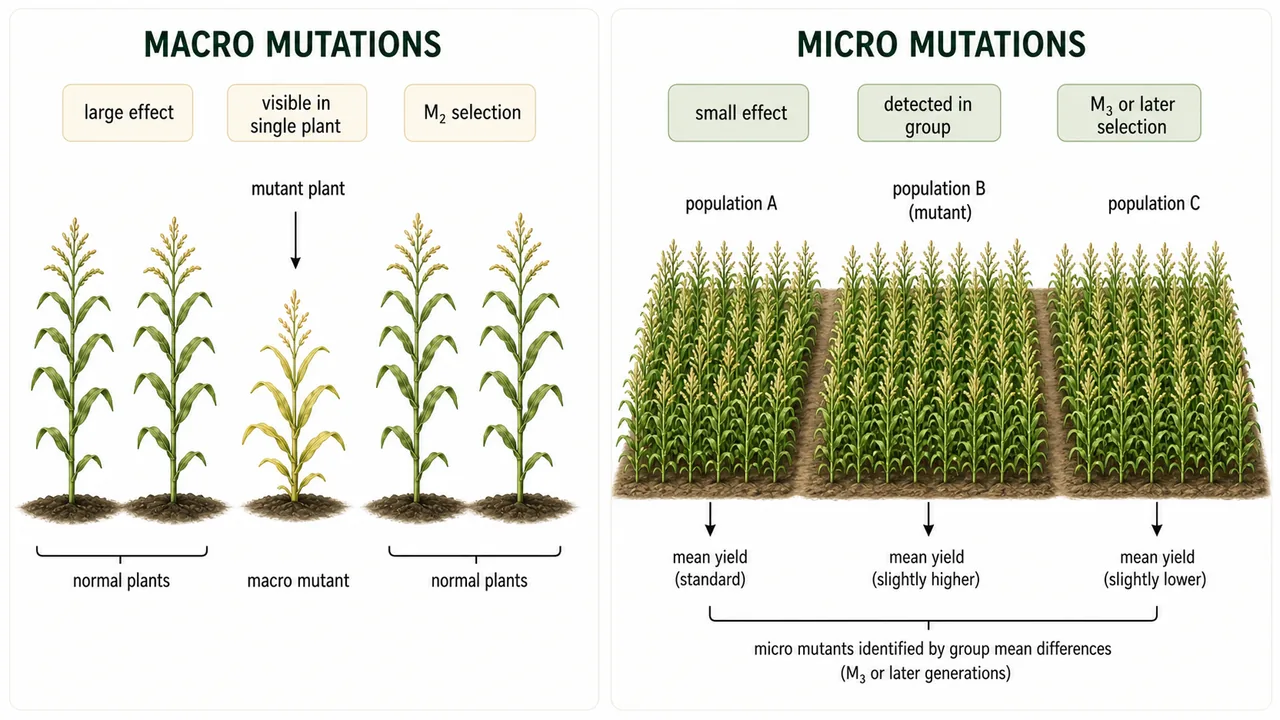
Macro mutations
- Oligogenic Mutation: Large phenotypic effect and recognizable on individual plant basis and can be seen easily in M2 generations.
- Eg. Ancon breed in sheep, pod maize to cob maize. These produce clearly visible changes that are easy to identify during screening.
Micro mutations
- Polygenic mutations: Small phenotypic effect which cannot be recognized on individual plant basis but can be recognize only in a group of plants. These affect quantitative traits like yield, where the contribution of each mutation is small.
- Selection should be done in M3 or later generations because these small effects become detectable only when progeny rows are compared statistically.
Types of Mutation
- Chromosome Mutation
- Gene Mutation or Point Mutation
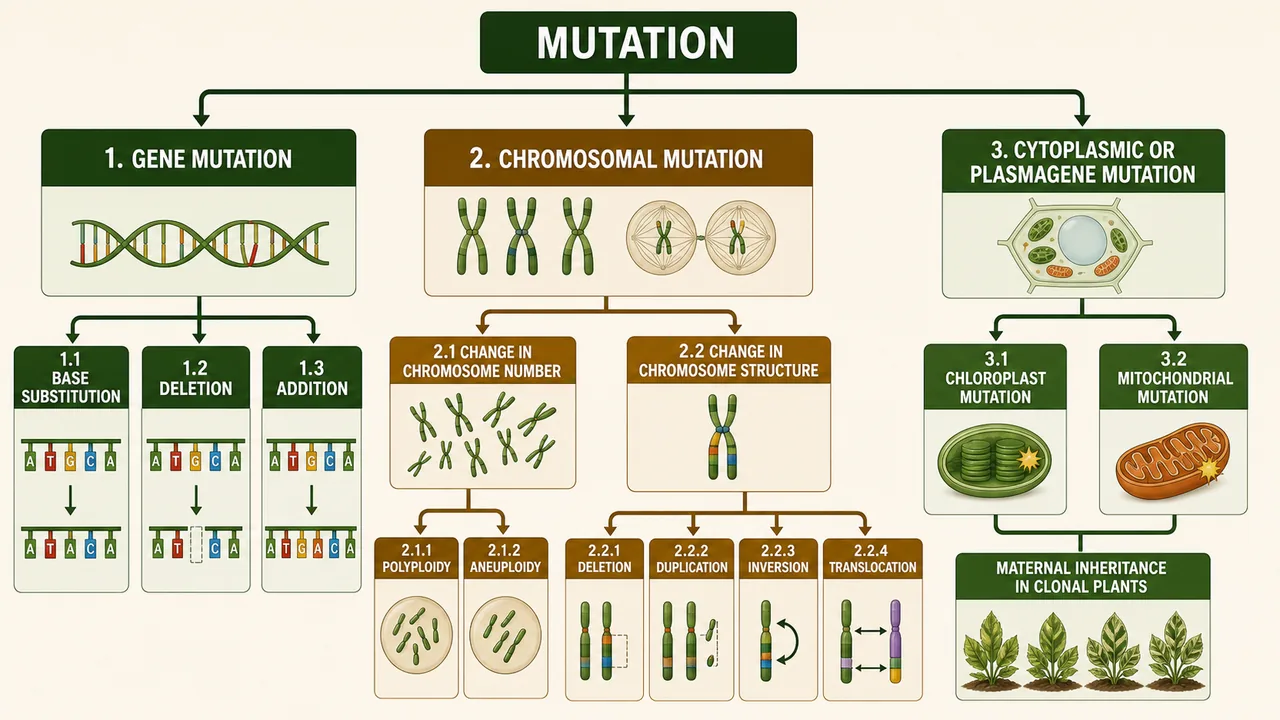
Chromosomal Mutation
- Change in number of chromosome (called Heteroploidy/Genomatic Mutation)
- Change in structure of Chromosome (called Chromosomal Aberration)
Change in Chromosome No. (Heteroploidy):
| Euploidy (Exact Multiple of one genome set) | Aneuploidy (One or Few Chromosomes extra or missing) |
|---|---|
| Auto polyploid: Auto triploid, Auto tetraploid, Auto pentaploid, Auto hexaploid, Auto octaploid | Hypo polyploid: Monosomy (2n - 1), Nullisomy (2n - 1), Doubly Monosomy (2n - 1 - 1) |
| Allo polyploid: Allo tetraploid, Allo hexaploid, Allo octaploid | Hyper polyploid: Trisomy (2n + 1), Tetrasomy (2n + 2), Double Trisomy (2n + 1 + 1) |
Heteroploidy/Genomatic Mutation
- Heteroploid = Hetero (Different) + Ploid (Multiple)
- Change in number of one or few chromosomes in a set or number of entire set of chromosome.
- It is of two types
- Euploidy -- Change in number of chromosome set
- Aneuploidy -- Change in number of chromosome in a set
- Individual carrying chromosome numbers other than the diploid (2x & not 2n) number are known as heteroploids and such situation is known as heteroploidy.
- x = basic chromosome no. or genomic number
- n = Somatic chromosome no. of the species whether diploid or polyploid.
- In a diploid species, n = x.
- The change in chromosome number may be either in an exact multiple of the basic number (i.e. Euploidy) or in not an exact multiple of the basic number.
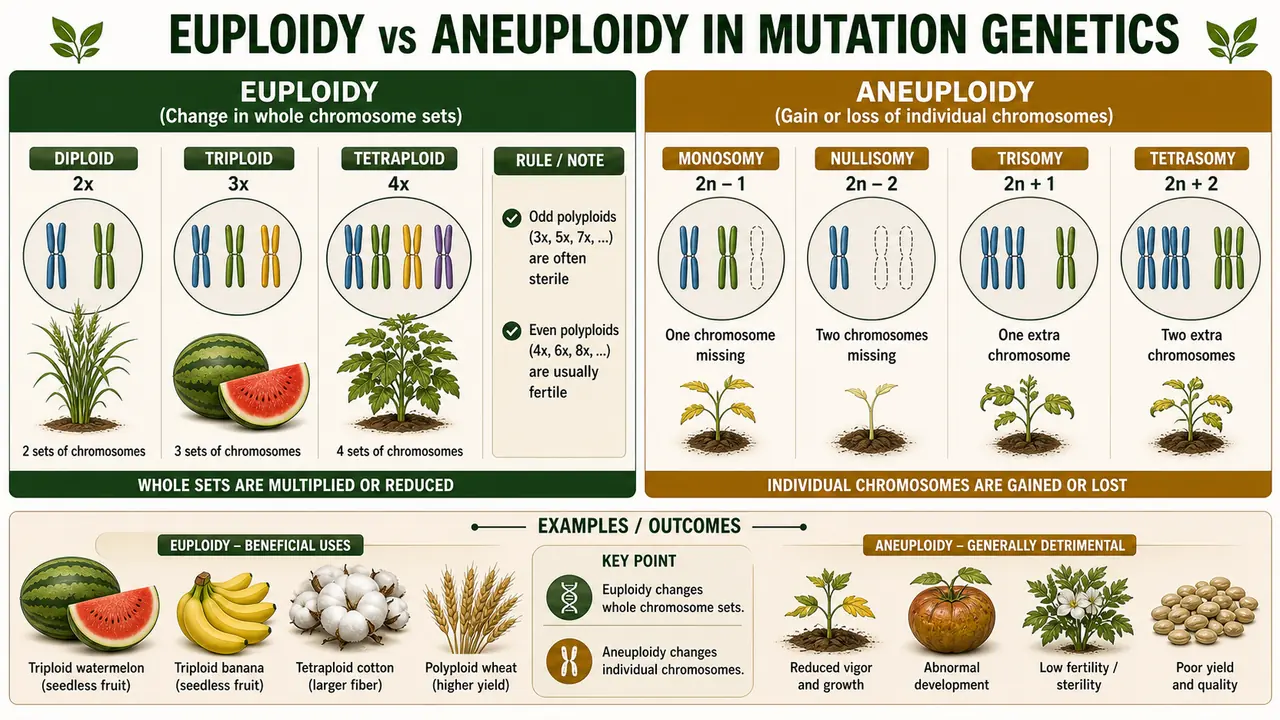
Euploidy
- Eu (good) Ploidy (multiple)
- Change in number of sets of chromosomes i.e. either loss or addition of sets of chromosomes.
- Euploidy is more commonly known as polyploidy. Polyploid is an individual having more than two basic or monoploid sets of chromosomes and the condition is known as polyploidy.
- Monoploidy (x): Presence of one set of chromosome
- Diploidy (2x): Presence of two set of chromosomes
- Polyploidy: Presence of more than two set of chromosomes. It may be:
- Triploidy (3x)
- Tetraploidy (4x)
- Pentaploidy (5x)
- Hexaploidy (6x)
- Heptaploidy (7x)
- Octaploidy (8x)
- Polyploid plants with even number of sets are always fertile, reproduce sexually and form seeds.
- Polyploid plants with odd number of sets are always sterile don't reproduce by sexual reproduction. They don't produce seeds but they may produce seedless fruits by parthenocarpy. Ex. Banana and seedless grapes.
👉🏻 Polyploid is of two types:
Autopolyploidy
- It is repetition of same set of chromosomes. Eg. AAA
- Autopolyploid plants are generally larger than their diploids but their fertility is somewhat reduced due to irregular chromosome pairing during meiosis.
- Cynadone and Rose are example of Autotriploid plants
- These are sterile plants.
- Reproduce by vegetative propagation.
Allopolyploidy
- More than one type of sets are present in these plants. Eg AABB
- These plants are obtained by intergeneric cross.
- Pairing between two or more homologous chromosomes (e.g. Raphanobrassica - cross between Raphanus sativus and Brassica oleracea) is called autosyndesis.
- Pairing between two or more non-homologous chromosomes whether it be complete or partial is called allosyndesis.
- Amphidiploid is an allopolypoid that has two copies of each genome and consequently behaves as a diploid during meiosis. A segmental allopolypoid contains 2 or more genomes which are identical with each other except for some minor differences.
Aneuploidy
- Loss or addition of chromosomes in a set of chromosomes. Unlike euploidy where entire sets change, aneuploidy involves changes in individual chromosomes.
- Types of Aneuploidy
Hypoaneuploidy (Loss)
- 2n - 1 = Monosomy: Loss of one chromosome in one set
- 2n - 1 - 1 = Double Monosomy: Loss of one chromosome from each set, but these are non-homologous
- 2n - 2 = Nullisomy: Loss of two homologous chromosomes
Hyperaneuploidy (Addition)
- 2n + 1 = Trisomy: Addition of one chromosome in one set
- 2n + 1 + 1 = Double Trisomy: Addition of one chromosome from each set, but these are non-homologous
- 2n + 2 = Tetrasomy: Addition of two homologous chromosomes
- The aneuploidy is the resultant of nondisjunction of chromosomes during cell division. Chromosome fails to separate during meiosis, so one daughter cell gets an extra chromosome and the other loses one.
- Chances of aneuploidy are more in higher age female due to less activity of oocyte, so chances of syndrome increase in children who are born from higher age female
- 1st synthesized species: Triticale by Rimpau (1890) (but with no full information like chromosome no.) from a cross between Triticum turgidum & Secale.
- 1st synthesized species with full information: Nicotiana digluta obtained by spontaneous chromosome doubling of F1 hybrid from interspecific cross between:

- Synthesized by Claussen & Goodspeed (1925).
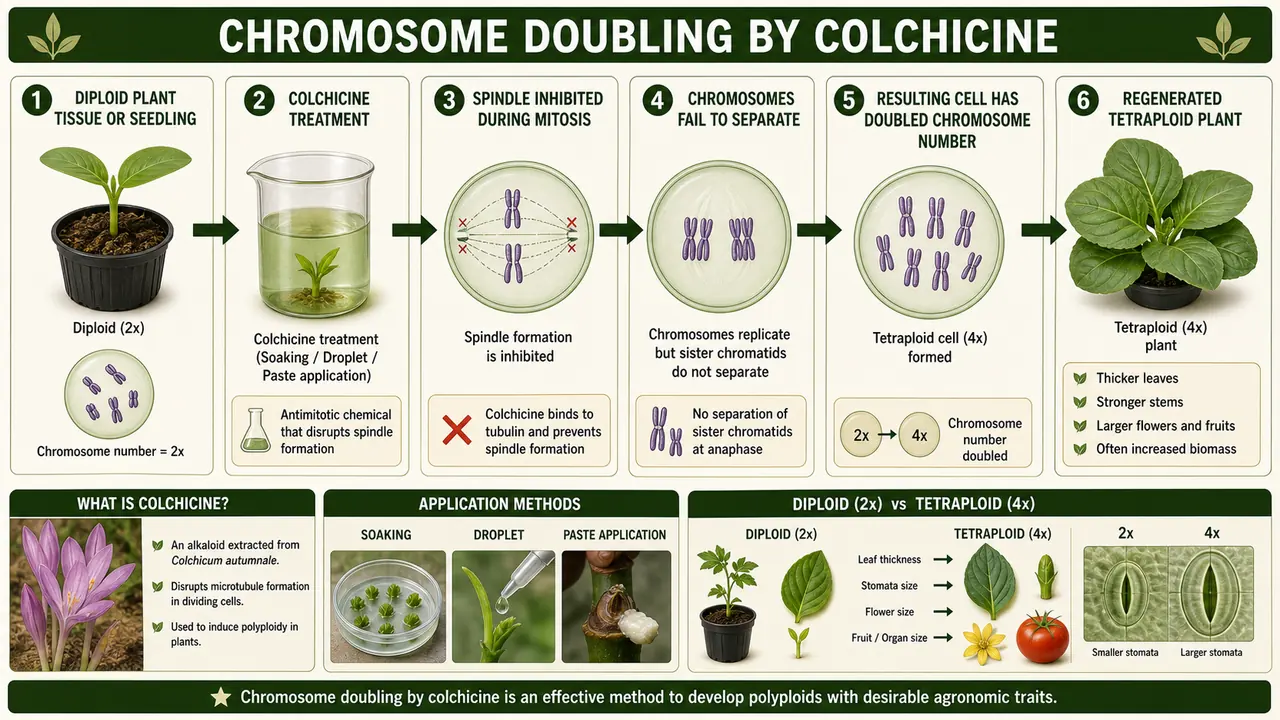
- The chromosome doubling action of colchicine was 1st described by Blakeslee and Nebel in 1937 but the effect of colchicine on mitosis was discovered in 1955.
- Colchicine is a poisonous chemical isolated from seeds (0.2 - 0.8%) and bulbs (0.1-0.5%) of autumn crocus (Colchicum automnale). Pure colchicine is C22O6N. It blocks spindle formation and thus inhibits movement of sister chromatids to the opposite poles. By preventing the spindle from forming, colchicine causes both sets of chromosomes to remain in the same cell, effectively doubling the chromosome number.
TIP
Colchicine is the most important chemical for chromosome doubling. Remember: source = Colchicum automnale (autumn crocus), mechanism = inhibits spindle formation.
- A trisomic (2n + 1) is known as primary trisomic when the extra chromosome is the same as one of the haploid genome means it is not modified. But when additional chromosome is an iso-chromosome (two arms of the chromosome are identical), it is called secondary trisomic and when the extra chromosome is translocated chromosome, it is called tertiary trisomic.
- The best source of aneuploids are triploid plants. Meiotic irregularities lead to formation of n + 1 and n - 1 gametes.
- Aneuploids are generally weaker than diploids. Monosomics don't survive in diploid species. Only trisomics survive in diploid species.
- Aneuploids are useful in locating a linkage group and a gene to a particular chromosome. Aneuploids are useful in production of substitution lines.
- Chromosome substitution means the transfer of a pair of chromosomes from one strain into a different strain. Chromosome substitution is easily done using nullisomics of the variety into which the chromosome is to be transferred (recurrent parent) but monosomics are used more commonly in place of nullisomics.
Features of autopolypoids
- Polyploids have larger cell size than diploids, larger guard cells of stomata, larger pollen grains, slower in growth and later flowering, larger and thicker leaves; larger Flowers & fruits but lesser in number than of diploids, reduced fertility due to meiotic irregularity and genotypic imbalances.
- Autotriploids are generally highly sterile e.g. water melons, but in some cases they are highly fertile e.g. spinach.
- In autotetraploid 4 chromosomes are homologous to each other, hence each gene has 4 copies.

- Autopolyploid played a limited role in the evolution of plant species. Autopolyploid crops are potato (4x), alfalfa (4x), banana (3x), sweet potato (6x).

Triploids
- Produced by hybridization between tetraploid and diploid strains; generally highly sterile, useful in production of seedless watermelons. Seedless watermelons are produced by crossing tetraploid (4x, female) and diploid (2x, male) lines and are grown commercially in Japan
- They do not produce true seeds.
- Triploid sugarbeets have larger roots and produce more sugar per unit area than diploids. Triploid sugarbeets were grown commercially in Europe and Japan but their popularity is declining. Seed production is difficult because beet flower is small.
- A triploid (3x) clone of tea (Camelia assamica) has been released for commercial cultivation in northern India. Triploid cultivar TV 29 produces larger shoots & biomass; yields more cured leaf per unit area and tolerant to drought than available diploid varieties.
- Triploids can't be maintained except through clonal propagation because their meiotic irregularities make sexual reproduction unreliable.
Tetraploids
- Some autotetraploids may be superior in some quality characters to their respective diploids e.g. tetraploid maize has 43% more carotenoid pigment and vitamin A.
- Certain distant crosses are not successful at the diploid level, but are relatively successful at the autotetraploid level e.g. 4x Brassica oleracea x B. chinensis is successful.
- Autotetraploid varieties of forage crops are proved successful e.g. tetraploid red clover (Trifolium pratense), rye grass (Lolium perenne), aliska clover (Trifolium hybridum variety Tetra) and Berseem (Trifolium alexandrium) variety Pusa Giant have been proved most successful.
- Autotetraploid red clover and ryegrass are more vigorous, more digestible and palatable and have greater resistance to nematodes as compared to diploids.
- Autotetraploid turnips (B. rapa) and cabbage (B. oleracea) are larger in size and have more water content than diploids. Many ornamental plants are autotetraploids which have increased flower size and longer flowering duration.
- Pusa Giant Berseem is the 1st autopolyploid variety released for general cultivation in India. It yields 20-30% more green fodder than diploid varieties. Sugandha is an autotetraploid variety of vetiver (Vetiveria zizanoides) which gives 11% more oil yield. Variety HMT-1 of Hyoscyamus niger is an autotetraploid which gives 15% more biomass and 36% more crude drug yield than diploid parent.
Allopolypoids
- The present day allopolypoids were most likely produced by chromosome doubling in F1 hybrids between two distinct species belonging to the same genera or to different genera. This process combines the genomes of two different species into a single organism.
- Homoeologous chromosomes (Partially homologous chromosome). The partially similar chromosomes but not exact identical, are called homoeologous chromosomes. Chromosomes of related species are partially similar to each other and are called homoeologous chromosomes. It means interspecific hybrids have two or more homoeologous chromosomes.
Amphidiploid
- An allopolyploid having two copies of each of the two or more different genomes present. Thus amphidiploid has the somatic chromosome complement of two or more diploid series.
- Diploidization: The process due to which allopolypoids show diploid like behaviour i.e. only bivalent formation, is known as diploidization. This is essential for the fertility and stability of allopolyploids.
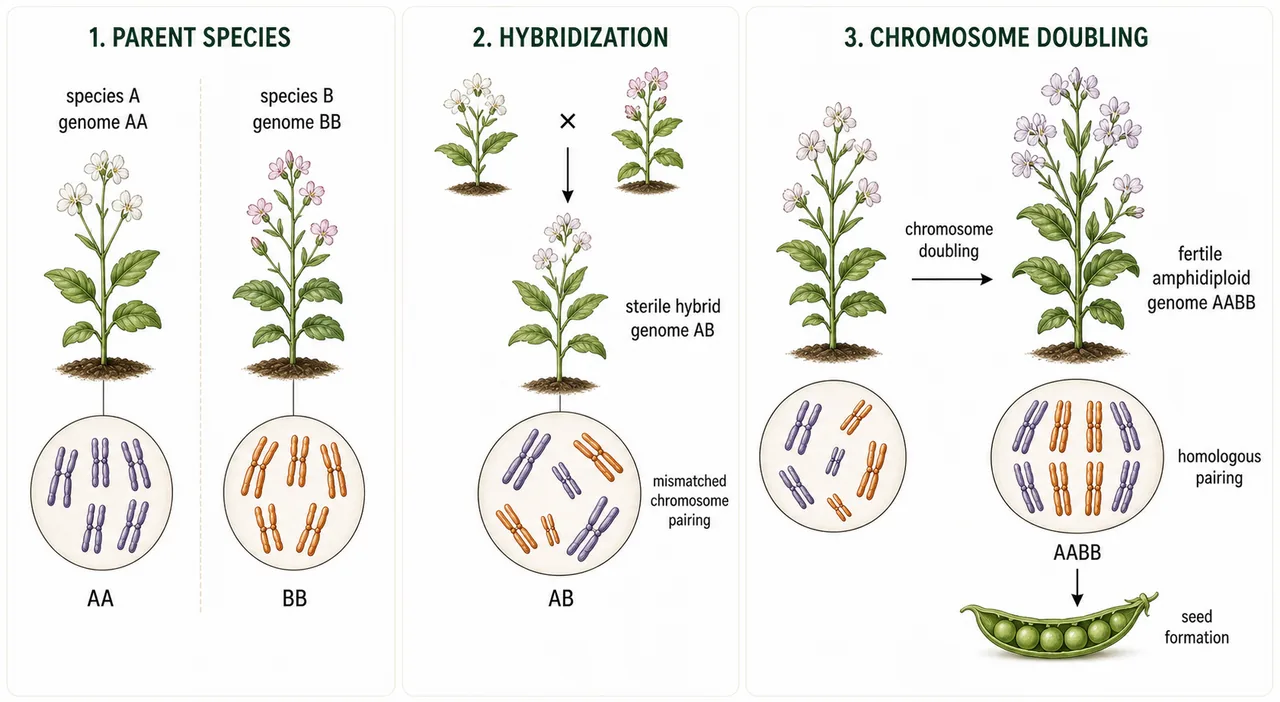
👉🏻 Synthesis of Triticale & Raphanobrassica

- Hardiness of rye (Secale cereale) and yielding ability of wheat (Triticum turgidum) were combined in Triticale hexaploide. This is one of the most successful examples of creating a new crop species through allopolyploidy.
- But in Raphanobrassica, the aim was not fulfilled. The aim in producing Raphanobrassica was to synthesize a crop species that would combine the root of radish (R. sativus) with the leaves of cabbage (B. oleracea).
- Raphanobrassica combined the leaves of radish and roots of cabbage -- exactly the opposite of what was desired. Triticale varieties are mainly grown in Poland, Germany & France. Many of allopolypoids are apomictic. Apomictic species are common in grasses e.g. Poa, Taraxacum, Parthenium, Rubus etc.
- Allopolypoids have been more successful as crop species than autopolypoids. About 1/3rd of the angiosperms are polypoids and by far the vast majority of them are allopolypoids. The synthetic allopolyploid does often resemble in many ways with natural allopolypoids.
👉🏻 Evolution of Bread wheat (Triticum aestivum)
- Bread wheat appeared about 8000 years ago as a hybrid between T. turgidum (female) and T. tauschii (male) possible in the regions of northern Iran and Armenia, where natural hybrids between T. turgidum & T. tauschii can be found in farmer's field.

- Genome of Wheat: ABD
- Previously considered that the source of 'B' genome was Aegilops speltoides and 'D' genome was Aegilops squarrosa. Understanding the genome composition of bread wheat has been crucial for utilizing wild relatives in wheat improvement programmes.
👉🏻 Evolution of Amphidiploid Brassica Species

- U's triangle showing the relationships between diploid and naturally occurring amphidiploid species of Brassica. The three diploid species are represented at the three tips of the triangle; their amphidiploids are presented midway between the parental species (and are encircled by doted circle).
- Letters within parentheses denote the genomic symbols. The origin of amphidiploid Brassica species is based on the famous U's triangle proposed by N.U. in 1935. This triangle elegantly explains how three basic diploid Brassica species gave rise to three amphidiploid species through natural hybridization and chromosome doubling.
👉🏻 Evolution of Nicotiana tabacum

👉🏻 Evolution of Gossypium hirsutum
Recent View

Old View

Chromosomal Aberration
👉🏻 Change in structure of chromosome. Unlike changes in chromosome number, chromosomal aberrations involve rearrangement, loss, or gain of chromosome segments without changing the total number of chromosomes.
Deletion
- Loss of a part or segment of chromosome which leads to loss of some genes is called as deletion.
- It is of two types:
Terminal Deletion
- Loss of chromosomal segment from one or both ends.
- E.g. The cry-du-chat syndrome is an example of terminal deletion in short arm of 5th Chromosome. This syndrome causes affected infants to produce a cry resembling that of a cat.

Intercalary Deletion
- Loss of chromosomal part between the ends. The two remaining segments rejoin, resulting in a shorter chromosome.

Inversion
- Breakage of chromosomal segment but reunion on same chromosome in reverse orders. It leads to change in distance between genes on chromosome or sequence of genes on chromosome so crossing over is affected.
- It is of two types:
Paracentric
- If inversion occur only in one arm and inverted segment does not include centromere.

Pericentric
- In this type of inversion inverted segment include centromere. This can change the arm ratio of the chromosome if the inversion is asymmetric.

Duplication
- Occurrence of a chromosomal segment twice on a chromosome. Duplications increase the amount of genetic material and can lead to gene dosage effects.
- Example: In drosophila "Bar eye character" is observed due to duplication in X-chromosome. Bar eye is a character where eyes are narrower as compared to normal eye shape.

Translocation
- In this, a part of the chromosome is broken and may be joined with non-homologous chromosome. This is also known as illegitimate crossing over (illegal crossing over). Translocation can bring genes from different linkage groups together, creating new gene associations.
- Three types of translocation:
Simple Translocation
- When a chromosomal segment breaks and attached to the terminal end of a non-homologous chromosome.

Interstitial or shift translocation
- If a segment of chromosome breaks and gets inserted in interstitial position of a non-homologous chromosome.

Reciprocal Translocation
- Exchange of segments between two non-homologous chromosomes. Both chromosomes exchange parts with each other.
- Ex. Chronic myeloid leukemia (CML) is a type of blood cancer. This disease is result of reciprocal translocation between 22 and 9 chromosome.
- Note: If exchange of segments takes place in between homologous chromosomes then it is called crossing over.

Gene Mutation or Point Mutation
👉🏻 Mutation produced by changes in the base sequences of genes are known as gene or point mutation. These are the smallest possible mutations, affecting just one or a few nucleotide bases. It is of two types:
Substitution
- Replacement of one nitrogenous base by another nitrogenous base is called substitution.
- It cause change in one codon in genetic code which leads to change in one amino acid in structure of protein.
- Eg. Sickle Cell Anemia -- where a single base substitution in the hemoglobin gene changes one amino acid, altering the shape and function of red blood cells.
- Types:
- Transition
- Transversion
Transition
- Here a purine is replaced by another purine e.g. Adenine is replaced by Guanine or vice-versa; or a Pyrimidine is replaced by another Pyrimidine e.g. Thymine is replaced by Cytosine or vice versa. One base substitution affects only one codon thus only one amino acid is altered. The transitional substitution occur due to
- Tautomerization: The tautomeric shifts occur due to shifts in electrons or protons in the normal nitrogen bases to convert them in their rare states or tautomers. Due to tautomerization, the amino form (NH2) of cytosine and adenine may convert into amino (-NH) tautomers and keto (C = O) forms of thymine and guanine may convert into enol (C-OH) tautomers. The tautomers loss their linkage capacity with their normal partners, thus a tautomer of amine may link with cytosine instead of linking with its normal partner thymine.
- Deamination: The amino group (-NH2) of a DNA base is replaced by a hydroxyl (-OH) group. Deamination converts cytosine to uracil which pairs with adenine and guanine to xanthine which pairs by two hydrogen bonds with cytosine.
- Base analogues: Certain chemical substances having similar molecular structure to the usual DNA bases, are called base analogues. e.g. 5-bromo uracil (5 BUe) in its keto form (BUk) is a structural analogue to thymine (5-methyl uracil).
Transversion
- The substitution or replacement of a purine (adenine or guanine) by pyrimidine (thymine or cytosine) or vice-verse is called transversion. Since a purine is being replaced by the other class of base (pyrimidine) or vice versa, transversions represent a more dramatic structural change than transitions.
- There are eight different types of possible transversions. i.e.
- A to T, A to C, G to C, G to T
- T to A, C to A, C to G, T to G
- One transversion affects only one codon and hence replaces only one amino acid in the concerned protein. The transversion mutation is first of all reported by Freese (1959).
Frame Shift Mutation/Gibbrerish Mutation
- Loss or addition of one or rarely more than one nitrogenous bases in structure of DNA. This causes the entire reading frame of the genetic code to shift, which is why it is called a frame shift mutation.
- Frame shift mutation is of two types:
- Addition: Addition of one or rarely more than one nitrogenous bases in structure of DNA.
- Deletion: Loss of one or rarely more than one nitrogenous bases in structure of DNA.
- Due to frame shift mutation complete reading of genetic code is changed. It leads to change in all amino acids. In structure of protein so a new protein is formed which is completely different from previous protein.
- So frame shift mutation are more harmful as compared to substitution because they affect every codon downstream of the mutation, not just one.
- Eg. Thallesemia (lethal genetic disorder)
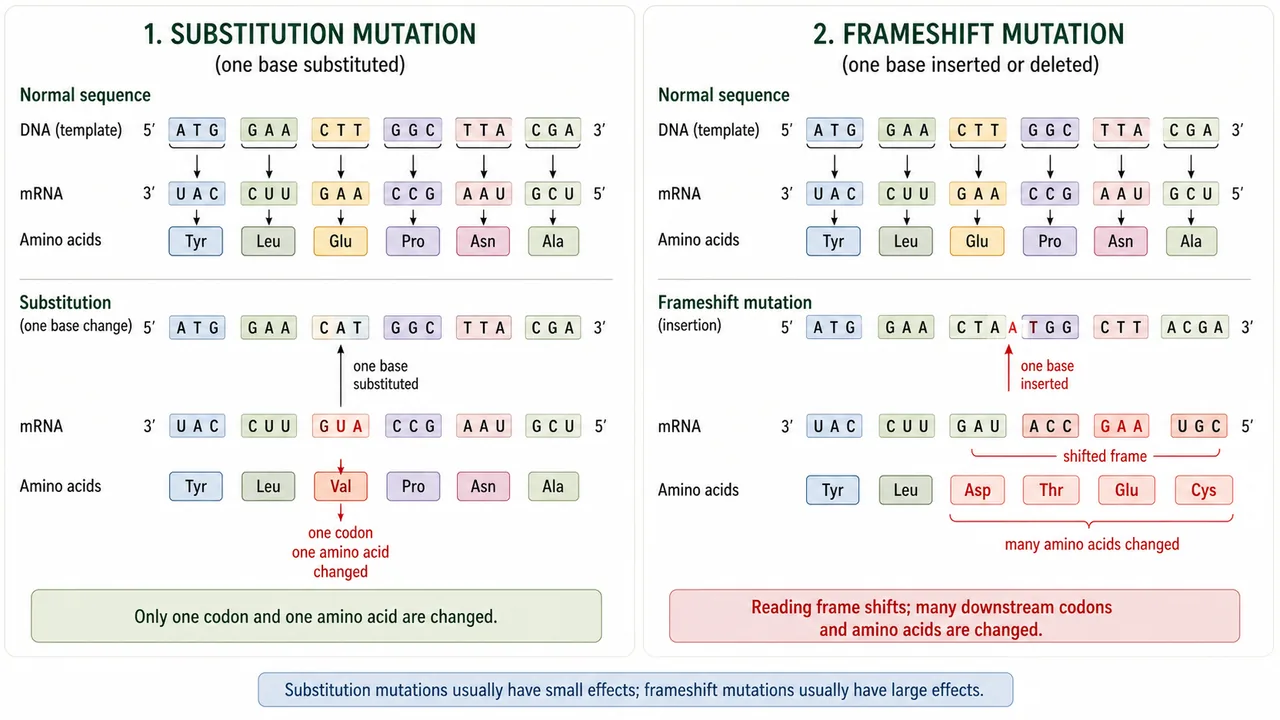
Mutagens
- Mutagenic action of X-rays was discovered by Muller in 1927 on Drosophila and of gamma-rays and X-rays in 1928 by Stadler in barley (H. vulgare) & maize (Z. mays). Muller was awarded Nobel Prize in 1946 for this discovery.
- Immediately after Muller's discovery, the Swedish mutation breeding programme was started in 1929 by Nilsson-Ehle.
- Mutagens are the agents used for inducing mutations. Mutagen may be physical or chemical.
Physical mutagens
- Different kinds of radiations are called physical mutagens.
Ionizing radiations
- Particulate radiations: E.g. alpha-rays (Densely Ionizing), beta-rays (sparsely ionising), Fast neutrons (densely ionising) & Thermal neutrons (densely ionising)
- Non-particulate radiations: (Electromagnetic Radiations): E.g. X-rays (sparsely ionising) & gamma-rays (sparsely ionising).
Non-ionising radiations.
- E.g. Ultraviolet (UV) radiations. UV rays lack sufficient energy to ionize atoms but can still cause chemical changes in DNA.
Chemical mutagens
- Certain chemicals inducing mutations are called chemical mutagens.
- Chemical mutagens are more harmful than radiation because body is not protected against chemicals.
- Source of chemical mutagens are food, air and water.
- Effect of radiation is localized, while chemical mutagens spread in complete body through blood circulation and when they reach in gonads they cause germinal mutation.
- Chemicals also cause chromosomal mutations.
Alkylating agents
- EMS -- Ethyl Methane Sulphonate
- MMS -- Methyl Methane Sulphonate
- These chemicals causes depurination means they remove one purine from structure of DNA. So a gap is formed. If this gap is filled by another purine then is called as transition.
- But if this gap is filled by pyrimidine then it is called as transversion.
- So, EMS and MMS may cause both transition and transversion. EMS is the most widely used chemical mutagen in plant breeding because it produces a high frequency of point mutations with relatively few chromosomal aberrations.
Acridine dyes
- E.g. Acriflavine, Proflavine, Acridine orange, Acridine yellow, Ethidium bromide. These chemicals intercalate (insert themselves) between adjacent base pairs of DNA, causing frame shift mutations by inducing additions or deletions during DNA replication.
Base analogues
- Those chemicals which are same as nitrogenous base in function. They are called base analogues or duplicates of nitrogenous base.
- E.g. Aminopurine is base analogue to Adenine (purine), 5-bromo uracil is base analogue to thymine.
Other
E.g.
- Mustard Gas (First Identified as Chemical Mutagen) -- discovered to have mutagenic properties during World War I studies
- Hydroxyl amine
- Sodium azide -- particularly effective in barley and other cereals
- Nitrous acid (HNO2)
- HNO2 change normal structure of nitrogenous base and changed nitrogenous base is called Tautomer.
- HNO2 cause deamination of nitrogenous base means they remove amino group from nitrogenous base.

- In DNA replication, Tautomer of adenine pairs with a normal cytosine and Tautomer of thymine pairs with normal guanine.
- It is usual pairing which is called as forbidden pairing so a wrong type of DNA is formed in cell.
Roentgen
- Exposure to radiation is measured in Roentgen (R) units. Roentgen is the electric charge produced in dry air under standard conditions by X-rays or gamma-rays divided by mass of air.
- 1 R = 2.58 x 10⁻⁴ coulomb/kg air
- One coulomb is the charge that flows in one second through a conductor that is carrying a current of one ampere. One electron has a charge of 1.6 x 10⁻¹⁹ Coulomb.
- LET (Linear Energy Transfer): is the amount of energy deposited or lost by a particle/photon per unit length of its path. LET is a crucial concept because it determines the density of ionization and hence the biological effect of different types of radiation.
- Sparsely ionising radiations (SIR): Such radiations which produce a few ionisations per micron of its path having low LET value, are called sparsely ionising radiations e.g. X-rays & gamma-rays.
- Densely ionising radiations (DIR): Such radiations produce several ionisation per micron having high LET. e.g. alpha-particles & fast & thermal neutrons.
- Alpha-rays: (alpha-particles) Alpha-particle has 2 protons & 2 neutrons thus having ++ charges and is produced by fission of radioactive isotopes of heavier elements. After losing energy, each alpha-particle capturing 2 electrons produces an atom of helium. Alpha-particle has much less penetrating power than neutrons and beta-rays. Alpha-rays move in straight line.
- Beta rays (beta-rays): High energy electrons produced by decay of radioactive isotopes e.g. 3H, 32P, 35S etc. Beta-rays move in a zig-zag line because electrons are easily deflected by atoms in their path. Electrons liberated as a result of ionisation also produce ionization & excitation i.e. they behave like beta-rays. Beta-rays have more penetrating power than alpha-rays but very little Compared to x-rays.
- Fast & thermal Neutrons: Fast neutrons are produced in cyclotrons or atomic reactors as a result of radioactive decay of heavier elements. Its velocity is reduced by graphite or heavy water to generate thermal or slow neutrons. Neutrons are uncharged particles and are highly penetrating in biological tissues. They move in a straight line and do not cause ionisation directly.
- X-rays & Gamma (gamma) rays: are electromagnetic radiations (high energy) consist of photons. X-rays are produced by X-ray tubes. Gamma-rays are produced by radioactive decay of certain elements like 14C, 60Co. etc.
- 60Co is the common source of gamma-rays used for biological studies. X-rays having wavelength 0.1-0.001 A degrees are called hard X-rays and having 10-1 A degrees wavelength are called soft X-rays. The electromagnetic radiations produce photo-electric effect, Crompton scattering & pair production. Wavelength of x-rays & gamma-rays = 0.001-10 A degrees. (1 A degree = 10-10 m).
- Ultraviolet (UV-rays): Wavelength of UV-rays: 100-3900 A degrees.
- UV-rays are present in solar radiation and are produced by mercury vapour lamps or tubes. UV-rays are low energy radiation. UV-rays are known for dimer formation and deamination. The most effective wavelength of UV rays is 2540 A degrees since DNA bases show maximum absorption at this wavelength.
- Oxygen effect: Oxygen enhances the biological effects of particularly low LET radiations. This means that cells irradiated in the presence of oxygen show more mutation and damage than those irradiated in anaerobic conditions.
- Mutagenesis: Treating of a biological material with a mutagen in order to induce mutations is known as mutagenesis. This is the foundation of mutation breeding programmes worldwide.
Summary Cheat Sheet
| Concept / Topic | Key Details |
|---|---|
| Mutation | Sudden heritable change in DNA sequence |
| Term coined by | Hugo de Vries (1901) — Mutation Theory |
| De Vries worked on | Oenothera lamarckiana (evening primrose) |
| Gene / Point mutation | Change in single nucleotide; most common type |
| Chromosomal mutation | Change in chromosome structure or number |
| Spontaneous mutation | Occurs naturally; very low frequency (~10⁻⁶) |
| Induced mutation | Caused by mutagens (physical or chemical agents) |
| First induced mutations | H.J. Muller (1927) — X-rays on Drosophila (Nobel 1946) |
| Transition | Purine ↔ Purine or Pyrimidine ↔ Pyrimidine |
| Transversion | Purine ↔ Pyrimidine |
| Forward mutation | Wild type → mutant |
| Back / Reverse mutation | Mutant → wild type (reversion) |
| Most mutations are | Recessive and harmful |
| Beneficial mutations | Rare but basis of evolution and crop improvement |
| Somatic mutation | In body cells; not inherited sexually (only vegetatively) |
| Germinal mutation | In reproductive cells; inherited by offspring |