🌩 Mutation Breeding: Procedure, Mutagens, and Achievements
Understand mutation breeding procedures for oligogenic and polygenic traits, physical and chemical mutagens, gamma gardens, and successful mutant varieties — with exam tips.
Why Mutation Breeding Matters in Agriculture
Over 3,300 mutant crop varieties have been officially released worldwide — from the groundnut variety TG-1 in India (developed using gamma rays) to the barley variety Golden Promise in the UK. Mutation breeding is especially valuable when a desired trait does not exist in the available germplasm, or when a breeder wants to improve one specific trait in an otherwise excellent variety without disrupting its entire genetic background.
- When mutations are induced for crop improvement, the entire operation of the induction and isolation, etc. of mutants is called mutation breeding. It is a powerful technique that allows breeders to create new genetic variation that may not exist in the natural germplasm.
- Seeds, pollen grains or vegetative propagules (buds & cuttings) may be used for mutagenesis. In sexually propagated crops, seeds are the most commonly used plant part. In case of clonal crops buds or cuttings are used for mutagenesis. Chemical mutagens are best used with seeds.
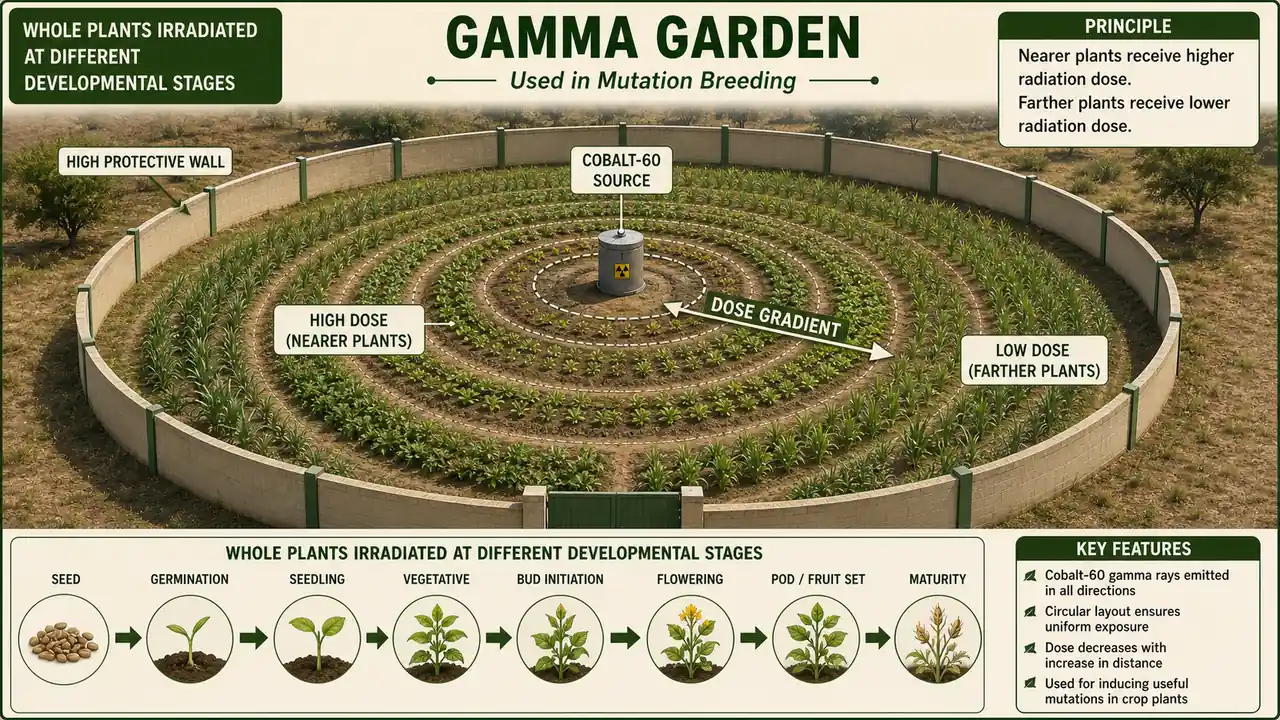
- Whole plants are generally irradiated during the flowering stage so that it is equivalent to irradiation of pollen grains and egg cells. Treatment of whole plants requires special facilities i.e. a gamma garden.
Gamma garden
- It is an area subjected to gamma-irradiation. This area is enclosed by thick high walls to prevent radiation from escaping and harming people outside. The purpose of gamma-garden is to irradiate whole plants during different stages of development and for varying durations. The source is in centre, and plants are arranged at various distances from it -- plants closer to the source receive higher doses.
- First gamma-garden was built in Long Island near New York (USA).
- The first gamma-garden in India was installed in Calcutta (Kolkata) at Bose Research Institute in 1959.
- In 1960 2nd gamma-garden was built at IARI, New Delhi. 3rd gamma-garden was built at Bhabha Atomic Research Centre, Trombay.
- The source of gamma-garden was 6g of 60Co in form of small pellets. The strength of 60Co source was 200 curies.
- The gamma-garden at IARI & BARC and at most other places in the world have now been dismantled because of their high Cost.
Optimum dose of mutagen
👉🏻 Selection of the variety for mutagen treatment
Pro Content Locked
Upgrade to Pro to access this lesson and all other premium content.
Charged once for one year · ₹1188 total
Save ₹100/month vs ₹2388/year launch price
- All Agriculture & Banking Courses
- AI Lesson Questions (100/day)
- AI Doubt Solver (50/day)
- Glows & Grows Feedback (30/day)
- AI Section Quiz (20/day)
- 22-Language Translation (100/day)
- Recall Questions (20/day)
- AI Quiz (15/day)
- AI Quiz Paper Analysis (100/day)
- AI Step-by-Step Explanations (100/day)
- Spaced Repetition Recall (FSRS)
- AI Tutor
- Immersive Text Questions
- Audio Lessons — Hindi & English
- Mock Tests & Previous Year Papers
- Summary & Mind Maps
- XP, Levels, Leaderboard & Badges
- Generate New Classrooms
- Voice AI Teacher (AgriDots Live)
- AI Revision Assistant
- Knowledge Gap Analysis
- Interactive Revision (LangGraph)
🔒 Secure one-time yearly payment via Razorpay · No hidden fees
Why Mutation Breeding Matters in Agriculture
Over 3,300 mutant crop varieties have been officially released worldwide — from the groundnut variety TG-1 in India (developed using gamma rays) to the barley variety Golden Promise in the UK. Mutation breeding is especially valuable when a desired trait does not exist in the available germplasm, or when a breeder wants to improve one specific trait in an otherwise excellent variety without disrupting its entire genetic background.
- When mutations are induced for crop improvement, the entire operation of the induction and isolation, etc. of mutants is called mutation breeding. It is a powerful technique that allows breeders to create new genetic variation that may not exist in the natural germplasm.
- Seeds, pollen grains or vegetative propagules (buds & cuttings) may be used for mutagenesis. In sexually propagated crops, seeds are the most commonly used plant part. In case of clonal crops buds or cuttings are used for mutagenesis. Chemical mutagens are best used with seeds.
- Whole plants are generally irradiated during the flowering stage so that it is equivalent to irradiation of pollen grains and egg cells. Treatment of whole plants requires special facilities i.e. a gamma garden.
Gamma garden
- It is an area subjected to gamma-irradiation. This area is enclosed by thick high walls to prevent radiation from escaping and harming people outside. The purpose of gamma-garden is to irradiate whole plants during different stages of development and for varying durations. The source is in centre, and plants are arranged at various distances from it -- plants closer to the source receive higher doses.
- First gamma-garden was built in Long Island near New York (USA).
- The first gamma-garden in India was installed in Calcutta (Kolkata) at Bose Research Institute in 1959.
- In 1960 2nd gamma-garden was built at IARI, New Delhi. 3rd gamma-garden was built at Bhabha Atomic Research Centre, Trombay.
- The source of gamma-garden was 6g of 60Co in form of small pellets. The strength of 60Co source was 200 curies.
- The gamma-garden at IARI & BARC and at most other places in the world have now been dismantled because of their high Cost.
Optimum dose of mutagen
👉🏻 Selection of the variety for mutagen treatment
- The variety selected for mutagenesis should be the best available in the crop. This ensures that the mutant retains most of the desirable traits of the parent variety while gaining the new trait induced by mutation.
- An optimum dose is the one which produces the maximum frequency of mutations and causes the minimum killing. A dose close to LD50 is the optimum.
- LD50 is the dose of mutagen which would kill 50% of the treated individuals.
IMPORTANT
LD50 (Lethal Dose 50) is the standard benchmark for determining the optimum mutagen dose in mutation breeding experiments. At this dose, a balance is struck between generating enough mutations and retaining enough surviving plants for screening.
- Treatment of seeds and vegetative propagules commonly produces chimeras.
- A chimera is an individual with one genotype in some of its parts and another genotype in the others. Chimeras form because the mutation occurs in only one or a few cells of the treated tissue, so the resulting plant is a mixture of mutated and non-mutated sectors.

Irradiation
- Exposure of a biological material to alpha-radiation like X-rays, gamma-rays etc. is known as irradiation. The primary effect of radiation is ionisation; the mechanism of ionisation differs to some extent from one radiation to other.
- Genetic effects of radiation i.e. effects on DNA means
- The change in a base i.e. deamination
- The loss of a base
- Breaking of hydrogen bonds in DNA
- Breaking in single and double strand of DNA
- Cross-linking of DNA strands
- Pyrimidines are more sensitive to radiation damage than purines
- Deamination and intrastrand dimerization of bases may lead to change base pairing producing changes in the base lead to sequence of DNA i.e. gene mutation.
Procedure for irradiation
👉🏻 The plant material may be treated in any of the following source.
- Seeds: Seeds are used after soaking to get greater frequency of induced mutations than air dried. Soaking increases the water content of seeds, making DNA more susceptible to radiation effects.
- Seedlings: At any stage of life cycle can be subjected to radiation but usually seedlings neither too young nor too old are irradiated due to their convenience in handling in pots transportation from nursery easily.
- Flowers: Meiotic cells have been found more sensitive than the mitotic cells and therefore plants are irradiated in the flowering stage in order to affect the developing gametes. This results in heritable mutations transmitted through the seeds.
- Cuttings: In case of fruit tree when they are propagated by clones -- the desirable cuttings are exposed to irradiation.
Mutation Breeding for oligogenic traits
👉🏻 The handling procedure described here is based on the selection for a recessive mutant allele of an oligogene. Since most induced mutations are recessive, they are not expressed in M1 and must be detected in M2 when they can appear in homozygous form.
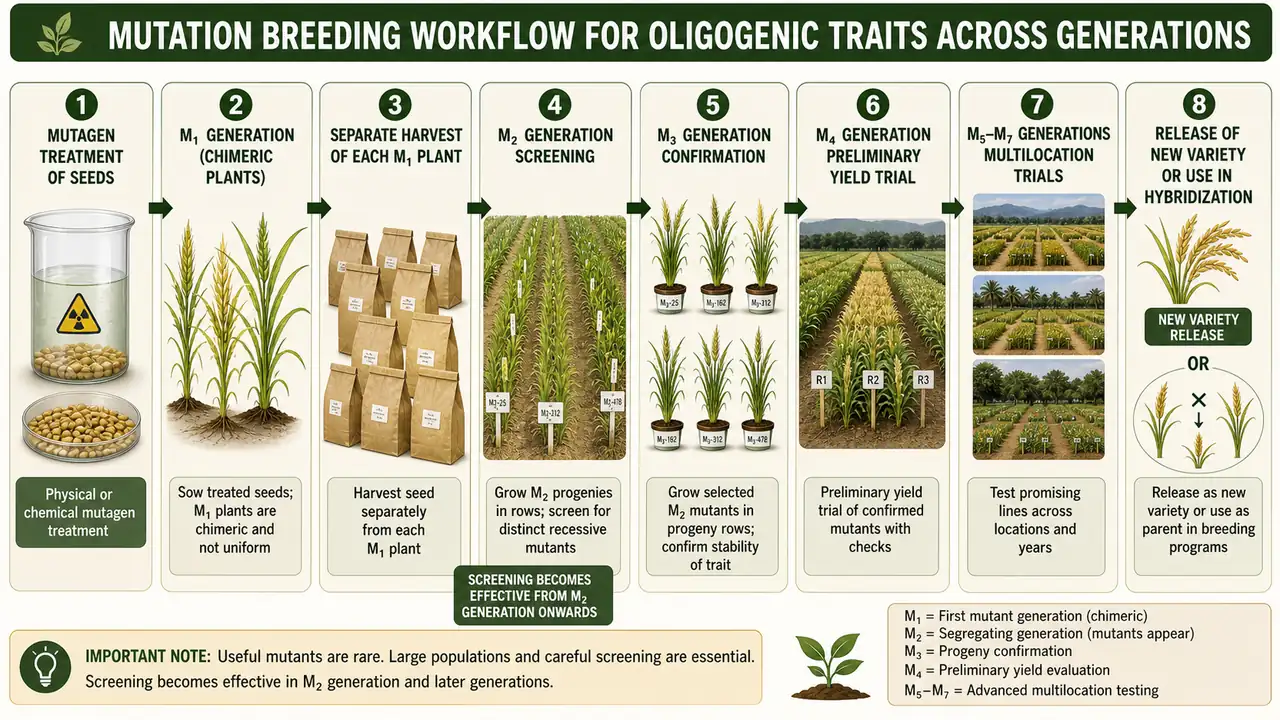
- M1. Several hundred seeds are treated with a mutagen and are space planted. In general, the number of treated seeds is so adjusted as to give rise to 500 fertile M1 plants at the harvest. Care should be taken to avoid outcrossing; this can be achieved either by planting the M1 population in isolation or by bagging the inflorescences of M1 plants or even the whole M1 plants. M1 plants will be chimeras for the mutations present in heterozygous state. About 20 to 25 seeds from each M1 spike are harvested separately to raise the M2 progeny rows.
- M2. About 2,000 progeny rows are grown. Careful and regular observations are made on the M2 rows. But only distinct mutations are detected in M2 because the observations are based on single plants. All the plants in M2 rows suspected of containing new mutations are harvested separately to raise individual plant progenies in M3. If the mutant is distinct, it is selected for multiplication and testing. However, most of the mutations will be useless for crop improvement. Only 1 -3 per cent of M2 rows may be expected to have beneficial mutations. Alternatively, M2 may be grown as a bulk produced by compositing one or more, but equal number of, seeds from each M1 spike/fruit/branch. Individual plants are then selected in M2 and individual plant progenies are grown in M3.
- M3. Progeny rows from individual selected plants are grown in M3. Poor and inferior mutant rows are eliminated. If the mutant progenies are homogeneous, two or more M3 progenies containing the same mutation may be bulked. Mutant M3 rows are harvested in bulk for a preliminary yield trial in M4.
-
M4. A preliminary yield trial is conducted with a suitable check, and promising mutant lines are selected for replicated multi-location trials.
-
M5-M7. Replicated multilocation yield trials are conducted. The outstanding line may be released as a new variety. The low yielding mutant lines, however, should be retained for use in hybridization programmes as they may carry valuable genes for other traits.
Mutation breeding for polygenic traits
👉🏻 Mutagenesis does produce genetic variation in polygenic traits; this variation is usually as much as 50% of that generated in F2 generation, but sometimes it may be as much as or even greater than the latter. Polygenic traits like yield require more careful screening because the mutant effects are small and easily masked by environmental variation.
- M1 and M2. M1 and M2 are grown in the same way as in the case of oligogenic traits. In M2, vigorous, fertile and normal looking plants that do not exhibit a mutant phenotype are selected and their seeds are harvested separately to raise individual plant progeny rows in M3. The rationale is that polygenic mutations do not produce visible phenotypic changes in individual plants.
- M3. Progeny rows from individual selected plants are grown. Careful observations are made on M3 rows for small deviations in phenotype from the parent variety. Inferior rows are discarded. Few rows may be homogeneous and would be harvested in bulk. Selection is done in M3 rows showing segregation; a majority of M3 rows would show segregation. Intensive and careful evaluation of a large number of M3 progeny rows allows identification of mutants with altered quantitative traits, e.g., partial or horizontal disease resistance. Such mutants occur in high frequencies that approach 1% or even high, so that their isolation becomes quite cost effective.
-
M4. Bulked seed from homogeneous M3 rows may be planted in a preliminary yield trial with a suitable check; superior progenies are selected for replicated multilocation yield trials. Individual plant progenies from M3 are critically observed. Progenies showing segregation may be subjected to selection only if they are promising. Superior homogeneous progenies are harvested in bulk for preliminary yield tests in M5.
-
M5-M8. Preliminary yield trials and / or multi-location trials are conducted depending upon the stage when the progenies become homogeneous. Outstanding progenies may be released as new varieties.
Applications of Mutation Breeding
- Mutation breeding has been used for improving both oligogenic as well as polygenic characters.
- Mutagenesis has been used to improve morphological and physiological characters including yielding ability.
- Various applications of mutation breeding are:
- Induction of desirable mutant alleles which may not be available in the germplasm. This is the unique advantage of mutation breeding over other methods.
- It is useful in improving specific characteristics of a well-adapted high yielding variety. Instead of replacing an entire variety, mutation can correct a single deficiency while keeping all other desirable traits intact.
- Mutagenesis has been successfully used to improve various quantitative characters including yield.
- F1 hybrids from intervarietal crosses may be treated with mutagens in order to increase genetic variability by inducing mutation and to facilitate recombination of linked genes.
- Irradiation of interspecific (distant) hybrids has been done to produce translocations.
✅ Advantages
- Mutation create inexhaustible variation. There is virtually no limit to the types of genetic changes that can be induced.
- When no improvement is possible through other methods, this method has to be adopted. It is the method of last resort when desired genes are not found anywhere in the germplasm.
❌ Limitations
- Frequency of desirable mutations is very low about 0.1 percent. To detect the desirable one in M2 considerable time, labour & other resources are to be employed.
- To screen large population, efficient, quick and inexpensive selection techniques are needed.
- Desirable mutations may be associated with undesirable side effects due to other mutations thus extending the mutation breeding programme. This phenomenon is called pleiotropy of linked mutations.
- Detection of recessive mutations in polyploids and clones is difficult and larger doses of mutagen have to be applied and larger populations are to be grown.
🏆 Achievements
- Natural mutants:
- Rice:
- GFB 24 -- arose as a mutant from Konamani variety. Dee-Gee-Woo-Gen -- Arose as a mutant from rice in China. This particular mutant is historically significant as it carries the semi-dwarf gene that contributed to the Green Revolution in rice.
- MTU 20 -- arose as a mutant from MTU-3
- Sorghum: Co. 18 -- arose as a mutant from Co. 2
- Cotton: DB 3-12 from G. heroaccum variety Western 1
- Rice:
- Induced mutants:
- Rice: Jagannath - Gamma ray induced mutant from T.141
- Wheat: Sarbati Sonora - Sonora-64 was gamma irradiated by M.S. Swaminathan and named them Sarbati-Sonora. This variety became widely popular in India for its improved grain quality.
- Cotton:
- Indore 2 Induced from Malwa upland 4
- MLU 7 gamma ray induced mutant from culture 1143 EE
- MLU 10 gamma ray induced mutant from MLU 4
- Mustard: Primax whicte (1950)
- Sugarcane: Co.8152 gamma ray induced mutant from Co. 52
- Groundnut: NC 4
- Castor: Aruna (NPH1) -- Fast neutrons induced mutant from HC 6
- China has developed the largest number of mutant varieties followed by India, Russia & Japan.
TIP
For exam recall: Country ranking for mutant varieties = China > India > Russia > Japan. Key Indian mutants: Sarbati Sonora (wheat), Jagannath (rice), Aruna (castor).

Polyploidy
- The somatic chromosome number of any species, whether diploid or polyploidy, is designated as 2n, and the chromosome number of gametes is denoted as n. An individual carrying the gametic chromosome number, n, is known as haploid.
- A monoploid, on the other hand, has the basic chromosome number, x. In a diploid species, n = x; one x constitutes a genome or chromosome complement. The different chromosomes of a single genome are distinct from each other in morphology and or gene content and homology; members of a single genome do not show a tendency of pairing with each other. Thus a diploid species has two, a triploid has 3 and a tetraploid has 4 genomes and so on.
- In diploid species, the haploid number and monoploid number are the same (n = x), but in polyploids they may differ. For example, a haploid derived from a tetraploid is often called a dihaploid or double haploid after chromosome doubling restores full homozygosity.
- Haploids are usually small, weak, and sterile because regular meiotic pairing is not possible, but their breeding value is very high because chromosome doubling in a haploid instantly creates a completely homozygous line that would otherwise require many generations of selfing.
- Historically, the first induced haploid is credited to Jorgensen (1928), and the first haploid through pollen culture was produced by Guha and Maheshwari (1964) in Datura.
- A classic applied route is the bulbosum technique, developed by Kasha and Kao (1970) for barley by crossing Hordeum vulgare × H. bulbosum; chromosome elimination from the wild parent leaves a haploid barley embryo that can then be chromosome-doubled. The same principle was later extended to wheat.
- In euploids, the chromosome number is an exact multiple of the basic or genomic number. Euploidy is more commonly known as polyploidy.
- When all the genomes present in a polyploidy species are identical, it is known as autopolyploid and the situation is termed as autopolyploidy.
- In the case of allopolyploids, two or more distinct genomes are present. Euploids may have 3 (triploid), 4 (tetraploid), 5 (pentaploid), or more genomes making up their somatic chromosome number. In case of autopolyploidy, they are known as autotriploid, autotetraploid, autopentaploid, and so on, while in the case of allopolyploidy they are termed as allotriploid, allotetraploid, allopentaploid, etc.
- Amphidiploid is an allopolyploid that has two copies of each genome present in it and, as a consequence, behaves as a diploid during meiosis. A segmental allopolyploid contains two or more genomes, which are identical with each other, except for some minor differences.
👉🏻 Origin and production of doubled chromosome numbers
- Spontaneous: Chromosome doubling occurs occasionally in somatic tissues and unreduced gametes are produced in low frequencies.
- Production of adventitious buds: decapitation in some plants leads to callus development at the cut ends of the stem. Such a callus has some polyploid cells and some of the shoot buds regenerated from the callus may be polyploid. In solanaceae 6-36% of adventitious buds are tetraploids. The frequency of polyploid buds may be increased by the application of 1% IAA at the cut ends as it promotes callus development.
- Treatment with physical agents: Heat or cold treatment, centrifugation, X-ray or gamma ray irradiation may produce polyploid. Exposing the plants or ears of maize to a temperature of 38-45 degrees C at the time of the first division of zygote produce 2 -5 % tetraploid progeny.
- Regeneration in vitro: polyploidy is a common feature of the cells cultured in-vitro. This is because cell division in culture conditions often leads to chromosome doubling events.
- Colchicine treatment: Colchicine treatment is the most effective and most widely used treatment for chromosome doubling.
Autopolyploids
👉🏻 Morphological and cytological features of auto polyploids
- Polyploids have larger cell size than diploids. Guard cells of stomata are larger the number of stomata per unit area is less in polyploids than diploids. This feature is often used as a quick diagnostic test to identify polyploids.
- Pollen grains of polyploids are generally larger than those of the corresponding diploids.
- Polyploids are generally slower in growth and later in flowering.
- Polyploids usually have larger and thicker leaves, and larger flowers and fruits which are usually less in number than in diploids.
- Polyploids generally show reduced fertility due to irregularities during meiosis and due to genotypic imbalance leading to physiological disturbances. The meiotic irregularities arise because more than two homologous chromosomes must pair, leading to multivalent formation.
- In many cases autopolyploidy leads to increased vigour and vegetative growth.
- Different species have different levels of optimum ploidy. For sugarbeet the optimum level is 3x, sweetpotato 6x while for timothy grass it is between 8 -10x.
- Autopolyploids generally have a lower dry matter content than diploids.
Application of Auto-polyploidy in Crop improvement Triploids
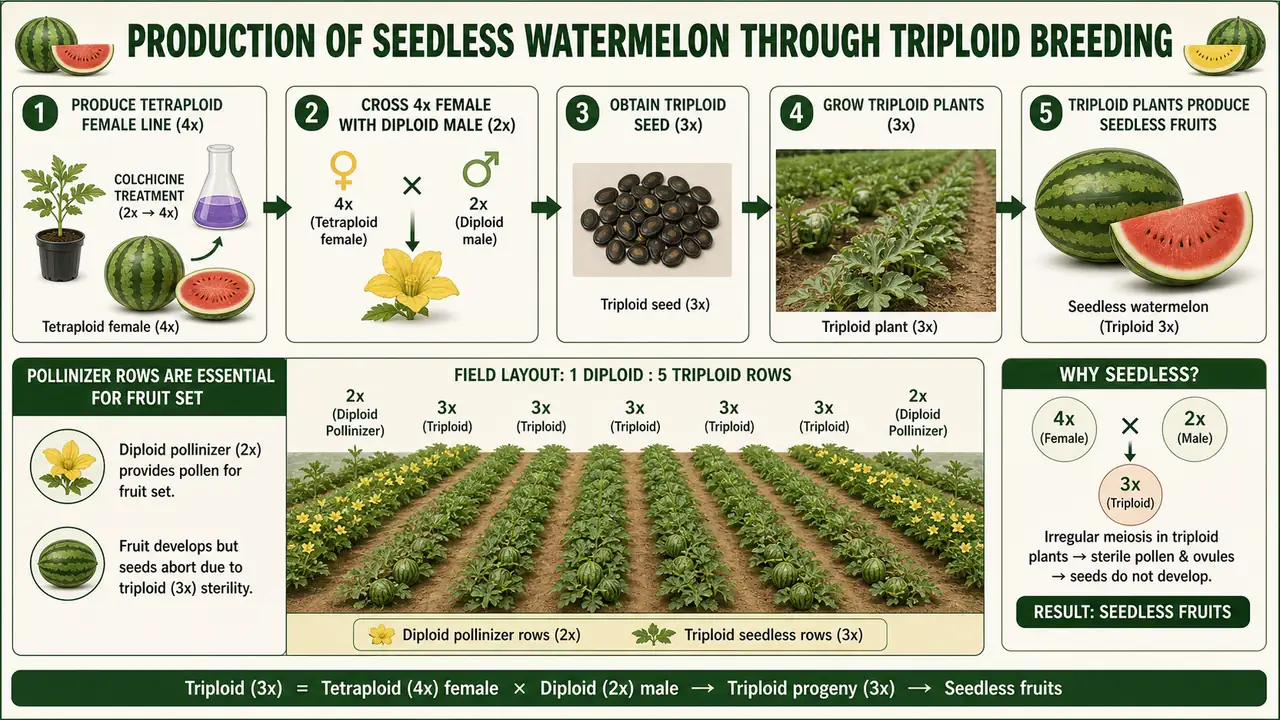
- Triploids are produced by hybridization between tetraploid and diploid strains. They are generally highly sterile, except in a few cases. This feature is useful in the production of seedless watermelons. In certain species, they may be more vigorous than the normal diploids, e.g., in sugarbeets. These two examples are described in some detail. Seedless watermelons are produced by crossing tetraploid (4x, used as female) and diploid (2x, used as male) lines, since the reciprocal cross (2x x 4x) is not successful. The triploid plants do not produce true seeds; almost all the seeds are small, white rudimentary structures like cucumber (Cucumis stivus) seeds. But few normal size seeds may occur which are generally empty. For good seed setting pollination is essential. For this purpose diploid lines are planted in the ratio 1 diploid : 5 triploid plants. There are several problem viz. genetic instability of 4x lines, irregular fruit shape, a tendency towards hollowness of fruits, production of empty seeds and the labour involved in triploid seed production.
- Triploid sugarbeets: Among root crops triploid sugar beets apparently represent the optimum level of polyploidy because 3n plants have longer roots than diploid and also yield more sugar per unit area.
- Tetraploid rye: the advantage of tetraploid over its diploid counterpart are large kernel size, superior ability to emerge under adverse condition and higher protein content. Tetraploid rye varieties have been released for cultivation. Eg. Double steel, Tetra petkus.
❌ Limitations of autoployploidy
- Larger size autoployploids generally contain more water and produce less dry matter content than diploids
- High sterility with poor seed setting is observed
- Due to complex segregation, progress through selection is slow
- Monoploids and triploids cannot be maintained except through clonal propagation
- The varieties cannot be produced at will
- Effects of autopolyploidy cannot be predicted
Segregation in Auto tetraploids
- Segregation in autotetraploids is much more complex than in diploids because each locus has four alleles instead of two.
- Depending upon the number of dominant alleles present, they are referred as simplex (Aaaa), duplex (AAaa), triplex (AAAa), Quadruplex (AAAA) and nulliplex (aaaa).
- On selfing a simplex will produce two types of gametes Aa and aa in 1:1 ratio due to random chromosome segregation. Self pollination of such a simplex would produce three genotypes AAaa, Aaaa and aaaa in the ratio 1:2:1 giving the phenotypic ratio of 3:1.
Allopolyploidy
- Allopolyploids have genomes from two or more species. Production of allopolyploids has attracted considerable attention; the aim almost always was creation of new species. Some success has been evident from the emergence of triticale. Raphanobrassica and allopolyploids of forage grasses.
- Morphological and cytological features of allopolyploids
- Allopolyploids combine the morphological and physiological characteristics of the parent species but it is very difficult to predict the precise combination of characters that would appear in the new species.
- Many allopolyploids are apomictic Ex: Tulips, Solanum
- The chromosome pairing in the new species depends upon the similarities between the chromosomes of the parental species. Chromosomes with such similarities are known as homologous chromosomes. After chromosome doubling, the allopolyploid would have two homologous chromosomes for each chromosome present in the F1 hybrid, comparable to the diploid species. Such allopolyploid is referred as amphidiploid or Allotetraploid.
- Fertility of Allopolyploids can be improved by hybridization and selection.
Application of allopolyploidy in crop improvement
- Utilization as a Bridging species: Amphidiploids serve as a bridge in transfer of characters from one species to a related species, generally from a wild species to cultivated species. An example of use of an amphidiploid as a bridging species in the use of synthetic N.digluta or transfer of resistance to tobacco mosaic virus from N.glutinosa to N.tabacum. The F1 hybrid from the cross N.tabacum x N.glutinosa is sterile. Chromosome doubling of the F1 hybrid produces the synthetic allehexaploid N.digluta which is reasonably fertile. N. digluta is backcrossed to the recipient species (N.tabacum) to produce a pentaploid having complete somatic chromosome complement of N.tabacum and one genome of N.glutinosa. The pentaploid is sufficiently fertile to be backcrossed to N.tabaccum in the progeny N.tabacum like plants resistant to tobacco mosaic are selected and cytologically analysed.
- Creation of New crop species
- Ex: Triticales, Raphanobrassica
- Triticum turgidum x secale cereale.
- Widening the genetic base of existing Allopolyploids: The genetic base of some natural allopolyploids may be narrow, and it may be useful to introduce variability in such cases by producing the allopolyploids afresh from their parental species. B. napus is a case in point; the genetic variability of this species is narrow and the only recourse available is to synthesize new allopolyploid B.napus to widen its genetic base. This is being done by crossing B.campestris (n=10, AA) with B.oleracea (n=9, CC), the parental diploid species, to produce the amphidiploid B.napus (n=19, AACC). The two species, B.campestris and B.olerancea, have to be crossed as autotetraploids; the cross is very difficult and embryo culture has to be used; somatic hybridization is being used to get around these problems.
❌ Limitations of Allopolyploidy
- The effects of allopolyploidy cannot be predicted. The allopolyploids have some features from both the parental species, but these features may be the undesirable ones, e.g., Raphanobrassica, or the desirable ones, e.g., Triticale.
- Newly synthesized allopolyploids have many defects, e.g., low fertility, cytogenetic and genetic instability, other undesirable features etc.
- The synthetic allopolyploids have to be improved through extensive breeding at the polyploidy level. This involves considerable time, labour and other resources.
- Only a small proportion of allopolyploids are promising; a vast majority of them are valueless for agricultural purposes.
Summary Cheat Sheet
| Concept / Topic | Key Details |
|---|---|
| Mutation breeding | Using induced mutations for crop improvement |
| Father of mutation breeding | H.J. Muller (1927) — induced mutations by X-rays in Drosophila |
| Physical mutagens | Gamma rays, X-rays, UV rays, neutrons |
| Most used physical mutagen | Gamma rays (from Cobalt-60) |
| Chemical mutagens | EMS (Ethyl Methane Sulphonate), MMS, colchicine, nitrous acid |
| Most used chemical mutagen | EMS — causes point mutations (GC → AT transitions) |
| Colchicine | Doubles chromosomes; induces polyploidy |
| Colchicine source | Colchicum luteum (Liliaceae) |
| Mutation breeding advantage | Creates novel variation not available in germplasm |
| Mutation breeding disadvantage | Most mutations are recessive and deleterious |
| Mutation frequency | Very low; requires large populations |
| Successful mutant varieties | Reimei (rice), Sharbati Sonora (wheat), Aruna (castor) |
| Sharbati Sonora | Amber grain wheat; gamma ray mutant of Sonora-64 |
| Best treated material | Seeds (most common), pollen, vegetative parts |
| LD50 | Dose causing 50% lethality; used to determine optimal dose |