🐝 Breeding for Disease and Insect Resistance
Understand the genetic basis of disease resistance, gene-for-gene hypothesis, vertical vs horizontal resistance, insect resistance mechanisms, and breeding procedures — with exam tips.
Why Disease and Insect Resistance Breeding Matters
The Bengal Famine of 1943 — caused by the brown spot disease of rice — killed an estimated 2 million people. The Irish Potato Famine was caused by late blight. These historical disasters underscore why breeding for biotic stress resistance (diseases and insects) is among the highest priorities in crop improvement. Resistant varieties are the most economical, environmentally safe, and farmer-friendly method of pest management.
Important Terms
NOTE
This lesson covers both disease resistance and insect resistance breeding. These topics are high-weightage in IBPS AFO, NABARD, and FCI exams. Pay special attention to the gene-for-gene hypothesis, vertical vs horizontal resistance, and mechanisms of insect resistance.
Understanding these fundamental terms is essential before studying disease resistance breeding. Each term defines a specific concept in the interaction between crops and their pathogens.
- Stress: Constraining influence, force, pressure or adverse conditions for crop growth caused by biological or environmental factors.
- Biotic (living): Adverse effects due to pests and diseases abiotic stresses.
- Abiotic (non-living): Adverse effects on host due to environmental factors eg: Drought, water logging, heat, cold, salinity, alkalinity and air pollution etc.
- Host: Plant effected by a disease or which can accommodate pathogen.
- Pathogen: An organism that produces the disease.
- Disease: Disease is an abnormal condition in the plant produced by an organism or environmental factor. Benedict Prevost in 1807 proved that wheat bunt disease was caused by a fungus. This was a landmark discovery establishing the germ theory of plant disease.
- Pathogenicity: The ability of a pathogen to infect a host strain.
- Virulence: Capacity of a pathogen to incite a disease. A highly virulent pathogen causes severe disease symptoms.
- Avirulence: The inability of a pathogen to cause or incite a disease.
- Physiological race: Strains of a single pathogen species with identical or similar morphology but differ in pathogenic capabilities. This means they look the same under a microscope but attack different host varieties.
- Pathotype: Strains of a pathogen classified on the basis of their virulence to known resistance genes present in the host.
- Epidemic: Severe and sudden outbreak of disease beginning from a low level of infection. An epidemic can devastate an entire crop if no resistant varieties are available.
Variability in fungal pathogens
Understanding how pathogens generate new variants is critical because it explains why disease resistance in crop varieties often breaks down over time.
Pro Content Locked
Upgrade to Pro to access this lesson and all other premium content.
Charged once for one year · ₹1188 total
Save ₹100/month vs ₹2388/year launch price
- All Agriculture & Banking Courses
- AI Lesson Questions (100/day)
- AI Doubt Solver (50/day)
- Glows & Grows Feedback (30/day)
- AI Section Quiz (20/day)
- 22-Language Translation (100/day)
- Recall Questions (20/day)
- AI Quiz (15/day)
- AI Quiz Paper Analysis (100/day)
- AI Step-by-Step Explanations (100/day)
- Spaced Repetition Recall (FSRS)
- AI Tutor
- Immersive Text Questions
- Audio Lessons — Hindi & English
- Mock Tests & Previous Year Papers
- Summary & Mind Maps
- XP, Levels, Leaderboard & Badges
- Generate New Classrooms
- Voice AI Teacher (AgriDots Live)
- AI Revision Assistant
- Knowledge Gap Analysis
- Interactive Revision (LangGraph)
🔒 Secure one-time yearly payment via Razorpay · No hidden fees
Why Disease and Insect Resistance Breeding Matters
The Bengal Famine of 1943 — caused by the brown spot disease of rice — killed an estimated 2 million people. The Irish Potato Famine was caused by late blight. These historical disasters underscore why breeding for biotic stress resistance (diseases and insects) is among the highest priorities in crop improvement. Resistant varieties are the most economical, environmentally safe, and farmer-friendly method of pest management.
Important Terms
NOTE
This lesson covers both disease resistance and insect resistance breeding. These topics are high-weightage in IBPS AFO, NABARD, and FCI exams. Pay special attention to the gene-for-gene hypothesis, vertical vs horizontal resistance, and mechanisms of insect resistance.
Understanding these fundamental terms is essential before studying disease resistance breeding. Each term defines a specific concept in the interaction between crops and their pathogens.
- Stress: Constraining influence, force, pressure or adverse conditions for crop growth caused by biological or environmental factors.
- Biotic (living): Adverse effects due to pests and diseases abiotic stresses.
- Abiotic (non-living): Adverse effects on host due to environmental factors eg: Drought, water logging, heat, cold, salinity, alkalinity and air pollution etc.
- Host: Plant effected by a disease or which can accommodate pathogen.
- Pathogen: An organism that produces the disease.
- Disease: Disease is an abnormal condition in the plant produced by an organism or environmental factor. Benedict Prevost in 1807 proved that wheat bunt disease was caused by a fungus. This was a landmark discovery establishing the germ theory of plant disease.
- Pathogenicity: The ability of a pathogen to infect a host strain.
- Virulence: Capacity of a pathogen to incite a disease. A highly virulent pathogen causes severe disease symptoms.
- Avirulence: The inability of a pathogen to cause or incite a disease.
- Physiological race: Strains of a single pathogen species with identical or similar morphology but differ in pathogenic capabilities. This means they look the same under a microscope but attack different host varieties.
- Pathotype: Strains of a pathogen classified on the basis of their virulence to known resistance genes present in the host.
- Epidemic: Severe and sudden outbreak of disease beginning from a low level of infection. An epidemic can devastate an entire crop if no resistant varieties are available.
Variability in fungal pathogens
Understanding how pathogens generate new variants is critical because it explains why disease resistance in crop varieties often breaks down over time.
- Hybridization: Recombination of genes of the two parental nuclei takes place in the zygote, and the haploid nuclei or gametes resulting after meiosis are different both from gametes that produced the zygote and from each other. Thus, every diploid pathogen individual is genetically different from any other pathogen even within the same species and variability of the new individual pathogens is continued indefinitely. E.g., Phytophthora infestans.
- Heterokaryosis: Condition in which fungal hyphae that are genetically different come together in the same cell to form heterokaryons. This allows the fungus to carry two different nuclear genotypes simultaneously, increasing its adaptive potential.
- Parasexualism: Parasexuality -- re-assortment of genetic material both in haploid and diploid condition, ready for natural and artificial selection. Mixtures of races grown together on a susceptible host combine genetically to produce new races e.g. Phytophthora infestans.
- Mutation: The rate at which new variants of a pathogen are produced will depend on the mutation rate of the genes at a particular locus. The mutation rate varies from gene to gene and from pathogen to pathogen. E.g. Melampsora lini -- new race produced with UV rays (Flor 1956).
- Cytoplasmic adaptation: There are several examples of cytoplasmic inheritance of important characteristics such as growth rate and virulence (Jinks 1966). Virulence of P. graminis f. sp. Avenae, carrying gene E, is maternally inherited and may be controlled by single plasma gene (Johnson et al 1967).
Breeding for disease and pest resistance
Mechanisms of Disease Resistance
- Three components viz. Pathogen, Host and Environment are essential for the development of disease. The fourth factor is time. All four must coincide for disease to develop -- a susceptible host, a virulent pathogen, a favorable environment, and sufficient time for infection.
- The interaction between host, pathogen & environment during the development of diseases is represented by a disease-triangle.

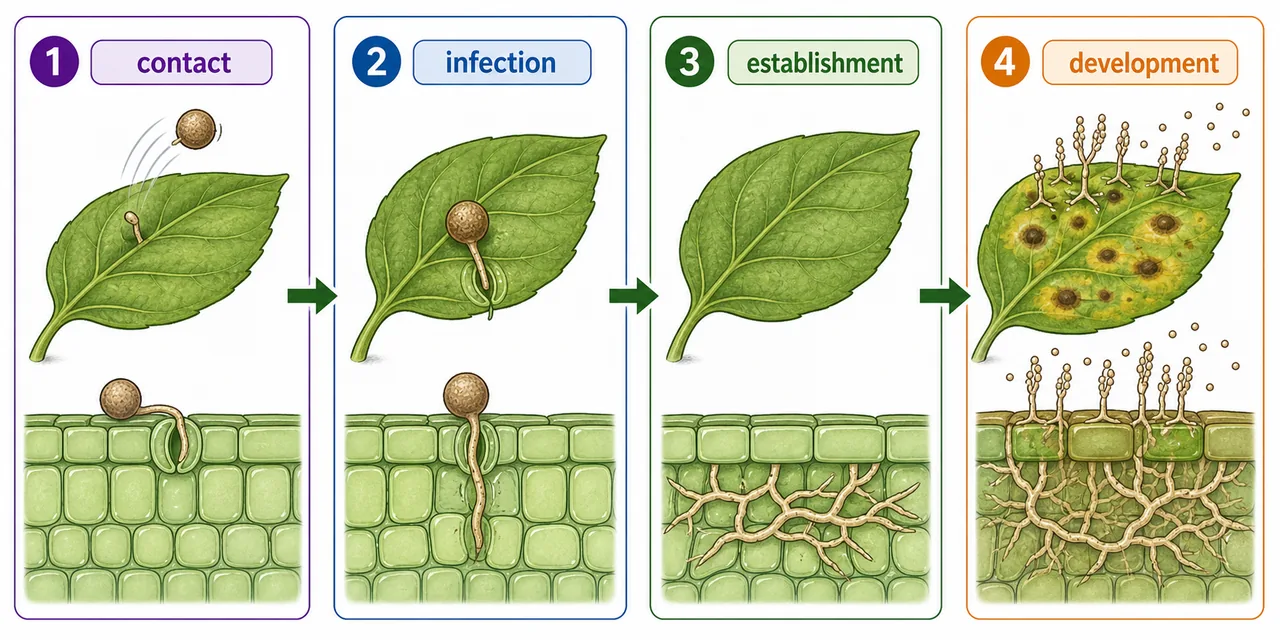
👉🏻 Development of diseases caused by fungi occurs in 4 well defined stages:
- Contact means landing of pathogen on the host tissue.
- Infection is the process by which the pathogen gains entry into the host tissue. Both contact and infection stages are greatly affected by environment and provide the means for disease escape.
- Establishment: Once the pathogen has entered the host tissue, the pathogen proliferates & spreads within the host tissue. This phase is called establishment. Here disease symptoms are not visible.
- Development: Disease symptoms are developed. Here spore production or multiplication is the crucial factor because spores serve as inoculum for uninfected plants.
Disease resistance
👉🏻 Disease resistance may be immune reaction (no disease, r = 0), resistance (less disease, r > 0 but < 1) or tolerance (high disease incidence but small loss in yield).
- Disease escape: The ability of susceptible host plants to avoid attack of disease due to environmental conditions factors, early varieties, change in the date of planting, change in the site of planting; balanced application of NPK etc. Eg.
- Early varieties of groundnut and potato may escape 'Tikka' and 'Late blight' diseases respectively since they mature before the disease epidemic occurs.
- Changing planting season in sugarcane from June to October has successfully escaped leaf-rust.
- Virus free seed potato is produced by sowing the crop in October in Jalander and other places instead of November, the normal planting time.
- Disease Endurance or Tolerance: The ability of the plants to tolerate the invasion of the pathogen without showing much damage. This endurance is brought about by the influence of external characters. Generally, tolerance is difficult to measure since it is confounded with partial resistance and disease escape. To estimate tolerance the loss in yield and some other trait of several host varieties having the same amount of disease eg., leaf area covered by disease etc., is compared. Eg.
- In Barley the variety Proctor shows 13% yield loss as compared to 20% loss in the varieties Zephy and Sultan.
- Wheat varieties when fertilized with potash and phosphorus are more tolerant to the rust and mildew infection.
- The Rice crop fertilized with silicate is resistant to blast infection in Japan.
- Disease Resistance: The ability of plants to withstand, oppose or overcome the attack of pathogens. Resistance is a relative term and it generally refers to any retardation in the development of the attacking pathogen. In case of resistance, disease symptoms do develop and the rate of reproduction is never zero i.e., r does not equal 0 but it is sufficiently lower than 1 (the rate of reproduction on the susceptible variety) to be useful. The inhibition of growth of the pathogen is believed to be nutritional in nature and in some cases chemical growth inhibitors may be involved. Resistance is largely controlled by inherited characters, may be controlled by single dominant gene in Ottawa 770 B, Newland flax variety, wheat all rusts NP 809.
- Immunity: When the host does not show the symptoms of disease it is known as immune reaction. Immunity may result from prevention of the pathogen to reach the appropriate parts of the host e.g. exclusion of spores of ovary infecting fungi by closed flowering habit of wheat and barley. It is more generally produced by hypersensitive reaction of the host usually immediately after the infection was occurred. In immune reaction the rate of reproduction in zero i.e. r = 0.
- Hypersensitivity: Immediately after the infection several host cells surrounding the point of infection are so sensitive that they will die. This leads to the death of the pathogen because the rust mycelium cannot grow through the dead cells. This super sensitivity (hypersensitivity) behaves as a resistant response for all practical purposes. Phytoalexins are specific polyphenolic or terpenoid chemicals and are produced by the host in response to the infection by a pathogen. More than 30 different phytoalexins have been identified. Phytoalexins are either fungicidal or fungistatic. Eg. Rust fungi and virus attack. The hypersensitive reaction is one of the most important defense mechanisms in plants.
Factors for disease resistance (Causes of Disease resistance)
- Morphological, structural and functional characteristics which prevents the entrance of the pathogen i.e. prevents the first stage of infection.
- Biochemical or anatomical properties of tissue which prevent the establishment of parasitic relationship.
Morphological characters
- Certain morphological features of the host may prevent infection. Eg. Resistance to Jassid attack in cotton has been shown to be correlated with the hairiness of varieties; hairy type resists the attack more, than glabrous types. Failure to germinate rust spores on the leaves of the barley due to waxy coating. Young sugarbeet leaves practically immune to attack of the Circospora because the stomata size is very small.
Physiological characters
- Protoplasmic factors or chemical interactions By virtues of its chemical composition the protoplasm may exert an inhibitory influence on the pathogen bringing about the desired resistance in the plant. Eg. Resistance of grape to powdery mildew is highly correlated with the acidity of cell sap. Presence of toxic substance in the red pigment in the coloured onions. The outer scales resist the smudge fungus attack when the scales are removed they become susceptible.
Anatomical
- More secondary thickening of the cell walls of resistant potato varieties which resists the mechanical puncture of the invading Pythium pathogen. Thicker cell walls create a physical barrier that pathogens must overcome.
Nutritional factors
- Reduction in growth and in spore production is generally supposed to be due to unfavourable physiological conditions within the host. Most likely a resistant host does not fulfill the nutritional requirements of the pathogen and thereby limits its growth and reproduction.
Environmental factors
- In addition to the above the environmental factors have marked effect on the pathogen attack. Temperature, moisture, humidity and soil pH and fertility status of the soil effects the pathogen reaction greatly.
Genetic Basis of Disease Resistance
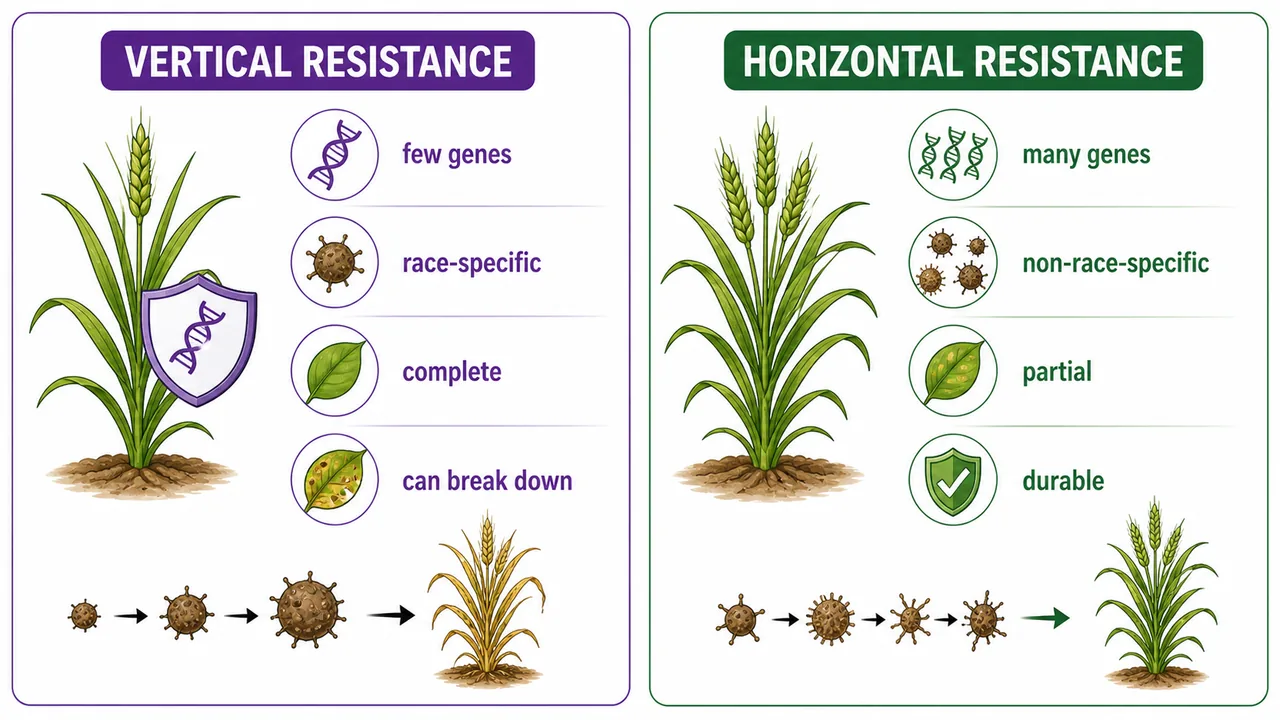
- Resistance is also classified as vertical & horizontal. Vertical resistance is oligogenic, pathotype specific and generally shows immunity.
- Horizontal resistance is polygenic, non-pathotype specific and acts by reducing r, i.e. r > 0 but < 1. The mechanism of disease resistance may be mechanical, due to hypersensitivity, antibiosis or nutritional in nature.
TIP
Vertical = few genes, race-specific, can break down (like a vertical wall that can topple). Horizontal = many genes, non-race-specific, more durable (like a broad horizontal platform that is stable).
- Genetically, resistance may be controlled by
- Oligogenes -- few major genes with large effects
- Polygenes -- many genes with small, additive effects
- Plasmagenes (Oligogenic) (polygenic) i.e. Cytoplasmic inheritance
Oligogenic inheritance
- The disease resistance is governed by one or few major genes and resistance is generally dominant to the susceptible reaction. The action of major resistance genes may be altered by modifying genes in many cases. Eg. bunt resistance in Wheat. Oligogenes generally produce immune reaction. The chief characteristic of the oligogenic disease resistance is pathotype specificity, i.e. resistant gene is effective against some pathogens, while it is ineffective against the others.
- In most cases, there are a number of major genes that determines resistance to a particular disease. Eg. more than 20 different resistance genes are known for leaf rust of wheat, while those for stem rust resistance exceed 30.
- The genetics of oligoganic resistance has advanced by two events viz.
- Discovery of a resistance gene to the prevalent pathotype and
- Evolution of a pathotype virulent to the new resistance gene.
- Oligogenic resistance is synonymous to vertical resistance.
Gene for gene hypothesis
- The concept of gene for gene hypothesis was first developed by Flor in 1956 based on his studies of host pathogen interaction in flax rust caused by Melampsora lini. This is one of the most important concepts in plant pathology and resistance breeding.
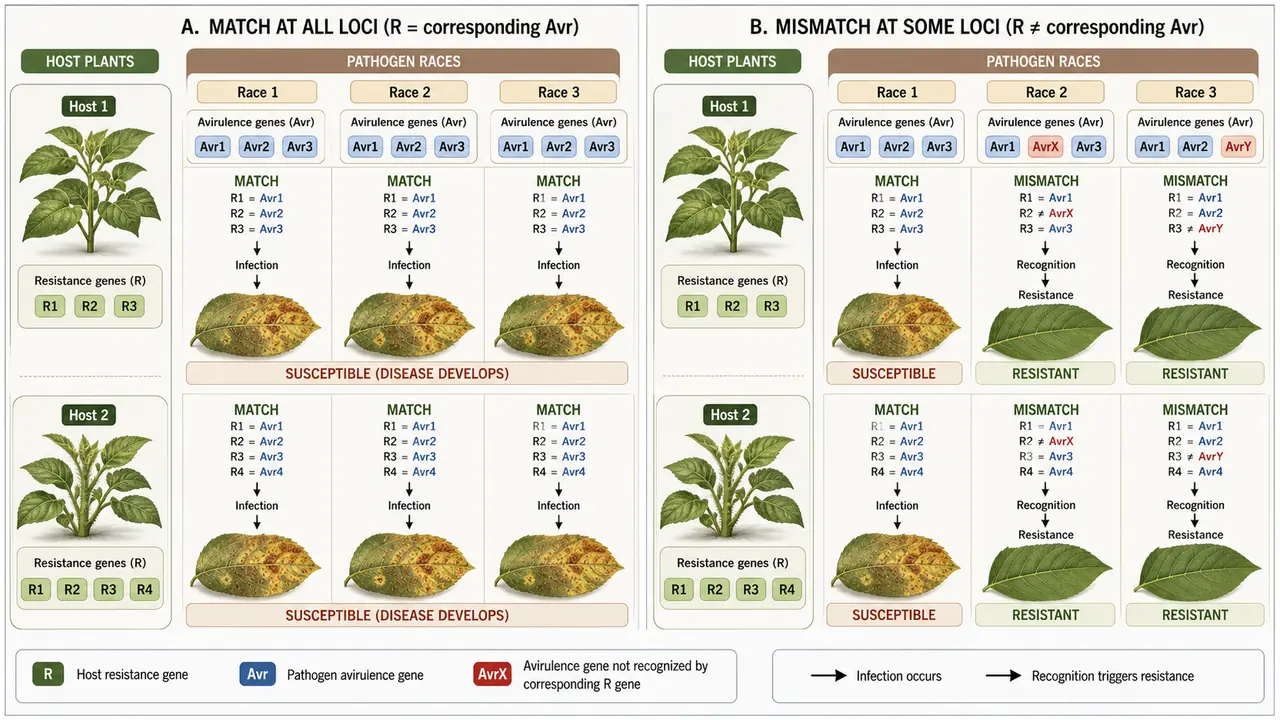
- The gene for gene hypothesis states that for each gene controlling resistance in the host, there is a corresponding gene controlling pathogenicity in the pathogen.
- The resistance of host is governed by dominant genes and virulence of pathogen by recessive genes.
IMPORTANT
Flor's Gene-for-Gene Hypothesis: Host resistance = dominant; Pathogen virulence = recessive. When host and pathogen genes match at all loci → susceptible reaction. When some loci are unmatched → resistant reaction. Also known as the Flor Hypothesis.
- The genotype of host and pathogen determine the disease reaction. When genes in host and pathogen match for all the loci, then only the host will show susceptible reaction. If some gene loci remain unmatched, the host will show resistant reaction. Now gene-for-gene relationship has been reported in several other crops like potato, Sorghum, wheat etc. The gene for gene hypothesis is known as "Flor Hypothesis".
Vertifolia Effect
- Vander Plank introduced the term vertifolia effect and refers to epidemic development in a variety carrying vertical resistance genes (oligogenes) leading to heavy economic losses. Total failure of vertical resistance leading to a disease epidemic is known as vertifolia effect.
- This failure occurs because of two reasons:
- The level of horizontal resistance in varieties carrying oligogenes is usually low and
- The pathogen is able to evolve new virulent pathotypes.
This means that when breeders focus exclusively on incorporating oligogenes for resistance, they inadvertently select against horizontal resistance, leaving the variety highly vulnerable when the pathogen overcomes the oligogenic resistance.
Polygenic inheritance
- In this type the disease resistance is governed by many genes with small effects and a continuous variation for disease reaction is produced.
- The genes show additive and non additive effects and the environmental effect is also observed.
- The polygenic resistance does not show pathotype-specificity as against the oligogenic resistance. This means it is effective against all races of a pathogen, making it more durable.
- It is almost same as horizontal resistance. In some cases the polygenic inheritance may have an oligogenic component, the oligogenes acting in an additive manner eg. bacterial blight resistance in cotton.

Cytoplasmic inheritance
- Resistance in some cases is determined by cytoplasmic genes or plasma gene(s).
- Eg. The T-male sterility cytoplasm (cms-T) in maize is extremely susceptible to Helminthosporium leaf blight, while the non-T cytoplasm are resistant to this disease. This classic example demonstrates how cytoplasmic genes can influence disease reaction and underscores the importance of cytoplasm selection in breeding programmes.
Sources of Disease Resistance
- A known variety: Disease reactions of most of the cultivated varieties are documented and a breeder may find the resistance he needs in a cultivated variety. Resistant plants were also related from commercial varieties as in the case of cabbage yellows in cabbage, curlytop resistance etc. These provide the basis for new resistance varieties.
- Germplasm collection: When resistance to a new disease or a new pathotype of a disease is not known in a cultivated variety germplasm collection should be screened. Several instances disease resistance were found from the germplasm collections. Eg. resistance to neckblotch in barley, resistance to wilt in watermelon.
- Related species: Often the resistance to a disease may be found in related species and transferred through interspecific hybridization. Eg. Resistance to stem, leaf & stripe rusts of wheat.
- Mutation: Resistance to diseases may be obtained through mutation arising spontaneously or induced through mutagenic treatments. Eg.
- Resistance to Victoria blight in oats was induced by irradiation with X-rays or thermal neutrons / also produced spontaneously.
- Resistance to stripe rust in wheat.
- Resistance to brown rust in oats.
- Resistance to mildew in barley.
- Resistance to rust in linseed.
- Resistance to tikka leaf spot and stem rot in groundnut.
Methods of Breeding for Disease Resistance
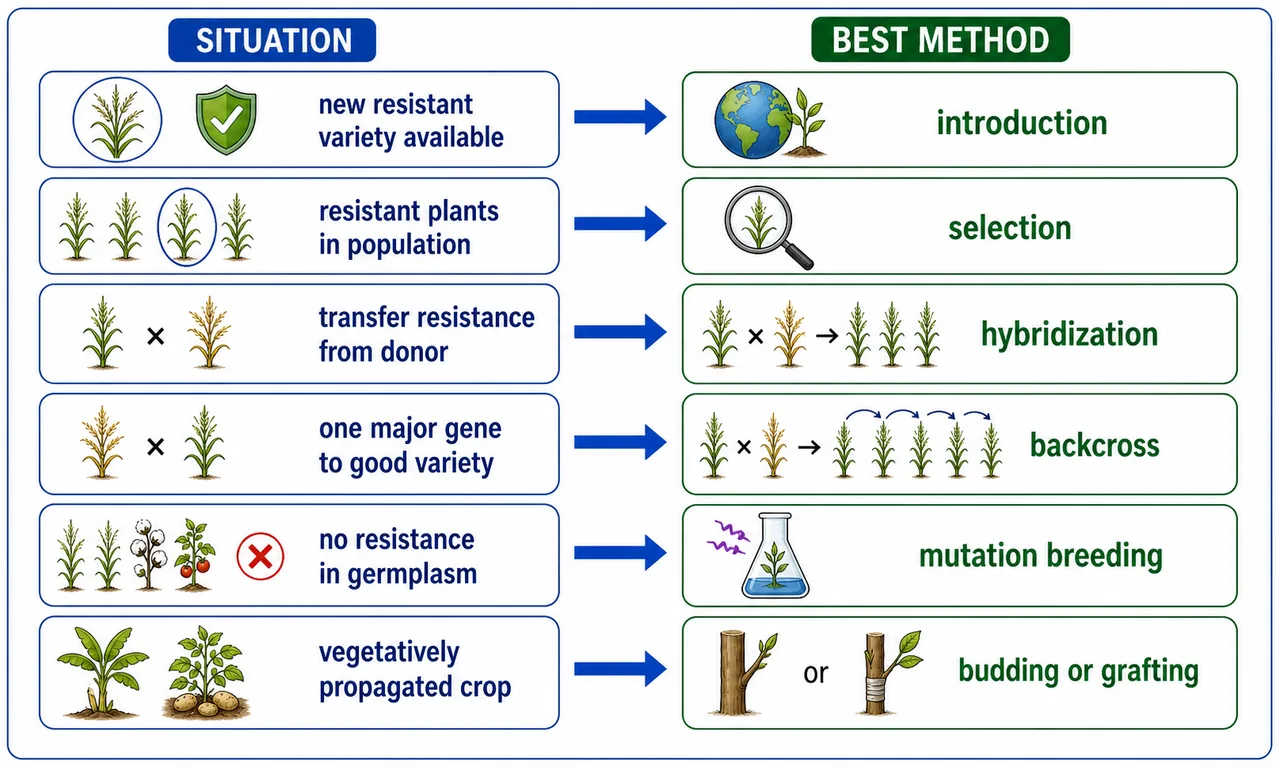
👉🏻 The methods of breeding for disease resistance are essentially same as those used for other agronomic traits. They are:
- Introduction
- Selection
- Hybridization
- Budding & Grafting
- Mutation Breeding
- Biotechnological methods
Introduction
- Resistant varieties may be introduced for cultivation in a new area. Eg.
- Early varieties of groundnut introduced from USA have been resistant to leaf spot (Tikka)
- Kalyanasona and Sonalika wheat varieties originated from segregating material introduced from CIMMYT, Mexico, were rust resistant.
- African bajra introductions have been used in developing downy mildew resistant CMS lines.
Selection
- Selection of resistant plants from commercial varieties is easiest method. Eg.
- Kufri Red potato is selection from Darjeeling Red round
- Pusa Sawani bhindi (yellow mosaic) selection from a collection obtained from Bihar
- MCU I was selection from CO4 for black arm resistance in cotton
Hybridization
👉🏻 Transferring disease resistance from one variety or species to the other.
- Pedigree method is quite suitable for horizontal resistance. Artificial disease epiphytotics are produced to help in selection for disease resistance. Eg. In wheat Kalyana Sona, Sonalaka, Malvika 12, Malvika 37, Malavika 206, Malavika 234, Laxmi in Cotton (Gadag 1 x CO2) for leaf blight resistance.
- Backcross method is used to transfer resistance genes from an undesirable agronomic variety to a susceptible, widely adoptable and is agronomically highly desirable variety. If the resistant parent is a wholly unadopted variety, backcross method is a logical choice. If resistant variety also possess some good qualities then chose pedigree method of handling segregating material. The backcross method is useful in oligogenic resistance or vertical resistance.
- Budding & Grafting: The disease resistance in vegetative propagated material is transferred by adopting either by budding or grafting. By grafting or budding the resistant material, the resistance can be transferred.
- Mutation Breeding: When adequate resistance is not available in the germplasm; Mutation breeding is resorted to induce resistance. This is also used to break the linkages between desirable resistant genes and other desirable genes.
Precautions
- The donor parent must possess the required amount of resistance
- It must be simply inherited without any linkage
- The recovery in the recipient parent should be more
- Proper condition for full expression of the resistant genes has to be provided
Advantages with breeding for disease resistance
- Helps in reducing the losses caused by pathogens
- Reduces the high cost of disease control by chemical treatment
- Helps to avoid the use of poisonous fungicides
- Only method available to some specific diseases like viruses, wilt etc where chemical control is ineffective
Limitations
- Linkage of resistant genes with genes of inferior quality
- Occurrence of physiological races of varying capacities
- Self-sterility in host plants
Utilization and achievements
- Rice: ADT 10 x Co4 (resistant to blast)
- Potato: Solanum tuberosum x Solanum demissum (Susceptible to late blight) (Wild resistant to late blight) F1 backcrossed with Sol. tuberosum Resistant variety
Varieties resistant to different diseases

Insect Resistance
- Global average loss due to insect pests is 14%. Estimated losses in individual crops vary from 5% in wheat to 26.7% in rice and still more in crops like cotton & sugarcane. These losses underscore the enormous economic importance of breeding for insect resistance.
- In the classical formulation of R. H. Painter (1951), host-plant resistance refers to the heritable plant characters that help a variety avoid, tolerate, or recover from insect attack better than other varieties of the same species. For this reason, Painter is widely remembered as the Father of Host Plant Resistance.
- Insect Resistance
- The ability of a plant to withstand, oppose or overcome the attack of an insect in known as insect resistance.
- It is the property of a variety or a host crop due to which it is attacked by an insect pest to a significantly lower degree than are other varieties of the same host.
- In exam-style language, host-plant resistance is treated as heritable, relative, measurable, and variable rather than absolute.
- Biotypes: Strains of a species of an insect pest, differing in their ability to attack different varieties of the same host species (syn: Physiological races). Just as pathogens have races, insect pests also evolve biotypes that can overcome previously resistant varieties.
Why Host-Plant Resistance Matters in IPM
- Well-bred host-plant resistance is valued because it is:
- specific to the target pest problem
- usually persistent once incorporated into the variety
- ecologically safe
- easy for farmers to adopt
- highly compatible with other pest-management methods
- Its practical limitations are equally important:
- resistance breeding often takes a long time
- usable donor genes may be limited
- the initial development cost is high
- pest biotypes may eventually overcome resistance
Host Habitation
- Polyphagy: Insects feed on a wide range of hosts avoiding few plant species. Eg. Scales & moths.
- Oligophagy: Live on one taxonomic unit only. Eg. Hessianfly on wheat
- Seasonal oligophagy: Insects may live on many species in one part of the year and on few in another part of the year. Eg. Aphids.
- Monophagy: Avoid all hosts except one particular species or variety Eg. Boll weevil on cotton.
Mechanism of Insect Resistance
- Non preference (Anti-xenosis): Host Varieties exhibiting this type of resistance are unattractive or unsuitable for colonization, oviposition or both by an insect pest. This type of resistance in also termed as non-acceptance and anti-xenosis. Non-preference involves various morphological and biochemical features of host plants such as -- color, hairness, leaf angle, taste etc. The insect simply avoids the resistant variety in favor of a more attractive host.
- The older term non-preference is therefore treated as synonymous with antixenosis.
- Antibiosis: Antibiosis refers to an adverse effect of feeding on a resistant host plant on the development and/or reproduction of the insect pest. In severe cases, it may even lead to the death of the insect pest. Antibiosis may involve morphological, physiological or biochemical features of the host plant; some cases of insect resistance involve a combination of features. Eg. Resistance to BPT is due to antibiosis & non-preference.
- Tolerance: An insect tolerant variety is attacked by the insect pest to the same degree as a susceptible variety. But at the same level of infestation, a tolerant variety produces a higher yield than a susceptible variety. Ability of the host plant to withstand the insect population to a certain extent which might have damaged a more susceptible host. Tolerance is mainly a host character and it may be because of greater recovery from pest damage. Eg. Rice varieties tolerant to stem borer/gall midge produce additional tillers to compensate yield losses (as in stem borer in sorghum) or due to the ability of host to suffer less damage by the pest eg. aphid tolerance in Sugarbeet & Brassica sps. And green bugs tolerance in cereals. Inheritance of tolerance is complex in many cases and is supposed to be governed by polygenes.
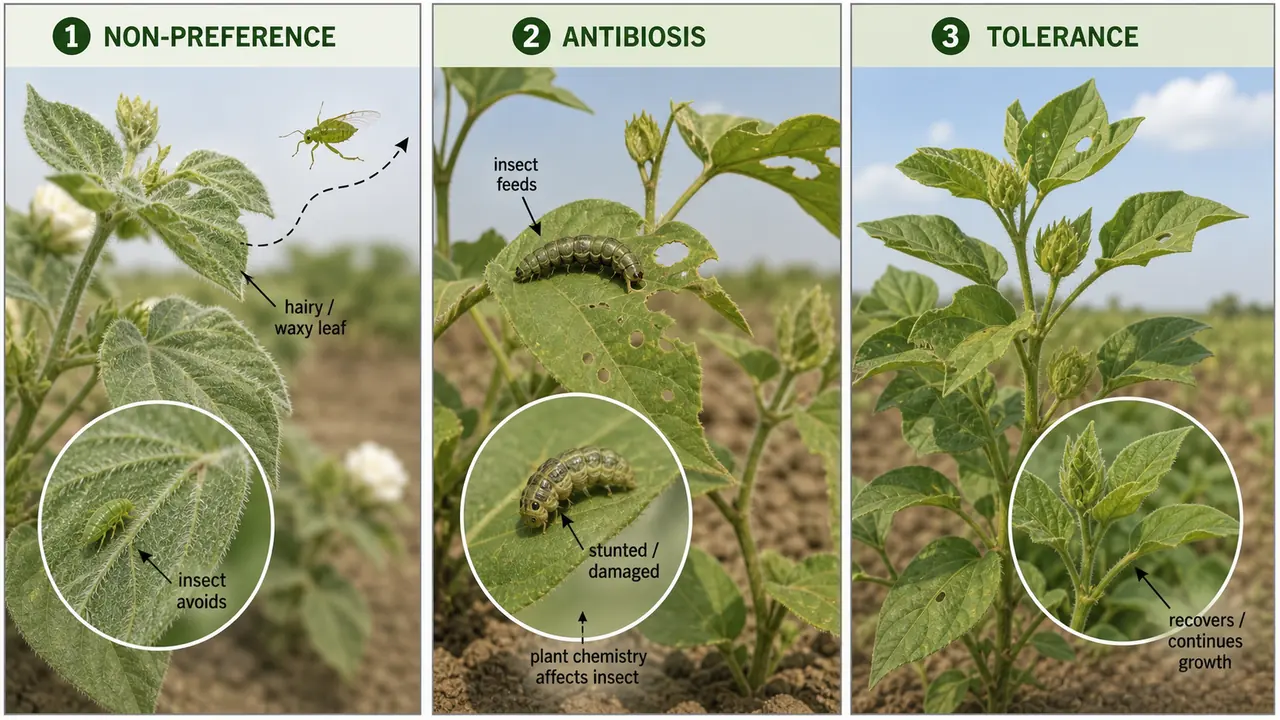
- Avoidance: Pest avoidance is the same as disease escape, and as such it is not a case of true resistance. Mostly insect avoidance result from the host plants being at a much less susceptible developmental stage when the pest population is at its peak. Eg. Early maturing cotton varieties escape pinkboll worm infestation, which occurs late in the season.
Nature of Insect Resistance / Factors for insect-resistance
- Morphological features: Morphological factors like, hairiness, colour, thickness and toughness of tissues etc. are known to confer insect resistance.
- Hairiness of leaves is associated with resistance to many insect pests -- leaf beetle in cereals, in cotton to Jassids, in turnip to turnip aphid.
- In more explicit antixenosis language, trichomes / pubescence can obstruct feeding, oviposition, and sheltering; classic recall links include cotton against whiteflies and hoppers.
- Colour of plant: Color may contribute to non preference in some cases. For example: Red cabbage, Red leaved brussel's sprouts are less favored than green varieties by butterflies and certain Lepidoptera for oviposition. Boll worms prefer green cotton plants to red ones.
- Thickness and Toughness of plant -- Tissues prevent mechanical obstruction to feeding and oviposition and thereby lead to non-preference as well as antibiosis. Eg.
- Thick leaf lamina in cotton contributes to Jassid resistance
- Solid stem in wheat confers resistance to wheat stem sawfly
- Thick and tough rind of cotton bolls makes it difficult for the boll worm larve to bore holes and enter the bolls.
- Surface waxes are another classical antixenosis factor because waxy surfaces can reduce pest settling and colonization.
- Other characters: Also contribute to insect resistance. Eg.
- Gossypium arboretum varieties with narrow lobed and leathery leaves are more resistant to Jassids than are those with broad lobed and succulent leaves.
- Cotton varieties with longer pedicels are more resistant to boll worms.
- Physiological Factors: Osmotic concentration of cell sap, various exudates etc. may be associated with insect resistance. Eg.
- Leaf hairs of some solanum sps. secrete gummy exudates. Aphids and coloradobeetles get trapped in these exudates.
- Exudates from secondary trichomes of Medicago disciformis leaves have antibiotic effects on alfalfa weevil.
- Cotton -- High osmotic concentration of cell sap is associated with Jassid resistance.
- Biochemical Factors: Several biochemical factors are associated with insect resistance in many crops. It is believed that biochemical factors are more important than morphological and physiological factors in conferring non-preference and antibiosis. Eg.
- High concentrations of gossypol is associated with resistance in several insect pests in cotton. Gossypol is a naturally occurring toxic compound that deters insect feeding.
- In rice -- high silica content in shoots gives resistance to shoot borer. Silica strengthens the plant tissue, making it physically harder for the borer to penetrate.
- In maize, the compound DIMBOA is a classical biochemical factor associated with resistance to the European corn borer (Ostrinia nubilalis), mainly through antibiosis.
- In lucerne, resistance to the spotted aphid is classically associated with high saponin levels in the leaves.
- Reduced asparagine in some rice backgrounds is another exam-style biochemical association linked with resistance to brown planthopper.
Classical Examples of Host-Plant Resistance
- Older historical recall often highlights:
- Wheat variety Underhill as an early Hessian-fly-resistant example
- Apple variety Winter Majetin in relation to woolly apple aphid resistance
- management of grape phylloxera as one of the important practical successes of host-plant resistance
Types of Resistance in Host-Plant Resistance
-
In compact classification language, resistance may be grouped into:
- Ecological resistance — also described as apparent or pseudo-resistance, because it depends mainly on environment rather than on stable heritable resistance genes
- Genetic resistance — inherited resistance, classically discussed as monogenic, oligogenic, or polygenic
- Biotype reaction — the host response changes when new insect biotypes arise that can damage previously resistant varieties
-
Ecological resistance commonly includes:
- Host evasion — the crop passes through the susceptible stage quickly
- Host escape — infestation fails to occur or remains incomplete because timing or environment does not favour attack
- Induced resistance — temporary strengthening of plant defence following chemical, physical, or environmental stimuli
-
In insect-resistance discussions, Van der Plank's vertical-versus-horizontal framing is often reused while explaining biotype reaction.
-
A biotype is an intraspecific category; exam books often cite the Hessian fly as a classic example with many named biotypes.
Classical Theory Names Often Asked with Host-Plant Resistance
-
Several older ecological and behavioural theories are frequently attached to host-plant resistance and host selection in objective exams:
- Fraenkel — token stimuli theory
- House — nutrient imbalance theory
- Kennedy and Booth — dual discrimination theory
- Root — resource concentration hypothesis
- Kogan and Ortman (1965) — the term antixenosis
- R. H. Painter — the older term non-preference
-
In colour-orientation recall for sap-feeding pests, yellow is the classic attractive colour for aphids, whiteflies, and thrips.
-
In rice variety recall, IR-36 is classically remembered as a multiple insect- and disease-resistant variety.
Summary Cheat Sheet
| Concept / Topic | Key Details |
|---|---|
| Biotic stress | Disease (fungi, bacteria, viruses) + insect pests |
| Vertical resistance | Race-specific; controlled by major genes; not durable |
| Horizontal resistance | Non-race-specific; polygenic; more durable |
| Gene-for-gene hypothesis | Flor (1956) — each resistance gene has corresponding virulence gene |
| Immunity | No infection at all |
| Resistance | Host limits pathogen development |
| Tolerance | Host yields well despite infection |
| Susceptibility | Host supports pathogen fully |
| Disease resistance mechanisms | Structural (thick cuticle, lignin) + Biochemical (phytoalexins, tannins) |
| Phytoalexins | Antimicrobial compounds produced on infection |
| Insect resistance mechanisms | Non-preference (antixenosis), antibiosis, tolerance |
| Antixenosis | Plant not preferred by insect for feeding/oviposition |
| Antibiosis | Plant chemicals harm insect biology |
| Silica content in rice | Gives resistance to shoot borer |
| Gossypol in cotton | Gives resistance to bollworm |
| Breeding methods | Backcross (major genes), pedigree (polygenic), gene pyramiding |