🌼 Marigold — India's Festival Flower from Mexico
Complete guide to marigold cultivation covering African vs French types, chromosome numbers, ploidy, genetic male sterility, important varieties including triploid Nugget, and key exam facts for competitive agriculture exams.
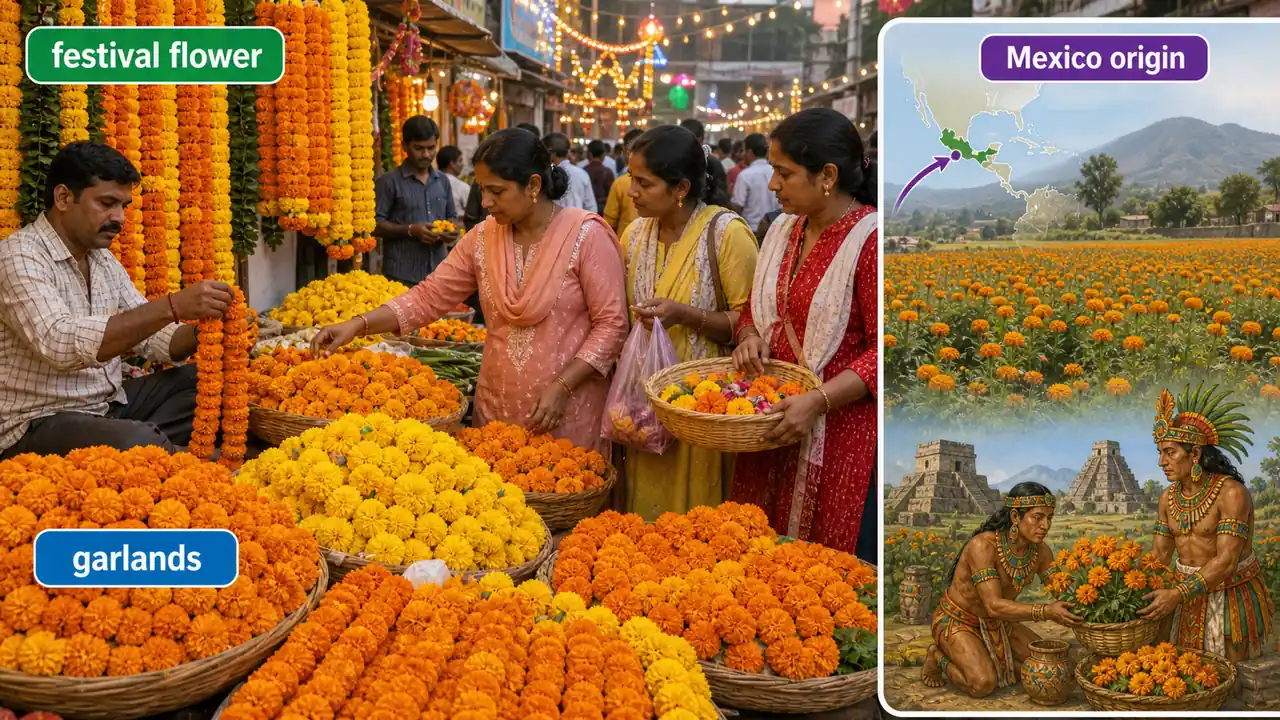
During Diwali preparations across India, flower markets overflow with bright orange and yellow marigold garlands — so deeply integrated into Indian festivals and religious ceremonies that most people forget this flower actually originated in Mexico, not India. The Aztecs cultivated it long before European contact, and it was early explorers who carried it to the subcontinent. Today, India is one of the largest marigold producers globally, and the crop's commercial importance extends beyond decoration to natural pigment extraction and essential oil production.
Marigold is one of the most widely grown and commercially important loose flowers in India. It is extensively used for making garlands, religious offerings, festival decorations, and for the extraction of natural pigments and essential oils.
IMPORTANT
Marigold has two main types with different chromosome numbers: African (2n = 24) and French (2n = 48). This is a frequently tested fact. Also remember: origin is Mexico, not Africa or France.
Pro Content Locked
Upgrade to Pro to access this lesson and all other premium content.
₹99 charged monthly · Cancel anytime
- All Agriculture & Banking Courses
- AI Lesson Questions (100/day)
- AI Doubt Solver (50/day)
- Glows & Grows Feedback (30/day)
- AI Section Quiz (20/day)
- 22-Language Translation (100/day)
- Recall Questions (20/day)
- AI Quiz (15/day)
- AI Quiz Paper Analysis (100/day)
- AI Step-by-Step Explanations (100/day)
- Spaced Repetition Recall (FSRS)
- AI Tutor
- Immersive Text Questions
- Audio Lessons — Hindi & English
- Mock Tests & Previous Year Papers
- Summary & Mind Maps
- XP, Levels, Leaderboard & Badges
- Generate New Classrooms
- Voice AI Teacher (AgriDots Live)
- AI Revision Assistant
- Knowledge Gap Analysis
- Interactive Revision (LangGraph)
🔒 Secure via Razorpay · Cancel anytime · No hidden fees
During Diwali preparations across India, flower markets overflow with bright orange and yellow marigold garlands — so deeply integrated into Indian festivals and religious ceremonies that most people forget this flower actually originated in Mexico, not India. The Aztecs cultivated it long before European contact, and it was early explorers who carried it to the subcontinent. Today, India is one of the largest marigold producers globally, and the crop's commercial importance extends beyond decoration to natural pigment extraction and essential oil production.
Marigold is one of the most widely grown and commercially important loose flowers in India. It is extensively used for making garlands, religious offerings, festival decorations, and for the extraction of natural pigments and essential oils.
IMPORTANT
Marigold has two main types with different chromosome numbers: African (2n = 24) and French (2n = 48). This is a frequently tested fact. Also remember: origin is Mexico, not Africa or France.
- Common Name: Rose of Indies. Marigold is also known as the "Rose of Indies" because early European explorers who encountered it in the Americas mistakenly associated it with India.
- Family: Compositae (Asteraceae). The Compositae is one of the largest families of flowering plants. Marigold shares this family with other important flower crops like sunflower, chrysanthemum, and dahlia.
- Origin: Mexico. Marigold is native to Mexico and Central America, where it was cultivated by the Aztecs long before European contact. It was introduced to India centuries ago and has since become deeply integrated into Indian culture and agriculture.
- Botanical Name: Marigold has two main cultivated types, each with distinct characteristics:
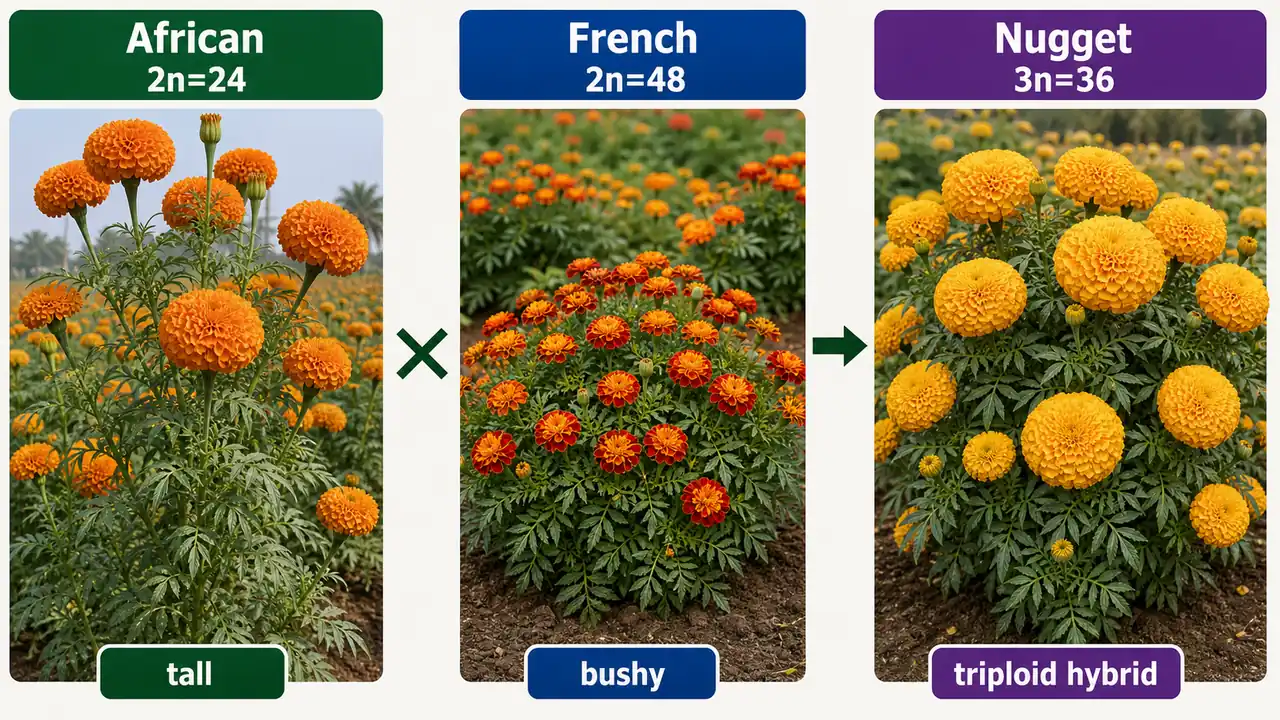
- African -- Tagetes erecta: 2n = 24. African marigold (despite its name, it originates from Mexico) is the taller type with large, globular flower heads. It has a diploid chromosome number of 24.
- French -- Tagetes patula: 2n = 48. French marigold is the shorter, bushier type with smaller but more numerous and colourful flowers. Interestingly, it has a tetraploid chromosome number of 48, indicating it has twice the basic chromosome set compared to African marigold.

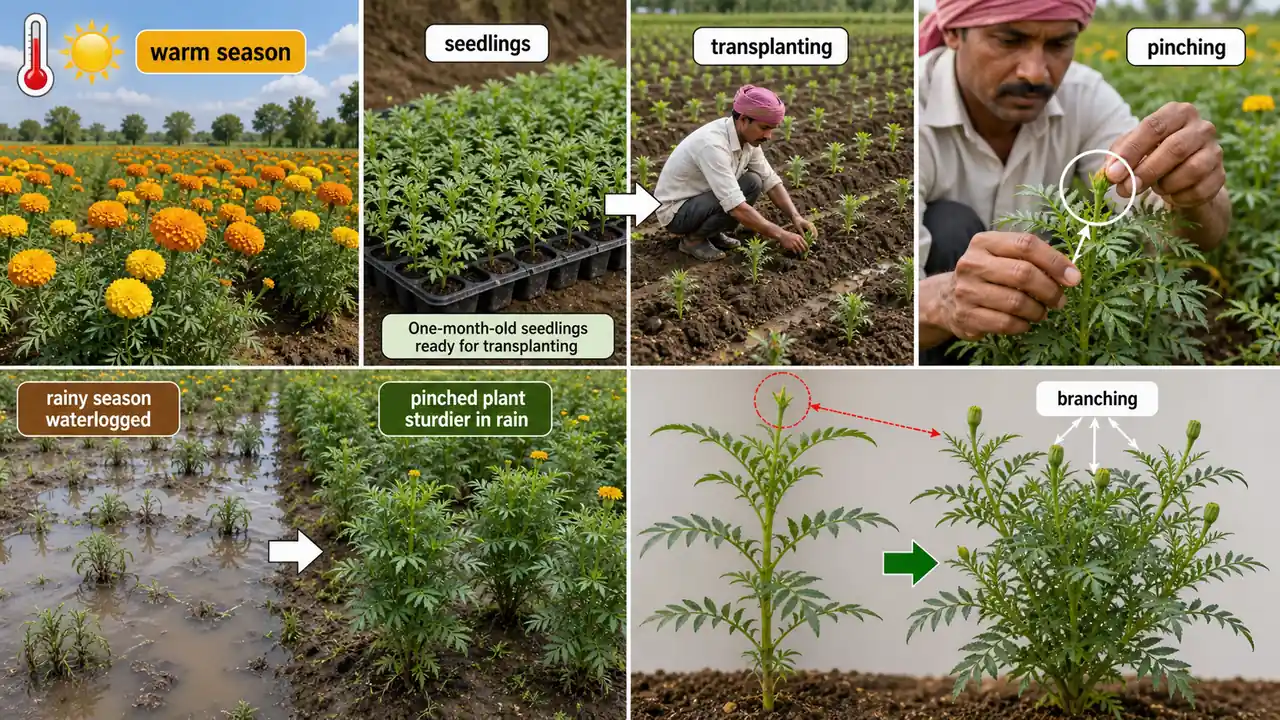
- Optimum temperature: 18-30 °C. Marigold grows best in this moderate temperature range. It is a warm-season crop but can tolerate a fairly wide range of temperatures, making it adaptable to diverse Indian climatic conditions.
- Marigold is a herbaceous plant. This means it has a soft, non-woody stem that dies back at the end of the growing season, unlike woody shrubs or trees.
- Seed rate: 1-1.5 kg/ha. This relatively low seed rate reflects the small size of marigold seeds and their generally good germination percentage.
- Seedlings become ready for planting one month after sowing. Marigold seedlings are raised in nursery beds and are typically ready for transplanting to the main field about 30 days after sowing, when they have developed adequate root systems and a few true leaves.
- Pinching of rainy crop is beneficial to avoid waterlogging. Pinching (removing the growing tip of young plants) encourages branching and more compact growth. During the rainy season, pinching helps plants resist waterlogging by promoting a sturdier, bushier structure.
- Marigold is not used in Gajra. (Generally Jasmine flowers are used). Gajra is a traditional Indian floral ornament worn in the hair, and it is typically made from fragrant jasmine (Jasminum) flowers, not marigold. Marigold is generally used for garlands and loose-flower decorations instead.

- S.P.S. Raghava is associated with Marigold. Dr. S.P.S. Raghava is a prominent Indian horticulturist known for his significant research contributions to marigold breeding and improvement in India.
- Protandry type of self-incompatibility is found in marigold. Protandry means the male reproductive organs (anthers) mature before the female organs (stigma) in the same flower. This natural mechanism promotes cross-pollination and prevents self-fertilization, leading to self-incompatibility in marigold.
- Male sterility in African marigold is due to female character. In African marigold, male sterility occurs when flowers develop with predominantly female characteristics, lacking functional pollen-producing anthers.
- Genetic male sterility (GMS) is very common in marigold. GMS is controlled by a recessive gene and is commercially exploited for producing F1 hybrid seeds without the need for manual emasculation, reducing the cost and effort of hybrid seed production.
African varieties
The following are important African marigold (Tagetes erecta) varieties:
- Cracker Jack
- Climax
- Golden Age
- Crown of Gold
- Chrysanthemum Charm
- Star Gold
- Pusa Narangi Genda -- developed by IARI (Indian Agricultural Research Institute), this is a popular orange-flowered variety.
- Pusa Basanti Genda -- an open-pollinated (OP) variety of marigold. OP varieties are naturally pollinated and produce seeds that are true-to-type, allowing farmers to save and replant seeds from their harvest.
- Nugget -- triploid variety of marigold. Triploid varieties (with three sets of chromosomes, 3n = 36) are produced by crossing diploid African marigold with tetraploid French marigold. Triploid marigolds are typically sterile (they don't produce seeds), which means all the plant's energy goes into producing larger, more abundant, and longer-lasting flowers.
TIP
Ploidy in marigold: African = diploid (2n=24), French = tetraploid (2n=48), Nugget = triploid (3n=36, a cross between African and French). Triploid = sterile = better flowers.
French varieties
The following are important French marigold (Tagetes patula) varieties. French marigolds are prized for their compact habit and brightly coloured, often bicoloured flowers:
- Rusty Red
- Butter Scotch
- Valencia
Summary Cheat Sheet
| Concept / Topic | Key Details / Explanation |
|---|---|
| Identity and economic role | Marigold is one of the most important loose flower crops in India and is widely used for garlands, religious offerings, festival decoration, pigment extraction, and essential oil production. |
| Common name, family, and origin | Marigold is called the Rose of Indies, belongs to the Compositae (Asteraceae) family, and is native to Mexico, not India, Africa, or France. |
| Main cultivated types | The two major cultivated types are African marigold = Tagetes erecta and French marigold = Tagetes patula. |
| Chromosome numbers and plant habit | African marigold is the taller type and is diploid with 2n = 24, while French marigold is shorter and bushier and is tetraploid with 2n = 48. |
| Climate and crop habit | Marigold grows best at 18-30°C and is a herbaceous plant with a soft, non-woody stem. |
| Seed rate and transplanting stage | The usual seed rate is 1-1.5 kg/ha, and seedlings are ready for transplanting about one month after sowing. |
| Pinching and rainy-season management | Pinching is useful in the rainy crop because it encourages branching and helps plants tolerate waterlogging better. |
| Gajra fact | Marigold is not used in gajra; jasmine is the standard flower used for gajra. |
Summary Continued
| Concept / Topic | Key Details / Explanation |
|---|---|
| Research association | S.P.S. Raghava is the scientist specifically associated with marigold work in the lesson. |
| Self-incompatibility | Marigold shows protandry, meaning the anthers mature before the stigma, which promotes cross-pollination. |
| Male sterility and hybrid-seed production | Genetic male sterility (GMS) is common in marigold and is commercially useful for F1 hybrid seed production; the lesson also notes that male sterility in African marigold is linked with female character. |
| African marigold varieties | Important African marigold varieties listed are Cracker Jack, Climax, Golden Age, Crown of Gold, Chrysanthemum Charm, Star Gold, Pusa Narangi Genda, Pusa Basanti Genda, and Nugget. |
| Pusa lines and OP type | Pusa Narangi Genda was developed by IARI, while Pusa Basanti Genda is an open-pollinated variety. |
| Nugget and ploidy logic | Nugget is a triploid marigold (3n = 36) produced by crossing diploid African marigold with tetraploid French marigold; triploids are generally sterile and channel more energy into flower production. |
| French marigold varieties | Important French marigold varieties mentioned are Rusty Red, Butter Scotch, and Valencia. |
| Core ploidy memory cue | The key revision set is African = 2n 24, French = 2n 48, and Nugget = 3n 36. |