🌺 Chrysanthemum — The Autumn Queen of Indian Gardens
Complete guide to chrysanthemum cultivation covering botanical identity, Compositae family, root sucker propagation, important varieties, and key exam facts for competitive agriculture exams.
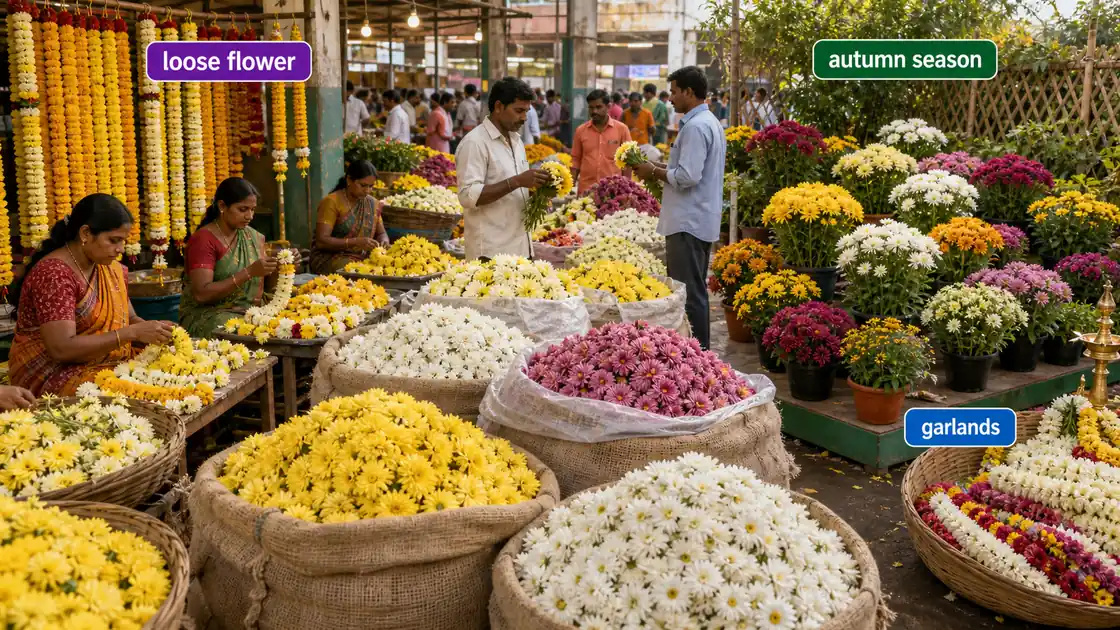
Walk through any Indian flower market during October-November, and you will see chrysanthemum dominating the stalls — bundles of golden, white, and pink "Guldaudi" flowers, freshly harvested for the festive season. From Diwali garlands to winter garden displays, chrysanthemum is one of the most commercially important flower crops in the country. Its popularity stems from an extraordinary diversity of flower forms, vibrant colours, and an extended bloom period that perfectly coincides with India's autumn and winter celebrations.
IMPORTANT
Remember: Chrysanthemum belongs to the Compositae (Asteraceae) family — the same family as sunflower, marigold, and dahlia. Its origin is China, and it is commercially propagated by root suckers.
Botanical Identity
| Parameter | Detail |
|---|---|
| Botanical Name | Dendranthema grandiflora (earlier classified as Chrysanthemum) |
| Family | Compositae (Asteraceae) |
| Common name (Hindi) | Guldaudi |
| Origin | China (cultivated for over 2,500 years) |
| Propagation | Root suckers (primary commercial method) |
| Uses | Garlands, religious offerings, floral decorations, garden displays |
| Peak season | Autumn and winter |

Key Facts for Exam Preparation
Family — Compositae (Asteraceae)
The Compositae is one of the largest families of flowering plants. It is characterized by composite flower heads made up of many small individual florets arranged together on a single receptacle, giving the appearance of a single large flower. Other well-known members include sunflower, marigold, and dahlia.
Pro Content Locked
Upgrade to Pro to access this lesson and all other premium content.
₹99 charged monthly · Cancel anytime
- All Agriculture & Banking Courses
- AI Lesson Questions (100/day)
- AI Doubt Solver (50/day)
- Glows & Grows Feedback (30/day)
- AI Section Quiz (20/day)
- 22-Language Translation (100/day)
- Recall Questions (20/day)
- AI Quiz (15/day)
- AI Quiz Paper Analysis (100/day)
- AI Step-by-Step Explanations (100/day)
- Spaced Repetition Recall (FSRS)
- AI Tutor
- Immersive Text Questions
- Audio Lessons — Hindi & English
- Mock Tests & Previous Year Papers
- Summary & Mind Maps
- XP, Levels, Leaderboard & Badges
- Generate New Classrooms
- Voice AI Teacher (AgriDots Live)
- AI Revision Assistant
- Knowledge Gap Analysis
- Interactive Revision (LangGraph)
🔒 Secure via Razorpay · Cancel anytime · No hidden fees
Walk through any Indian flower market during October-November, and you will see chrysanthemum dominating the stalls — bundles of golden, white, and pink "Guldaudi" flowers, freshly harvested for the festive season. From Diwali garlands to winter garden displays, chrysanthemum is one of the most commercially important flower crops in the country. Its popularity stems from an extraordinary diversity of flower forms, vibrant colours, and an extended bloom period that perfectly coincides with India's autumn and winter celebrations.
IMPORTANT
Remember: Chrysanthemum belongs to the Compositae (Asteraceae) family — the same family as sunflower, marigold, and dahlia. Its origin is China, and it is commercially propagated by root suckers.
Botanical Identity
| Parameter | Detail |
|---|---|
| Botanical Name | Dendranthema grandiflora (earlier classified as Chrysanthemum) |
| Family | Compositae (Asteraceae) |
| Common name (Hindi) | Guldaudi |
| Origin | China (cultivated for over 2,500 years) |
| Propagation | Root suckers (primary commercial method) |
| Uses | Garlands, religious offerings, floral decorations, garden displays |
| Peak season | Autumn and winter |
Key Facts for Exam Preparation
Family — Compositae (Asteraceae)
The Compositae is one of the largest families of flowering plants. It is characterized by composite flower heads made up of many small individual florets arranged together on a single receptacle, giving the appearance of a single large flower. Other well-known members include sunflower, marigold, and dahlia.
Origin — China
Chrysanthemum has been cultivated in China for over 2,500 years, making it one of the oldest cultivated ornamental plants. It holds deep cultural significance in Chinese tradition and is considered one of the "Four Gentlemen" of Chinese art (along with plum blossom, orchid, and bamboo).
Propagation — Root Suckers
The most common and commercially preferred method is through root suckers (also called basal suckers). These are vegetative shoots that emerge from the base of the mother plant. Using root suckers ensures that new plants are true-to-type, maintaining the exact characteristics of the parent variety. Other methods include stem cuttings and tissue culture.

Important Varieties
The following are important varieties of chrysanthemum cultivated in India:
- Diana
- Basanti
- Ralchi
- Birbal Sahani
- Indira
- Red Gold
Summary Cheat Sheet
| Concept / Topic | Key Details / Explanation |
|---|---|
| Botanical identity | Chrysanthemum is Dendranthema grandiflora and belongs to the Compositae (Asteraceae) family. |
| Common name and season | Its Hindi name is Guldaudi, and it is an important flower of the autumn and winter season in India. |
| Origin | The lesson identifies China as the origin and notes that the crop has been cultivated there for more than 2,500 years. |
| Family significance | Compositae/Asteraceae is one of the largest flowering-plant families, and the lesson groups chrysanthemum with sunflower, marigold, and dahlia under this family. |
| Composite flower-head concept | A key family feature is the composite flower head, where many small florets are arranged together on a common receptacle and look like one large flower. |
| Chinese cultural association | Chrysanthemum is one of the Four Gentlemen of Chinese art, along with plum blossom, orchid, and bamboo. |
| Main propagation method | The commercially preferred propagation method is through root suckers (basal suckers). |
| Why root suckers are preferred | Root suckers give true-to-type plants, preserving the exact characteristics of the mother plant. |
| Other propagation methods | Besides root suckers, the lesson also mentions stem cuttings and tissue culture. |
| Main uses | Chrysanthemum is used for garlands, religious offerings, floral decoration, and garden display and is widely sold as a loose flower crop. |
| Important varieties | Important chrysanthemum varieties listed in the lesson are Diana, Basanti, Ralchi, Birbal Sahani, Indira, and Red Gold. |