🌸 Gladiolus — The Queen of Cut Flowers
Complete guide to gladiolus cultivation covering Iridaceae family, corm vs bulb distinction, propagation by corms, important varieties, and key exam facts for competitive agriculture exams.
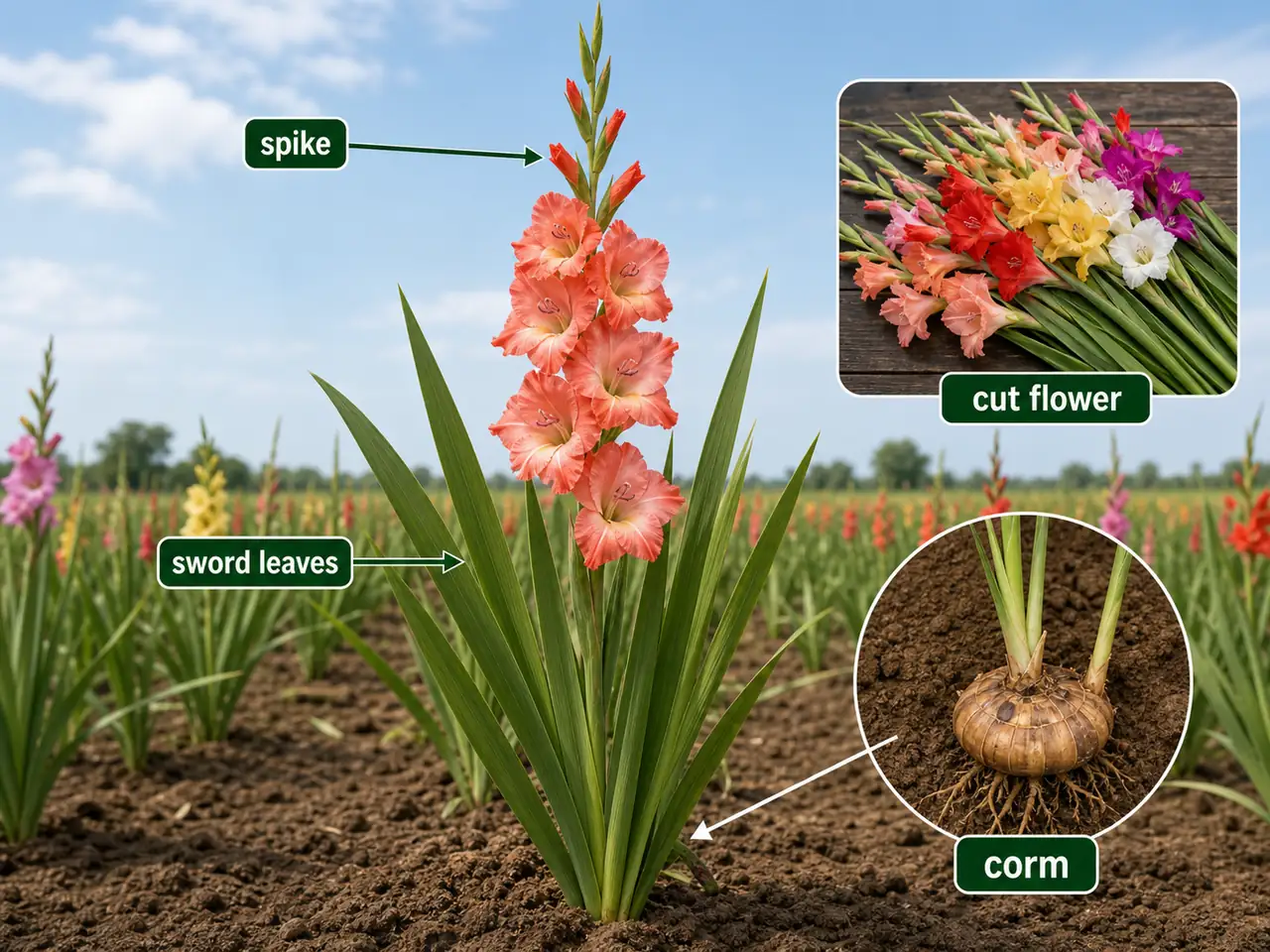
At a flower exhibition in Bangalore, visitors pause to admire tall, striking spikes of gladiolus — each bearing 12-20 or more florets arranged in a row, in colours ranging from deep crimson to pale yellow. The name "Gladiolus" itself tells the story of this flower: derived from the Latin word gladius meaning "sword," it refers to the plant's graceful, sword-shaped leaves. In the hierarchy of flowers, if the rose is the King, then gladiolus is the undisputed Queen — and this distinction is one of the most commonly asked questions in competitive agriculture exams.
IMPORTANT
Gladiolus is called the Queen of Flowers (Rose is the King of Flowers). This distinction is a common exam question. Also remember: propagation is by corms (not bulbs), and the family is Iridaceae.

Botanical Identity
| Parameter | Detail |
|---|---|
| Botanical Name | Gladiolus hybridus |
| Family | Iridaceae (iris family — monocotyledonous) |
| Title | Queen of Flowers |
| Name meaning | From Latin gladius = "sword" (refers to leaf shape) |
| Propagation | Corms and tissue culture |
| Use | Primarily a cut flower (tall spikes with 12-20+ florets) |
| Other family members | Iris, Crocus, Freesia |
The cultivated gladiolus is a hybrid species developed through extensive cross-breeding of several wild species, resulting in the enormous diversity of colours, sizes, and flower forms available today.
Pro Content Locked
Upgrade to Pro to access this lesson and all other premium content.
₹99 charged monthly · Cancel anytime
- All Agriculture & Banking Courses
- AI Lesson Questions (100/day)
- AI Doubt Solver (50/day)
- Glows & Grows Feedback (30/day)
- AI Section Quiz (20/day)
- 22-Language Translation (100/day)
- Recall Questions (20/day)
- AI Quiz (15/day)
- AI Quiz Paper Analysis (100/day)
- AI Step-by-Step Explanations (100/day)
- Spaced Repetition Recall (FSRS)
- AI Tutor
- Immersive Text Questions
- Audio Lessons — Hindi & English
- Mock Tests & Previous Year Papers
- Summary & Mind Maps
- XP, Levels, Leaderboard & Badges
- Generate New Classrooms
- Voice AI Teacher (AgriDots Live)
- AI Revision Assistant
- Knowledge Gap Analysis
- Interactive Revision (LangGraph)
🔒 Secure via Razorpay · Cancel anytime · No hidden fees
At a flower exhibition in Bangalore, visitors pause to admire tall, striking spikes of gladiolus — each bearing 12-20 or more florets arranged in a row, in colours ranging from deep crimson to pale yellow. The name "Gladiolus" itself tells the story of this flower: derived from the Latin word gladius meaning "sword," it refers to the plant's graceful, sword-shaped leaves. In the hierarchy of flowers, if the rose is the King, then gladiolus is the undisputed Queen — and this distinction is one of the most commonly asked questions in competitive agriculture exams.
IMPORTANT
Gladiolus is called the Queen of Flowers (Rose is the King of Flowers). This distinction is a common exam question. Also remember: propagation is by corms (not bulbs), and the family is Iridaceae.
Botanical Identity
| Parameter | Detail |
|---|---|
| Botanical Name | Gladiolus hybridus |
| Family | Iridaceae (iris family — monocotyledonous) |
| Title | Queen of Flowers |
| Name meaning | From Latin gladius = "sword" (refers to leaf shape) |
| Propagation | Corms and tissue culture |
| Use | Primarily a cut flower (tall spikes with 12-20+ florets) |
| Other family members | Iris, Crocus, Freesia |
The cultivated gladiolus is a hybrid species developed through extensive cross-breeding of several wild species, resulting in the enormous diversity of colours, sizes, and flower forms available today.
Corm vs Bulb — A Critical Distinction
This distinction is frequently tested in horticulture exams:
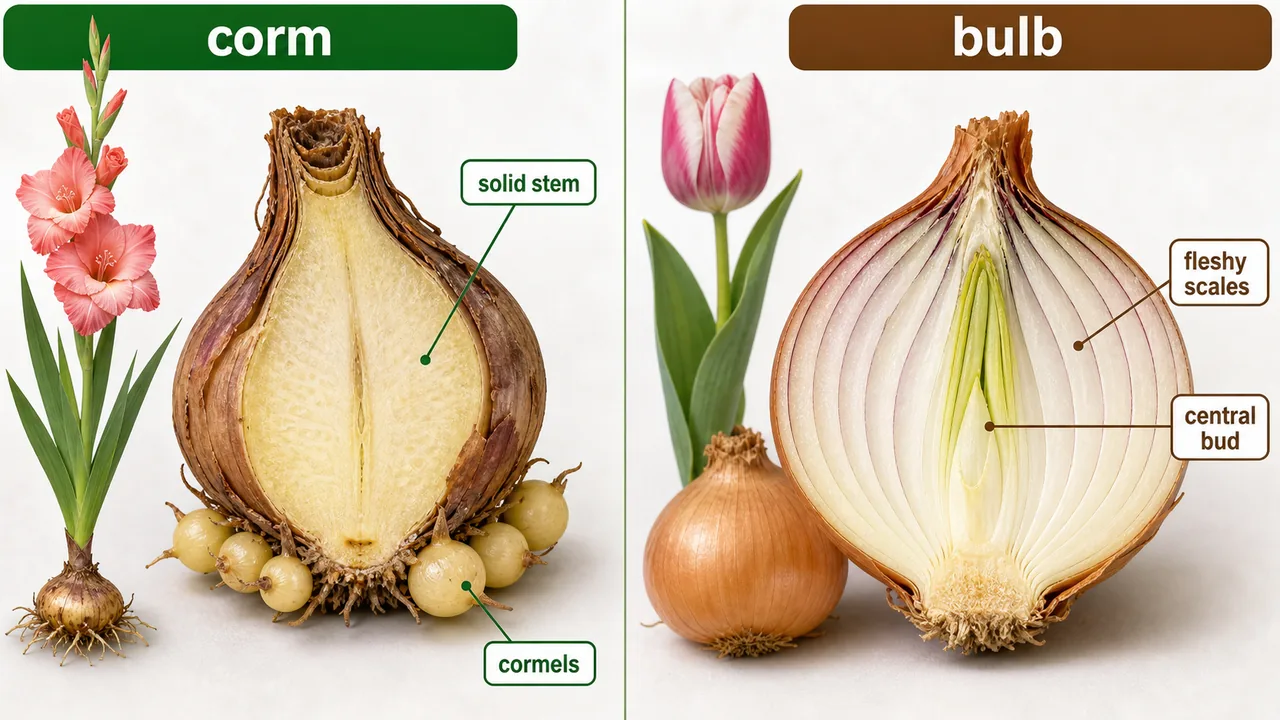
Corm vs Bulb -- What's the difference?
| Feature | Corm | Bulb |
|---|---|---|
| Internal structure | Solid, uniform | Layered fleshy scales |
| Food storage | In the solid stem tissue | In the fleshy scale leaves |
| Examples | Gladiolus, Crocus, Saffron | Onion, Tulip, Lily |
| Baby propagules | Cormels (small corms at base) | Bulblets (small bulbs) |
A corm is a solid, swollen underground stem base with a uniform internal structure. A bulb has layers of fleshy scales around a central bud. Gladiolus produces cormels (baby corms) that can be grown into flowering-size corms over 1-2 seasons.
Propagation
- Corms are the primary and most common method. Each mother corm also produces small cormels that can be grown into flowering-size corms over 1-2 seasons.
- Tissue culture is used for rapid multiplication of disease-free planting material, especially for new or rare varieties.
- Using corms ensures plants are true-to-type, maintaining the exact characteristics of the parent variety.

Important Varieties
The following are important varieties of gladiolus cultivated in India:
- Priyadarshani
- Happy End
- Suchitra
- Friendship
Comparison — King vs Queen of Flowers
| Title | Flower | Family | Propagation |
|---|---|---|---|
| King of Flowers | Rose (Rosa spp.) | Rosaceae | T-budding (shield budding) |
| Queen of Flowers | Gladiolus (G. hybridus) | Iridaceae | Corms |
Summary Cheat Sheet
| Concept / Topic | Key Details / Explanation |
|---|---|
| Identity and title | Gladiolus is Gladiolus hybridus of the Iridaceae family and is called the Queen of Flowers, while rose is the King of Flowers. |
| Name meaning | The word Gladiolus comes from the Latin gladius, meaning sword, which refers to its sword-shaped leaves. |
| Main use | Gladiolus is mainly a cut flower crop, valued for its long spikes carrying about 12-20 or more florets. |
| Family associates | Other important members of the Iridaceae family mentioned in the lesson are Iris, Crocus, and Freesia. |
| Hybrid nature | The cultivated gladiolus is treated as a hybrid species created through extensive cross-breeding, which explains its diversity of flower colours and forms. |
| Corm vs bulb distinction | Gladiolus propagates through a corm, not a bulb; a corm has a solid internal structure, while a bulb has layered fleshy scales. |
| Corm examples vs bulb examples | The lesson contrasts Gladiolus, Crocus, and Saffron as corm crops with Onion, Tulip, and Lily as bulb crops. |
| Baby propagules | A corm produces cormels, while a bulb produces bulblets. |
| Main propagation method | The primary commercial propagation method is through corms, and each mother corm also produces cormels that can be grown to flowering size in 1-2 seasons. |
| Tissue culture role | Tissue culture is used for rapid multiplication of disease-free planting material, especially for rare or newly introduced varieties. |
| True-to-type multiplication | Propagation through corms helps maintain true-to-type plants, preserving the exact varietal characters. |
| Important varieties | Important gladiolus varieties listed in the lesson are Priyadarshani, Happy End, Suchitra, and Friendship. |
| Rose vs gladiolus exam contrast | The lesson closes with a classic exam comparison: Rose = King of Flowers = Rosaceae = T-budding, while Gladiolus = Queen of Flowers = Iridaceae = Corms. |