🥬 Olericulture — The Science of Vegetable Cultivation
Complete guide to vegetable science covering India's production statistics, botanical classification, sex expression, respiration patterns, photoperiod response, salinity tolerance, and life cycle classification of major vegetable crops.
Walk into any Indian kitchen, and you will find vegetables at the heart of every meal — from the humble onion in a farmer's field in Maharashtra to the fresh tomatoes ripening on stakes in a small holding in Uttar Pradesh. India is the second largest vegetable producer in the world, and understanding the science behind this vast production system is exactly what olericulture is all about.
IMPORTANT
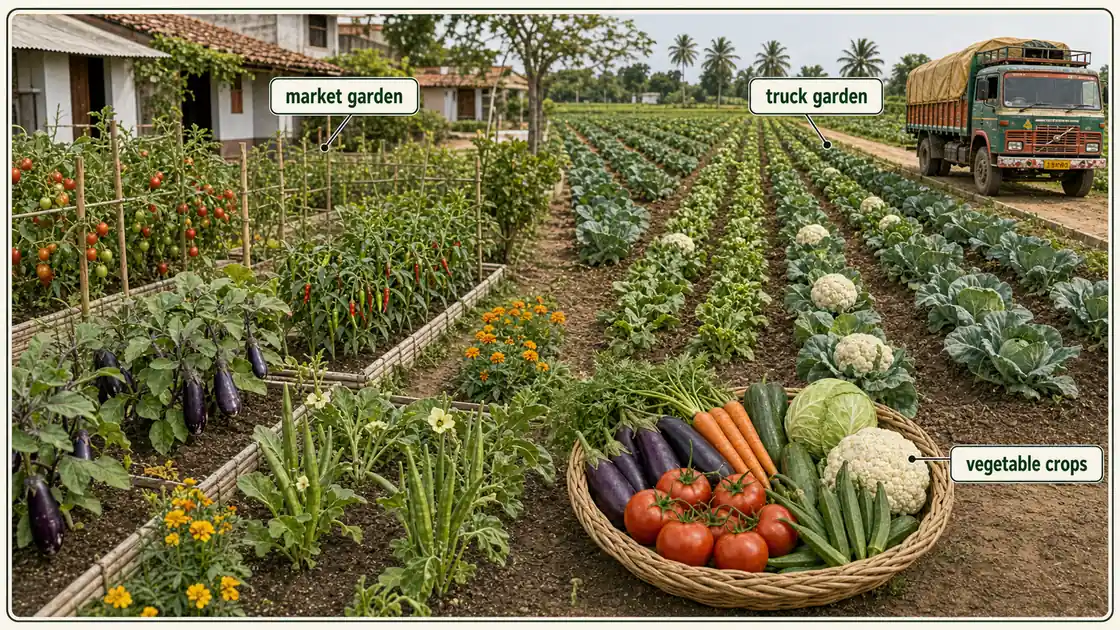
Olericulture is the branch of horticulture dealing with the cultivation, processing, and marketing of vegetable crops. For exams, remember the distinction between market garden (intensive, near cities) and truck garden (extensive, distant transport).
Why Vegetables Matter
Vegetables are a rich source of vitamins and minerals, forming an essential part of a balanced diet. They contribute vital micronutrients that help prevent deficiency diseases and support overall health.
Pro Content Locked
Upgrade to Pro to access this lesson and all other premium content.
Charged once for one year · ₹1188 total
Save ₹100/month vs ₹2388/year launch price
- All Agriculture & Banking Courses
- AI Lesson Questions (100/day)
- AI Doubt Solver (50/day)
- Glows & Grows Feedback (30/day)
- AI Section Quiz (20/day)
- 22-Language Translation (100/day)
- Recall Questions (20/day)
- AI Quiz (15/day)
- AI Quiz Paper Analysis (100/day)
- AI Step-by-Step Explanations (100/day)
- Spaced Repetition Recall (FSRS)
- AI Tutor
- Immersive Text Questions
- Audio Lessons — Hindi & English
- Mock Tests & Previous Year Papers
- Summary & Mind Maps
- XP, Levels, Leaderboard & Badges
- Generate New Classrooms
- Voice AI Teacher (AgriDots Live)
- AI Revision Assistant
- Knowledge Gap Analysis
- Interactive Revision (LangGraph)
🔒 Secure one-time yearly payment via Razorpay · No hidden fees
Walk into any Indian kitchen, and you will find vegetables at the heart of every meal — from the humble onion in a farmer's field in Maharashtra to the fresh tomatoes ripening on stakes in a small holding in Uttar Pradesh. India is the second largest vegetable producer in the world, and understanding the science behind this vast production system is exactly what olericulture is all about.
IMPORTANT
Olericulture is the branch of horticulture dealing with the cultivation, processing, and marketing of vegetable crops. For exams, remember the distinction between market garden (intensive, near cities) and truck garden (extensive, distant transport).
Why Vegetables Matter
Vegetables are a rich source of vitamins and minerals, forming an essential part of a balanced diet. They contribute vital micronutrients that help prevent deficiency diseases and support overall health.
Consider a practical example: a farmer growing leafy greens like spinach in Bihar gets not only a quick cash crop (harvested in 25-30 days) but also provides a major source of folic acid (Vitamin B9) to local communities — a nutrient that is critical during pregnancy for preventing neural tube defects.
India's Vegetable Production — Key Statistics
| Parameter | Fact |
|---|---|
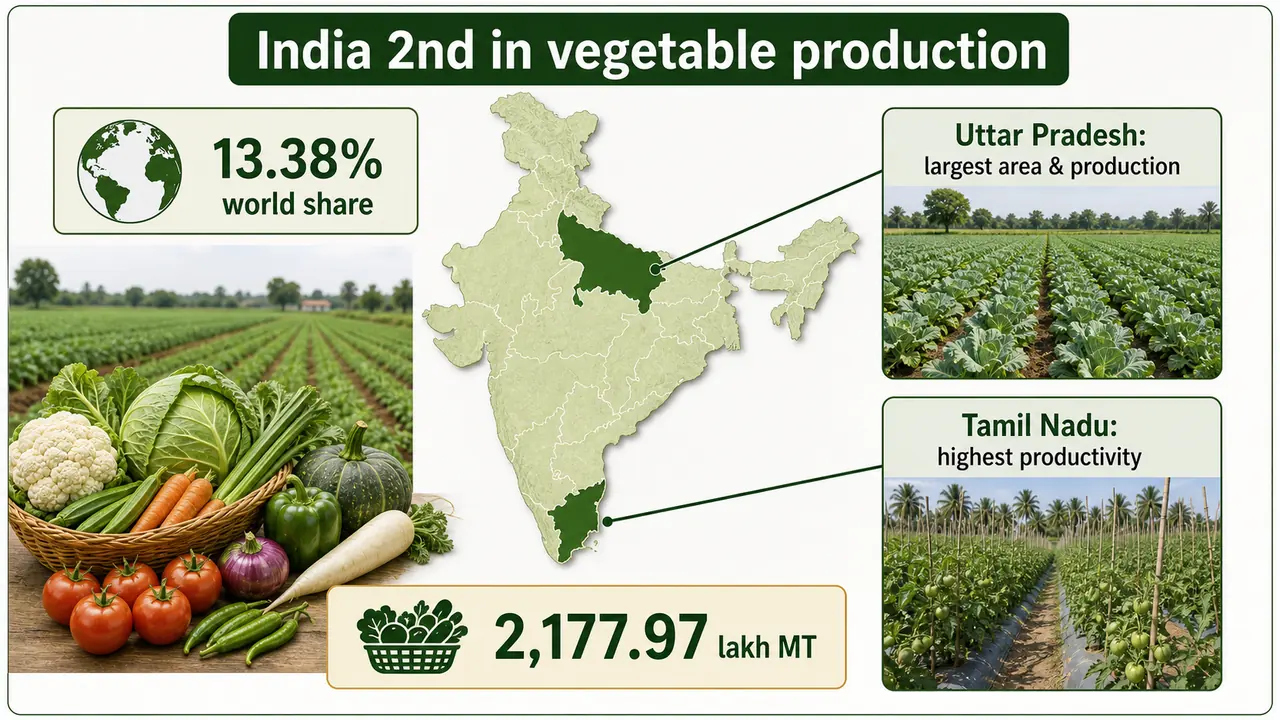
| India's global rank in vegetable production | 2nd (after China) |
| Share of world vegetable production | 13.38% |
| Area under vegetables in India | 7.8% of total cropped area |
| Vegetable production (2024-25 Final) | 2,177.97 lakh MT (+5.11% over 2023-24)[1] |
| Largest state by area and production | Uttar Pradesh |
| Highest productivity state | Tamil Nadu |
| Major mineral in fruits and vegetables | Potassium (K) |
| Green leafy vegetables are rich in | Folic acid (Vitamin B9) |
Despite occupying only 7.8% of the total cropped area, vegetables make a significant contribution to both food security and farmer incomes across India.
Overall Horticulture at a Glance (2024-25 Final Estimates)
| Category | Production (Lakh MT) | Change over 2023-24 |
|---|---|---|
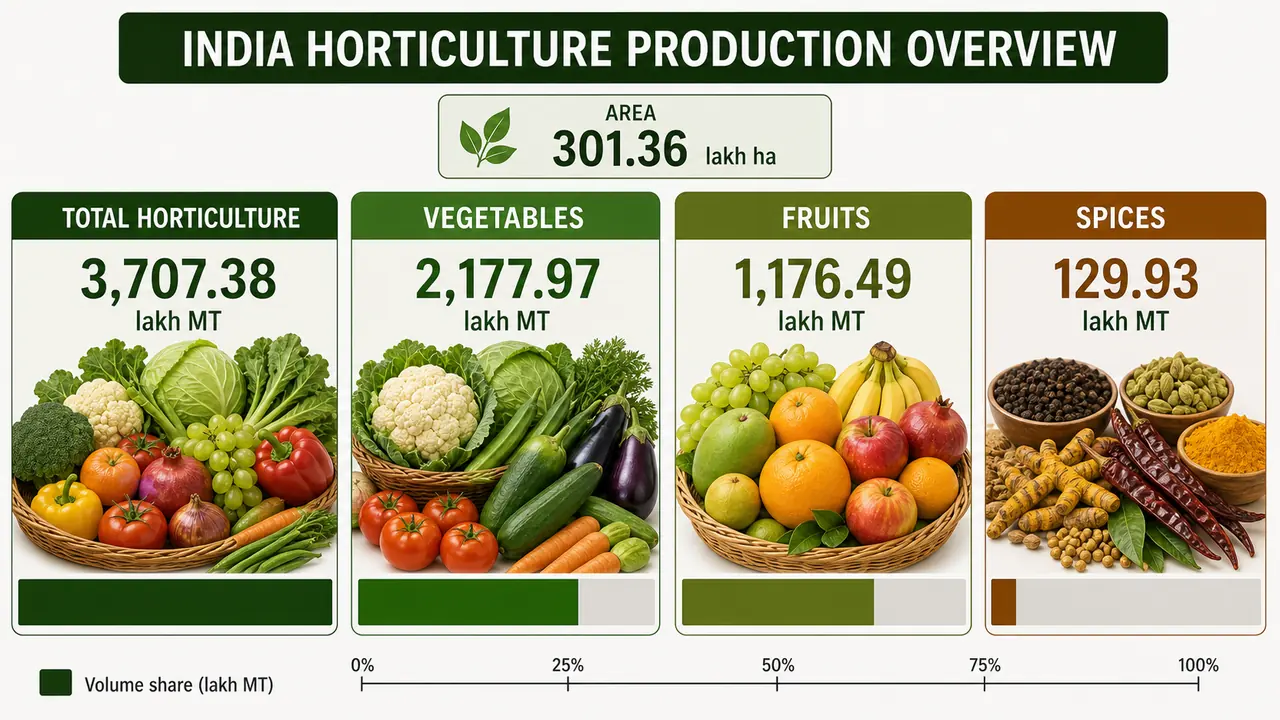
| Total Horticulture | 3,707.38 | +4.51% |
| Fruits | 1,176.49 | +4.13% |
| Vegetables | 2,177.97 | +5.11% |
| Spices | 129.93 | +4.08% |
Total horticulture area grew to 301.36 lakh ha (+3.61% over 2023-24).[1]
TIP
Key vegetable growth drivers in 2024-25: onion, potato, cauliflower, cabbage, brinjal, okra, peas all registered production increases.[1]
Market Garden vs Truck Garden
These are two contrasting systems of commercial vegetable production. Understanding the difference is a common exam question.
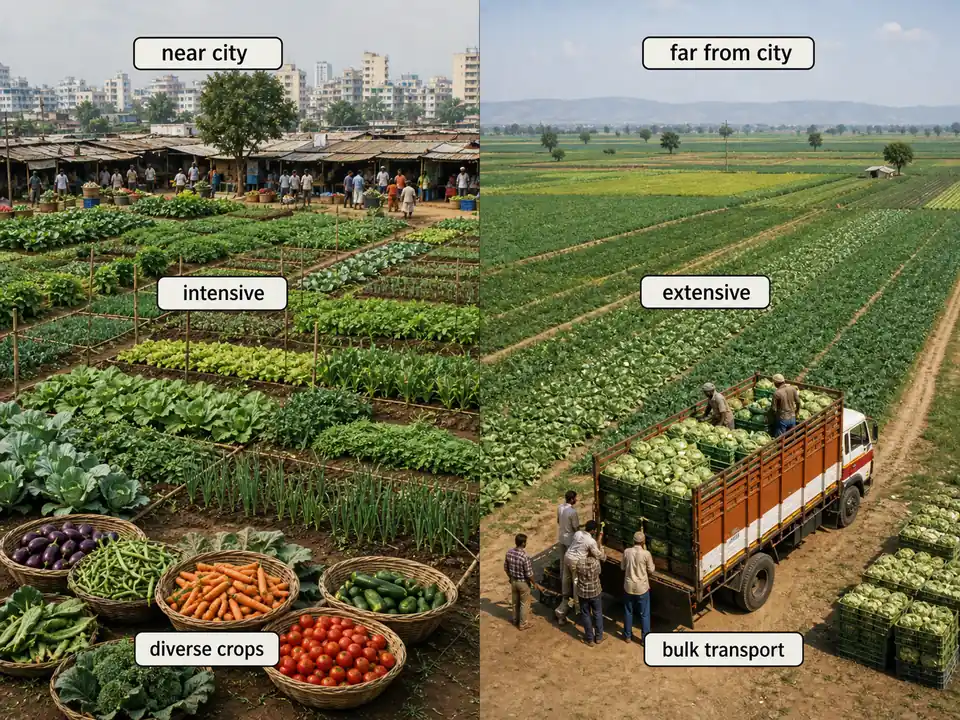
| Feature | Market Garden | Truck Garden |
|---|---|---|
| Scale | Small plots | Large scale |
| Location | Near urban centres | Far from cities |
| Method | Intensive cultivation | Extensive cultivation |
| Crop variety | Wide variety | Fewer crops, bulk production |
| Transport | Minimal (nearby market) | Long distance (by truck) |
TIP
Memory aid: Market garden = nearby Market, intensive. Truck garden = Transport to distant markets, extensive.
Botanical Classification of Vegetables
Vegetables are classified into different families based on their botanical characteristics such as flower structure, fruit type, and seed morphology. This classification helps in understanding growth habits, nutritional profiles, and pest-disease relationships. Crops in the same family often share similar pests and diseases, which is why crop rotation between different families is a fundamental practice in vegetable farming.
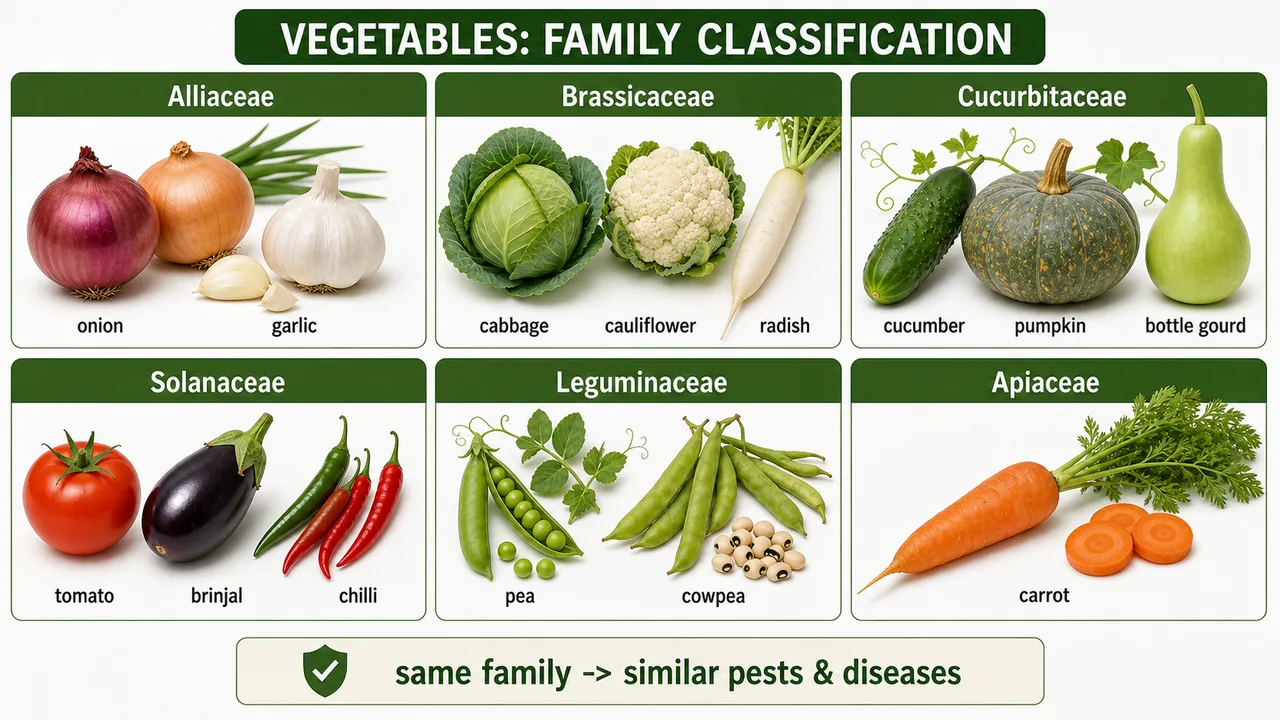
| Family | Common Name | Botanical Name | Origin | Edible Part |
|---|---|---|---|---|
| Alliaceae | Onion | Allium cepa | Central Asia | Bulb |
| Alliaceae | Garlic | Allium sativum | Central Asia | Cloves |
| Lilliaceae | Asparagus | Asparagus officinalis | — | Spears |
| Araceae | Taro | Colocasia esculenta | — | Corms |
| Chenopodiaceae | Beet root | Beta vulgaris | — | Roots |
| Chenopodiaceae | Palak | Beta vulgaris var. bengalensis | — | Leaves |
| Chenopodiaceae | Spinach | Spinacia oleracea | — | Leaves |
| Compositae | Lettuce | Lactuca sativa | — | Leafy heads |
| Amaranthaceae | Amaranthus | Amaranthus sp. | India | Leaves, stem |
| Convolvulaceae | Sweet potato | Ipomoea batata | S. America | Tuber (modified roots) |
| Cruciferae / Brassicaceae | Cabbage | Brassica oleracea var. capitata | — | Head |
| Cruciferae / Brassicaceae | Cauliflower | Brassica oleracea var. botrytis | — | Curd |
| Cruciferae / Brassicaceae | Broccoli | Brassica oleracea var. italica | — | Flower bud |
| Cruciferae / Brassicaceae | Turnip | Brassica rapa | — | Root |
| Cruciferae / Brassicaceae | Radish | Raphanus sativus | — | Root & leaves |
| Cruciferae / Brassicaceae | Knol khol (wild cabbage) | — | — | Modified stem |
| Cucurbitaceae | Cucumber | Cucumis sativus | India | Fruit |
| Cucurbitaceae | Musk melon | Cucumis melo | T. Africa | Fruit |
| Cucurbitaceae | Water melon | Citrullus lanatus | T. Africa | Fruit |
| Cucurbitaceae | Pumpkin | Cucurbita moschata | Mexico | Fruit |
| Cucurbitaceae | Bottle gourd | Lagenaria siceraria | — | Fruit |
| Cucurbitaceae | Bitter gourd | Momordica charantia | — | Fruit |
| Cucurbitaceae | Pointed gourd (Parval) | Trichosanthes dioica | India | Fruit |
| Cucurbitaceae | Snake gourd | Trichosanthes anguina | India | Fruit |
| Malvaceae | Okra | Abelmoschus esculentus | Africa | Fruit |
| Leguminaceae | Peas | Pisum sativum | Asia | Pod |
| Leguminaceae | French bean (Rajama) | Phaseolus vulgaris | Mexico | Pod |
| Leguminaceae | Cluster bean | Cyamopsis tetragonolobus | India | Pod |
| Leguminaceae | Cow pea | Vigna unguiculata | Africa | Pod |
| Umbelliferae (Apiaceae) | Carrot | Daucus carota | Afghanistan | Root |
| Umbelliferae (Apiaceae) | Coriander | Coriandrum sativum | — | Leaves |
| Umbelliferae (Apiaceae) | Cumin | Cuminum cyminum | — | Leaves |
| Umbelliferae (Apiaceae) | Fennel | Foeniculum vulgare | — | — |
| Umbelliferae (Apiaceae) | Celery | — | — | — |
| Umbelliferae (Apiaceae) | Parsley | — | — | — |
| Umbelliferae (Apiaceae) | Parsnip | — | — | — |
| Asteraceae (Daisy) | Lettuce (Lactuca sativa) | — | — | — |
| Solanaceae | Potato | Solanum tuberosum | S. America | Tuber |
| Solanaceae | Tomato | Lycopersicon esculentum | — | Fruit |
| Solanaceae | Brinjal | Solanum melongena | India | Fruit |
| Solanaceae | Chilli | Capsicum annuum | Mexico | Fruit |
| Euphorbiaceae | Cassava | Manihot esculenta | Brazil | Tuber |
Acids Present in Vegetables
Different vegetables contain characteristic organic acids that influence their taste, preservation, and nutritional value. For instance, the tartness of a ripe tomato comes from citric acid, while the tang in spinach comes from oxalic acid. Knowing which acid is present in which vegetable is important for food processing and exam preparation alike.
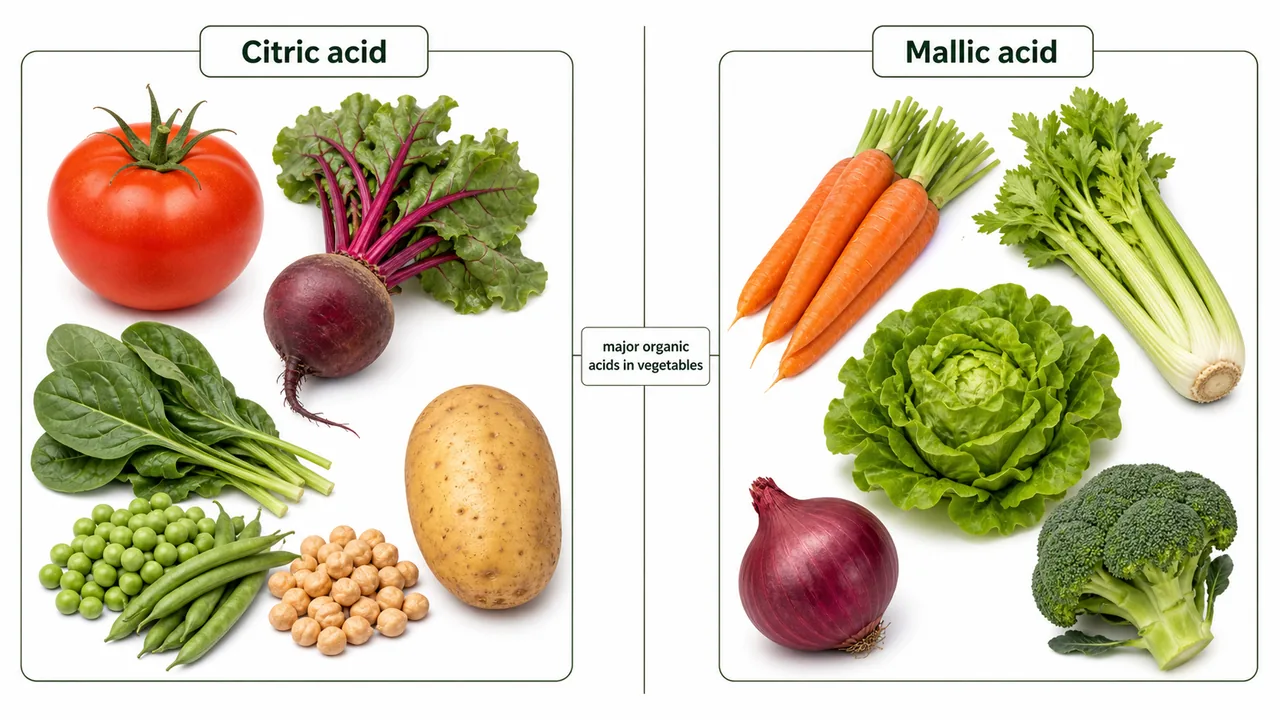
| Citric Acid | Mallic Acid |
|---|---|
| Tomato, beet root, leafy vegetables, legumes, potato | Carrot, celery, lettuce, onion and broccoli |
Sex Expression in Vegetable Crops
Vegetables show diverse sex expression patterns — some bear male and female flowers on the same plant (monoecious), while others have them on separate plants (dioecious). This is not merely a botanical detail — it has direct practical implications for pollination planning, hybrid seed production, and yield optimization.
For example, cucumber is monoecious (separate male and female flowers on the same plant), and applying growth regulators like ethrel can increase the ratio of female flowers, directly boosting fruit set and yield.
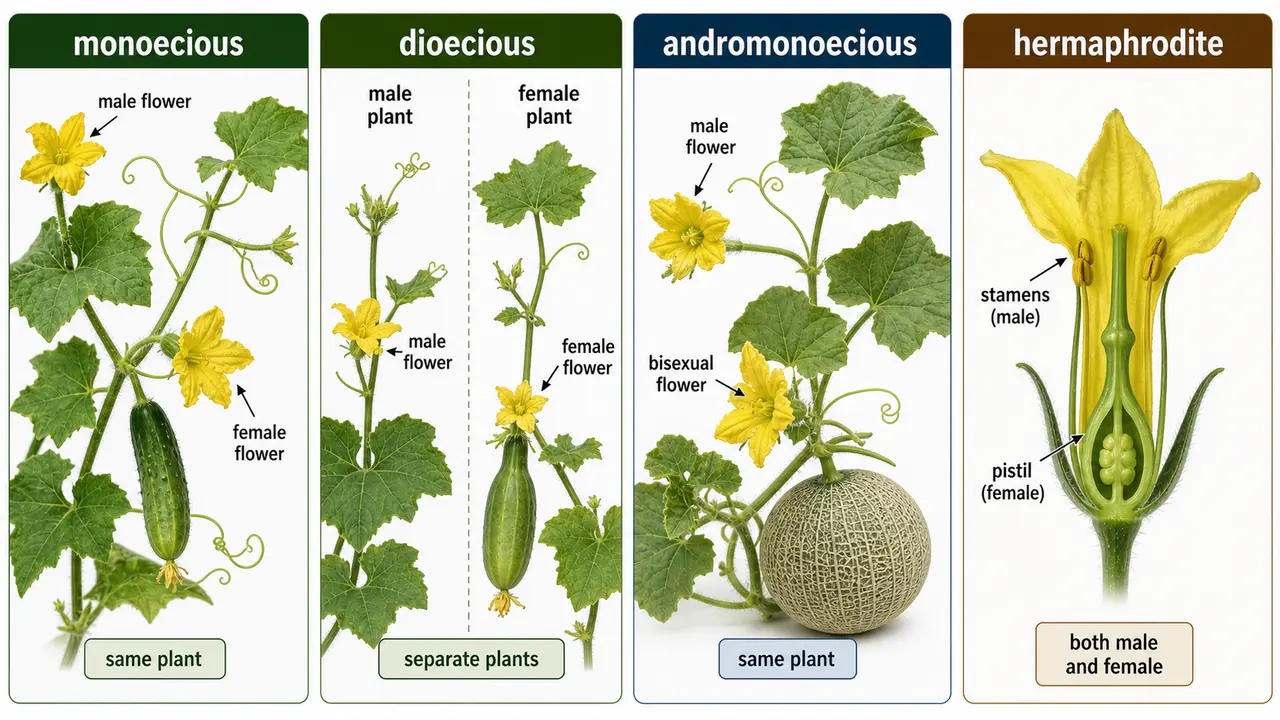
| Sex Type | Meaning | Examples |
|---|---|---|
| Monoecious | Male and female flowers on the same plant | Cucumber, pumpkin, watermelon |
| Dioecious | Male and female on separate plants | Pointed gourd, spine gourd |
| Andromonoecious | Male and bisexual flowers on the same plant | Muskmelon |
| Hermaphrodite | Both male and female organs in one flower | Tomato, chilli, brinjal |
| Dioecious Vegetables | Monoecious Vegetables |
|---|---|
| Pointed gourd | Cucurbits |
| Beet root | Cassava |
| Spinach | Amaranths |
Classification by Respiration Pattern
Vegetables can be grouped based on their respiration patterns after harvest. Climacteric vegetables show a sudden rise in respiration rate during ripening (triggered by ethylene), while non-climacteric vegetables do not show this peak. This classification directly affects post-harvest handling and storage life.
A practical example: tomato (climacteric) can be harvested green and will ripen during transit, while cucumber (non-climacteric) must be harvested at the right stage since it will not improve after picking.
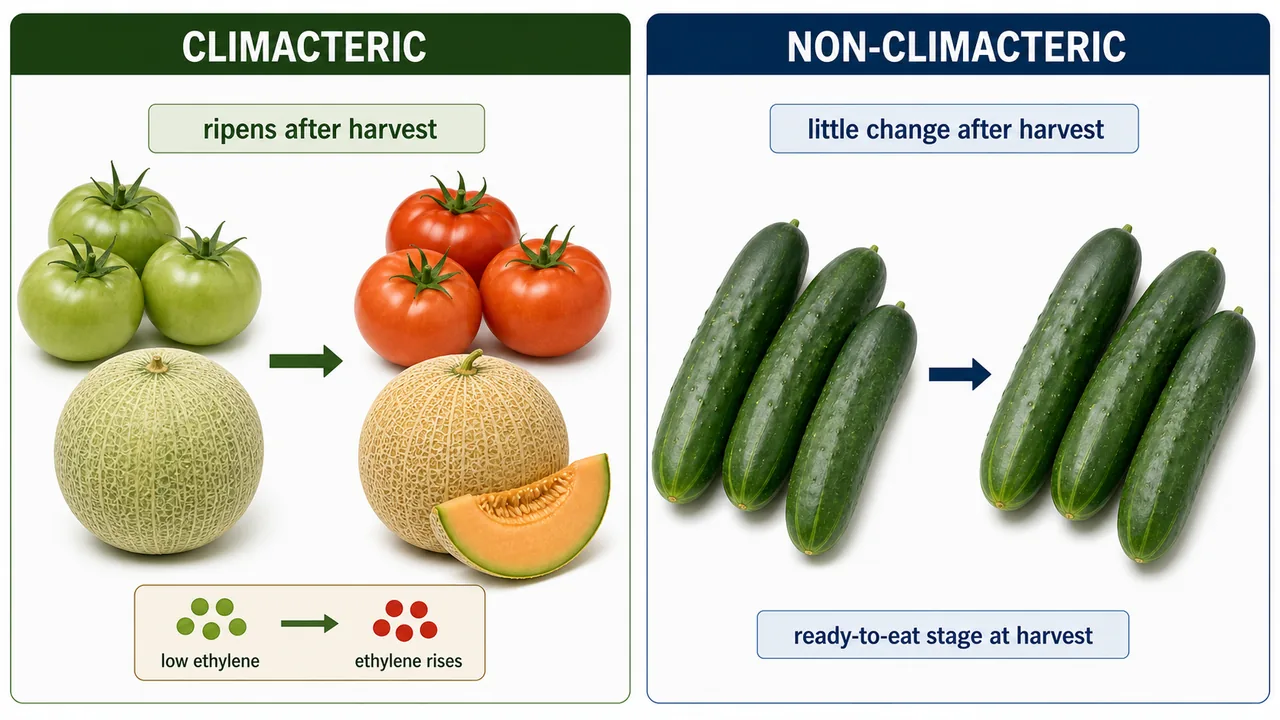
| Climacteric | Non-Climacteric |
|---|---|
| Musk melon, watermelon and tomato | Cucumber |
Classification by Photoperiod Response
Photoperiod refers to the duration of light a plant receives in a 24-hour cycle. Vegetables are classified as short-day, long-day, or day-neutral plants based on how day length influences their flowering and bulb formation. This classification is critical for determining the correct sowing season in different regions of India.
For instance, onion is a long-day plant for bulb formation — it needs 14-16 hours of daylight to form bulbs properly, which is why certain varieties fail to bulb in southern India where day length remains relatively short.
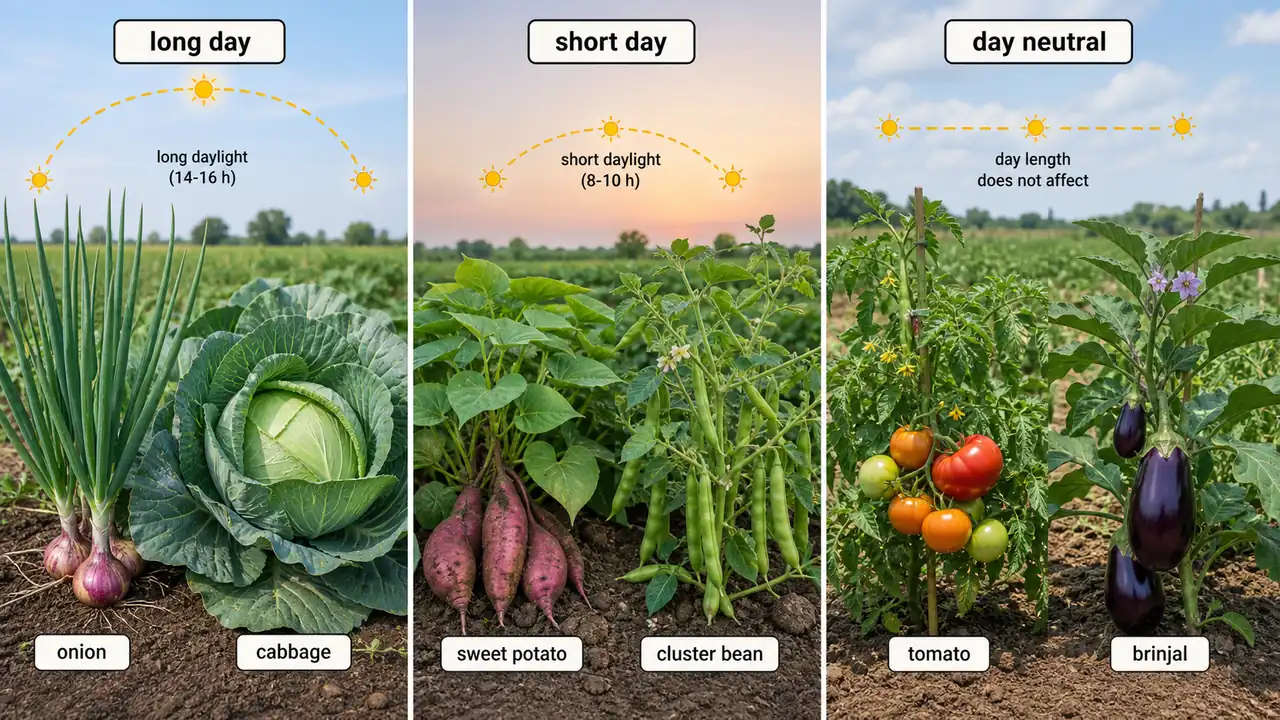
| Long Day Plant | Short Day Plant | Day Neutral Crop |
|---|---|---|
| Potato | Sweet Potato | Tomato |
| Onion | Cluster bean | Brinjal |
| Cabbage | Winged bean | Chilli |
| Cauliflower | Indian Spinach | Okra |
| Raddish | — | Amaranthus |
| Carrot | — | French Bean |
| Lettuce | — | Cowpea |
| Spinach | — | Sweet Pepper |
| Palak | — | Cucurbits |
| Turnip | — | — |
| Beetroot | — | — |
Classification by Respiration Rate of Produce
The rate of respiration in harvested produce determines how quickly it deteriorates. Think of it as the vegetable "breathing" — the faster it breathes, the faster it uses up stored energy and wilts.
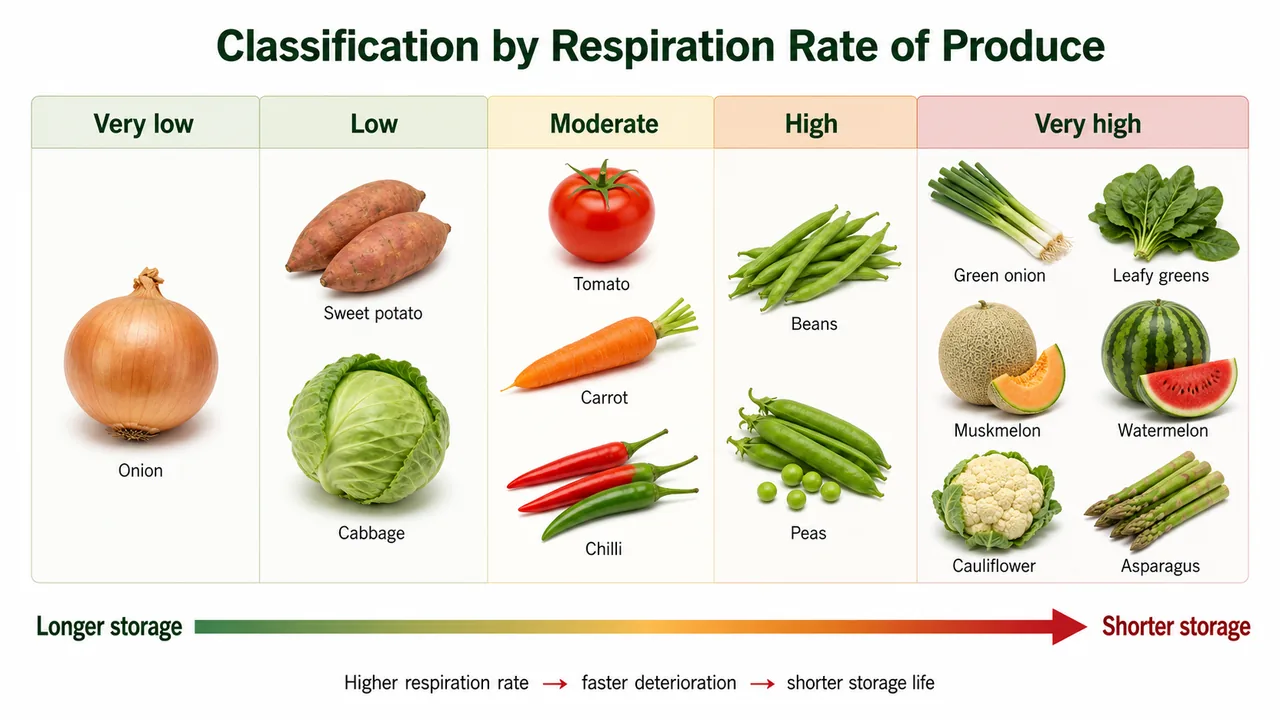
| Respiration Rate | Examples |
|---|---|
| Very Low | Onion |
| Low | Sweet Potato, cabbage |
| Moderate | Tomato, carrot, chilli |
| High | Beans, peas |
| Very High | Green onion, leafy greens, musk melon, water melon, cauliflower and asparagus |
Tolerance to Soil Salinity
Soil salinity is a major limiting factor in vegetable production across arid and semi-arid regions of India, particularly in parts of Rajasthan, Gujarat, and Haryana. Some vegetables are tolerant to high salt concentrations, while others are sensitive. Knowing a crop's salinity tolerance helps farmers select the right vegetable for saline or alkaline soils.
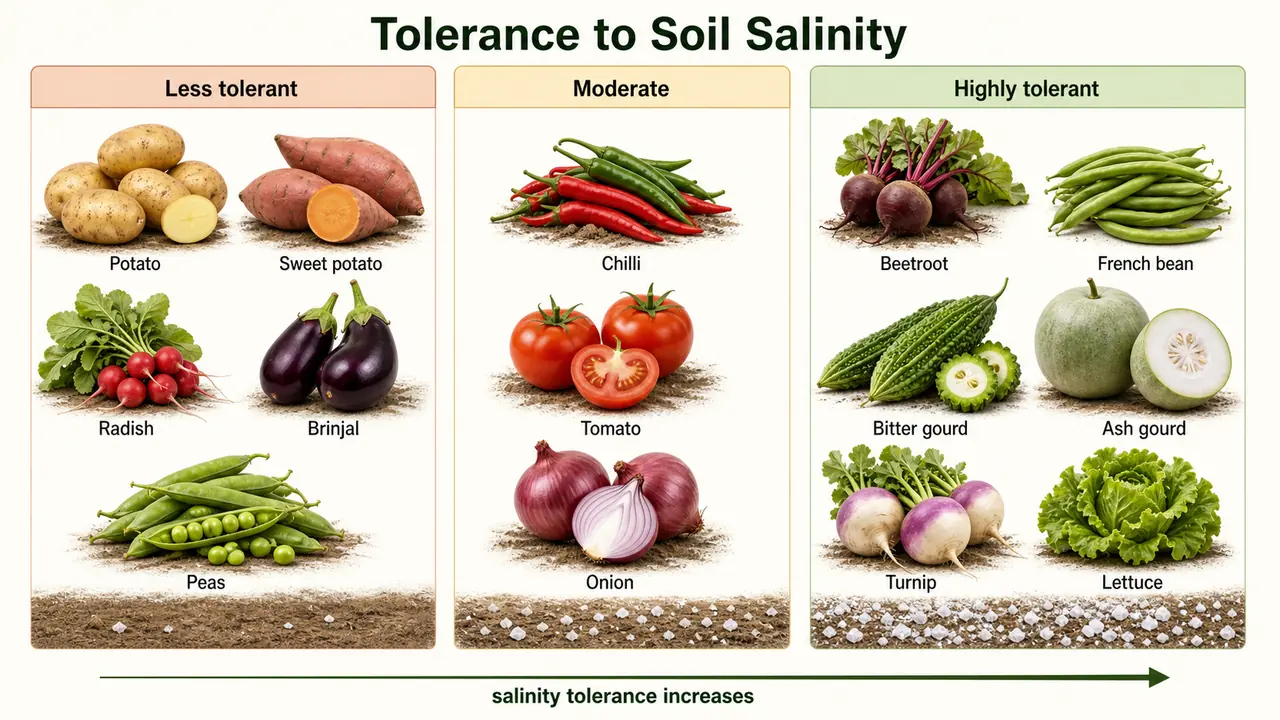
| Less tolerant | Moderate | Highly tolerant |
|---|---|---|
| Potato | Chilli | Beetroot |
| Sweet Potato | Tomato | French bean |
| Raddish | Onion | Bitter gourd |
| Brinjal | — | Ash gourd (Petha) |
| Peas | — | Perak |
| — | — | Turnip |
| — | — | Lettuce |
Tolerance to Soil Acidity
Soil pH (acidity or alkalinity) influences nutrient availability and root health. Vegetables differ in their tolerance to acidic soils (low pH). For instance, potato thrives in slightly acidic conditions (pH 5.0-5.5), while most other vegetables require near-neutral pH for optimal growth.
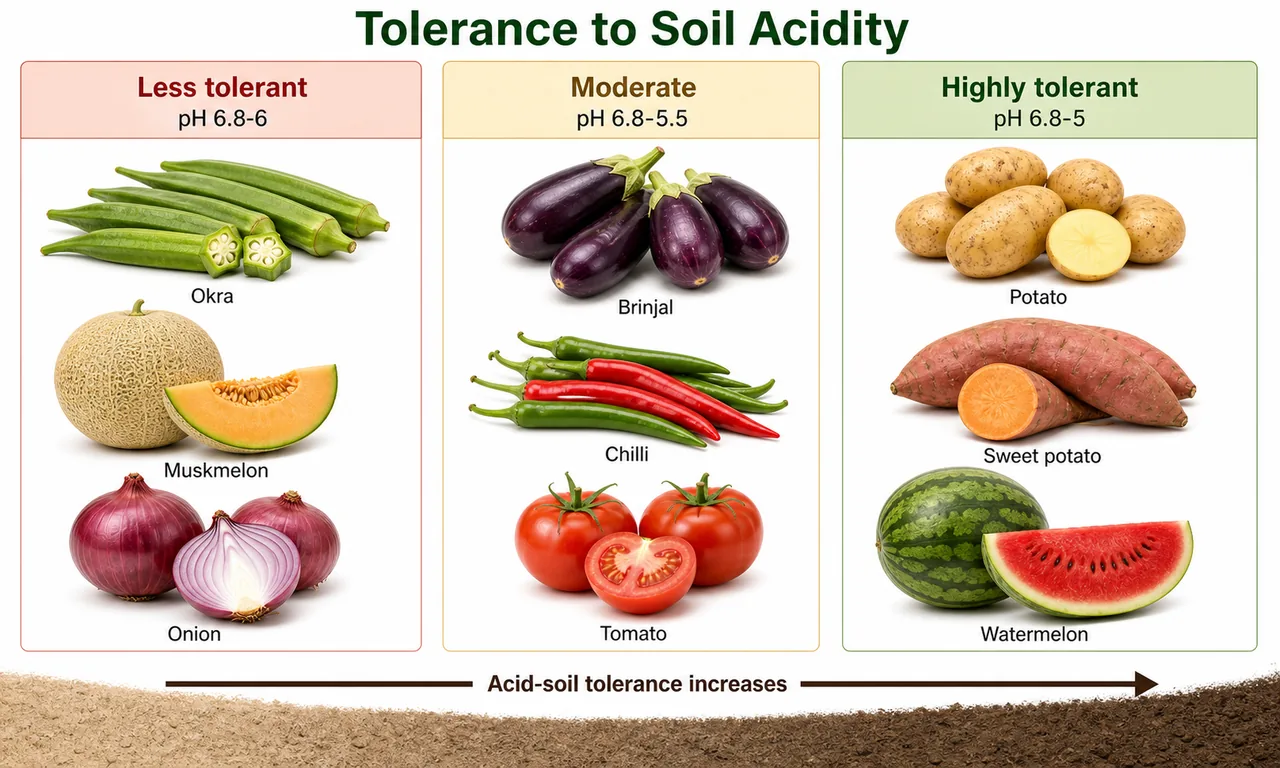
| Less tolerant (pH: 6.8 - 6) | Moderate (pH: 6.8 - 5.5) | Highly tolerant (pH: 6.8 - 5) |
|---|---|---|
| Okra | Brinjal | Potato |
| Musk Melon | Chilli | Sweet Potato |
| Onion | Tomato | Water Melon |
Water Requirements of Vegetables
Vegetables have varying water requirements depending on their root depth, leaf area, and growth duration. Proper irrigation scheduling based on a crop's water needs is essential for maximizing yield and water-use efficiency. A deep-rooted crop like watermelon can access moisture from deeper soil layers, while shallow-rooted lettuce requires frequent, light irrigation.
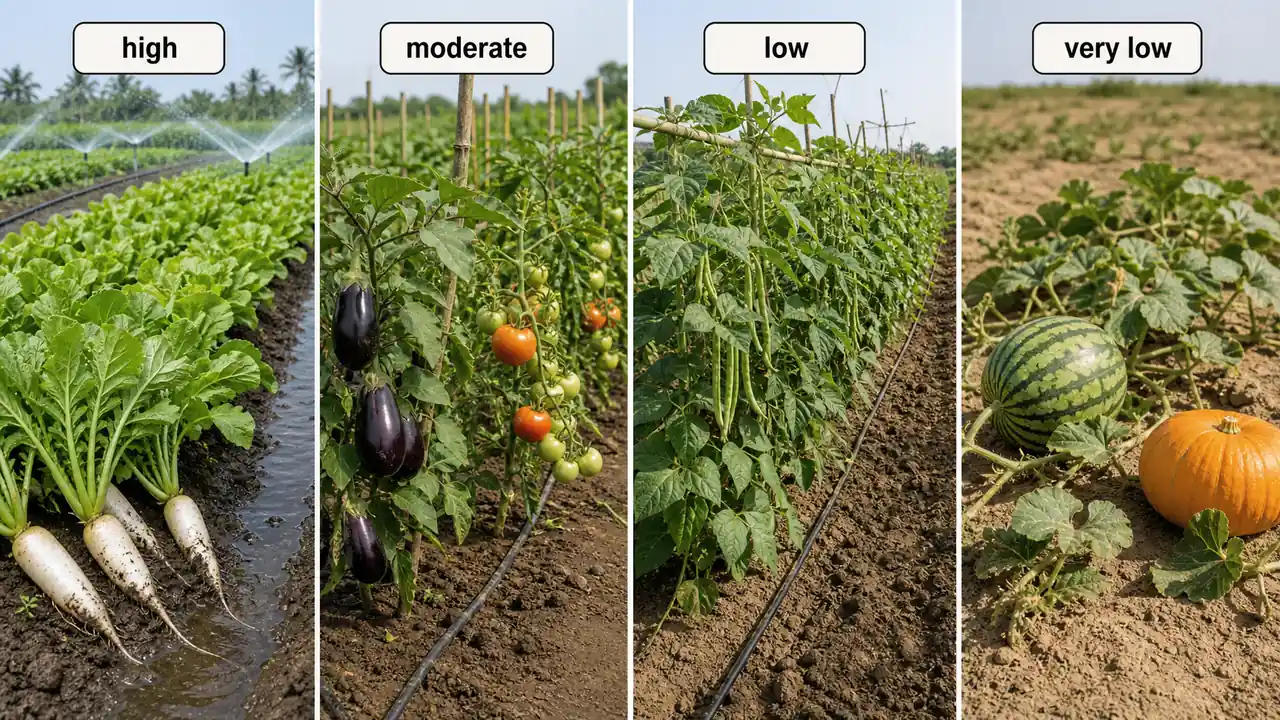
| High | Moderate | Low | Very Low |
|---|---|---|---|
| Raddish | Brinjal | Beans | Water Melon |
| Leafy Vegetables | Chilli | — | Musk Melon |
| — | Tomato | — | Pumpkin |
| — | Potato | — | — |
Life Cycle Classification
Vegetables are classified based on the duration of their life cycle, which directly affects crop rotation planning and seed production programmes.
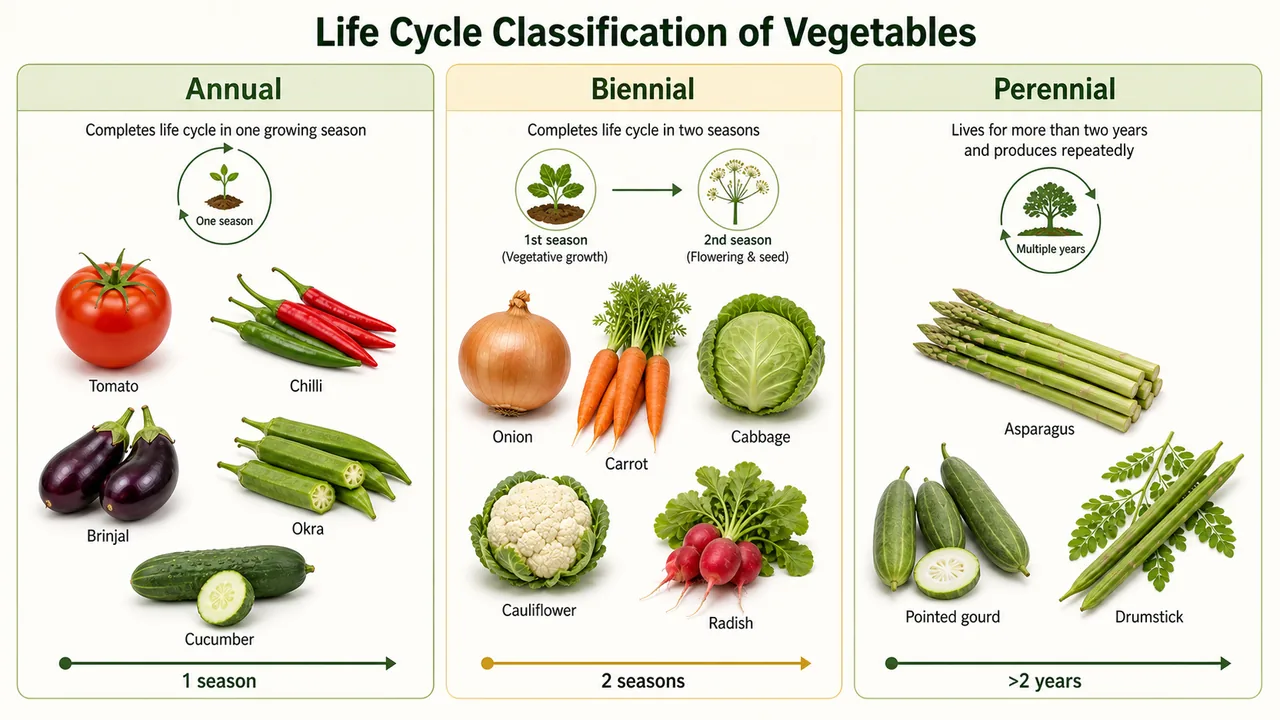
| Life Cycle | Duration | Examples |
|---|---|---|
| Annual | Completes in one season | Tomato, chilli, brinjal, okra, cucumber |
| Biennial | Two seasons (vegetative first, flowering second) | Onion, carrot, cabbage, cauliflower, radish |
| Perennial | Lives for more than two years | Asparagus, pointed gourd, drumstick |
| Life cycle | Example |
|---|---|
| Annual | Tomato, Brinjal, Okra, Cowpea |
| Biennial | Cabbage, Cauliflower, Radish, Carrot, Onion |
| Perennial | Ginger, Garlic, Sweet potato, Parval |
Summary Cheat Sheet
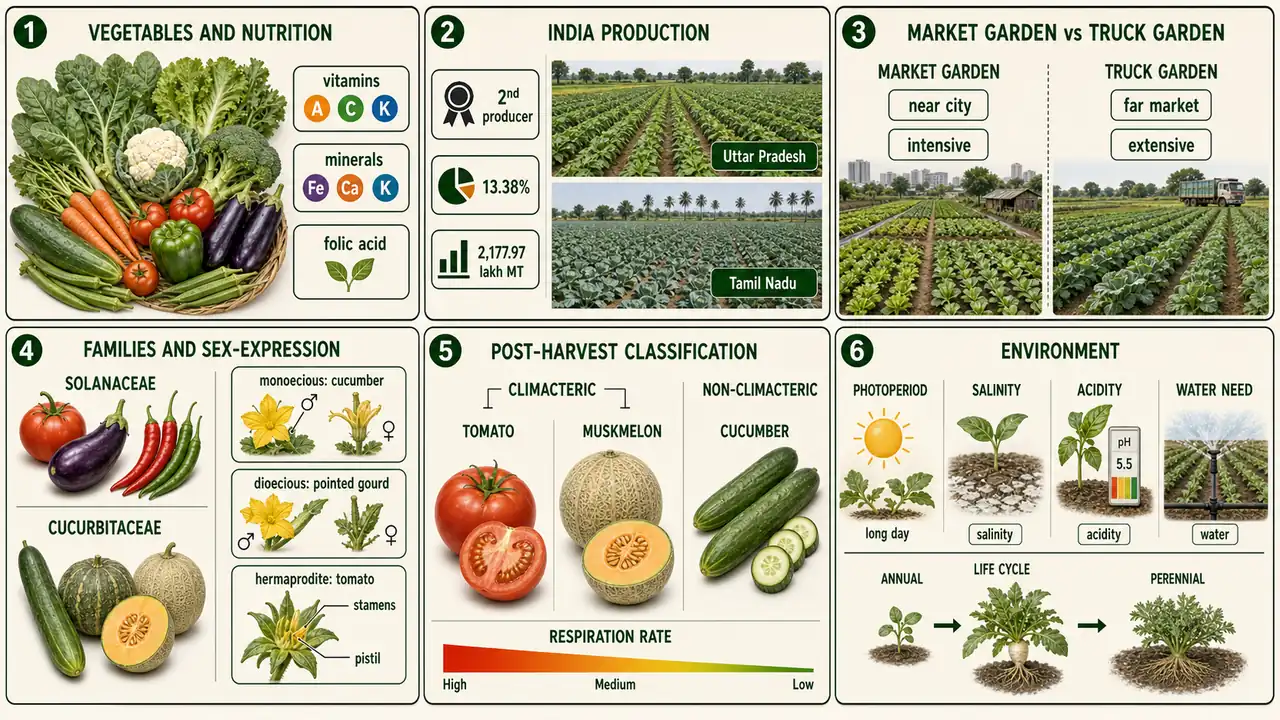
| Concept / Topic | Key Details / Explanation |
|---|---|
| Meaning of olericulture | Olericulture is the branch of horticulture concerned with the cultivation, processing, and marketing of vegetable crops. |
| Why vegetables matter | Vegetables are emphasized as major sources of vitamins and minerals, and the lesson highlights folic acid (Vitamin B9) in green leafy vegetables as an important nutritional fact. |
| India’s vegetable position | India is the second largest vegetable producer in the world and contributes about 13.38% of global vegetable production. |
| Area, production, and leading states | Vegetables occupy about 7.8% of total cropped area; 2024-25 final vegetable production is 2,177.97 lakh MT; Uttar Pradesh is the largest state by area and production, while Tamil Nadu has the highest productivity. |
| Wider horticulture context | The lesson places vegetables inside the wider horticulture totals: total horticulture production = 3,707.38 lakh MT, fruits = 1,176.49 lakh MT, vegetables = 2,177.97 lakh MT, spices = 129.93 lakh MT, and total horticulture area is 301.36 lakh ha. |
| Recent growth pattern | Vegetable growth in 2024-25 is linked especially with onion, potato, cauliflower, cabbage, brinjal, okra, and peas. |
| Market garden | A market garden is a small-scale, intensive vegetable-production system located near urban markets and usually grows a wider crop range. |
| Truck garden | A truck garden is a large-scale, extensive vegetable-production system located far from cities, depending on transport to reach distant markets. |
| Core contrast between market and truck gardening | The exam memory cue is Market = nearby market + intensive, whereas Truck = transport to distant markets + extensive. |
| Why botanical classification matters | Vegetables are classified into families using flower structure, fruit type, and seed morphology, and this matters because crops from the same family often share pests and diseases, making it important for crop rotation. |
Summary Continued
| Concept / Topic | Key Details / Explanation |
|---|---|
| Acids in vegetables | Different vegetables contain characteristic organic acids that influence taste, processing behavior, and nutritional quality. |
| Sex expression | Vegetables may be monoecious, dioecious, andromonoecious, or hermaphrodite, and this has direct importance for pollination, hybrid-seed production, and fruit set. |
| Sex-type examples | The lesson gives cucumber, pumpkin, and watermelon as monoecious; pointed gourd and spine gourd as dioecious; muskmelon as andromonoecious; and tomato, chilli, and brinjal as hermaphrodite. |
| Respiration-pattern classification | Vegetables are classified as climacteric or non-climacteric depending on whether they show a rise in respiration during ripening, which directly affects harvest stage and post-harvest handling. |
| Photoperiod classification | Vegetables may be short-day, long-day, or day-neutral, and this classification is crucial for flowering, bulb formation, and choosing the right sowing season. |
| Respiration-rate and storage life | Produce with very high respiration has very short storage life, while crops with low respiration, such as potato, onion, and garlic, store much longer. |
| Soil salinity and acidity tolerance | The lesson stresses that vegetables differ in their tolerance to saline and acid soils, so crop choice should match soil condition. |
| Water requirement | Vegetable crops also differ widely in water requirement, which matters for irrigation scheduling and efficient production. |
| Life-cycle classification | Vegetables are classified as annual, biennial, or perennial: tomato, chilli, brinjal, okra, cucumber are annual; onion, carrot, cabbage, cauliflower, radish are biennial; and asparagus, pointed gourd, drumstick are perennial. |