🌶 Chilli and Capsicum — India's Spiciest Solanaceous Crops
Complete guide to chilli and capsicum cultivation covering capsaicin, varieties, seed rates, thrips and whitefly management, disease-resistant varieties, and India's dominance in global chilli production for competitive exams.
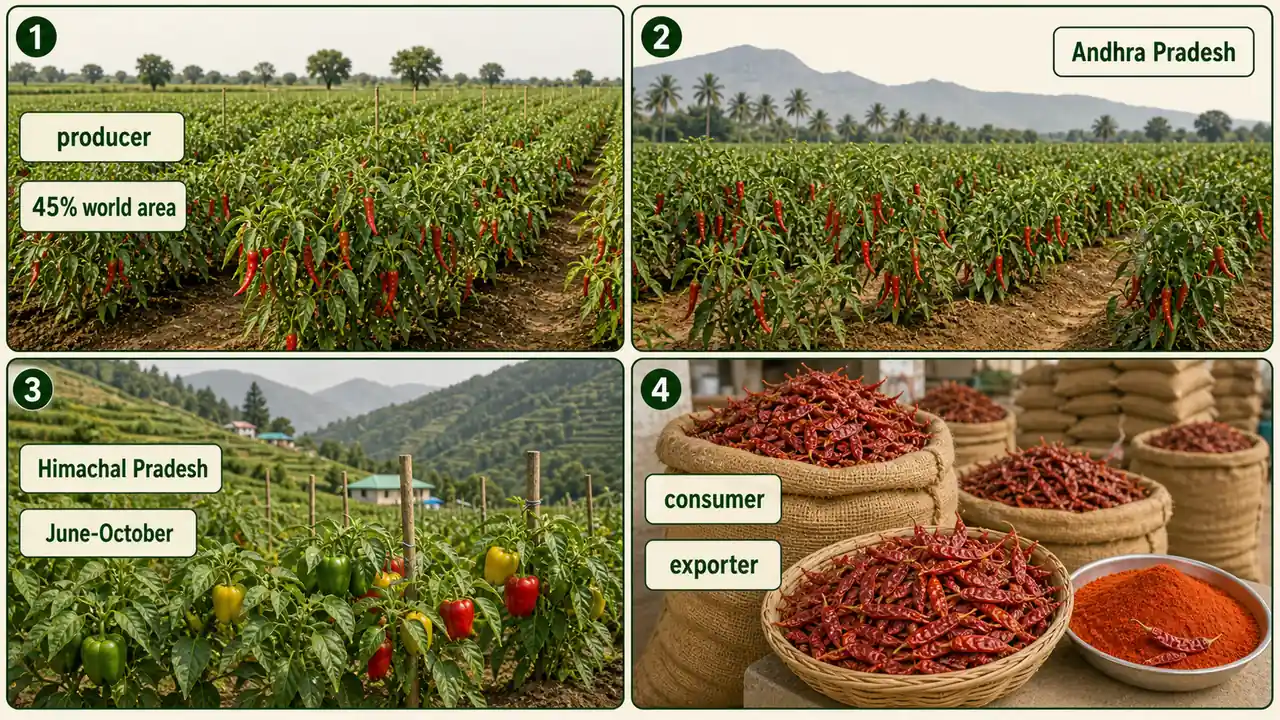
In the sun-baked fields of Guntur, Andhra Pradesh, rows of bright red chillies dry on tarpaulins under the open sky. It takes 3-10 days of sun-drying to reduce moisture from 80% to just 10%, and the ratio of green to dry chilli is 10:1 — meaning 10 kg of fresh green chillies yield only 1 kg of dried chillies. This simple fact explains why dried chilli commands a premium price. Andhra Pradesh is the pioneer in chilli production, and India itself accounts for 45% of the world's chilli cultivation area, making it the undisputed global leader.
IMPORTANT
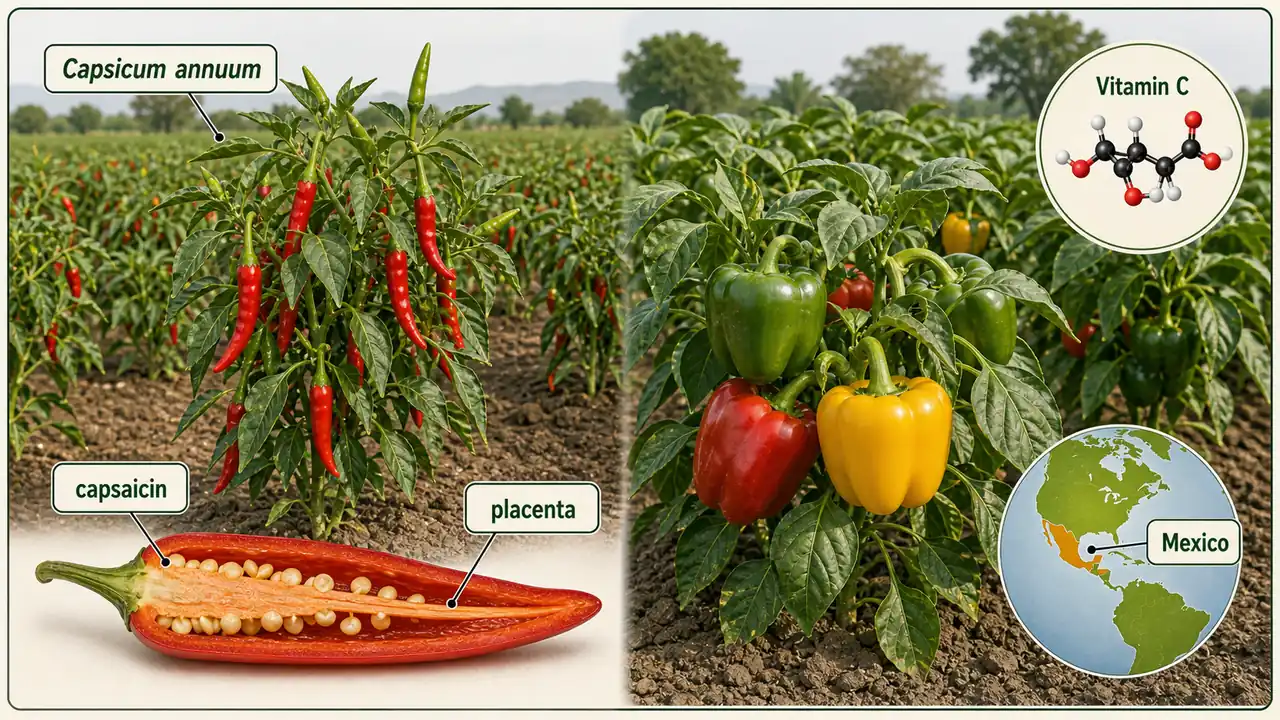
Key exam facts: Chilli and capsicum both belong to Capsicum annuum (same species, same family). The pungent principle is capsaicin, concentrated in the placenta (not seeds). Chilli is the richest vegetable source of Vitamin C. Origin is Mexico.
Botanical Identity
| Parameter | Detail |
|---|---|
| Botanical Name | Capsicum annuum |
| Family | Solanaceae |
| Origin | Mexico (introduced to India by the Portuguese, 17th century) |
| Pungent principle | Capsaicin (alkaloid, 90% in placenta) |
| Richest source of | Vitamin C |
| Other vitamin | Vitamin P (flavonoids/bioflavonoids) |
| Anti-cancer enzyme | Asperginase (in green chilli) |
| Root system | Bidirectional (lateral + vertical) |
Chilli vs Capsicum — Same Species, Different Heat
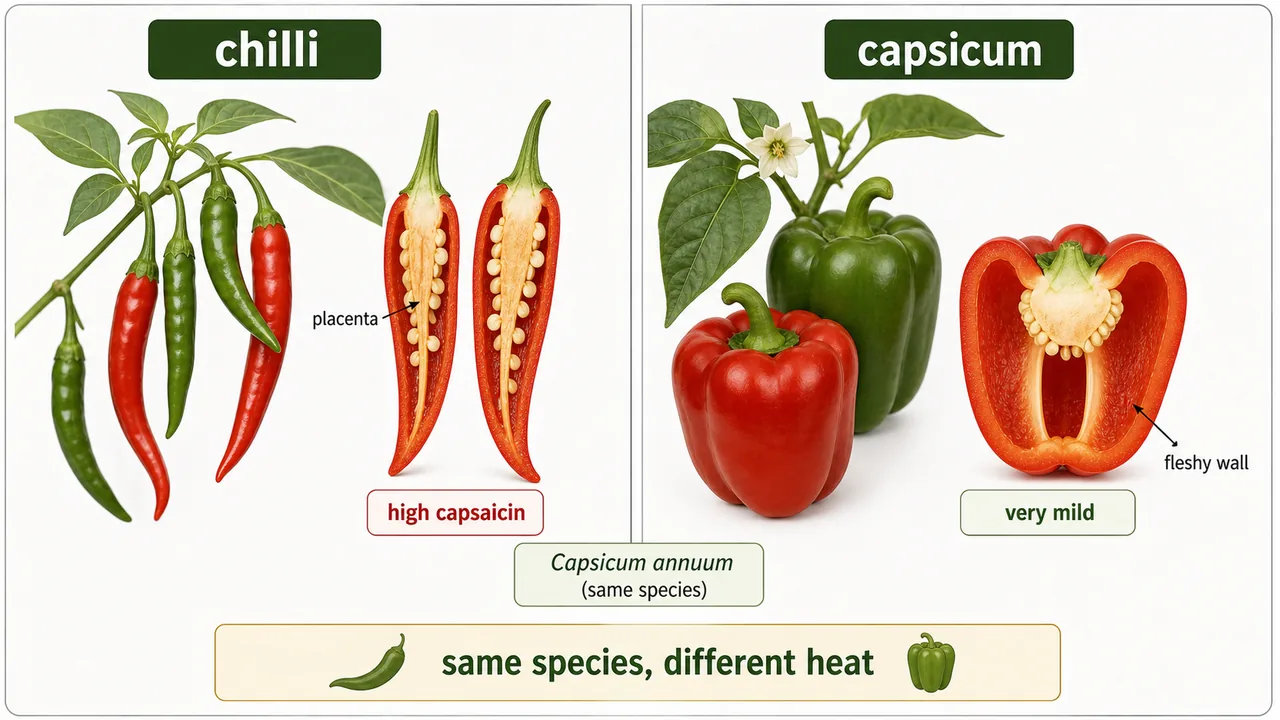
Both chilli and capsicum (bell pepper / sweet pepper / Shimla Mirch) belong to the same species (Capsicum annuum), but they differ fundamentally in pungency. Chilli is hot due to high capsaicin content, while capsicum is mild and sweet with negligible capsaicin.
Pro Content Locked
Upgrade to Pro to access this lesson and all other premium content.
Charged once for one year · ₹1188 total
Save ₹100/month vs ₹2388/year launch price
- All Agriculture & Banking Courses
- AI Lesson Questions (100/day)
- AI Doubt Solver (50/day)
- Glows & Grows Feedback (30/day)
- AI Section Quiz (20/day)
- 22-Language Translation (100/day)
- Recall Questions (20/day)
- AI Quiz (15/day)
- AI Quiz Paper Analysis (100/day)
- AI Step-by-Step Explanations (100/day)
- Spaced Repetition Recall (FSRS)
- AI Tutor
- Immersive Text Questions
- Audio Lessons — Hindi & English
- Mock Tests & Previous Year Papers
- Summary & Mind Maps
- XP, Levels, Leaderboard & Badges
- Generate New Classrooms
- Voice AI Teacher (AgriDots Live)
- AI Revision Assistant
- Knowledge Gap Analysis
- Interactive Revision (LangGraph)
🔒 Secure one-time yearly payment via Razorpay · No hidden fees
In the sun-baked fields of Guntur, Andhra Pradesh, rows of bright red chillies dry on tarpaulins under the open sky. It takes 3-10 days of sun-drying to reduce moisture from 80% to just 10%, and the ratio of green to dry chilli is 10:1 — meaning 10 kg of fresh green chillies yield only 1 kg of dried chillies. This simple fact explains why dried chilli commands a premium price. Andhra Pradesh is the pioneer in chilli production, and India itself accounts for 45% of the world's chilli cultivation area, making it the undisputed global leader.
IMPORTANT
Key exam facts: Chilli and capsicum both belong to Capsicum annuum (same species, same family). The pungent principle is capsaicin, concentrated in the placenta (not seeds). Chilli is the richest vegetable source of Vitamin C. Origin is Mexico.
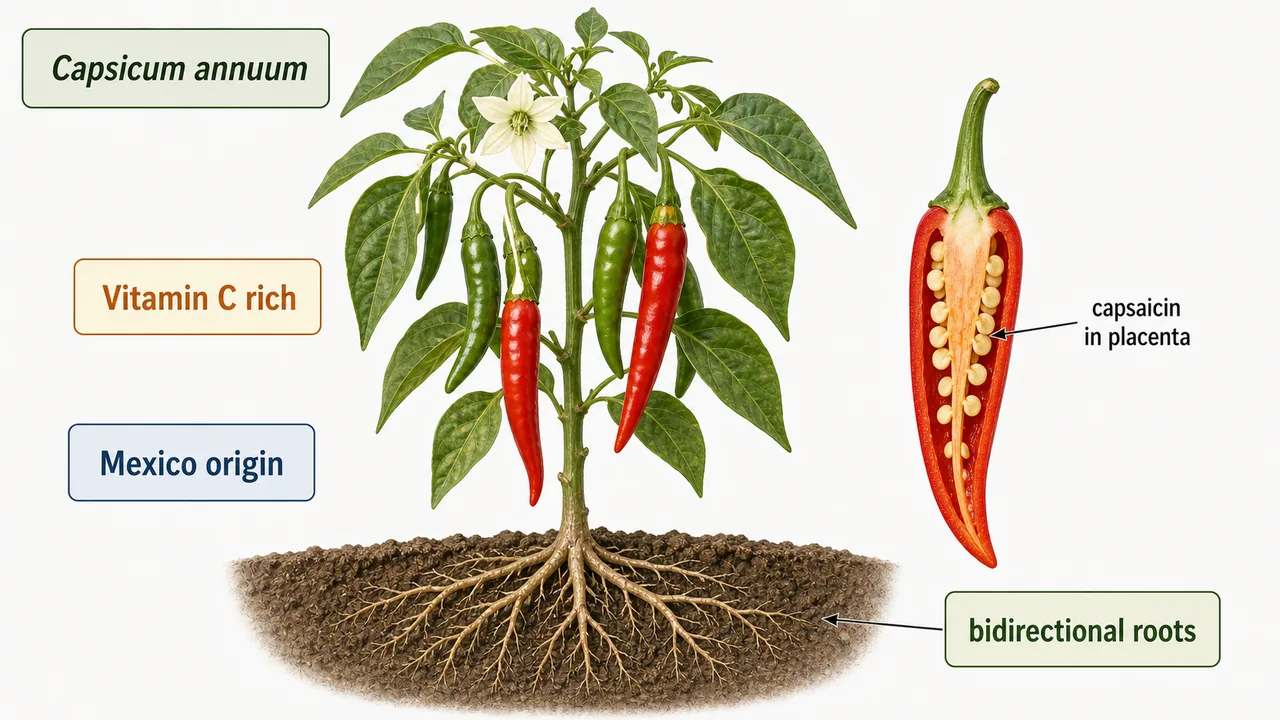
Botanical Identity
| Parameter | Detail |
|---|---|
| Botanical Name | Capsicum annuum |
| Family | Solanaceae |
| Origin | Mexico (introduced to India by the Portuguese, 17th century) |
| Pungent principle | Capsaicin (alkaloid, 90% in placenta) |
| Richest source of | Vitamin C |
| Other vitamin | Vitamin P (flavonoids/bioflavonoids) |
| Anti-cancer enzyme | Asperginase (in green chilli) |
| Root system | Bidirectional (lateral + vertical) |
Chilli vs Capsicum — Same Species, Different Heat
Both chilli and capsicum (bell pepper / sweet pepper / Shimla Mirch) belong to the same species (Capsicum annuum), but they differ fundamentally in pungency. Chilli is hot due to high capsaicin content, while capsicum is mild and sweet with negligible capsaicin.
| Feature | Chilli | Capsicum (Bell Pepper) |
|---|---|---|
| Pungency | High (capsaicin-rich) | None to very mild |
| Global leader | India (45% of world area) | China |
| Leading Indian state | Andhra Pradesh | Himachal Pradesh (off-season) |
| Flower colour | White (C. annuum, C. frutescens) | White |
TIP
Exam Recall — Vitamin champions: Chilli = Vitamin C, Brinjal = Vitamin B, Onion = Vitamin B Complex, Carrot = Vitamin A (beta-carotene).
India's Position in Global Chilli Trade
| Parameter | Fact |
|---|---|
| India's role | Major producer, consumer, and exporter |
| India's share of world area | 45% |
| India's share in world chilli exports | 4% |
| Leading state | Andhra Pradesh |
| Off-season capsicum supplier | Himachal Pradesh |
| Growing period (South India) | June-October (Kharif season) |
Flower Biology and Species Identification
| Species | Flower Colour |
|---|---|
| C. annuum | White |
| C. frutescens | White |
| C. pubescens | Purple |

- Anthesis (flower opening) occurs at 5 am.
- Pusa Sadabahar (a variety of C. frutescens) is perennial in nature, unlike most annual chilli varieties.
Capsaicin — The Heat Factor
About 90% of capsaicin is concentrated in the placenta — the central tissue connecting seeds with the pericarp. This is why removing the seeds and inner white membrane significantly reduces the heat of a chilli.

Composition of Dry Chilli
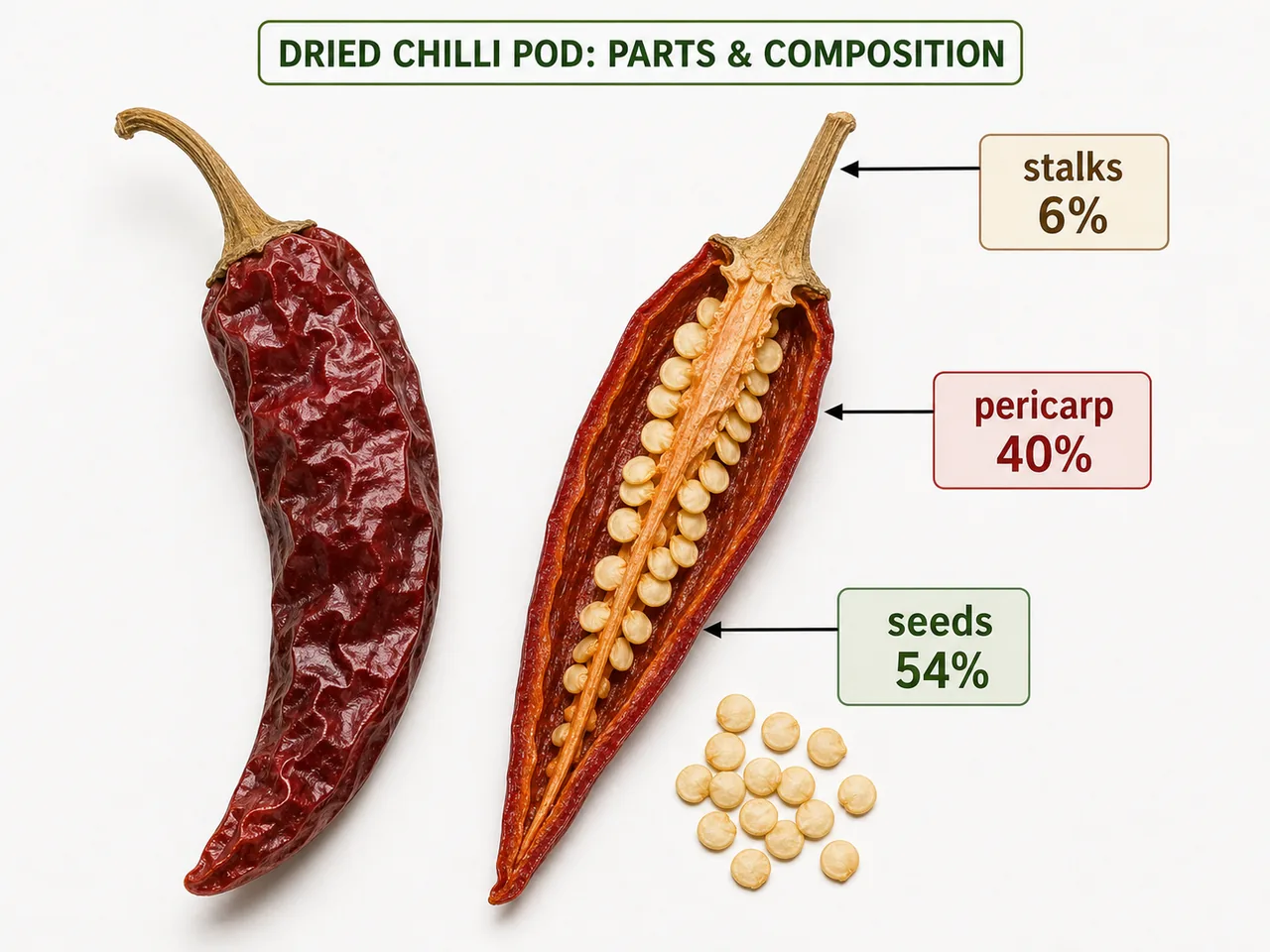
| Component | Percentage |
|---|---|
| Seeds | 54% |
| Pericarp | 40% |
| Stalks | 6% |
Cultivation Practices
Seed Rate and Transplanting
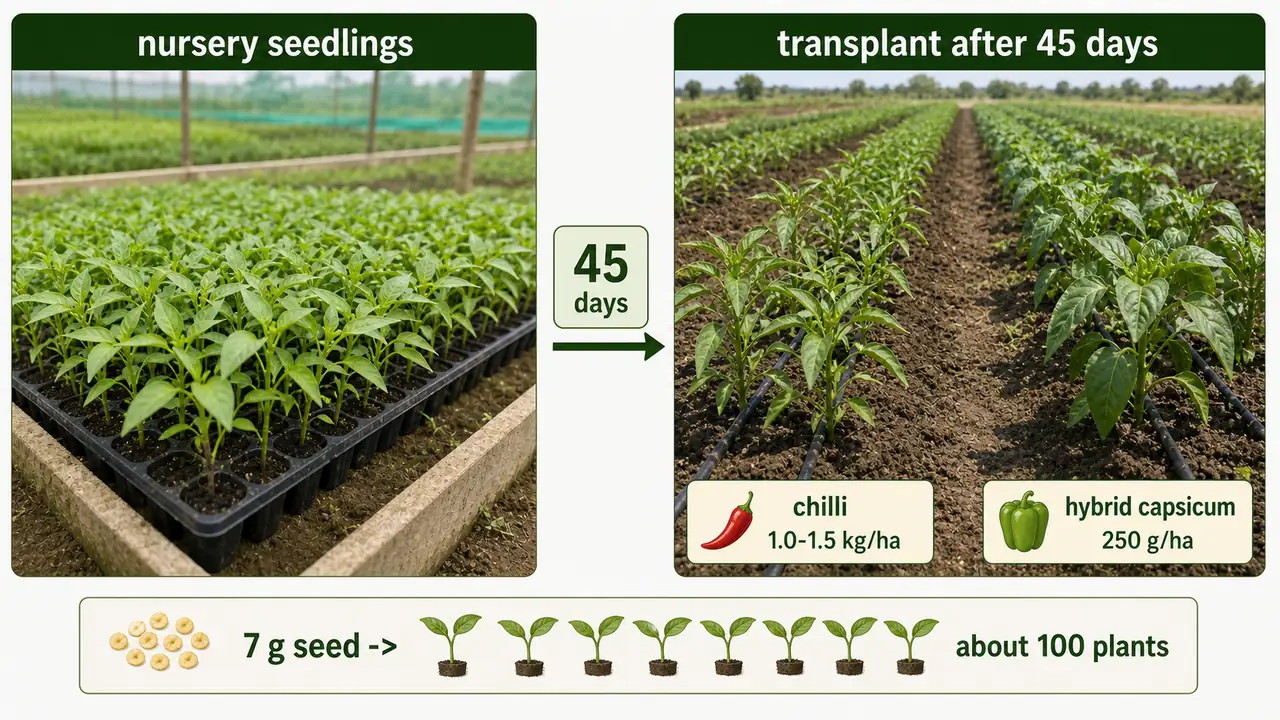
| Type | Seed Rate |
|---|---|
| Chilli | 1.0-1.5 kg/ha |
| Capsicum (hybrid) | 250 g/ha |
- Seedlings are raised in a nursery and transplanted after 45 days.
- 7 g of good quality seed provides about 100 plants.
- Capsicum requires 15 irrigations during its growth cycle.
Managing Fruit Drop and Quality
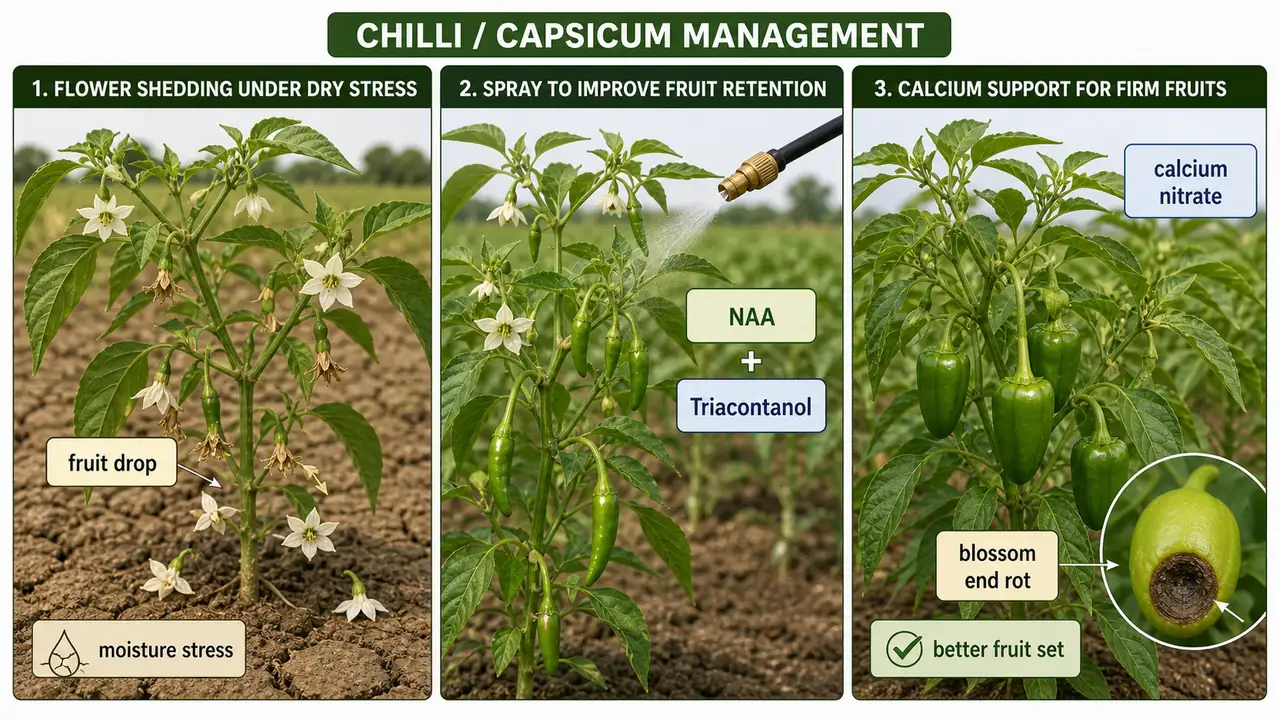
- NAA (Planofix) @ 10 ppm and Triacontanol control fruit drop by preventing abscission layer formation.
- Calcium nitrate @ 1 litre/ha or broadcasting 25 kg/ha prevents fruit rot by strengthening cell walls.
- Long dry periods cause flower shedding and fruit fall due to moisture stress.
- Excess nitrogen + water stress causes blossom end rot in capsicum (impaired calcium uptake).
- Green to dry chilli ratio: 10:1. Sun drying takes 3-10 days (moisture reduced from 80% to 10%).
Capsicum (Bell Pepper) Varieties
| Category | Varieties |
|---|---|
| Introduced | California Wonder, Yolo Wonder, World Beater, Chinese Giant, Golden Wonder, Bullnose, Sweet Banana |
| Selection | Arka Mohini, Arka Gaurav, Arka Basant |
| Public hybrid | Pusa Deepti, Green Gold |
| Private hybrid | Early Bounty, Bharat, India, Lario, Hira |
| First public F1 hybrid | Pusa Meghdoot (landmark in Indian capsicum breeding) |

Chilli Varieties
| Category | Variety | Special Feature |
|---|---|---|
| Selection | Arka Lohit | Tolerant to powdery mildew |
| Hybrid | Pusa Jwala | NP-46-A x Puri Red; leaf curl resistant |
| Hybrid | Pant-C-1 | NP-46-A x Khandari; leaf curl resistant |
| Hybrid | Punjab Lal | For colour extraction (high oleoresin); MDR (leaf curl, TMV, wilt, dieback) |
| Hybrid | Punjab Surakh | Multiple disease resistant |
| Hybrid | Bhaskar | Yellow anther type; resistant to thrips and mites |
| Hybrid | Andhra Jyoti | Cherry-type fruits (for pickling) |
| Hybrid | CH-1 | Released by PAU Ludhiana using genetic male sterile (GMS) line |
| Mutant | MDU-1 | Developed through mutation breeding |
| HDP suitable | Jwalamukhi | High density planting variety |
| Perennial | Pusa Sadabahar | C. frutescens; produces fruits over multiple seasons |
| Fruit rot resistant | K-2 | Resistant to fruit rot |
| Bacterial wilt resistant | Utkal Rashmi, Arka Gaurav | Resistant to Ralstonia solanacearum |
Major Pests
Thrips — Most Important Pest of Chilli
- Scientific Name: Scirtothrips dorsalis
- Damage: Lacerate tissue and feed on sap, causing leaf curling, silvering, and upward cupping of leaves
- Key role: Vector for chilli leaf curl virus

Whitefly
- Scientific Name: Bemisia tabaci
- Key role: Vector for chilli mosaic virus

Management of Thrips and Whiteflies
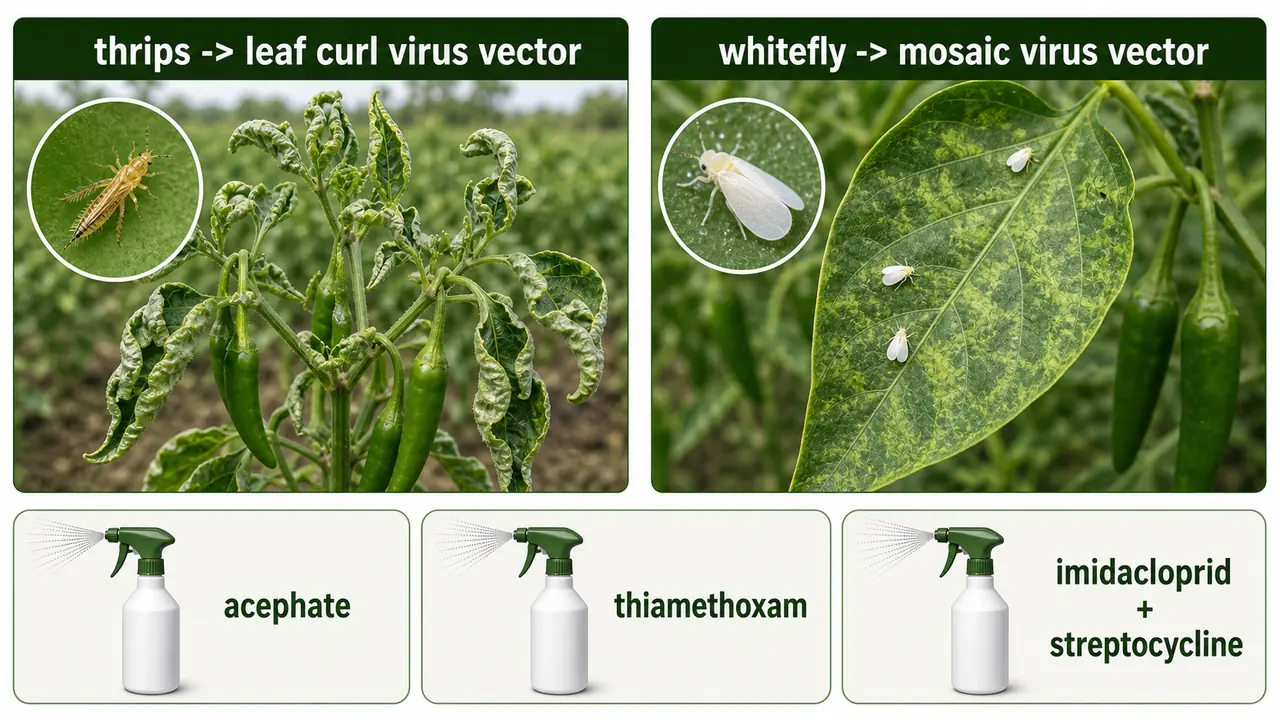
Both can be controlled by systemic insecticides:
- Acephate @ 1.0 ml/litre of water
- Thiamethoxam @ 0.4 ml/litre spray
- Imidacloprid @ 0.5 ml/litre + Streptocycline @ 0.1 g/litre
Major Disease
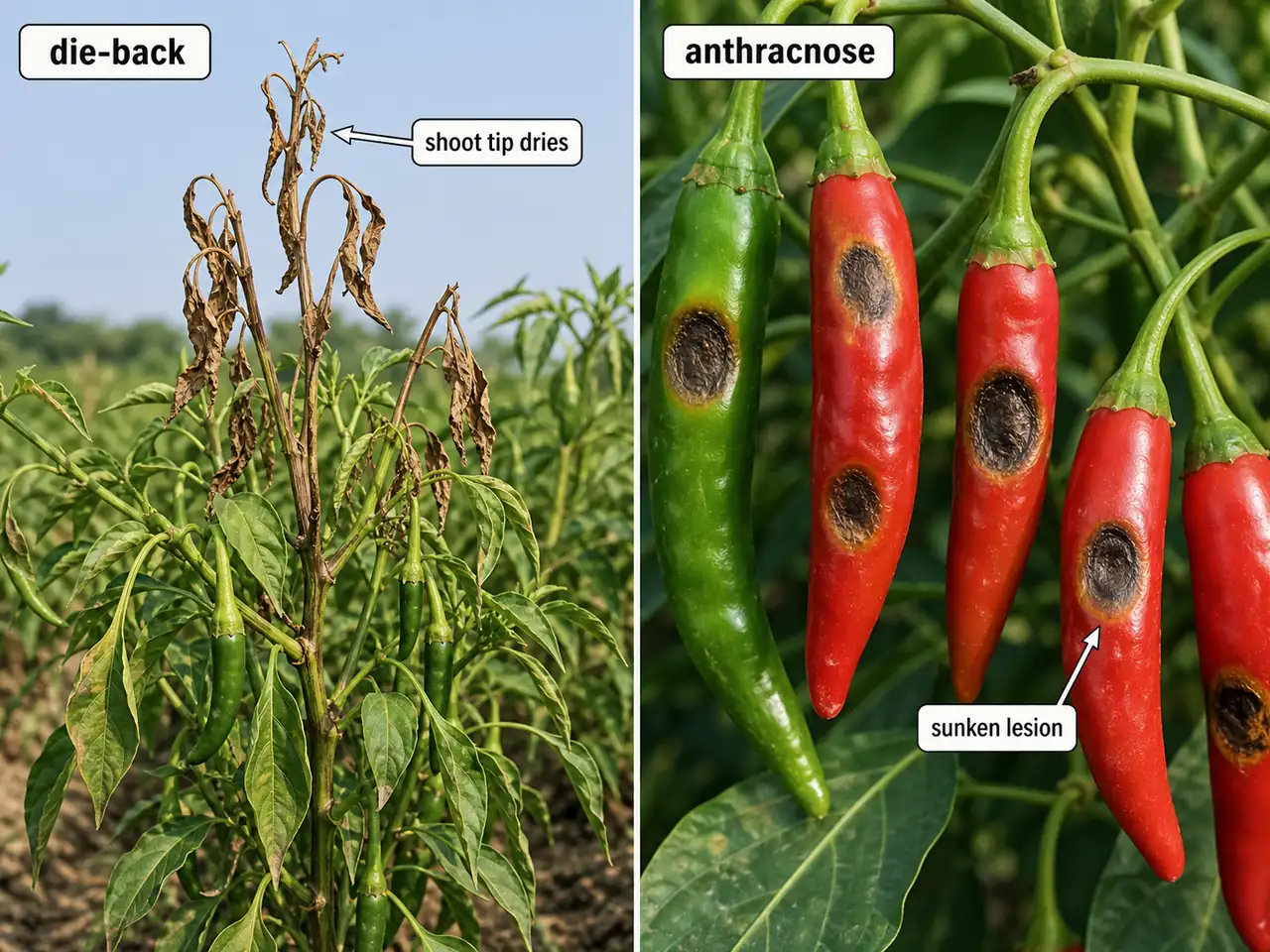
Anthracnose / Die-back
- Cause: Colletotrichum capsici (fungus)
- Symptoms: Dark, sunken lesions on fruits; die-back of shoots from tip downward
- Rains during Dec-Nov favour powdery mildew incidence
Summary Cheat Sheet
| Concept / Topic | Key Details / Explanation |
|---|---|
| Botanical identity and origin | Chilli and capsicum both belong to Capsicum annuum of the Solanaceae family, originated in Mexico, and were introduced to India by the Portuguese. |
| Distinguishing facts | The pungent principle is capsaicin, about 90% of which is present in the placenta; chilli is the richest vegetable source of Vitamin C, also contains Vitamin P, and green chilli is noted for asperginase. |
| Chilli vs capsicum | Both are the same species, but chilli is pungent while capsicum is sweet or mildly pungent; in India chilli is linked with Andhra Pradesh, while off-season capsicum supply is associated with Himachal Pradesh. |
| India's global position | India is a major producer, consumer, and exporter of chilli and accounts for about 45% of the world chilli area; Andhra Pradesh is the leading state. |
| Flower biology and species clue | Anthesis occurs around 5 am; flower colour is white in C. annuum and C. frutescens, but purple in C. pubescens. |
| Perennial type | Pusa Sadabahar belongs to C. frutescens and is important because it behaves as a perennial chilli type. |
| Dry chilli composition | Dry chilli consists of about 54% seeds, 40% pericarp, and 6% stalks. |
| Seed rate and nursery facts | Seed rate is 1.0-1.5 kg/ha for chilli and about 250 g/ha for hybrid capsicum; seedlings are transplanted after 45 days, and 7 g seed is enough for roughly 100 plants. |
| Water and crop management | Capsicum needs about 15 irrigations; NAA (10 ppm) and Triacontanol reduce fruit drop, while calcium nitrate helps prevent fruit rot and calcium-related disorders. |
Summary Continued
| Concept / Topic | Key Details / Explanation |
|---|---|
| Physiological and post-harvest facts | Long dry spells lead to flower and fruit drop; excess nitrogen plus water stress causes blossom end rot in capsicum; green to dry chilli conversion is about 10:1, with sun-drying for 3-10 days. |
| Important capsicum varieties | Common introduced varieties are California Wonder, Yolo Wonder, World Beater, Chinese Giant, Golden Wonder, Bullnose, and Sweet Banana; selection types include Arka Mohini, Arka Gaurav, and Arka Basant. |
| Capsicum hybrids | Pusa Deepti and Green Gold are public hybrids, Early Bounty, Bharat, India, Lario, and Hira are private hybrids, and Pusa Meghdoot is the first public F1 hybrid. |
| Important chilli varieties | Arka Lohit is tolerant to powdery mildew; Pusa Jwala and Pant-C-1 are leaf-curl-resistant hybrids; Punjab Lal is used for colour extraction and has multiple disease resistance. |
| Variety traits to remember | Punjab Surakh is multiple-disease resistant, Bhaskar resists thrips and mites, Andhra Jyoti is a cherry type for pickling, CH-1 was released using a GMS line, MDU-1 is a mutant, and Jwalamukhi suits high-density planting. |
| Disease- and stress-resistant lines | K-2 is resistant to fruit rot, while Utkal Rashmi and Arka Gaurav are resistant to bacterial wilt. |
| Most important pest | Thrips (Scirtothrips dorsalis) is the most important pest, causing leaf curling, silvering, and upward cupping, and it acts as vector of chilli leaf curl virus. |
| Whitefly and control | Whitefly (Bemisia tabaci) transmits chilli mosaic virus; both thrips and whitefly are managed with Acephate, Thiamethoxam, or Imidacloprid + Streptocycline sprays. |
| Major disease | Anthracnose / die-back is caused by Colletotrichum capsici and produces dark sunken fruit lesions with tip die-back; the lesson also notes that rainy weather favours powdery mildew incidence. |