🍉 Watermelon — The World's Most Cultivated Cucurbit
Complete guide to watermelon cultivation covering maturity indicators, seedless triploid varieties, Arka Manik triple disease resistance, bud necrosis, and key varieties for competitive exams.
A farmer in Rajasthan taps a watermelon with his knuckles and listens carefully. A heavy, dull thumping sound tells him the fruit is ripe and ready; a metallic, high-pitched ring would mean it needs more time on the vine. This simple acoustic test, combined with checking whether the tendril at the fruit base has dried and the ground spot has turned yellow, is how experienced growers determine the perfect harvest moment — a skill that separates premium produce from mediocre fruit.
Watermelon is the most widely cultivated cucurbit in the world, originating in the Kalahari Desert region of Tropical Africa. With 95% water content, it is nature's own hydration solution for the scorching Indian summer.
IMPORTANT
Key exam facts: Seedless watermelon is triploid (3n) — from crossing tetraploid (4n) female x diploid (2n) male. Dull thumping sound = mature, metallic sound = immature. Bitter substance is Cucurbitacin E. Arka Manik is resistant to anthracnose + powdery mildew + downy mildew.
Pro Content Locked
Upgrade to Pro to access this lesson and all other premium content.
Charged once for one year · ₹1188 total
Save ₹100/month vs ₹2388/year launch price
- All Agriculture & Banking Courses
- AI Lesson Questions (100/day)
- AI Doubt Solver (50/day)
- Glows & Grows Feedback (30/day)
- AI Section Quiz (20/day)
- 22-Language Translation (100/day)
- Recall Questions (20/day)
- AI Quiz (15/day)
- AI Quiz Paper Analysis (100/day)
- AI Step-by-Step Explanations (100/day)
- Spaced Repetition Recall (FSRS)
- AI Tutor
- Immersive Text Questions
- Audio Lessons — Hindi & English
- Mock Tests & Previous Year Papers
- Summary & Mind Maps
- XP, Levels, Leaderboard & Badges
- Generate New Classrooms
- Voice AI Teacher (AgriDots Live)
- AI Revision Assistant
- Knowledge Gap Analysis
- Interactive Revision (LangGraph)
🔒 Secure one-time yearly payment via Razorpay · No hidden fees
A farmer in Rajasthan taps a watermelon with his knuckles and listens carefully. A heavy, dull thumping sound tells him the fruit is ripe and ready; a metallic, high-pitched ring would mean it needs more time on the vine. This simple acoustic test, combined with checking whether the tendril at the fruit base has dried and the ground spot has turned yellow, is how experienced growers determine the perfect harvest moment — a skill that separates premium produce from mediocre fruit.
Watermelon is the most widely cultivated cucurbit in the world, originating in the Kalahari Desert region of Tropical Africa. With 95% water content, it is nature's own hydration solution for the scorching Indian summer.
IMPORTANT
Key exam facts: Seedless watermelon is triploid (3n) — from crossing tetraploid (4n) female x diploid (2n) male. Dull thumping sound = mature, metallic sound = immature. Bitter substance is Cucurbitacin E. Arka Manik is resistant to anthracnose + powdery mildew + downy mildew.
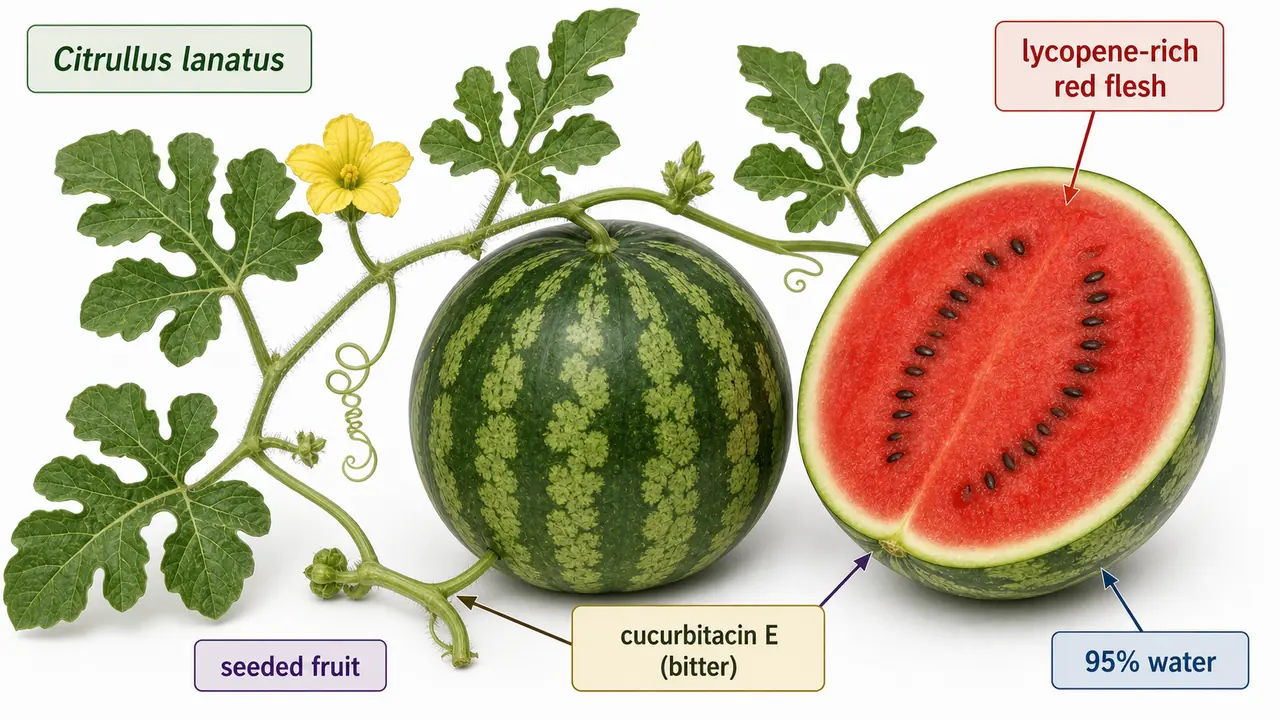
Botanical Identity
| Parameter | Detail |
|---|---|
| Botanical Name | Citrullus lanatus |
| Family | Cucurbitaceae |
| Origin | Tropical Africa (Kalahari Desert) |
| Water content | 95% |
| TSS range | 8-13% (10%+ = good quality) |
| Seed rate | 4-4.5 kg/ha |
| Red pigment | Lycopene (same as tomato) + anthocyanin |
| Bitter substance | Cucurbitacin E (tetracyclic triterpene) |
| Potassium content | 160 mg per 100 g |
| Rank among cucurbits | 1st (most widely cultivated) |
Maturity Indicators
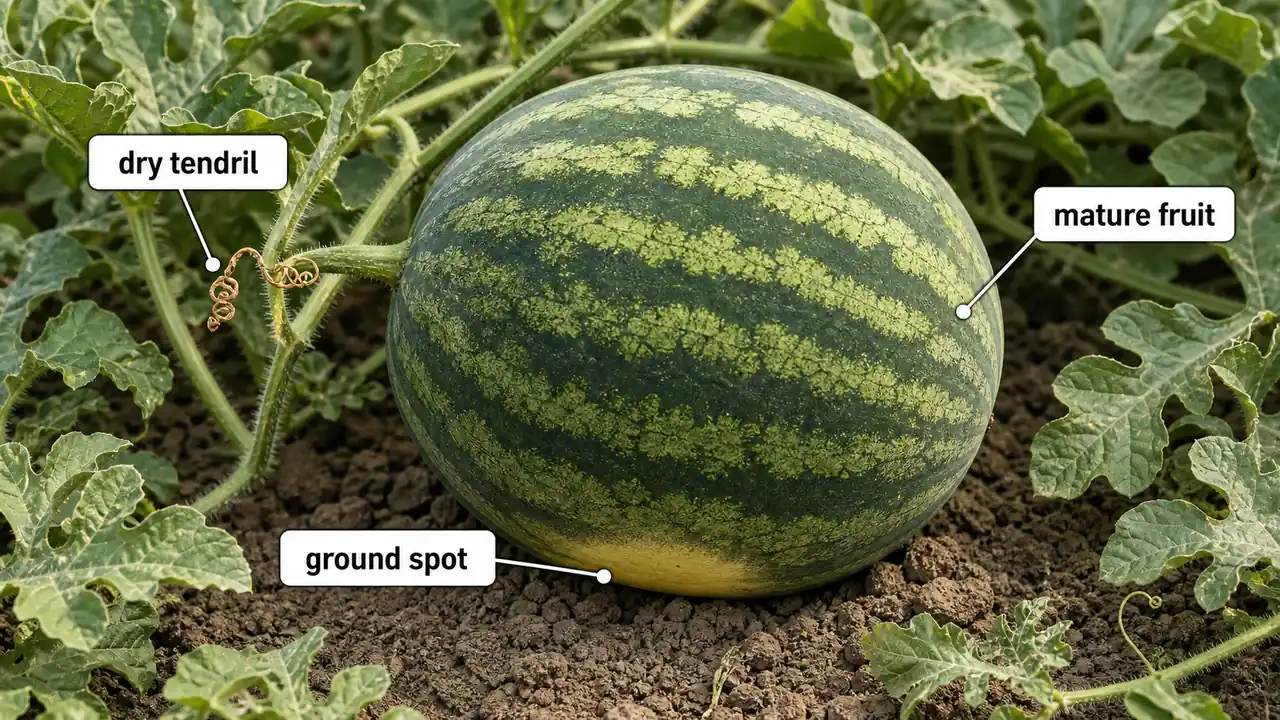
Knowing when to harvest watermelon is critical — it must be harvested at full mature stage (unlike many cucurbits harvested immature). Seed maturity and edible maturity coincide.
| Indicator | Maturity Status |
|---|---|
| Heavy, dull thumping sound (on tapping) | Mature (flesh is soft and juicy) |
| Metallic, high-pitched ringing sound | Immature (flesh is still firm) |
| Tendril at fruit base turns brown and dry | Mature |
| Ground spot turns yellow | Mature |
| White heart at central position | Poor quality (uneven ripening) |
TIP
Watermelon maturity signs: Dull thumping sound + dried tendril at fruit base + ground spot turning yellow. Metallic sound = still immature. These three signs together give reliable results.
Seedless Watermelon — The Triploid Story
Seedless watermelon is triploid (3n), produced by crossing:
- Tetraploid (4n) female parent x Diploid (2n) male parent = Triploid (3n) offspring
Triploid plants are sterile — they cannot produce mature seeds, giving consumers seedless fruit.
Pusa Bedana is India's first seedless watermelon variety, developed by crossing Tetra-2 x Pusa Rasal. It was released by Dr. Kihara, a pioneering Japanese geneticist who developed the technique of producing triploid seedless watermelons. The name "Bedana" means "without seeds" in Hindi.

Cultivation Challenges
- Weed competition causes yield losses up to 30%, especially during early growth stages when trailing vines are slow to cover the ground. Timely weeding or mulching is essential.
- Bud necrosis is a viral disease transmitted by aphids (Aphis craccivora), causing death of growing tips and necrotic ring spots on leaves.

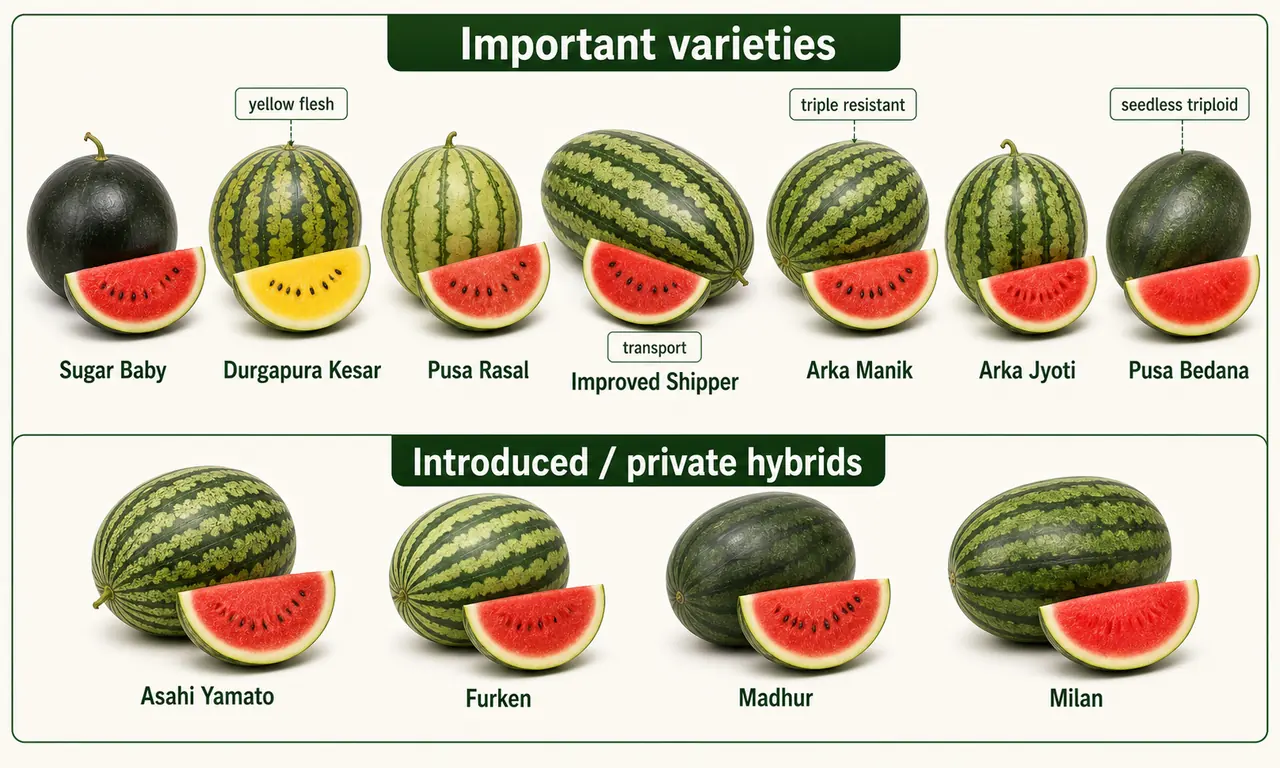
Important Varieties
| Category | Variety | Special Feature |
|---|---|---|
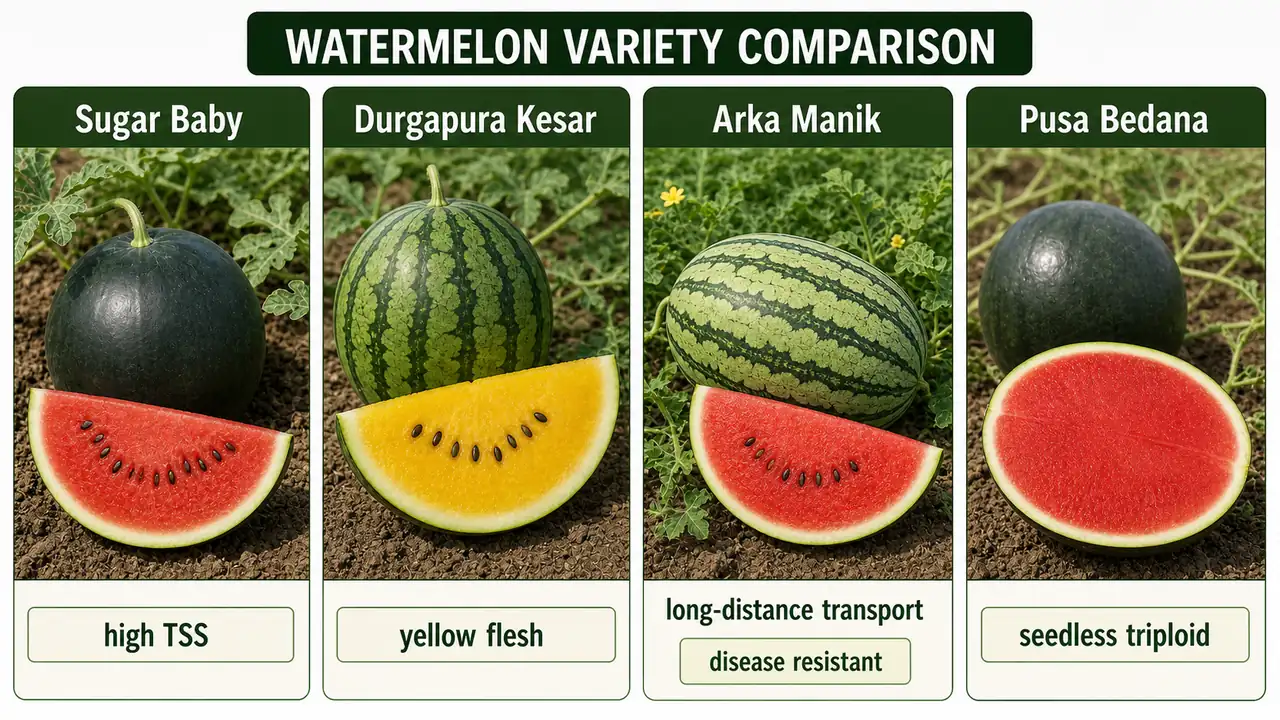
| Selection | Sugar Baby | 11-13% TSS; small, round, dark green; bright red flesh |
| Selection | Durgapura Kesar | Yellow-fleshed variety |
| Selection | Pusa Rasal | Parent of seedless variety |
| Selection | Improved Shipper | American introduction; withstands long-distance transport |
| Introduced | Asahi Yamato, Furken | From foreign germplasm |
| Hybrid | Arka Manik | IIHR x Crimson Sweet; 11-12% TSS; triple disease resistant (anthracnose + PM + DM); suitable for long-distance transport |
| Hybrid | Arka Jyoti | IIHR-20 x Crimson Sweet; 11-12% TSS |
| Triploid (seedless) | Pusa Bedana | Tetra-2 x Pusa Rasal; India's 1st seedless variety; by Dr. Kihara |
| Private hybrid | Madhur, Milan | Commercial hybrids |
Summary Cheat Sheet
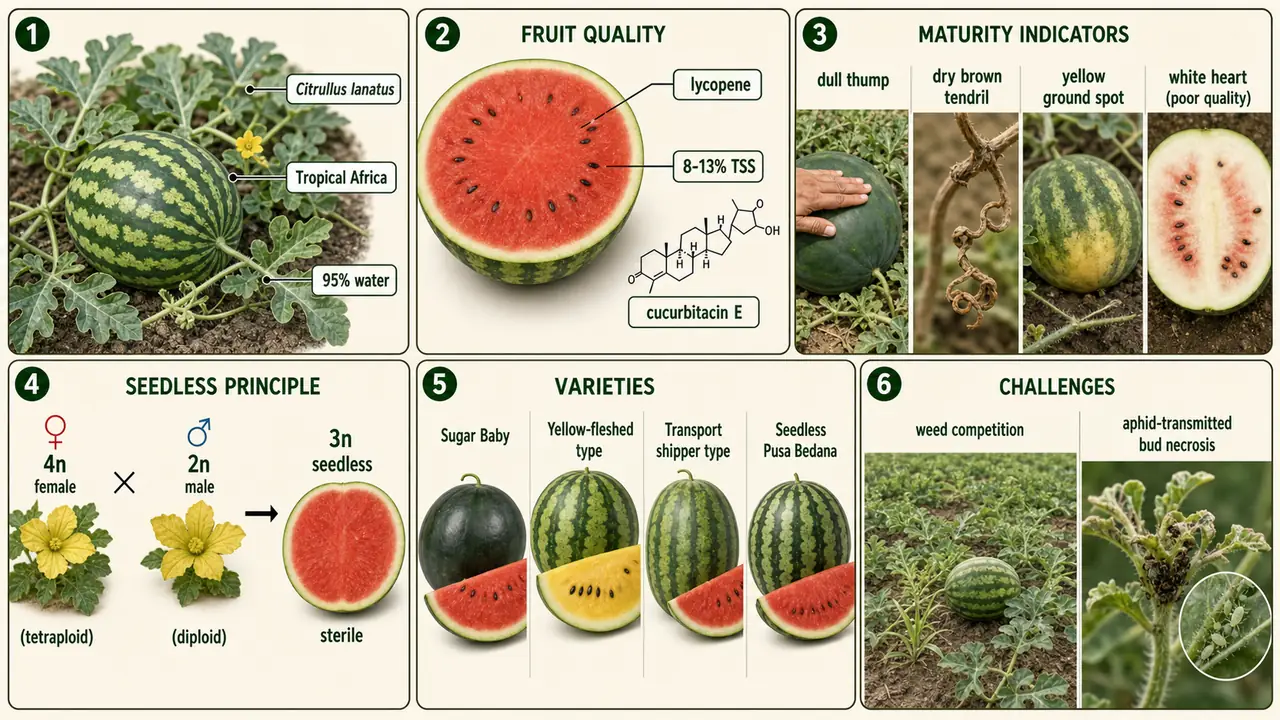
| Concept / Topic | Key Details / Explanation |
|---|---|
| Botanical identity | Watermelon is Citrullus lanatus of the Cucurbitaceae family, originated in Tropical Africa, and is the most widely cultivated cucurbit. |
| Fruit quality facts | The fruit contains about 95% water, has 8-13% TSS, contains lycopene as the main red pigment, and bitterness is due to cucurbitacin E. |
| Seed rate and nutrition fact | Seed rate is 4-4.5 kg/ha, and potassium content is about 160 mg per 100 g. |
| Maturity indicators | A heavy dull thumping sound, dried brown tendril near the fruit, and yellow ground spot indicate maturity, while a metallic sound indicates immaturity; a white heart suggests poor quality. |
| Seedless watermelon principle | Seedless watermelon is triploid (3n) and is produced by crossing a tetraploid female (4n) with a diploid male (2n); triploid plants are sterile. |
| Important seedless variety | Pusa Bedana is the first Indian seedless watermelon variety and was developed from Tetra-2 x Pusa Rasal. |
| Cultivation challenge and disease | Early weed competition can reduce yield by about 30%, and bud necrosis is a viral disease transmitted by aphids (Aphis craccivora). |
| Important varieties | Sugar Baby is a small round high-TSS type, Durgapura Kesar is yellow-fleshed, Pusa Rasal is the parent of the seedless line, and Improved Shipper is valued for transport. |
| Disease-resistant hybrid | Arka Manik is especially important because it shows resistance to anthracnose, powdery mildew, and downy mildew and is suitable for long-distance transport; Arka Jyoti is another named hybrid. |
| Other varieties | Introduced varieties include Asahi Yamato and Furken, while Madhur and Milan are private hybrids. |