🥒 Cucumber and Cucurbits — Warm-Season Vine Crops
Complete guide to cucumber and cucurbit cultivation covering sex expression, ethrel for female flowers, diara cultivation, pillow disease, cucumber mosaic virus, and important varieties for competitive exams.
Along the sandy riverbeds of the Ganga in eastern Uttar Pradesh, farmers practise diara cultivation — growing cucurbits on the exposed sandy banks as river water recedes during the dry season. The natural moisture, excellent drainage, and warm sandy soil create perfect conditions for crops like muskmelon and cucumber. This centuries-old practice demonstrates how Indian farmers have ingeniously adapted cucurbit cultivation to local geography.
Cucurbits are a large family of vegetables that includes cucumber, watermelon, muskmelon, pumpkin, bottle gourd, bitter gourd, and various other gourds. They are primarily warm-season crops requiring ample sunlight, warm temperatures, and good drainage.
IMPORTANT
Key exam facts: Cucumber origin is India. It is monoecious (separate male and female flowers on same plant). Ethrel (150-200 ppm) increases female flowers. Pillow disease = calcium deficiency. CMV vector = aphid. Among cucurbits, muskmelon is most suitable for diara cultivation.
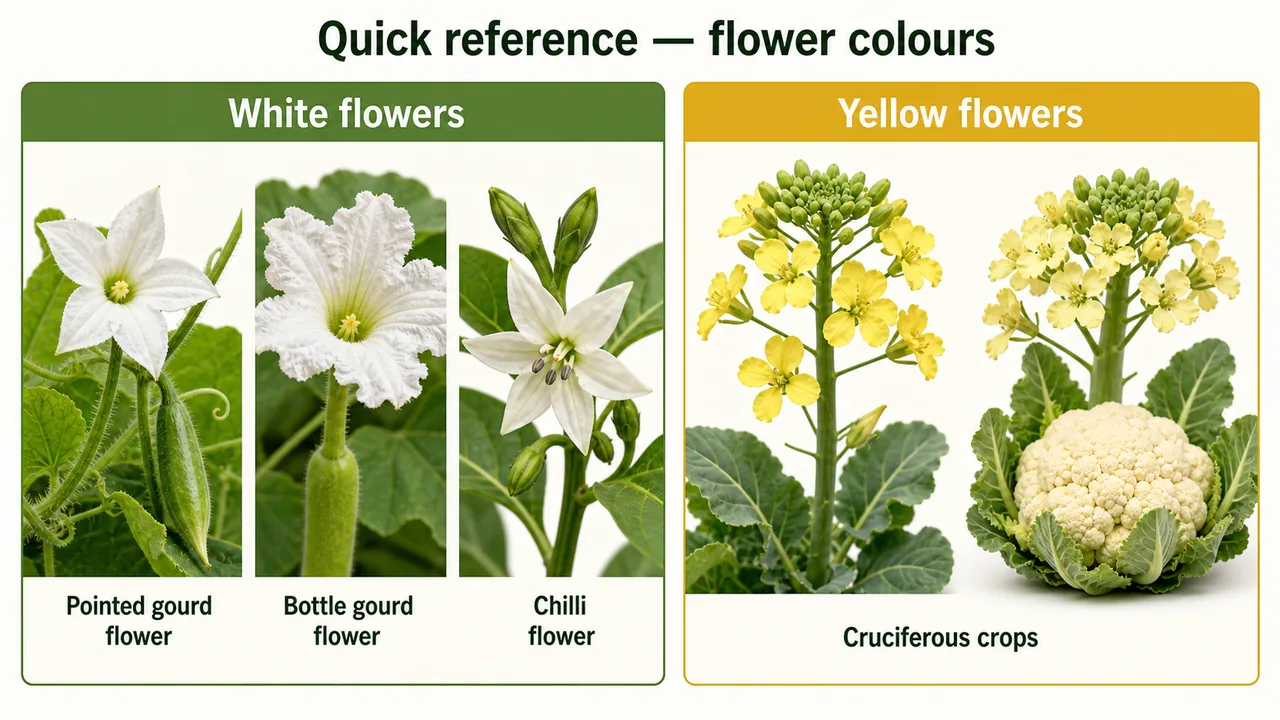
Quick Reference — Flower Colours
| Crop | Flower Colour |
|---|---|
| Pointed gourd, Bottle gourd, Chilli | White |
| All cruciferous crops (cabbage, cauliflower, etc.) | Yellow |
Cucumber — Detailed Study
Botanical Identity
| Parameter | Detail |
|---|---|
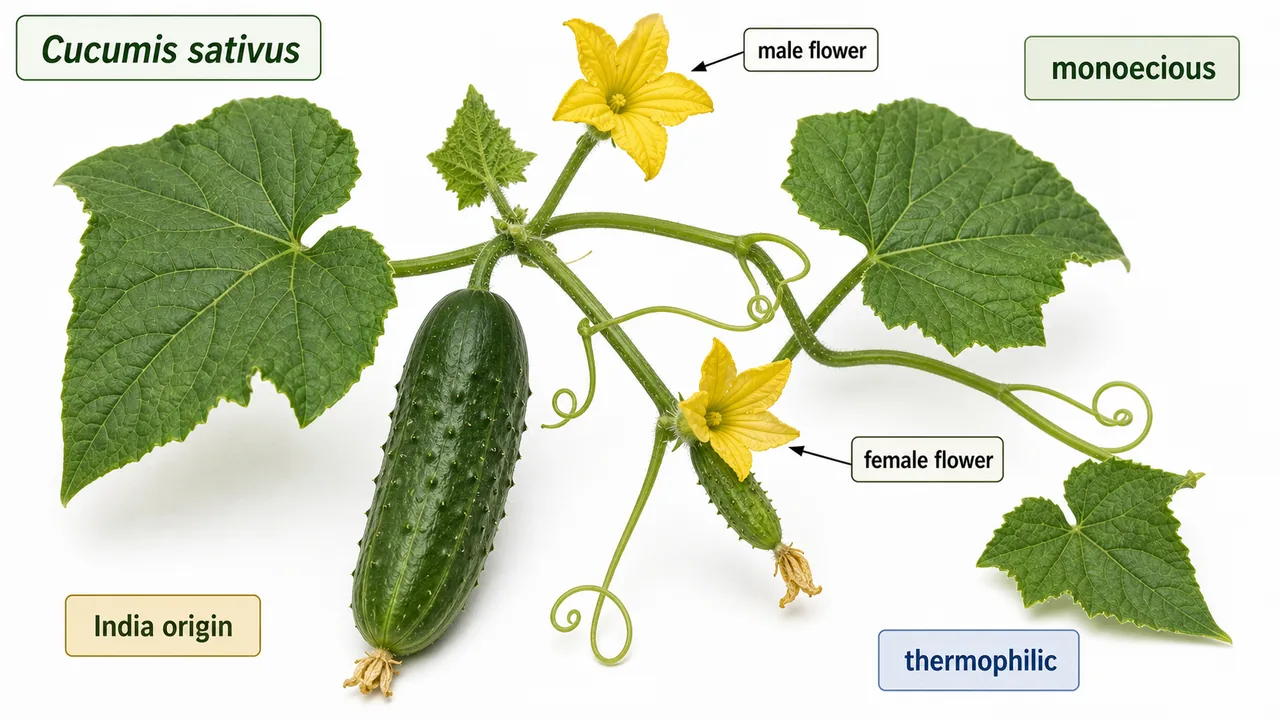
| Botanical Name | Cucumis sativus |
| Family | Cucurbitaceae |
| Origin | India (domesticated over 3,000 years ago) |
| Common name (Hindi) | Kheera |
| Sex form | Monoecious (separate male and female flowers on same plant) |
| Optimum growth temperature | 26.4 degrees C |
| Anthesis and dehiscence temperature | 13-18 degrees C |
| Seed rate | 2.5 kg/ha |
| Global rank among cucurbits | 2nd most widely cultivated (after watermelon) |
| Nature | Thermophilic and frost susceptible |
Cucumber is about 95% water, making it an excellent food for people suffering from constipation, jaundice, and indigestion.
Pro Content Locked
Upgrade to Pro to access this lesson and all other premium content.
Charged once for one year · ₹1188 total
Save ₹100/month vs ₹2388/year launch price
- All Agriculture & Banking Courses
- AI Lesson Questions (100/day)
- AI Doubt Solver (50/day)
- Glows & Grows Feedback (30/day)
- AI Section Quiz (20/day)
- 22-Language Translation (100/day)
- Recall Questions (20/day)
- AI Quiz (15/day)
- AI Quiz Paper Analysis (100/day)
- AI Step-by-Step Explanations (100/day)
- Spaced Repetition Recall (FSRS)
- AI Tutor
- Immersive Text Questions
- Audio Lessons — Hindi & English
- Mock Tests & Previous Year Papers
- Summary & Mind Maps
- XP, Levels, Leaderboard & Badges
- Generate New Classrooms
- Voice AI Teacher (AgriDots Live)
- AI Revision Assistant
- Knowledge Gap Analysis
- Interactive Revision (LangGraph)
🔒 Secure one-time yearly payment via Razorpay · No hidden fees
Along the sandy riverbeds of the Ganga in eastern Uttar Pradesh, farmers practise diara cultivation — growing cucurbits on the exposed sandy banks as river water recedes during the dry season. The natural moisture, excellent drainage, and warm sandy soil create perfect conditions for crops like muskmelon and cucumber. This centuries-old practice demonstrates how Indian farmers have ingeniously adapted cucurbit cultivation to local geography.
Cucurbits are a large family of vegetables that includes cucumber, watermelon, muskmelon, pumpkin, bottle gourd, bitter gourd, and various other gourds. They are primarily warm-season crops requiring ample sunlight, warm temperatures, and good drainage.
IMPORTANT
Key exam facts: Cucumber origin is India. It is monoecious (separate male and female flowers on same plant). Ethrel (150-200 ppm) increases female flowers. Pillow disease = calcium deficiency. CMV vector = aphid. Among cucurbits, muskmelon is most suitable for diara cultivation.
Quick Reference — Flower Colours
| Crop | Flower Colour |
|---|---|
| Pointed gourd, Bottle gourd, Chilli | White |
| All cruciferous crops (cabbage, cauliflower, etc.) | Yellow |
Cucumber — Detailed Study
Botanical Identity
| Parameter | Detail |
|---|---|
| Botanical Name | Cucumis sativus |
| Family | Cucurbitaceae |
| Origin | India (domesticated over 3,000 years ago) |
| Common name (Hindi) | Kheera |
| Sex form | Monoecious (separate male and female flowers on same plant) |
| Optimum growth temperature | 26.4 degrees C |
| Anthesis and dehiscence temperature | 13-18 degrees C |
| Seed rate | 2.5 kg/ha |
| Global rank among cucurbits | 2nd most widely cultivated (after watermelon) |
| Nature | Thermophilic and frost susceptible |
Cucumber is about 95% water, making it an excellent food for people suffering from constipation, jaundice, and indigestion.
Sex Modification in Cucurbits
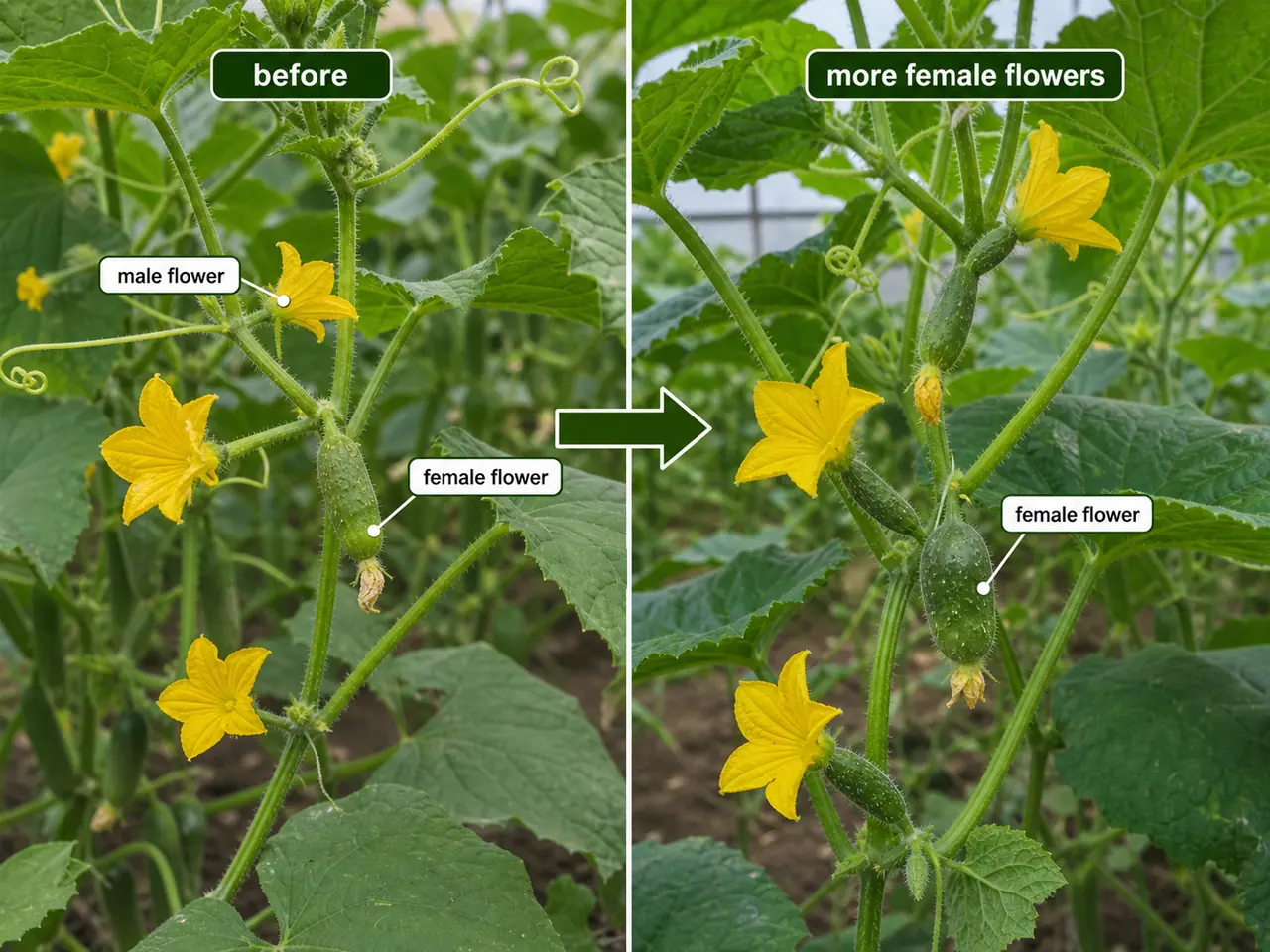
This topic is critical for understanding hybrid seed production:
| Growth Regulator | Effect | Purpose |
|---|---|---|
| Ethrel (ethephon) 150-200 ppm | Increases female flowers | Boost fruit yield |
| GA3 (Gibberellic acid) | Induces male flowers on gynoecious lines | Obtain pollen for seed production |
| Silver Nitrate (AgNO3) | Induces male flowers on gynoecious lines | Obtain pollen for seed production |
TIP
Sex modification in cucurbits: Ethrel = more female flowers (more fruits). GA3 and Silver Nitrate = induce male flowers on gynoecious lines. This is critical for hybrid seed production.
Anthesis and Pollination
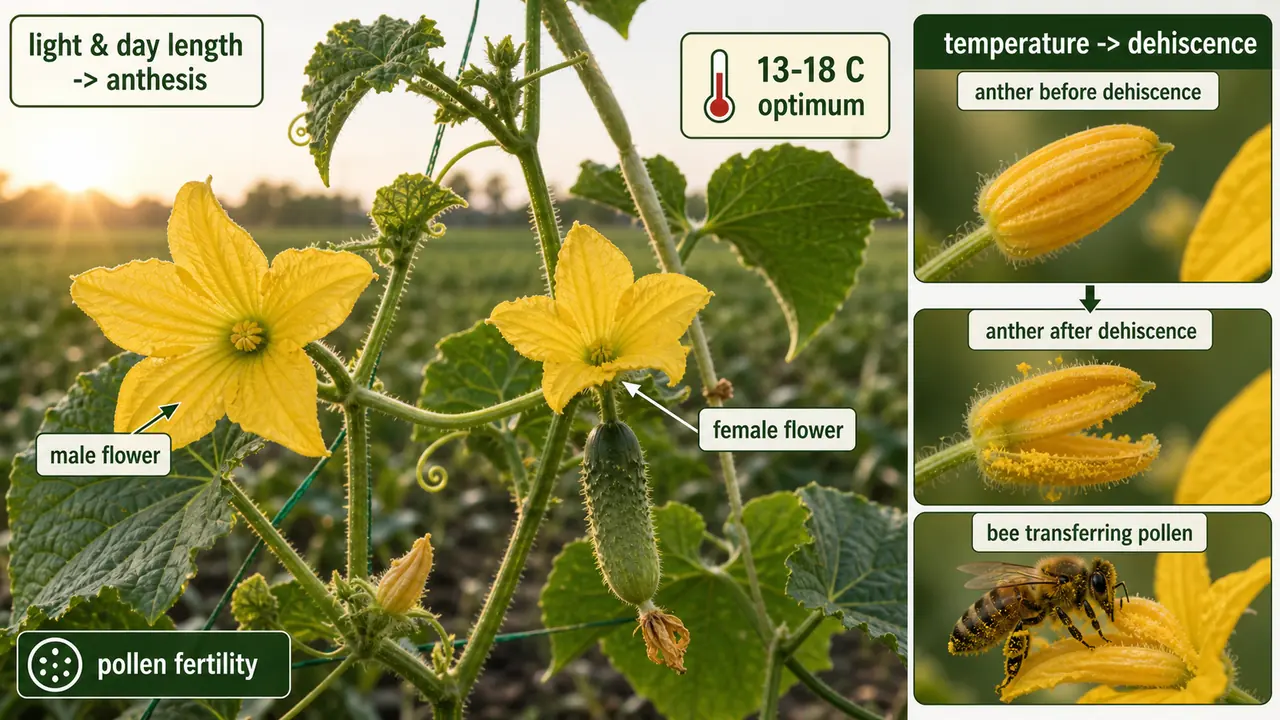
- Light intensity and day length influence anthesis (flower opening) more than temperature.
- Temperature influences anther dehiscence (pollen release) and pollen fertility.
- Optimum temperature for anthesis and dehiscence: 13-18 degrees C — cooler than the optimum growth temperature.
Maturity Indicators
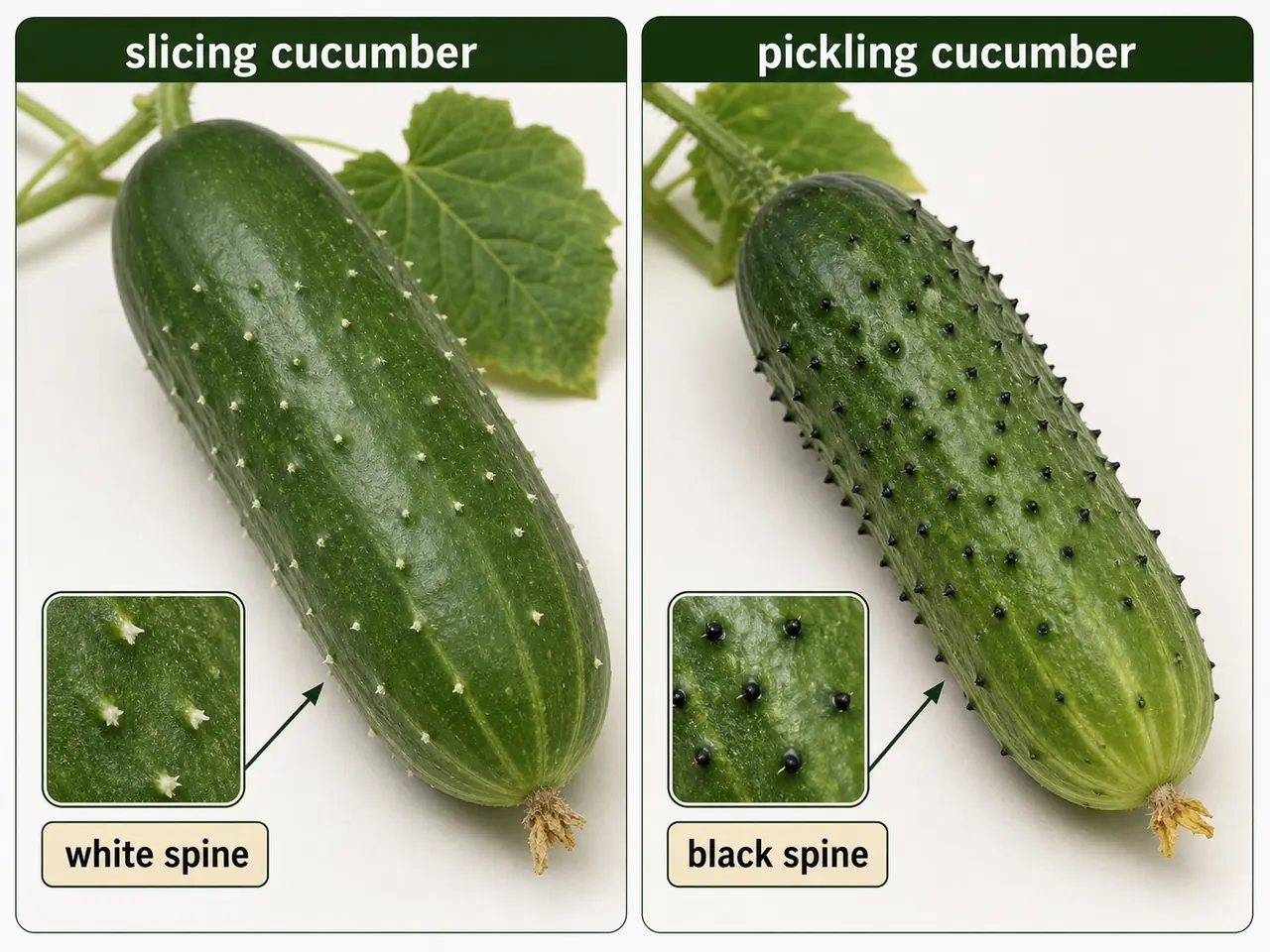
| Type | Spine Colour at Maturity |
|---|---|
| Slicing cucumber | White spine |
| Pickling cucumber | Black spine |
Pillow Disease
Pillow disease of cucumber is caused by calcium deficiency. The fruit becomes soft and puffy (pillow-shaped) due to inadequate calcium supply, which weakens cell wall structure.

Cucumber Mosaic Virus (CMV)
- Vector: Aphid (transmits in non-persistent manner — acquired and transmitted during brief feeding probes)
- Resistant varieties: Tokyo Long Green, Winscrimson, Chinese Long, Table Green

Diara Cultivation
Diara cultivation is a traditional practice of growing cucurbits on sandy riverbeds during the dry season (February-June). The natural moisture from the receding river and sandy soil provide ideal growing conditions.
Among cucurbits, muskmelon is the most suitable for diara cultivation due to its preference for warm, sandy, well-drained conditions.
Important Varieties
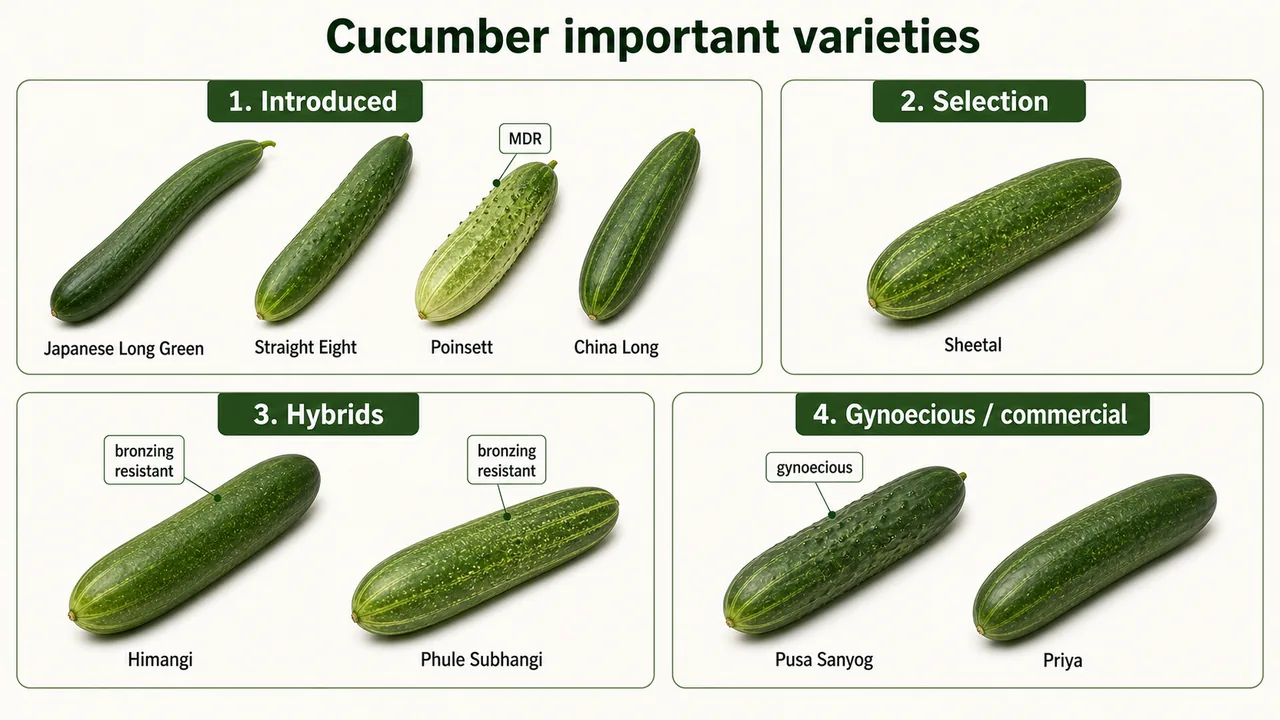
| Category | Variety | Special Feature |
|---|---|---|
| Introduced | Japanese Long Green | Temperate region only |
| Introduced | Straight Eight | Temperate region only |
| Introduced | Poinsett | MDR — resistant to powdery mildew, downy mildew, anthracnose, angular leaf spot |
| Introduced | China Long | General purpose |
| Selection | Sheetal | Selected from local populations |
| Hybrid | Himangi | Poinsett x Kalyanpur Aged; bronzing resistant |
| Hybrid | Phule Subhangi | Poinsett x Kalyanpur Aged; bronzing resistant |
| Public hybrid | Pusa Sanyog | Gynoecious variety (only female flowers = higher fruit set) |
| Private hybrid | Priya | Commercial hybrid |
Summary Cheat Sheet
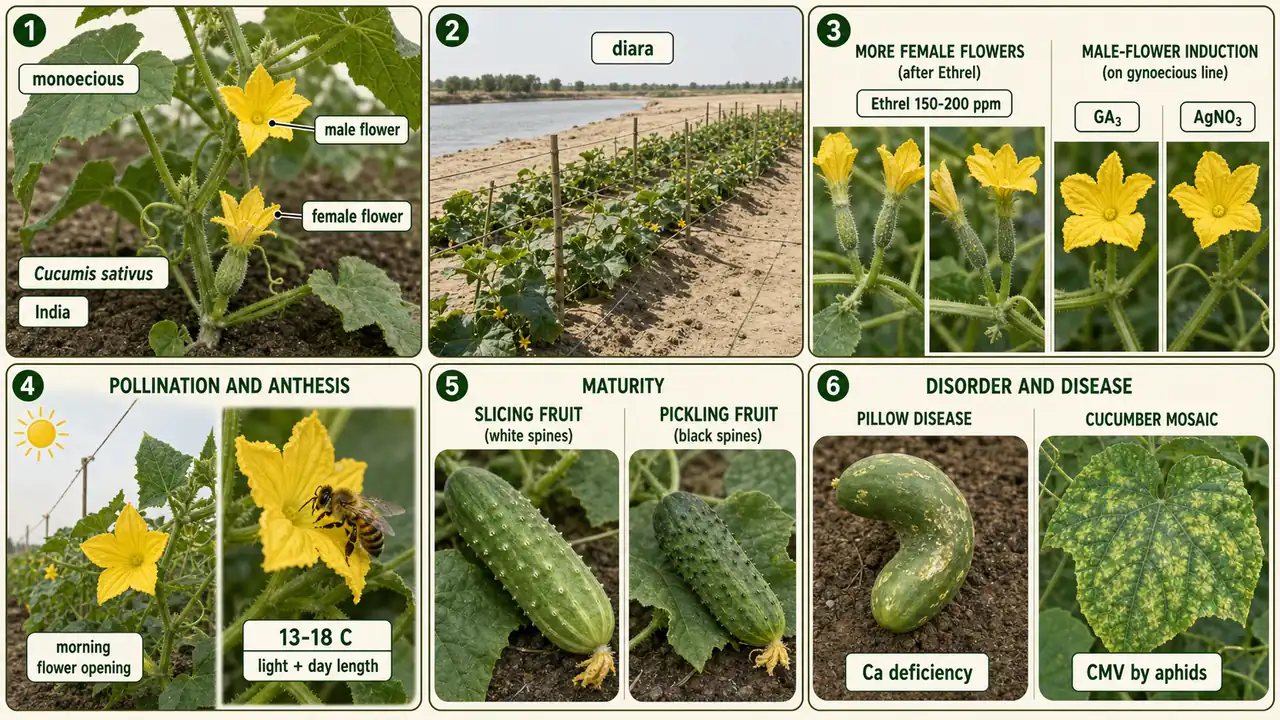
| Concept / Topic | Key Details / Explanation |
|---|---|
| Cucurbit context | Cucurbits are warm-season vine crops, and diara cultivation on sandy riverbeds is an important traditional system; among cucurbits, muskmelon is considered most suitable for diara conditions. |
| Quick flower-colour recall | Pointed gourd, bottle gourd, and chilli have white flowers, while cruciferous crops like cabbage and cauliflower have yellow flowers. |
| Cucumber identity | Cucumber is Cucumis sativus of the Cucurbitaceae family, originated in India, is called kheera, and is monoecious. |
| Crop and seed facts | Cucumber is thermophilic and frost susceptible, optimum growth temperature is about 26.4 degrees C, anthesis and dehiscence are favoured by 13-18 degrees C, seed rate is 2.5 kg/ha, and the crop is about 95% water. |
| Sex modification | Ethrel (150-200 ppm) increases female flowers and raises fruit set, whereas GA3 and silver nitrate are used to induce male flowers on gynoecious lines for hybrid seed production. |
| Pollination facts | Light intensity and day length influence anthesis more than temperature, but temperature strongly affects anther dehiscence and pollen fertility. |
| Maturity indicator | In maturity identification, slicing cucumber has white spines and pickling cucumber has black spines. |
| Physiological disorder | Pillow disease of cucumber is due to calcium deficiency. |
| Viral disease | Cucumber Mosaic Virus (CMV) is transmitted by aphids; resistant varieties mentioned are Tokyo Long Green, Winscrimson, Chinese Long, and Table Green. |
| Important varieties | Important introduced varieties are Japanese Long Green, Straight Eight, Poinsett, and China Long; Poinsett is notable for multiple disease resistance. |
| Hybrids and gynoecious line | Sheetal is a selection, Himangi and Phule Subhangi are bronzing-resistant hybrids, Pusa Sanyog is a gynoecious public hybrid, and Priya is a private hybrid. |