🌼 Cauliflower — The Thermo-Sensitive Cole Crop
Complete guide to cauliflower cultivation covering curd formation, blanching, scooping, seasonal varieties, physiological disorders (browning, whiptail, buttoning), and disease-resistant varieties for competitive exams.
A cauliflower farmer in Punjab carefully bends the outer leaves over each developing curd, shielding it from the sun. This practice, called blanching, is what keeps the curd brilliantly white — without it, direct sunlight would turn the curd yellow and reduce its market value. But some modern varieties like Pusa Snowball have solved this problem entirely: their wrapper leaves naturally curve inward, making them self-blanching and saving hours of labour per acre.
Cauliflower is among the most popular and widely cultivated cole crops in India. It is unique among the Brassica vegetables because the edible curd is a transitional structure — neither purely vegetative nor fully reproductive — making cauliflower the only cole crop where curding lies between the vegetative and reproductive stage.
IMPORTANT
Key exam facts: Cauliflower was introduced in India in 1822 by Dr. Jenson. It is a thermo-sensitive crop — temperature deviations cause disorders like riceyness, buttoning, and blindness. Browning = Boron deficiency, Whiptail = Molybdenum deficiency.
Pro Content Locked
Upgrade to Pro to access this lesson and all other premium content.
Charged once for one year · ₹1188 total
Save ₹100/month vs ₹2388/year launch price
- All Agriculture & Banking Courses
- AI Lesson Questions (100/day)
- AI Doubt Solver (50/day)
- Glows & Grows Feedback (30/day)
- AI Section Quiz (20/day)
- 22-Language Translation (100/day)
- Recall Questions (20/day)
- AI Quiz (15/day)
- AI Quiz Paper Analysis (100/day)
- AI Step-by-Step Explanations (100/day)
- Spaced Repetition Recall (FSRS)
- AI Tutor
- Immersive Text Questions
- Audio Lessons — Hindi & English
- Mock Tests & Previous Year Papers
- Summary & Mind Maps
- XP, Levels, Leaderboard & Badges
- Generate New Classrooms
- Voice AI Teacher (AgriDots Live)
- AI Revision Assistant
- Knowledge Gap Analysis
- Interactive Revision (LangGraph)
🔒 Secure one-time yearly payment via Razorpay · No hidden fees
A cauliflower farmer in Punjab carefully bends the outer leaves over each developing curd, shielding it from the sun. This practice, called blanching, is what keeps the curd brilliantly white — without it, direct sunlight would turn the curd yellow and reduce its market value. But some modern varieties like Pusa Snowball have solved this problem entirely: their wrapper leaves naturally curve inward, making them self-blanching and saving hours of labour per acre.
Cauliflower is among the most popular and widely cultivated cole crops in India. It is unique among the Brassica vegetables because the edible curd is a transitional structure — neither purely vegetative nor fully reproductive — making cauliflower the only cole crop where curding lies between the vegetative and reproductive stage.
IMPORTANT
Key exam facts: Cauliflower was introduced in India in 1822 by Dr. Jenson. It is a thermo-sensitive crop — temperature deviations cause disorders like riceyness, buttoning, and blindness. Browning = Boron deficiency, Whiptail = Molybdenum deficiency.
Botanical Identity
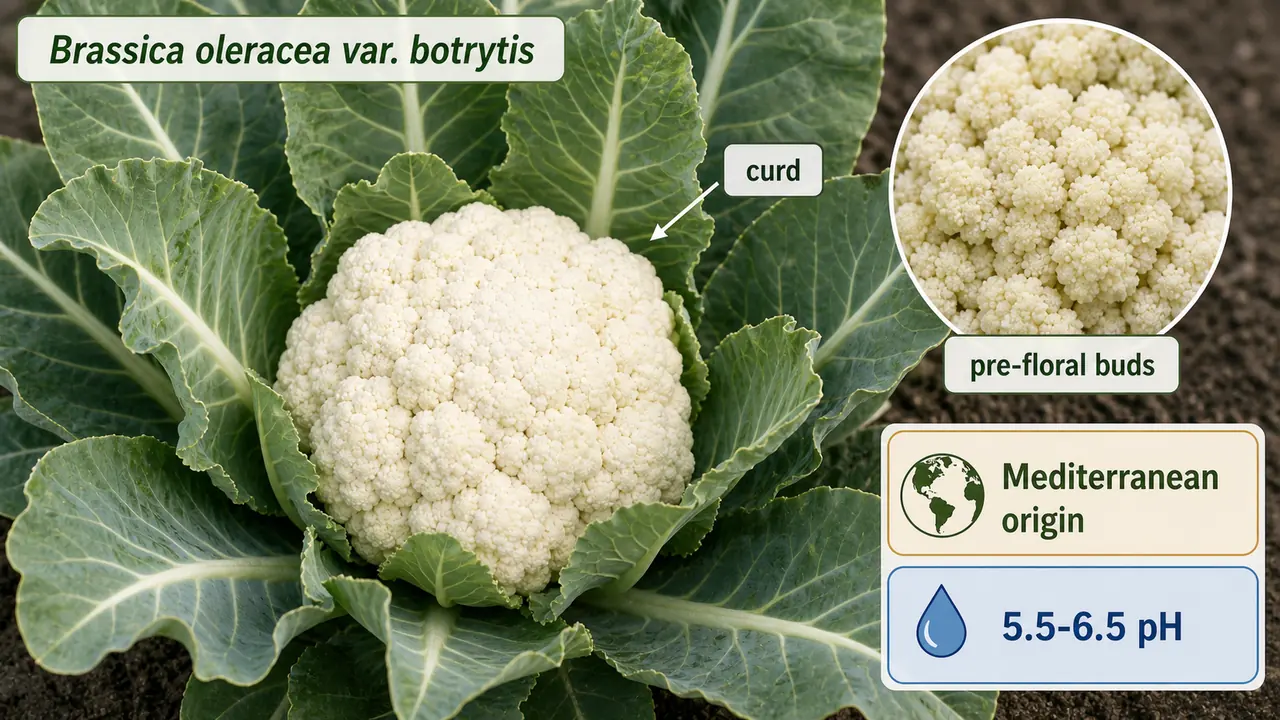
| Parameter | Detail |
|---|---|
| Botanical Name | Brassica oleracea var. botrytis |
| Family | Cruciferae (Brassicaceae) |
| Origin | Mediterranean region |
| Introduced in India | 1822 by Dr. Jenson (from London) |
| Edible part | Curd (pre-floral, compressed flower buds) |
| Seed rate | 450-700 g/ha |
| Optimal soil pH | 5.5 to 6.5 |
| Irrigations needed | 5-8 during growth |
Key Concepts in Cauliflower Cultivation
The Curd
The curd is a mass of pre-floral, compressed, undifferentiated flower buds that forms the edible head. It is harvested before the flowers fully develop and open. Cauliflower is the only cole crop in which the intermediate stage of curding lies between the vegetative and reproductive stage — the curd is a transitional structure.
Blanching
Blanching involves tying or bending the outer leaves over the curd to shield it from direct sunlight. This prevents the formation of yellow pigments, maintains the desirable white colour, and helps arrest enzymatic activity.

Most late-type (Snowball) varieties have a self-blanching habit — their naturally incurving wrapper leaves cover the curd, eliminating the need for manual blanching. Examples: Pusa Himjyoti and Pusa Snowball.
Scooping
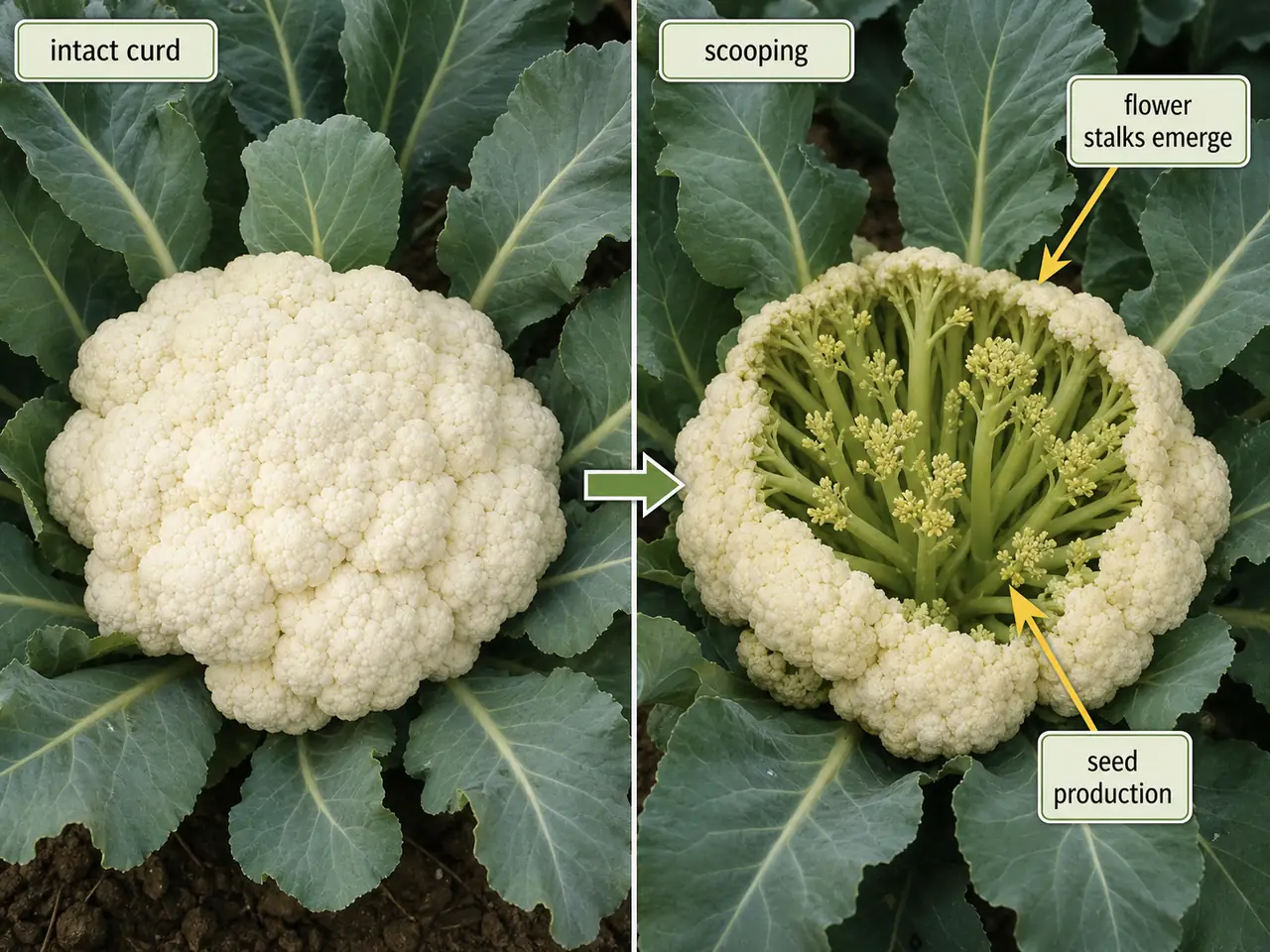
Scooping is the removal of the central portion of the curd to allow easier initiation of flower stalks. This technique is used specifically during seed production — by removing the dense centre, the flower stalks can emerge more easily and set seed.
Thermo-Sensitivity
Cauliflower is a thermo-sensitive crop, meaning its growth, curd initiation, and curd quality are highly dependent on temperature. Even small deviations from the optimal range can cause physiological disorders. This is why Indian breeders have developed three seasonal groups of varieties.
Seasonal Varieties
Three season groups are available, ensuring year-round cauliflower production across India:
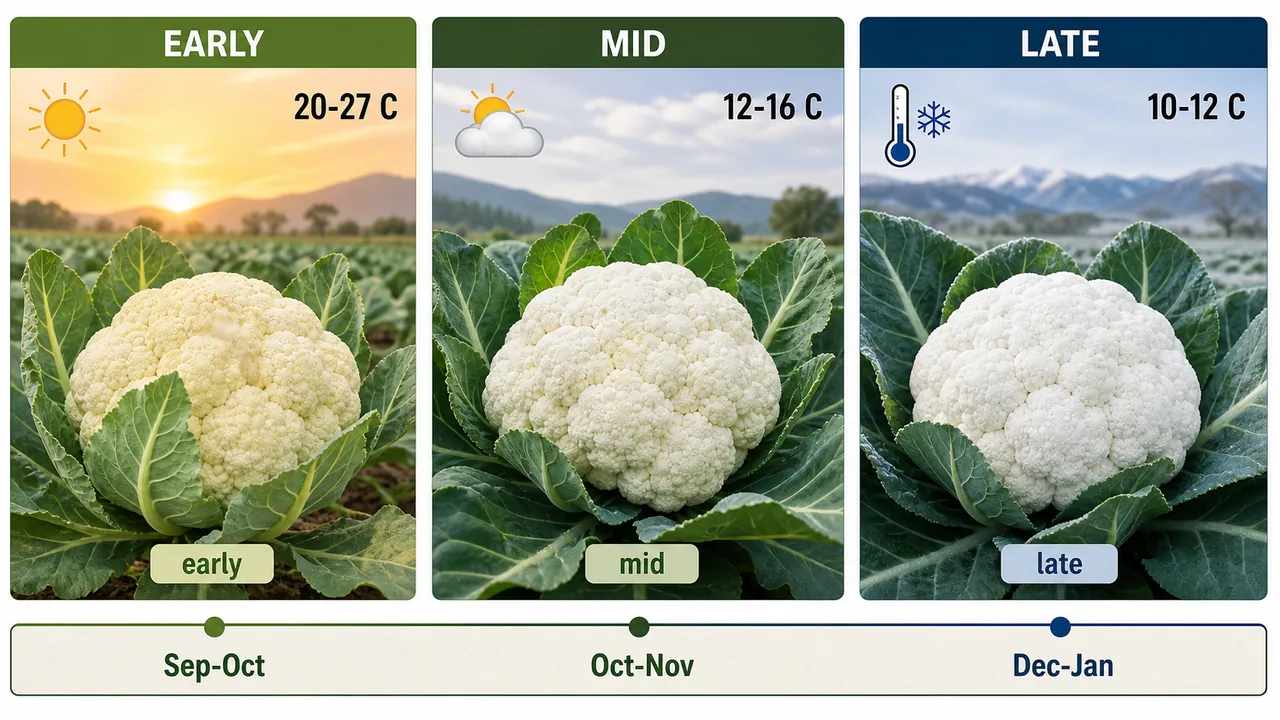
| Cauliflower | Sowing Time | Harvesting Time | Growth Temperature |
|---|---|---|---|
| Early | Mid May-Mid June | July end | 20-27°C |
| Mid early | July end | Sept end | 12-16°C |
| Mid late | Aug-end | Sept-end | 12-16°C |
| Late | Sept end | Oct end | 10-12°C |
| Season | Planting Time | Examples |
|---|---|---|
| Early | September-October | Early Kunwari, Pusa Early Synthetic, Pusa Deepali, Pusa Ketki |
| Mid | October-November | Improved Japanese, Pusa Sharad, Pusa Aghani |
| Late | December-January | Pusa Snowball, Pusa Snowball K-1, Pusa Himjyoti |
Early varieties mature in 60-90 days and are planted for harvest during the festive season when prices are high.
| Varieties | Seed rate | Yield | Sowing time | Maturing time |
|---|---|---|---|---|
| Early | 500-600 g/hac | 12-15 t/hac | Mid May-Mid June | Sept-Oct |
| Mid and late | 350-400 g/hac | 20-30 t/hac | July-Aug | Nov-Dec |
Important Varieties by Category
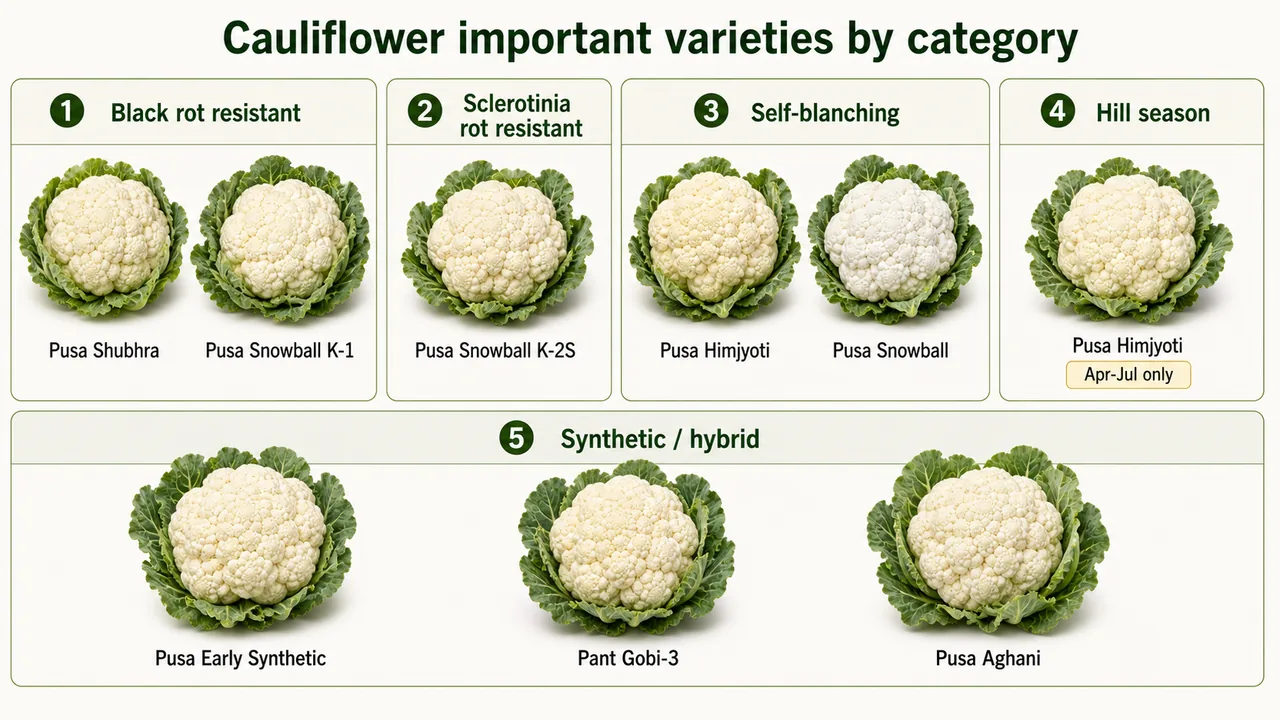
| Category | Variety | Special Feature |
|---|---|---|
| Sclerotinia rot resistant | Pusa Snowball K-2S | Resistant to fungal curd rot |
| Black rot resistant | Pusa Shubhra, Pusa Snowball K-1 | Resistant to Xanthomonas |
| Self-blanching | Pusa Himjyoti, Pusa Snowball | Natural leaf cover over curd |
| Hill season (Apr-Jul) | Pusa Himjyoti | Only variety for off-season hill production |
| Introduced | Improved Japanese | From foreign germplasm |
| Synthetic | Pusa Early Synthetic, Pusa Synthetic, Pant Gobi-3 | Inter-mated selected lines, genetically diverse |
Hybrid Varieties
- Pusa Shubhra
- Pusa Aghani
Private Sector Hybrids
- Candid Charm, Cash More, Early Himlata, Himani, White Flesh, Nath Ujwala, Nath Shweta
Physiological Disorders
Cauliflower is particularly susceptible to disorders due to its thermo-sensitive nature. Understanding these disorders is essential for producing quality curds and answering exam questions.
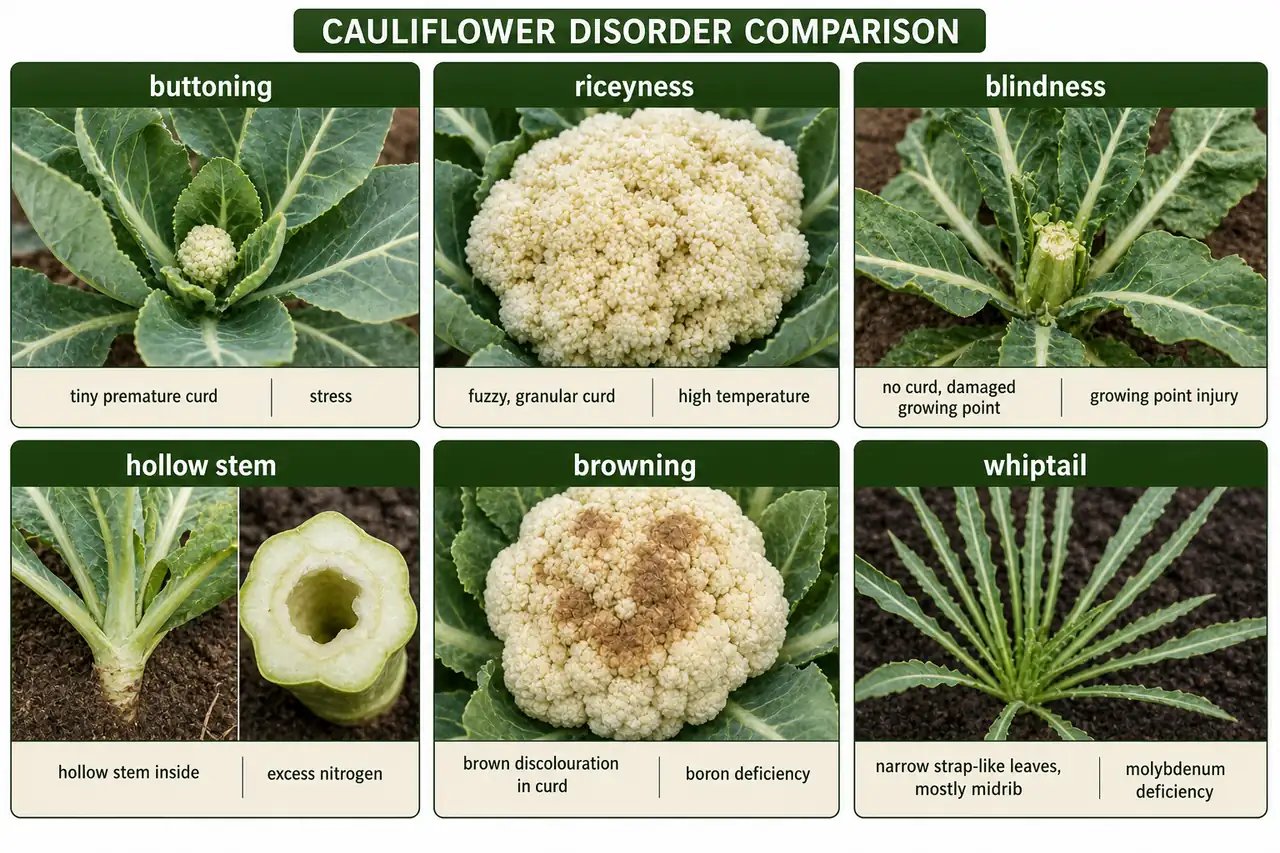
| Disorder | Cause | Description |
|---|---|---|
| Buttoning | Stress, late transplanting, nutrient deficiency | Premature formation of small, unmarketable curds |
| Riceyness | High temperature during curd formation | Fuzzy, granular curd surface with elongated flower buds |
| Blindness | Damage to growing point (mechanical or pest injury) | Complete failure to form a curd |
| Hollow stem | Excessive use of fertilizers, especially nitrogen | Excessive growing plants of cauliflower develop hollow stem and curd |
| Browning | Boron deficiency | Brown discolouration inside the curd; hollow stem |
| Whiptail | Molybdenum deficiency | Leaves become narrow, strap-like; only midrib remains |
| Chlorosis | Mg deficiency | Interveinal, yellow mottling of lower leaves |
Key Disorders at a Glance
| Disorder | Cause |
|---|---|
| Buttoning | Premature small curd formation (stress, late transplanting) |
| Riceyness | Fuzzy, granular curd surface (high temperature) |
| Blindness | Failure to form curd (damage to growing point) |
| Hollow stem | Excessive use of fertilizers, especially nitrogen |
| Browning | Boron deficiency |
| Whiptail | Molybdenum deficiency |
| Chlorosis | Mg deficiency |
Summary Cheat Sheet
| Concept / Topic | Key Details / Explanation |
|---|---|
| Botanical identity | Cauliflower is Brassica oleracea var. botrytis of the Brassicaceae family, originated in the Mediterranean region, and was introduced into India in 1822 by Dr. Jenson. |
| Edible part and basic requirements | The edible part is the curd, made of pre-floral compressed flower buds; seed rate is 450-700 g/ha, optimum soil pH is 5.5-6.5, and the crop usually needs 5-8 irrigations. |
| Nature of the curd | Cauliflower is unique because curding lies between the vegetative and reproductive stage, so the curd is treated as a transitional structure. |
| Blanching | Blanching means tying or bending outer leaves over the curd to protect it from sunlight and keep the curd white. |
| Self-blanching types | Late Snowball types such as Pusa Himjyoti and Pusa Snowball are naturally self-blanching because wrapper leaves curve over the curd. |
| Scooping | Scooping means removing the central part of the curd during seed production so flower stalks emerge more easily. |
| Thermo-sensitive nature | Cauliflower is a highly thermo-sensitive crop; temperature mismatch produces major disorders such as buttoning, riceyness, and blindness. |
Summary Continued
Summary Continued
| Concept / Topic | Key Details / Explanation |
|---|---|
| Seasonal groups | Early varieties are planted in September-October, mid-season in October-November, and late varieties in December-January. |
| Seasonal examples | Important early varieties are Early Kunwari, Pusa Early Synthetic, Pusa Deepali, and Pusa Ketki; mid-season varieties include Improved Japanese, Pusa Sharad, and Pusa Aghani; late varieties include Pusa Snowball, Pusa Snowball K-1, and Pusa Himjyoti. |
| Special varieties | Pusa Snowball K-2S is resistant to Sclerotinia rot, Pusa Shubhra and Pusa Snowball K-1 resist black rot, Pusa Himjyoti is the only important hill-season off-season type, and Improved Japanese is an introduced variety. |
| Synthetic and hybrid types | Important synthetic types are Pusa Early Synthetic, Pusa Synthetic, and Pant Gobi-3; hybrids named in the lesson are Pusa Shubhra and Pusa Aghani, while private hybrids include Candid Charm, Cash More, Early Himlata, Himani, White Flesh, Nath Ujwala, and Nath Shweta. |
| Physiological disorders | Buttoning is premature small-curd formation due to stress or late transplanting, riceyness occurs under high temperature and gives a granular curd surface, and blindness is failure of curd formation after damage to the growing point. |
| Nutrient-deficiency disorders | Browning is due to boron deficiency and often shows brown curd tissue with hollow stem, while whiptail is due to molybdenum deficiency and produces narrow strap-like leaves. |