🥬 Cabbage and Cole Crops — Cool-Season Crucifers
Complete guide to cole crops and cabbage covering protogyny, self-incompatibility, diamond back moth management, club root disease, varieties, and key cultivation practices for competitive exams.
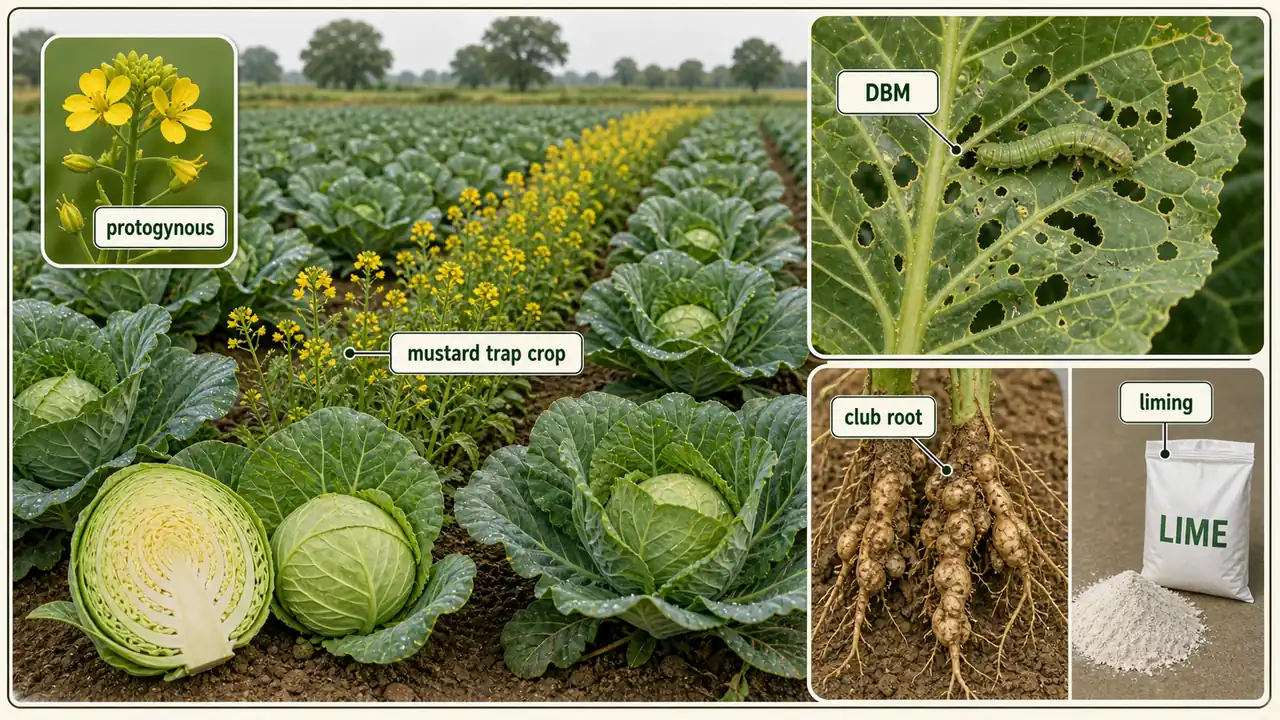
In the cool highlands of Ooty, a farmer growing cabbage spots tiny holes appearing on the underside of his crop's leaves — the unmistakable "window-pane" damage of the Diamond Back Moth (DBM), the single most destructive pest of cabbage worldwide. His neighbour, however, has planted rows of Indian mustard around the field, and 80-90% of the moths are drawn there instead. This simple trap-cropping strategy is one of the most effective IPM techniques in cole crop farming.
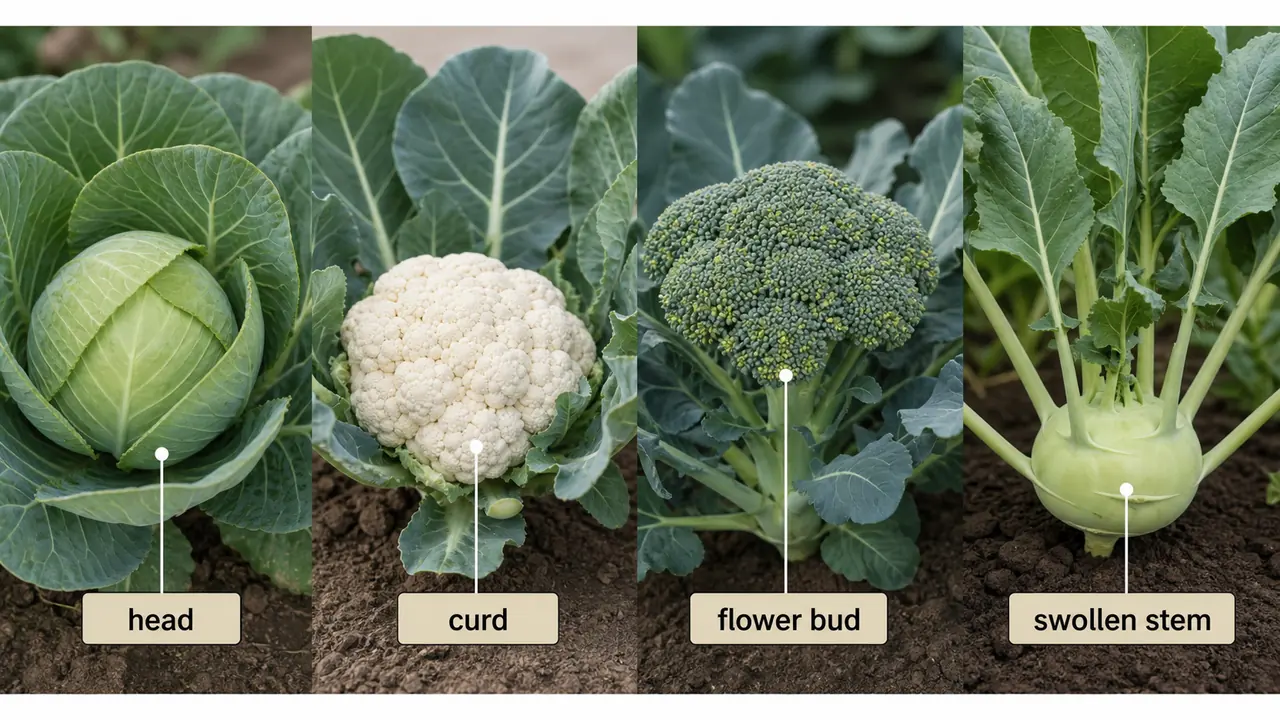
Cole crops are vegetables belonging to the genus Brassica of the family Cruciferae (Brassicaceae). This group includes cabbage, cauliflower, broccoli, knol-khol, and Brussels sprouts. They are cool-season crops that prefer moderate temperatures for best growth and quality.
IMPORTANT
All cole crops are protogynous (female matures first), which promotes cross-pollination. The characteristic flavour of cole crops is due to dimethyl trisulphide. Club root disease is 100% at pH 5.7 — liming is the key management strategy.
Pro Content Locked
Upgrade to Pro to access this lesson and all other premium content.
Charged once for one year · ₹1188 total
Save ₹100/month vs ₹2388/year launch price
- All Agriculture & Banking Courses
- AI Lesson Questions (100/day)
- AI Doubt Solver (50/day)
- Glows & Grows Feedback (30/day)
- AI Section Quiz (20/day)
- 22-Language Translation (100/day)
- Recall Questions (20/day)
- AI Quiz (15/day)
- AI Quiz Paper Analysis (100/day)
- AI Step-by-Step Explanations (100/day)
- Spaced Repetition Recall (FSRS)
- AI Tutor
- Immersive Text Questions
- Audio Lessons — Hindi & English
- Mock Tests & Previous Year Papers
- Summary & Mind Maps
- XP, Levels, Leaderboard & Badges
- Generate New Classrooms
- Voice AI Teacher (AgriDots Live)
- AI Revision Assistant
- Knowledge Gap Analysis
- Interactive Revision (LangGraph)
🔒 Secure one-time yearly payment via Razorpay · No hidden fees
In the cool highlands of Ooty, a farmer growing cabbage spots tiny holes appearing on the underside of his crop's leaves — the unmistakable "window-pane" damage of the Diamond Back Moth (DBM), the single most destructive pest of cabbage worldwide. His neighbour, however, has planted rows of Indian mustard around the field, and 80-90% of the moths are drawn there instead. This simple trap-cropping strategy is one of the most effective IPM techniques in cole crop farming.
Cole crops are vegetables belonging to the genus Brassica of the family Cruciferae (Brassicaceae). This group includes cabbage, cauliflower, broccoli, knol-khol, and Brussels sprouts. They are cool-season crops that prefer moderate temperatures for best growth and quality.
IMPORTANT
All cole crops are protogynous (female matures first), which promotes cross-pollination. The characteristic flavour of cole crops is due to dimethyl trisulphide. Club root disease is 100% at pH 5.7 — liming is the key management strategy.
Key Features of Cole Crops
| Feature | Detail |
|---|---|
| Family | Cruciferae (Brassicaceae) |
| Flower colour | Yellow (all cruciferous crops) |
| Sex mechanism | Protogynous (female matures before male) |
| Self-incompatibility | Most common in Cruciferae family |
| Characteristic flavour | Due to dimethyl trisulphide (sulphur compound) |
| Anti-cancer compound | Indole-3-carbinol (found in cabbage) |
- Protogyny means the female reproductive parts mature before the male parts within the same flower, promoting cross-pollination and genetic diversity.
- Self-incompatibility is a genetic mechanism that prevents fertilization by the plant's own pollen, ensuring outcrossing. This trait is exploited in hybrid seed production.
Diseases of Cole Crops
| Disease | Causal Agent | Key Details |
|---|---|---|
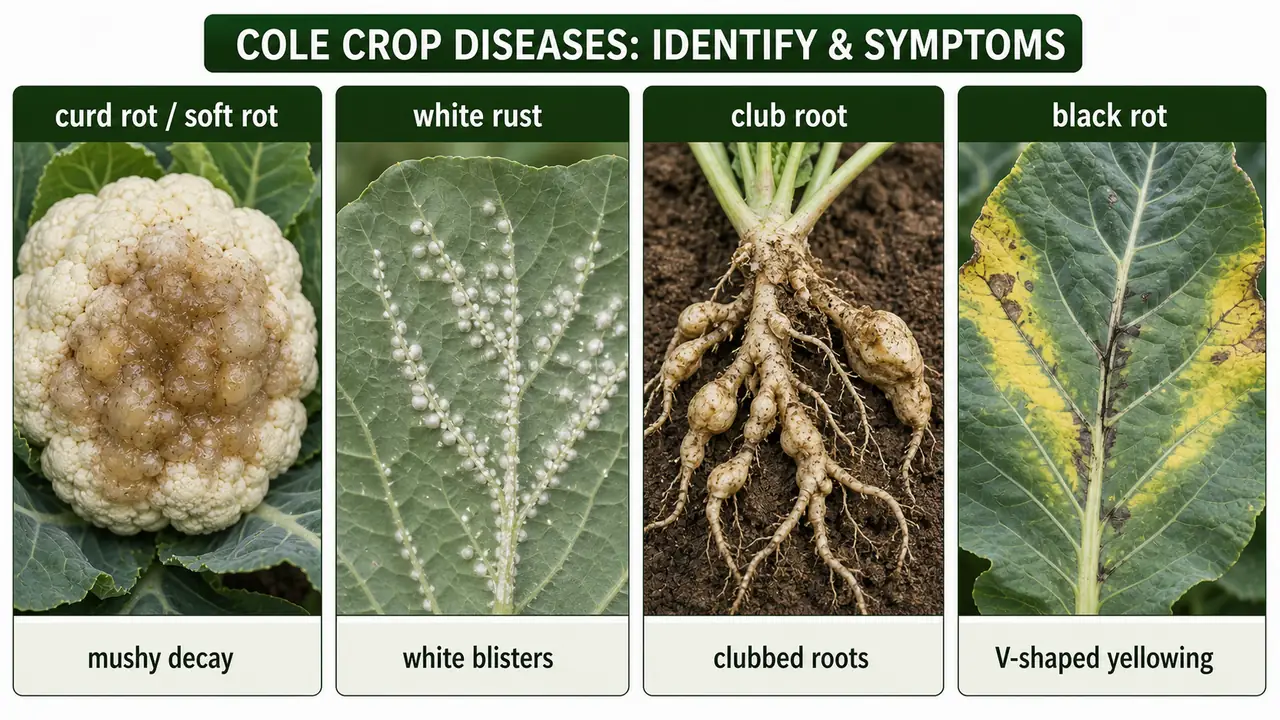
| Curd rot / Soft rot | Erwinia carotovora | Bacterial; water-soaked, mushy, foul-smelling decay; worst in warm, humid conditions |
| White rust / White blister | Albugo candida | Oomycete; white blister-like pustules on leaf undersurface |
| Club root | Plasmodiophora brassicae | Protist; root swelling into club shapes; 100% infection at pH 5.7; liming above pH 7.0 is the primary management |
| Black rot | Xanthomonas campestris | Bacterial; V-shaped yellowing from leaf margins |

Major Pests of Cole Crops
Diamond Back Moth (DBM) — Most Important Pest
- Scientific Name: Plutella xylostella
- Damage: Larvae feed on leaves and create "window-pane" damage (only upper epidermis remains). Older larvae make galleries in heads.
- Key challenge: DBM has developed resistance against most insecticides, making IPM essential.
- Management:
- Indian mustard as trap crop — attracts 80-90% of DBM moths away from the main crop
- Spray rotation: Quinalphos 35 EC @ 250 ml/ha, Cartap hydrochloride @ 500 g a.i./ha, or Fenvalerate 20 EC @ 45 g a.i./ha
WARNING
DBM is notorious for developing insecticide resistance. Rotation of insecticides and use of trap crops (Indian mustard) are essential IPM strategies.

Other Pests
| Pest | Scientific Name | Order/Family | Key Feature |
|---|---|---|---|
| Mustard sawfly | Athalia proxima lugens | Hymenoptera / Tenthredinidae | Only major crop pest from Hymenoptera (an order of mostly beneficial insects) |
| Cabbage semi-looper | Plusia orichalcea | Noctuidae | Characteristic looping movement while crawling |
Cabbage — Detailed Study
| Parameter | Detail |
|---|---|
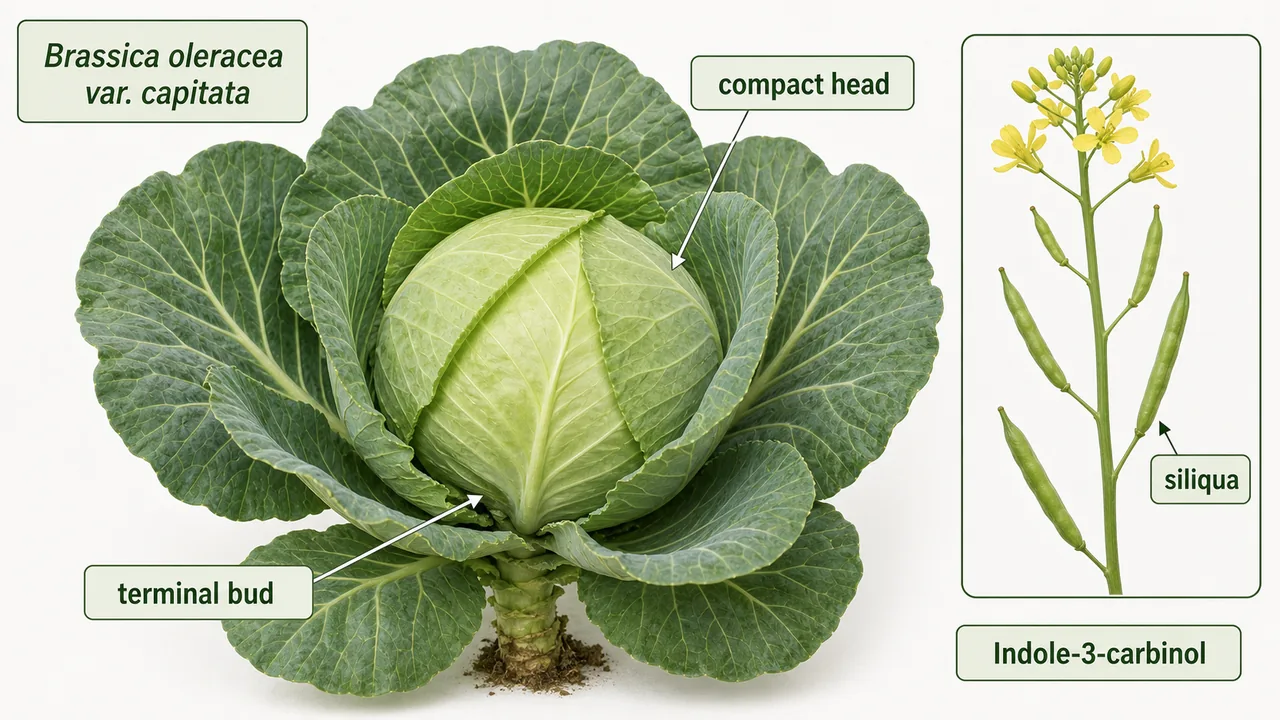
| Botanical Name | Brassica oleracea var. capitata |
| Edible part | Head (compact mass of tightly wrapped, overlapping leaves) |
| Fruit type | Siliqua (dry, dehiscent fruit — when it flowers for seed) |
| India's global rank | 3rd in cabbage production |
| Seed rate | 500-750 g/ha |
| Anti-cancer compound | Indole-3-carbinol |
| Club root | 100% incidence at pH 5.7 |
The variety name "capitata" comes from the Latin word for "head," referring to the compact head that cabbage forms. The edible portion is actually a large terminal bud consisting of tightly wrapped, overlapping leaves.
Varieties
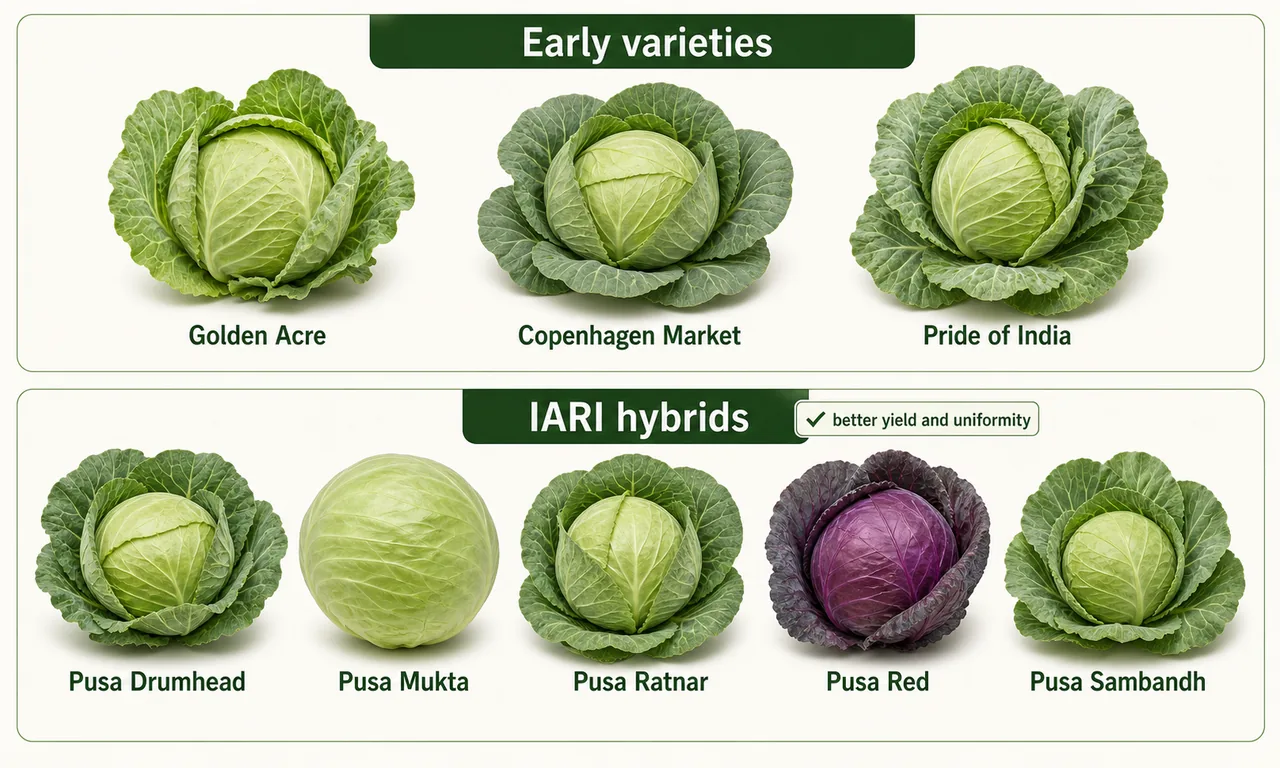
| Category | Variety | Special Feature |
|---|---|---|
| Early | Golden Acre | Popular early-maturing, round compact heads |
| Early | Copenhagen Market | Uniform, globe-shaped heads, fresh market |
| Early | Pride of India | Early and round variety |
Hybrid Varieties (IARI)
- Pusa Drumhead
- Pusa Mukta
- Pusa Ratnar
- Pusa Red
- Pusa Sambandh
These hybrid varieties developed by IARI exhibit improved yield, uniformity, and disease resistance compared to open-pollinated varieties.
Summary Cheat Sheet
| Concept / Topic | Key Details / Explanation |
|---|---|
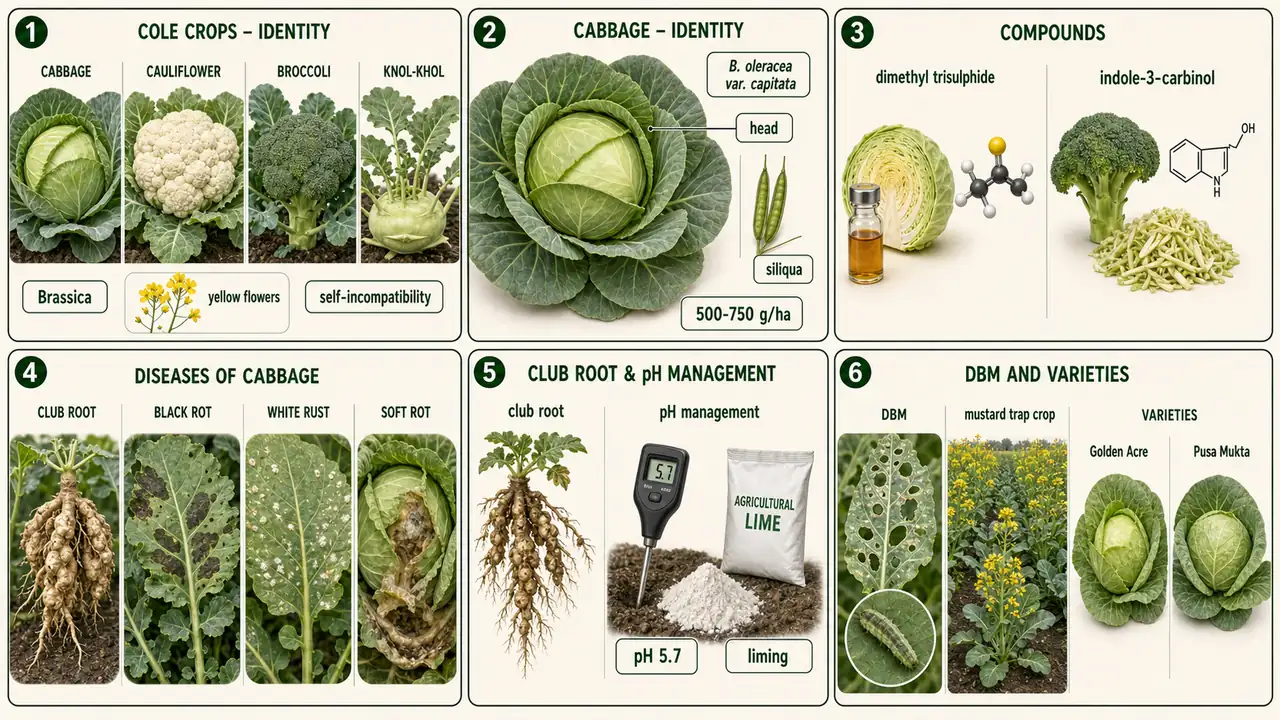
| Cole crop identity | Cole crops belong to the genus Brassica of the Cruciferae/Brassicaceae family and include cabbage, cauliflower, broccoli, knol-khol, and Brussels sprouts. |
| Common floral and breeding features | All cole crops have yellow flowers, are protogynous, and show strong self-incompatibility, which promotes cross-pollination and is useful in hybrid seed production. |
| Characteristic compounds | The typical flavour is due to dimethyl trisulphide, and cabbage is noted for the anti-cancer compound indole-3-carbinol. |
| Major diseases of cole crops | Curd rot/soft rot is caused by Erwinia carotovora, white rust by Albugo candida, club root by Plasmodiophora brassicae, and black rot by Xanthomonas campestris. |
| Club root fact | Club root causes swollen club-shaped roots and reaches severe incidence around pH 5.7; the key management is liming the soil above neutral range. |
| Most important pest | Diamond Back Moth (Plutella xylostella) is the most important pest of cole crops and causes characteristic window-pane damage on leaves, later boring into heads. |
| DBM management | Because DBM develops insecticide resistance quickly, integrated control is emphasized: Indian mustard is used as a trap crop, and sprays such as Quinalphos, Cartap hydrochloride, or Fenvalerate are rotated. |
| Other pests | Athalia proxima lugens is mustard sawfly and is important as the only major crop pest from Hymenoptera; Plusia orichalcea is the cabbage semi-looper. |
| Cabbage identity | Cabbage is Brassica oleracea var. capitata; the edible part is the head, the fruit type is siliqua, India ranks third in production, and seed rate is 500-750 g/ha. |
| Extra cabbage recall points | The term capitata refers to the head, cabbage also contains indole-3-carbinol, and club root remains a key disease concern. |
| Important cabbage varieties | Early varieties highlighted are Golden Acre, Copenhagen Market, and Pride of India. |
| IARI hybrids | Important IARI hybrids named in the lesson are Pusa Drumhead, Pusa Mukta, Pusa Ratnar, Pusa Red, and Pusa Sambandh. |