🫑 Gourds — Diverse Cucurbit Vegetables of India
Complete guide to gourd cultivation covering bottle gourd, bitter gourd, summer squash, snake gourd, pointed gourd, ash gourd, chow-chow, ridge gourd, sponge gourd, common diseases and pests of cucurbits for competitive exams.
In a village near Varanasi, a farmer hollows out a dried bottle gourd shell and hands it to a local instrument maker who will fashion it into the resonating chamber of a sitar. Across the country in Kerala, another farmer harvests chow-chow — the only cucurbit with a single seed per fruit — from a perennial vine that has been producing for years. From the bitterest vegetable (bitter gourd) to the longest-storing one (ash gourd, up to 12 months), gourds represent an astonishing diversity of forms, flavours, and uses within the cucurbit family.
IMPORTANT
Key exam facts: Ash gourd has the longest storage life among cucurbits. Chow-chow is the most nutritious cucurbit and has a single seed per fruit. Bitter gourd's bitterness is due to momordicin. Pointed gourd is dioecious (needs 10% male plants). Powdery mildew = upper leaf surface, Downy mildew = lower leaf surface.
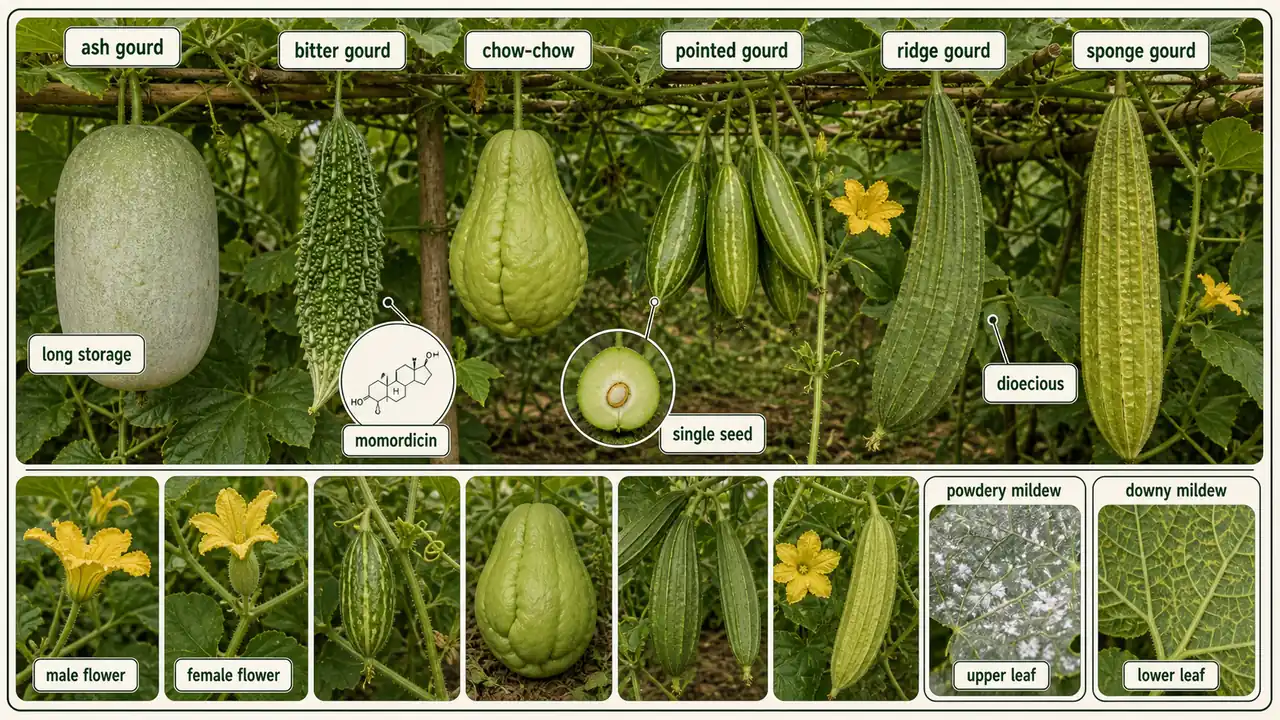
Quick Comparison — All Gourds
Gourd Comparison Table
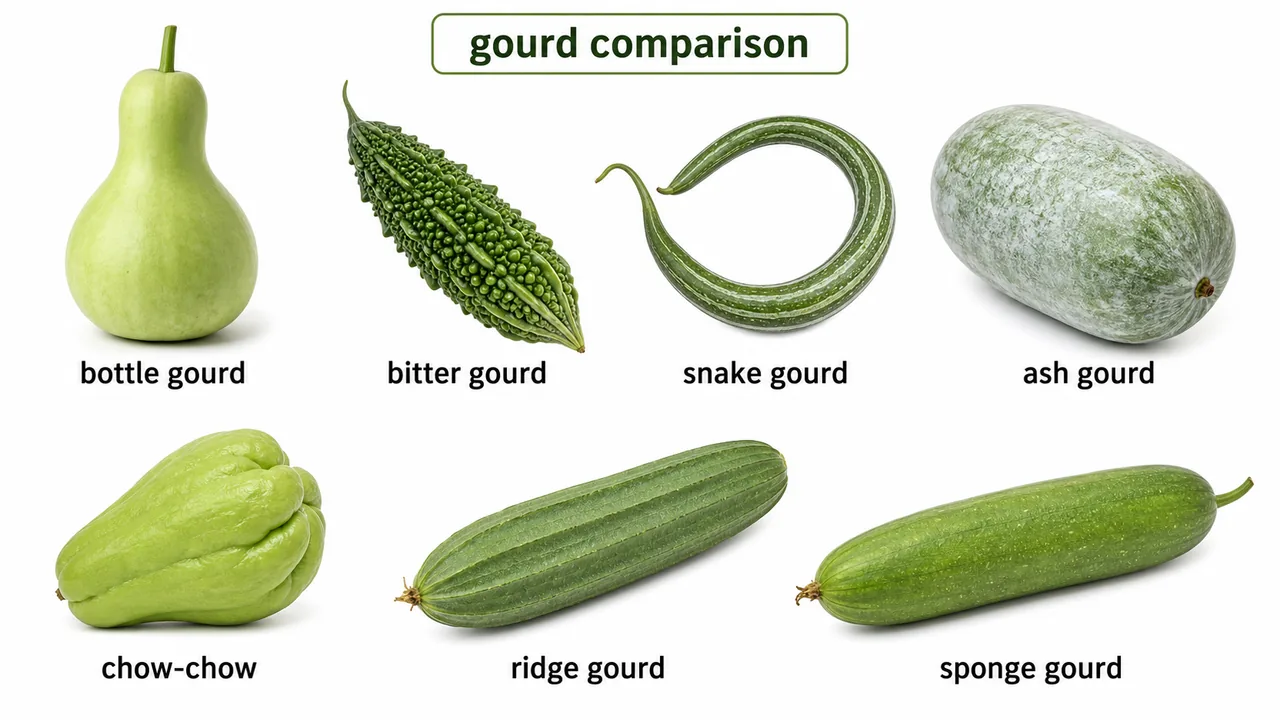
| Gourd | Botanical Name | Origin | Unique Feature |
|---|---|---|---|
| Bottle gourd | Lagenaria siceraria | South Africa | Dried shell for musical instruments; tutti-frutti |
| Bitter gourd | Momordica charantia | Indo-Burma | Bitter taste (momordicin); anti-diabetic |
| Summer squash | Cucurbita pepo | Mexico | Bushy habit; harvested at 1/3rd maturity |
| Snake gourd | Trichosanthes anguina | India | Long, twisted fruits; bower system training |
| Pointed gourd | Trichosanthes dioica | India | Dioecious; perennial; vine cutting propagation |
| Ash gourd | Benincasa hispida | Japan | Longest storage life; waxy surface |
| Chow-chow | Sechium edule | Mexico | Single-seeded; most nutritious; viviparous |
| Ridge gourd | Luffa acutangula | Asia | Ridged fruit; kniffin system; bathing sponge |
| Sponge gourd | Luffa cylindrica | Asia | Smooth fruit; higher protein than ridge gourd |
Bottle Gourd (Lauki)
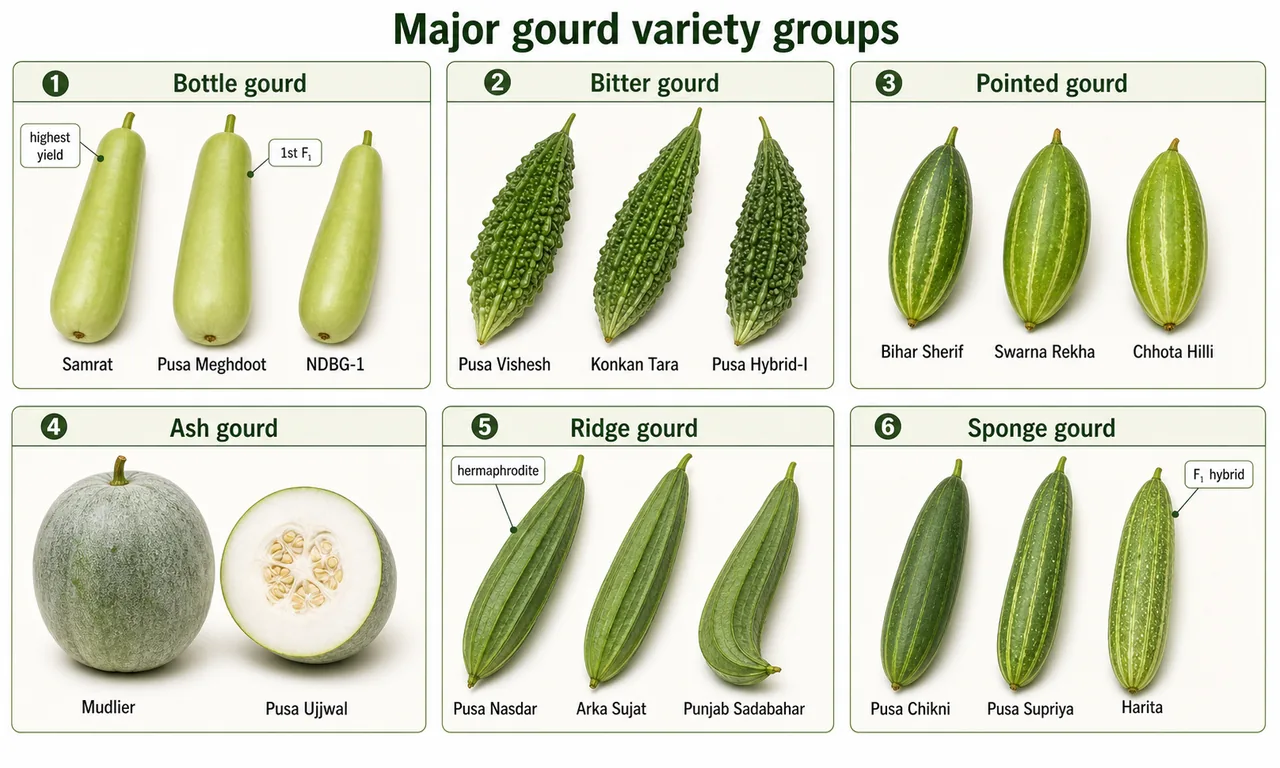

| Parameter | Detail |
|---|---|
| Botanical Name | Lagenaria siceraria |
| Family | Cucurbitaceae |
| Origin | South Africa |
| Seed rate | 3-6 kg/ha |
| Germination temperature | 25-30 degrees C |
Bottle gourd is one of the most versatile cucurbit crops — used as a vegetable, for making Kofta and Petha (translucent sweet), and even for tutti-frutti (candied fruit for bakeries). The dried shell is used for musical instruments (sitar tumba, tanpura resonators) and craft items.
Pro Content Locked
Upgrade to Pro to access this lesson and all other premium content.
Charged once for one year · ₹1188 total
Save ₹100/month vs ₹2388/year launch price
- All Agriculture & Banking Courses
- AI Lesson Questions (100/day)
- AI Doubt Solver (50/day)
- Glows & Grows Feedback (30/day)
- AI Section Quiz (20/day)
- 22-Language Translation (100/day)
- Recall Questions (20/day)
- AI Quiz (15/day)
- AI Quiz Paper Analysis (100/day)
- AI Step-by-Step Explanations (100/day)
- Spaced Repetition Recall (FSRS)
- AI Tutor
- Immersive Text Questions
- Audio Lessons — Hindi & English
- Mock Tests & Previous Year Papers
- Summary & Mind Maps
- XP, Levels, Leaderboard & Badges
- Generate New Classrooms
- Voice AI Teacher (AgriDots Live)
- AI Revision Assistant
- Knowledge Gap Analysis
- Interactive Revision (LangGraph)
🔒 Secure one-time yearly payment via Razorpay · No hidden fees
In a village near Varanasi, a farmer hollows out a dried bottle gourd shell and hands it to a local instrument maker who will fashion it into the resonating chamber of a sitar. Across the country in Kerala, another farmer harvests chow-chow — the only cucurbit with a single seed per fruit — from a perennial vine that has been producing for years. From the bitterest vegetable (bitter gourd) to the longest-storing one (ash gourd, up to 12 months), gourds represent an astonishing diversity of forms, flavours, and uses within the cucurbit family.
IMPORTANT
Key exam facts: Ash gourd has the longest storage life among cucurbits. Chow-chow is the most nutritious cucurbit and has a single seed per fruit. Bitter gourd's bitterness is due to momordicin. Pointed gourd is dioecious (needs 10% male plants). Powdery mildew = upper leaf surface, Downy mildew = lower leaf surface.
Quick Comparison — All Gourds
Gourd Comparison Table
| Gourd | Botanical Name | Origin | Unique Feature |
|---|---|---|---|
| Bottle gourd | Lagenaria siceraria | South Africa | Dried shell for musical instruments; tutti-frutti |
| Bitter gourd | Momordica charantia | Indo-Burma | Bitter taste (momordicin); anti-diabetic |
| Summer squash | Cucurbita pepo | Mexico | Bushy habit; harvested at 1/3rd maturity |
| Snake gourd | Trichosanthes anguina | India | Long, twisted fruits; bower system training |
| Pointed gourd | Trichosanthes dioica | India | Dioecious; perennial; vine cutting propagation |
| Ash gourd | Benincasa hispida | Japan | Longest storage life; waxy surface |
| Chow-chow | Sechium edule | Mexico | Single-seeded; most nutritious; viviparous |
| Ridge gourd | Luffa acutangula | Asia | Ridged fruit; kniffin system; bathing sponge |
| Sponge gourd | Luffa cylindrica | Asia | Smooth fruit; higher protein than ridge gourd |
Bottle Gourd (Lauki)
| Parameter | Detail |
|---|---|
| Botanical Name | Lagenaria siceraria |
| Family | Cucurbitaceae |
| Origin | South Africa |
| Seed rate | 3-6 kg/ha |
| Germination temperature | 25-30 degrees C |
Bottle gourd is one of the most versatile cucurbit crops — used as a vegetable, for making Kofta and Petha (translucent sweet), and even for tutti-frutti (candied fruit for bakeries). The dried shell is used for musical instruments (sitar tumba, tanpura resonators) and craft items.


Key Facts
- Highly sensitive to photoperiod — day length strongly influences flowering behaviour.
- High temperature + high nitrogen induces maleness (more male flowers, fewer fruits).
- Fruit pulp is a good source of fibre-free carbohydrates — suitable for diabetic patients.
- Heterosis (hybrid vigour) is expressed through the entire life cycle — hybrids are particularly productive.
Varieties
| Category | Variety | Special Feature |
|---|---|---|
| Selection | Samrat | Highest yield |
| Selection | Pusa Summer Prolific Long/Round | Popular summer varieties |
| Selection | Arka Bahar, Pusa Naveen | General purpose |
| Hybrid | Pusa Meghdoot | 1st F1 hybrid by public sector |
| Hybrid | Punjab Komal, Pusa Mangan | Good commercial hybrids |
| Diara type | NDBG-1 | For riverbed cultivation |
| New variety | Pusa Sandesh | Recently released |
Bitter Gourd (Karela)

| Parameter | Detail |
|---|---|
| Botanical Name | Momordica charantia |
| Family | Cucurbitaceae |
| Origin | Indo-Burma |
| Bitter principle | Momordicin (triterpene glycoside) |
| Rich in | Iron (beneficial for anaemia) |
| Harvest stage | Immature, tender fruits (before turning orange-yellow) |
| Days to first harvest | 60-70 DAS |
| Sowing time (NE India) | January-February |
Momordicin gives bitter gourd its characteristic bitterness but also confers significant anti-diabetic and anti-inflammatory properties. Temperature above 40 degrees C induces maleness, reducing fruit set.
Varieties
| Category | Variety | Special Feature |
|---|---|---|
| Selection | Pusa Vishesh, Arka Harit | Popular varieties |
| Selection | Konkan Tara | Suitable for export |
| Hybrid | Phule Green Gold | Green Long x Delhi Local |
| Hybrid | Pusa Hybrid-I | Public sector hybrid |
Summer Squash

| Parameter | Detail |
|---|---|
| Botanical Name | Cucurbita pepo |
| Origin | Mexico |
| Harvest stage | At 1/3rd maturity (tender, mild-flavoured) |
| Growth habit | Bushy (not vining) — also called bushy/ornamental cucurbit |
| Category | Variety |
|---|---|
| Introduced | Patty Pan, Australian Green |
| Selection | Early Yellow Prolific |
| F1 Hybrid | Pusa Alankar (Chappan x Early Yellow Prolific) |
Snake Gourd

| Parameter | Detail |
|---|---|
| Botanical Name | Trichosanthes anguina |
| Origin | India |
| Training system | Bower (pandal) system — fruits hang freely and grow straight |
| Varieties | Konkan Shweta, Arka Suryamukhi, Pink Banana |
Pointed Gourd (Parwal)
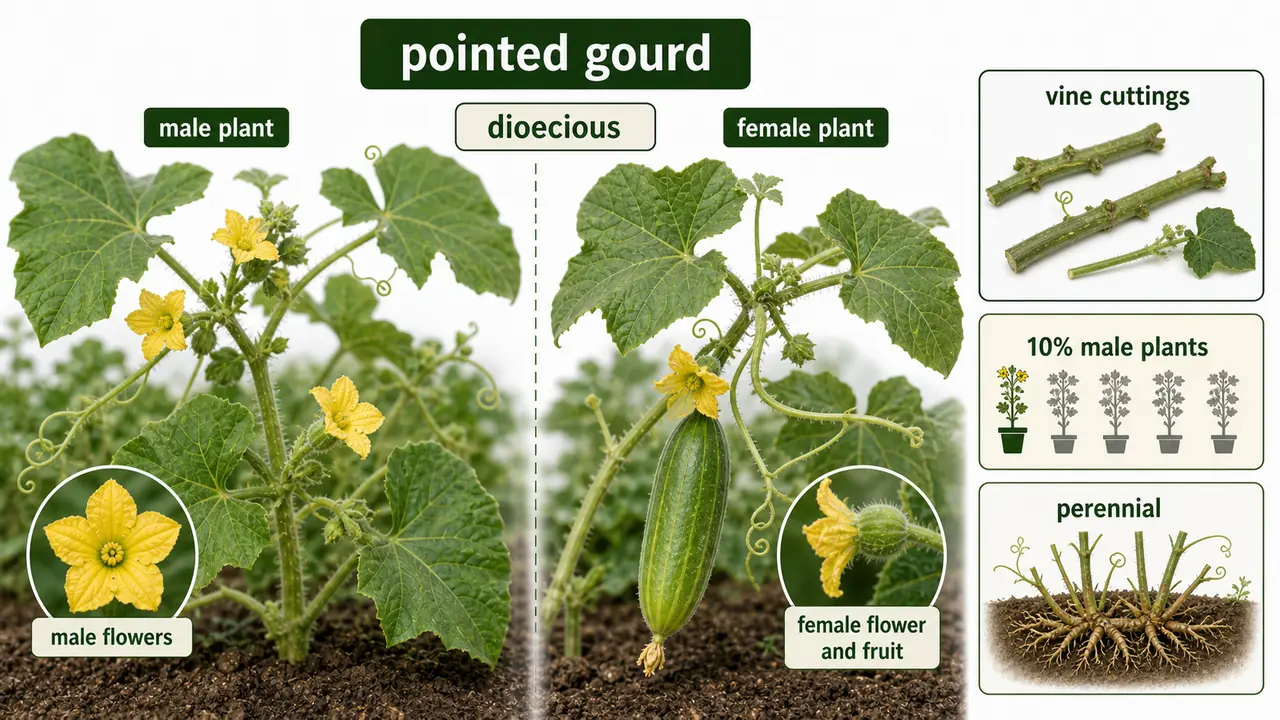
| Parameter | Detail |
|---|---|
| Botanical Name | Trichosanthes dioica |
| Origin | India |
| Sex expression | Dioecious (separate male and female plants) |
| Propagation | Vine cuttings (2000-2500 cuttings/ha) — not seeds |
| Male plants needed | 10% for adequate pollination |
| Nature | Perennial (unlike most annual cucurbits) |
| Medicinal use | Recommended during convalescence (easily digestible) |
Varieties
- Bihar Sherif, Kalyani, Shankolia, Swarna Rekha, Dandli, Damodar, Swarna Alaukik, Chhota Hilli
Ash Gourd (Wax Gourd / Winter Melon)

| Parameter | Detail |
|---|---|
| Botanical Name | Benincasa hispida |
| Origin | Japan |
| Storage life | Longest among cucurbits (up to 12 months) |
| Surface at maturity | White, waxy coating (resembling ash) |
| Other name | Chinese preserving melon |
| Varieties | Mudlier, Pusa Ujjwal |
The white waxy coating acts as a natural protective barrier against moisture loss, giving ash gourd its exceptional storage capability.
Chow-Chow (Chayote)

| Parameter | Detail |
|---|---|
| Botanical Name | Sechium edule |
| Origin | Mexico |
| Seeds per fruit | Single seed (unique among cucurbits) |
| Nutrition | Most nutritious among cucurbits; high calcium |
| Nature | Herbaceous, perennial, monoecious, climbing vine |
| Propagation | By fruits (vivipary — seed germinates inside the fruit) |
| Other names | Chayote, Choco, Askas |
| Growing regions | Hill regions (Western Ghats, North-East India) |
NOTE
Chow-chow has three unique distinctions among cucurbits: single-seeded, most nutritious, and viviparous propagation (seed germinates inside the fruit).
Spine Gourd (Kakrol): Dioecious cucurbit propagated by tuberous roots.
Ridge Gourd (Tori)

| Parameter | Detail |
|---|---|
| Botanical Name | Luffa acutangula |
| Origin | Asia |
| Training system | Kniffin system (trellis with horizontal wires) |
| Secondary use | Mature dried fruits used as bathing sponge (loofah) |

Varieties
| Variety | Feature |
|---|---|
| Pusa Nasdar | Hermaphrodite variety |
| Satputia | Hermaphrodite variety |
| Surekha, Arka Sujat | F1 hybrids |
| Konkan Harita, Punjab Sadabahar | Selection varieties |
Sponge Gourd

| Parameter | Detail |
|---|---|
| Botanical Name | Luffa cylindrica |
| Origin | Asia |
| Nutrition | Higher protein and carotene than ridge gourd |
| Common compound | Luffien (gelatinous compound in both Luffa species) |
| Anthesis | 4-8 am |
| Harvest | Tender stage (before fibre develops) |
Varieties
- Pusa Chikni (smooth, early, selection), Pusa Supriya, Phule Prajakta, Harita (F1 hybrid)
Common Diseases of Cucurbits
| Disease | Causal Agent | Key Symptom |
|---|---|---|
| Powdery mildew | Erysiphe cichoracearum | White powder on upper leaf surface |
| Downy mildew | Pseudoperonospora cubensis | Purplish-grey fuzz on lower leaf surface |
| Yellow vine | Serratia marcescens | Vines turn yellow, wilt, and die (bacterial) |
| Bud necrosis | Virus (transmitted by aphids) | Death of growing tips; mainly in watermelon |

TIP
Quick recall: Powdery mildew = upper leaf surface (white powder). Downy mildew = lower leaf surface (fuzzy growth). This distinction applies across all cucurbits.
Common Pests of Cucurbits
Red Pumpkin Beetle
- Scientific Name: Raphidopalpa foveicollis
- Damage: Grubs bore into roots; adults feed on leaves, flowers, and young fruits. Most destructive in March-April when seedlings are young.
- Management: Carbofuran 3G @ 7.0 kg/ha or Malathion 50 EC @ 0.05%

Cucurbit Fruit Fly (Most Serious Pest)
- Scientific Name: Bactrocera cucurbitae
- Damage: Female punctures fruit skin, lays eggs inside; maggots feed on pulp causing internal decay and premature fruit drop
- Management: Bait spray — 50 ml Malathion 35 EC + 0.5 kg jaggery in 50 litres water per hectare (jaggery attracts adult flies)

Cucurbit Mite (Red Spider Mite)
- Scientific Name: Tetranychus cucurbitae
- Damage: Sucks sap from underside of leaves; creates webbing; causes yellowing and bronzing
- Management: Dicofol or Ethion 50 EC @ 1.5 ml/litre (acaricides, not insecticides)

Summary Cheat Sheet
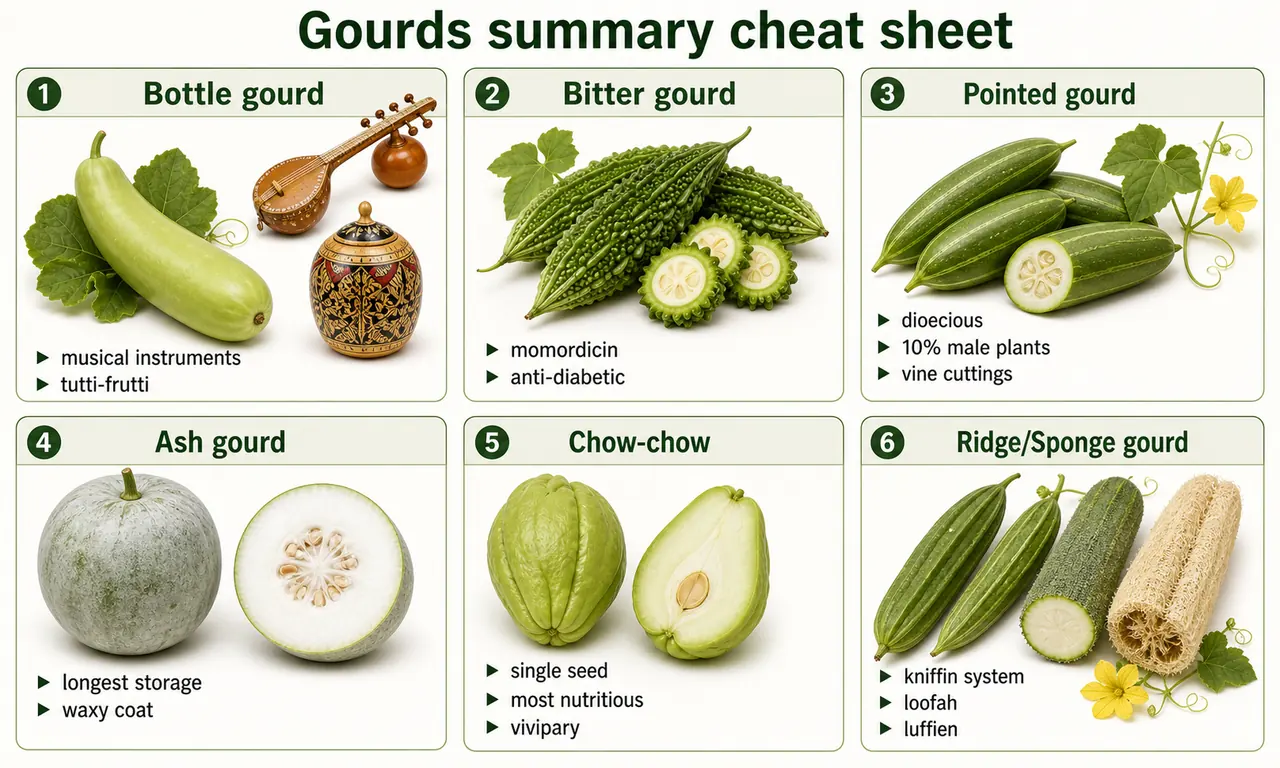
| Concept / Topic | Key Details / Explanation |
|---|---|
| Bottle gourd | Bottle gourd is Lagenaria siceraria from South Africa; seed rate is 3-6 kg/ha, it germinates best at 25-30 degrees C, and dried shells are used for musical instruments, petha, and tutti-frutti. |
| Bottle gourd crop facts and varieties | It is sensitive to photoperiod, high temperature plus nitrogen induces maleness, and important varieties include Samrat, Pusa Summer Prolific Long/Round, Arka Bahar, Pusa Naveen, Pusa Meghdoot, Punjab Komal, Pusa Mangan, NDBG-1, and Pusa Sandesh. |
| Bitter gourd | Bitter gourd is Momordica charantia from Indo-Burma; bitterness is due to momordicin, it is rich in iron, fruits are harvested immature, and first harvest starts around 60-70 DAS. |
| Bitter gourd varieties | Important varieties are Pusa Vishesh, Arka Harit, Konkan Tara, Phule Green Gold, and Pusa Hybrid-I. |
| Summer squash | Summer squash is Cucurbita pepo from Mexico; it is a bushy cucurbit and is harvested at about one-third maturity; important entries are Patty Pan, Australian Green, Early Yellow Prolific, and Pusa Alankar. |
| Snake gourd | Snake gourd is Trichosanthes anguina of Indian origin and is trained on the bower/pandal system; varieties include Konkan Shweta, Arka Suryamukhi, and Pink Banana. |
| Pointed gourd | Pointed gourd is Trichosanthes dioica, is dioecious, propagated by vine cuttings, needs about 10% male plants, is perennial, and is recommended in convalescence; varieties include Bihar Sherif, Kalyani, Shankolia, Swarna Rekha, Dandli, Damodar, Swarna Alaukik, and Chhota Hilli. |
| Ash gourd | Ash gourd is Benincasa hispida from Japan and has the longest storage life among cucurbits, up to 12 months, because of its white waxy surface; varieties are Mudlier and Pusa Ujjwal. |
Summary Continued
| Concept / Topic | Key Details / Explanation |
|---|---|
| Chow-chow and spine gourd | Chow-chow is Sechium edule from Mexico, is the most nutritious cucurbit, has a single seed, is viviparous, and is perennial; spine gourd (kakrol) is dioecious and propagated by tuberous roots. |
| Ridge and sponge gourd | Ridge gourd is Luffa acutangula and is trained on the Kniffin system; sponge gourd is Luffa cylindrica, has higher protein and carotene than ridge gourd, and both contain luffien. |
| Important ridge and sponge gourd varieties | Ridge gourd varieties include Pusa Nasdar, Satputia, Surekha, Arka Sujat, Konkan Harita, and Punjab Sadabahar; sponge gourd varieties include Pusa Chikni, Pusa Supriya, Phule Prajakta, and Harita. |
| Common diseases of cucurbits | Powdery mildew caused by Erysiphe cichoracearum appears on the upper leaf surface; downy mildew caused by Pseudoperonospora cubensis appears on the lower leaf surface; yellow vine is caused by Serratia marcescens; bud necrosis is a viral disease spread by aphids. |
| Common pests of cucurbits | Red pumpkin beetle is Raphidopalpa foveicollis, the most serious fruit pest is Bactrocera cucurbitae, and cucurbit mite is Tetranychus cucurbitae. |
| Pointed Gourd (Parwal) (continued) | Nature: Perennial (unlike most annual cucurbits) - Medicinal use: Recommended during convalescence (easily digestible) |
| Pointed Gourd (Parwal) — Varieties | Bihar Sherif, Kalyani, Shankolia, Swarna Rekha, Dandli, Damodar, Swarna Alaukik, Chhota Hilli |
Summary Continued
| Concept / Topic | Key Details / Explanation |
|---|---|
| Ash Gourd (Wax Gourd / Winter Melon) | Botanical Name: Benincasa hispida - Origin: Japan - Storage life: Longest among cucurbits (up to 12 months) - Surface at maturity: White, waxy coating (resembling ash) - Other name: Chinese preserving melon |
| Ash Gourd (Wax Gourd / Winter Melon) (continued) | Varieties: Mudlier, Pusa Ujjwal - The white waxy coating acts as a natural protective barrier against moisture loss, giving ash gourd its exceptional storage capability. |
| Chow-Chow (Chayote) | Botanical Name: Sechium edule - Origin: Mexico - Seeds per fruit: Single seed (unique among cucurbits) - Nutrition: Most nutritious among cucurbits; high calcium - Nature: Herbaceous, perennial, monoecious, climbing vine |
| Chow-Chow (Chayote) (continued) | Propagation: By fruits (vivipary — seed germinates inside the fruit) - Other names: Chayote, Choco, Askas - Growing regions: Hill regions (Western Ghats, North-East India) - Chow-chow has three unique distinctions among cucurbits: single-seeded, most nutritious, and viviparous propagation (seed germinates inside the fruit). - Spine Gourd (Kakrol): Dioecious cucurbit propagated by tuberous roots. |
| Ridge Gourd (Tori) | Botanical Name: Luffa acutangula - Origin: Asia - Training system: Kniffin system (trellis with horizontal wires) - Secondary use: Mature dried fruits used as bathing sponge (loofah) |
| Ridge Gourd (Tori) — Varieties | Variety: Feature - Pusa Nasdar: Hermaphrodite variety - Satputia: Hermaphrodite variety - Surekha, Arka Sujat: F1 hybrids - Konkan Harita, Punjab Sadabahar: Selection varieties |
| Sponge Gourd | Botanical Name: Luffa cylindrica - Origin: Asia - Nutrition: Higher protein and carotene than ridge gourd - Common compound: Luffien (gelatinous compound in both Luffa species) - Anthesis: 4-8 am |
Continued
| Concept / Topic | Key Details / Explanation |
|---|---|
| Sponge Gourd (continued) | Harvest: Tender stage (before fibre develops) |
| Sponge Gourd — Varieties | Pusa Chikni (smooth, early, selection), Pusa Supriya, Phule Prajakta, Harita (F1 hybrid) |
| Common Diseases of Cucurbits | Disease: Causal Agent; Key Symptom - Powdery mildew: Erysiphe cichoracearum; White powder on upper leaf surface - Downy mildew: Pseudoperonospora cubensis; Purplish-grey fuzz on lower leaf surface - Yellow vine: Serratia marcescens; Vines turn yellow, wilt, and die (bacterial) - Bud necrosis: Virus (transmitted by aphids); Death of growing tips; mainly in watermelon |
| Common Diseases of Cucurbits (continued) | Quick recall: Powdery mildew = upper leaf surface (white powder). Downy mildew = lower leaf surface (fuzzy growth). This distinction applies across all cucurbits. |
| Common Pests of Cucurbits — Red Pumpkin Beetle | Scientific Name: Raphidopalpa foveicollis - Damage: Grubs bore into roots; adults feed on leaves, flowers, and young fruits. Most destructive in March-April when seedlings are young. - Management: Carbofuran 3G @ 7.0 kg/ha or Malathion 50 EC @ 0.05% |
| Common Pests of Cucurbits — Cucurbit Fruit Fly (Most Serious Pest) | Scientific Name: Bactrocera cucurbitae - Damage: Female punctures fruit skin, lays eggs inside; maggots feed on pulp causing internal decay and premature fruit drop - Management: Bait spray — 50 ml Malathion 35 EC + 0.5 kg jaggery in 50 litres water per hectare (jaggery attracts adult flies) |
| Common Pests of Cucurbits — Cucurbit Mite (Red Spider Mite) | Scientific Name: Tetranychus cucurbitae - Damage: Sucks sap from underside of leaves; creates webbing; causes yellowing and bronzing - Management: Dicofol or Ethion 50 EC @ 1.5 ml/litre (acaricides, not insecticides) |