🦴 Radish and Turnip — Fast-Growing Root Vegetables
Complete guide to radish and turnip cultivation covering sporophytic self-incompatibility, steckling for seed production, brown heart (boron deficiency), varieties, and turnip facts for competitive exams.
A small-scale farmer near Jaipur sows radish seed in August and harvests crisp, white roots just 25-30 days later — among the fastest returns of any vegetable crop. This speed makes radish a favourite for farmers seeking quick cash between two main-season crops. But for those who want to save seed, the harvested root must be carefully stored and replanted the next season as a steckling — a practice essential for biennial root crops. Understanding these cultivation nuances is key for both farming and competitive agriculture exams.
IMPORTANT
Key exam facts: Radish has sporophytic self-incompatibility (promotes cross-pollination). Brown heart is caused by boron deficiency. Roots saved for seed production are called stecklings. Pusa Himani can be grown throughout the year. Origin is Europe.
Radish — Botanical Identity
| Parameter | Detail |
|---|---|
| Botanical Name | Raphanus sativus |
| Family | Cruciferae (Brassicaceae) |
| Origin | Europe |
| Seed rate | 5.5-11 kg/ha (directly sown) |
| Pollination | Sporophytic self-incompatibility (cross-pollinated) |
| Vitamin C content | 15-40 mg/100 g |
| Pests | Mustard sawfly (Athalia proxima), Painted bug (Bagrada hilaris) |
Sporophytic self-incompatibility means pollen rejection is determined by the genotype of the parent plant (sporophyte) that produced the pollen, not by the pollen grain itself. This ensures cross-pollination and maintains genetic diversity.
Pro Content Locked
Upgrade to Pro to access this lesson and all other premium content.
Charged once for one year · ₹1188 total
Save ₹100/month vs ₹2388/year launch price
- All Agriculture & Banking Courses
- AI Lesson Questions (100/day)
- AI Doubt Solver (50/day)
- Glows & Grows Feedback (30/day)
- AI Section Quiz (20/day)
- 22-Language Translation (100/day)
- Recall Questions (20/day)
- AI Quiz (15/day)
- AI Quiz Paper Analysis (100/day)
- AI Step-by-Step Explanations (100/day)
- Spaced Repetition Recall (FSRS)
- AI Tutor
- Immersive Text Questions
- Audio Lessons — Hindi & English
- Mock Tests & Previous Year Papers
- Summary & Mind Maps
- XP, Levels, Leaderboard & Badges
- Generate New Classrooms
- Voice AI Teacher (AgriDots Live)
- AI Revision Assistant
- Knowledge Gap Analysis
- Interactive Revision (LangGraph)
🔒 Secure one-time yearly payment via Razorpay · No hidden fees
A small-scale farmer near Jaipur sows radish seed in August and harvests crisp, white roots just 25-30 days later — among the fastest returns of any vegetable crop. This speed makes radish a favourite for farmers seeking quick cash between two main-season crops. But for those who want to save seed, the harvested root must be carefully stored and replanted the next season as a steckling — a practice essential for biennial root crops. Understanding these cultivation nuances is key for both farming and competitive agriculture exams.
IMPORTANT
Key exam facts: Radish has sporophytic self-incompatibility (promotes cross-pollination). Brown heart is caused by boron deficiency. Roots saved for seed production are called stecklings. Pusa Himani can be grown throughout the year. Origin is Europe.
Radish — Botanical Identity
| Parameter | Detail |
|---|---|
| Botanical Name | Raphanus sativus |
| Family | Cruciferae (Brassicaceae) |
| Origin | Europe |
| Seed rate | 5.5-11 kg/ha (directly sown) |
| Pollination | Sporophytic self-incompatibility (cross-pollinated) |
| Vitamin C content | 15-40 mg/100 g |
| Pests | Mustard sawfly (Athalia proxima), Painted bug (Bagrada hilaris) |
Sporophytic self-incompatibility means pollen rejection is determined by the genotype of the parent plant (sporophyte) that produced the pollen, not by the pollen grain itself. This ensures cross-pollination and maintains genetic diversity.

Key Concepts
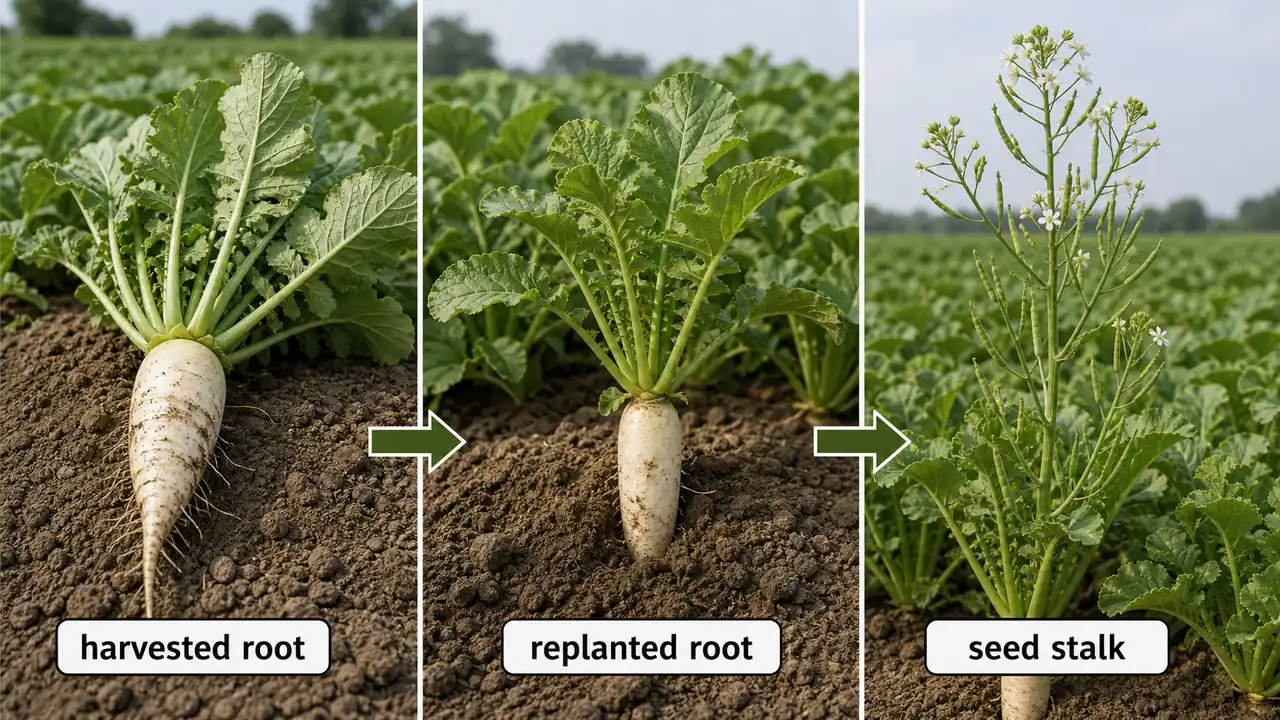
Steckling — Seed Production from Root Crops
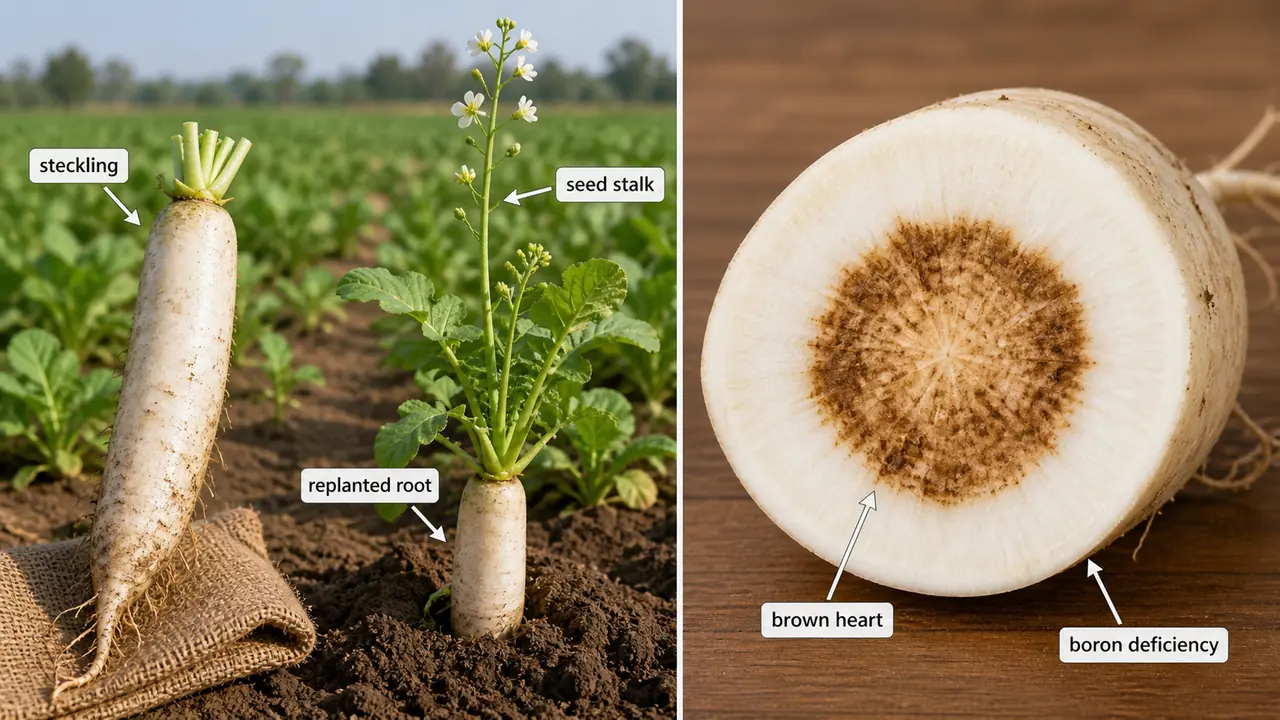
Roots of radish prepared for seed production are called stecklings. A steckling is a root that has been harvested, stored over winter, and then replanted to produce seed the next season. This technique is used in biennial root crops where the root develops in the first season and the plant flowers and sets seed in the second.
Brown Heart — Boron Deficiency
Brown heart in radish is caused by boron deficiency. The internal tissue of the root turns brown and corky, making it unmarketable. It can be corrected by applying borax to the soil before sowing.
IMPORTANT
Micronutrient deficiency disorders to remember: Browning in cauliflower = Boron. Whiptail in cauliflower = Molybdenum. Brown heart in radish = Boron. Pillow disease in cucumber = Calcium. BER in tomato = Calcium.
Asiatic vs European Radish Varieties
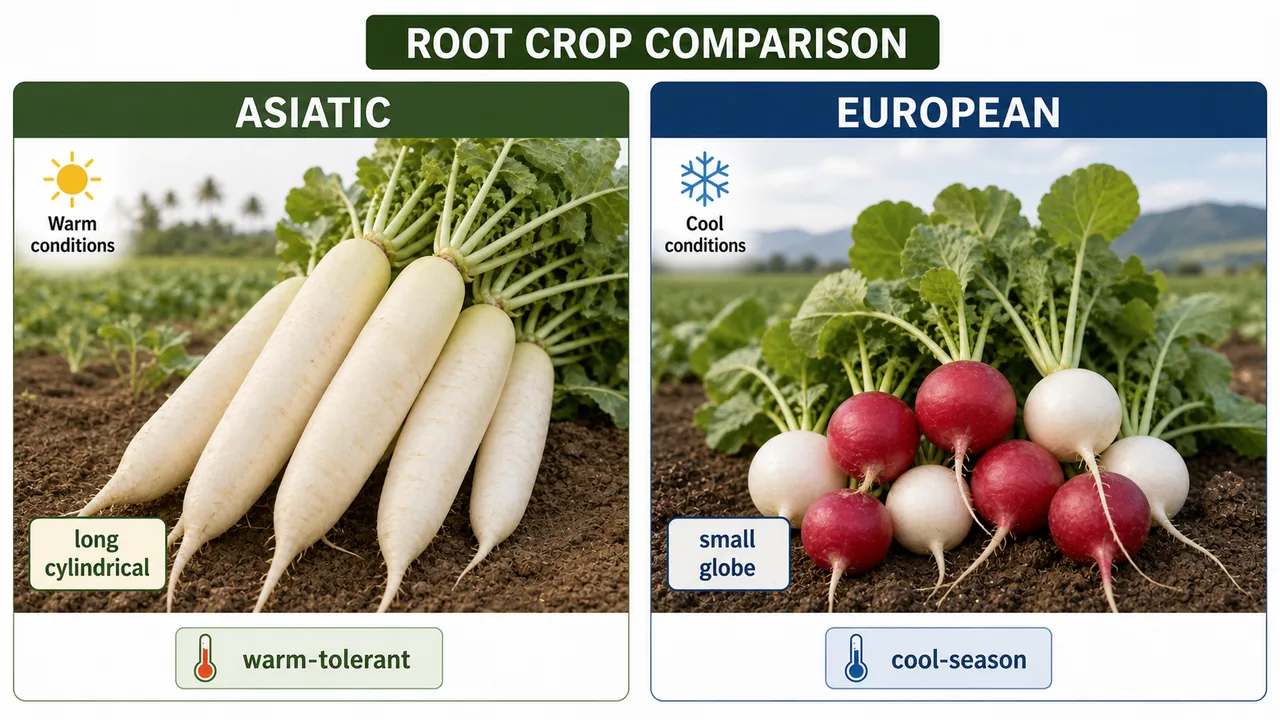
| Feature | Asiatic Varieties | European Varieties |
|---|---|---|
| Life cycle | Can produce seeds in tropical and temperate regions | Biennial (need two seasons) |
| Root shape | Long, cylindrical | Small, globe-shaped (salad types) |
| Climate | Warm-tolerant | Cool-season |
| Examples | Pusa Chetki, Pusa Desi, Japanese White | Scarlet Globe, White Icicle, Pusa Himani |
Important Varieties
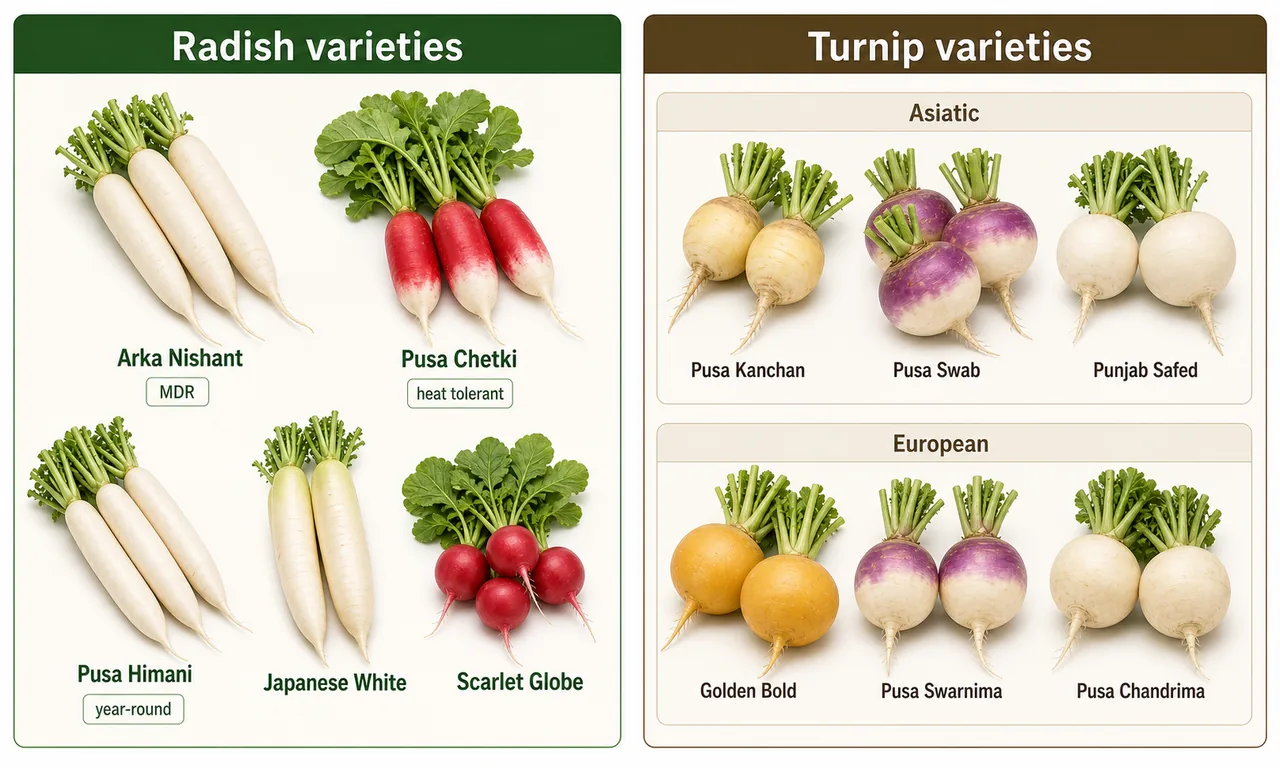
| Variety | Special Feature |
|---|---|
| Arka Nishant | MDR — resistant to white rust, pithiness, premature bolting, and forking |
| Pusa Chetki | Heat-tolerant — suitable for growing in hotter months |
| Pusa Himani | Can be grown throughout the year (tolerates both heat and cold) |
| Pusa Rashmi | Green type x Desi type hybrid |
| Pusa Safed | White-5X x Japanese White hybrid |
| Japanese White | Popular Asiatic variety |
| Scarlet Globe | Globe-shaped European salad radish |
| Rapid Red, White Tipped | Globe-shaped European variety |
Turnip
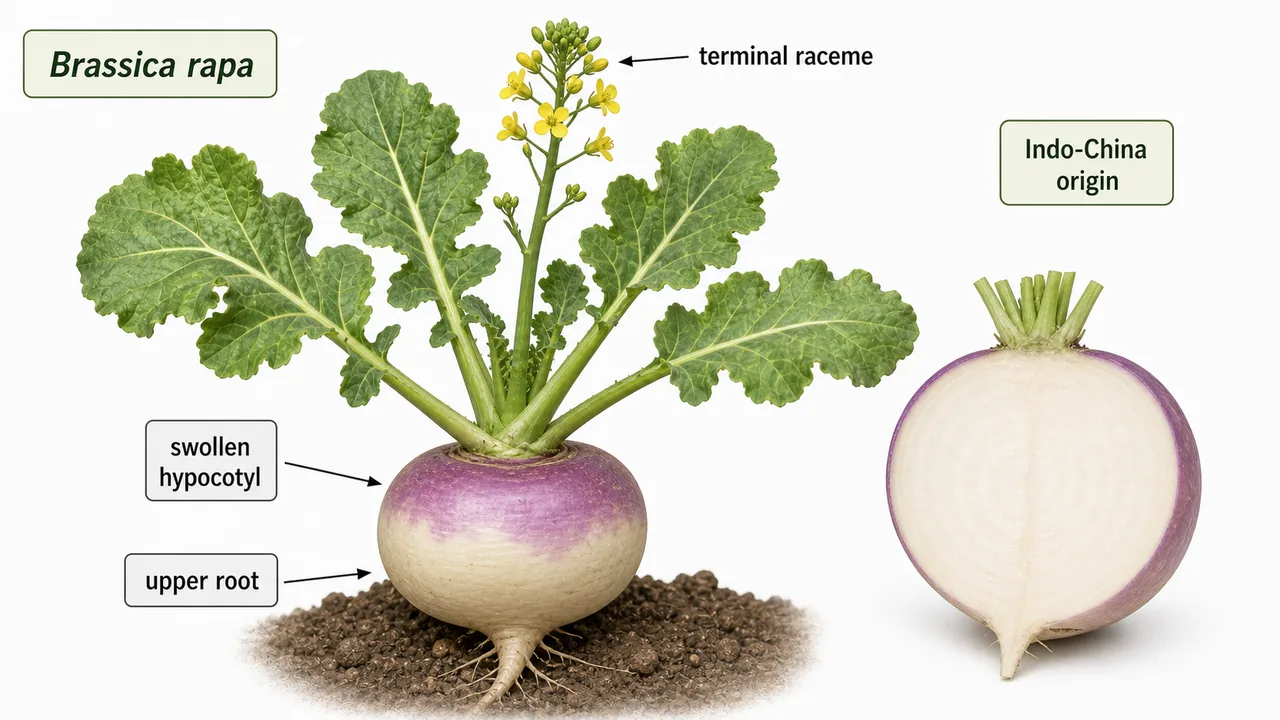
| Parameter | Detail |
|---|---|
| Botanical Name | Brassica rapa |
| Family | Cruciferae (Brassicaceae) |
| Origin | Indo-China |
| Edible part | Swollen hypocotyl + upper root (different from radish's modified taproot) |
| Inflorescence | Terminal raceme |
| Self-incompatibility | Strong sporophytic type |
| Overcoming SI | NaCl and CO2 application (for breeding) |
| Altitude | Grows well at 1500 m above sea level or higher |
Thinning is essential in turnip (directly sown) to maintain optimum plant-to-plant spacing for proper root development.
Turnip Varieties
| Type | Varieties |
|---|---|
| Asiatic (heat-tolerant, shorter cycle) | Pusa Kanchan, Pusa Swab, Punjab Safed |
| European (smoother roots, temperate hills) | Golden Bold, Pusa Swarnima, Pusa Chandrima |
Summary Cheat Sheet
| Concept / Topic | Key Details / Explanation |
|---|---|
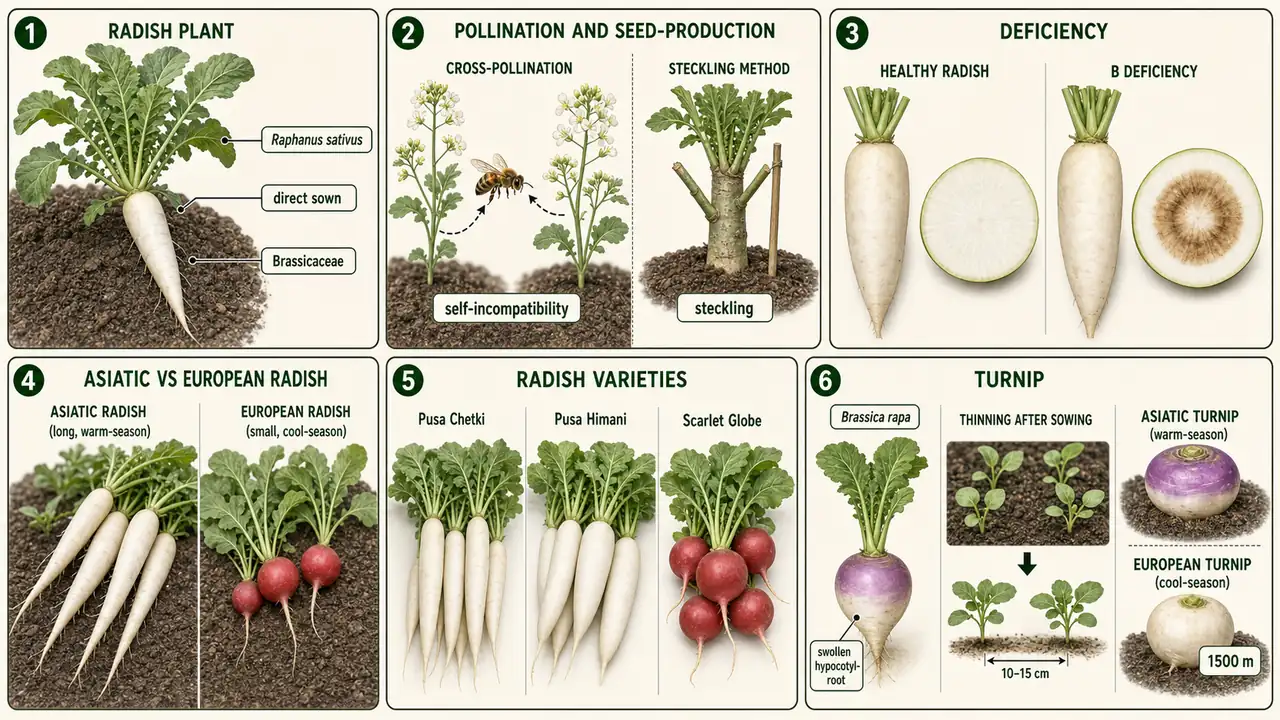
| Radish identity | Radish is Raphanus sativus of the Brassicaceae family, originated in Europe, is directly sown with seed rate 5.5-11 kg/ha, and contains about 15-40 mg Vitamin C per 100 g. |
| Pollination and pests | Radish is cross-pollinated due to sporophytic self-incompatibility; important pests named are mustard sawfly and painted bug. |
| Steckling | Roots selected, stored, and replanted for seed production are called stecklings. |
| Brown heart and deficiency recall | Brown heart in radish is caused by boron deficiency; the lesson also links this with browning in cauliflower as a boron-deficiency disorder. |
| Asiatic vs European types | Asiatic radishes are generally longer, more warm-tolerant, and can set seed in tropical regions, whereas European types are smaller globe-shaped salad radishes and are more strictly biennial and cool-season. |
| Important radish varieties | Arka Nishant is multiple-disease resistant, Pusa Chetki is heat tolerant, Pusa Himani can be grown throughout the year, and other named varieties are Pusa Rashmi, Pusa Safed, Japanese White, Scarlet Globe, Rapid Red, and White Tipped. |
| Turnip identity | Turnip is Brassica rapa, originated in Indo-China, and its edible part is the swollen hypocotyl plus upper root. |
| Turnip breeding and cultivation facts | Turnip has strong sporophytic self-incompatibility, this can be overcome by NaCl and CO2 in breeding work, it grows well around 1500 m altitude, and thinning is essential after direct sowing. |
| Turnip varieties | Asiatic turnips include Pusa Kanchan, Pusa Swab, and Punjab Safed; European types include Golden Bold, Pusa Swarnima, and Pusa Chandrima. |