🍆 Brinjal — India's Favourite Solanaceous Vegetable
Complete guide to brinjal (eggplant) cultivation covering botany, varieties, hybrid varieties, fruit and shoot borer management, little leaf disease, and other key pests and diseases for competitive exams.
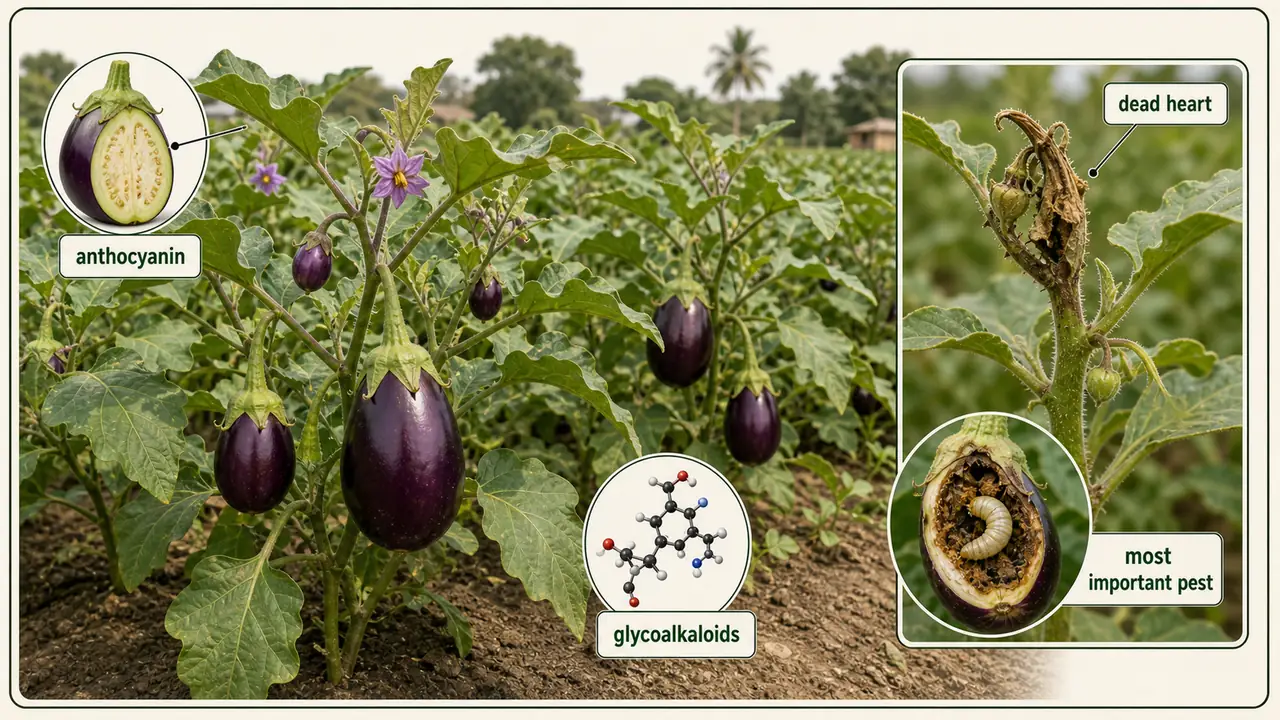
In the fertile fields of West Bengal, a farmer inspects his brinjal crop and notices a wilted shoot tip — the telltale "dead heart" sign of the fruit and shoot borer, the single most destructive pest of brinjal across South and Southeast Asia. Understanding how to identify and manage this pest is as critical for farming success as it is for clearing competitive agriculture exams.
Brinjal (also known as eggplant or aubergine) is one of the most commonly grown vegetables in India and tropical Asia. Its characteristic purple colour comes from anthocyanin pigments, and its slight bitterness is due to naturally occurring glycoalkaloids.
IMPORTANT
The fruit and shoot borer (Leucinodes orbonalis) is the single most important pest of brinjal. The "dead heart" symptom in young shoots is a key identification point. Also remember: little leaf disease is caused by Phytoplasma (not a virus), transmitted by leaf hoppers.
Pro Content Locked
Upgrade to Pro to access this lesson and all other premium content.
Charged once for one year · ₹1188 total
Save ₹100/month vs ₹2388/year launch price
- All Agriculture & Banking Courses
- AI Lesson Questions (100/day)
- AI Doubt Solver (50/day)
- Glows & Grows Feedback (30/day)
- AI Section Quiz (20/day)
- 22-Language Translation (100/day)
- Recall Questions (20/day)
- AI Quiz (15/day)
- AI Quiz Paper Analysis (100/day)
- AI Step-by-Step Explanations (100/day)
- Spaced Repetition Recall (FSRS)
- AI Tutor
- Immersive Text Questions
- Audio Lessons — Hindi & English
- Mock Tests & Previous Year Papers
- Summary & Mind Maps
- XP, Levels, Leaderboard & Badges
- Generate New Classrooms
- Voice AI Teacher (AgriDots Live)
- AI Revision Assistant
- Knowledge Gap Analysis
- Interactive Revision (LangGraph)
🔒 Secure one-time yearly payment via Razorpay · No hidden fees
In the fertile fields of West Bengal, a farmer inspects his brinjal crop and notices a wilted shoot tip — the telltale "dead heart" sign of the fruit and shoot borer, the single most destructive pest of brinjal across South and Southeast Asia. Understanding how to identify and manage this pest is as critical for farming success as it is for clearing competitive agriculture exams.
Brinjal (also known as eggplant or aubergine) is one of the most commonly grown vegetables in India and tropical Asia. Its characteristic purple colour comes from anthocyanin pigments, and its slight bitterness is due to naturally occurring glycoalkaloids.
IMPORTANT
The fruit and shoot borer (Leucinodes orbonalis) is the single most important pest of brinjal. The "dead heart" symptom in young shoots is a key identification point. Also remember: little leaf disease is caused by Phytoplasma (not a virus), transmitted by leaf hoppers.
Botanical Identity
| Parameter | Detail |
|---|---|
| Botanical Name | Solanum melongena |
| Family | Solanaceae |
| Fruit pigment | Anthocyanin (purple to dark violet) |
| Bitterness due to | Glycoalkaloids |
| Rich source of | Vitamin B complex |
| Seed rate | 200 g/ha (nursery sowing) |
Brinjal belongs to the Solanaceae family, making it a close relative of tomato, chilli, and potato. Seeds are first sown in a nursery and the seedlings are later transplanted to the main field.

Important Varieties
Open-Pollinated Varieties
| Variety | Special Feature |
|---|---|
| Pusa Purple Long | Extra early maturity (early market advantage) |
| Pant Samrat | Resistant to Phomopsis blight and bacterial wilt |
| Black Beauty | Nematode resistant |
| Arka Sheel, Arka Nidhi | Good fruit quality (developed by IIHR, Bangalore) |
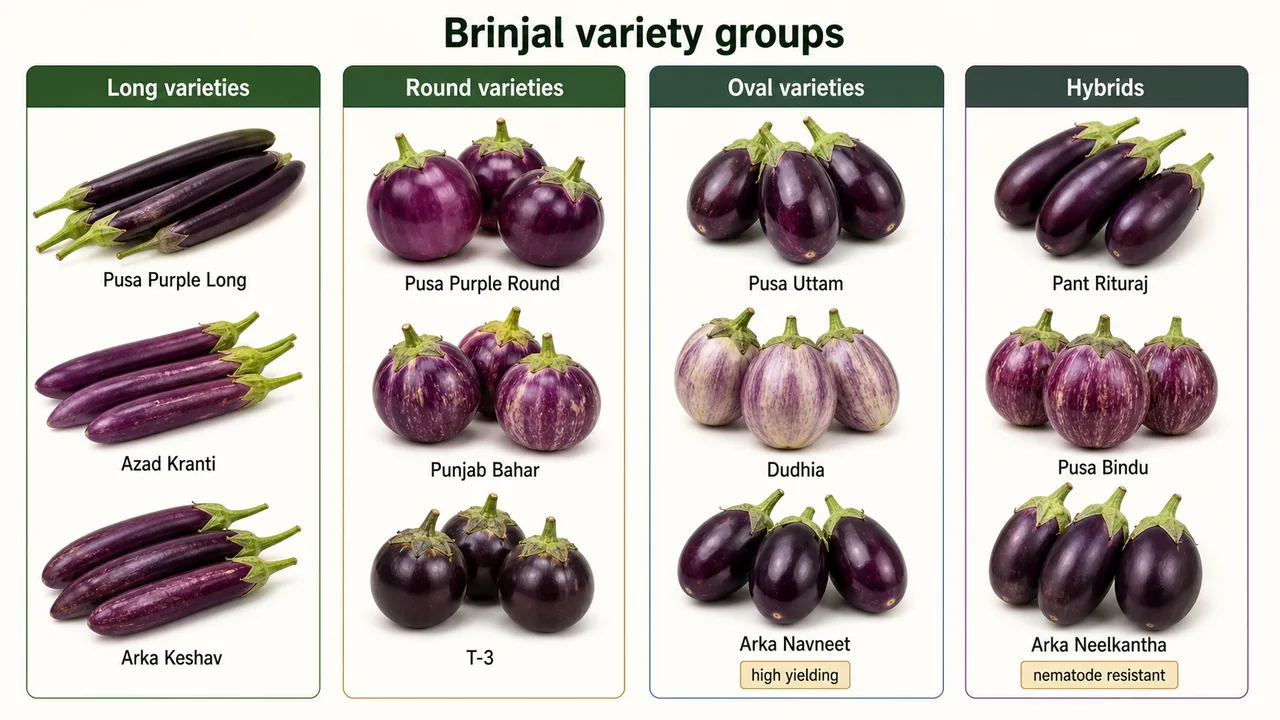
| Long Varieties | Round Varieties | Oval Varieties | Hybrids |
|---|---|---|---|
| Pusa Purple Long | Pusa Purple Round | Arka Navneet | Pant Rituraj |
| Pusa purple cluster | Pant Rituraj | Pusa Uttam | Pusa Bindu |
| Azad Kranti | Punjab Bahar | Dudhia | Pusa Upkar |
| Arka Keshav | Arka Kusumaker | BH-2 (F1) | Pusa bhairav |
| Arka Shirish | T-3 | Arka Navneet | Arka Navneet |
| Pusa Hybrid-5 | — | — | Arka neelkantha |
| — | — | — | Arka Keshav |
Hybrid Varieties
| Hybrid | Special Feature |
|---|---|
| Pusa Bindu | General purpose hybrid |
| Pusa Upkar | General purpose hybrid |
| Pusa Bhairav | Phomopsis blight resistant |
| Arka Navneet | Highest yielding hybrid |
| Arka Neelkantha | Nematode resistant |
| Annamalai | Aphid resistant, recommended for Tamil Nadu |
| Arka Keshav | Good quality hybrid |
Major Pests
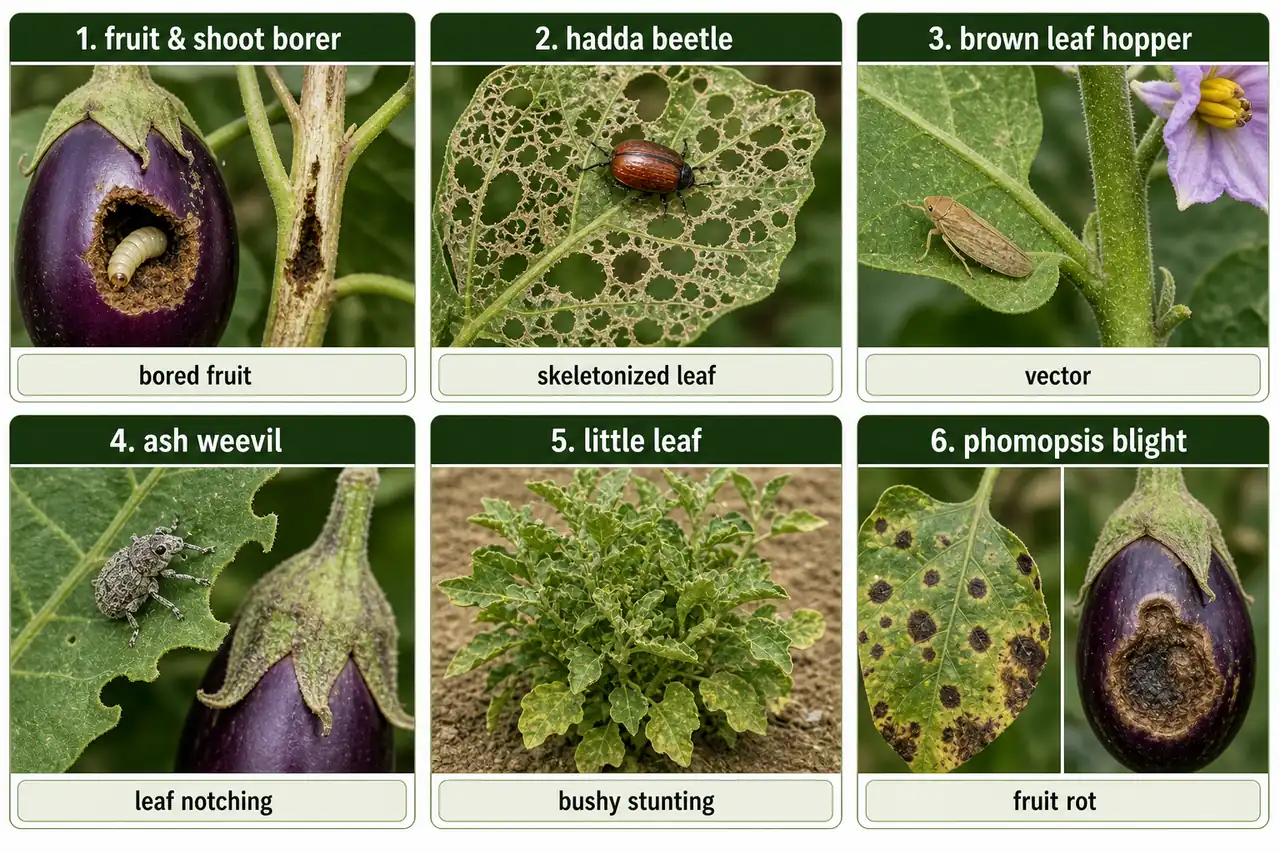
1. Fruit and Shoot Borer (Most Important Pest)
- Scientific Name: Leucinodes orbonalis
- Family/Order: Pyralidae, Lepidoptera
- Damage: Causes "dead heart" in young plants — larvae bore into the growing tip of young shoots, killing them. In the fruiting stage, larvae enter fruits, making them unfit for consumption.
- Management: Spirotetramat 150 SC @ 75 g a.i./ha or Flubendiamide 48 SC @ 60 g a.i./ha

2. Hadda Beetle
- Scientific Name: Epilachna vigintioctopunctata
- Family: Coccinelidae
- Note: Unlike most ladybird beetles (which are beneficial predators), the Hadda beetle is phytophagous (plant-feeding). Both adults and grubs scrape the leaf surface, creating a skeletonized appearance.

3. Brown Leaf Hopper
- Scientific Name: Cestius phycitis
- Significance: Acts as the vector for the phytoplasma that causes the devastating little leaf disease
- Management: Imidacloprid 200 SL @ 75 g a.i./ha

4. Ash Weevils
- Scientific Name: Myllocerus subfasciatus
- Damage: Leaf-feeding beetles that create characteristic notching on leaf margins. Called "ash weevils" because of the greyish-white scales covering their body.

Major Disease: Little Leaf
- Cause: Mycoplasma (Phytoplasma) — cell-wall-less bacteria that inhabit the phloem tissue
- Symptoms: Excessive branching, shortened internodes, small and narrow leaves, giving the plant a bushy and stunted appearance with drastically reduced fruit set
- Vector: Leaf hopper — Cestius phycitis
- Management: Control the leaf hopper vector through insecticide sprays; remove and destroy infected plants

Pest and Disease Comparison
| Problem | Causal Agent | Type | Key Symptom | Management |
|---|---|---|---|---|
| Fruit & shoot borer | L. orbonalis | Insect pest | Dead heart, bored fruits | Spirotetramat / Flubendiamide |
| Hadda beetle | E. vigintioctopunctata | Insect pest | Skeletonized leaves | Contact insecticides |
| Brown leaf hopper | C. phycitis | Insect pest + vector | Vectors little leaf disease | Imidacloprid |
| Ash weevil | M. subfasciatus | Insect pest | Leaf margin notching | Contact insecticides |
| Little leaf | Phytoplasma | Disease | Bushy, stunted, small leaves | Vector control + rogue infected plants |
| Phomopsis blight | Phomopsis vexans | Fungal disease | Fruit rot, leaf blight | Resistant varieties (Pant Samrat, Pusa Bhairav) |
Summary Cheat Sheet
| Concept / Topic | Key Details / Explanation |
|---|---|
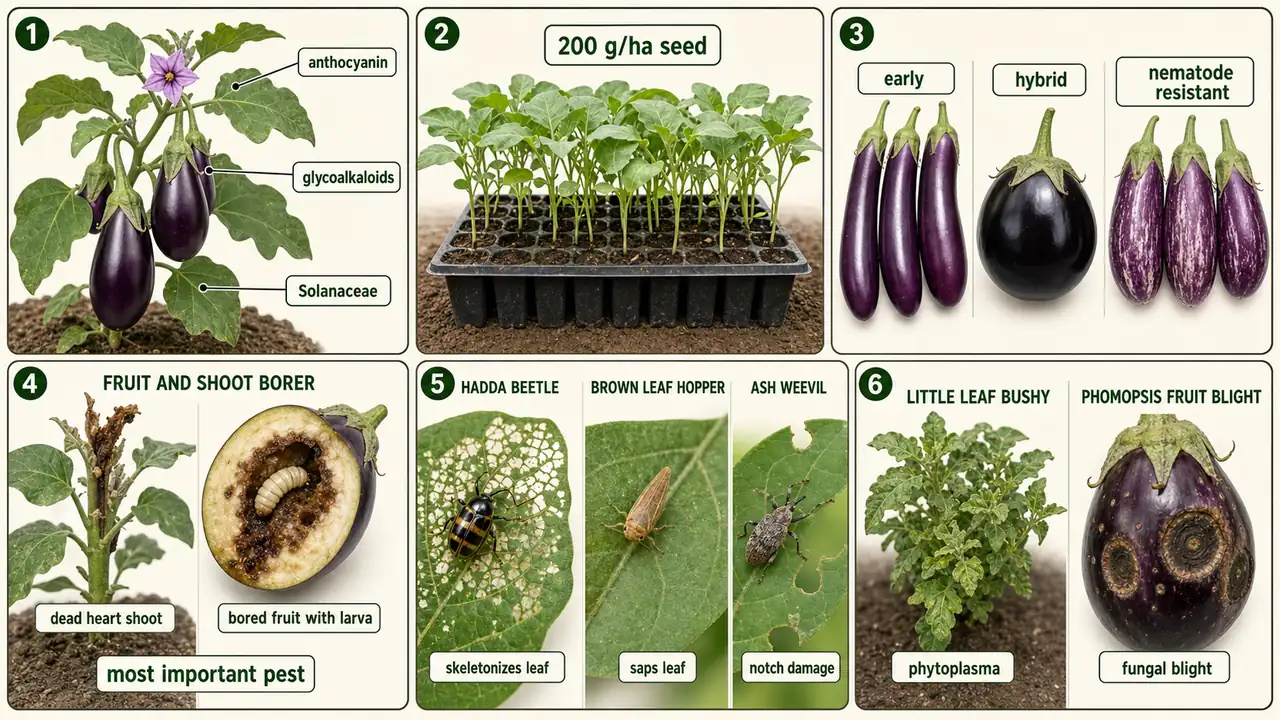
| Botanical identity | Brinjal is Solanum melongena of the Solanaceae family. |
| Quality traits | The purple colour comes from anthocyanin, the bitterness is due to glycoalkaloids, and the crop is treated as a rich source of Vitamin B complex. |
| Seed rate | The nursery seed rate is 200 g/ha. |
| Solanaceous relation | The lesson explicitly groups brinjal with tomato, chilli, and potato inside the Solanaceae family. |
| Important open-pollinated varieties | Important OP varieties are Pusa Purple Long for extra earliness, Pant Samrat for resistance to Phomopsis blight and bacterial wilt, Black Beauty for nematode resistance, and Arka Sheel/Arka Nidhi for good fruit quality. |
| Important hybrids | Important hybrids are Pusa Bindu, Pusa Upkar, Pusa Bhairav, Arka Navneet, Arka Neelkantha, Annamalai, and Arka Keshav. |
| Hybrid-specific traits | Arka Navneet is identified as the highest-yielding hybrid, Pusa Bhairav is resistant to Phomopsis blight, Arka Neelkantha is nematode resistant, and Annamalai is aphid resistant and recommended for Tamil Nadu. |
| Most important pest | The fruit and shoot borer, Leucinodes orbonalis, is the single most important pest of brinjal. |
Summary Continued
| Concept / Topic | Key Details / Explanation |
|---|---|
| Fruit and shoot borer damage and management | This pest causes dead heart in young shoots and boring in fruits; recommended management is Spirotetramat 150 SC @ 75 g a.i./ha or Flubendiamide 48 SC @ 60 g a.i./ha. |
| Hadda beetle | Epilachna vigintioctopunctata is the Hadda beetle; unlike beneficial ladybird beetles, it is phytophagous and causes skeletonization of leaves. |
| Brown leaf hopper | Cestius phycitis is the brown leaf hopper, important because it is the vector of little leaf disease; control includes Imidacloprid 200 SL @ 75 g a.i./ha. |
| Ash weevil | Myllocerus subfasciatus causes leaf-margin notching and is recognized as the ash weevil. |
| Little leaf disease | Little leaf is caused by Phytoplasma/Mycoplasma, not by a virus. |
| Little leaf symptoms and management | Symptoms include excessive branching, short internodes, narrow leaves, bushy stunting, and poor fruit set; management depends on vector control and removing infected plants. |
| Final comparison set | The lesson closes by contrasting fruit and shoot borer, Hadda beetle, brown leaf hopper, ash weevil, little leaf, and Phomopsis blight by cause, symptom, and control, with Pant Samrat and Pusa Bhairav named as resistant lines for Phomopsis blight. |