🥜 Cashew — India's Coastal Nut Crop
Complete guide to cashew cultivation covering origin, Maharashtra's leadership, CNSL, economic significance, and key exam facts for competitive agriculture exams.

Origin and Distribution
- Native to Brazil and West Indies, the cashew is chiefly grown in India, Brazil, East Africa, Mozambique and Kenya.
The cashew (Anacardium occidentale) originated in the tropical regions of Brazil and the West Indies. Portuguese traders introduced cashew to India in the 16th century, primarily for soil conservation on the coastal slopes of Goa. From there, its cultivation spread along the western and eastern coasts of India. Today, cashew is commercially cultivated in several countries, with India, Brazil, East Africa, Mozambique, and Kenya being the major producers. India is one of the largest producers, processors, and exporters of cashew in the world.
NOTE
The Portuguese introduction of cashew to India was originally for soil conservation, not food production — the nut's commercial value was recognized much later.
Consumption
- The United States consumes over 90 % of the world's cashew crop.
This is a remarkable statistic that highlights the enormous demand for cashew nuts in the American market. The USA is the single largest consumer of processed cashew kernels globally, importing vast quantities primarily from India and Vietnam. This heavy reliance on a single market makes global cashew prices particularly sensitive to demand fluctuations in the US.
Pro Content Locked
Upgrade to Pro to access this lesson and all other premium content.
₹99 charged monthly · Cancel anytime
- All Agriculture & Banking Courses
- AI Lesson Questions (100/day)
- AI Doubt Solver (50/day)
- Glows & Grows Feedback (30/day)
- AI Section Quiz (20/day)
- 22-Language Translation (100/day)
- Recall Questions (20/day)
- AI Quiz (15/day)
- AI Quiz Paper Analysis (100/day)
- AI Step-by-Step Explanations (100/day)
- Spaced Repetition Recall (FSRS)
- AI Tutor
- Immersive Text Questions
- Audio Lessons — Hindi & English
- Mock Tests & Previous Year Papers
- Summary & Mind Maps
- XP, Levels, Leaderboard & Badges
- Generate New Classrooms
- Voice AI Teacher (AgriDots Live)
- AI Revision Assistant
- Knowledge Gap Analysis
- Interactive Revision (LangGraph)
🔒 Secure via Razorpay · Cancel anytime · No hidden fees
Origin and Distribution
- Native to Brazil and West Indies, the cashew is chiefly grown in India, Brazil, East Africa, Mozambique and Kenya.
The cashew (Anacardium occidentale) originated in the tropical regions of Brazil and the West Indies. Portuguese traders introduced cashew to India in the 16th century, primarily for soil conservation on the coastal slopes of Goa. From there, its cultivation spread along the western and eastern coasts of India. Today, cashew is commercially cultivated in several countries, with India, Brazil, East Africa, Mozambique, and Kenya being the major producers. India is one of the largest producers, processors, and exporters of cashew in the world.
NOTE
The Portuguese introduction of cashew to India was originally for soil conservation, not food production — the nut's commercial value was recognized much later.
Consumption
- The United States consumes over 90 % of the world's cashew crop.
This is a remarkable statistic that highlights the enormous demand for cashew nuts in the American market. The USA is the single largest consumer of processed cashew kernels globally, importing vast quantities primarily from India and Vietnam. This heavy reliance on a single market makes global cashew prices particularly sensitive to demand fluctuations in the US.
Economic Significance
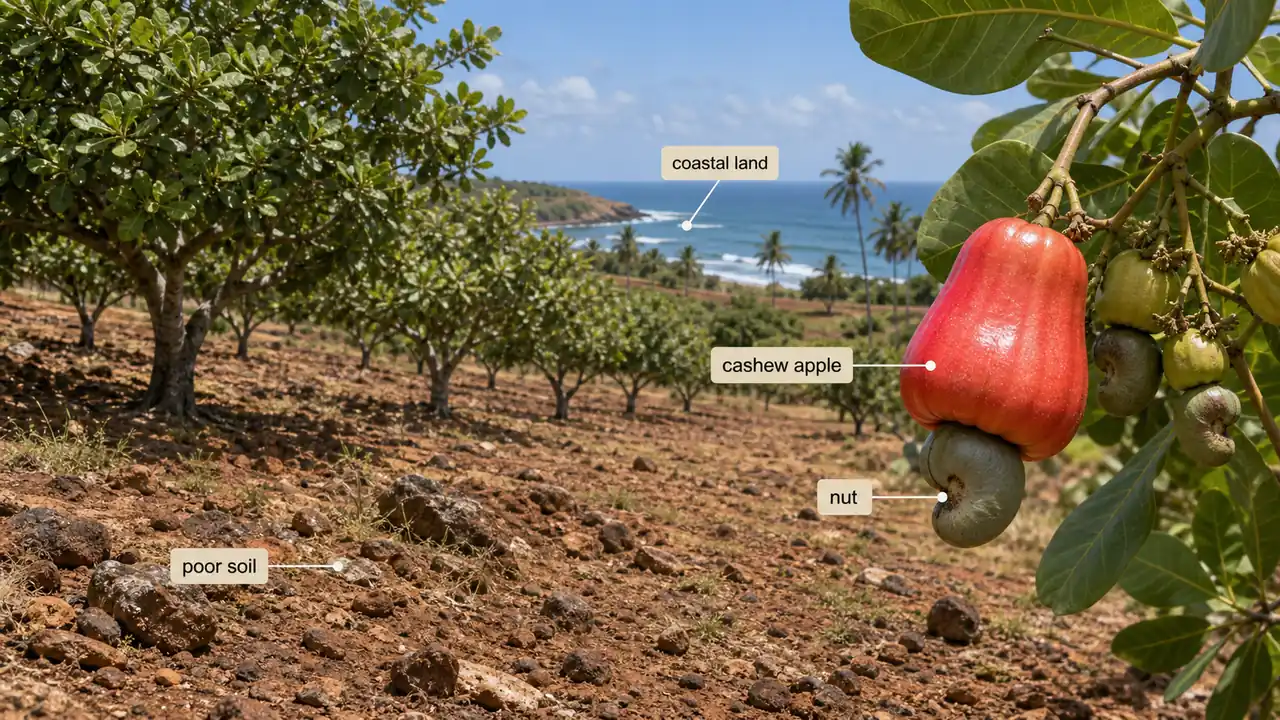
- Also known as "Gold Mine of Waste Land".
Cashew has earned the title "Gold Mine of Waste Land" because of its remarkable ability to grow and produce well on degraded, laterite, and waste lands where most other crops fail to thrive. This makes cashew an economically valuable crop for rehabilitation of marginal and barren lands. It plays a crucial role in soil conservation, afforestation of degraded areas, and providing livelihood to rural communities in coastal regions. The crop is well-adapted to poor, sandy, and rocky soils with minimal input requirements, yet yields a high-value nut that commands excellent prices in both domestic and international markets.
IMPORTANT
Remember: Cashew = "Gold Mine of Waste Land" — this nickname is frequently tested in exams and reflects the crop's unique ability to thrive on degraded, marginal lands.
Current Production and Area
According to the current policy summary, cashew cultivation in India extends across nearly 12.05 lakh hectares, with annual production exceeding 8.02 lakh tonnes.
Major cashew-growing states include:
- Odisha
- Andhra Pradesh
- Maharashtra
- Tamil Nadu
- Karnataka
- Kerala
- Chhattisgarh
- West Bengal
- parts of the North Eastern region
This distribution gives cashew a strong coastal and sub-coastal production base, while also improving regional spread and production stability.
Exports and Global Market Presence
In 2024-25, India’s cashew exports totalled about USD 369.17 million. Major destinations included:
- United Arab Emirates
- Vietnam
- Japan
- Netherlands
- Saudi Arabia
This export presence is one reason cashew is treated as a strategic high-value plantation crop rather than just a dry-fruit crop.
Policy and Institutional Support
Cashew and cocoa are promoted under a common institutional framework through the Directorate of Cashewnut and Cocoa Development, located at Kochi, Kerala under the Department of Agriculture and Farmers Welfare.
Its major focus areas include:
- expansion of area under cashew cultivation
- replanting of senile plantations with high-yielding varieties
- nursery establishment and modernization
- training on value addition
The Union Budget 2026-27 has proposed a dedicated programme for Indian cashew and cocoa with the objective of:
- making India more self-reliant in raw cashew and cocoa production
- strengthening processing
- improving export competitiveness
- positioning Indian cashew and Indian cocoa as premium global brands by 2030
Summary Cheat Sheet
| Concept / Topic | Key Details / Explanation |
|---|---|
| Botanical identity and origin | Cashew is Anacardium occidentale, originated in Brazil and the West Indies, and was introduced into India by the Portuguese mainly for soil conservation. |
| Distribution and demand | Cashew is grown widely in India, Brazil, East Africa, Mozambique, and Kenya, and the United States is highlighted as the dominant consumer of the world cashew crop. |
| Economic identity | Cashew is called the Gold Mine of Waste Land because it performs productively on lateritic, marginal, degraded, and waste lands where many other crops fail. |
| Area and production spread | The lesson places Indian cashew area near 12.05 lakh ha with production above 8.02 lakh tonnes, and names major states such as Odisha, Andhra Pradesh, Maharashtra, Tamil Nadu, Karnataka, Kerala, Chhattisgarh, West Bengal, and parts of the North East. |
| Export importance | In 2024-25, India’s cashew exports were about USD 369.17 million, with key destinations including the UAE, Vietnam, Japan, Netherlands, and Saudi Arabia. |
| Institutional and policy support | Cashew and cocoa are supported by the Directorate of Cashewnut and Cocoa Development, Kochi, and current policy emphasis includes replanting old orchards, nursery modernization, value addition, stronger self-reliance, processing, and export competitiveness. |