🏀 Rubber — Natural Latex from Hevea brasiliensis
Complete guide to rubber cultivation covering tapping, Kerala's dominance, soil and climate requirements, Rubber Board, and key exam facts for competitive agriculture exams.

Botanical Identity and Crop Type
- Scientific Name: Hevea brasiliensis
- Crop Type: Cash crop, tropical tree crop.
Rubber belongs to the species Hevea brasiliensis, a member of the family Euphorbiaceae. As the name suggests, it is native to Brazil — specifically the Amazon basin of South America. Rubber is classified as a cash crop (grown primarily for sale rather than subsistence) and a tropical tree crop that thrives in hot, humid equatorial and tropical regions. The tree produces latex, a milky white fluid, which is the raw material for natural rubber — an indispensable commodity used in the manufacturing of tyres, footwear, medical equipment, and thousands of other products worldwide.
Soil Requirements
- Suitable soil type: deep and lateritic fertile soil with an acidic pH of 4.5 to 6.0.
Rubber trees grow best in deep, well-drained, lateritic soils that are fertile and have an acidic pH ranging from 4.5 to 6.0. Laterite soils — which are commonly found in the Western Ghats region of India — are particularly well-suited because they provide good drainage while retaining sufficient moisture in deeper layers. Waterlogged or shallow soils are unsuitable as they hinder root development and make the trees susceptible to root diseases.
Pro Content Locked
Upgrade to Pro to access this lesson and all other premium content.
Charged once for one year · ₹1188 total
Save ₹100/month vs ₹2388/year launch price
- All Agriculture & Banking Courses
- AI Lesson Questions (100/day)
- AI Doubt Solver (50/day)
- Glows & Grows Feedback (30/day)
- AI Section Quiz (20/day)
- 22-Language Translation (100/day)
- Recall Questions (20/day)
- AI Quiz (15/day)
- AI Quiz Paper Analysis (100/day)
- AI Step-by-Step Explanations (100/day)
- Spaced Repetition Recall (FSRS)
- AI Tutor
- Immersive Text Questions
- Audio Lessons — Hindi & English
- Mock Tests & Previous Year Papers
- Summary & Mind Maps
- XP, Levels, Leaderboard & Badges
- Generate New Classrooms
- Voice AI Teacher (AgriDots Live)
- AI Revision Assistant
- Knowledge Gap Analysis
- Interactive Revision (LangGraph)
🔒 Secure one-time yearly payment via Razorpay · No hidden fees
Botanical Identity and Crop Type
- Scientific Name: Hevea brasiliensis
- Crop Type: Cash crop, tropical tree crop.
Rubber belongs to the species Hevea brasiliensis, a member of the family Euphorbiaceae. As the name suggests, it is native to Brazil — specifically the Amazon basin of South America. Rubber is classified as a cash crop (grown primarily for sale rather than subsistence) and a tropical tree crop that thrives in hot, humid equatorial and tropical regions. The tree produces latex, a milky white fluid, which is the raw material for natural rubber — an indispensable commodity used in the manufacturing of tyres, footwear, medical equipment, and thousands of other products worldwide.
Soil Requirements
- Suitable soil type: deep and lateritic fertile soil with an acidic pH of 4.5 to 6.0.
Rubber trees grow best in deep, well-drained, lateritic soils that are fertile and have an acidic pH ranging from 4.5 to 6.0. Laterite soils — which are commonly found in the Western Ghats region of India — are particularly well-suited because they provide good drainage while retaining sufficient moisture in deeper layers. Waterlogged or shallow soils are unsuitable as they hinder root development and make the trees susceptible to root diseases.
Climatic Requirements
- Annual rainfall requirement: 2000 – 4500 mm.
- Adequate temperature: 25°C to 34°C with 80 % relative humidity.
- Suitable Season: June – July
Rubber requires abundant and well-distributed rainfall in the range of 2000 to 4500 mm per year. The ideal temperature for rubber cultivation is between 25°C and 34°C, coupled with a relative humidity of about 80%. These conditions ensure vigorous vegetative growth and sustained latex flow. The suitable planting season is June to July, coinciding with the onset of the southwest monsoon in India, which provides adequate moisture for the young plants to establish. Rubber is sensitive to frost, drought, and strong winds, which can severely damage the trees.
NOTE
Rubber demands one of the highest rainfall ranges among plantation crops (2000-4500 mm). Compare this with tea (1500-2500 mm) and coffee (1500-2000 mm).
Production in India
- Number of rubber producing states in India: 16
- Top two rubber producing states in India: Kerala & Tripura
Rubber is cultivated in 16 states across India, but production is heavily concentrated in the southern and northeastern regions. Kerala is by far the largest rubber-producing state, accounting for the bulk of India's natural rubber output, thanks to its ideal tropical climate and long history of rubber cultivation. Tripura holds the second position, representing the growing importance of northeastern India in rubber production. Other notable rubber-growing states include Karnataka, Tamil Nadu, and the Andaman and Nicobar Islands.
Rubber Tapping
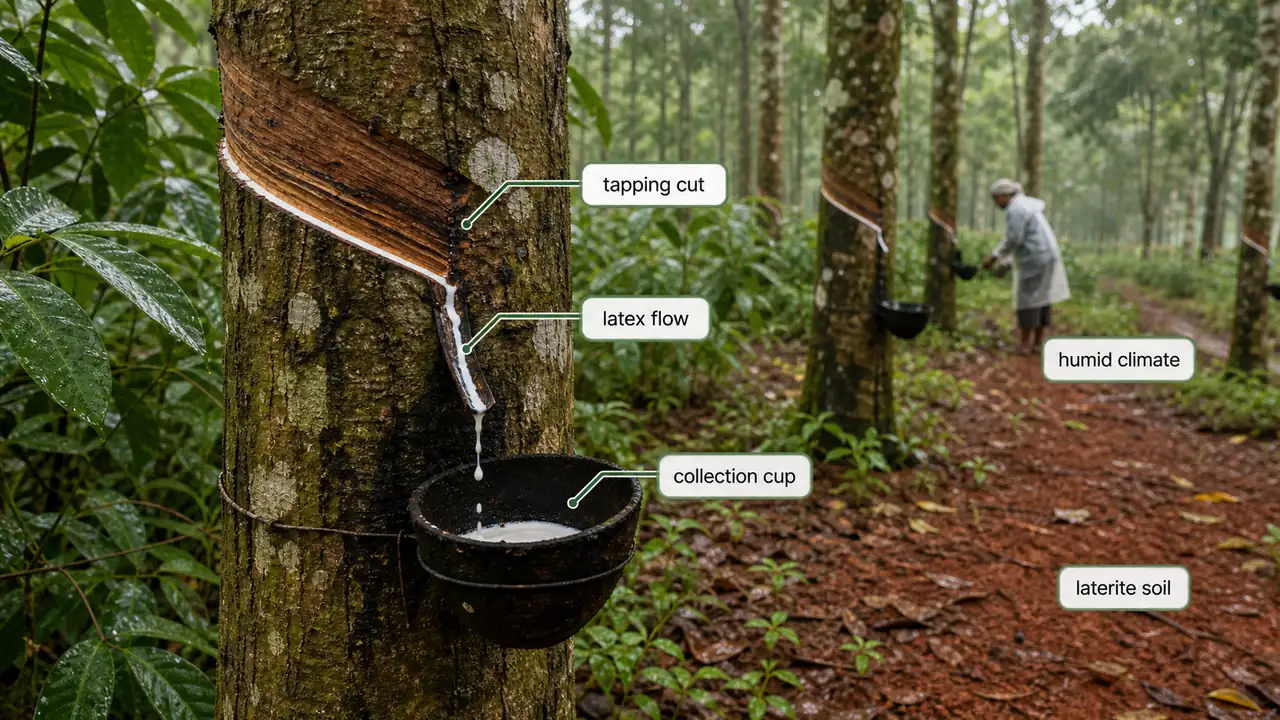
- Rubber Tapping: It is the process by which latex is removed from rubber trees.
Rubber tapping is the key harvesting operation in rubber cultivation. It involves making a controlled, shallow incision on the bark of the rubber tree using a special knife called a tapping knife. The cut penetrates the latex vessels (located in the bark), allowing the milky white latex to flow out. The latex drips into a small collection cup attached to the tree. Tapping is typically done in the early morning hours when latex flow is highest due to higher turgor pressure in the cells. A well-managed rubber tree can be tapped for 25-30 years. The tapping is usually done on alternate days, following a specific tapping system (e.g., half-spiral, every other day — denoted as S/2 d/2) to ensure sustained yield without damaging the tree.
Understanding Tapping Notation: S/2 d/2
- S/2 = Half-spiral cut (the incision goes halfway around the trunk)
- d/2 = Tapping done every 2nd day (alternate days)
- This system balances maximum latex yield with bark regeneration, ensuring the tree can be tapped sustainably for decades.
Rubber Board
- Rubber Board: Headquarters Kottayam, Kerala.
The Rubber Board is a statutory body established under the Rubber Act, 1947, functioning under the Ministry of Commerce and Industry, Government of India. Its headquarters is located in Kottayam, Kerala — the heart of India's rubber belt. The Board is responsible for the overall development of the rubber industry in India, including research, extension, training, quality control, and market regulation. It plays a pivotal role in supporting rubber growers, promoting sustainable cultivation practices, and facilitating technology transfer to farmers.
IMPORTANT
Rubber Board HQ = Kottayam, Kerala | Established under Rubber Act, 1947 | Under Ministry of Commerce and Industry.
Summary Cheat Sheet
| Concept / Topic | Key Details / Explanation |
|---|---|
| Botanical identity | Rubber is Hevea brasiliensis of the Euphorbiaceae family, native to Brazil, and is classified as a cash crop as well as a tropical tree crop. |
| Soil requirement | Rubber grows best in deep, fertile, well-drained lateritic soils with acidic reaction around pH 4.5-6.0. |
| Climate and planting season | It requires 2000-4500 mm rainfall, about 25°C to 34°C temperature, nearly 80% relative humidity, and the preferred planting season is June-July. |
| Indian production pattern | Rubber is cultivated in 16 states, with Kerala as the leading producer and Tripura as the second major producer. |
| Tapping concept | Rubber tapping is the controlled incision made in bark to collect latex, usually in the morning. |
| Tapping notation | S/2 d/2 means a half-spiral cut tapped on alternate days, balancing latex yield with bark recovery. |
| Institutional fact | The Rubber Board is headquartered at Kottayam, Kerala, and functions under the Rubber Act, 1947 and the Ministry of Commerce and Industry. |