🌳 Sandalwood and Agarwood — India’s High-Value Aromatic Tree Crops
Sandalwood and agarwood in India covering production geography, processing value, North East potential, export quotas and current government focus.
Why These Crops Matter
Sandalwood and agarwood are among India’s most valuable aromatic tree crops. They are not major volume crops like coconut, but they are strategically important because of their:
- high unit value
- strong processing potential
- role in fragrance, luxury, and cultural markets
- export earning capacity
Sandalwood
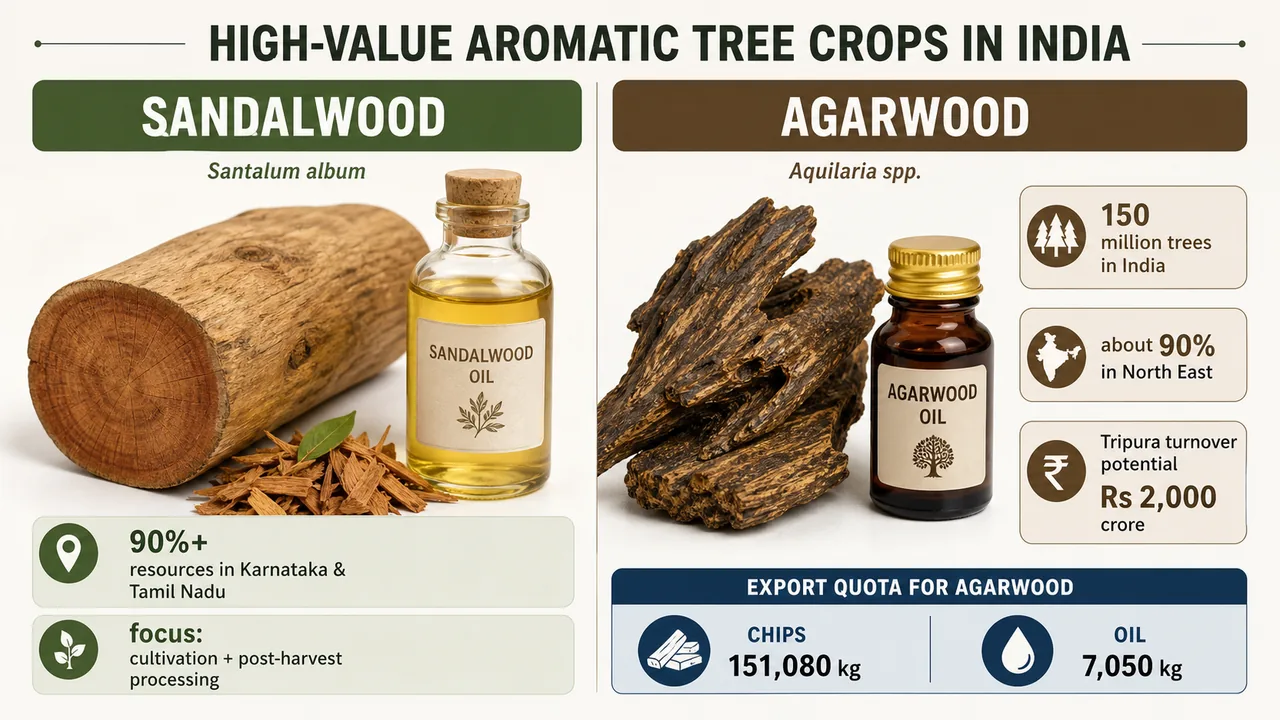
Indian sandalwood is Santalum album. It is a highly valuable and culturally significant tree species used in:
- religious practices
- perfumery
- fragrance industries
- essential oil extraction
Indian sandalwood commands a high price internationally because of its superior oil quality.
More than 90% of India’s sandalwood resources are located in:
- Karnataka
- Tamil Nadu
This concentration makes south India the core belt for sandalwood-based cultivation and processing.
Because of its high economic value, sandalwood has strong potential for:
- rural employment generation
- value-added processing
- export earnings
The Union Budget 2026-27 proposed focused promotion of:
Pro Content Locked
Upgrade to Pro to access this lesson and all other premium content.
Charged once for one year · ₹1188 total
Save ₹100/month vs ₹2388/year launch price
- All Agriculture & Banking Courses
- AI Lesson Questions (100/day)
- AI Doubt Solver (50/day)
- Glows & Grows Feedback (30/day)
- AI Section Quiz (20/day)
- 22-Language Translation (100/day)
- Recall Questions (20/day)
- AI Quiz (15/day)
- AI Quiz Paper Analysis (100/day)
- AI Step-by-Step Explanations (100/day)
- Spaced Repetition Recall (FSRS)
- AI Tutor
- Immersive Text Questions
- Audio Lessons — Hindi & English
- Mock Tests & Previous Year Papers
- Summary & Mind Maps
- XP, Levels, Leaderboard & Badges
- Generate New Classrooms
- Voice AI Teacher (AgriDots Live)
- AI Revision Assistant
- Knowledge Gap Analysis
- Interactive Revision (LangGraph)
🔒 Secure one-time yearly payment via Razorpay · No hidden fees
Why These Crops Matter
Sandalwood and agarwood are among India’s most valuable aromatic tree crops. They are not major volume crops like coconut, but they are strategically important because of their:
- high unit value
- strong processing potential
- role in fragrance, luxury, and cultural markets
- export earning capacity
Sandalwood
Indian sandalwood is Santalum album. It is a highly valuable and culturally significant tree species used in:
- religious practices
- perfumery
- fragrance industries
- essential oil extraction
Indian sandalwood commands a high price internationally because of its superior oil quality.
More than 90% of India’s sandalwood resources are located in:
- Karnataka
- Tamil Nadu
This concentration makes south India the core belt for sandalwood-based cultivation and processing.
Because of its high economic value, sandalwood has strong potential for:
- rural employment generation
- value-added processing
- export earnings
The Union Budget 2026-27 proposed focused promotion of:
- sandalwood cultivation
- strengthening of post-harvest processing
Agarwood
Agarwood is a premium resinous wood, also internationally known as oud or agar. It is widely used in:
- traditional medicine
- religious practices
- luxury perfumery
The plant is harvested for:
- agarwood chips
- powder
- essential oil
- beads and carved products
- leaves for agarwood tea
As of January 2026, India had nearly 150 million agarwood trees, with about 90% located in the North Eastern states under plantation and agroforestry systems.
Within the region, the agarwood market in Tripura alone is estimated to have an annual turnover potential of around Rs 2,000 crore.
Export and Regulatory Support for Agarwood
The strategic roadmap approved in 2024 focuses on sustainable:
- cultivation
- processing
- trade
North Eastern states have been encouraged to prepare area-expansion plans supported by geospatial mapping, especially in:
- Tripura
- Assam
Export promotion has been strengthened through enhanced annual CITES quota limits of:
- 151,080 kg for agarwood chips
- 7,050 kg for agarwood oil
Applications have also been integrated into the DGFT portal to streamline export regulation.
The Union Budget 2026-27 is expected to give further impetus through support for:
- area expansion
- processing capacity
- export potential from the North East
Exam Quick Contrast
| Crop | Core geography | Main value logic |
|---|---|---|
| Sandalwood | Karnataka and Tamil Nadu | Premium oil, fragrance, cultural use |
| Agarwood | North Eastern states | Resinous wood, oil, export and luxury use |
Summary Cheat Sheet
| Concept / Topic | Key Details / Explanation |
|---|---|
| Shared importance | Sandalwood and agarwood are high-value aromatic tree crops valued for processing, fragrance, luxury markets, cultural use, and export earnings rather than bulk production. |
| Sandalwood identity | Indian sandalwood is Santalum album and is valued mainly for religious use, perfumery, fragrance industries, and essential oil extraction. |
| Sandalwood geography | More than 90% of India’s sandalwood resources are concentrated in Karnataka and Tamil Nadu. |
| Sandalwood policy focus | Sandalwood is important for rural employment, value-added processing, and exports, and current policy emphasizes cultivation expansion and post-harvest processing. |
| Agarwood identity | Agarwood, also known as oud or agar, is a premium resinous wood used in traditional medicine, religion, and luxury perfumery. |
| Agarwood products | Important commercial outputs include chips, powder, essential oil, beads, carved products, and agarwood tea leaves. |
| Agarwood geography and scale | As of January 2026, India had nearly 150 million agarwood trees, about 90% of them in the North Eastern states; Tripura alone is highlighted for major turnover potential. |
| Agarwood regulation and export support | Since 2024, the roadmap has stressed sustainable cultivation, processing, and trade, with area expansion in Tripura and Assam, DGFT-linked export procedures, and enhanced CITES quotas for chips and oil. |
| Exam contrast | Sandalwood is identified with Karnataka and Tamil Nadu and premium oil value, while agarwood is identified with the North East and resinous export-oriented luxury use. |