🏔️ High-Value Nut Crops — Walnut, Almond and Chilgoza
Walnut, almond and chilgoza in India’s hilly regions covering production, exports, regional concentration and current government focus.
Nut Crops in India’s Hilly Strategy
India’s hilly regions cultivate several high-value nut crops suited to cooler climates and specialized agro-ecological zones. Among those highlighted in the present policy framework, the most important are:
- walnut
- almond
- chilgoza (pine nut)
These crops matter because they combine:
- premium market value
- climate-specific regional advantage
- orchard-based diversification
- value-addition potential
Walnut
Walnut is the most important temperate nut crop in India.
Jammu and Kashmir accounts for the majority of walnut cultivation, while:
- Uttarakhand
- Himachal Pradesh
- Ladakh
- Arunachal Pradesh
- Manipur
make only a relatively small contribution in comparison.
Indian walnuts are broadly classified into:
- paper-shelled
- thin-shelled
- medium-shelled
- hard-shelled
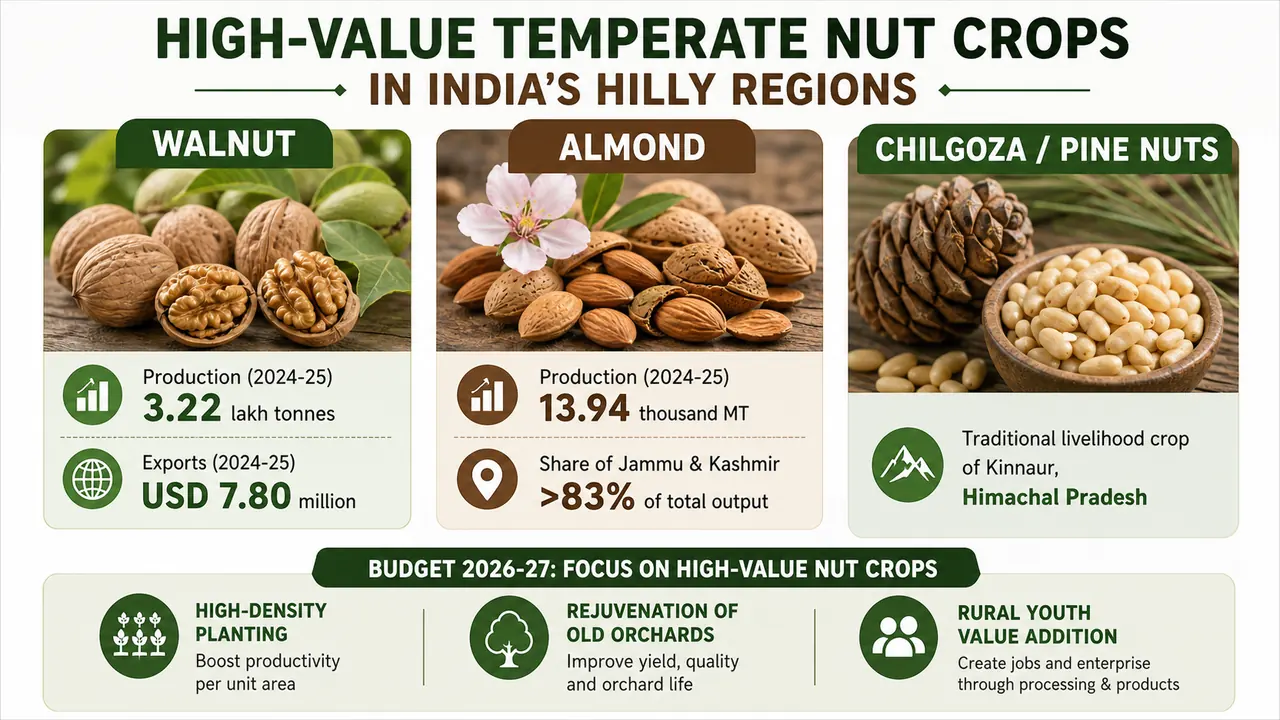
During 2024-25, walnut production reached about 3.22 lakh tonnes.
In FY 2024-25, walnut exports were valued at about USD 7.80 million.
Key destinations included:
Pro Content Locked
Upgrade to Pro to access this lesson and all other premium content.
Charged once for one year · ₹1188 total
Save ₹100/month vs ₹2388/year launch price
- All Agriculture & Banking Courses
- AI Lesson Questions (100/day)
- AI Doubt Solver (50/day)
- Glows & Grows Feedback (30/day)
- AI Section Quiz (20/day)
- 22-Language Translation (100/day)
- Recall Questions (20/day)
- AI Quiz (15/day)
- AI Quiz Paper Analysis (100/day)
- AI Step-by-Step Explanations (100/day)
- Spaced Repetition Recall (FSRS)
- AI Tutor
- Immersive Text Questions
- Audio Lessons — Hindi & English
- Mock Tests & Previous Year Papers
- Summary & Mind Maps
- XP, Levels, Leaderboard & Badges
- Generate New Classrooms
- Voice AI Teacher (AgriDots Live)
- AI Revision Assistant
- Knowledge Gap Analysis
- Interactive Revision (LangGraph)
🔒 Secure one-time yearly payment via Razorpay · No hidden fees
Nut Crops in India’s Hilly Strategy
India’s hilly regions cultivate several high-value nut crops suited to cooler climates and specialized agro-ecological zones. Among those highlighted in the present policy framework, the most important are:
- walnut
- almond
- chilgoza (pine nut)
These crops matter because they combine:
- premium market value
- climate-specific regional advantage
- orchard-based diversification
- value-addition potential
Walnut
Walnut is the most important temperate nut crop in India.
Jammu and Kashmir accounts for the majority of walnut cultivation, while:
- Uttarakhand
- Himachal Pradesh
- Ladakh
- Arunachal Pradesh
- Manipur
make only a relatively small contribution in comparison.
Indian walnuts are broadly classified into:
- paper-shelled
- thin-shelled
- medium-shelled
- hard-shelled
During 2024-25, walnut production reached about 3.22 lakh tonnes.
In FY 2024-25, walnut exports were valued at about USD 7.80 million.
Key destinations included:
- United Arab Emirates
- Turkey
- Iraq
- Singapore
- Algeria
- Qatar
- Bhutan
- Kuwait
- Seychelles
- Nigeria
Almond
Almond is another high-value temperate nut crop known for both nutritional and commercial importance.
India produced about 13.94 thousand metric tonnes of almonds in 2024-25.
Cultivation is largely concentrated in:
- Jammu and Kashmir
- Gujarat
- Himachal Pradesh
Jammu and Kashmir accounts for more than 83% of India’s almond production, and also serves as the main regional hub for processing and manufacturing.
Chilgoza
Chilgoza or pine nut is an important high-value nut crop of the north-western Himalayas.
It is especially important in the Kinnaur district of Himachal Pradesh, where it is a key livelihood source for tribal communities.
The crop grows in:
- inner arid valleys
- low-rainfall mountain areas
- zones with heavy winter snowfall
Chilgoza nuts are:
- highly nutritious
- eaten raw or roasted
- valued for healthy unsaturated fats
The crop is often described as ecologically adapted and economically important for local mountain communities.
Current Government Focus
The Union Budget 2026-27 proposed a dedicated programme for:
- high-density cultivation of walnuts, almonds and pine nuts
- rejuvenation of old and low-yielding orchards
- enhancing farmer incomes
- encouraging value addition through rural youth participation
This is a very exam-relevant shift because it shows that current policy is not limited to crop production alone. It includes:
- orchard modernization
- productivity improvement
- processing and enterprise development
Summary Cheat Sheet
| Concept / Topic | Key Details / Explanation |
|---|---|
| Hilly-region nut-crop strategy | The key high-value nut crops highlighted for India’s hilly strategy are walnut, almond, and chilgoza, important for premium value, regional specialization, orchard diversification, and value addition. |
| Walnut | Walnut is the most important temperate nut crop in India, with cultivation dominated by Jammu and Kashmir and smaller contributions from Uttarakhand, Himachal Pradesh, Ladakh, Arunachal Pradesh, and Manipur. |
| Walnut grades and trade | Indian walnut classes include paper-shelled, thin-shelled, medium-shelled, and hard-shelled; production in 2024-25 was about 3.22 lakh tonnes, with exports around USD 7.80 million. |
| Almond | Almond is another premium temperate nut crop; India produced about 13.94 thousand metric tonnes in 2024-25, and Jammu and Kashmir accounts for more than 83% of national production. |
| Almond geography | The main almond-growing regions named are Jammu and Kashmir, Gujarat, and Himachal Pradesh. |
| Chilgoza | Chilgoza or pine nut is a high-value Himalayan nut especially important in Kinnaur district of Himachal Pradesh, where it supports tribal livelihoods. |
| Chilgoza adaptation and use | Chilgoza grows in inner arid valleys, low-rainfall mountain belts, and snowy winter zones, and the nuts are highly nutritious, eaten raw or roasted, and valued for healthy unsaturated fats. |
| Current policy focus | The current policy push includes high-density planting, rejuvenation of old orchards, higher farmer income, orchard modernization, productivity improvement, and youth-led value addition and processing. |